Over the 150 years since its unification in 1861, Italy almost caught up with the most advanced economies, becoming a relevant actor in the international economy. Footnote 1 Such a result was achieved in the presence of an industrial structure that is unique in many respects, characterized by a dominance of small firms and a marginal role of large firms. Footnote 2 In the past twenty years, however, this positive trend has stopped. Some scholars have wondered whether Italy’s poor economic performance since the 1990s is a consequence of the suboptimal mix of small size, family control, and specialization in traditional sectors, which has prevented full convergence toward the technological frontier. Footnote 3
The reasons for Italy’s peculiar industrial structure have been widely debated. Historiography stressed that the advent of big business was curbed by some traits that date back to the origin of the Italian unitary state, including the limited size of the domestic market, the general shortage of capital, and the lack of natural resources. As a consequence, only a few big companies could prosper, often enjoying state protection and monopolistic positions. Footnote 4 State interventionism translated into “political capitalism”: Entrepreneurs pursued growth not for economic reasons (economies of scale and scope), but to strengthen their bargaining power with politics. Footnote 5
The creation of one the largest state-owned sectors in the Western world was a way to provide those Gerschenkron-type “substitution factors,” Footnote 6 allowing Italy to catch up with more industrialized countries. State-owned enterprises (SOEs) prompted capital-intensive industries that the government considered strategic for the nation’s economic development and in which the private sector was reluctant to invest, such as steel, heavy engineering, energy, motorways, and public utilities. Footnote 7
Some factors were identified as crucial to the success of Italian small firms in the long run: the key role of family in Italian society; the preservation of craft skills whose roots date back to the late medieval communal civilization; and the propensity of Italian small firms to aggregate in industrial districts (IDs)—geographic clusters of small firms, each specializing in one or a few phases of the same production process—characterized by relevant agglomeration economies. Footnote 8
Other authors identified the reasons for the dominance of small firms in Italy in the consequences of the restructuring of Italian big business after the “Golden Age” of the 1950s and 1960s. This led to manufacturing decentralization and the transfer of a large number of activities to small subcontractor firms, which used backward technology and resorted to a large extent to tax evasion and “black” labor. Footnote 9
This article analyzes the evolution of Italy’s industrial structure in a long-term perspective and offers an interpretation of it based on the role of institutions. It argues that Italy’s peculiar industrial structure is only in part the result of entrepreneurial failures of big business and of the dynamism of small firms. Instead, it emphasizes the role that institutions played in determining the relative performances of both types of firms. By following Douglass North, it focuses on the role of both “formal” institutions (regulation, legislation, and government policy) and “informal” institutions constituted by social norms, cultural habits, values, and ideologies. Footnote 10 In this, it provides a different (and complementary) interpretation of the Italian industrial development from those focusing mainly on institutional failures. One notable example is provided by Barca, who individuates the roots of the overall institutional efficiency (or even the absence of regulatory institutions) in a compromise set up among political parties and pressure groups immediately after World War II, which led the governments to skip the necessary reforms in institutions regulating the financial market, the stock exchange, and the market for corporate control, thus jeopardizing the growth of Italian big business. Footnote 11
This article is organized as follows: After this introduction, the next section presents a picture of Italy’s industrial structure from unification to present days. The third and fourth sections illustrate the role of formal institutions in determining the performance of big business and the small firm sector, respectively. The fifth section focuses on informal institutions and, in particular, on the ideology and failed hegemony of Italy’s corporate elite and its interplay with the nation’s political elite, leading to the conclusion.
Italy’s Industrial Structure
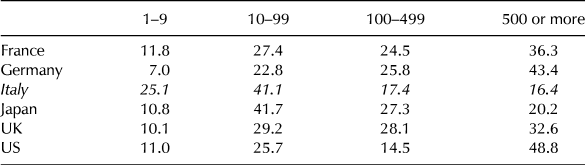
The classification of Italian enterprises by size at the beginning of the twenty-first century is relatively simple. The weight of small firms (up to 99 employees) appears to be overwhelming, well above those of all the other major industrialized nations (see Table 1). Small and medium-sized enterprises (SMEs)—firms with fewer than 500 employees—also account for the absolute majority of value added of the industrial sector, around 65 percent. Footnote 12
Workforce distribution by country and by size, 2001 (employees per firm in manufacturing)

Source: OECD, SME and Entrepreneurship, Table A.2.
Conversely, big business plays a marginal role. Among Fortune’s 2011 list of the world’s largest 500 corporations, Footnote 13 Italy presents only 10 companies, far fewer than other economies of relatively similar size. For example, Britain has 30, France 35, Germany 34, Japan 68, not to mention the United States (more than 130) and China (61). The largest Italian manufacturing company is Eni (a state-controlled oil company, in 23rd place), followed by Enel (electricity, 56th) and Exor-Fiat (motor vehicles, 83rd). The average size of Italian large firms is smaller than that of the other main European economies in all manufacturing sectors. Footnote 14
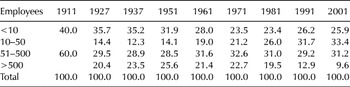
The presence of a large small-firm sector represents a long-term trait of the Italian economy, dating back well before Italy’s unification. The textile districts of Schio, Biella, and Prato, for instance, have gone through a remarkable expansion since the late eighteenth century. Footnote 15 The years following unification gave a further boost to existing IDs through the creation of a national market and of technical schools training skilled workers. Footnote 16 The first industrial census in 1911 showed that micro-firms with fewer than ten employees accounted for 40 percent of Italy’s manufacturing workforce. In the following decades, their share of total employment progressively diminished, to a minimum in 1981. Then the trend was reversed, as happened for the immediately larger size class (small firms from 10 to 50 employees), whereas medium-sized enterprises (MSEs) from 51 to 500 employees remained fairly stable, at around 30 percent throughout the twentieth century (see Table 2). Footnote 17
Employees in manufacturing in Italy by size of the establishment (%)

Source: Giannetti and Vasta, Storia dell’impresa, Table 2.9.
After World War II, the growth of Italian industry was strongly connected to an increasing opening of European markets, which added to a fast-growing domestic demand in which Italy was able to use its competitive advantages—not only its craft and technical skills, but also low labor costs and labor-intensive production in a substantial part of the economy. As a result, Italian SMEs tended to specialize in the “made-in-Italy” industries—personal and household goods (such as textiles, clothing, leather, footwear, wood, tiles, furniture, jewelry, cosmetics, musical instruments, toys, and sports items), and light engineering (machine tools), in which technical economies of scale are not relevant. Footnote 18 At the beginning of the twenty-first century, these industries accounted for about two-thirds of Italy’s total manufacturing workforce and had a competitive advantage in international markets, thanks to systematic, often informal, innovation that was not recorded in the international research and development (R&D) statistics. Footnote 19 At the same time, however, these have become slow-growing industries; this is a major factor explaining Italy’s poor economic performance in the past twenty years. Moreover, with globalization—outsourcing from the core economies to East Asia and southeast Europe—Italy was one of the countries that suffered the most because a substantial part of its competitive advantages in several industries were lost. Footnote 20
Large production units with more than 500 employees showed an inversely U-shaped dynamic, reaching a peak at 25.6 percent in 1951. Their share of total employment remained stable until 1971 and then decreased. The decline was slight in the 1970s, but became massive after 1981, spurred by the crisis of Fordist big businesses.
This trend is even more evident if one looks at the weight of large firms in terms of assets compared to gross domestic product (GDP). In fact, the total assets of the largest 200 Italian firms in GDP rose steadily from 20.6 percent in 1913 to 42 percent in 1952, jumping to 62.3 percent in 1971. In the following decades, however, the trend reversed. In 1981, this figure dropped to 46.2 percent and in 2001 it further declined to 44.7 percent, slightly above the level reached immediately after World War II. Footnote 21
The birth of big business in Italy dates to the last two decades of the nineteenth century, when successful ventures started in fast-growing industries such as cotton, metallurgy, electricity, and mechanics, Footnote 22 while the state—together with some German-style universal banks—created a favorable framework for entrepreneurial action. Footnote 23 Thus, in the twenty years prior to World War I, large companies such as Fiat (automobiles), Pirelli (rubber), Ansaldo (shipbuilding), and Falck, Terni, and Piombino (steel), established themselves as “first movers” and then long-time leaders in their respective industries. Footnote 24
World War I provided sound opportunities for existing leaders, which consolidated their respective sectors. The interwar period saw Italy in a contradictory situation: On the one hand, some leaders had emerged in modern industries characterized by a level of industrial concentration in line with that of the other advanced nations. On the other hand, the domestic market was smaller than those enjoyed by U.S. or German companies, and Italian big businesses lacked internationalization strategies comparable to those of their Swiss, Swedish, or Belgian counterparts, and their relative technological backwardness made Italian companies not competitive in terms of exports. The result was that mass production remained almost unattainable, at least at levels comparable with those of other advanced countries. Footnote 25
During the “Golden Age,” the Italian economy enjoyed extremely high growth rates, led by Fordist big business. A growing share (from less than 40 percent prior to World War II to 60 percent in 1971) of employees in manufacturing were operating in capital-intensive industries (automotives, chemicals, rubber, heavy mechanics, steel, and shipbuilding). The nation’s industrial structure became more similar to those of the more advanced economies: The total assets of the top 200 manufacturing companies rose from 26 percent of GDP in 1952 to 38.5 percent in 1971. Footnote 26
As to ownership structures, Italian big business remained characterized by strong concentration in the hands of a few blockholders. Some entrepreneurial dynasties controlled most of the largest companies. Another relevant blockholder was the state, as a result of a massive bailout of the banking sector, which in the 1930s brought in the hands of a state agency, Iri, all the shareholdings of the former universal banks. After World War II, another big state holding, Eni, was created in the energy industry. Footnote 27
However, the convergence of Italy’s industrial structure with the more advanced economies came to an end in the 1970s. After that point, divergence started. Total assets of the top 200 manufacturing firms fell to 16.3 percent of GDP in 2001. Footnote 28 Employment in large firms (with 500 employees or more) decreased in Italy more than in the other advanced nations. Divergence also concerns the sectoral distribution of large firms, with a much smaller weight of information and communications technology (ICT)-related industries in Italy. Footnote 29 The privatizations of the 1990s did not change much in this respect, as they did not (with some exceptions as Finmeccanica, a world leader in the airspace industry) result in the emergence of global technological leaders. Footnote 30
In recent years, other protagonists have emerged in the Italian corporate economy. Since the mid-1990s, MSEs have displayed outstanding results in terms of growth and profitability. By the beginning of the twenty-first century, more than 1,500 businesses with annual sales between 150 million and 1.5 billion euros were operative in Italy. Most of these MSEs emerged from the entrepreneurial seedbed of IDs. They are specialized in niches, often global, and have pursued dimensional growth and accelerated internationalization. However, these MSEs went on sharing many of the features of the traditional ID firms—family ownership, centralized management, and specialization in the sectors of “made in Italy” and light engineering. Footnote 31
Another major novelty is the growing weight of foreign-owned firms. Actually, foreign capital has been constantly present in Italy’s industrialization since its inception before World War I. Foreign-controlled firms constantly tend to cluster in industries in which indigenous entrepreneurship has been weak or even absent, and for which a high technological expertise is needed. Footnote 32
Formal Institutions and Weak Big Business
A number of entrepreneurial failures undermined Italy’s competitive capabilities in some capital- and technology-intensive industries, such as those of Montedison (Italy’s largest chemical company during the 1970s), Olivetti in electronics, and Enel in nuclear energy. The attempts of these companies to enter the leading industries of the third industrial revolution failed miserably during the 1960s, stably undermining the country’s competitiveness in industries characterized by high technological intensity and partially explaining the humble performance of Italian big business since the 1970s. Footnote 33
In this process, however, institutions must also be considered, even though these are only partially exogenous, as economic actors are able to condition institution building. This section focuses on the role of formal institutions (in particular, government policy and regulation) in explaining the evolutionary process in Italy’s industrial structure, whereas informal institutions are considered in the fifth section.
In general, it is possible to individuate several (necessary, but not sufficient) conditions that can allow an economy characterized by a small, and not particularly dynamic, domestic market to develop a bulk of large companies in leading positions in their respective industries, both at home and abroad. A first condition is that large firms can successfully develop internationally instead of relying on a small domestic market. A quite trivial precondition for this is a strong market leadership, which is normally (even if not always) of a technological nature. The history of the Swiss chemical and pharmaceutical industry is particularly significant in this respect, combining strong technological leadership with precocious strategies of internationalization spurred by the limited size of the domestic market. A second factor for big business expansion pertains to industrial policies aiming at fostering international competitiveness and, at the same time, preserving control over the domestic market. Even thought it is not always so, the successful catching up of Asian latecomers demonstrates how aggressive policies for competitiveness can play a key role in the growth of domestic companies. Footnote 34 A third factor concerns the availability of adequate human capital, both technical and managerial. Nurturing technical and managerial capabilities has been a key element in Japan’s success since the late nineteenth century. Footnote 35 Technical training is considered the main asset in the affirmation of German big business, whereas the rise of big business in the United States was accompanied by the rise of powerful business and technical schools. Footnote 36 A fourth factor is an efficient financial sector able to channel resources to firms for investments and growth.
Unfortunately, formal institutions in Italy proved unsatisfactory in all four of these areas. To make things worse, the inefficiency of formal institutions in promoting the creation of a prosperous cohort of international leaders in capital- and technology-intensive industries was a long-standing trait of the whole Italian post-unification history.
Thanks to efficient regulation, large companies could have leveraged on international expansion to break the constraint of a small domestic market. However, what happened during almost all of the period under consideration—and at least until the end of the 1970s—was just the opposite: Thanks to the state’s protection, Italian big businesses, with a few exceptions, enjoyed monopolistic positions in the domestic market despite a lack of technological leadership, which involved limited internationalization. Footnote 37 As a result, they pursued dimensional growth until the point at which the marginal benefits deriving from a better bargaining position with the state were superior to the marginal cost of the investment. Footnote 38
A second institutional failure was the unwillingness of the Italian governments to foster the internationalization of domestic companies to an extent at least comparable to that of another latecomer, such as Japan in the 1950s and the 1960s. In particular, this happened in a crucial phase characterized by unprecedented fast growth, such as in the two decades following World War II. Undoubtedly, Italian industry benefited quite substantially from the creation of the European Common Market in 1958, which added its beneficial contribution to an already fast-growing domestic demand. However, the European Common Market boosted, above all, exports of low- and medium-tech industries largely dominated by SMEs, whereas, again, large firms were largely committed to serve the internal demand, on which, for the reasons suggested earlier, they exerted a sort of monopolistic grip. Footnote 39
Formal institutions also did not provide adequate human capital and organizational capabilities. Particularly in the phase of expansion of big business immediately before and, above all, after World War II, the qualitative divergence of Italian big business became apparent to external observers. Large firms were not only smaller than their European counterparts, but they were also less modern in their organizational and ownership structures: Their management was rarely carried on by professionals, whose training could not rely on business schools comparable to those of the other advanced countries. Footnote 40
Finally, the domestic corporate finance system has also been inadequate to sustain big business. The weakness of the banking system had its roots in the events that accompanied the growth of Italian large firms during World War I, when (as happened in other European countries) large companies established close equity links with the main universal banks. This led to the capture of the creditor by the debtor-shareholder, as was the case for the Banca Italiana di Sconto (at that time, Italy’s third largest bank), closely linked to Ansaldo, a huge vertically integrated konzern in steel and heavy mechanics. At the end of the war, the group was so heavily indebted to the bank that this brought its Hausbank to bankruptcy. The worst came in the early 1930s, when all of Italian big business was hit by the Great Depression, and the largest universal banks found their balance sheets burdened by toxic assets: credits toward the distressed industrial system, and shares of failing big business. The solution, a giant bailout of the nation’s three largest banks, brought into the hand of a state agency, the IRI, one-fifth of the entire share capital of Italian stock companies, including the shares of the banks in the portfolios of these companies. The Italian state became thus the largest blockholder of the country, as well as the owner of the three largest domestic banks. This, in theory, put at the disposal of the state a powerful instrument to pursue effective industrial policies. What happened was, however, extremely different from the case of other nations—such as Korea or, more recently, China—where the government used bank ownership and credit selection as an incentive to push domestic companies to expand abroad. Instead, Italian SOEs pursued growth and expansion mainly in the domestic market, in this way behaving similarly to private big business. Footnote 41
At the same time, the other source of corporate finance, the stock exchange, was weak and unattractive. Footnote 42 The maturing phase of Italian stock markets, which took place between the end of the nineteenth and the beginning of the twentieth century, was trapped into a sort of endogenous lock-in. On the one hand, legislation lacked any form of protection of minority shareholders, who were frequently exploited, as source of easy cash, by the main blockholders (families and the state) and by self-interested managers entrenched in their controlling position. This led to a situation in which the stock market largely lost its role in financing the growth of firms, given the reluctance of households to invest in shares. On the other hand, the sole constituency potentially interested in promoting a reform of the stock market—the main corporate owners and managers—lacked the necessary incentives to lobby for it. In the eyes of Italian industrialists, an improvement of the stock market regulation in the direction of higher shareholders’ protection would have undermined their ability to keep a firm control over their enterprises. This threat more than counterbalanced the benefit deriving from the inflow of additional capital to their companies. Thus, it is not surprising that the new regulation of joint-stock companies, passed in 1942, openly aimed at consolidating the main blockholders’ position rather than protecting minorities and encouraging households to invest in the stock market. Footnote 43
An opportunity to create a financial institute to boost the growth of big business was missed in 1962, when the government rejected a proposal by Mediobanca—Italy’s only merchant bank at that time—to set up a big investment trust to manage the sums the state had to pay in compensation for the nationalization of the electricity industry. Instead, the compensations were given directly to the former electrical companies that scattered them in a range of unrelated, and often unprofitable, investments. Footnote 44
Formal Institutions and the Small Firm Sector
If the growth of big business lacked an adequate support from formal institutions, the consolidation of the small firm sector in Italy was also, to a large extent, the result of institutional action.
In fact, an important push to the small firm economy came after World War II from state action. Starting in the late 1940s, the Italian state passed legislation that not only promoted small undertakings, but also positively discriminated in their favor. One important action was the 1956 Artisan Act, which defined the boundaries of artisanship. Unlike the German and French regulations, under which the artisan qualification was defined on the basis of professional lists of activities, the Italian artisan firm was defined on the basis of size. Footnote 45 This was not a professional category but a legal regime, membership of which entitled the owner to a wide variety of benefits—soft loans, loan guarantees, lower tax and employers’ contributions, welfare benefits at reduced premiums, and exemptions from keeping accounts and from bankruptcy proceedings. Thus, contrary to other European countries, Italian artisanship policy did not foster firm growth, but instead provided incentives to remain small, as a condition to qualify for such a wide array of benefits was not to exceed the size limits established by the law. Footnote 46
A policy was also conceived to support SMEs, defined as the companies with between 11 and 500 employees. Financial subsidies in favor of SMEs were introduced starting in 1952. SMEs could receive soft loans through the network of the regional medium-term credit institutions (mediocrediti regionali), which were able to extend loans at lower interest rates because they could refinance themselves under favorable terms at the central medium-term credit institution (mediocredito centrale). Footnote 47
After World War II, Italy’s banking system was restructured to strengthen the local banks that funded small firms clustered in IDs. The growth of the former was strongly associated with that of the latter. In fact, throughout the post-World War II period, the national banks within IDs had a much lower share of the local credit market than elsewhere. Lower assessment, monitoring, and enforcement costs, along with social connections between local banks’ managers and local entrepreneurs, gave local banks a competitive edge within IDs. The Bank of Italy played a decisive role in this respect: Bank competition was restricted to prevent an increase in industrial concentration because it was felt that if the small firms were deprived of necessary credit, they would be forced to merge with the larger firms. Footnote 48
Labor market regulation also provided incentives to remain small. In fact, Law 300 of 1970 (known as Statuto dei Lavoratori), which protects individual workers against unjustified firing, applied only to firms with more than 15 employees. Footnote 49 To this one must add the shortcomings of insolvency legislation that, by not providing efficient alternative instruments to bankruptcy to guarantee still potentially vital companies’ continuity, also contributed to high company turnover and kept company size small. Footnote 50
Finally, an important contribution to the expansion of the small firm sector came from local institutions. Especially in the north and the center of the country, these provided services and infrastructure—technical and vocational schools, estates for SME settling, innovation centers—that effectively supported SME development. Footnote 51
In recent years, MSE growth seems to have relied less on domestic formal institutions, as it appears principally a corporate response to the challenges of globalization and ICT revolution. Nonetheless, some of these companies took advantage of the massive privatizations of the 1990s to reorient their businesses toward the domestic market. This was, for example, the case of Benetton, which acquired Società Autostrade, Italy’s largest highway company. Footnote 52
Moreover, insofar as these MSEs are rooted in their IDs of origin, their surge did not undermine their need for institutional support, even though the relevant institutional action changed. A good case in point is that of Emilia-Romagna, where the local Confindustria—the industrialists’ association—lobbied the regional government to establish the “Regional System of Industrial Research, Technology Transfer and Innovation” to prompt technology transfer from universities and research centers to the local firms. Footnote 53
Informal Institutions and the Failed Hegemony of the Corporate Elite
The formation of a unitary state in Italy in 1861 was led by a political elite made up of northern landlords and financiers and southern notables. This ruling elite soon realized that Italy needed to create a heavy industry if it wanted to establish itself as a power in the European geopolitics. State-led industrialization was also conceived as a way to reassert the leading role of this political elite. Footnote 54 Thus, beginning in the late 1870s, a policy deliberately aimed at prompting industrialization was put in place. Custom duties were imposed to protect some industries, such as steel, textiles, and sugar. Footnote 55 The state also provided the main business opportunities to the first private big businesses. The procurement necessities of the navy led in 1884 to the establishment of the first large-scale iron and steelwork in Terni. The state was also an important buffer in periods of crisis, as was the case in 1911 when the state, through the Bank of Italy, provided the financial resources to rescue the entire steel sector. Footnote 56
However, industrialists, academics, and journalists were warning against the dangers of big business and highlighting the merits of a system based on SMEs, as this held together industry and agriculture and prompted a seamless transition into industrialization without social and environmental fractures. The industrial ideology that developed in post-unification Italy was heavily marked by Catholic paternalistic solidarity, which is considered the most resilient informal institution in the whole Italian history. SMEs were seen as essential preservers of social stability, as they reduced the destabilizing impact of unionization and labor conflict. Small-scale production was also recognized as more suited to a country poorly endowed with natural resources and with badly connected markets. Footnote 57
As a result, the consensus for big business in the Italian society remained weak and the corporate elite did not try to become a political elite as well. After unification, industrialists preferred to bargain sectoral benefits from the established ruling elite. This had structural consequences on the relationship between the nation’s political and corporate elite, with the latter lacking what the Italian leftist thinker Antonio Gramsci called “cultural hegemony.” In fact, industrialists failed to work out a project for the development of the whole Italian society that legitimized them as the leading force of the nation and shaped institutions according to corporate values. The corporate elite in turn-of-the-century Italy was concerned with fully fledged industrialization as a possible source of social conflict and instability. As a result, it failed to develop an ideology that asserted the central role of big business as the driver of industrial development, with long-standing consequences on the nation’s public sphere. Footnote 58
The weakness of the corporate elite became apparent at the beginning of the twentieth century, when Prime Minister Giovanni Giolitti pursued a policy that coupled fast economic growth, led by big business, with a modernization of the Italian society hinged on the creation of a state-funded welfare system and more advanced labor relations. The corporate elite refused to engage in a leading role in this process. Instead, many industrialists opposed it, as they were reluctant to pay the cost for enlarged welfare benefits and to recognize trade unions as a co-determinant of income distribution. Footnote 59
The failure of Giolitti’s project eventually paved the way for the advent of fascism after World War I. Italian big business supported the fascist government and some prominent industrialists played a key role in it. However, this did not involve an ideological and organizational identification of big business with fascism. The fascist political elite and the corporate elite remained distinct from each other, and each of them tried to use the other to pursue its own goals. Thus, the fascist regime freed industrialists from independent trade unions and allowed them to consolidate their positions in a protected domestic market, but at the same time some of its actions were strongly opposed by the industrialists, such as the revaluation of the Italian lira to “quota 90”—90 lire for one British pound—in 1927 and the creation of a big state-owned sector of the economy in the 1930s. More generally, fascism’s ultimate goal—to organize the whole Italian society within a state-controlled corporatist system—was foreign to private big business and corporate values. Footnote 60
After World War II, to tackle the left-wing parties, the Confindustria—the Italian industrialists’ association (representing Italy’s corporate elite)—supported the Christian Democratic Party (DC), despite the fact that the ideology and political program of this party were, in many respects, hostile to big business. In fact, the DC’s ideology awarded positive value to the petite bourgeoisie and sought to swell the small-firm sector. In emphasizing the role of small firms, the DC was heir to the problem that had urged Catholics into the political arena: the need to deflect the proletariat from the attractions of socialism through the diffusion of property. In the DC’s ideology, large firms engendered class struggle, whereas smaller units fostered interclass solidarity and social cohesion. Footnote 61 Moreover, the DC was influenced by the Catholic economists of the early twentieth century, who stressed that technological progress is not a prerogative only of the large factory, but small firms can also exploit it. Footnote 62 Thus, the state had to promote small undertakings and, at the same time, combat the “antisocial” forms of property: the latifundia and the large monopolistic concentrations. This orientation was based not on any objective assessment of the Italian market structure, but on the assumed attributes of scale. The DC tended to identify big business tout court with the monopolies: The significance given to this term was explicitly political, referring to “an economic overlord capable of subverting government policy and the democratic process.” Footnote 63 This left room for the expansion of the SOE sector: To meet the problems normally requiring large-scale undertakings, the state itself had to step in to fill this gap. Footnote 64
In the mid-1950s, the expansion of the SOEs worried the Confindustria to such an extent that in 1956 it signed an alliance with the Confagricoltura (the Italian landlords’ association) and the Confcommercio (the Italian tradesmen’s association), called the Confintesa, under the leadership of the Confindustria itself. The three employers’ associations agreed to mobilize their membership in favor of the right-wing candidates of the DC at the 1958 parliamentary elections. That is, the Confintesa aimed to weaken the DC’s pro-SOE leadership (Italy’s political elite at that time) by not just lobbying the party from outside but also by acting from inside it—becoming part of the political elite. This initiative failed, as only a few candidates supported by the Confintesa were elected.
The main reason for the failure was the lack of mass support for the Confintesa, consequent on the failed hegemony of the corporate elite in the Italian society. The Confintesa’s anti-SOE and pro-private big business stance turned out to be not appealing to the mass of SMEs that constituted the bulk of the membership of the Confintesa itself. In fact, contrary to the leadership of the Confintesa, most Italian SMEs were not concerned about SOE expansion and supported the DC’s policy in favor of small private undertakings, of which they were the main beneficiaries. Footnote 65
Thus, the weak hegemonic grip of the corporate elite on the Italian society and its disconnection from the political elite throughout most, if not all, of the post-unification history ended up emphasizing the role of the political elite in mediating the relationship between the society and the state. Footnote 66 After World War I and the introduction of male universal suffrage in 1919, mass-based political parties replaced traditional notables as the central actors in Italian politics and decision making, and became able to profoundly condition formal institution building. The central role of political parties in allocating public resources was strengthened by the long-standing weakness of the “culture of administration” in the modern decision-making sense. Footnote 67
This curbed the formation in Italy of constituencies alternative to, or potentially in competition with, powerful mass-based political parties. Powerful big business, independent from political parties, could play this role of alternative constituency. Politics thus pursued formal institution building to limit the space of big business, creating a favorable context for noncompeting constituencies as small firms. The sole big business allowed to exist could be in some way under political control—that is SOEs and some private companies heavily relying on political connections.
Conclusions
This article has shown that Italy’s industrial structure, in international comparison, is characterized by an overwhelming presence of SMEs in terms of employment and, conversely, by a limited weight of large firms. SMEs are concentrated mostly in the “made-in-Italy” industries. Conversely, the weakness of big business led Italy to cover a smaller share of the high-tech and large-scale sectors than the other advanced economies.
This peculiar industrial structure seems to be the outcome of a long-term evolution of Italian capitalism, which has been only partially modified by two novelties that occurred in recent years: the rise of MSEs and the increased weight of foreign-owned firms.
Italy’s peculiar industrial structure is only in part the result of entrepreneurial failures of big business and of the dynamism of small entrepreneurs, as institutions were a key factor in determining the contrasting performances of big businesses and small firms.
Formal institutions were unsatisfactory in all the areas in which big business could be supported: technological leadership, internationalization, human capital, and corporate finance. As a result, Italian large firms grew protected in the domestic market, strong and in a monopolistic position at home but relatively small and weak in the international markets. Conversely, after World War II, formal institutions fostered the small firm sector through a variety of measures: artisanship policy, subsidized credit to SMEs, banking and labor market regulation, and insolvency legislation.
Such an anti-private big business stance of formal institutions is largely the consequence of the deeper influence of informal institutions, in particular the failed hegemony of big business and corporate values on the Italian society and the consequent disconnection of the corporate elite from the political elite throughout most, if not all, of Italy’s post-unification history. Thus, the weakness of large companies in Italy is also the consequence of the fact that, differently from other advanced industrial nations such as the United States, Italy failed to create a modern industrial democracy characterized by the leadership of big business and corporate values.