INTRODUCTION
Three constraints, namely drought, low soil nitrogen (N) and infestation by Striga hermonthica Del. (Benth), act and interact to reduce maize (Zea mays L.) grain yield in the agroecologies of West and Central Africa (WCA). In most developing countries of the world, maize production occurs under low-N conditions (McCown et al. Reference McCown, Keating, Probert and Jones1992; Oikeh & Horst Reference Oikeh, Horst, Horst, Schenk, Bürkert, Claassen, Flessa, Frommer, Goldbach, Olfs, Römheld, Sattelmacher, Schmidhalter, Schubert, Wirén and Wittenmayer2001) due to limited N-fertilizer use and reduced N-uptake in drought-prone environments, high price ratios between fertilizer and grain, non-availability of fertilizer or lack of credit for farmers (Bänziger & Lafitte Reference Bänziger and Lafitte1997). The estimated annual loss of maize yield resulting from low-N stress environments varies from 10 to 50% (Wolfe et al. Reference Wolfe, Henderson, Hsiao and Alvino1988). Therefore, the development of maize germplasm with tolerance to low soil N is crucial for increased maize productivity (Betrán et al. Reference Betrán, Beck, Bänziger and Edmeades2003).
A major strategy of the International Institute for Tropical Agriculture Maize Improvement Programme (IITA-MIP) to improve maize production and productivity in WCA during the last three decades is to breed for resistance to S. hermonthica and tolerance to drought. However, under field conditions, drought, Striga and soil nutrient deficiencies can occur simultaneously and the combined effect can be devastating (Cechin & Press Reference Cechin and Press1994; Kim & Adetimirin Reference Kim and Adetimirin1997). Therefore, in the Sudan and northern Guinea savannahs of WCA where intermittent drought occurs frequently, it is desirable to incorporate drought tolerance into cultivars that have resistance to Striga as the two stresses occur at the same time. Farmers in the Striga endemic ecologies of sub-Saharan Africa (SSA) are presently demanding cultivars with combined stress factors and are unwilling to adopt maize cultivars that do not meet these criteria (Badu-Apraku et al. Reference Badu-Apraku, Menkir, Ajala, Akinwale, Oyekunle and Obeng-Antwi2010).
Several workers (Bänziger et al. Reference Bänziger, Edmeades and Lafitte1999; Badu-Apraku et al. Reference Badu-Apraku, Fakorede, Oyekunle and Akinwale2011) have reported that improvement for drought tolerance also resulted in specific adaptation and improved performance under low-N conditions, suggesting that tolerance to either stress involves a common adaptive mechanism. Although there are several methods available for the control of Striga, drought and low soil N in WCA, the most sustainable and economic control method is genetic enhancement of the maize germplasm. Even though the early maturing Striga resistant and drought-tolerant inbreds, hybrids and open-pollinated cultivars developed in the IITA-MIP were not intentionally selected for tolerance to low-N until 2007, selection for Striga resistance is normally conducted under low-N conditions. To elicit maximum genotypic differences among S1 progenies of the IITA recurrent selection programme for improved resistance/tolerance to Striga in two extra-early populations, TZEE-W Pop STR and TZEE-Y Pop STR, Badu-Apraku et al. (Reference Badu-Apraku, Fakorede, Lum and Akinwale2009) evaluated the S1 progenies under low-N rate (30–50 kg N/ha) rather than the high dose (120 kg N/ha) recommended for maize production in the savannah agro-ecology of WCA. Their study showed that the yield gain after three cycles of selection in the extra-early white and yellow populations for grain yield under artificially Striga-infested and Striga-free environments were more pronounced in the advanced cycles under high-N (157 kg/ha/cycle) than low-N (144 kg/ha/cycle) in the yellow, and higher under low-N than high-N in the white. Furthermore, Badu-Apraku et al. (Reference Badu-Apraku, Menkir, Ajala, Akinwale, Oyekunle and Obeng-Antwi2010) identified EVDT 97 STRC1, TZE-W DT STR C4 and TZE Comp3 C3 as tolerant to low-N even though there was no conscious effort to select for tolerance to low-N in the recurrent selection for Striga resistance and/or drought tolerance programmes through which they were derived. It was concluded that selection of S1 progenies for grain yield and Striga resistance in the two populations under Striga infestation at low-N led to concomitant improvement in grain yield and some other traits in the advanced cycle of selection. Edmeades et al. (Reference Edmeades, Bänziger, Campos, Schussler, Lamkey and Lee2006) observed gains of 210 kg/ha/cycle for S1 family selection and 86 kg/ha/cycle for full-sib selection, or about the same gain per year from both methods. Edmeades et al. (Reference Edmeades, Bänziger, Campos, Schussler, Lamkey and Lee2006) reported similar gains under drought, indicating that selection in a drought environment may be the most effective for improving grain yields under low fertility conditions, and concluded that drought environments caused variation in the partitioning of N to the ear at flowering and identified genotypes with higher harvest indices. Thus, selection for improved partitioning of assimilates to the developing ear using drought stress at flowering as the selection criterion can simultaneously improve tolerance to drought and low-N. This perception is reinforced by the findings of Andrade et al. (Reference Andrade, Cirilo, Echarte, Otegui and Slafer2000) who reported that a common curve described the response of kernel number to crop growth rate around flowering whether the crop was stressed by inadequate water or by N deficiency.
Genetic gain studies comparing old and new cultivars have been conducted routinely in the temperate zones in an effort to understand how genetic selection has shaped important traits such as grain yield in maize (Castleberry et al. Reference Castleberry, Crum and Krull1984; Duvick Reference Duvick2005; Campos et al. Reference Campos, Cooper, Edmeades, Löffler, Schussler and Ibañez2006; Wang et al. Reference Wang, Ma, Li, Bai, Liu, Liu, Tan, Shi, Song, Carlone, Bubeck, Bhardwaj, Jones, Wright and Smith2011). Several comparisons of older and newer hybrids under contrasting N levels have been reported (Castleberry et al. Reference Castleberry, Crum and Krull1984; Tollenaar et al. Reference Tollenaar, Nissanka, Rajcan and Bruulsema1997; Sangoi et al. Reference Sangoi, Ender, Guidolin, de Almeida and Konflanz2001; O'Neill et al. Reference O'Neill, Shanahan, Schepers and Caldwell2004), but similar studies in tropical maize is limited thus making it difficult to ascertain completely the genetic gain that has been made for grain yield in relationship to N fertility in the numerous cultivars that have been released in SSA. For example, Castleberry et al. (Reference Castleberry, Crum and Krull1984) showed that genetic gains for grain yield under low and high soil fertility of 25 open-pollinated and hybrid maize cultivars used between the 1930s and 1980s had been 51 and 87 kg/ha/year, respectively. Similarly, with four hybrids representing Brazilian maize germplasm released between the 1960s and 1990s, the most recent hybrid produced higher grain yields at all levels of N (Sangoi et al. Reference Sangoi, Ender, Guidolin, de Almeida and Konflanz2001). Likewise, a newer hybrid (Pioneer 3902, released in 1988) produced c. 25% more grain than an older hybrid (Pride 5, released in 1959) at both low- and high-N (Tollenaar et al. Reference Tollenaar, Nissanka, Rajcan and Bruulsema1997). In contrast to these studies, O'Neill et al. (Reference O'Neill, Shanahan, Schepers and Caldwell2004) showed that a hybrid widely grown in the USA during the 1970s (B73 × Mo17) produced c. 8% more yield under a deficit N treatment than hybrids released in the early and late 1990s, while the latter had greater yield responses at high fertilizer N levels.
Breeding early maize for resistance or tolerance to the three stresses presented above has covered three specific eras; 1988–2000 when drought tolerance was emphasized, 2001–06 and 2007–11 with emphasis on Striga resistance along with drought tolerance. It was hypothesized that the cultivars selected for drought tolerance and Striga resistance during the three eras would also possess tolerance to low-N. In addition, the available materials provided an opportunity for evaluating the genetic gain over the 22-year period when evaluated under low- and high-N environments. The objectives of the present study were to: (i) test the hypothesis that tolerance to low-N had been improved while selecting for drought tolerance and Striga resistance; (ii) evaluate under low and high soil N the genetic gain in grain yield of early maturing maize cultivars developed during the three breeding eras; and (iii) determine the trait associations for improved performance under low- and high-N in WCA.
MATERIALS AND METHODS
Development of Striga-resistant and drought-tolerant populations and cultivars
A total of 50 Striga-resistant and drought-tolerant early maturing cultivars were developed during three breeding periods, including 15, 16 and 19 during era 1 (1988–2000), era 2 (2001–6) and era 3 (2007–11), respectively. A detailed description of the breeding methodology employed for the development of the cultivars has been described by Badu-Apraku et al. (Reference Badu-Apraku, Fakorede and Lum2007, Reference Badu-Apraku, Fakorede and Lum2008, Reference Badu-Apraku, Fakorede, Lum and Akinwale2009, Reference Badu-Apraku, Oyekunle, Menkir, Obeng-Antwi, Yallou, Usman and Alidu2013a, Reference Badu-Apraku, Yallou and Oyekunleb). Era 1 cultivars were derived mainly from Pool 16 DT SR, a drought-tolerant population developed through eight cycles of recurrent selection (Badu-Apraku et al. Reference Badu-Apraku, Diallo, Fajemisin, Fakorede, Edmeades, Bänzinger, Mikelson and Peña-Valdivia1997, Reference Badu-Apraku, Oyekunle, Menkir, Obeng-Antwi, Yallou, Usman and Alidu2013a, Reference Badu-Apraku, Yallou and Oyekunleb). The full-sib recurrent selection method was applied and various strategies were used to induce drought stress including: tied and untied ridges at Kamboinse, a location in the Sudan savannah zone, where they were used to simulate different levels of drought stress; high plant density at Sinemantiale in the Guinea savannah zone of Cote d'Ivoire; an overhead sprinkler irrigation system, which applied 17 mm of water per week and induced drought stress was imposed by withdrawing irrigation water from about 2 weeks before anthesis to the end of the season; and natural terminal drought that usually occurs shortly before flowering to the end of the crop cycle at Bagauda (12°00′ N, 8°22′ E, 580 m asl, 800 mm annual rainfall) in the Sudan savannah of Nigeria. The emphasis of the breeding programme during the second period was the formation of two high-yielding early, drought-tolerant and Striga-resistant populations of white (TZE-W Pop DT C0 STR C0) and yellow (TZE-Y Pop DT C0 STR C0) kernel colours. The two populations were developed by inter-mating promising local and adapted germplasm from diverse sources identified through several years of extensive testing in WCA, including some materials derived from period 1. This was followed by introgression of drought tolerance and Striga resistance genes from the selected IITA inbred lines (1368 STR and 9450 STR) as the sources of resistance. Backcrossing, inbreeding and hybridization were all adopted for genetic enhancement in the populations. Response to selection for drought tolerance in period 1 was only about 2·0% per cycle when evaluated under drought stress (Badu-Apraku et al. Reference Badu-Apraku, Diallo, Fajemisin, Fakorede, Edmeades, Bänzinger, Mikelson and Peña-Valdivia1997); therefore selection for drought tolerance was continued in period 2, along with selection for Striga resistance. At the initial stage, selection for drought tolerance was carried out under controlled conditions at Ferke and Sinematiali in Côte d'Ivoire and Kamboinse in Burkina Faso. At the later stages, the screening sites were shifted to Ikenne (6°53′ N, 30°42′ E, 60 m asl, 1500 mm annual rainfall), using the dry-season sprinkler irrigation approach, and Bagauda, both in Nigeria. The two populations, TZE-W Pop DT C0 STR C0 and TZE-Y Pop DT C0 STR C0 were each subjected to recurrent selection under artificial Striga infestation in 1996, using S1 lines as the selection unit. That year, progeny trials were conducted in Ferke (under artificial Striga infestation), Sine (high-yield environment) and Kamboinse (drought stress environment) and the selected top 0·25–0·30 identified from the across location analysis of the trial data were recombined in 1998 to complete the first cycle (C1), which was the population for the next cycle of improvement. In addition, the top 0·07–0·10 of the S1 families from each population was recombined to form the cultivars EV DT-W 98 and EV DT-Y 98, respectively. Each population was taken through three additional cycles of S1 recurrent selection, involving screening under artificial infestation with S. hermonthica and under non-infested conditions at Ferke and/or Abuja and Mokwa. The number of progenies screened in each cycle ranged from 196 to 280, and the top 0·25–0·30 of each population was recombined to reconstitute the respective populations. In addition, the top 0·10 of the S1 families of each cycle were inter-mated to form Striga tolerant experimental cultivars (EV) for each population.
Additional cycles of recurrent selection were conducted during the period 2007–11 to further increase the frequencies of favourable alleles for tolerance to drought and resistance to S. hermonthica in the two populations. The strategy of the programme during this period was to expose inbred lines to natural terminal drought that normally starts from flowering and continues till harvesting at Bagauda. In addition, the inbred lines were exposed to induced drought stress at Ikenne by withdrawing irrigation water 28 days after planting until maturity. Promising inbred lines selected for drought tolerance were used to develop early maturing DT cultivars and hybrids. The promising drought-tolerant S1 lines identified were also screened for Striga resistance under artificial infestation at Mokwa (9°18′ N, 5°4′ E, 457 m asl, 1100 mm annual rainfall) and Abuja (9°16′ N, 7°20′ E, 300 m asl, 1500 mm annual rainfall), both sites are in the southern Guinea savannah (SGS agro-ecological zone of Nigeria where Striga is endemic). Selected drought-tolerant and Striga-resistant inbred lines were also used for introgression into the early breeding populations undergoing S1 family recurrent selection. The top 0·10 S1 selected as drought-tolerant and Striga-resistant were recombined to form EV that were evaluated for tolerance to drought as well as adaptive traits at selected sites in Nigeria to constitute the third generation cultivars. In addition, two new populations, DTE STR-Y Syn Pop C0 and DTE STR-W Syn Pop C0 were developed in 2008 from selected test-crosses involving drought- and Striga-resistant yellow inbred lines. The improved cycles of selection of these two new populations were other important sources of the third generation of Striga-resistant and drought-tolerant early maturing white and yellow cultivars.
Evaluation of the 50 maize cultivars for response to low- and high nitrogen
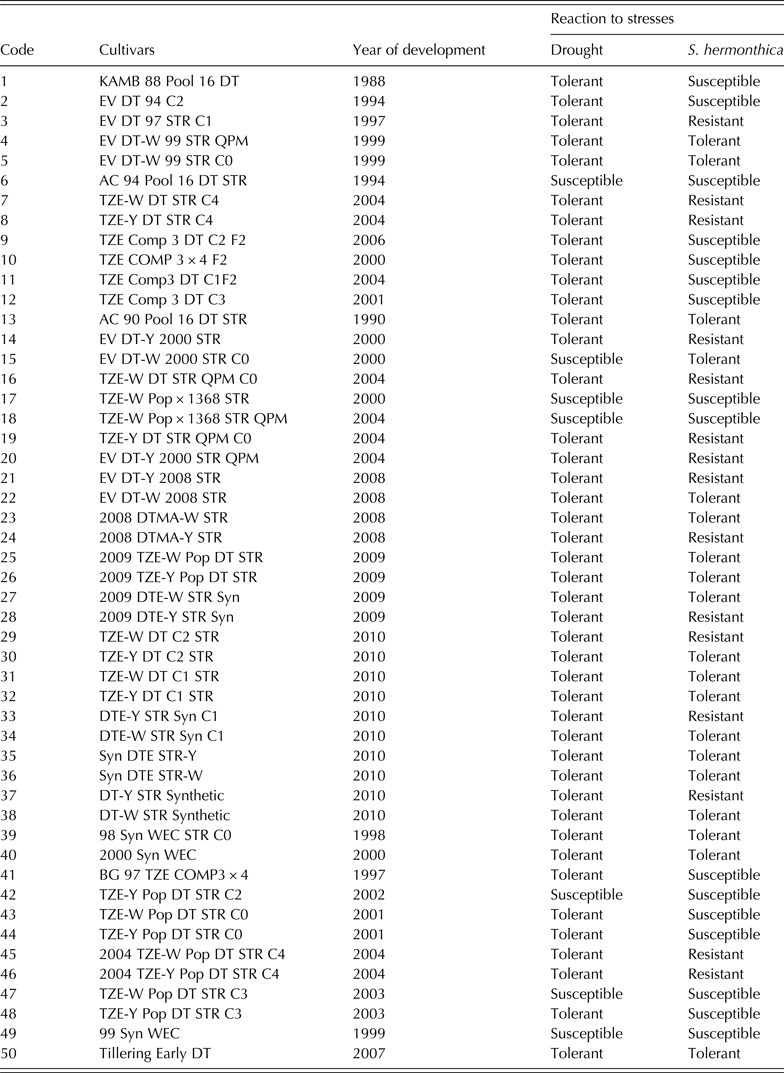
The 50 cultivars used in the present study (Table 1; Badu-Apraku et al. Reference Badu-Apraku, Oyekunle, Menkir, Obeng-Antwi, Yallou, Usman and Alidu2013a, Reference Badu-Apraku, Yallou and Oyekunleb) were evaluated under low-N (30 kg N/ha) and high-N (90 kg N/ha) conditions in 2010 and 2011 at the Teaching and Research Farm, Obafemi Awolowo University, Ile-Ife (4°32′ E, 7°28′ N, 280 m asl) in the forest agroecology and at Mokwa, both in Nigeria. A randomized incomplete block design with two replications was used. A plot consisted of two rows, 5 m long, spaced 0·75 m apart with 0·40 m spacing between plants within the row in all trials. Three seeds were planted per hill. The maize plants were thinned to two per stand about 2 weeks after emergence to give a final plant population density of 66 000 plants/ha.
Maize cultivars used for the study, their year of breeding and reaction to drought and Striga hermonthica

The soil at Mokwa is a luvisol (IUSS Working Group WRB 2006) with 0·27, 0·04 and 0·48% organic carbon, organic N and phosphorus content (by volume). On the other hand, the soil at Ile-Ife is characterized as fine-loamy, isohyperthemic Plinthustalf Plinthustalf (Soil Survey Staff 2007). The experimental fields were depleted of N by continuously planting maize and removing the biomass after each harvest for a period of 2 years. Soil samples were taken each year before planting for all the test environments and N content was determined at the IITA soil laboratory at Ibadan. The total N in the soils was determined by Kjeldahl digestion and colorimetric determination on Technicon AAII Autoanalyser (Bremner & Mulvaney Reference Bremner, Mulvaney, Page, Miller and Keeney1982). The soils of the sites used for the trials were very low in N, ranging from 0·84 to 0·87 g/kg N. Fertilizers were applied to bring the total available N to 90 kg/ha for the moderately high-N field and 30 kg/ha for the low-N field when the soil N was less than that. The N-fertilizer was applied 2 weeks after planting. Also, single superphosphate (P2O5) and muriate of potash (K2O) were applied to both low- and high-N blocks at the rate of 60 kg/ha. The trial was kept weed-free with the application of herbicides and by hand weeding.
Data collection
Data were recorded on both low- and high-N plots for days to 50% silking (DS), as the number of days from planting to when 50% of the plants had emerged silks, and days to anthesis (DA) when 50% had shed pollen. The anthesis-silking interval (ASI) was calculated as the difference between DS and 50% anthesis. Plant height was measured as the distance from the base of the plant to the height of the first tassel branch and ear height as the distance to the node bearing the upper ear. Root lodging (percentage of plants leaning > 30° from the vertical), stalk lodging (percentage broken at or below the highest ear node), disease reaction and ear aspect were also recorded. Ear number per plant (EPP) was obtained by dividing the total number of ears per plot by the number of plants harvested. Plant aspect was recorded on a scale of 1–5 based on the plant type, where 1 = excellent and 5 = poor. Husk cover was rated on a scale of 1–5, where 1 = husks tightly arranged and extended beyond the ear tip and 5 = ear tips exposed. Ear aspect was based on a scale of 1 to 5, where 1 = clean, uniform, large and well-filled ears, and 5 = ears with undesirable features. In addition, leaf senescence scores were recorded at 70 days after planting on a scale of 1 to 10, where 1 = almost all leaves green and 10 = virtually all leaves dead. Harvested ears from each plot were shelled to determine the percentage grain moisture. Grain yield was adjusted to 15% moisture and computed from the shelled grain weight. On the other hand, in the high-N plots, grain yield was computed based on 80% (800 g grain/kg ear weight) shelling percentage and adjusted to 150 g/kg moisture content.
Statistical analysis
The analysis of variance (ANOVA) combined across environments was performed on plot means for grain yield, DS, ASI, EPP, plant height, percentage stalk lodging, leaf senescence score, ear and plant aspects, and husk cover with PROC GLM in SAS using a RANDOM statement with the TEST option (SAS Institute 2001). Data collected on rating scales were log-transformed before subjecting them to ANOVA. In the combined ANOVA, the location–year combinations, replicates and blocks of each experiment were considered as random factors, while era and genotypes with era were considered as fixed effects. Means were separated using the least significant difference (LSD). In addition, combined ANOVA across low- and high-N environments was performed to elicit information on G × N and G × N × E interactions (where G is genotype, N is nitrogen and E is environment). Subsequently, the yield data were subjected to genotype main effect plus genotype × environment interaction (GGE) biplot analysis to decompose the G × E interactions of each experiment (Yan et al. Reference Yan, Hunt, Sheng and Szlavnics2000; Yan Reference Yan2001). The GGE biplot was used to obtain information on the cultivars that were suitable for stress and non-stress environments and to investigate the stability of cultivars across environments. The analyses were done using GGE biplot, a Windows application that fully automates biplot analysis (Yan Reference Yan2001). The program is available at http://www.ggebiplot.com (verified 1 December 2013).
Means for grain yield and other traits of the maize cultivars were regressed as dependent variables on the year of breeding as independent variables (expressed as number of years since 1988) to obtain regression coefficient (b-value) under low- and high-N conditions. The coefficient of linear regression (b-value) was then divided by the intercept and multiplied by 100 to obtain the relative genetic gain per year.
Correlation coefficients were computed between grain yield and other measured traits, as well as between each pair of the measured traits for the 50 maize cultivars under the different environmental conditions. Correlation analysis was done with the SAS package, version 9.2 (SAS Institute 2001) while regression analysis, including the parameters and the graphical display of the regression line were done using the Excel software in the Microsoft Office suite 2007. In addition, R-factor analysis, an analysis based on correlation among traits with principal component analysis (PCA) approach, was used to study the association of agronomic traits with grain yield under each group of N environments. In this analysis, each trait was expressed as a linear function of other traits and the best linear combination of variables was identified as the first principal factor or factor 1, which accounted for a larger proportion of the total variance for the set of data than any other factor. Other factors were determined similarly, with each subsequent factor explaining more of the residual variance than others after it. The factors were subjected to varimax rotation method applied to the characteristic roots and vectors from the correlation matrix so that the resulting rotated factors were orthogonal. Traits loaded on each factor were sorted in descending order based on the value of the components attributable to the factor. To facilitate interpretation of the results, loaded component values of 0·4 or less were suppressed in the computer output and only the factors with eigenvalue ⩾1 were retained. Factor analysis was done using the Statistical Packages for the Social Sciences (SPSS), version 17. Subsequent to factor analysis, SPSS was also used for stepwise multiple regression analysis of grain yield on all other traits to identify the best subset of traits for predicting grain yield as well as their order of importance under stress and non-stress conditions. This technique included in the regression model only the traits that contributed significantly to grain yield by systematically adding the traits, one at a time, to the model and terminating the analysis at the point where no other trait significantly contributed to grain yield at 0·05 level of probability specified by the researcher. The traits identified in the stepwise regression under stress conditions were individually used to predict grain yield under non-stress conditions, using the Excel software in Microsoft Office suite.
RESULTS
Analysis of variance across low- and high-nitrogen environments
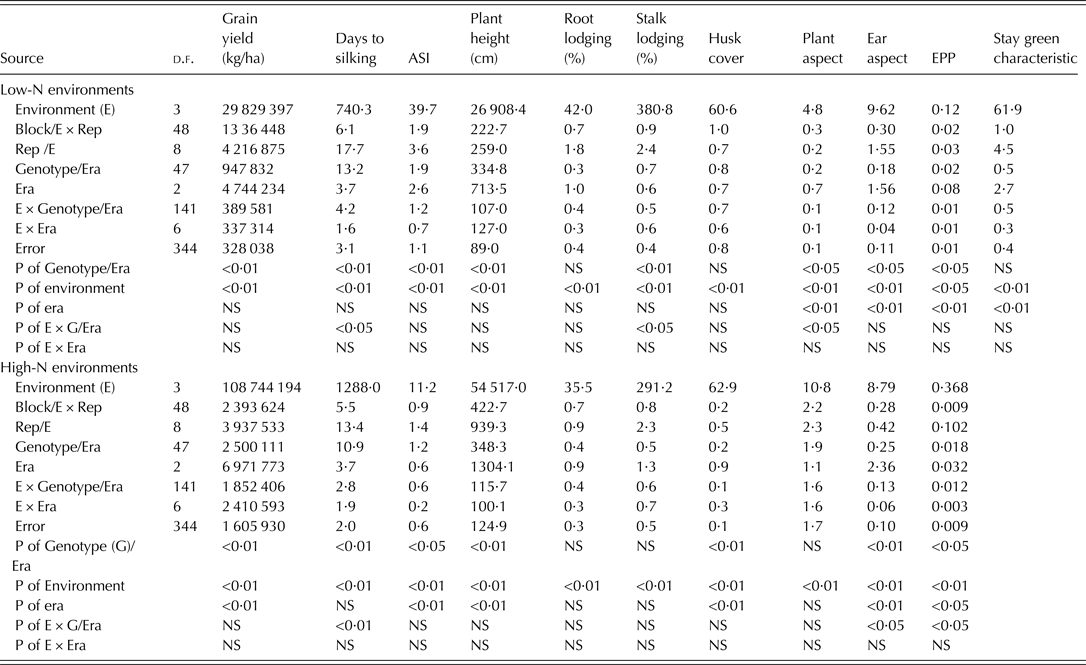
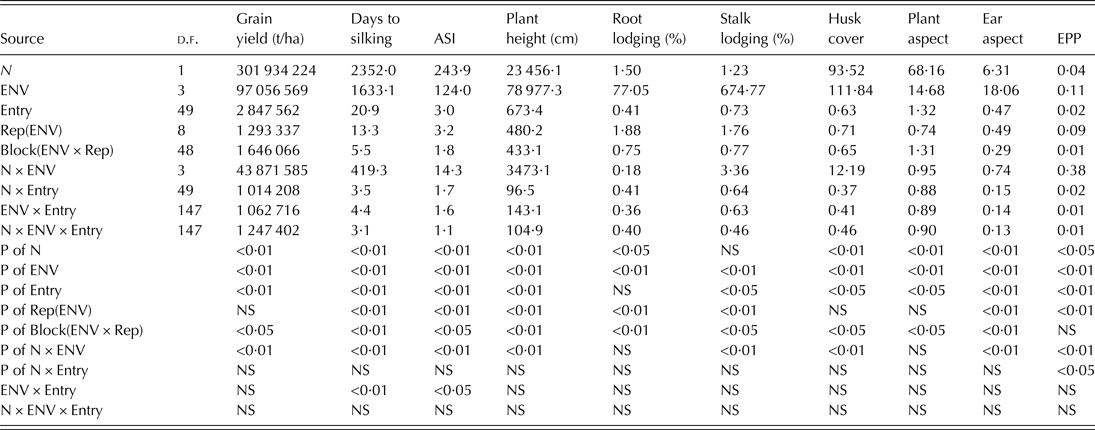
The combined ANOVA for grain yield of the 50 maize cultivars showed highly significant (P ⩽ 0·01) mean squares for all sources of variation with the exception of Environment × Era and Environment × Genotype/Era for both low- and high-N environments (Table 2). The environment accounted for c. 0·70 of the variation for each of the two N environments. In all cases, Era accounted for a rather low proportion of the total variation (0·11) while Cultivar/Era accounted for <0·03. The Environment × Cultivar/Era interaction accounted for a much lower proportion of the total variation (0·01) than the Environment × Era interaction (⩽0·02). Furthermore, the G × N and G × N × E interaction mean squares were not significant across the combined ANOVA for the low and high-N environments with the exception of G × N for EPP (Table 3).
Mean squares for grain yield and other agronomic traits of maize cultivars of three breeding periods evaluated under low- and high-nitrogen conditions at Mokwa and Ile-Ife, 2010 and 2011
ASI, Anthesis-silking interval; EPP, ear number per plant; NS, not significant at <0·01 and <0·05.
Combined ANOVA for grain yield and other agronomic traits of maize cultivars developed during three breeding eras and evaluate under low- and high-nitrogen environments at Mokwa and Ile-Ife, 2010 and 2011
NS, not significant at <0·01 and <0·05.
Genetic gains in grain yield under low- and high-nitrogen environments
The regression analysis showed that under both low- and high-N, grain yield increased significantly (P ⩽ 0·05) from the first to the third breeding period with b-values of 159 and 205, respectively (Fig. 1). Similarly for both low and high-N, plant and ear heights increased slightly, while ear aspect decreased from period 1 to period 3 (data not shown). Breeding period did not alter the number of days to flowering as well as stalk and root lodging. Rather, under low but not high-N, plant aspect and the stay green character improved in period 3 relative to period 1. Under low-N conditions, grain yield improved from 2280 ± 56·0 kg/ha during the first period to 2610 ± 54·0 kg/ha during the third period, an increase of 1650 kg/ha per era with r 2 of 0·99 (Fig. 1). Under high-N, yield increased from 3200 ± 176·0 kg/ha to 3650 ± 68·0 kg/ha, an increase of 225·0 kg/ha and r 2 of 0·93. Relative gain per period (that is, gain in grain yield in a period per unit yield in the previous period) was 30 kg/ha for each of the two N rates with r 2 values of 0·99 and 0·94, respectively. The genetic gains under low- and high-N environments were exactly the same. Similarly, regression analysis of grain yield under N environments showed positive predictive relationship between one level and the other, with performance under low-N predicting performance under high-N better than vice versa (Figs 2(a) and (b)).
Relationship among grain yield of early maturing maize cultivars (kg/ha) for three breeding eras evaluated under low- and high-nitrogen environments at Ile-Ife and Mokwa, Nigeria, 2010 and 2011.
Regression of (a) grain yield of low-nitrogen (N) environments on grain yield of high-N environments and (b) grain yield of high-N environments on grain yield of low-N environments.
The highest-yielding cultivars under both N environments, such as TZE-W DT C2 STR, EV DT-W 2008 STR, 2009 DTE-Y STR Syn and TZE-W DT C1 STR were mainly from period 3. Mean grain yields under low-N environments were not significantly different during periods 1 and 2, but they were significantly different (P ⩽ 0·05) in period 3 (Table 4). In each breeding period, as expected, high-N environments supported significantly (P ⩽ 0·05) higher productivity than low-N environments.
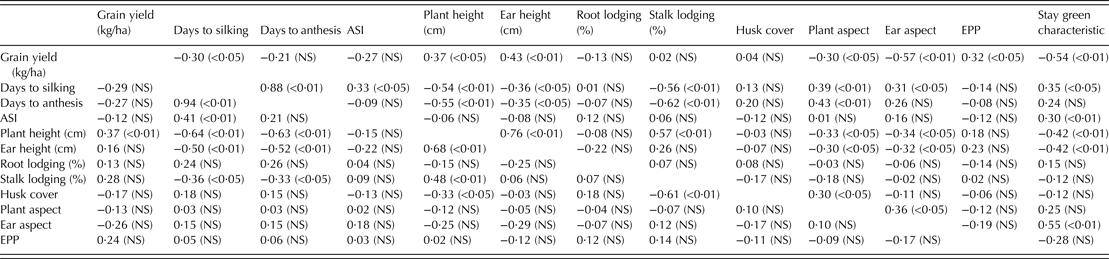
Correlation coefficients of grain yield and other agronomic traits of maize cultivars of three breeding eras evaluated under low- (above diagonal) and high-nitrogen (below diagonal) conditions at Mokwa and Ile-Ife, 2010 and 2011
ASI, Anthesis-silking interval; EPP, ear number per plant; NS, not significant; <0·01 and <0·05.
Correlation between grain yield and other traits under low- and high-nitrogen environments
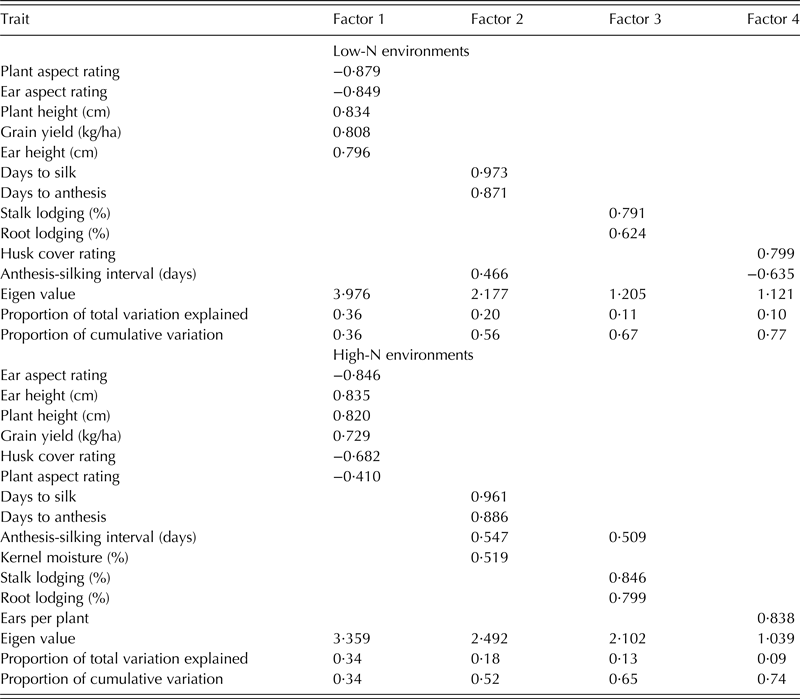
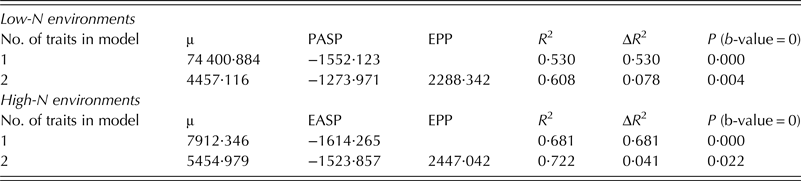
There were more statistically significant correlation coefficients among the traits assayed under low than high-N (Table 5). Of the 66 possible correlation coefficients in the study, 25 were statistically significant for low-N compared with only 13 for high-N environments. Under high-N, only plant height had significant correlation (r = 0·37) with grain yield, whereas six traits (DS, plant and ear heights, plant and ear aspects, and EPP) had significant correlation with yield under low-N. In all cases, each trait with significant correlation with grain yield had r 2 ⩽ 0·22. Grain yield and the other traits were grouped into four factors under the two N environments (Table 5). The factors accounted for c. 0·77 and 0·74 of the variance for all traits under low- and high-N environments, respectively. Patterns of component loadings on the factors were similar but not identical in the two group of environments; that is in both cases, factor 1 was grain yield and its determinants, factor 2 was flowering traits and factor 3 had lodging traits; however, traits loaded on factor 4 were completely different under the two scenarios. Furthermore, the order of trait loadings within each factor varied somewhat and the number of traits that finally met the criteria for inclusion in the factors was 11 for low-N and 13 for high-N; ears per plant and kernel moisture were not loaded on any factor under low-N and surprisingly, ears per plant was loaded on a separate factor from grain yield and all other traits under high-N (Table 5). That notwithstanding, ear per plant was picked by the stepwise multiple regression as the second most important trait determining grain yield under both N conditions, with plant and ear aspects being the most important under low- and high-N, respectively (Table 6). The two traits in each case accounted for 0·61 and 0·72 of the variation in grain yield under low- and high-N, respectively.
Components from varimax-rotated factor analysis for grain yield and other agronomic traits of 50 early maturing maize cultivars developed during three breeding eras and evaluated under low- and high-nitrogen environments at Ile-Ife and Mokwa, Nigeria, 2010 and 2011
Partial regression coefficients (b-value) and coefficients of determination (R2) from the stepwise regression analysis of grain yield (kg/ha) on several other agronomic traits of 50 early maturing maize cultivars developed during three breeding eras and evaluated under low- and high-nitrogen environments in Ile-Ife and Mokwa, Nigeria, 2010 and 2011
PASP, Plant aspect; EASP, Ear aspect; EPP, Number of ears per plant; ΔR 2, increase in R 2 attributable to the addition of another variable to the model.
Stability of performance of early maturing maize cultivars across low- and high-nitrogen environments
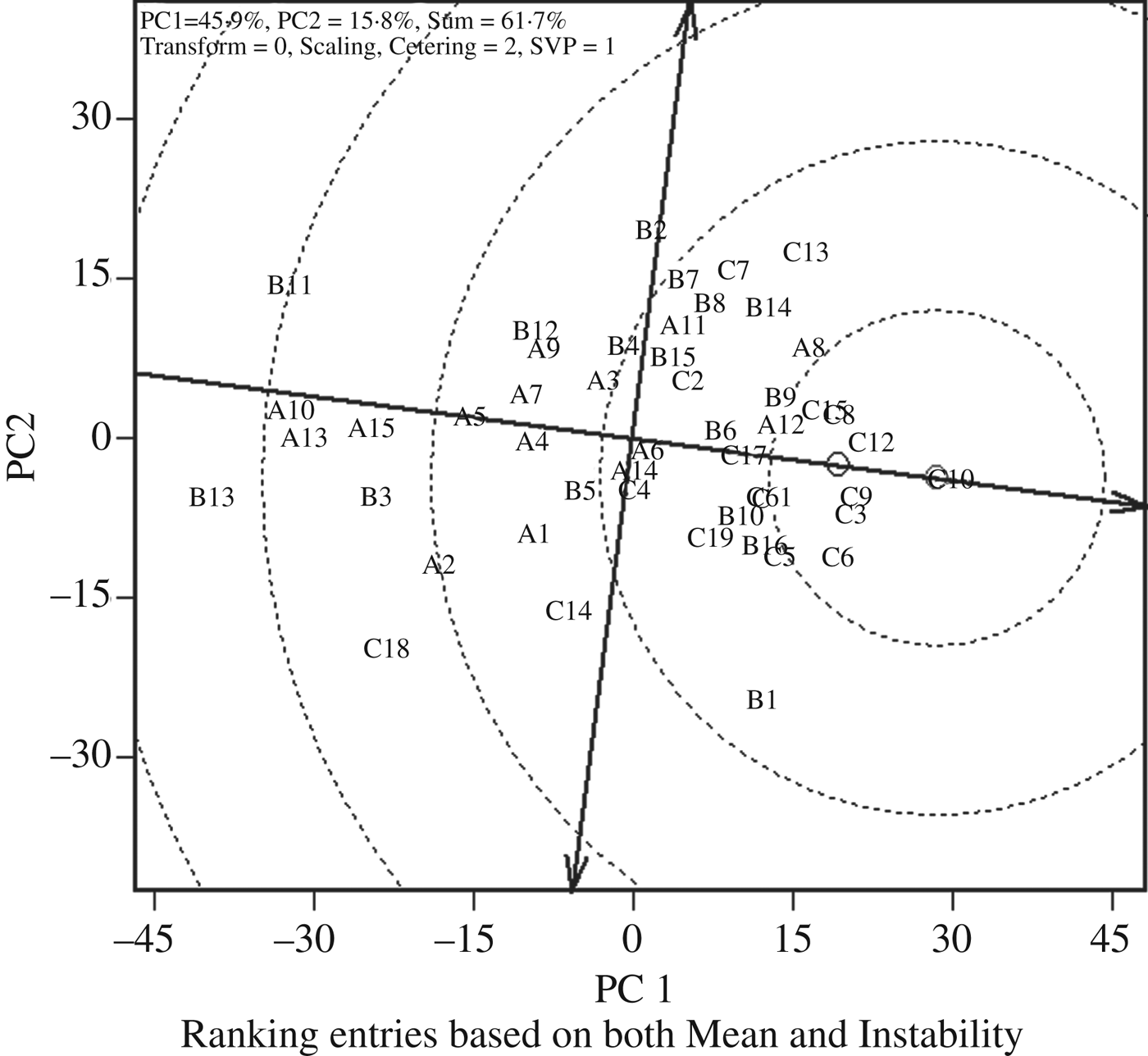
Figure 3 shows the GGE biplots for grain yield of the 50 early-maturing maize cultivars evaluated under low- and high-N environments at Mokwa and Ile-Ife in 2010 and 2011. The first (PC1) and second (PC2) principal component (PC) axis explained 0·46 and 0·16 of the total variation; thus, PC1 and PC2 together explained 0·62 of the total variation in grain yield, indicating that the biplot of PC1 and PC2 across the research environments adequately approximated the environment-centred data. In the GGE biplot display, the thick single-arrow black line that passes through the biplot origin (intercept of the vertical and horizontal axis) and the average tester (centre of the innermost concentric circle with an arrow) is referred to as the average-tester coordinate axis (ATC). The double-arrow line (ATC ordinate) separates entries with below-average means (to the left side of the line) from those with above-average means (to the right side of the line). The average performance of a genotype is approximated by the projection of its marker on the ATC abscissa. On the other hand, the stability of the genotypes is measured by the projection onto the ATC y-axis single-arrow line (ATC abscissa). The greater the absolute length of the projection of the entry the less stable is the genotype (Yan et al. Reference Yan, Kang, Ma, Woods and Cornelius2007). The biplot shows the ranking of the cultivars on the basis of their mean performance and stability across test environments. An ideal cultivar is one that has the largest projection on the abscissa of all the cultivars (highest yielding) and has a zero projection on the ATC ordinate (most stable). That is, an ideal cultivar has superior grain yield and stability as well as the most desirable agronomic characteristics across environments. The cultivar marker is expected to fall inside the innermost concentric cycle of the biplot inside which the arrow head is located. Based on this, TZE-W DT C2 STR, TZE-W DT C1 STR, 2009 TZE-W Pop DT STR, EV DT-W 2008 STR, 2009 DTE-W STR, 2009 DTE-Y STR Syn and DTE-W STR Syn C1, all from period 3 were identified as the ideal cultivars across the research environments (Fig. 3).
The biplot view showing the ranking of 50 early-maturing maize cultivars evaluated in eight environments based on both their mean grain yield performance and stability. Principal component (PC) 1 and PC 2 explained 0·62 of yield variation. See Table 1 for cultivar code.
DISCUSSION
An important objective of the present study was to test the hypothesis that some of the cultivars selected for drought tolerance and Striga resistance during the last three decades in WCA would also possess tolerance to low-N. The results of the study has amply demonstrated that, although no conscious effort was made until 2007 to breed for tolerance for low-N in the IITA maize improvement programme, selecting for drought tolerance and Striga resistance at 30 kg N/ha under Striga infestation has led to concomitant improvement in grain yield and some other traits of some products from the advanced cycle of selection of the breeding populations. The results of the present study corroborate the findings of several workers (Bänziger et al. Reference Bänziger, Edmeades and Lafitte1999; Andrade et al. Reference Andrade, Cirilo, Echarte, Otegui and Slafer2000; Badu-Apraku et al. Reference Badu-Apraku, Fakorede, Lum and Akinwale2009, Reference Badu-Apraku, Menkir, Ajala, Akinwale, Oyekunle and Obeng-Antwi2010, Reference Badu-Apraku, Fakorede, Oyekunle and Akinwale2011).
Furthermore, under both low- and high-N levels in the present study, there was only a slight increase in plant and ear heights while ear aspect decreased from period 1 to period 3 without the breeding period altering the number of days to flowering as well as stalk and root lodging. In addition, the relative ranking of the cultivars across low- and high-N was consistent, as indicated by non-significant G × N and G × N × E mean squares in the combined ANOVA. Rather, under low but not high-N, plant aspect and the stay green characteristic improved in period 3 relative to period 1. The strong negative correlation observed between grain yield and the stay green characteristic under low-N corroborates the results of Badu-Apraku et al. (Reference Badu-Apraku, Oyekunle, Menkir, Obeng-Antwi, Yallou, Usman and Alidu2013a) and justifies the use of this trait in the IITA base index for selecting for improved grain yield under low-N environments. Significant G × N interaction mean squares also indicated that the expression of EPP was not consistent across low- and high-N environments, implying that selection for EPP may have to be done independently for low- v. high-N environments. On the other hand, it is difficult to explain the significant negative correlation between grain yield and the DS and DA under both low- and high-N environments. The use of a selection index that kept DA and DS constants to identify progenies for recombination might have resulted in the development of early cultivars with little change in the two traits during the recurrent selection programme. The selection index was also effective in keeping plant and ear heights almost constant despite improvements in yield potential of the second and third generations of early cultivars. This indicates the effectiveness of the different base indices used for selecting for drought tolerance and Striga resistance.
The genetic gain of 165 and 225 kg/ha (0·55 and 0·94% per year) in grain yield observed under low- and high-N environments, respectively, in the present study is substantially greater than the 51 and 87 kg/ha/year reported by Castleberry et al. (Reference Castleberry, Crum and Krull1984) under low and high soil fertility for 25 open-pollinated and hybrid maize cultivars developed between the 1930s and 1980s. Similarly, the genetic gains are substantially higher than the 0·41% per year reported by Kamara et al. (Reference Kamara, Menkir, Fakorede, Ajala, Badu-Apraku and Kureh2004) for late maturing maize cultivars developed from 1970 to 1999 in the West African savannahs. The genetic gain in grain yield was associated with increased total biomass production and kernel weight along with reductions in plant height and days to flowering. The genetic gains obtained in our study are also higher than those reported by Russell (Reference Russell1984) for US Corn belt cultivars (0·68% per year) from 1930s to the 1980s but lower than the 1·7% per year reported by Tollenaar (Reference Tollenaar1989) for commercially important maize hybrids in Central Ontario from the late 1950s to the late 1980s.
Comparison of the results of the present study and the earlier genetic gain studies involving the 50 early maturing cultivars conducted under drought, Striga infested, optimum environments and under multiple stress environments (Badu-Apraku et al. Reference Badu-Apraku, Oyekunle, Menkir, Obeng-Antwi, Yallou, Usman and Alidu2013a, Reference Badu-Apraku, Yallou and Oyekunleb) revealed some interesting trends. The gains in grain yield from selection were higher in the later cycles of selection under all research conditions. For example, Badu-Apraku et al. (Reference Badu-Apraku, Yallou and Oyekunle2013b) reported an average genetic yield gain of 1·7% per era when the 50 cultivars were evaluated under Striga infestation. On the other hand, Badu-Apraku et al. (Reference Badu-Apraku, Oyekunle, Menkir, Obeng-Antwi, Yallou, Usman and Alidu2013a) reported an annual genetic gain of 1·1% under drought stress and 1·3% per year under well-watered environments. Furthermore, in a similar study under 16 multiple stress environments, there was a genetic gain of 30 kg/ha/year, an annual genetic gain of 1·2% which was slightly lower than the average rate of increase in grain yield across optimum growing environments of 40 kg/ha/year with a genetic gain of 1·3% per year (Badu-Apraku et al. Reference Badu-Apraku, Fakorede, Oyekunle, Yallou, Obeng-Antwi, Haruna, Usman and Akinwale2015). The moderately high genetic gains in grain yield under both low- and high-N environments in the present study is not surprising because during the development of the first era of early cultivars, the major emphasis of the breeding programme was on the selection for drought tolerance and resistance to maize streak virus disease. During the development of the second era cultivars, the major breeding emphasis was on recurrent selection for improved Striga resistance in the early white and yellow source populations with reduced emphasis on selection for drought tolerance. Starting from 2007, the source populations were subjected to improvement for tolerance to drought, low-N and resistance to Striga, resulting in the development of several cultivars with combined resistance and /or tolerance to the three stresses (Table 1, Badu-Apraku et al. Reference Badu-Apraku, Oyekunle, Menkir, Obeng-Antwi, Yallou, Usman and Alidu2013a, Reference Badu-Apraku, Yallou and Oyekunleb). These improvements have definitely made significant contributions to the outstanding performance of the third generation of early cultivars compared to that of the first generation.
It is particularly striking that traits associated with grain yield were almost exactly the same and nearly in the same order under both low- and high-N conditions. In both cases, factor 1 carried about half of the total variation accounted for by all traits while the proportions accounted for by subsequent factors were much lower than that of factor 1. The influence of a factor on a particular trait is determined by the square of the factor loading for the trait (Fakorede Reference Fakorede1979). Therefore, factor 1 accounted for 0·65 and 0·53 of the grain-yield variance under low- and high-N environments, respectively. Although correlation of EPP with grain yield was low under both N conditions (r = 0·32 for low-N and 0·24 for high-N) and the trait was not loaded on any factor under low-N and on a separate (stand-alone) factor under high-N, stepwise multiple regression showed that when the effect of either plant or ear aspect was held constant (partial regression coefficient), EPP was the most important determinant of grain yield under the conditions of this study. The present study results clearly show that traits related to grain yield in maize are more or less the same under different N rates, although the magnitude of the effects may vary between N rates. It may be inferred, therefore, that indirect selection for grain yield using traits such as plant and ear aspects and EPP under low-N will result in low-N tolerance with improved yield under low soil N as well as under high soil N as a value addition.
The outstanding performance of TZE-W DT C2 STR, TZE-W DT C1 STR, 2009 TZE-W Pop DT STR, EV DT-W 2008 STR, 2009 DTE-W STR Syn, 2009 DTE-Y STR Syn, and DTE-W STR Syn C1 is not surprising since these cultivars are known to be tolerant and/or resistant to both Striga and drought. The drought and low-N tolerance as well as Striga resistance of these cultivars are of special interest as drought, Striga and low-N stresses do not occur separately under field conditions in WCA, but occur simultaneously, and when this happens the combined effect can be devastating (Cechin & Press Reference Cechin and Press1994; Kim & Adetimirin Reference Kim and Adetimirin1997; Badu-Apraku et al. Reference Badu-Apraku, Fakorede, Oyekunle and Akinwale2011). The superior performance of the cultivars is therefore very interesting and desirable because maize cultivars targeted to the drought-prone areas of WCA must also be resistant/tolerant to the three stresses.
CONCLUSIONS
Results of the evaluation of the 50 early maturing cultivars of the three breeding eras showed that selection for Striga resistance and drought tolerance in early maturing maize populations enhanced low-N tolerance in the maize cultivars derived from the populations. The improvement was higher in later than earlier breeding periods. It may be concluded that substantial progress has been made in breeding for high yielding, Striga resistant/tolerant, drought and low-N tolerant cultivars during the past three decades. The outstanding cultivars, TZE-W DT C2 STR, TZE-W DT C1 STR, 2009 TZE-W Pop DT STR, EV DT-W 2008 STR, 2009 DTE-W STR Syn, 2009 DTE-Y STR Syn, and DTE-W STR Syn C1 should be extensively tested in WCA and vigorously promoted for commercialization to contribute to food security in the sub-region.
The financial support of the Drought Tolerant Maize for Africa (DTMA) Project and the International Institute of Tropical Agriculture (IITA) for this study is gratefully acknowledged. Special thanks are also due to the staff of the IITA Maize Improvement Program in Ibadan, Nigeria, for technical assistance.