Introduction
Laryngotracheal stenosis is a condition that can cause severe patient morbidity because airway obstruction causes respiratory distress. Laryngotracheal stenosis continues to provide significant challenges for specialists treating this condition, primarily because of regrowth of granulation tissue at the site of intervention or at the anastomotic site.Reference Clément, Hans, de Mones, Sigston, Laccourreye and Brasnu1
The management of laryngotracheal stenosis remains discretionary and has often been tailored to the severity, underlying causes, levels of stenosis (single or multiple), surgeon's experience and available institutional infrastructure. Open neck procedures have been performed to reconstruct the stenotic airway or for resection and anastomosis of stenosis. Frequently, multiple endoscopic procedures may be required after an open procedure to maintain an adequate airway. Endoscopic interventions are preferred by many surgeons for mild stenosis (I and II) with or without stenting. Unfortunately, endoscopic procedures result in the need for repeated interventions because the effect is usually short lasting because of re-stenosis. Open laryngotracheal reconstruction is preferred for severe grades of stenosis (III and IV). However, no single approach gives satisfactory results in terms of decannulation outcomes.Reference Lewis, Earley, Rosenfeld and Silverman2
Following the open procedure, the reconstructed laryngo-tracheal framework is usually supported by stents with cartilage grafts (thyroid or costal cartilage). Although several types of stents have been used in the past, the choice is governed subjectively by the surgeon's experience. Montgomery™ T-tube, the most frequent variety, has been used safely and effectively.Reference Wahidi and Ernst3 In addition, when the T-tube is used, it has been shown that some patients do not need further surgical airway resection after early decannulation. It is likely that the injured segment of trachea undergoes remodelling and makes a cicatricial tubular structure around the tube. Therefore, even after removal, the trachea remains patent and stable. However, the appropriate duration for temporary stenting has not been adequately explored.Reference Saghebi, Zangi, Tajali, Farzanegan, Farsad and Abbasidezfouli4 Although the optimum period of stenting has been traditionally related to the severity of the stenosis, some authors have used different kinds of stents for shorter periods, with satisfactory surgical outcomes.Reference Chen and Inglis5
We proposed that in the absence of an autologous graft, stenting for a shorter period (less than three months) even in severe grades of stenosis would be sufficient to allow adequate remodelling of the reconstructed laryngotracheal tissue. In the present study, we compared the outcome in terms of successful decannulation for shorter periods (less than three months) with longer periods of stenting.
Materials and methods
This was a comparative study conducted in our department over 18 months between July 2018 and December 2019 in order to evaluate outcomes in terms of successful decannulation. Fifteen participants with moderate to severe (grade II, III or IV) laryngotracheal stenosis were included in each of the two groups to compare short with long-term stenting.
Fifteen patients were included in the short-term stent group after a fibre-optic endoscopy and were followed for a period of three months after reconstruction and placement of the stent. The demographic and clinical parameters of included participants were recorded, and they were evaluated for vocal fold status, grade, site and length of stenosis. Details of tracheostomy, frequency of tube change and stoma hygiene were noted. When a longer length of stenosis was suspected on the basis of radiographic shadow of soft tissue, a computer tomography bronchoscopy was performed to characterise the status of cartilage and determine the presence of multiple levels of stenosis. The surgical procedure was then planned depending on the grade and level of stenosis and status of true folds. Following surgery, a tracheal T-tube stent was placed for up to three months.
Fifteen patients were identified for comparison in the long-term stent group after matching for age, sex and baseline diagnosis (which formed the primary indication for intubation) from a retrospective review of hospital clinical records available in our department (ICD J39.8, J38.6). Cases were included in the long-term stent group if they had received a tracheal T-tube stent that had been in place for over six months in the previous five years.
Patients less than 12 years of age, those who had received radiotherapy in the past, those with a poor neurological status or a history of intra- or extra-luminal tracheal tumours were excluded from the study.
Surgical procedures
Isolated tracheal stenosis
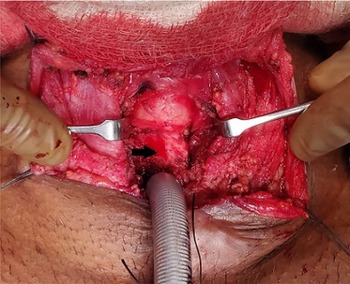
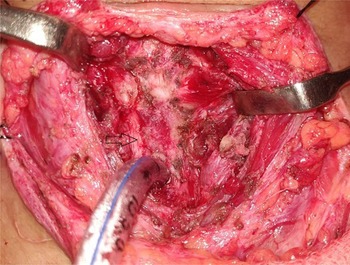
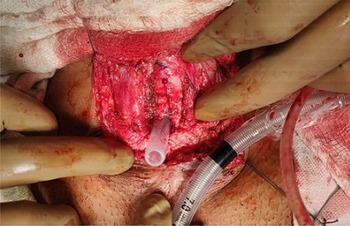
A horizontal incision was made at the level of the pre-existing stoma. Subplatysmal flaps were raised superiorly and the strap muscles were dissected; after this, the trachea, including two rings inferior to stoma, were skeletonised (Figure 1). The core of fibrotic tissue was taken out using cold instruments, namely using a number 15 blade, tissue micro-scissors or coblation until a normal tracheal ring was identified proximally (Figure 2). Mitomycin-C (0.4 mg/ml soaked cotton pledgets kept for 2 minutes, 3 times) was applied to the patient post-operatively. A T-tube of proper size, based on age and virtual computed tomography scan and intra-operative findings was introduced. The trachea was closed using 4-0 vicryl (Figure 3).
Deformed trachea visualised after skeletonisation. Arrow shows stenotic part of trachea.

Trachea after scoring out the scarred tracheal tissue with anterior cricoid split. Arrow shows cut end of trachea.

Tracheal closure after Montgomery T-tube placement.

Combined subglottic and upper tracheal stenosis
A horizontal incision was made at the level of stenosis. Fibrotic tissue was cored out, as mentioned before, from the trachea as well as from the cricoid lumen. Posterior cricoid splitting was performed if required. Cricotracheal reconstruction was performed which was followed by stenting.
Combined subglottic-posterior glottic stenosis
This essentially requires a posterior cricoid split with interposition of costochondral cartilage followed by stenting. The Montgomery T-tube was carefully sized based on the length of area to be stented; it was measured intra-operatively. The tube was trimmed if needed, and the trimmed end was bevelled and smoothened to avoid injury to mucosa. The tube was secured, using 3-0 prolene, to the anterior tracheal wall. Endoscopy was performed prior to wound closure to check for the right positioning of the proximal end of the T-tube. Suture removal was performed after 7–10 days depending on the wound status.
Follow up
Patients in the short-term stent group were followed up at the end of weeks 1, 6 and 12 after placement of stent. A check endoscopy at the end of the first week (7–10th post-operative day) was performed to assess the tube position and identify the upper and lower ends of the tube. Participants were followed up at six weeks with a fibre-optic laryngoscopy to assess the status of the wound and the vocal folds. At the end of three months, participants were hospitalised and evaluated for the tracheal lumen. They were placed on a tracheostomy tube of appropriate size after removal of the T-tube, and treated with steroids, nebulisation and proton-pump inhibitors. Decannulation was attempted by downsizing and strapping of the tube.
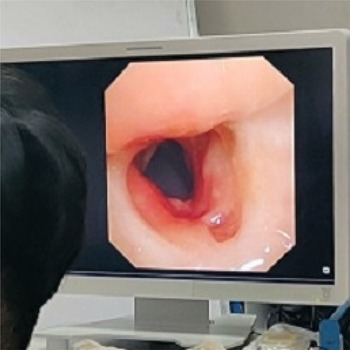
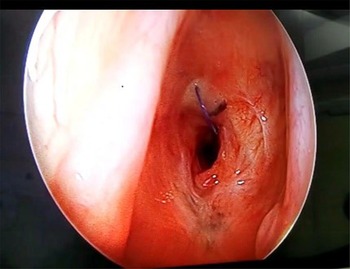
Decannulation was considered successful if a participant remained symptom-free after two weeks (Figure 4). In cases of failure, participants received surgical resection and anastomosis (Figure 5).
Fibre-optic laryngoscopic image of patient on follow up after stent removal and successful decannulation.

Tracheostomy dependent patient with perisistent grade II stenosis (failure).

Results
Profile of study patients
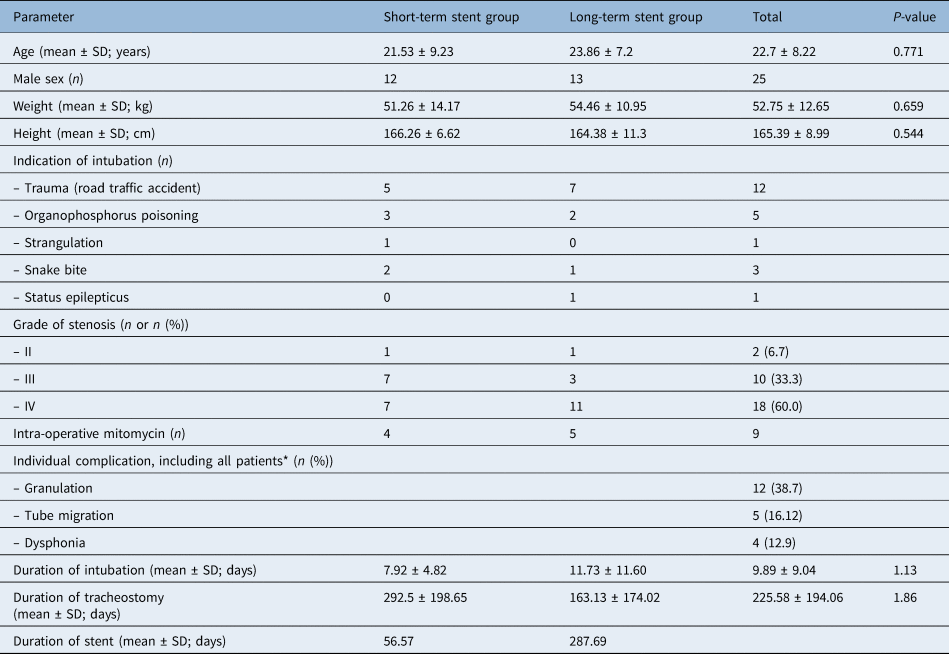
The mean age of the participants was 22.7 (± 8.2) years. The mean body mass index of participants was 19.3 (± 4.3). All patients developed stenosis post-intubation and the most common indication for intubation among participants was road traffic accident, followed by organophosphorus poisoning, strangulation, snake bite and status epilepticus. The baseline characteristics of the participants are shown in Table 1.
Baseline characteristics of study participants in the two groups

*n = 31. Assessment details were available for 24 participants only. Mitomycin was used in a dose of 0.4 mg/ml every two minutes (three doses) in five patients in the short-term stent group. P-values less than 0.05 were considered statistically significant. SD = standard deviation
Factors affecting successful decannulation
One in three participants in the study could be successfully decannulated (32.1 per cent). A greater proportion of patients in the short-term group could be successfully decannulated (5 of 15; 33.3 per cent) than in the retrospective long-term group (4 of 15; 26.66 per cent); however, the difference in proportions was not significant (p = 0.8).
We evaluated the role of other factors such as age, stomal hygiene, duration of initial intubation, duration of tracheostomy and history of initial trauma in achieving successful decannulation. There was no significant difference in the age of patients who failed decannulation when compared with those who could be successfully decannulated (20 years and 28 years respectively; p = 2.5).
It was found that two patients had poor stomal hygiene at the time of evaluation, and both could not be decannulated. Although the duration of intubation was slightly longer (10.6 days) in patients who could not be decannulated when compared with those in whom this was successfully achieved (9.1 days), the difference was not significant. Similarly, the duration of tracheostomy was longer for patients with successful outcome (312 days) than those who could not be decannulated (202 days), but this difference was also not significant (p = 1.3). Although the traumatic cases had a better rate of decannulation (37.5 per cent) than the non-traumatic causes (14 per cent), the difference was not statistically significant (p = 0.12).
Patients with single site stenosis received more frequent tube changes (once in three days or less) whereas those with multi-level stenosis received less frequent tube changes (once in four days or more). In addition, findings on computed tomography virtual bronchoscopy did not correspond with the intra-operative findings, especially in terms of the length of stenotic segment.
Complications
Common complications noticed among our participants were presence of granulations at the proximal end of tube (38.7 per cent), followed by superior migration of tube (16.12 per cent) and dysphonia (12.9 per cent). There were three instances of tube-block and two instances of the T-Tube getting anteriorly displaced into the soft tissue in front of the trachea. Two patients had cough associated with swallowing that was indicative of aspiration, but this improved without any active intervention. One of the participants had glottis stenosis and reported aphonia.
Discussion
A comparison of short- (less than three months) with long-term (more than six months) stent placement after laryngotracheal reconstruction in severe stenosis did not show any difference in chances of successful decannulation. Various demographic and disease factors such as sex, age, cause of intubation, presence or absence of initial treatment, and duration for which the patient was kept on tracheostomy tube were also found to have no significant role to play in the outcomes.
With the developments in critical care, there has been a steady increase in the number of endotracheal intubations, and thus subglottic stenosis, to nearly 4.9 cases per million intubations per year.Reference Nouraei, Ma, Patel, Howard and Sandhu6 About 90 per cent of cases of subglottic stenosis in children and infants happen because of intubation.Reference Holinger, Kutnick, Schild and Holinger7 However, the duration of intubation as well as the timing for converting oro-tracheal intubation to tracheostomy has been subjective. With the advent of percutaneous tracheostomy, conversion after 10 days of oro-tracheal intubation is currently preferred.Reference McWhorter8 Our findings favour early tracheostomy. We noticed that participants who received intubation for as short as two to four days also subsequently developed subglottic stenosis, indicating a role of unidentified factors in the development of stenosis.
Previous studies have shown a wide variation in successful decannulation rates from as low as 20 per centReference Ozkul, Songu, Ozturkcan, Imre, Erdogan and Ates9 to as high as 100 per cent after stent with T-tubes.Reference Bitoh, Okata, Tsugawa, Tsugawa, Miyauchi and Aida10
• Montgomery T-tube as a single modality for severe grades of laryngotracheal stenosis does not give satisfactory results
• Long-term stenting does not provide an additional benefit in outcome
• Tracheostomy as a temporising measure may help in stenosis maturation
• Post-operative granulations being a result of low-grade infection and the role of antibiotics in this requires further study
• Early removal of stents should be considered to avoid the complications intuitively associated with long-term stent placement
Tracheostomy: a temporising measure
Tracheostomy is an easy, safe and efficient way to secure the airway in subglottic stenosis as it allows active inflammation to settle while a more definitive intervention is planned. However, long-term tracheostomy and associated regular change of tube could lead to bacterial colonisation and possible increase in the length of the stenosis.Reference Ciccone, De Giacomo, Venuta, Ibrahim, Diso and Coloni11
The duration of tracheostomy and frequency of tube change did not have any association with the ability to achieve final decannulation status. The patients who were decannulated successfully stayed on average 100 days longer on tracheostomy tube. It would be important to consider the role of stenosis maturation over bacterial colonisation while evaluating the impact of duration of tracheostomy.
While patients with more frequent tube change (interval between changes less than three days) reported better decannulation rates, it is important to note that they had single-site (sub-glottic) stenosis. Patients with multi-level stenosis received less frequent tube changes and had poorer decannulation outcome. It would be interesting to consider if regular tube changes also prevented pooling of secretions which could act as a growth medium for bacteria.
Factors affecting decannulation
In a previous study, Saghebi et al. retrospectively analysed 1738 patients with airway stenosis in 2012 and did not find a significant association between age, sex, site of stenosis or baseline diagnosis.Reference Saghebi, Zangi, Tajali, Farzanegan, Farsad and Abbasidezfouli4 However, in a systematic review in 2016, Lewis et al. showed that aetiology significantly affected outcome.Reference Lewis, Earley, Rosenfeld and Silverman2 They found better rates of decannulation were associated with intubation or tracheostomy aetiology (88 per cent) compared with laryngotracheal trauma (78 per cent). Idiopathic stenosis had the lowest rates of decannulation (63 per cent).
We did not find any association of gender, age, stomal hygiene, duration of initial intubation or duration of tracheostomy with successful decannulation outcome. A large proportion of our study participants were younger men who presented following trauma and had better chances for decannulation (35 per cent) in comparison with those presenting with a systemic illness (16 per cent). Although this could be attributed to a better health status prior to intubation among trauma victims, a broader group may be required to arrive at more generalisable results.
Duration of stenting
The rates of successful decannulation were not different in patients who received stenting in the short term (n = 5; 33.3 per cent) from those who received it for a longer term (n = 4; 26.7 per cent).
It has been postulated previously in literature that a mature scar, which prevents secondary scar contraction, forms by three months.Reference Monnier and Monnier12 However, Saghebi et al. failed to prove a statistically significant relation between the decannulation rates and duration of stenting.Reference Saghebi, Zangi, Tajali, Farzanegan, Farsad and Abbasidezfouli4 Subsequently, in 2016, Ozkul et al. retrospectively analysed data from 17 patients with grade III subglottic stenosis who underwent dilatation of the stenotic segment followed by T-tube stenting and found that successful decannulation was achieved in only 3 patients (20 per cent).Reference Ozkul, Songu, Ozturkcan, Imre, Erdogan and Ates9 Despite being limited by small numbers, they concluded that T-tube placement was ineffective as a stand-alone procedure.
Although Bitoh et al., in 2018, reported 100 per cent success rates in managing sub-glottic stenosis using anterior posterior cricoid split with long-term stenting with T-tube, it is noteworthy that their patient group included participants with less severe disease (grades I and II).Reference Bitoh, Okata, Tsugawa, Tsugawa, Miyauchi and Aida10
In 2018, Smith et al. of the Cincinnati group showed that children on stenting after laryngotracheal reconstruction had more chance of decannulation (72.6 per cent) if the stent was placed for more than 3 weeks (mean, 44 days). Their findings not only validate our attempt at a short-term stenting but also indicate that if the stent is placed for too short a period (less than three weeks), it may itself result in a poorer outcome.Reference Smith, de Alarcon, Jefferson, Tabangin, Rutter and Cotton13
However, in a recent study, Jethwa et al., in 2019, while studying factors predicting treatment failure in 114 patients with subglottic stenosis who underwent cricotracheal resection with stenting, concluded that longer T-tube duration was associated with higher risk of permanent tracheostomy.Reference Jethwa, Hasan, Palme, Makitie, Espin-Garcia and Goldstein14 They reported 95 per cent success (decannulation) after cricotracheal resection and thyrotracheal anastomosis. Patients had stenting for longer periods (65.1 days) if they had extensive or multiple levels of stenosis or co-morbidities that increased chances of failure. They considered duration of T-tube stenting to be a surrogate marker for such factors and thus failure of decannulation.
Strengths and limitations
Our results are limited by a small sample size including only severe stenosis with short follow up, two weeks after T-tube removal. Given the chronicity of the condition, a longer follow up may be more informative. Although we compared a prospective group with short-term stenting with a retrospective group who received long-term stents and had limited follow-up data because of logistic issues, a larger prospective randomised trial may be able to delineate the issue of duration of stenting more clearly.
Suggestions for future research
In our study, we found that 1 in 3 patients could be successfully decannulated in the short-term group (33.3 per cent), but this was lower in the long-term group (26.6 per cent). Based on this observed difference of proportions, we find a sample of 614 in each group would be needed if a randomised study were planned to estimate this difference (using a two sample-proportions chi-square test) with a power of 80 per cent and a significance level of 0.05.
Conclusion
Decannulation is not more successful after placing Montgomery silicon T-tubes for longer periods of time when compared with stent removal within the first three months. With an overall decannulation rate of 32.14 per cent, Montgomery T-tubes, as a single modality of definitive treatment for laryngotracheal stenosis, do not give satisfactory results. Proper case selection and planning is essential for the successful outcome in cases of stenting. Surgeons should consider early removal of the stent to reduce complications intuitively associated with long-term stent placement after open reconstruction for severe laryngotracheal stenosis while exploring alternative definitive solutions.
Competing interests
None declared