Introduction
With the advancement in swine breeding programmes, hyperprolific sow lines emerged (Kobek-Kjeldager et al., Reference Kobek-Kjeldager, Moustsen, Theil and Pedersen2020). However, space and nutrient restrictions in the uterine environment can lead to the birth of lighter and weaker piglets (Rekiel et al., Reference Rekiel, Wiecek, Batorska and Kulisiewicz2014). This inadequate development of piglets generates an increase in the variability of their birth weight, which has a negative impact on the entire production system.
Low piglet birth weight is an extremely important concern, both from an ethical perspective (low birth weight piglets are sacrificed at birth) and from a production perspective (Dallanora et al., Reference Dallanora, Marcon, Walter, Biondo, Bernardi, Wentz and Bortolozzo2017). Low birth weight piglets are associated with a higher pre-weaning mortality rate and lower weight gain (Milligan et al., Reference Milligan, Fraser and Kramer2002; Quiniou et al., Reference Quiniou, Dagorn and Gaudré2002).
As a nutritional strategy to minimise these deleterious effects, supplementation with the synthetic amino acid L-arginine has been recommended (Palencia et al., Reference Palencia, Lemes, Garbossa, Abreu, Pereira and Zangeronimo2018). Studies show that dietary arginine supplementation from pregnancy onwards can increase the weight of piglets at birth (Cui et al., Reference Cui, Guo, Gao, Wang, Chen and Jiang2017), once the use of arginine is involved in the synthesis of proteins, nitric oxide, polyamines and creatine. Nitric oxide and polyamines are essential for placental growth and angiogenesis (Wu et al., Reference Wu, Bazer, Johnson and Hou2018). Li et al. (Reference Li, Bazer, Johnson, Burghardt, Frank, Dai, Wang, Wu, Shinzato and Wu2014) reported that supplying 0.8 % arginine from day 25 of gestation increased placental growth by 34 % and the number of viable foetuses per litter in approximately two piglets. Likewise, dietary supplementation with 0.77 % arginine for sows during the last third of gestation reduced the birth weight variation of piglets by 19 % (Quesnel et al. Reference Quesnel, Quiniou, Roy, Lottin, Boulot and Gondret2014). According to Wu et al. (Reference Wu, Bazer, Johnson and Hou2018), the dietary arginine supply is intended for several metabolic pathways that will affect muscle protein synthesis in sows and increase nutrient availability for foetuses.
That said, it is recognised that supplementation with up to 1.0 % of L-arginine increases the plasma concentration of both polyamines and NO (products of Arg) (Gao et al., Reference Gao, Jiang, Lin, Zheng, Zhou, Chen, Yang and Wu2012). However, the ideal period for the use of the amino acid during gestation is still not completely defined. It is known, however, that supplementation with 1 % L-arginine raises the plasma concentration of these components by 70 % after 2 h of feed intake (Mateo et al., Reference Mateo, Wu, Bazer, Park, Shinzato and Kim2007). Consequently, several studies have used 1 % L-arginine over different supplementation periods, such as 1 % L-arginine from 30 days of gestation to parturition in gilts (Mateo et al., Reference Mateo, Wu, Bazer, Park, Shinzato and Kim2007); 1 % L-arginine at 93 days of gestation (Bass et al., Reference Bass, Bradley, Johnson, Zier-Rush, Boyd, Usryc, Maxwell and Frank2017); 1 % arginine from 25 to 53 days of gestation (Garbossa et al., Reference Garbossa, Júnior, Silveira, Faria, Schinckel, Abreu and Cantarelli2015) and 1 % L-arginine from 14 to 28 days of gestation (Madsen et al., Reference Madsen, Pardo, Kreuzer and Bee2017).
Thus, given the context, the hypothesis adopted in this study was that L-arginine supplementation for pregnant sows can alleviate the effects of uterine malnutrition in piglets, and the aim of this study was to evaluate the effects of supplementing the feed of gestating sows with 1.0 % of L-arginine, in three different periods, on the variability of piglet birth weight.
Materials and methods
The database arose from four experiments, and all the experimental procedures were approved by the Animal Ethics Committee, identified by protocols 76/2013 (experiment 1), 99/2012 (experiment 2), 62/2016 (experiment 3) and 13/2014 (experiment 4).
The sows used were of a hyperprolific commercial hybrid line (DanBred 90). Four experiments were conducted on commercial farms in the state of Minas Gerais, Brazil. All females used were inseminated by the same genetic group of boars and selected considering their reproductive history of 14–16 piglets born per litter. A total of 133 selected sows were distributed from the second to seventh parity, with 2033 total piglets born and 1909 piglets born alive.
A completely randomised design was used in each experiment, with the sow and its litter constituting an experimental unit. A 2 × 3 factorial arrangement was adopted, without or with arginine supplementation and three periods of supplementation of this amino acid. Therefore, combined analysis of the experiments consisted of four trials: Trial 1: L-arginine supply was from days 25 to 53 of gestation, providing 23 g/day from days 25 to 28 and 18 g/day from days 29 to 53 of gestation; Trial 2: L-arginine supply was from days 30 to 60 of gestation and from day 80 of gestation to farrowing, providing 18 g/day in the first period and 45 g/day in the second period. Trials 3 and 4: the amino acid was supplied from day 85 of gestation to farrowing, 24 g/day for Trial 3 and in Trial 4, 28 g/day was supplied from days 85 to 107 of gestation and 56 g/day from day 108 of gestation to farrowing.
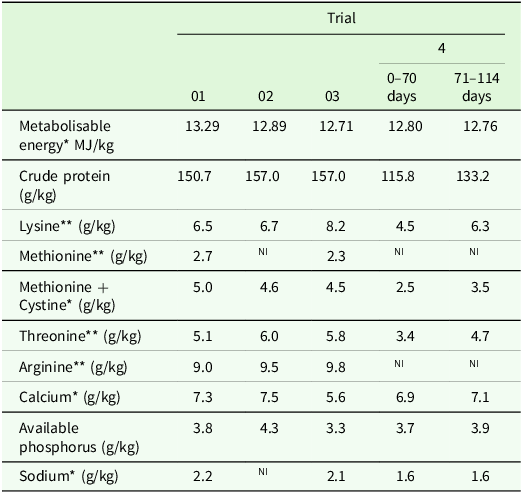
The treatments characterised by the different periods of arginine supplementation were defined to cover all stages of gestation of the sow (Rekiel et al., Reference Rekiel, Wiecek, Batorska and Kulisiewicz2014), and thus, it would be possible to identify the optimal time for amino acid supplementation as a function of the gestational phase. The feed was top-dressed with 1.0 % of L-arginine according to feed intake. The amino acid had a 98.5 % purity rating and was acquired from the Animal Nutrition Division of Ajinomoto of Brazil Indústria and Comércio of Alimentos Ltda, Limeira, São Paulo, Brazil. The gestation feed used in the experiments was adopted by the farms, a formulation of corn, soybean meal and wheat bran (Table 1). The diets were analysed for dry matter (DM), crude protein (CP) and mineral contents as described by AOAC (2012). Metabolisable energy and amino acid profile were estimated from the SIBNAS® (2020). Water was provided ad libitum throughout the experimental period.
Nutritional parameters of the feed provided to gestating sows in the control in each trial

*Analysed values from the SIBNAS® (2020); **Digestible amino acid values; NI Not informed.
The feeding management was different in each experiment. In experiment 01, sows received 1.8 kg/day of feed until 85 days of gestation; 3.0 kg/day from 86 to 107 days of gestation and 4.5 kg/day of feed from 108 days of gestation until farrowing. In experiment 02, sows received 1.8 kg/day of feed until 85 days of gestation and 2.4 kg/day from 86 days of gestation until parturition. In experiment 03, the sows received 2.0 kg/day of feed until 85 days of gestation; 2.8 kg/day from 86 to 107 days of gestation and 5.6 kg/day from 108 days of gestation until farrowing. In experiment 04, the sows received 2.3 kg/day of feed until 28 days of gestation; 1.9 kg/day of from 29 to 85 days of gestation; 2.8 kg/day of feed from 86 to 107 days of gestation and 2.6 kg/day of feed from 108 days of gestation until farrowing.
For data collection, all farrowing was assisted; at birth, the piglets were dried and weighed individually. The weight and number of stillborn piglets were evaluated to calculate total litter size, as well as average piglet weight at birth.
The weight variability of the piglets at birth in each litter (total piglets born and those born alive) was evaluated by calculation of the average litter weight, the standard deviation of the litter weight and the coefficient of variation of the litter weight. The total number of piglets born consisted of the sum of piglets born alive and stillborn piglets.
The weight variability of the piglets was analysed by descriptive analysis, Pearson correlation, analysis of variance, stratification in percentage of piglet weight at birth and fitting normal distribution for piglet weight at birth (Moreira et al., Reference Moreira, Mendes, Palencia, Lemes, Roque, Kutschenko, Ferreira and Abreu2020).
Descriptive analyses (including symmetry and kurtosis) for total piglets and piglets born alive were carried out in PROC UNIVARIATE of the SAS® software (SAS 9.3). Distribution was considered symmetric when the coefficient of symmetry was statically equal to zero; if the coefficient of symmetry was greater than zero, this distribution was considered asymmetric to the right and if it was less than zero, asymmetric to the left. Likewise, a distribution with a kurtosis coefficient equal to zero was considered mesokurtic; if the kurtosis coefficient was negative, it was platykurtic and if it was greater than zero, it was considered leptokurtic. Piglet weight distributions with probability values in the Shapiro–Wilk test greater than 5% were considered symmetrical.
Correlation analyses were obtained through PROC CORR of SAS® (SAS 9.3), considering the following variables: parity, litter size, average weight of piglets, standard deviation of piglet weight, coefficient of variation of litter and number of stillborn piglets (except for litters with all piglets born alive).
The normality test was conducted using the PROC UNIVARIATE for litter size, average weight, standard deviation of litter weight and coefficient of variation of litter. For probability values greater than 5 % in the Shapiro-Wilk test, the weight distribution was considered normal; otherwise, the PROC RANK procedure of the SAS® (SAS 9.3) was used for the standardisation of residues. Analysis of variance was performed using the PROC MIXED of SAS® (SAS 9.3), and the means were compared by the Tukey test (5 %). P between 5 and 10 % was considered a trend. The following model was used:

where
Y ikj = observations of the effects of 1.0 % of L-arginine i, replicate j, trial k and l litter size;
μ = overall average;
£ k = random effect of the trial;
Ȣl = random effect of the litter size;
Ǥ i = fixed effect of supplementation with 1.0 % of L-arginine;
β j = fixed effect of the supplementation period with 1.0 % of L-arginine;
(Ǥ x β) ij = interaction between supplementation of 1.0 % of L-arginine and supplementation period;
ε ijk = random error associated with each observation, considered independent and identically distributed under normal distribution with mean 0 and variance σ2.
The weight of the piglets in each litter was divided into seven classes: less than or equal to 800, from 801 to 1000, from 1001 to 1200, from 1201 to 1400, from 1401 to 1600, from 1601 to 1800 and greater than 1800 g. The criteria for the use of these classes were based on Bérard et al. (Reference Bérard, Kreuzer and Bee2010), who stated that piglets weighing less than 800 grams are considered as having retarded intrauterine growth, and Pettigrew et al. (Reference Pettigrew, Cornelius, Moser, Heeg, Hanke, Miller and Hagen1986), Roehe and Kalm (Reference Roehe and Kalm2000) and Quiniou et al. (Reference Quiniou, Dagorn and Gaudré2002), who stated that the probability of pre-weaning survival is reduced (below 75 %) for piglets weighing less than 1000 grams and exceeds 95 % for piglets weighing more than 1800 g.
According to the methodology proposed by Moreira et al. (Reference Moreira, Mendes, Palencia, Lemes, Roque, Kutschenko, Ferreira and Abreu2020), through the average and standard deviations of piglet weight (total piglets and piglets born alive), normal distribution charts were generated using Microsoft Office Excel® software (2007 version). To ensure 100 % of the data in the normal distribution, 3.01 standard deviations of the average in a 100-point graph was adopted, where the increment of each point was calculated, which is defined as
 $$\eqalign{ & {\rm{Increment}} = \;\left( {\bar x + \left[ {3.01 \times {\rm{deviation}}} \right]} \right) \cr & \quad \quad \quad \quad \quad - \;\left( {\bar x - \left[ {3.01 \times {\rm{deviation}}} \right]} \right)/100 - 1 \cr} $$
where
 $\bar x$
= mean piglet birth weight;
 ${\rm{deviation}}$
= standard deviation of mean piglet birth weight.
Subsequently, the probability of each weight in the normal distribution was calculated using the = DIST.NORM.N function within the range of means and 3.01 times the mean standard deviation. That way, it was possible to generate the graph in the ‘insert area chart’ option, with a dispersion option for each treatment. With the superposition of the normal distribution curves of piglet weights from sows supplemented or not with 1.0 % of L-arginine, the intersection points (weights) of these curves were determined and, therefore, probabilities of the areas representing the differences between the curves were calculated using the = DIST.NORM.N function. In addition, the equivalent weights at each curve were calculated through the =INV.NORM.N function using the probabilities found in the intersection points (weights).
Results
Descriptive analyses for total piglets and piglets born alive were carried, and the value of symmetry for the curve of the weight of total piglets (−0.07) and piglets born alive (−0.10) from sows that were not supplemented with 1.0 % of L-arginine exhibited (P > 0.05) negative symmetric distribution. However, for total piglets (−0.22) and piglets born alive (−0.22) from sows supplemented with 1.0 % of L-arginine exhibited (P<0.05) negative asymmetric distribution.
The kurtosis of weight for total piglets born in the control treatment (−0.03) and for piglets from sows supplemented with 1.0 % of L-arginine (−0.38) showed platykurtic kurtosis (negative values). For piglets born alive without amino acid supplementation, the kurtosis value was 0.08 (leptokurtic kurtosis). However, for piglets born alive from sows with supplementation, the kurtosis value was −0.37.
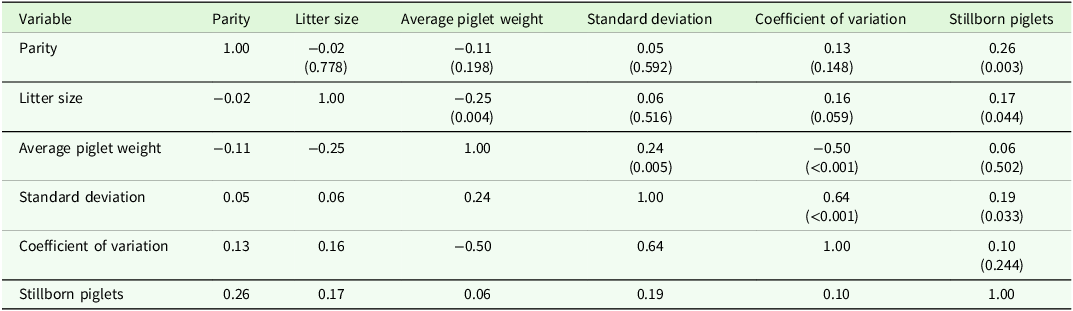
There is a positive (P<0.05) correlation between the number of stillborn piglets and the following variables: parity, litter size and standard deviation of the mean weight of total piglets born (Table 2). This parameter is important to differentiate results regarding piglets born alive and total piglets born.
Pearson correlation coefficients and P value between parenthesis among the productive variables of litters from total piglets born

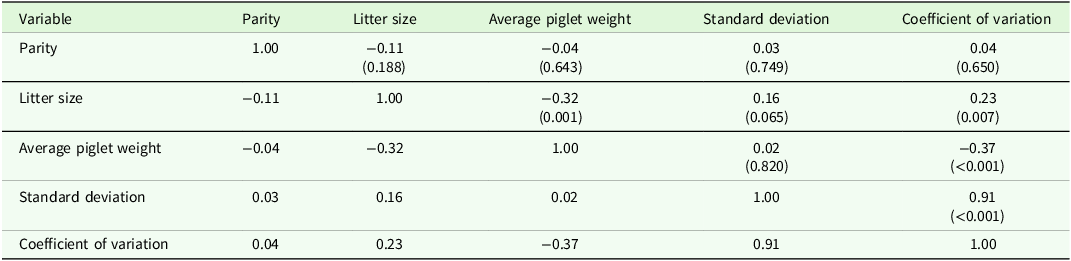
A positive correlation (P < 0.05) was found between the coefficient of variation and the standard deviation of the weight of total piglets born and a negative correlation between the coefficient of variation and the mean weight of piglets. A positive correlation (P < 0.05) was found between the standard deviation and the coefficient of variation of the total piglets born and a negative correlation between the coefficient of variation and the mean weight of piglets. There was a negative correlation (P < 0.05) between mean weight of piglets and litter size. A positive correlation of the coefficient of variation was observed with litter size and standard deviation and a negative correlation of the coefficient of variation with the mean weight of piglets (P < 0.05). There was a negative correlation (P < 0.05) between mean weight of piglets and litter size. There was a trend (P = 0.065) of correlation between the standard deviation and litter size (Table 3).
Pearson correlation coefficients and P value between parenthesis among the productive variables of litters from piglets born alive

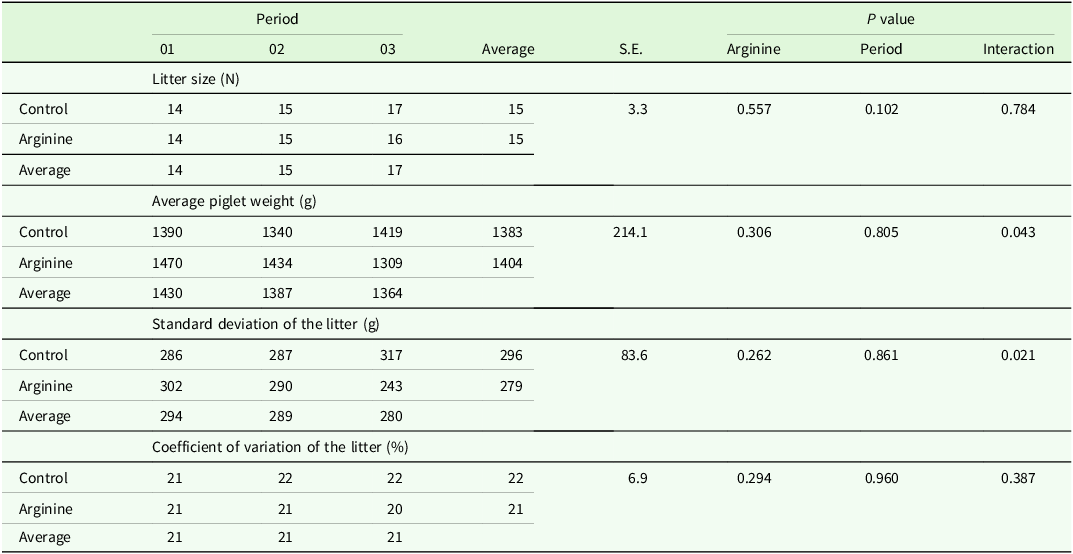
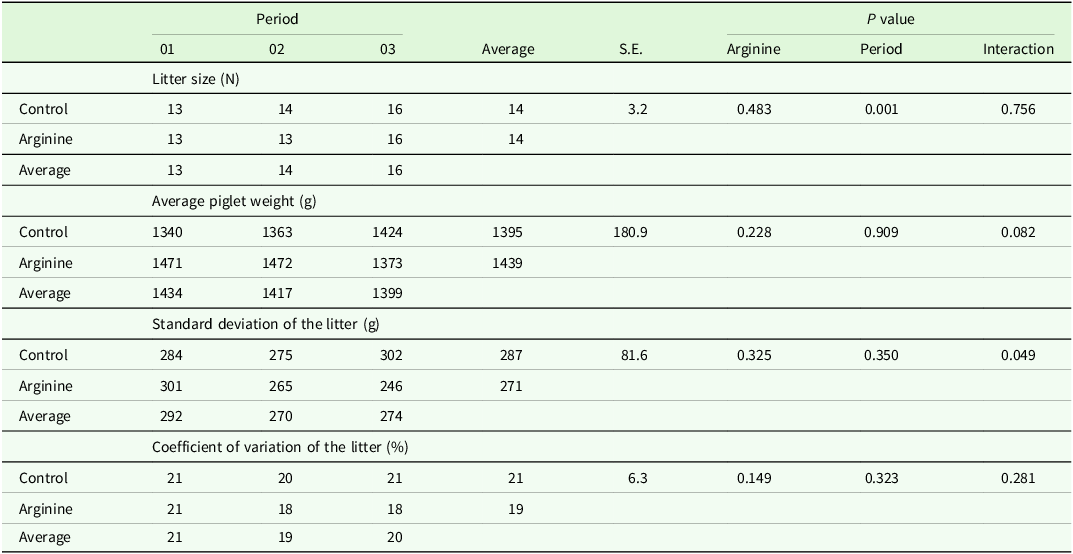
There was no interaction (P > 0.05) of supplementation with 1.0 % of L-arginine with the farrowing period in terms of litter size of piglets born alive and total piglets born. Supplementation with 1.0 % of L-arginine did not affect (P > 0.05) the litter size of piglets born alive or total piglets (Tables 4 and 5).
Litter size, average piglet weight, standard deviation and coefficient of variation of litters from total piglets born from sows supplemented or not with L-arginine at different periods of gestation

Averages with uppercase letters differ in the column by the Tukey test (5 %). Averages with lowercase letters differ from each other in the interaction of rows and columns by the Tukey test (5 %). Period 1: 1.0 % of L-arginine supplementation from day 25 to 53 of gestation; Period 2: 1.0 % of L-arginine supplementation from day 30 to day 60 and from day 80 of gestation to delivery; Period 3: 1.0 % of L-arginine supplementation from day 80 of gestation to delivery.
Litter size, average piglet weight, standard deviation and coefficient of variation of litters from piglets born alive from sows supplemented or not with L-arginine at different periods of gestation

Averages with uppercase letters differ in the column by the Tukey test (5 %). Averages with lowercase letters are different from each other in the interaction of rows and columns by the Tukey test (5 %). Averages with lowercase letters tend to differ from each other in the interaction of rows and columns by Tukey’s test (P between 5 and 10 %). Period 1: 1.0 % of L-arginine supplementation from day 25 to day 53 of gestation; Period 2: 1.0 % of L-arginine supplementation from day 30 to day 60 and from day 80 of gestation to delivery; Period 3: 1.0 % of L-arginine supplementation from day 80 of gestation to delivery.
There was interaction (P < 0.05) of the period of supplementation with 1.0 % of L-arginine and the average weight of the total piglets born, and a tendency (P=0.079) was shown for piglets born alive (Tables 4 and 5).
Supplementation with 1.0 % of L-arginine in period 1 increases (P<0.05) average litter weight compared to the control treatment in period 2 and compared to supplementation with 1.0 % of L-arginine in period 3 of total piglets born and piglets born alive (Tables 4 and 5). There was an interaction (P<0.05) between the periods of supplementation of 1.0 % of L-arginine and the standard deviation of the average litter weight of total piglets born. Supplementation with 1.0% of L-arginine reduced (P<0.05) standard deviation by 73.3 g (23.14 %) and 55.99 g (18.53 %) in period 3 for total piglets born. There was no interaction (P>0.05) of 1.0 % of L-arginine supplementation and the supplementation periods on the coefficient of variation of the litters from piglets born alive and total piglets born. There was likewise no effect of these factors separately (Tables 4 and 5).
Supplementation with 1.0 % of L-arginine reduced (P<0.05) the percentage of total piglets born and piglets born alive weighing less than 800 g by 2.26 and 2.05 percentage points, respectively. It increased (P<0.05) the percentage of total piglets born and piglets born alive with weight between 1601 and 1800 g by 5.89 and 6.08 percentage points, respectively (Figure 1).
Stratification in percentage of the weight of total piglets born (control: 69 litters, 1.0 % of L-arginine: 64 litters) and piglets born alive (control: 69 litters, 1.0 % of L-arginine: 64 litters).

Analysis of the probability distribution for piglet birthweight showed that L-arginine supplementation decreased the probability of weighing less than 1180 g by 4.12 percentage points for total piglets born and decreased the probability of weighing less than 1196 g by 4.99 percentage points for piglets born alive. Besides it, L-arginine increased the probability by 4.83 percentage points of total piglets born weighing between 1180 and 1893 g and 4.56 percentage points for piglets born alive weighing between 1196 and 1888 g. Concurrently, L-arginine reduced the probability of total born piglets weighing more than 1893 g by 0.72 percentage points and for piglets born alive weighing more than 1888 g L-arginine reduced the probability by 0.58 percentage points. From the sum of the differences of the areas calculated between the curves, for the total born, there was an improvement of 8.23 percentage points representing an increase of 80.27 g and for alive piglets born an increase of 7.98 percentage points representing 79.32 g (Figure 2).
Distribution of the weight probabilities of total piglets born (control: 69 litters, 1.0 % of L-arginine: 64 litters) and piglets born alive (control: 69 litters, 1.0 % of L-arginine: 64 litters).

Discussion
The symmetry of litter weight demonstrated that most of the piglets born (total or alive) are below the mean weight of their litter, regardless of supplementation with 1.0 % of L-arginine. Furthermore, the supplementation with 1.0 % L-arginine causes a flattening in the birth weight distribution curve of the piglets (Moreira et al., Reference Moreira, Mendes, Palencia, Lemes, Roque, Kutschenko, Ferreira and Abreu2020).
Different studies have evaluated birth weight in several ways: piglets born alive, total piglets born or both (Köck et al., Reference Köck, Fuerst-Waltl and Baumung2009; Koketsu et al., Reference Koketsu, Iida and Piñeiro2021); in some cases, these parameters are not reported separately. This description is important and should be provided because nutritional effects can be observed only in one of these categories, as observed by Gonçalves et al. (Reference Gonçalves, Gourley, Dritz, Tokach, Bello, De Rouchey, Woodworth and Goodband2016), who observed an effect only on piglets born alive upon comparing different concentrations of energy for gestating sows.
Parity influences the weight variability of the piglets born (Zotti et al., Reference Zotti, Resmini, Schutz, Volz, Milani, Bridi, Alfieri and Silva2017). In a trial conducted by Zindove et al. (Reference Zindove, Dzomba and Chimonyo2014), piglets born from primiparous sows showed lower weight variation. According to Ogawa et al. (Reference Ogawa, Konta, Kimata, Ishii, Uemoto and Satoh2019), parity has a positive correlation with the number of total piglets born and piglets born alive, percentage of stillbirths, mean litter weight and the coefficient of variation of these variables. Those results differ from the results found in this study, except for the correlation between parity and the number of stillborn piglets, probably due to the analysis in this study of sows with a parity interval between the second and seventh farrowing, whereas the author cited grouped parity differently from this study.
Quiniou et al. (Reference Quiniou, Dagorn and Gaudré2002), Quesnel et al. (Reference Quesnel, Brossard, Valancogne and Quiniou2008) and Zindove et al. (Reference Zindove, Dzomba and Chimonyo2014) likewise observed a positive correlation between the number of piglets born and the coefficient of variation of litter at birth. This can be explained by competition for space (nutrients) among the foetuses, causing birth weight variation.
The number of stillborn piglets is correlated with the coefficient of variation, according to Quesnel et al. (Reference Quesnel, Brossard, Valancogne and Quiniou2008), which, in turn, is related to litter size. In this study, there was no correlation with the coefficient of variation. However, there was a correlation with the standard deviation of the mean, which is also considered a measure of weight variability. Udomchanya et al. (Reference Udomchanya, Suwannutsiri, Sripantabut, Pruchayakul, Juthamanee, Nuntapaitoon and Tummaruk2019) also found a significant positive correlation between litter size and number of stillborn piglets. Canario et al. (Reference Canario, Cantoni, Le Bihan, Caritez, Bilion, Bidanel and Foulley2006) also found a correlation for these same parameters, similar to the result found in this study, which was 0.17. There is a negative correlation between litter size and average piglet weight at birth (Quiniou et al., Reference Quiniou, Dagorn and Gaudré2002; Wolf et al., Reference Wolf, Žáková and Groeneveld2008), which was also found for total piglets born and average weight of piglets born alive in this study.
There is only one report in the literature in which supplementation with 0.8% of L-arginine led to a smaller size of the litter (Li et al., Reference Li, Bazer, Johnson, Burghardt, Erikson, Frank, Spencer, Shinzato and Wu2010). However, in that study, supplementation occurred from 0 to 25 days of gestation, different from the periods evaluated in this study. When sows are supplemented with L-arginine from day 14 to day 28 of gestation, there is an improvement in embryo survival, so the number of piglets born is greater (Bérard and Bee, Reference Bérard and Bee2010). In another study, it was observed that foetal mortality is low in the final third of gestation (Town et al., Reference Town, Patterson, Pereira, Gourley and Foxcroft2005). Thus, supplementation with L-arginine in period 3 is not able to affect litter size (Quesnel et al., Reference Quesnel, Quiniou, Roy, Lottin, Boulot and Gondret2014).
Supplementation with 1.0 % of L-arginine in period 1 increased the weight of total piglets born compared to the control treatment in period 3 and period 2 with supplementation with L-arginine. Therefore, when sows were supplemented in period 3 (85 days from gestation to farrowing), the average piglet weight was lower in arginine treatments. Nevertheless, a smaller number of piglets was observed in period 1, which may have favoured this result. Dallanora et al. (Reference Dallanora, Marcon, Walter, Biondo, Bernardi, Wentz and Bortolozzo2017) observed a reduction in weight variability in litters of less than 14 piglets, which may explain the greater weight. However, supplementation with L-arginine did not increase the weight of piglets born alive, which corroborates the results of other authors (Che et al., Reference Che, Yang, Fang, Lin and Wu2013; Gao et al., Reference Gao, Jiang, Lin, Zheng, Zhou, Chen, Yang and Wu2012; Garbossa et al., Reference Garbossa, Júnior, Silveira, Faria, Schinckel, Abreu and Cantarelli2015), regardless of the amino acid supplementation period.
Supplementation of 1.0 % of L-arginine in period 3 reduced the standard deviation of the weight of total piglets born. There was also a tendency toward reduction in this same parameter for piglets born alive; however, no reduction in the coefficient of variation was observed. In contrast, Quesnel et al. (Reference Quesnel, Quiniou, Roy, Lottin, Boulot and Gondret2014) observed a reduction in the coefficient of variation with L-arginine. This effect can be explained through the placenta being the organ responsible for transporting nutrients, respiratory gases and products of metabolism between the maternal and foetal circulatory systems.
Placental development and vascular development are essential for foetal growth and development (Reynolds et al., Reference Reynolds, Borowicz, Vonnahme, Johnson, Grazul-Bilska, Redmer and Caton2005). Several authors have observed that the supply of nutrients and oxygen to the foetuses increases as nitric oxide increases in the uterine environment, improving the uterine capacity to nourish a larger number of foetuses adequately (Liu et al., Reference Liu, Wu, Yin, Liu, Geng, Yang, Blachier and Wu2012; Wu et al., Reference Wu, Jaeger, Bazer and Rhoads2004). Thus, L-arginine supplementation improves placental efficiency and foetal development (Quesnel et al., Reference Quesnel, Quiniou, Roy, Lottin, Boulot and Gondret2014). The most adequate period for supplementation would be in the final third of gestation, due to greater foetal growth, in which greater weight variation occurs (Ji et al., Reference Ji, Wu, Blanton and Kim2005).
In this study, no differences were observed in the coefficient of variation with supplementation with 1.0 % of L-arginine. Results likewise did not exhibit differences in Gao et al. (Reference Gao, Jiang, Lin, Zheng, Zhou, Chen, Yang and Wu2012) in litters with 12.46 piglets in the control treatment and 13.77 piglets with arginine supplementation; in Che et al. (Reference Che, Yang, Fang, Lin and Wu2013) in litters with 11.24 piglets in the control treatment and 11.37 piglets with arginine supplementation and in Dallanora et al. (Reference Dallanora, Marcon, Walter, Biondo, Bernardi, Wentz and Bortolozzo2017) in litters with 14.30 piglets in the control treatment and 13.30 piglets with arginine supplementation – studies with smaller litter sizes. However, results are different when sows have a greater number of piglets, as observed by Quesnel et al. (Reference Quesnel, Quiniou, Roy, Lottin, Boulot and Gondret2014) in litters with 15.10 piglets in the control treatment and 16.20 piglets with arginine supplementation.
Litter size has a negative correlation with standard deviation and the coefficient of variation of piglet birth weight (Quiniou et al., Reference Quiniou, Dagorn and Gaudré2002), which affected the proportion of piglets in each weight class in this study. Quesnel et al. (Reference Quesnel, Brossard, Valancogne and Quiniou2008) observed that the increase from 10 to 15 total piglets born is accompanied by an increase in the percentage of piglets with 1 kg. Adding the class with less than 800 g and up to 1000 g represents approximately 15 %. The minimum and maximum values observed for sows without supplementation of L-arginine were 12.89 and 15.83 %, respectively, in agreement with the results found by the author cited above. In this context, even with a greater number of piglets born, supplementation with 1.0 % of L-arginine reduced the proportion of piglets weighing less than 800 g for total piglets born and piglets born alive and increased the proportion of piglets born alive and total piglets born with weight between 1601 and 1800 g.
The effects of nutritional strategies on the weight variation of litters are rarely described (Van Den Brand et al., Reference Van Den Brand, Soede and Kemp2006). Similarly, there is not a standard form of analysis; for example, results of absolute values or percentage of piglets in different weight classes are observed. This lack of standardisation of analysis of piglet weight variability makes it difficult to compare the results found. Therefore, the use of normal distribution of piglet weight is an alternative for standardisation in this analysis, since it is possible to determine the weight or exact probability from the intersection of the curves (control and 1.0 % of L-arginine), showing the reader the benefits of reducing variability in a more precise manner (Moreira et al., Reference Moreira, Mendes, Palencia, Lemes, Roque, Kutschenko, Ferreira and Abreu2020).
Supplementation with 1.0 % of L-arginine decreases the percentage of piglets born with less than 1180 g (for total piglets born) and 1196 g (for piglets born alive). Piglets weighing less than 1100 g represented approximately one-fourth of the piglets born, which is close to the percentages reported by Wu et al. (Reference Wu, Bazer, Wallace and Spencer2006).
Foxcroft (Reference Foxcroft, Ball and Zijlstra2007) suggested that lightweight piglets born from smaller litters respond better to interventions in maternal nutrition, which reduces birth weight variation. According to Rehfeldt et al. (Reference Rehfeldt, Kuhn, Nürnberg, Kanitz, Schneider, Beyer, Nürnberg and Ender2001), this is shown by the effect of exogenous somatotropin at the beginning of gestation, which corroborates the results found in this study, in which supplementation with L-arginine was more efficient in litters with fewer than 16 piglets, as also observed by Quesnel et al. (Reference Quesnel, Quiniou, Roy, Lottin, Boulot and Gondret2014). They observed that the impact of supplementation with L-arginine in the final third of gestation on the coefficient of variation of birth weight was lower in litters that had more than or equal to 16 piglets compared with litters with fewer than 16 piglets.
The earlier the effects of weight variability at birth are minimised, the lower the chances of spreading the negative effects related to low birth weight of piglets. Birth weight variability has a direct impact on pre-weaning mortality (Fix et al., Reference Fix, Cassady, Holl, Herring, Culbertson and See2010), weight gain during lactation (Oliviero, Reference Oliviero2022), weaning weight (Škorput et al., Reference Škorput, Dujmović, Karolyi and Luković2018) and carcass quality (Zotti et al., Reference Zotti, Resmini, Schutz, Volz, Milani, Bridi, Alfieri and Silva2017). An additional advantage is a reduction in the number of adoptive sows, which are used to reduce the weight variability of litters (Quesnel et al., Reference Quesnel, Brossard, Valancogne and Quiniou2008).
Conclusion
Supplementation with 1.0 % of L-arginine for gestating sows improves litter uniformity, with an average reduction of 4.06 percentage points in the piglet population of less than 1180 g, in addition to an increase of 4.70 percentage points in the piglet population between 1180 and 1890 g. Period 1 provided the greatest increase in the average litter weight of total births, while Period 2 promoted an increase in the average weight of live-born piglets. Period 3, in turn, showed improved litter uniformity, both for total births and live-born piglets.
Acknowledgements
The authors want to acknowledge Conselho Nacional de Desenvolvimento Científico e Tecnológico (CNPq), Instituto Nacional de Ciência e Tecnologia de Ciência Animal (INCT-CA/CNPq), Fundação de Amparo à Pesquisa do Estado de Minas Gerais (FAPEMIG), Foundation for Research Support of Rio Grande do Norte (FAPERN) and Coordenação de Aperfeiçoamento de Pessoal de Nível Superior (CAPES) – cod. 001, for the scholarship granted to the first author and Ajinomoto Animal Nutrition. A special acknowledgement is dedicated to the beloved late researcher Dr. Fabyano Fonseca e Silva.
Author contributions
RHRM, CAPG, LSF and MDS collected the data for this study; RHRM and MLTA conducted the statistical analyses; RHRM and CAPG collaborated in the interpretation of the results; RHRM, CAPG, LSF and MDS wrote the initial draft of this manuscript; VSC, CAPG and MLTA developed the original hypotheses and designed the experiments; RHRM, PHSF, RAF, REMO and CMS collaborated in interpreting the results and finalised the manuscript. Both authors have read and approved the finalised manuscript.
Funding statement
This research received no specific grant from any funding agency, commercial or not-for-profit sectors.
Competing interests
The authors declare no conflicts of interest.
Ethical standards
All procedures were submitted and executed following the guidelines of the Ethics Committee on Animal Use (CEUA) of the Universidade Federal of Lavras, identified by protocols 76/2013, 99/2012, 62/2016 and 13/2014.