INTRODUCTION
Socioeconomic status (SES) is associated with variations in children's language comprehension by 9 months (Halle et al., Reference Halle, Forry, Hair, Perper, Wandner, Wessel and Vick2009) and production by 18 months (e.g. Fernald, Marchman & Weisleder, Reference Fernald, Marchman and Weisleder2013). While early differences may appear small, they gradually accumulate over time and are linked to sizable gaps, on average, in academic achievement between children from lower- and higher-SES backgrounds (Durham, Farkas, Hammer, Tomblin & Catts, Reference Durham, Farkas, Hammer, Tomblin and Catts2007; Farkas & Beron, Reference Farkas and Beron2004). Indeed, a substantial income-based achievement gap in language and literacy skills is already evident as early as kindergarten (Reardon, Reference Reardon, Murnane and Duncan2011). Prior research has focused primarily on understanding early SES differences in vocabulary development (Arriaga, Fenson, Cronan & Pethick, Reference Arriaga, Fenson, Cronan and Pethick1998; Hart & Risley, Reference Hart and Risley1995; Hoff, Reference Hoff2003; Rowe & Goldin-Meadow, Reference Rowe and Goldin-Meadow2009; Weisleder & Fernald, Reference Weisleder and Fernald2013). Yet importantly, SES differences are also evident in syntactic development (Huttenlocher, Vasilyeva, Cymerman & Levine, Reference Huttenlocher, Vasilyeva, Cymerman and Levine2002; Huttenlocher, Waterfall, Vasilyeva, Vevea & Hedges, Reference Huttenlocher, Waterfall, Vasilyeva, Vevea and Hedges2010), but less is known about their underlying causes. The current study adopts the test case of passive sentences to examine whether SES differences in a standardized measure of syntactic development are best explained by variations in the knowledge of a construction or in how efficiently children recruit this knowledge during comprehension.
SES differences in vocabulary are thought to emerge in part because of variations in the quantity and quality of communicative input that children are exposed to (Fernald & Marchman, Reference Fernald, Marchman, Arnon and Clark2011; Hart & Risley, Reference Hart and Risley1995; Hoff, Reference Hoff2003; Rowe, Reference Rowe2012; Weisleder & Fernald, Reference Weisleder and Fernald2013). There is also accumulating evidence that variations in the quantity and quality of syntactic information in caregivers’ input is associated with variations in children's syntactic development (Ambridge, Kidd, Rowland & Theakston, Reference Ambridge, Kidd, Rowland and Theakston2015), yet identifying mechanisms underlying these input effects is less straightforward (Newport, Gleitman & Gleitman, Reference Newport, Gleitman, Gleitman, Snow and Ferguson1977). Theories of language acquisition (e.g. levels and kinds; Ambridge et al., Reference Ambridge, Kidd, Rowland and Theakston2015), posit that frequency effects exist across multiple levels of acquisition from concrete effects (e.g. lexical items) to category effects (e.g. syntactic constructions). While isolating lexical effects can be relatively straightforward, pinpointing category effects is more difficult in part because constructions operate over syntactic categories rather than word tokens. For instance, a syntactic construction like the passive can appear across a variety of sentence frames, each containing different words and introducing distinct processing demands (e.g. the girl is hugged by the boy; she is hugged by him; the girl is kissed by him). Correctly interpreting passives not only relies on knowledge of the construction itself, but also involves recruiting processing resources. Unlike active constructions, successful comprehension of passives involves revising role assignments to determine who did what to whom within the construction (Huang, Zheng, Meng & Snedeker, Reference Huang, Zheng, Meng and Snedeker2013). Thus when SES differences in syntactic development emerge, it is unclear whether differences are driven by variations in knowledge of syntactic constructions per se, or processing factors associated with the recruitment of this knowledge.
Sources of individual differences in syntactic development
While traditional theories of syntactic development suggest children reach linguistic milestones at approximately the same time (e.g. Bloom, Reference Bloom1970), accumulating evidence suggests there are substantial individual differences in how much children know at a given age, as well as when they acquire such knowledge (Dollaghan et al., Reference Dollaghan, Campbell, Paradise, Feldman, Janosky, Pitcairn and Kurs-Lasky1999; Huttenlocher et al., Reference Huttenlocher, Vasilyeva, Cymerman and Levine2002; Huttenlocher et al., Reference Huttenlocher, Waterfall, Vasilyeva, Vevea and Hedges2010; Rescorla, Roberts & Dahlsgaard, Reference Rescorla, Roberts and Dahlsgaard1997). One source of these individual differences is in caregivers' input (Huttenlocher et al., Reference Huttenlocher, Waterfall, Vasilyeva, Vevea and Hedges2010). Research indicates that mothers’ use of verbs, questions, and diversity of copulas across sentence frames (e.g. this is a ball, there it is ) predicts the acquisition and production of these structures in children's speech later on (Furrow, Nelson & Benedict, Reference Furrow, Nelson and Benedict1979; Goodwin, Fein & Naigles, Reference Goodwin, Fein and Naigles2014; Hoff-Ginsberg, Reference Hoff-Ginsberg1986; Naigles & Hoff-Ginsberg, Reference Naigles and Hoff-Ginsberg1998; Newport et al., Reference Newport, Gleitman, Gleitman, Snow and Ferguson1977; Rispoli & Hadley, Reference Rispoli and Hadley2014; Rowland, Pine, Lieven & Theakston, Reference Rowland, Pine, Lieven and Theakston2003). Rowland and colleagues (Reference Rowland, Pine, Lieven and Theakston2003), for instance, have found that the order in which children acquire syntactic forms such as wh-questions can be predicted from the frequency in which these forms appear in caregivers’ input.
Though there is debate regarding the precise mechanisms involved in how children use input to acquire syntactic representations (Lidz & Gagliardi, Reference Lidz and Gagliardi2015), these findings suggest that input plays some role in explaining variation in syntactic development. These effects have direct relevance for SES-related differences in the development of syntax because of established, average differences in how parents from different SES backgrounds communicate with their children. For example, Huttenlocher and colleagues (Reference Huttenlocher, Waterfall, Vasilyeva, Vevea and Hedges2010) found that higher-SES mothers use a greater variety of syntactic structures such as wh-questions, relative clauses, adjectives, and modifiers than lower-SES mothers, on average. This work suggests that SES input effects contribute to differences in children's syntactic development, but reasons for these differences remain unclear. One possibility is that children from lower-SES backgrounds may simply fail to acquire certain structures such as passives due to their low frequency in the input. Therefore, SES differences in syntactic development may simply be a reflection of differences in how many syntactic representations children possess.
Yet in addition to acquiring the grammatical rules of their language, children must also effectively recruit this knowledge to understand the meanings of sentences (Trueswell, Sekerina, Hill & Logrip, Reference Trueswell, Sekerina, Hill and Logrip1999). Thus, it is also possible that SES differences in syntactic development result from variations in processes that allow children to efficiently recruit acquired knowledge during comprehension. Within the area of vocabulary development, Fernald and colleagues have shown that differences in vocabulary growth are best accounted for not by the number of words that children know but by the speed in which they recognize words from the speech stream (Fernald, Perfors & Marchman, Reference Fernald, Perfors and Marchman2006; Fernald, Pinto, Swingley, Weinberg & McRoberts, Reference Fernald, Pinto, Swingley, Weinberg and McRoberts1998). On average, 18-month-old children from lower-SES families are slower to recognize lexical items than their peers from higher-SES families (Fernald et al., Reference Fernald, Marchman and Weisleder2013), and these differences in turn explain SES differences in receptive vocabulary size at 24 months (Weisleder & Fernald, Reference Weisleder and Fernald2013). This work has made an important contribution to understanding the mechanisms for SES effects on vocabulary development and raises the possibility that a similar mechanism may be at play in explaining SES differences in syntactic development.
Recent research on children's syntactic processing has focused on the interpretation of temporarily ambiguous sentences such as (1a) and (1b) (Huang et al., Reference Huang, Zheng, Meng and Snedeker2013; Hurewitz, Brown-Schmidt, Thorpe, Gleitman & Trueswell, Reference Hurewitz, Brown-Schmidt, Thorpe, Gleitman and Trueswell2000; Trueswell et al., Reference Trueswell, Sekerina, Hill and Logrip1999):
-
(1)
-
a. active: The seal is quickly eating it.
-
b. passive: The seal is quickly eaten by it.
-
Young children have substantial difficulties understanding passives and often misinterpret them as actives (Huang et al., Reference Huang, Zheng, Meng and Snedeker2013; Stromswold, Eisenband, Norland & Ratzan, Reference Stromswold, Eisenband, Norland and Ratzan2002). While these errors are often thought to reflect children's failure to acquire low-frequency passives (Demuth, Reference Demuth1989), recent evidence suggests that they may instead result from challenges associated with processing syntactic knowledge during real-time comprehension (Huang et al., Reference Huang, Zheng, Meng and Snedeker2013). Since passives cannot be distinguished from actives until after the verb (e.g. eaten versus eating), it is initially unclear whether the first noun phrase (NP1) is an agent or theme (e.g. is the seal the predator or prey?). Furthermore, since actives occur more frequently than passives in the input (Demuth, Reference Demuth1989; Stromswold et al., Reference Stromswold, Eisenband, Norland and Ratzan2002), listeners initially misinterpret the NP1 of a passive as an agent. Critically, once they hear the past participle and the by-phrase, adults will correctly reanalyze NP1 to be the theme. Children, in contrast, often fail to do so.
In the present study, we ask whether an individual differences approach to understanding the comprehension of passives can help to reveal sources of SES differences in syntactic development. Recall that previous research has found SES differences in caregivers’ production of syntactic structures such as questions and relative clauses. Similar to passives, these constructions require listeners to interpret an argument displaced from its canonical position (Huttenlocher et al., Reference Huttenlocher, Waterfall, Vasilyeva, Vevea and Hedges2010). Over time, children from more advantaged backgrounds may encounter more complex syntactic structures in their input, leading to more efficient processing of these structures during comprehension. Using this logic, the present study investigates the extent to which syntactic revision is more successful in children from higher-SES backgrounds than their peers from lower-SES backgrounds, and if so, whether individual variation in this ability explains SES differences in broader syntactic development.
Current study
To measure comprehension of passives, the present study modified a task developed for Mandarin-speaking children (Huang et al., Reference Huang, Zheng, Meng and Snedeker2013) for English speakers. Children were asked to act out passive and active sentences, and their interpretations were measured based on actions produced with three thematically related objects: an expressed noun (seal), a likely agent (shark), and a likely theme (fish). In the Expressed NP1 condition (1a–b), the expressed noun (seal) is in the NP1 position. Thus, the grammatical role for the pronoun (it) in NP2 position is a theme (fish) for active sentences and an agent (shark) for passive sentences. Critically, in the Pronoun NP1 condition, we reduced the need for syntactic revision by switching the positions of the expressed noun and pronoun (2a–b). Previous research has shown that children are less likely to automatically interpret NP1 as an agent when it is a pronoun (Huang et al., Reference Huang, Zheng, Meng and Snedeker2013). For passives, this allows children to infer grammatical roles based on syntactic cues without revising a misinterpretation, and improves their comprehension of passives. In Pronoun NP1 trials, the pronoun is an agent (shark) for active sentences and a theme (fish) for passive sentences.
-
(2)
-
a. pronoun-active: It is quickly eating the seal.
-
b. pronoun-passive: It is quickly eaten by the seal.
-
Manipulating NP1 status allows us to determine the extent to which SES differences in syntactic development reflect variation in the knowledge of syntactic structures (passives) or the processes associated with accessing this knowledge (syntactic revision). If SES effects emerge because of differences in syntactic knowledge, then SES should be similarly associated with interpretations of passives in both the Expressed and Pronoun NP1 conditions. Moreover, performance in both conditions should explain SES effects on syntactic development. If however, effects emerge because of differences in syntactic processing, then SES differences should be magnified when comprehending passives requiring revision in the Expressed NP1 condition, and attenuated when passives do not require revision in the Pronoun NP1 condition. Further, the association between SES background and syntactic development should be accounted for specifically by children's performance with passives that require revision, not their general knowledge of passives.
METHOD
Participants
One hundred and three children participated in the present study. From this group, five children were excluded from the sample because the child was absent for the second testing session (n = 3), because of experimenter error during data collection (n = 1), or because the child's primary language was not English (n = 1). This resulted in a final sample of ninety-eight children (48 females, 50 males) with a mean age of 4;9 (SD = 0;9, range = 3;7 to 7;2). To obtain a sample of children from a wide range of SES backgrounds, we recruited children from Head Start Centers and private preschools within the Washington DC metropolitan area.
We measured SES as the parental education level and annual family income, collected from a demographic questionnaire filled out by parents. In the case that two parents of the same child reported different levels of education, the higher level was used. Categorical items were transformed for interpretation into years of education and income in US dollars. Parents averaged 14·8 years of education (SD = 2·53, range = 11–18) and had an average annual family income of $59,000 (SD = $36,936, range = < $15,000 – $90,000+). Since parental education and family income were positively associated (r = ·77, p < ·001), these variables were combined into a composite SES measure using principal components analysis, which weighted income and education equally and positively in the first component, and explained 88·6% of the original variance in the two measures. The composite was scaled such that the mean score was 0 with a standard deviation of 1. Thus scores above 0 indicate families with more years of parental education and higher reported annual income and scores below zero indicate fewer years of parental education and lower reported incomes. The average SES composite scores for the Expressed-NP1 condition (M = – 0·07; SD = 1·02) and the Pronoun-NP1 condition (M = 0·06; SD = 0·98) did not differ significantly (t = 0·70, p = ·49).
Procedure
For each child, passive- and active-sentence interpretations were measured during a first session. Syntactic development scores were obtained during a second session approximately one week later. All data were collected at the child's school.
Syntax
Syntax was measured using the Diagnostic Evaluation of Language Variation – Screening Test, Diagnostic Risk Status subtest (DELV-ST; Seymour, Roeper, De Villiers & De Villiers, Reference Seymour, Roeper, De Villiers and De Villiers2003). Items assessed children's understanding of syntactic structures such as wh-movement, auxiliary and copula forms, and possessive pronouns. Each of the eleven test items presented participants with a color photograph paired with a corresponding statement and prompt from the researcher. Children's verbal responses were scored according to an established criterion where a higher score reflects more errors. For ease of interpreting results, we reverse-coded this measure such that higher values reflect better performance. Possible scores ranged from 0 to 19.
Passive and active interpretations
Children sat facing a wooden podium with shelves containing sets of three toy-sized objects. Children were instructed to use these objects to act out sentences they heard, and their actions were videotaped for later coding. Each trial featured three object types: a likely agent (e.g. shark), likely theme (e.g. fish), and an expressed noun (e.g. seal). The experiment represented four cells of a 2 × 2 design (Table 1). The first factor, construction type, contrasted active versus passive sentences and was varied within subjects. The second factor, NP1 status, contrasted an expressed noun (e.g. the seal) versus pronoun (it) in the first subject position and was varied between subjects.
Example stimuli by condition

1 Expressed NP1 passives require syntactic revision.
For each object set, we constructed sentences such as (1a–b) and (2a–b). Each sentence contained a full noun (the seal), auxiliary and adverb (is quickly), main verb (eating or eaten by), and pronoun (it). Verbal morphology distinguished between actives (i.e. present progressive) and passives (i.e. past participle). Adverbs were embedded between NP1 and the verb to create a period of ambiguity in which role assignments could not be informed by the verb. Studies of adult sentence processing have shown that lengthening this ambiguity period strengthens a misanalysis (Tabor & Hutchins, Reference Tabor and Hutchins2000). Twelve critical trials were randomly presented with thirty-six filler sentences.
To quantify interpretations, research assistants coded videotapes of children's actions. To ensure reliability in coding, a second trained research assistant coded the actions of 25% of the sample. Percent agreement averaged 94·8% with a mean Cohen's kappa of .93. Correct actions were defined as those that depicted correct role assignments. For Expressed NP1-Passive and Pronoun NP1-Active trials, this referred to actions where likely agents did something to expressed items (e.g. making the shark eat the seal). For Expressed NP1-Active and Pronoun NP1-Passive trials, this referred to actions where expressed items did something to likely themes (e.g. making the seal eat the fish). Incorrect actions were defined as those indicating incorrect role assignments. For Expressed NP1-Passive and Pronoun NP1-Active trials, this referred to actions where expressed items did something to likely themes. For Expressed NP1-Active and Pronoun NP1-Passive trials, this referred to actions where likely agents did something to expressed items. Incorrect actions also involved ambiguous cases where the expressed items were selected with no additional object, or no object was selected at all.
Covariate
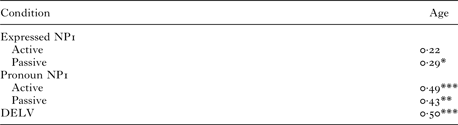
Given the wide age range of our sample, we included age as a covariate in all analyses. Child age was measured based on parent-report and is presented in months (e.g. 4 years as 48 months). Table 2 displays correlations between age, passive interpretations, active interpretations, and DELV scores.
Bivariate correlations between age and dependent measures

notes: * p < ·05; ** p < ·01; *** p < ·001.
RESULTS
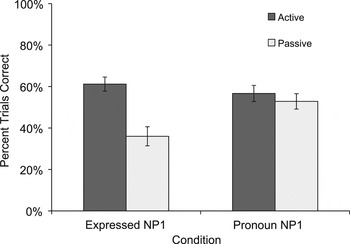
Scores on the DELV averaged 11·00 (SD = 4·89), and the range of scores fell across the entire scale (Range = 0–19). Moreover, scores did not differ between children in the Expressed NP1 (M = 11·25; SD = 4·77) and Pronoun NP1 condition (M = 10·76; SD = 5·05) (p > ·05). A two-way mixed ANOVA with one between-subjects factor (Construction: Active vs. Passive) and one within-subjects factor (Condition: Expressed vs. Pronoun NP1) was then conducted to compare children's interpretations. This analysis revealed a significant condition by construction interaction (F(3,95) = 12·81, p < ·001). As illustrated in Figure 1, children's active interpretations in the Expressed NP1 condition were more accurate than passive interpretations (Active: M = 62·0%; SD = 24·8%; Passive: M = 36·0%; SD = 33·3%) (t = 5·61, p < ·001). However, in the Pronoun NP1 condition, accuracy was similar across construction type (Active: M = 56·7%; SD = 26·9%; Passive: M = 52·8%; SD = 25·9%) (t = 1·09, p = ·28).Footnote 1 This is consistent with prior work showing that children's difficulties with syntactic revision lead to difficulties in interpreting passives (Huang et al., Reference Huang, Zheng, Meng and Snedeker2013) and temporarily ambiguous sentences more generally (e.g. Hurewitz et al., Reference Hurewitz, Brown-Schmidt, Thorpe, Gleitman and Trueswell2000; Trueswell et al., Reference Trueswell, Sekerina, Hill and Logrip1999).
Children's actions following active and passive trials in Expressed and Pronoun NP1 conditions (N = 98). Whereas active and passive comprehension was similar in the Pronoun NP1 condition, comprehension of passives was significantly lower than actives in the Expressed NP1 condition.

Explaining the relation between SES and syntax
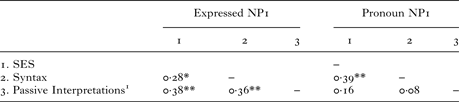
Across the entire sample, SES was positively associated with children's scores on the DELV (r = ·38, p < ·001). This significant relation held after controlling for the child's age (r = ·34, p = ·001). To explore underlying mechanisms associated with SES effects on syntax, our next set of analyses examined associations between (1) SES and passive interpretations and (2) passive interpretations and standardized syntax (DELV) scores (Table 3). We compared these associations for contexts that do and do not require syntactic revision (Expressed and Pronoun NP1 conditions, respectively). Partial correlations controlled for age and performance on active trials, the latter of which was not associated with SES (p > ·05). While task demands are similar for active and passive trials (e.g. co-referencing of pronoun, use of plausibility information from the discourse), active sentences are high in frequency and do not require syntactic revision. Thus, controlling for these trials isolates the specific challenges associated with passive interpretations.
Partial correlations between SES, DELV (syntax) scores, and passive interpretations (N = 98)

notes: * p < ·05; ** p < ·01; 1 Correlations controlling for age and active sentence interpretations.
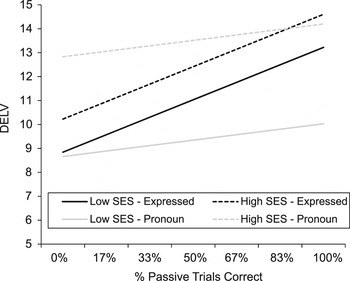
Partial correlations indicate that within the Expressed NP1 condition, SES was positively associated with passive interpretations (r = ·38, p = ·01). Further, passive interpretations were significantly and positively associated with performance on the DELV (r = ·37, p = ·01). In contrast, no significant relation was observed between SES and passive interpretations in the pronoun NP1 condition (r = ·16, p = ·26). There was also no significant association between children's passive interpretations and their DELV performance in this condition (r = ·08, p = ·59). Figure 2 displays the stronger relation between passive interpretations and DELV scores in the Expressed NP1 condition compared to the Pronoun NP1 condition for both children from lower- and higher-SES backgrounds (10th vs. 90th percentile of SES measure). Thus, SES relates to passive interpretations only when syntactic revision is required. Similarly, variation in interpreting passives in this context is uniquely associated with performance on the DELV.
Effect of passive interpretations on DELV scores, controlling for active interpretations and age (N = 98). Solid black line represents estimated effect for child assigned to the Expressed NP1 condition whose family SES is at the 10th percentile of the sample. Solid grey line represents similar effect for child assigned to the Pronoun NP1 condition. Dashed black line represents estimated effect for child assigned to the Expressed NP1 condition whose family SES is at the 90th percentile. Dashed grey line represents similar effect for child assigned to the Pronoun NP1 condition.

As a final step, we focused on the significant relations found in the Expressed NP1 condition and fit a series of regression models to examine whether passive interpretations that require syntactic revision mediated the relation between SES and DELV performance. As covariates, we again included age and active interpretations. The four mediation assumptions (Baron & Kenney, Reference Baron and Kenny1986) were met in our data: (1) the predictor variable (SES) related to the outcome variable (DELV) (β = ·23, p = .05); (2) the predictor variable (SES) related to the mediating variable (passive interpretations) (β = ·35, p = .01); (3) the mediating variable (passive interpretations) related to the outcome variable (DELV) (β = ·27, p = ·04); and (4) the relation between the predictor and outcome variable reduced significantly after including the mediating variable into the model. Bootstrapping procedures to test the significance of the indirect effect gave a 95% confidence interval of .06 to 1·09. This interval does not include zero, thus syntactic revision is a significant mediator of the relation between SES and children's syntax scores.
DISCUSSION
The current study explored possible explanations for SES differences in preschoolers’ syntactic development and yielded two major findings. First, consistent with prior research (Dollaghan et al., Reference Dollaghan, Campbell, Paradise, Feldman, Janosky, Pitcairn and Kurs-Lasky1999; Huttenlocher et al., Reference Huttenlocher, Vasilyeva, Cymerman and Levine2002; Huttenlocher et al., Reference Huttenlocher, Waterfall, Vasilyeva, Vevea and Hedges2010; Rescorla et al., Reference Rescorla, Roberts and Dahlsgaard1997), we found that, on average and controlling for age, children from higher-SES backgrounds have more advanced syntactic development as measured on the DELV than children from lower-SES backgrounds, and that syntactic revision partially explains these SES differences. Specifically, our results suggest that these SES differences may not result from a lack of knowledge of syntactic constructions, but rather from the ability to recruit this knowledge effectively. When syntactic revision of passives was required, children from higher-SES backgrounds were more successful at interpreting these structures compared to their peers from lower-SES backgrounds. Critically, however, when the need for syntactic revision was removed – in the case of Pronoun NP1 passives – children from lower-SES backgrounds performed equally as well as children from higher-SES backgrounds.
Children's comprehension of passives yields patterns that complement both traditional theories of syntactic acquisition (Bloom, Reference Bloom1970) as well as more recent work on individual learner differences (Ambridge et al., Reference Ambridge, Kidd, Rowland and Theakston2015; Huttenlocher et al., Reference Huttenlocher, Vasilyeva, Cymerman and Levine2002; Huttenlocher et al., Reference Huttenlocher, Waterfall, Vasilyeva, Vevea and Hedges2010; Weisleder & Fernald, Reference Weisleder and Fernald2013). All children in our sample demonstrated knowledge of the passive when processing demands were minimal, supporting theories that most typically developing children acquire syntactic constructions across similar timescales. Where we saw significant SES differences, however, was when the processing demands associated with accessing this knowledge were elevated, specifically when successful comprehension required syntactic revision. Performance in this context suggests that one source of individual differences within language development may lie in the mechanisms supporting efficient processing of spoken utterances (Lidz & Gagliardi, Reference Lidz and Gagliardi2015; Weisleder & Fernald, Reference Weisleder and Fernald2013). Indeed, we saw that individual differences in syntactic revision explained, or statistically mediated, the relation between SES and a standardized measure of syntactic development. Just as SES differences in the recognition of known vocabulary words relates to lexical development (Fernald et al., Reference Fernald, Marchman and Weisleder2013; Weisleder & Fernald, Reference Weisleder and Fernald2013), we found that variations in the recruitment of complex syntactic structures is associated with broader measures of syntactic development.
Our results raise the challenging question of why children from lower-SES backgrounds who understand passives under certain circumstances (when revision is not needed) nevertheless demonstrate difficulties recruiting this knowledge under other circumstances (when revision is needed). While prior accounts of developmental syntactic revision have focused on effects of age-related differences in general cognitive abilities (e.g. inhibitory control; Novick, Trueswell & Thompson-Schill, Reference Novick, Trueswell and Thompson-Schill2005), our results allude to a seemingly more influential factor: language experience. Variations along this dimension influence comprehension strategies in adults (Macdonald, Reference MacDonald2013), and these effects are likely to be even greater in less experienced language users such as children. However, our findings are limited to average differences across SES and thus do not speak to the specific input properties that may be responsible for such variation in outcomes. Since full passives make up less than 1% of child-directed speech (Gordon & Chafetz, Reference Gordon and Chafetz1990; Stromswold et al., Reference Stromswold, Eisenband, Norland and Ratzan2002), it is unlikely that hearing this construction alone serves as the basis for successful syntactic revision. Nevertheless, children may be sensitive to other structures with similar processing demands, such as argument movement in wh-questions. These non-canonical constructions are frequent in child-directed speech and show substantial SES variations (Huttenlocher et al., Reference Huttenlocher, Waterfall, Vasilyeva, Vevea and Hedges2010). Future studies examining the input properties that promote syntactic revision will help address questions of how processing mechanisms mediate effects of input on variable outcomes.
In sum, the recent attention to the average income ‘language-gap’ often emphasizes the lack of knowledge that children from lower-SES backgrounds possess relative to their more advantaged peers. However, the data presented here suggest a different message: SES differences may lie more in the efficiency with which children recruit knowledge during comprehension than in their general syntactic knowledge. In order to understand why we see variability in this area, we must first understand more about what kind of experiences are useful in honing language processing strategies. As SES differences in language development have consequences for later academic success (e.g. Farkas & Beron, Reference Farkas and Beron2004), it is vital for future research to further uncover the mechanisms underlying SES differences in language skills.