In her recent study of the heritage project that is contemporary New Orleans, anthropologist Shanon Dawdy has suggested that “[s]ociety presents itself simultaneously as a ruin and as a kind of playland” (2016, 147). This notion that the ruin is both a product of, and a basis for, heritage practice serves as a useful intervention into long-standing treatments of ruins as exotic, romantic, and awaiting the discovery, glorification, and preservation of those that might give them meaning. In the present essay, I further challenge heritage approaches to ruins through an examination of the ways in which they have been associated, in various Muslim cultural contexts, with a set of distinctly sentient, yet non-human actors, the jinn. This pairing between place and spirits has shaped long-standing affective responses and practical engagements between local (human) inhabitants and their archaeologically rich landscapes across the Middle East and North Africa. This essay examines how those engagements often push against contemporary discourses highlighting the sublime aspects of ruins and the quasi-sacred nature of heritage. To that end, the following guiding questions structure my contribution: Can contemporary heritage discourses accommodate practices in which humans share control and ownership of the material past with spectral others? How might we reframe the mandate to preserve such ruins in light of alternative perspectives that mark these sites as sinister, and/or meaningful, precisely because of their ruination? Can universalizing heritage discourses accommodate practices that derive value from the material past without also subscribing to explicit preservationist goals? Such questions offer an opportunity to consider the inclusion of the Unseen, and perhaps others, whose perspectives have gone unrecognized, within professional heritage management and its hermeneutics of the past.
To be clear, I am not interested in whether or not the jinn truly exist. For many Muslims (and non-Muslims as well) their reality is, however, firmly grounded in Qurʾanic revelation. While this may pose discomfort for some readers in our current secular age of reason, Latour's mantra that “we have never been modern” may give cover for temporarily suspending disbelief in the Unseen without shame or embarrassment. In order to align scholarly consideration of the jinn with how Muslim scholars have treated their interactions with human beings, consider them not as imaginary, but as Amira El-Zein argues, as “imaginal” (2009, 5–9). In drawing on the French philosopher Henry Corbin, she distinguishes between that which is merely fantastical and utopian, and that whose existence is potentially real, albeit in a realm to which most humans have little or no substantial access. Such a starting point allows for the possibility, at least, to explore how actual people (past and present) envision the ways jinn intersect with the material world, particularly ruins. We might then ask: Should we recognize that jinn (and perhaps other associated sentient beings of the imaginal realm) have a stake in the transformation of ruins into heritage? If so, how should we—as those invested in discourses and practices that seek to both learn from and preserve the material record of the past—account for the jinn in our approaches to heritage? Can we acknowledge and respect the Unseen—as broadly construed as might befit varied cultural contexts—as a creative force in the heritage process, despite our own disbelief in either its very existence, or its ability to influence the material realm?
In the tradition of many entertaining and enlightening stories I will offer an episode in the life of King Solomon (Sulaymān) as an entry into the production of ruins and their potential for transformation into heritage. Here I draw on his hagiography from within a Muslim context, whose lore has many connections with the realm of the unseen. King Solomon is well attested in both the Qurʾan and later exegetical works to have exerted control over legions of jinn, and, in some accounts, to have enslaved them and used them to build his many great works, including the great temple.
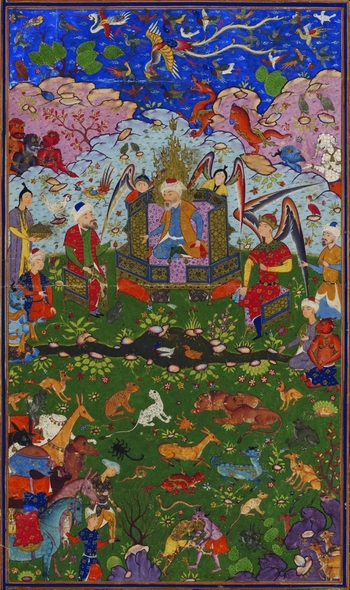
The legends of Solomon and his jinn are recounted in the Qurʾan itself [for example 34.12–15] and offer a glimpse into the importance of these beings of smokeless fire, not only for enlivening the stories of ruins, but also for their very construction and later destruction (see figure 1). The scriptural account of Solomon and the jinn is further enhanced and explained by the Palestinian scholar Tewfik Canaan in his early twentieth century work on Muslim sanctuaries in Palestine when he elucidates why villagers often associate the carob tree with the existence of jinn. Solomon, they report, was warned that the carob plant (al-kharrūb) was destined to “destroy thy works” (1927, 37–38).Footnote 1 Indeed, the Queen of Sheba once challenged Solomon to thread a bead with a spiral hole. The wise king enlisted a worm to guide the thread and allow the king to earn his reward. The worm too, was granted its own remuneration and permitted to take up residence in a carob tree that would become the Prophet's very own kharrūb wood staff. As was his custom, King Solomon spent much of his waning days, cane in hand, overseeing his enslaved jinn as they toiled in the construction of his monuments. Eventually, he would die, still standing in observation of their toil, the weight of his corpse supported upon that length of carob. Then, after forty years, the worm-ridden staff finally gave way and the king, unceremoniously, collapsed. With their oppressor now prostrate on the ground the jinn seized their chance to suspend their drudgery.
King Solomon enthroned with angels, beasts and jinn. Illustrated folio from a manuscript of the Shahnama by Firdawsi. Unknown artist. Harvard University Art Museums/Arthur M. Sackler Museum, The Norma Jean Calderwood Collection of Islamic Art, 2002.50.37.

What are we to make of this particular evidence, even if we are to bracket any psychological profile the prophetic persecutor of these imaginal beings? These tales connect the jinn, intimately and actively, with both the production of monuments and their ultimate ruination. Further, their intersection with the material world is linked to both the artificial and the natural. As Canaan relates, Palestinian peasants associated both the carob trees and stone piles (rujm, likely burial tumuli) that dotted their landscape as potential habitations for the jinn (1927, 73). These landmarks operated in the community as charged places, usually considered dangerous, yet potentially powerful if properly handled.
There are further lines of evidence that strengthen the association of the jinn with a ruin-filled archaeological landscape, particularly that of various pre-Islamic civilizations. Multiple accounts of the Prophet Muhammad relate that, in his travels through the Hijaz, he would scrupulously avoid the ruins of al-Hijr (Madaʾin Saleh), as it was understood to be the traces (āthār) of those people of Thamūd so chastised in the Qurʾan. The Prophet warned his companions that those ruins were inhabited by jinn and therefore unsafe. Similar accounts suggest that the still-lost site of Ubar (associated with the ʿAd tribe and Iram Dhāt al-ʿImad in the Qurʾan) was the abode of many jinn who protected its secrets and treasures (Lebling Reference Lebling2010; 65–69; Hamdani Reference Hamdani, al-Haik and Faris1938, 69–71).
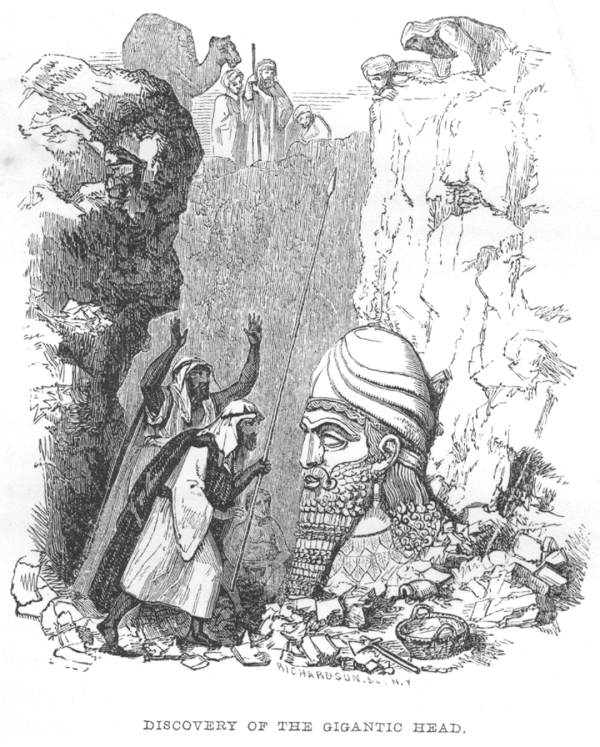
By considering these associations we might better contextualize the reactions of the British explorer/archaeologist Austen Henry Layard's (d. 1894) local workforce upon their discovery of a lamasu (human-headed winged-lion) sculpture during his excavations at Nimrud. Layard recounts: “I was not surprised that the Arabs had been amazed and terrified at this apparition. It required no stretch of the imagination to conjure up the most strange fancies” (1849, 73). By this he means the jinn, or rather what he describes as “those fearful beings which are pictured in the traditions of the country, as appearing to mortals, slowly ascending from the regions below.” After a careful inspection, Layard reports that the local shaykh would claim that the figure was “not the work of men's hands. . .but of those infidel giants of whom the Prophet. . .has said they were higher than the tallest date tree” (1849, 73). The British explorer would capture their collective amazement and trepidation at this materialization of the Unseen realm in an engraving that illustrated the moment of discovery (see figure 2).
“Discovery of the Gigantic Head” during excavations at Nineveh (Layard Reference Layard1849, 72).

Such an encounter deserves further contextualization with respect to the fabled relationship of jinn with treasure, made explicit and practical in the genre of medieval treasure hunting manuals. These get-rich-quick handbooks supported a whole industry of practitioners, known in Egypt as mutalibūn, who would be officially organized, as early as the ninth century CE, into a guild with their own governmentally appointed supervisor (Daly Reference Daly2005, 31–38). This early effort by a Muslim polity to assert the authority of the state over the past and its antiquities was largely in response to their potential financial value (Straughn Reference Straughn2017). By the late-nineteenth century, concern with these practices would face a new regime of control following the emergence of the modern Egyptian Antiquities Service. The French Egyptologist Gaston Maspero (d. 1916) would suggest that his Egyptian colleague, Ahmad Kamal (d. 1923), edit and publish one of the more well-known manuals to demystify such beliefs, and quell some of the more destructive approaches to the monuments. The result was the production of both an Arabic edition and French translation of Kitāb al-Durr al-Maknūz wa al-Sirr al-Ma'zūz fi al-Dala'il wa al-Khabaya wa al-Dafa'in wa al-Kunūz. Leaving aside the success of Kamal's larger project to change the behavior of his compatriots by cultivating respect for a national archaeological patrimony and its preservation, one extraordinary aspect of this volume was that it included a separate index for all the jinn mentioned in the text: 315 in total (Kamal Reference Kamal1907, 249–51). With names like: Kartoush, Qabaqib, Tashoush and Tashloush, Aqshamqesh, and Zibaal—he provides an impressive and intimidating phalanx of imaginal beings with whom Egyptians have shared their archaeological heritage, and have perhaps employed in its exploration and exploitation.
But does it matter to the practices of contemporary heritage whether these, or other jinn, have taken up residence in any number of ruins, particularly when they become recast as archaeological sites of national or global importance? Consider one account of a man who, when urinating on a ruined ashlar, became possessed by a truly “pissed-off” jinn for having had his home defiled (Lebling Reference Lebling2010, 74). These are beings that can drive one mad, literally majnūn. Footnote 2 Might archaeologists and other heritage professionals think twice when disturbing and appropriating their haunts and preserves? Is there a way to respect the rights of the Unseen to inhabit their ruined dwelling places? Or even an ethical imperative to do so? Consider, as well, that activities which employ the jinn in the search for antiquities and treasure have not completely disappeared. The Palestinian scholar Salah Al-Houdalieh (Reference Al-Houdalieh2012) has recently conducted a remarkable study of some seventy-three illicit excavators in the Occupied Palestinian National Territories (OPNT) who employ those able to communicate with various jinn with knowledge of locations that might yield valuable antiquities. While there is considerable debate among these individuals regarding the efficacy of jinn assistance, they were, nevertheless, convinced that jinn served as protectors of such treasures (Al-Houdalieh Reference Al-Houdalieh2012, 126). Any failure in the quest was attributed to these beings as either too powerful or fundamentally deceitful. In such cases, perhaps heritage professionals owe a debt of gratitude to the jinn for safeguarding the past from those who might seek to loot it.
A recent movement within archaeological thought has sought to embrace the role of non-human actors as a means to break with the humanocentrism and Cartesian dualism at the ontological core of post-Enlightenment hermeneutics of the past (for an overview of this “symmetrical archaeology,” see Olsen and Witmore Reference Olsen and Witmore2015). My goal in exploring the relationship of the jinn to the material realm of ruins is far more modest. Heritage discourses and practices have an opportunity, if not an obligation, to engage with the imaginal realm, despite its potential to disrupt the narrative of the ruin's transcendent qualities in giving meaning to the past in the present. I argue that the inclusion of the jinn—as well as ghosts, spirits, and other inhabitants of imaginal realms—is compelling, not only for the stories we can tell, but also as an ethical stance, a position of humility in the face of the Unseen and the potentially unknown. My hope is that should heritage practitioners embrace the jinn in acts of preservation, knowledge production, and meaning making with respect to such ruins, the stage will be set for the inclusion of other marginalized voices in shaping a future for the past.