OCAD University acknowledges the ancestral and traditional territories of the Mississaugas of the Credit, the Haudenosaunee, the Anishinaabe and the Huron-Wendat, who are the original owners and custodians of the land on which we stand and create.
This land acknowledgement used at OCAD University commemorates and celebrates the treaties signed with First Nations people in Toronto that allow all in the city, both Indigenous and settler populations, to benefit from the beauty and bounty of the land we all call home.
The School of Interdisciplinary Studies at OCAD University offers an Indigenous Visual Culture (INVC) program that leads to a Bachelor of Fine Arts degree or an interdisciplinary minor. The curriculum combines courses in the cultural, social, political and visual history of Indigenous peoples, preparing students to engage in global discourses in contemporary art practice through a range of expressions, materials and media.Footnote 1 These goals are achieved through the deceptively simple strategy of learning how to tell stories.
In this spirit, a story will be offered on the development of models for research and student evaluation that emerged from traditional information literacy concepts informed and transformed by Indigenous knowledge as expressed through Anishinaabeg teachings.Footnote 2 Although this story chronicles one individual instruction session, it highlights how decolonisation, as Indigenous scholars Marisa Elena Duarte and Miranda Belgarde-Lewis claim, is ‘knowledge work.’Footnote 3
A narrative framework will be used to present an information literacy session for the course IVCL 3001, History of the Métis,Footnote 4 first from the perspective of Daniel Payne, who is from the Canadian settler population. Then tenure-track assistant professor Howard Munroe, a member of the Métis Indigenous nation, will present an evaluation model that creates a learning ecology with his students. Finally, students will present visual story-telling through an exhibition of selected works accompanied by artists statements in their own words.
For inspiration we look to the Anishinaabeg concept of w'daeb-awae: truth as it is ‘perceived by the speaker.’ Anishinaabe theorist, historian and linguist Basil H. Johnston describes this as a philosophical acknowledgment that ‘the speaker casts his words and his voice only as far as his vocabulary and his perception will enable him.’Footnote 5
Story-telling
At the centre of the Indigenous Visual Culture programming is the understanding that story-telling forms the foundation not only of social relationships and human perception, but shapes ‘material reality.’Footnote 6 Such understandings have resonances in many cultures; narrative tropes such as myths, allegories, analogies, aphorisms, parables are frequently used to illuminate deeper meanings of perceived reality. Yet in many Indigenous epistemologies, stories move beyond metaphor to become a conceptual ‘prefix’ to all understanding of the world, demonstrating principles necessary for life.Footnote 7
Compellingly, contemporary research in both visual studies and cognitive sciences have converged in support for such perspectives. Art historian Gordon Hughes, in referencing Rosalind Krauss's book Optical Unconscious, asks the question,
How does the two-dimensional retinal image become the three-dimensional experience of everyday vision? … the retinal information of the eye is coupled in the brain with experiential memory, so that in the act of visual perception we are always combining what we know with what we see … Our understanding is correlative to our perception; we must seek to see.Footnote 8
Cognitive scientist and philosopher, Zenin Pylynshin affirms this observation:
There is now considerable evidence that we visually encode very little in a visual scene unless we explicitly attend to the items in question, and that we do that only if our attention or gaze is attracted to it … It is you alone who controls your image.Footnote 9
In short, we seek to see based on the stories we are told about what we should seek to see. Such empirical evidence for realisations that are traditionally known in Indigenous communities might be best enunciated by OCAD University faculty member Dr. James Miller of Indigenous Hawaiian and Japanese ancestry: in a recent INVC learning circle, titled Knowledge Givers 2.0, he noted, ‘the more “advanced” Western-European science becomes, the closer it approaches Indigenous knowledge systems.’Footnote 10
Of primary concern in exploring Indigenous knowledge lies the risk of cultural appropriation; Duarte and Belgarde-Lewis, however, offer the theoretical model of ‘imagining’ as a means of communicating between cultural traditions. They challenge people to ‘step outside of the normative expectations' of Western-European research methodologies by imaging alternate modes of reasoning and ontologies:
Non-Indigenous epistemic partners will want to step outside their comfort zone, sensitize themselves to Indigenous histories and political realities, learn to listen in new ways, and position themselves as followers in collaborative projects with Indigenous specialists leading the way.Footnote 11
A similar imagining ethos has permeated the curriculum at OCAD University with the adoption of an academic plan, Transforming Student Experience, that presents six founding principles, the first of which is decolonisation. In presenting the four priorities that seek to integrate founding principles into the curriculum, the first rubric prioritises Indigenous education.Footnote 12 Recently, the university's Faculty Curriculum Development Centre has produced a set of Indigenous learning outcomes that will soon be published as a guide for instructors seeking to decolonise syllabi or course outlines.
Information literacy as story-telling: Daniel Payne as narrator
The back-story: Learning outcomes as story-telling
During the fourth week of the winter 2020 term, Métis Indigenous Visual Culture instructor Howard Munroe sat down at the reference desk at the OCAD University Library and expressed concern at the research materials students were sourcing for his course IVCL 3001, History of the Métis. He felt that the information being collected lacked depth of focus, offering only a mundane, literal approach to their research topics. In an informal survey of students, he found that few were actively using the library's collection. An annotated bibliography assignment was approaching that revolved around researching a primary document, object or personage from Métis culture. This research material would serve as the foundation for a research paper, which would then inform a final art or design project that required students to express ‘understanding of the past, present and future of Métis knowledge, culture, heritage, and society.’
To prepare for my presentation to IVCL 3001 students, I sought a relationship between standard research models used in OCAD University Library instruction and those emanating from Indigenous visual culture methodologies.
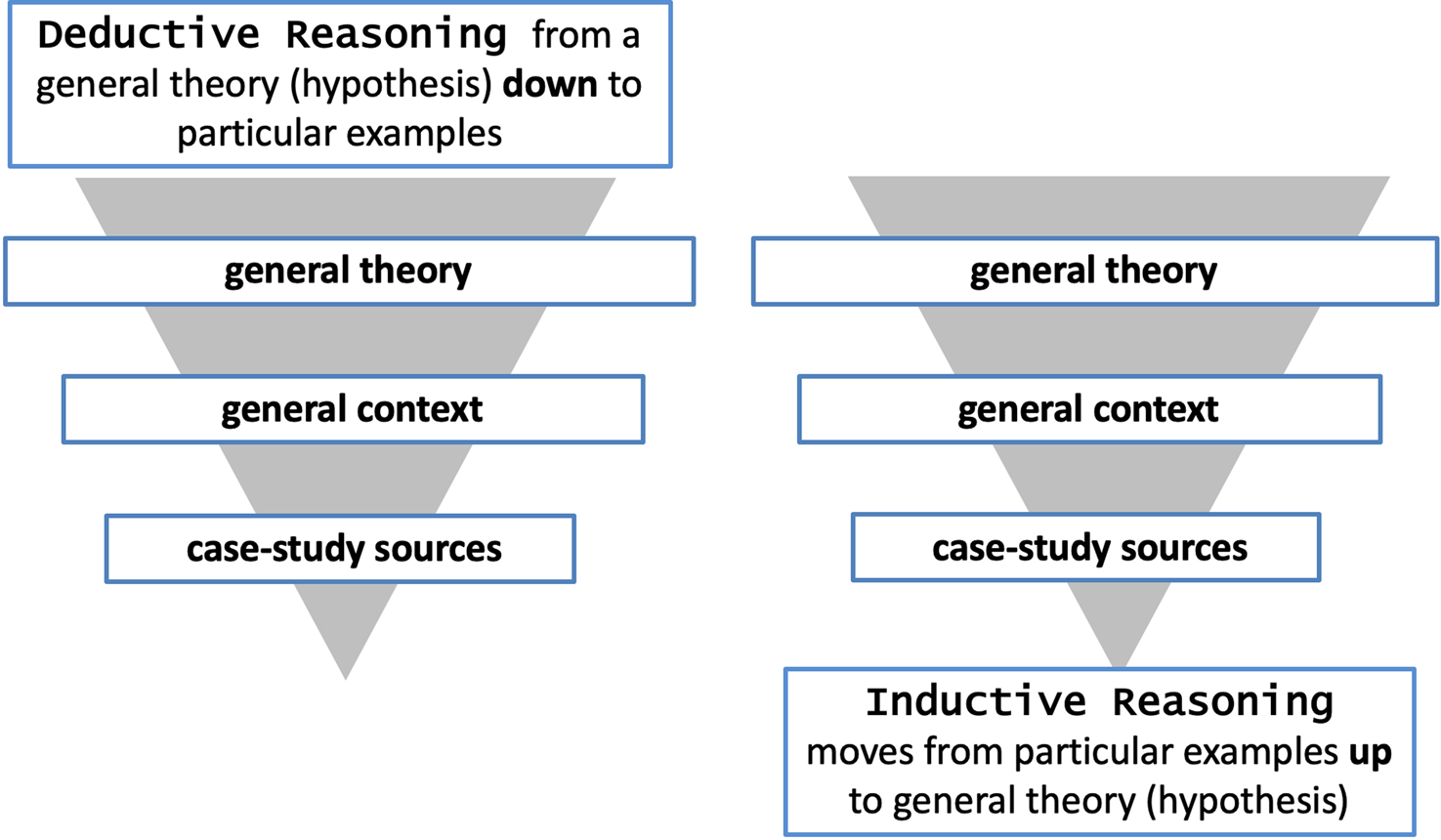
Information literacy instruction at OCAD University uses an informal set of learning outcomes for each level of the four-year degree program, moving from general breadth in earlier years to depth of focus in upper years. A gradated introduction to research models based on modes of reasoning occurs (Fig.1). One involves inductive logic, where researchers begin with ‘particular examples’ then ‘move up’ to reveal broader general theories. Deductive reasoning, conversely, begins with general theories then ‘moves down’ to particular examples.Footnote 13
Information literacy models: Deductive and inductive reasoning

Information sources are to be retrieved according to the research stage starting with encyclopedias and reference resources, then books or exhibition catalogues, to the final level of accessing journal literatures. Modifications to the models, particularly in abductive reasoning practices, are introduced in upper year classes, especially for thesis preparation or thesis studio courses. I felt that these models would be useful, particularly the inductive approach, given that students were required to select primary sources from Métis culture, then find the story that emanates from this case study object.
Of foremost importance, then, was the need to translate these information literacy ‘stories’ to address the ‘story’ of the course, IVCL 3001 History of the Métis, as expressed through its syllabus:
IVCL 3001: Learning Outcomes
By the end of the course students will:
• gain an in-depth understanding of issues around the development of the Métis as a distinct Nation within the context of Aboriginal-European relations in Canada
• understand the influence of past events on contemporary Métis life
• learn professional skills in historical research including interpreting and analyzing various types of primary sources
• produce original research, in written and visual form on historic and contemporary political and issues surrounding the Métis in Canada
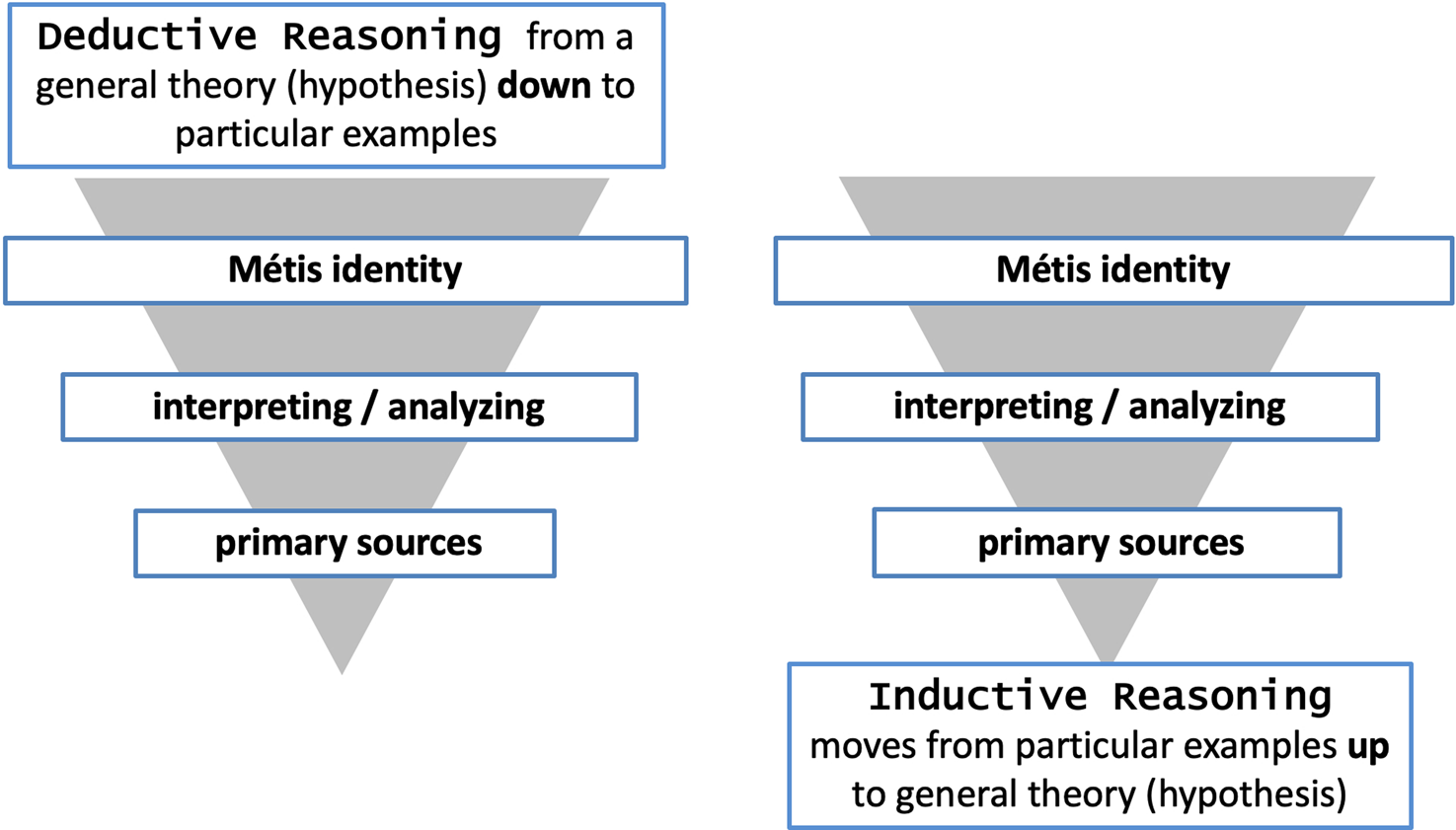
Mapped to established OCAD University information literacy models, key themes were identified then restructured: Métis identity becomes the general theory, then the actions of interpretation and analysis serve as the context through which to understand primary sources (Fig. 2).
Deductive and inductive models expressed using IVCL 3001 learning outcomes

An Indigenous mnemonic model was now needed to ground the research stages. Inspiration can be found in the linguistic structures of many Indigenous languages. For example, in Cree (a dialect of Anishinaabemowin), individual words are ‘as complex as English sentences.’Footnote 14 Unlike English, which is a noun-based language, Cree is organised around verb-based descriptive phrases, placing emphasis on relationships: ‘rather than floating alone as separate units of meaning, the words for people, animals, and objects are embedded in narratives about how these things interact with each other and the environment.’Footnote 15 Basil H. Johnston reveals that there is order to this conceptual complexity: words in Anishinaabemowin have three levels of interpretation which might be loosely associated with Saussurean semiotics:
1. surface or literal meaning
■ semiotic ‘signified’ meaning
2. fundamental meaning
■ semiotic ‘signifier’
3. philosophical meaning
■ semiotic ‘sign’ which provides the foundation for both literal & fundamental interpretation.Footnote 16
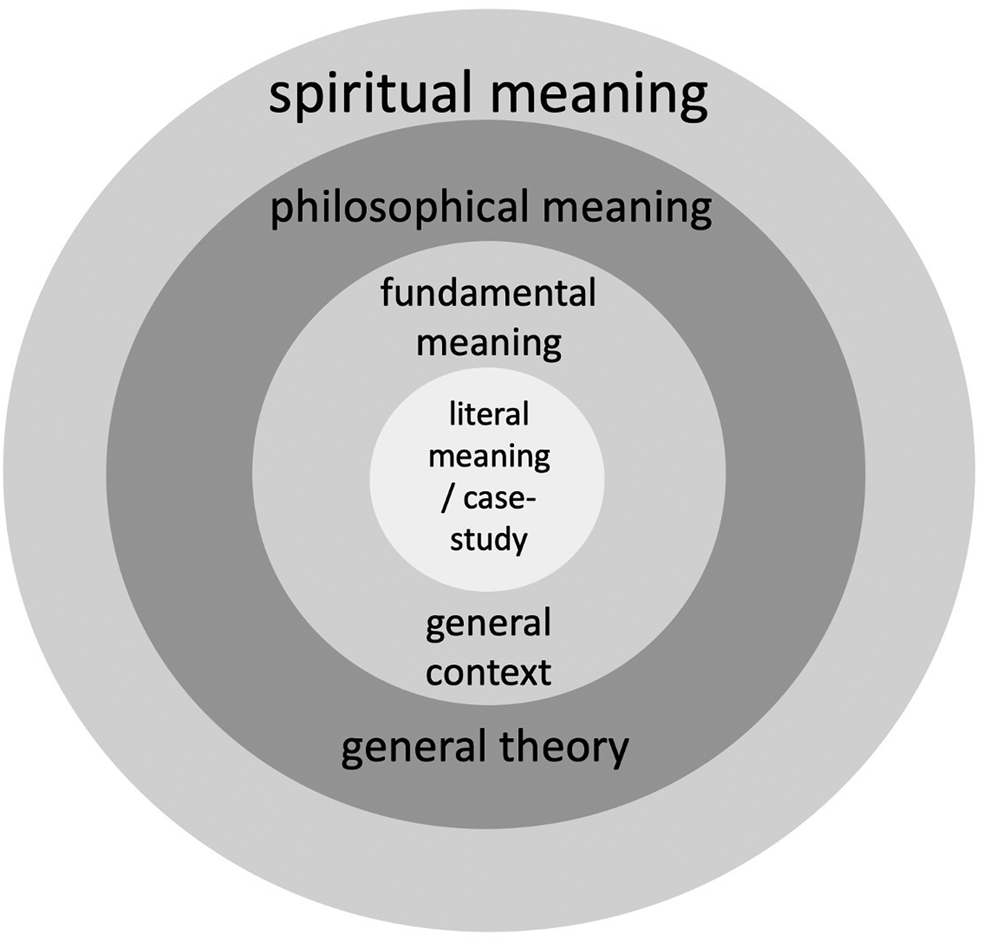
One final level of meaning is understood, but not frequently written down: the spiritual interpretation of words; a concept that might find commonalities with Noam Chomsky's linguistic analysis of ‘deep structure’ in languages.Footnote 17 It is noteworthy that Michif, the Indigenous language of the Métis, preserves the verbal structure of the Cree language, while the noun system is based in the French language.Footnote 18
Finally, the linear, pyramidal structuring of research models proved unsatisfactory. Indigenous journalist and activist Tanya Talaga, in a recent lecture series titled All our Relations: Finding the Path Forward, emphasises how the linear hierarchies used in Western European epistemological models are antithetical to Indigenous knowledge systems. Instead, the circle offers the fundamental embodiment of Indigenous understandings, “underscoring how everything is interrelated and life operates in a circular pattern.”Footnote 19
Johnston and Talaga's theories essentially invert the pyramid; rather than viewing it vertically, researchers are compelled to observe it from above, where the apex of the pyramid becomes the central core. The resulting concentric circles offered a far more holistic model for Indigenous knowledge systems (Fig. 3).
Merging information literacy and Indigenous research models

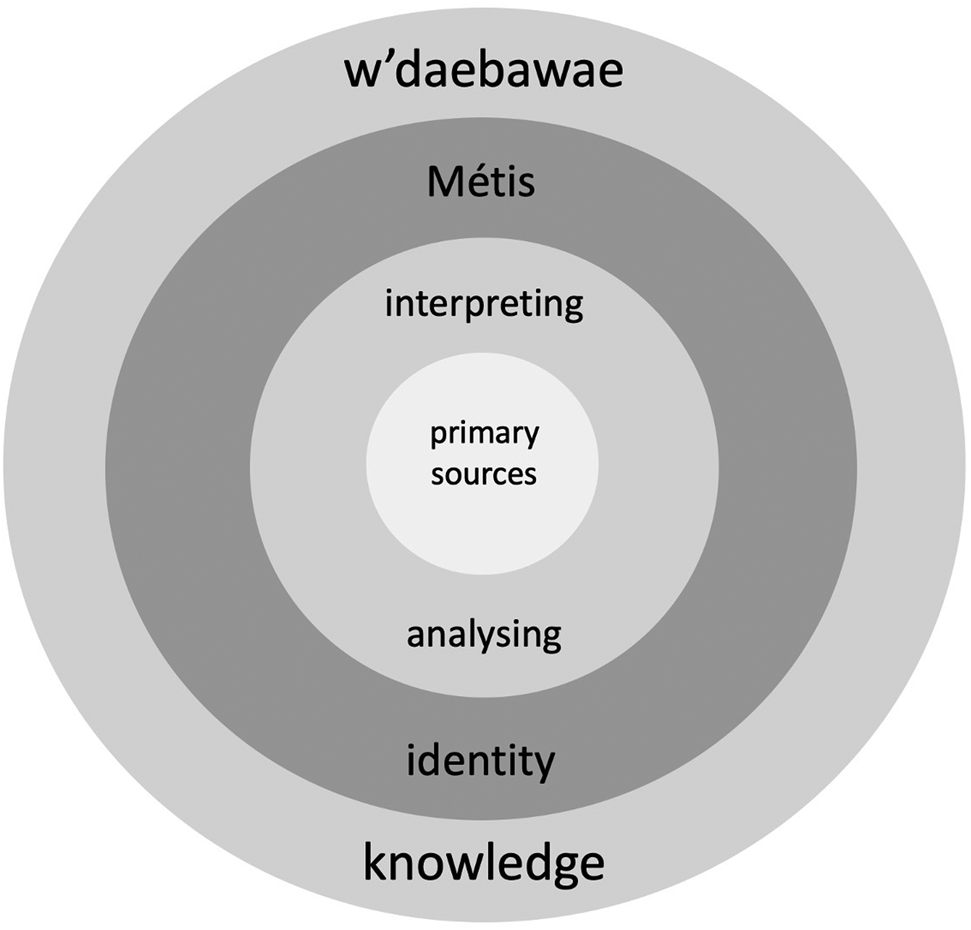
The final stage was to incorporate all narrative frameworks to present a unique model tailored specifically for INVCL 3001, the History of the Métis (Fig. 4).
Merging Indigenous research models and IVCL 3001 learning outcomes

The three primary research stages—the literal, fundamental, and philosophical—relate to standard information literacy models used at OCAD University, but the final spiritual meaning is more intangible. I would advocate that, in working inductively (moving from the inside to the outer circle) or deductively (from the outside to inside), the entire process combined conveys w'daeb-awae; all research stages are enacted separately, but at the same time function as an integrated whole to create knowledge. Likewise, the creation of an artwork emanating from the students' research processes would embody a spiritual understanding of their chosen primary source subjects.
Beginning of the story: Literal meaning
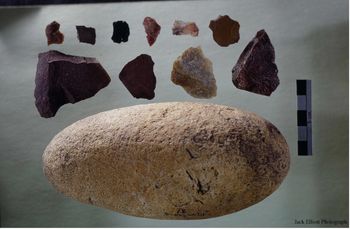
To structure my information literacy session, I created an hour-long seminar that presented the logic of my research model, asked for student feedback, then provided a research example to demonstrate how this model can be enacted. Since the ‘imagined’ research model presented relies heavily on Anishinaabeg knowledge systems, it was important to select an object that functioned within a Métis community associated with this language group. The Virtual Museum of Métis History and Culture provided a range of case-study objects: one deceptively simple example, hunting and hide-working stones crafted by Hivernant buffalo hunters in Cypress Hills, Saskatchewan, offered an ideal research example to present to the class. The image shows an archaeologically recovered hammer stone and discarded stone shards left from the production of flaked stone tools in a mid-1800s Métis hide hunters' winter camp. Métis hunters were the principal players in a commercial buffalo hide hunting industry which flourished on the Canadian Northwest Plains at that time and often used traditional flaked stone tools to process their buffalo hides and robes for market.Footnote 20
Hammer Stone and Stone Flakes, Hivernant Buffalo Hunters and Hide Workers in the Cypress Hills (image courtesy: Jack Elliott, The Virtual Museum of Métis History and Culture, www.metismuseum.ca)

The objects were surprising to students; without the context of a museum display, the stones did not offer any clues of being hand-crafted. To translate these objects into search terms, I encouraged the simplest configuration possible: rocks and Métis.
To begin, a dictionary definition for the word ‘rock’ was sought using one of the growing number of online open access Indigenous language dictionaries. In Ojibwe (another Anishinaabemowin dialect), rock is defined as Asin; however, the definition linked to contextual usages:
■ Asiniiwan; it is of rock or stone / it is rock-hard
■ Asiniiwi: s/he is of rock or stone / s/he is rock-hard.Footnote 21
I encouraged students to ask key questions after consulting each information source. In this case, what does it mean to be made of stone? In English, the phrase has definite connotations, but I warned students cannot draw conclusions based on an essentialist viewpoint that imposes non-Indigenous knowledge frameworks.
To confirm a cultural context, encyclopedias are crucial, so the open access Canadian Encyclopedia offered a seminal starting point. Using Métis as a search term, we were surprised to only find an entry on the ‘Powley Case’; one of the first court cases to assert Métis hunting rights. Surprisingly, there was no immediate definition of Métis culture; however, I encouraged students to ‘trust’ the encyclopedia and, instead of resorting to finding a literal definition, explore the results and understand why these entries were offered. In this case, the legal case established criteria, known as the Powley Test, defining who can legally qualify for Métis rights. The case also clarified that the Métis are a distinct people, separate from First Nations and Inuit peoples in Canada.Footnote 22 Unexpectedly, this landmark case—rooted deeply in the right to hunt—offers the best, most tangible definition of the Métis.
Middle of the story: Fundamental meaning
To find a contextual resource, I continued to use the search terms, Metis AND rocks, but searched specifically for books. One of the first titles retrieved, Heather Devine's People Who Own Themselves, chronicles the two-hundred-year history of the Desjarlais family that intermingled French Canadian and Indigenous cultures. Their family history essentially mirrors the emergence of Métis identity beginning in the seventeenth century where the cultural openness offered by Indigenous cultures, particularly those engaged in the fur trade, contrasted with the confining feudal structure of New France (Québec). Embracing Indigeneity allowed the Desjarlais family to ‘own themselves.’ The conclusion offers a compelling description of how Métis people can ‘own themselves’ in our contemporary cultural context:
Despite the negative impact of many government policies on aboriginal families and communities, the tools needed for reformulating ethic identify and revitalizing communities exist. Today thousands of people of mixed ancestry are using the vast accumulation of corporate, government, and religious records to document their origins and reclaim the Native heritage. In archives and libraries, at genealogical workshops and family reunions, on internet newsgroups, and at aboriginal festival and conferences, they exchange their family histories, meet their distant cousins, and discuss their shared experience of being Métis-in-diaspora.Footnote 23
Each research step yielded new questions, but also answered earlier ones. In this case, the socio-economic foundations of Métis culture, rooted in hunting and the fur trade, allowed members of these communities to claim identity; one that was a fusion of European and Indigenous cultures and, as such, distinct. Yet in the contemporary context, are Métis peoples now encouraged to hunt through the archive?
Regardless, it was clear that the context for analysis and interpretation—the fundamental meaning of my subject—was the act of hunting in order to sustain life and culture.
End of the story: Philosophical meaning
In inductive reasoning, journal articles allow researchers to take the unique occurrence of a particular case-study and branch out to find similar phenomenon in a broader global context. As such, the periodical literature offers an ideal means of approaching a philosophical understanding of one's research object.
Once again, using the search terms rocks AND Metis, but adding a limit to visual arts journals, retrieved three articles; each offering conceptual material to move towards a philosophical level of interpretation. The first contained an exhibition review of works by Anishinaabe elder and former OCAD University faculty member, Bonnie Devine:
In her sculptural installation, Letters from Home, Bonnie Devine calls upon the viewer to consider the stones from the Serpent River First Nation as elders. The casts of these stones are framed as texts, and viewers are encouraged to learn how to read these lessons, collapsing the divide between deep time and the present.Footnote 24
The second offered an artist statement by Métis painter David Garneau:
In Indigenous understanding, rocks are animate. And they are considered grandfathers. There is an ontology to these things in geological thinking. A rock is mineral aggregate; a stone is the same thing transformed by human use.Footnote 25
The final result, another exhibition review of Métis artist Gábriellé L'Hirondelle Hill, focuses on her use of discarded objets trouvė to convey a critique of capitalist economies of use. Her work titled Waste Lands makes direct connection to the long-term effects that consumerism has on the physical environment and visually challenges viewers to consider Indigenous approaches to material culture as a means of ‘seeding new ways of thinking about systems of exchange.’Footnote 26
Each of the articles elicit new questions, yet offer material that responds to questions asked at earlier research stages: being ‘made of rock’ actually means being animate; stones function as historical archives; archival objects offer guides to the future. The objects used in historic buffalo hunting economies are not static reminders of the past but, through their placement in an archival collection contextualised within a cultural narrative, offer a means of teaching us about our place in current and future socio-cultural contexts.
The moral of the story: Spiritual meaning
I was unable to offer any definitive conclusions for students in structuring a hypothetical research paper or creating a work of art that could emerge from this research process, but I did map each question or discovery on the concentric circles of our IVCL research model. I strongly emphasized that the research results I presented, in retrospect, provide a sense of coherence, but while in the midst of research processes, my search path was not immediately clear. It was only after progressing through each stage that the vision of the entire research process—as seen from above as our model suggests—could be understood. Finding the narrative of one's primary document is a cumulative process, one that involves taking chances that, at the time, might seem inconsequential, but the spiritual understanding needed to create a visual artwork requires this reflective, even reflexive process-based thinking. In my own experience of researching the stones used by the Hivernant buffalo hunters and hide workers in Saskatchewan's Cypress Hills area, I was able to appreciate these objects as animate guides challenging us to understand the past, present and future not only of Métis culture, but that of Canada as a whole.
Studio critiques as story-telling: Howard Munroe as narrator
The research process, informed by Indigenous linguistic and symbolic understandings, was a journey that started for students in selecting an Indigenous object, belief, or personage then led to an annotated bibliography, a 1,200-word research essay, and culminated in the creation of an artwork based on this discovery process. For evaluation purposes, a similar Indigenous rubric was needed to judge the students' work that was respectfully supportive but critically engaged. Both are needed for the ultimate goal of challenging students to find their own creative voices through the lens of Indigenous cultural knowledge systems beginning from literal meanings, through to fundamental, philosophical, and spiritual understandings. An ethical framework for these purposes can be found in the Seven Grandfather Teachings. These are a set of characteristics that, in a literal interpretation, guide people in aspiring to live a good life, or milo pimatisiwin.Footnote 27 On a fundamental level, the seven principles can serve as a rubric for evaluation that—through enacting the critique—offers philosophical, even spiritual guidance. Although this teaching is common to many communities across North America, the Anishinaabeg formulation was used for understanding students' artworks in IVCL 3001.Footnote 28
Although the seven teachings were used to evaluate each student's work, selected examples that highlight core principles for each will be presented accompanied by excerpts of student's artist statements offered as their personal research stories.
1. Wisdom: Define the problem to be solved with a set of parameters to establish a final outcome. This phase is tied to the Wisdom teachings which requires the ability to ask questions and make decisions based on personal knowledge and experience.
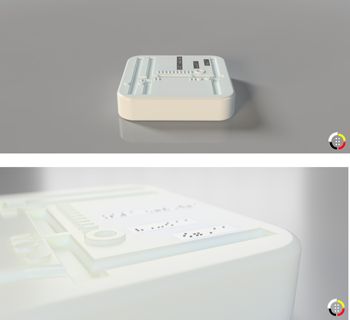
Keli Hawley. Miikana Braille Map. Steel plate (braille), oak board, and polyurethane board (Map section). 8 x 8 inches.

Artist statement: The Miikana Project focused on creating a map that represented OCAD University's campus in Toronto, Canada. The inspiration for this project comes from cartographic studies of Indigenous pictorial mapping techniques in North America. The map is intended for the visually impaired, but can be used by anyone, and offers Braille names of popular places in the region. To acknowledge the use of these Indigenous practices evident in the project we have named it Miikana which comes from the Ojibwa language meaning ‘path.’ The Ojibwa language was spoken by many of the Indigenous groups that were the original custodians of the land OCAD University sits on today.
We have also tried to acknowledge these groups by using a logo which represents the Native American Medicine Wheel. The white section, standing for Air (Mental) is enlarged to show importance as we want our users to visualise the pathway through their minds.
2. Respect: Analysis and research are used to gather as much information as possible within a set amount of time. Whether doing interviews, observations or literary searches, this phase requires the teachings of Respect. Having an understanding of and honouring what you are analysing or researching, then giving it Respect is very important.
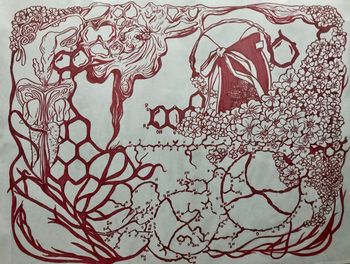
Fiona Enright. The Use of Yarrow in the Treatment of a Bee Sting. Ink on paper. 20 x 25 inches.

Artist statement: Métis floral beadwork's multifaceted role in Métis identity, both historically and contemporarily, extends beyond pure aesthetics. Floral designs in Métis beadwork serve as explorations of utility and self-understanding.
Since the majority of the flowers represented in beadwork have a practical use in traditional Métis medicine, floral designs can function as a medical guide. By beading particular plants onto garments and everyday items, the designer could signal to the user that a certain plant is both useful and safe. Beading is a means through which a designer can divert an individual away from dangerous plants which may cause pain, injury or death. A prime example of a useful and safe plant within traditional Métis medicine is Yarrow (Michif- Cree: Larbaden), a thin, white and yellow, flowering plant indigenous to the Métis homeland.
3. Courage: Ideate through creative brainstorming where techniques and methods are used to think in non-linear ways to generate ideas. This phase requires the teachings of Courage as it is the ability to face danger, fear or change with confidence and bravery in exposing innovative ideas and thought process.
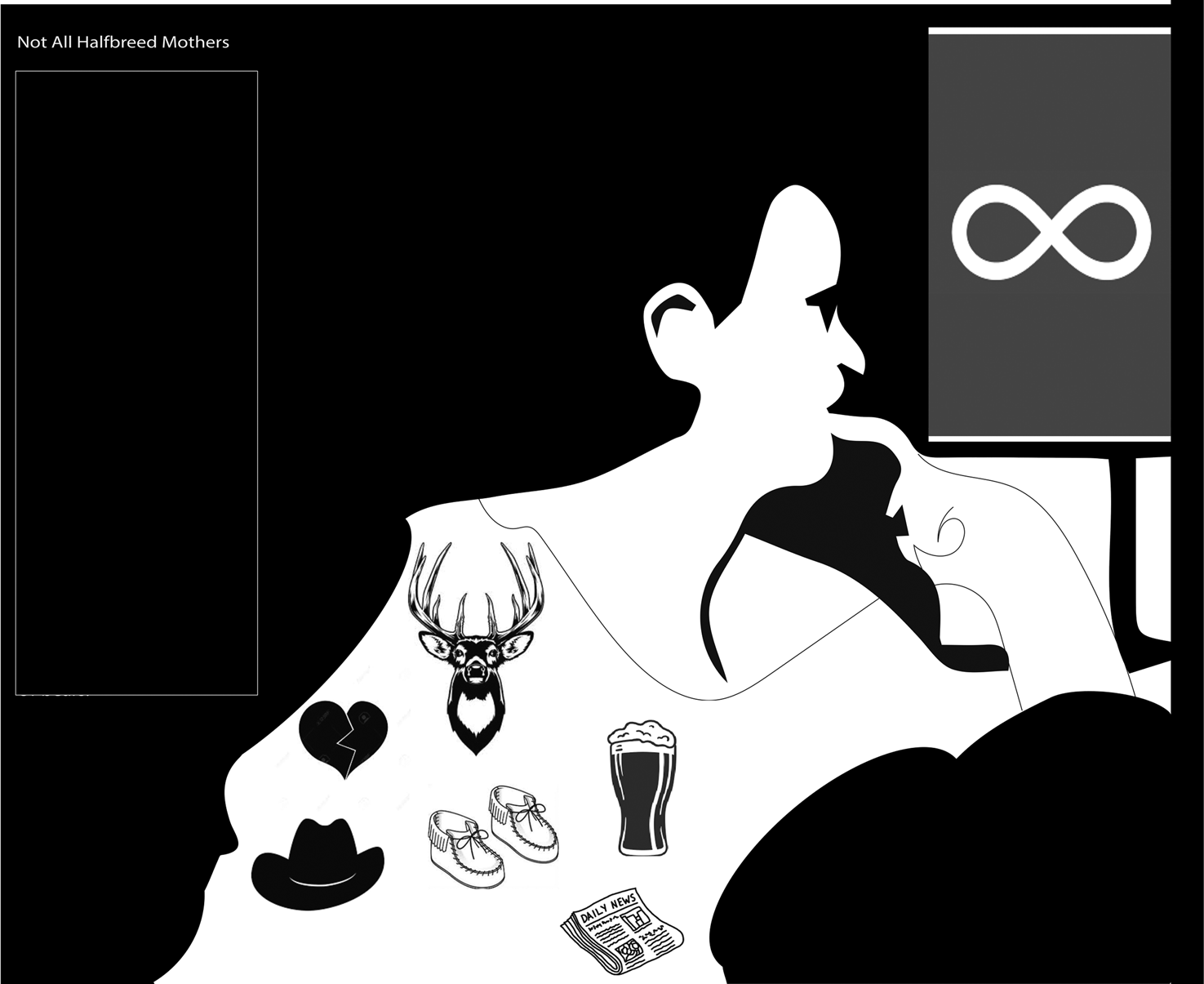
Liam Greenlees. Métis is Story-Telling. Digital print. 11 x 17 inches. Poster text: Gregory Scofield. “Not All Halfbreed Women,” in Witness, I Am (Gibsons, BC: Nightwood Editions, 2016). For copyright reasons, the text has been removed, but its place is demarcated on the poster.

Artist statement: ‘Not All Halfbreed Women’ is a poem by Gregory Scofield featured in the text Witness, I Am. This text deals with the critical issue of missing and murdered Indigenous women.
The graphic I've created shows a low detail white figure. The purpose of this figure is to create a connection with the viewer to have them either imagine themselves or someone they know. On the lower section of the figure where a shirt or sweater would be, I placed some symbols that represent the negative stereotypes that are associated with Indigenous culture as they are a thing that is carried amongst people and throughout generations.
In the image the figure is looking towards the Métis flag. This flag represents a profound optimism and unity. This unity is a key to the future of Métis people. This strength will be a key attribute in the regeneration of the Indigenous community.
4. Honesty: Select the best ideas for implementation. This phase is tied to the Honesty teaching which requires the ability to speak and act truthfully, and thereby remain morally upright in decision-making. Honesty is linked to Respect in how one's choices will affect others so to demonstrate this correlation, the conclusion of the artist statement for Fiona Enright's The Use of Yarrow in the Treatment of a Bee Sting is representative of both teachings:
Artist statement: Due to the significant influence that floral beadwork has, and continues to have, on Métis identity, it cannot be regarded as purely decorative. The floral designs that adorn a variety of garments produced by Métis artisans serve an expanded purpose of relating to one's environment and exploring identity. Métis identity itself evolved alongside the progress of floral imagery in their beadwork.
5. Love: Implement ideas through a chosen medium. This phase is tied to the Love teaching which requires unconditional commitment to a project. The Love and passion that are put into the implementation process are always reflected in the outcomes.
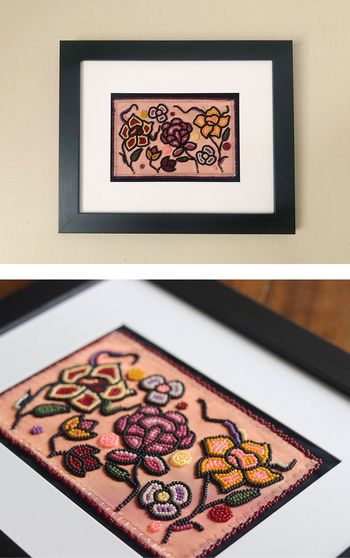
Emily Kewageshig. My Mother's Garden. Seed beads with copper mesh background. 5 x 7 inches (framed 8 x 10 inches).

Artist statement: Métis artists create work that is rooted in their ancestry and personal history. In order to preserve Métis identity, many artists have focused their practices around building relationships and promoting their unique way of life through visual storytelling.
One of the oldest surviving forms of art is beadwork and embroidery. Métis beaders and embroiders are well known throughout many nations because of their unique approach to creating accessories, clothing and decorative items.
It is vital to consider all methods of making as an act of resilience, as this is situating Métis identity at the forefront of Indigenous art within Canada. Which is exactly what Métis artists, designers, and scholars did when they produced material that spoke directly to their ancestry. The important history engrained in Métis is culture is expansive and includes the work of many past, current, and future artists. Métis people have made their mark within Canada, and will continue to do so until the end of time.
6. Humility: Evaluate ideas presented through critique. This phase requires the Humility teaching as one's process and ideas are being analysed by others to give constructive feedback. This stage of the process can be quite stressful because it is a true reflection of your abilities and to some can be quite hurtful.
Neha Matthew. Untitled. Cinema4D digital images. 1280 x 720 pixels.

Artist statement: These works are reminiscent of the commonly held belief behind the Hudson's Bay point blankets and what they represent to the Métis community. Something that the colonizer handed out as a ‘peaceful gesture’ after robbing them of so much and using it as a tool for biological warfare, spreading illnesses through the blankets.
Land, nature and the environment as a whole are an integral part of Métis culture, identity and history… narratives that will inform the future generations and current community of Indigenous peoples.
7. Truth: This phase is tied to the Truth teaching which requires you to look back and understand if you have gone through the research process and have been true to all seven Grandfather teachings. It replicates the cyclic nature of existence, recognising that everything is interrelated and life operates in a circular pattern.
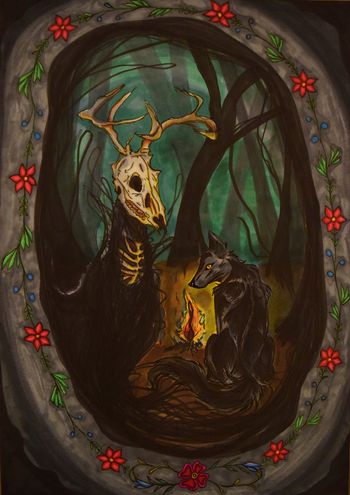
Artist statement: Like many aspects of the Métis identity and culture, storytelling traditions have embraced both the Indigenous approach to oral storytelling, and the European practice of written storytelling. In the same vein, most prominent Métis stories have developed out of the duality and fluid adaptability of their complex cultural identity.
In the spirit of many aspects of Métis culture, the rougarou story is a hybridisation of French-Canadian (beginning with French voyageur) stories and Indigenous trickster stories, particularly of Cree-Ojibwa origin. Various recounts of the rougarou sway in different directions. The rougarou can be a negative or positive figure, depending on the influential bias towards the French-Canadian loup-garou or Indigenous tricksters like Wesakaycha. The loup-garou and, therefore, many versions of the rougarou also draw significantly from the Algonquin windigo beliefs. The French- Canadian loup-garou stories are quite different from previous, ‘courtly,’ werewolf stories of ‘auld.’ Werewolves in European traditions have always been symbols of the negotiation between ‘civility’ and ‘purity’ versus ‘barbarism’ and ‘savagery’, hence the human versus animal state of being.
As the world becomes more and more multicultural, stories from people like the Métis—with a truly hybrid and uniquely diverse culture—are an invaluable lesson for people who do not have such an immediate link to their identities and culture.
Shanae Winslow. Rougarou & Windigo (In Darkness). Ink and marker on paper. 12 x 17 inches.

Afterword: The story continues
We hope that our experiences with integrating Western-European and Indigenous visual culture pedagogies will be instructive. The reflective insight, the w'daeb-awae, of the works that students produced does offer us tangible evidence that the goal of finding common pathways in creative research was successful. Both of us know that this respectful collaboration between librarian and professor will remain animate, continuing forward in future curricular interactions and research initiatives. Most powerfully, however, is the knowledge that this work has been a small, but meaningful part of the broader goals of decolonising educational practices at OCAD University. We know, too, that the students' engagement in this synthesis of knowledge systems will allow them to take this experience beyond OCAD University and work toward achieving truth and reconciliation nation-wide through Indigenous visual cultural understandings.