Introduction
A common approach for designing functional materials involves the assembly of functional groups—a collection of atoms with unique properties that can be interwoven to create new materials. Organic chemists, for example, are able to tailor the reactivity, electronic structure, and mechanical properties of complex compounds through changes in the symmetry, arrangement, and coordination of such functional units on supporting “in-active” backbones.Reference Kanis, Ratner and Marks1 Their inorganic colleagues, however, face substantial challenges: Those materials scientists who aim to rationally discover and design multifunctional inorganic phases must first identify such equally important and property-determining “functional groups” or molecular units hiding in the crystalline stateReference Hoffmann2 and then subsequently establish methods to control and characterize their geometry and assembly.
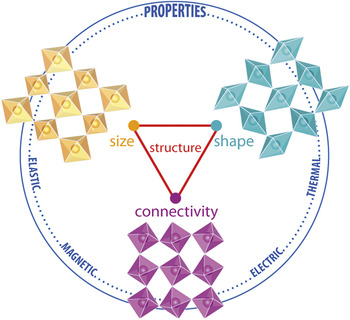
Transition metal oxides of the ABO3 perovskite class possess such a fundamental and functional unit: the corner-sharing BO6 octahedra with central B-site transition metal cations coordinated by six oxygen ligands. Variations in the size (B–O bond lengths), shape (number of unequal B–O bonds), and connectivity (here used to describe the magnitude and pattern of octahedral rotations) of the functional octahedral units provide access to a wide spectrum of multifunctional properties (Figure 1), enabled by the strong coupling among the lattice, charge, spin, and orbital degrees of freedom.Reference Goodenough3–Reference Imada, Fujimori and Tokura5 Understanding the geometric patterns and tiling—symmetry and topology—of the BO6 building blocks therefore permits material properties in perovskites to be explained in terms of their underlying structure, making these materials amenable to control for specific functionalities. One principal challenge to engineering functionality into perovskite oxides lies in finding new synthetic routes to control the crystal lattice. Studies of bulk systems have developed guidelines to understand perovskite structures based on ionic radii of the constituents and inter-atomic bond lengths (e.g., tolerance factor).Reference Goodenough3 The strategy to control the size, shape, and connectivity of the BO6 octahedra relies on hydrostatic pressure and/or chemical substitution/alloying; unfortunately, the octahedral responses are limited to the available chemistries. A grand challenge is then to find routes to go beyond this limitation to access multifunctional properties through rational control of the octahedral connectivity (i.e., the rotational patterns of the BO6 units—the perovskite structural feature that has a profound impact on properties).
The interplay among different structural distortions of the octahedral units—their size, shape, and connectivity—dictates the functional elastic, magnetic, electric, and thermal properties.

In this article, we describe how layer-by-layer epitaxial synthesis methods have opened the door to the direct tuning of the octahedral connectivity in perovskite oxides without resorting to chemical substitution. By building on the strong structure–property relationships in perovskites, epitaxial constraints provide new opportunities to achieve atomic and electronic structures that are inaccessible in bulk equilibrium phases. Using recent examples from the literature, we focus on three rapidly developing methods aimed at the targeted design of octahedral rotations (and their derived properties) in oxide thin films and heterostructures. These principal strategies are epitaxial strain, interfacial coupling at heterointerfaces, and coherent superlattice formation. We conclude by highlighting emerging avenues for both static/synthetic and dynamic external control of the octahedral connectivity in perovskite oxide heterostructures as a foundation for innovative technologies.
Function and structure of octahedra in perovskite oxides
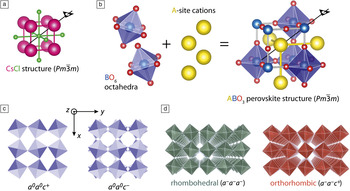
Starting from a crystal-chemistry approach, the ABO3 perovskite structure is built by tiling the fundamental BO6 octahedral building blocks on the Cl sublattice in the simple interpenetrating cubic CsCl structure (Figure 2a) to yield the signature corner-connected BO6 octahedral framework (Figure 2b). The A-site cations are then substituted on the Cs sites. In the absence of octahedral rotations and distortions, this creates the aristotype cubic perovskite phase with a three-fold axis along the body-diagonal.
Illustration of the supramolecular assembly of the perovskite structure from the simple cubic CsCl structure (a) using functional BO6 octahedral units and A-site cations (b). The BO6 octahedra are able to rotate either in-phase (+) or out-of-phase (−) about the c-axis, as shown in (c) for the tetragonal a0a0c+ and a0a0c– rotational patterns.Reference Glazer19 In (d), two common octahedral rotation patterns adopted by perovskite oxides are illustrated: cooperative rotations about the cubic [111]-direction give the rhombohedral (a–a–a–) rotation pattern, whereas rotations about the cubic [110]-direction give the most pervasive orthorhombic (a–a–c+) rotation pattern.Reference Woodward27

The properties of most perovskite oxides are mainly attributed to the chemistry of the transition metal at the center of the BO6 unit since the A-site cations prefer to form fixed valence, closed-shell electronic configurations. The electric, magnetic, and thermal responses depend on both the manner in which electrons fill the orbital levels on the B-site and on the covalency of the material,Reference Goodenough6, Reference Zaanen, Sawatzky and Allen7 a feature determined by the cation-oxygen bond lengths and the octahedral connectivity. The size, shape, and extended connectivity of the highly flexible octahedral framework (Figure 1) all modify the hybridization/chemical bonding through changes in the overlap of transition metal 3d and oxygen 2p orbitals.
The size of the BO6 units can be modulated to form small and large octahedra without necessarily altering the point symmetry of the archetypal phase. For instance, static segregation of charge (δ) can drive an ordered charge disproportionation reaction of the type 2BN + ⇌ B(N+δ)+ + B(N-δ)+ (N is the nominal ionic charge on the B cation),Reference Mazin, Khomskii, Lengsdorf, Alonso, Marshall, Ibberson, Podlesnyak, Martinez-Lope and Abd-Elmeguid8 which results in alternating octahedra that are dilated (long B–O bonds) and contracted (short B–O bonds) (Figure 1, left).Reference Takeda, Kanno, Kawamoto, Takano, Kawasaki, Kamiyama and Izumi9, Reference Woodward, Cox, Moshopoulou, Sleight and Morimoto10 Shape-altering distortions of the octahedra can arise from the first-order cooperative Jahn-Teller effect when filling of B-site d-orbitals leads to an orbital degeneracy. The degeneracy can be lifted by tetragonally distorting the octahedra, where two elongated and four compressed B–O bonds are created (Figure 1, right).Reference Jahn and Teller11–Reference Lufaso and Woodward13 Cooperative polar B-cation displacements can also occur and lead to noncentrosymmetric crystal structures with functional optical, piezo-, and ferroelectric properties.Reference Burdett14–Reference Halasyamani and Poeppelmeier16
In addition to size and shape distortions, which modify the B–O bond lengths, rotations of the BO6 units (Figure 1, bottom) buckle the octahedral framework along different Cartesian axes (B–O–B bond angles <180°) and play an important role in determining the physical properties of perovskite oxides. There are 15 distinct rotation patternsReference Howard and Stokes17, Reference Stokes, Kisi, Hatch and Howard18 that keep the BO6 units nearly rigid and are classified using the Glazer notationReference Glazer19 by the manner in which adjacent octahedra rotate along a particular Cartesian direction: a –(+) indicates out-of-phase (in-phase) rotations, while a 0 denotes no rotation, about a Cartesian axis. This is best illustrated for the simple case in Figure 2c, which shows in- and out-of-phase rotations only along the z-axis. For perovskite oxides, the cooperative behavior of the octahedra, reinforced by their corner connectivity, often results in two common rotation systems, rhombohedral (a–a–a–) or orthorhombic (a–a–c+) (Figure 2d).
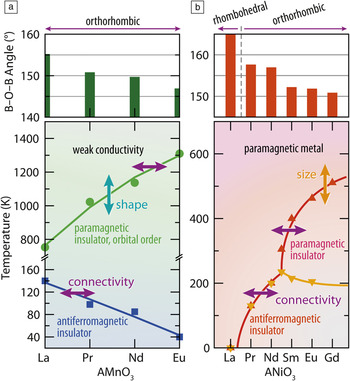
These changes in the extended structure of the octahedral framework, which alter the translational symmetry, influence the material properties by bending the B–O–B bond angle away from 180°. The strength of the B–O–B interactions necessarily changes as the overlap between O 2p and B d-orbitals is reduced. The magnitude and symmetry of the rotations, for example, determine electronic bandgaps,Reference Eng, Barnes, Auer and Woodward20 thermal conductivity,Reference Wang, Sui, Ren, Wang, Wang, Su and Fan21 magnetic properties,Reference Anderson22–Reference Kanamori24 and critical (superconductivity) transition temperatures.Reference Pei, Jorgensen, Dabrowski, Hinks, Richards, Mitchell, Newsam, Sinha, Vaknin and Jacobson25 They are most routinely controlled in bulk materials by judicious choice of the A- and B-site cation size mismatchReference Woodward26–Reference Goldschmidt28 through chemical pressureReference Tomioka and Tokura29–Reference Thomas31 or through applications of external hydrostatic pressure.Reference Angel, Zhao and Ross32, Reference Tohei, Kuwabara, Yamamoto, Oba and Tanaka33Figure 3 provides two examples of how isovalent A-site substitution is used to tune functional properties by altering the connectivity (B–O–B bond angles) of the functional BO6 units in manganitesReference Zhou and Goodenough34, Reference Dabrowski, Kolesnik, Baszczuk, Chmaissem, Maxwell and Mais35 and nickelates.Reference Zhou, Goodenough, Dabrowski, Klamut and Bukowski36, Reference Medarde37 However, this approach is limited by available chemistries. Finding new synthetic routes to tailor the connectivity of the octahedral building blocks in a manner independent of composition is highly desirable; it would provide directionality control over materials properties while simultaneously achieving desired compositions. Recent attention has been devoted to understanding epitaxial and heterostructure control of the octahedral rotations, generating structures with chemistries inaccessible via bulk synthesis.
The isovalent phase diagrams of rare earth manganites (a) and nickelates (b) with A-site composition exhibit changes in the octahedral connectivity (B–O–B bond angles, upper panels) and symmetry. Changes to the octahedral connectivity (horizontal arrows) affect the temperatures associated with magnetic and charge ordering phase transitions, whereas periodic orderings of the octahedral shape and size (vertical arrows) occur at the orbital ordering and bond disproportionation transitions in the manganites and nickelates, respectively (lower panels). Data adapted from References Reference Zhou and Goodenough34–Reference Medarde37.

Before strategies for octahedral control in films are discussed, we note that the measurement of oxygen positions in thin films, required to identify the octahedral behavior, presents a formidable task. In bulk perovskites, powder diffraction is available to characterize octahedral behavior, enabling identification of the structure-properties relationships shown in Figure 3. While x-ray diffraction is routinely used to gain insight into the shape and the size of the unit cell, the quantification of octahedral connectivity in films is much more difficult due to the limited sample volume of films, the presence of a thick substrate, and the weak scattering from oxygen atoms. However, advances in transmission electron microscopy and the availability of synchrotron x-ray sources have enabled measurements of rotational patterns and magnitudes in thin perovskite films.Reference Xie, Budnick, Hines, Wells and Woicik38–Reference Muller47 These advances in experimental techniques concomitant with first-principles density functional methods have enabled new insights into octahedral behavior in oxide heterostructures.Reference Muller47 More details on the application of density functional calculations to investigate structure in perovskite films can be found in a recently published review article.Reference Rondinelli and Spaldin48
Strain engineering of octahedral rotations
For the last decade, the choice of substrate materials on which to grow a functional perovskite oxide has primarily been governed by the lattice mismatch between the substrate and film—an approach taken from the growth and design of compound semiconductors. The underlying assumption in this strategy is that the elastic strain energy imposed on the film by the substrate is accommodated by changes in the film’s unit cell parameters rather than by changes in the internal atomic positions. This route has been extremely successful in tailoring the dielectric, piezoelectric, and multiferroic properties of thin-film perovskites.Reference Ramesh and Schlom49–Reference Schlom, Chen, Eom, Rabe, Streiffer and Triscone51
However, the flexible corner-connected octahedral network in perovskites allows for epitaxial stresses to be accommodated by changes to octahedral connectivity (rotations), in addition to size and shape distortions. The strain–octahedral rotation coupling mechanism, however, is less understood and more poorly characterized than strain-induced lattice parameter distortions, due in part to the experimental difficulty in extracting oxygen positions in heteroepitaxial thin films. However, as octahedral rotations couple directly to magnetic, electronic, and multiferroic behaviors, strain-based control over these functional propertiesReference Thiele, Dorr, Bilani, Rodel and Schultz52–Reference Boschker, Mathews, Houwman, Nishikawa, Vailionis, Koster, Rijnders and Blank60 requires a detailed understanding of the BO6 units’ response to epitaxial strain; it is the octahedral rotations and size/shape distortions, and not solely the lattice tetragonality (c/a ratio of in- versus out-of-plane lattice constants), that provide the physical basis for strain-induced changes to electronic and ferroic properties. To this end, first-principles density functional calculationsReference Hohenberg and Kohn61, Reference Kohn and Sham62 are proving to be particularly useful in revealing the coupling between strain and octahedral connectivity.Reference Rondinelli and Spaldin48
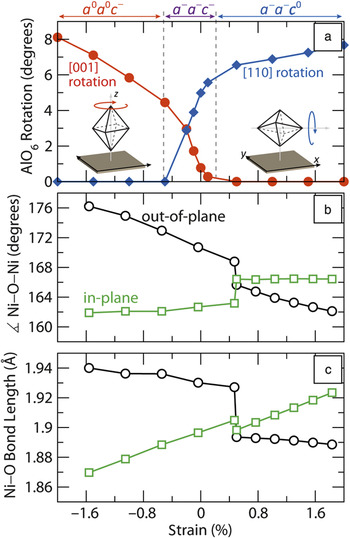
Recent computational studies of rhombohedral perovskites with the a–a–a– pattern (Figure 2d) under biaxial strain show that strain directly modifies the magnitude of the octahedral rotations about different crystallographic directions relative to that of the substrate.Reference May, Kim, Rondinelli, Karapetrova, Spaldin, Bhattacharya and Ryan39, Reference Hatt and Spaldin63Figure 4a shows that in LaAlO3, compressive biaxial strain enhances the magnitude of the octahedral rotations about the [001]-direction, while tensile strain favors the [110]-direction (i.e., in-plane octahedral rotations).Reference Hatt and Spaldin63 In fact, moderately large compressive (tensile) strains are able to completely quench the rotations about the [110] ([001]) axis, achieving atomic configurations inaccessible in the bulk. For small intermediate strains, the bulk-like rotation pattern persists, albeit with a small monoclinic distortion of the lattice.
The zero-kelvin density functional theory (local density approximation) strain–octahedral phase diagram for rhombohedral LaAlO3 under biaxial strain (a). The choice of lattice mismatch between the film and substrate enables selection of the thin film’s octahedral rotation angles: Increasing strain from compressive to tensile changes the magnitude of the AlO6 rotation angles about the different Cartesian directions a 0a 0c –, (along z-) a –a –c – (along x-, y-, and z-), and a –a –c 0 (along x- and y-directions) relative to the (001)-oriented cubic substrate (inset). The simulated (001)-strain dependence on the in-plane (□) and out-of-plane (○) bond angles (b) and bond lengths (c) for rhombohedral LaNiO3 reveal that strain is accommodated by octahedral rotations and transition metal bond distortions. Data reproduced from References Reference Rondinelli and Spaldin48 and Reference Hatt and Spaldin63. ©2010, American Physical Society and ©2011, Wiley-VCH Verlag.

In rhombohedral LaNiO3, however, the strain-space over which the bulk-like rhombohedral rotation phase persists is much larger. It is stable for all computationally explored strain values.Reference May, Kim, Rondinelli, Karapetrova, Spaldin, Bhattacharya and Ryan39 Nonetheless, distinct changes in the electronic conductivity are observed.Reference Son, Moetakef, LeBeau, Ouellette, Balents, Allen and Stemmer64, Reference Chakhalian, Rondinelli, Liu, Gray, Kareev, Moon, Prasai, Cohn, Varela, Tung, Bedzyk, Altendorf, Strigari, Dabrowski, Tjeng, Ryan and Freeland65 This occurs because the misfit strain directly alters both the octahedral shape and connectivity (Figure 4b–c). Somewhat unexpectedly at first glance, the in-plane bond angles are weakly sensitive to the epitaxial strain state, while the out-of-plane bond angle can be tuned by nearly 3.6° per percent strain. In contrast, the in-plane bond lengths couple linearly to strain—a consequence of accommodating the change in the in-plane unit cell area that occurs from coherent epitaxy—while the out-of-plane bond lengths are weakly dependent on strain. The latter occurs because the changes in the out-of-plane lattice parameter (due to Poisson effects) are accommodated largely by the rotations of the octahedra rather than through bond compression. Using an x-ray diffraction approach based on the measurement of half-order peaks arising from octahedral rotations,Reference Glazer66 the rotational magnitudes in strained LaNiO3 films were measured and found to be in good agreement with the first-principles results described previously.Reference May, Kim, Rondinelli, Karapetrova, Spaldin, Bhattacharya and Ryan39 Similarly, in films of La0.5Sr0.5CoO3, which is rhombohedral in bulk form, extended x-ray absorption spectroscopy (EXAFS) was used to show that strain is accommodated by both octahedral rotations and distortions.Reference Woicik, Xie and Wells67
In addition, epitaxial control of octahedral rotations provides a new opportunity to realize novel phase transitions: the discontinuity near 0.5% strain in Figure 4b–c signals an isosymmetric transitionReference Rondinelli and Coh68 that is associated with the change in “sense” of the a–a–c– rotation pattern, which occurs when the film’s axial (c/a) ratio approaches unity. Such structure-driven transitions are inaccessible in bulk rhombohedrally distorted perovskites since they originate from the 2D-mechanical coupling of the octahedral framework of the film to the substrate. These abrupt (isosymmetric) transitionsReference Scott69 in octahedral rotation patterns were recently reported near the self-morphotropic phase boundary in highly compressed magnetoelectric and multiferroic BiFeO3 films.Reference Zeches, Rossell, Zhang, Hatt, He, Yang, Kumar, Wang, Melville, Adamo, Sheng, Chu, Ihlefeld, Erni, Ederer, Gopalan, Chen, Schlom, Spaldin, Martin and Ramesh70 At this functional transition—accessible only through misfit strain control—a concomitant large and electric-field-tunableReference Bea, Ziegler, Bibes, Barthelemy and Parush71 reorientation of the ferroelectric polarization occurs.
Orthorhombic perovskites offer the ability to separately control the B–O bond lengths and B–O–B angles because they have an intrinsic or “built-in” anisotropy originating from the a–a–c+ rotation pattern (Figure 2d) not afforded by their rhombohedral relatives. The in-phase component (c+) of the rotation pattern occurs about the longest axis. Thus, control over electric and magnetic polarizationsReference Malashevich and Vanderbilt72–Reference Eklund, Fennie and Rabe75 is predicted to be accessible by judiciously choosing the film/substrate orientation. In c-oriented orthorhombic SrRuO3 films (i.e., with the c+ rotation about the long axis set perpendicular to the substrate) the rotation–strain interactions resemble those described for rhombohedral perovskites. Compressive (tensile) strain increases (decreases) the rotations about the [001]-direction, while the total magnitude of the rotation pattern is kept nearly constant by a compensating increase (decrease) in the rotations about the [110]-direction. In films where the long axis and the c + rotation occurs in the plane of epitaxy, however, both rotations about the [001] and [110]-directions decrease as the strain goes from compressive to tensile.Reference Zayak, Huang, Neaton and Rabe76 Controlled growth of orthorhombic perovskites should therefore enable a direct route for tuning the total magnitude of the rotational pattern—the B–O–B bond angles and thus the magnetic interactions and electronic bandwidths derived from them. Indeed, the asymmetric orientation-dependent RuO6 rotation response in SrRuO3 films was found to give a larger magnetostructural coupling than that provided by biaxial strain alone.Reference Zayak, Huang, Neaton and Rabe77
Clearly, strain couples strongly to octahedral rotations in perovskite oxides. A substantial portion of the change in lattice parameters is mediated by changes in both the relative magnitude of the BO6 octahedral rotations and the B–O bond lengths. Complete guidelines governing the response of the octahedral units in perovskites to strain are not yet available; however, these early studies reveal that misfit strain provides a direct handle by which to tune a film’s octahedral rotational patterns and properties.
Interfacial coupling of octahedral rotations
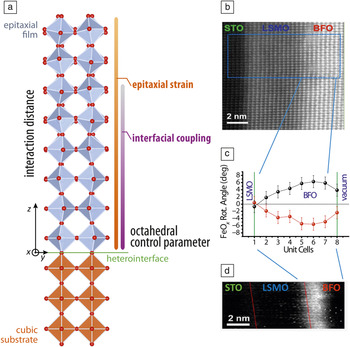
The substrate also plays a crucial role in determining the octahedral behavior of the film. In addition to imposing mechanical stresses and epitaxial strain on the film, perovskite-structured substrates also enforce a geometric constraint: the BO6 octahedra (barring oxygen vacancies) must remain corner-connected. This corner-connectivity enables the octahedral distortions and rotations present in the substrate to be transferred across the heteroepitaxial interface and imprinted into the film. In other words, there exists an octahedral proximity effect at perovskite/perovskite heterointerfaces (Figure 5).Reference Borisevich, Chang, Huijben, Oxley, Okamoto, Niranjan, Burton, Tsymbal, Chu, Yu, Ramesh, Kalinin and Pennycook78–Reference He, Borisevich, Kalinin, Pennycook and Pantelides80
A schematic illustration detailing how rotations in a film (a–a–c–pattern) might evolve with distance from a cubic substrate due to different octahedral control parameters (structural tuning knobs: epitaxial strain and/or interfacial coupling) (a). Interfacial octahedral coupling effects have been observed at a BiFeO3/La0.7Sr0.3MnO3 interface (b), in which the rotation angles of the FeO6 octahedra (odd [red] and even [black] sites of the two-dimensional map) are suppressed at the heterointerface (c). The reduced rotations lead to a near interfacial region that exhibits an anomalous dielectric response, as indicated by the non-linear behavior of the low energy component of the electron energy loss spectra (d, showing the χ2-error [weighted sum of squared errors] of the multiple linear least squares fit). Parts (b and d) reproduced from and part (c) adapted from Reference Reference Borisevich, Chang, Huijben, Oxley, Okamoto, Niranjan, Burton, Tsymbal, Chu, Yu, Ramesh, Kalinin and Pennycook78. ©2010, American Physical Society. Note: BFO, BiFeO3; LSMO, La0.7Sr0.3MnO3; and STO, SrTiO3.

Interfacial octahedral coupling provides a complementary route to the strain coupling described previously for tuning the connectivity of the functional BO6 units.Reference Jia, Mi, Faley, Poppe, Schubert and Urban41, Reference Borisevich, Chang, Huijben, Oxley, Okamoto, Niranjan, Burton, Tsymbal, Chu, Yu, Ramesh, Kalinin and Pennycook78–Reference Vlasko-Vlasov, Lin, Miller, Welp, Crabtree and Nikitenko81 Symmetry matching between the film and substrate has been shown to play a key role in stabilizing high-quality perovskite films.Reference Proffit, Jang, Lee, Nelson, Pan, Rzchowski and Eom82 However, the intentional use of a symmetry-mismatch between the substrate and film allows for the stabilization of non-equilibrium rotational patterns in the films. For example, rotations present in the low temperature, tetragonal phase of a SrTiO3 substrate were predicted to persist into a SrFeO3 film, creating an interfacial region with a symmetry that differs from bulk cubic SrFeO3.Reference Rondinelli and Spaldin79 Interfacial coupling not only modifies the octahedral response of the film, but it can also modify the atomic structure within the substrate at the heterojunction. In the SrTiO3/LaAlO3 system, scanning transmission electron microscopy (STEM) imaging revealed that the bulk-like (a–a–a–) octahedral rotations present in the LaAlO3 film propagate into a cubic (lacking rotations at room temperature) SrTiO3 substrate, altering the SrTiO3 symmetry in the three unit cells nearest the interface.Reference Jia, Mi, Faley, Poppe, Schubert and Urban41
The octahedral coupling across a perovskite heterointerface may allow for the stabilization of different lattice symmetries in films under nearly identical strain states—an inaccessible route to tailor functionality in structurally simple binary oxides and compound semiconductors. For example, consider an ultrathin rhombohedral (a–a–a–) film grown epitaxially on cubic (La1–xSrx)(Al1–yTay)O3 (LSAT) (a 0a 0a 0) and orthorhombic NdGaO3 (a–a–c+) substrates, two crystals with similar pseudocubic lattice parameters.Reference Rondinelli and Spaldin48 Each substrate may stabilize octahedral rotation patterns at the film/substrate interface that are absent in the rhombohedral film’s bulk phase. Full control of the octahedral proximity effect in this capacity remains to be exploited for realizing multifunctional heterostructures.
Interfacial octahedral coupling also provides a direct and controllable route to alter the BO6 rotation angles at the heterointerface. In situations where a rhombohedral or orthorhombic film is grown on a cubic substrate, the substrate is able to largely suppress rotations in the near interface region of the film. At the interfaces between the cubic phase of SrTiO3 and rhombohedral La0.75Sr0.25MnO3 (a–a–c–), the rotations about the [110]-direction are quenched in the manganite, while the rotations about the [001] direction are slightly enhanced.Reference He, Borisevich, Kalinin, Pennycook and Pantelides80 A similar interfacial behavior was reported for the case of orthorhombic SrRuO3 (a–a–c+) on SrTiO3.Reference He, Borisevich, Kalinin, Pennycook and Pantelides80, Reference Chang, Chang, Jang, Jeong, Jung, Kim, Chung and Noh83
The altered connectivity of the BO6 units in the interfacial region should exhibit electronic and/or ferroic behavior that differs from the non-interfacial regions of the film and its bulk counterpart. For instance, the suppression of rotations can lead to interfacial regions with anomalous dielectric behavior and a reduced bandgap, as was observed in the near-interfacial region of BiFeO3 at the BiFeO3/La0.7Sr0.3MnO3/SrTiO3 heterointerface (Figure 5b–d).Reference Borisevich, Chang, Huijben, Oxley, Okamoto, Niranjan, Burton, Tsymbal, Chu, Yu, Ramesh, Kalinin and Pennycook78 In addition to static octahedral reconstructions, the lattice vibrational (phonons) modes associated with dynamic octahedral rotations (cooperative oxygen displacements) can propagate across interfaces and produce markedly different macroscopic electronic properties. Coupling of the phonons associated with the a 0a 0c– pattern in the SrTiO3 substrate was found to increase the resistivity of an La0.53Sr0.47MnO3 film due to enhanced phonon scattering at temperatures near the cubic-to-tetragonal SrTiO3 structural phase transition.Reference Segal, Garrity, Vaz, Hoffman, Walker, Ismail-Beigi and Ahn84 This phase transition also produces long-range buckling of the SrTiO3 surface leading to anisotropic surface rumpling, a structural feature that can propagate into epitaxial films.Reference Vlasko-Vlasov, Lin, Miller, Welp, Crabtree and Nikitenko81, Reference Hoppler, Stahn, Bouyanfif, Malik, Patterson, Willmott, Cristiani, Habermeier and Bernhard85
An important aspect of engineering the octahedral proximity effect is the spatial length scale over which the octahedral patterns in the film are modified, because this is the region accessible to property control via the functional BO6 units. Although the precise distance over which the substrate-induced rotational behavior penetrates across the interface remains an open issue, early evidence suggests it is determined by the symmetries of the rotational patterns belonging to the bulk phases of the substrate and film, as well as the chemical mismatch between these materials. For instance, density functional techniques have shown that the single-axis rotations imprinted from insulating SrTiO3 into metallic SrFeO3 persist for only two unit cells about the [001]-direction,Reference Rondinelli and Spaldin79 likely a result of the weak interlayer coupling associated with the a 0a 0c– rotations about that z-direction (i.e., this rotation pattern maintains corner-connectivity across the interface independent of the rotations about the [001] direction). When the coupling involves both in- and out-of-plane rotations, however, the substrate-induced behavior is expected to persist over greater length scales. Altered octahedral behavior is reported over a five unit cell region (∼2 nm) at the SrTiO3/La0.75Sr0.25MnO3 interface.Reference He, Borisevich, Kalinin, Pennycook and Pantelides80 A similar length scale was observed with STEM for the suppression of rotations in BiFeO3 at a heterojunction with La0.7Sr0.3MnO3.Reference Borisevich, Chang, Huijben, Oxley, Okamoto, Niranjan, Burton, Tsymbal, Chu, Yu, Ramesh, Kalinin and Pennycook78 Films of SrRuO3 grown on SrTiO3 were found to exhibit a tetragonal symmetry for at least 9 unit cells before relaxing to their bulk-like orthorhombic symmetry at greater film thicknesses, suggesting that interfacial-stabilized symmetries persist over more than just a few unit cells.Reference Chang, Chang, Jang, Jeong, Jung, Kim, Chung and Noh83 The strength and length scale of interfacial octahedral coupling at structurally more complex rhombohedral/orthorhombic ([a–a–a–]/[a–a–c+]) heterointerfaces, two of the most commonly occurring symmetries in perovskites, remain to be explored.
Coherent heteroepitaxy of perovskite films requires the BO6 octahedra to both distort and rotate to maintain the corner-connected network across the substrate-film heterojunction. This requirement provides an opportunity to tailor the interfacial coupling of BO6 octahedral behavior to stabilize familiar perovskite materials with new functionalities. To effectively harness this effect requires that both the lattice parameters and symmetry of the substrate are fully considered during experimental design and analysis in addition to the processes—changes in bond lengths and bond angles and/or point and planar defect formation—by which the octahedral behavior in the film relaxes away from the substrate-induced symmetry. One important area of future study is developing a deeper understanding of the local structure in the region where the interfacial coupling effect yields to the epitaxial strain-rotation coupling—local octahedral distortions are likely required to maintain the geometric connectivity.Reference Borisevich, Chang, Huijben, Oxley, Okamoto, Niranjan, Burton, Tsymbal, Chu, Yu, Ramesh, Kalinin and Pennycook78 A greater understanding of the role played by the electronic structure of the two materials—whether a metal/metal, insulator/metal, or insulator/insulator heterointerface exists—is also likely a critical aspect to realizing the full potential of this design approach.
Rotational behavior in synthetic superlattices
The octahedral proximity effect identified at the substrate/film interface can be additionally exploited for rational control of the BO6 octahedral units in ways not available to single layer films or simple heterojunctions. The formation of short-period coherent superlattices and multilayer heterostructures—consisting of two materials with different transition metal cations (B and B’) and dissimilar BO6 and B’O6 rotational symmetries and/or magnitudes at a periodicity shorter than the length scale associated with relaxation of the proximity effect—makes it possible to either (1) maximize the interfacial octahedral coupling effect in short-period superlattices, or (2) spatially localize the non-equilibrium octahedral behavior, realizing a form of rotational “δ-doping,” described more thoroughly later. Both routes afford control of the octahedral behavior in synthetic heterostructures through changes in the relative number of constituent repeat units (and their composition) in the heterostructure—parameters selected prior to materials synthesis and thus amenable to rational property design.
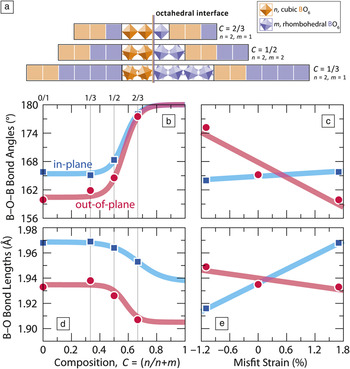
Tuning the ratio of the BO6 and B’O6 octahedra in a superlattice provides direct control over the octahedral shape and connectivity in a fundamentally different fashion than that available to simple fixed-composition and epitaxially strained films. Consider, for example, different period (n,m)-superlattices formed from cubic (n) and rhombohedral (m) perovskites with the a 0a 0a 0 and a–a–c– patterns (Figure 6a), respectively. The overall superlattice composition derived from the number of n and m building blocks, given as C = n/(n+m), emerges as a new variable to tune the octahedral connectivity through the proximity effect. Increasing the composition C→1 at fixed m, for example, favors the non-tilted octahedral geometry. The proximity effect derived from the cubic perovskites blocks (n) suppresses the preference for rotations in the rhombohedral (m) blocks. As a result, all inter-octahedral B–O–B bond angles increase toward 180° in the superlattice (Figure 6b). This is unlike the strain–octahedral rotation coupling where a decrease (increase) in the in-plane bond angle is usually accommodated by an increase (decrease) in the out-of-plane bond angle (Figure 6c), thereby maintaining the net magnitude of the octahedral rotation system as nearly constant. The compositional control in the superlattice enables a net reduction or enhancement in the total rotation amplitude. Due to the corner-connectivity of the perovskite structure, this net change in octahedral rotation magnitude forces cooperative compression (or elongation) of all B–O bonds (Figure 6d), contrasting the compensating and anisotropic behavior observed in strained films (Figure 6e).
A schematic illustrating octahedral rotational control in short-period perovskite superlattices consisting of cubic and rhombohedral constituents of varying thickness (a). In (b and c), the bond angles in (SrMnO3)n/(LaNiO3)m superlattices and strained LaNiO3 films are compared showing the distinct octahedral responses to superlattice formation at varying composition (left panels) and epitaxial strain at fixed composition (right panels). The behavior of the B–O bond lengths for the same set of superlattices and films are shown in (d and e). Altering the superlattice composition makes it possible to decrease (or increase) both the in-plane and out-of-plane structural features simultaneously; in contrast, a decrease (increase) of an in-plane structural feature from epitaxial strain is compensated by an increase (decrease) in the corresponding out-of-plane feature. Data adapted from References Reference Dabrowski, Kolesnik, Baszczuk, Chmaissem, Maxwell and Mais35 and Reference May, Smith, Kim, Karapetrova, Bhattacharya and Ryan86. Note: C, overall superlattice composition.

This tuning of the bond lengths and angles through superlattice composition control has recently been demonstrated in (LaNiO3)m/(SrMnO3)2 superlattices.Reference May, Smith, Kim, Karapetrova, Bhattacharya and Ryan86 For superlattices with m = 1, the rotations are strongly suppressed (SrMnO3 is cubic) and yields ultrathin nickelate layers exhibiting octahedral behavior that is markedly different from the bulk—the NiO6 rotations are almost completely absent. In contrast, large rotations are induced in the SrMnO3 layers for the case of m = 4. As a result, direct tuning of structure-driven electronic properties should be accessible using this superlattice approach. Indeed, variable composition SrTiO3/SrFeO3 superlattices exhibit remarkably different octahedral size, shape, and connectivity with corresponding metal-insulator transitions and orbital polarizations.Reference Rondinelli and Spaldin87 First-principles calculations of LaNiO3/LaAlO3 superlattices also reveal a strong coupling between the electronic structure and octahedral behavior.Reference Blanca-Romero and Pentcheva88 Furthermore, the formation of ultrashort n = m = 1 superlattices with perovskite constituents that have different octahedral rotations patterns appears to be an emerging strategy for realizing novel forms of improper ferroelectricity (i.e., the primary order parameter for the phase transition is not the ferroelectric polarization).Reference Benedek and Fennie89 A polarization enhancement occurs in ultrashort 1/1 period SrTiO3/PbTiO3 superlattices simultaneously with a modulation in the a 0a 0c– rotation magnitude in SrTiO3 from the heterointerface proximity effect with PbTiO3.Reference Muller47 Such unusual forms of ferroelectricity are crucial for realizing temperature-independent dielectric properties for thin-film capacitor applications.
The unit cell-by-unit cell growth of oxide heterostructures allows for δ-doping of chemically and structurally distinct single BO6 monolayers. These approaches, which were originally employed in conventional semiconductor heterostructures,Reference Dingle, Stormer, Gossard and Wiegmann90 are actively being pursued in perovskite oxides as a route to enhance carrier mobility and tune magnetic interactions.Reference Kozuka, Kim, Ohta, Hikita, Bell and Hwang91–Reference Jalan, Stemmer, Mack and Allen93 Using the rotational proximity effect in a digitally ordered superlattice allows a perovskite, which exhibits large octahedral rotations in the bulk, to be sandwiched within a material with no tendency to rotations (i.e., n ≫ m, m = 1). The spatially confined BO6 rotation layer, or δ-doped rotation, which occurs simultaneously with A-site cation substitution, enables direct charge-carrier doping and electronic control in the octahedrally doped region. This strategy was recently demonstrated in a series of uniformly strained SrTiO3/LaAlO3 heterojunctions, interleaved with different single layer A3+AlO3 unit cells with larger octahedral rotations (decreasing rare-earth ionic radii), to be a remarkably powerful route to tune a metal-insulator transition in a buried two-dimensional electron gas.Reference Jang, Felker, Bark, Wang, Niranjan, Nelson, Zhang, Su, Folkman, Baek, Lee, Janicka, Zhu, Pan, Fong, Tsymbal, Rzchowski and Eom94
Another intriguing line of study made possible by these octahedral engineering approaches is the formation of rotational superstructures that exhibit spatially modulated rotational magnitudes or rotational periods much longer than two unit cells. Such a structure could be realized in superlattices by tuning the constituent layer thicknesses, allowing partial relaxation of the octahedral rotations between the interfaces. These superstructures may give rise to novel modulated magnetic and electronic behavior. Additionally, the importance of covalent interactions in perovskites for stabilizing rotational patternsReference Garcia-Fernandez, Aramburu, Barriuso and Moreno95 suggests that the formation of artificially structured oxides in which the constituent compounds exhibit dramatically different electronic structures could yield novel octahedral behavior. The abrupt changes in covalency among the chemically distinct layers could be used to realize particular rotation patterns and, in turn, desired material properties.
Summary and prospects
Tailoring the size, shape, and connectivity of functional BO6 units is crucial to engineering material properties in perovskites. The thermal, electric, and magnetic responses are all strongly linked to changes in the atomic structure. We have illustrated the principal routes by which direct control over the connectivity of the octahedral structure is possible using epitaxial constraints. This offers exciting opportunities to achieve desired properties in targeted compositions and the possibility of generating new ground-states unavailable in the bulk counterparts. However, a multifunctional material should be responsive to a variety of external stimuli (e.g., pressure, strain, chemical, optical, electric, and magnetic). The direct routes we have described for tuning the octahedral connectivity make it possible to position many transition metal perovskite oxides closer to functional phase boundaries where external perturbations may be used to traverse and induce colossal responses.
Consider the case of coupling to external electric fields, especially in lieu of the desire to utilize complex transition metal oxides as low-power electronic materials,Reference Mannhart and Schlom96 where the property-determining rotations should be electric-field addressable. In simple perovskites, the individual octahedra and their broader connectivity couple weakly (if at all) to external electric fields—a consequence of the geometric centricity of the BO6 units. This raises a critical challenge for the discovery of new multifunctional electric-field tunable oxides: Are there synthetic perovskite assembly routes that permit combinations of BO6 octahedra to induce polarizations? Such questions are intensely being studied, and materials design guidelines for engineering BO6 octahedra that respond to electric fields are at present being identified;Reference Muller47, Reference Benedek and Fennie89, Reference Stroppa, Fukushima, Picozzi and Perez-Mato97–Reference Rondinelli and Fennie99 quasi-two dimensionality or “layering” achieved through A-site cation ordering and particular orthorhombic rotation systems appear promising. Strategies for external control of rotations may also arise from a recently developed system for describing rotational symmetry operations.Reference Gopalan and Litvin100 Another route to control the octahedral rotations relies on the piezoelectric effect in heterostructures integrating piezoelectric substrates or interfacial layers:Reference Rata, Herklotz, Nenkov, Schultz and Dorr101 Application of an electric field induces a lattice distortion, which modifies the strain state, and in turn the octahedral rotation magnitudes through strain–rotation coupling. Additional opportunities for dynamical control of structure arise from photostrictionReference Korff Schmising, Harpoeth, Zhavoronkov, Ansari, Aku-Leh, Woerner, Elsaesser, Bargheer, Schmidbauer, Vrejoiu, Hesse and Alexe102 or harnessing direct phonon coupling with THz radiation.Reference Rini, Tobey, Dean, Itatani, Tomioka, Tokura, Schoenlein and Cavalleri103, Reference Fausti, Tobey, Dean, Kaiser, Dienst, Hoffmann, Pyon, Takayama, Takagi and Cavalleri104
To fully exploit these emerging design approaches requires addressing several fundamental questions: What are the critical parameters that determine the octahedral behavior in a film under epitaxial strain or across a heterointerface with a symmetry mismatch? What are the length scales and mechanisms associated with relaxation of substrate-induced octahedral behavior? To what extent is it possible to separate cation composition and material symmetry? How can octahedral behavior be controlled independently along both in-plane and out-of-plane directions? How do defects inhibit the strategies described herein to control octahedral connectivity? We anticipate that great strides will be made in addressing these questions over the next decade, and in the process, materials scientists will establish new strategies for structure-driven control of functional properties in complex oxide heterostructures.
Acknowledgments
The authors would like to acknowledge fruitful discussions with K.R. Poeppelmeier, C.J. Fennie, P.M. Woodward, D.D. Fong, P.J. Ryan, and A.Y. Borisevich. S.J.M. and J.M.R. gratefully acknowledge support from the Office of Naval Research (ONR N00014–11–1-0664). J.W.F. was supported by the U.S. DOE, Basic Energy Sciences, under U.S. DOE, Office of Basic Energy Sciences, under Contract No. DE-AC02–06CH11357.
 James M. Rondinelli is an assistant professor at Drexel University in the Materials Science and Engineering Department. He received his PhD degree in materials science from the University of California–Santa Barbara (2010) under the supervision of Nicola Spaldin, followed by the Joseph Katz Distinguished Postdoctoral Fellowship at Argonne National Laboratory (2011). Rondinelli’s main research interests are in the first-principles design and understanding of complex oxide- and fluoride-based materials for sustainable energy technologies and next-generation low-power electronic devices. Rondinelli can be reached by phone at 215-571-3671 and email jrondinelli@coe.drexel.edu.
 Steven J. May is an assistant professor at Drexel University in the Materials Science and Engineering Department. He received his PhD degree in the field of materials science and engineering from Northwestern University in 2007. He was a postdoctoral researcher at Argonne National Laboratory from 2007 to 2009 in the Magnetic Thin Films group within the Materials Science Division. At Drexel, May’s research is focused on the synthesis and characterization of complex oxide heterostructures for electronics and energy generation. May can be reached by phone at 215-571-3650 and email smay@coe.drexel.edu.
 John W. Freeland is a staff scientist at Argonne National Laboratory. He received his PhD degree in condensed matter physics from Johns Hopkins University in 1996. From 1996 until 1998, he was a National Research Council Fellow at the Naval Research Laboratory. At Argonne, his research has focused on harnessing advanced probes to study surface and interface phenomena in complex oxide heterostructures. Freeland can be reached by phone at 630-252-9614 and email freeland@anl.gov.