INTRODUCTION
The pelagic habitat of the deep sea is the largest and least explored environment on our planet (Herring, Reference Herring2002; Robison, Reference Robison2004). The dimly lit subsection of this habitat called the mesopelagic, or twilight zone, comprises a vast swath from 200 to 1000 m depth. In the upper reaches of the mesopelagic, about 1% of sunlight from the surface waters is still present, though very diffuse (Lythgoe, Reference Lythgoe, Atema, Fay, Popper and Tavolga1988; Robison, Reference Robison1999). In response to this light source, and the light produced by bioluminescent organisms in this habitat, many mesopelagic animals possess vision as a crucial sensory system component (Lythgoe, Reference Lythgoe, Atema, Fay, Popper and Tavolga1988; Robison, Reference Robison1999, Reference Robison2004; Herring, Reference Herring2002). Cephalopods are one group of such animals. Since the Cretaceous period, coleoid cephalopods are believed to have comprised a significant portion of the mesopelagic community, often accounting for a majority of the biomass in a given mesopelagic habitat (Rodhouse & Nigmatullin, Reference Rodhouse and Nigmatullin1996; Bush & Robison, Reference Bush and Robison2007; Arkhipkin et al., Reference Arkhipkin, Bizikov and Fuchs2012; Young et al., Reference Young, Vecchione and Mangold2012).
Mesopelagic cephalopods possess many morphological and behavioural adaptations to avoid detection by a host of predators including pelagic fishes, pinnipeds, cetaceans, seabirds and other cephalopods (Clarke, Reference Clarke1996; Croxall & Prince, Reference Croxall and Prince1996; Klages, Reference Klages1996; Smale, Reference Smale1996). For example, in the upper mesopelagic, cephalopods have transparent bodies, silvering, and downward-directed bioluminescence to break up their silhouettes (Herring, Reference Herring2002). At depths around 600 m, or the mid-mesopelagic, cephalopod bodies are generally less transparent while the number and density of brown, orange and red body chromatophores increases (Robison, Reference Robison1999; Herring, Reference Herring2002). Many mesopelagic squids also undertake diel vertical migrations, staying deeper during the day in order to avoid detection by visually cued predators, and returning to shallower depths during the night (Rodhouse & Nigmatullin, Reference Rodhouse and Nigmatullin1996; Robison, Reference Robison2003).
Because of the restricted light regime of their habitat, the visual components of deep-sea cephalopod behaviour were not expected to include the more complex visual communication behaviours similar to those utilized by their shallow-water counterparts (Hanlon & Messenger, Reference Hanlon and Messenger1996; Nixon & Young, Reference Nixon and Young2003). However, recent evidence suggests otherwise. Bush & Robison (Reference Bush and Robison2007) found that many deep-sea squids produce six or more different ink release types among them, some of which had never been described even in shallow-water cephalopods. Also, Bush et al. (Reference Bush, Robison and Caldwell2009) described 59 unique chromatic, postural, locomotor and bioluminescent behavioural components performed by the mesopelagic squid Octopoteuthis deletron. This total is comparable to or exceeds the number of unique components in ethograms constructed for shallow-water species of squid (Hanlon et al., Reference Hanlon, Smale and Sauer1994, Reference Hanlon, Maxwell, Shashar, Loew and Boyle1999; Jantzen & Havenhand, Reference Jantzen and Havenhand2003; Bush et al., Reference Bush, Robison and Caldwell2009).
The limited light regime of the mesopelagic depth range is well suited for visual mimicry, the ecological condition in which the two or more participants appear similar, as this similarity protects one or both participants (Pasteur, Reference Pasteur1982; Robison, Reference Robison1999; Herring, Reference Herring2002). In animal mimicry systems, there are three participants: the model (agent producing detectable stimuli or signals), the mimic (organism plagiarizing the model's signals) and the dupe (animal receiving and being deceived by mimic's deceptive stimuli) (Pasteur, Reference Pasteur1982). For protective mimicry to be successful, the habitat must contain an abundance of unpalatable models. An abundance and diversity of gelatinous fauna, including medusae, ctenophores and salps, constitute potential models in this locality; they not only lack sufficient nutrient density to make them worthwhile targets for most active predators, but the medusae also possess abundant stinging nematocysts (Robison, Reference Robison1999). Possible cases of medusa mimicry in fishes, chaetognaths, tomopterids and appendicularians have been documented in Monterey Bay (Robison, Reference Robison1999). In addition, Bush & Robison (Reference Bush and Robison2007) suggest that the ink ropes produced by the mesopelagic squid Gonatus onyx might resemble various species of elongate siphonophores which populate this midwater habitat. Gonatus spp. larvae have also been hypothesized to mimic small jellyfishes in other mesopelagic habitats when they curl their head, arms and tentacles inside their mantle cavity as a threat response (Arkhipkin & Bizikov, Reference Arkhipkin and Bizikov1996).
Since the advent of deep sea observation and exploration utilizing remotely operated vehicles (ROVs) in Monterey Bay, one particular squid has been hypothesized to be a developmental mimic, or morphologically fixed mimic during a certain life stage (Pasteur, Reference Pasteur1982), in this locality. Chiroteuthis calyx (Young, Reference Young1972) is an abundant mesopelagic squid inhabiting the temperate waters of the North Pacific (Roper & Young, Reference Roper and Young2013). It is commonly known as the swordtail squid, owing to the large ornamented extension of the gladius, or tail, that only the juvenile (doratopsis) life stage possesses (Roper & Young, Reference Roper and Young2013). An intact tail more than doubles the length of the animal and provides buoyancy and stability via increased surface area and ammonium content (Seibel et al., Reference Seibel, Goffred, Thuesen, Childress and Robison2004). The tail also gives the squid a resemblance to the nematocyst-laden physonect siphonophore, Nanomia bijuga – the hypothesized mimicry model of juvenile C. calyx and an abundant and active predator inhabiting a similar depth range (Robison et al., Reference Robison, Reisenbichler, Sherlock, Silguero and Chavez1998). When observed in situ, all physonect siphonophores, including N. bijuga, appear to be divided into two general regions (excluding the pneumatophore): the nectosome, which contains the swimming bells, and the siphosome, which includes all other colonial parts of the organism (Mackie et al., Reference Mackie, Pugh and Purcell1987). The tail of a juvenile C. calyx and the elongate siphosome of N. bijuga appear similar, as do the body of a juvenile C. calyx and the nectosome of N. bijuga. Aside from morphological comparisons, no specific evaluations have been made to explore this potential siphonophore mimicry by a cephalopod (Vecchione et al., Reference Vecchione, Robison and Roper1992; Hunt, Reference Hunt1996; Seibel et al., Reference Seibel, Goffred, Thuesen, Childress and Robison2004; Bush & Robison, Reference Bush and Robison2007; Roper & Young, Reference Roper and Young2013).
General aspects of morphology are consistent across ontogonetic stages in C. calyx. Both juveniles and subadults have four pairs of arms with pronounced arm keels; each successive arm pair is larger than the pair preceding it; the first pair is the smallest and the fourth pair the largest (Vecchione et al., Reference Vecchione, Robison and Roper1992). Two extensible feeding tentacles rest within sheathing grooves on the fourth arms that, when fully deployed, are almost twice the length of the entire animal (Vecchione et al., Reference Vecchione, Robison and Roper1992; Hunt, Reference Hunt1996). Photophores are found along the lengths of the tentacle stalks and fourth arms, on the tentacle clubs and on the ventral surface of the ink sac and eyes (Vecchione et al., Reference Vecchione, Robison and Roper1992; Hunt, Reference Hunt1996; Herring, Reference Herring2002; Roper & Young, Reference Roper and Young2013); all can be exposed or concealed by contracting or expanding the surrounding chromatophores. The dorsal surface of the animal is covered by chromatophores from tail tip to tentacle tips, with reduced coverage on the ventral and lateral surfaces. Chromatophores are arranged into distinct cohorts on the tail, mantle, neck, head, arms and tentacles (Hunt, Reference Hunt1996). All cohorts of chromatophores can be expanded or contracted individually or in unison (Vecchione et al., Reference Vecchione, Robison and Roper1992; Hunt, Reference Hunt1996; Bush & Robison, Reference Bush and Robison2007).
Chiroteuthis calyx undergoes a remarkable morphological transformation as it ages (Hunt, Reference Hunt1996). The doratopsis life stage is characterized by a long, ornate tail, an elongate brachial pillar, neck and mantle; there are fewer chromatophores than in subadults and adults and the chromatophores are an orange-brown colour (Vecchione et al., Reference Vecchione, Robison and Roper1992; Hunt, Reference Hunt1996; Robison, Reference Robison2004). As the animal progresses into its subadult form, the tail is significantly shortened and/or eventually lost (Hunt, Reference Hunt1996), the brachial pillar becomes proportionally shorter, the neck virtually disappears (Hunt, Reference Hunt1996; Bush & Robison, Reference Bush and Robison2007), the mantle becomes relatively shorter, the arms (particularly the fourth pair) become longer and more robust (Hunt, Reference Hunt1996; Seibel et al., Reference Seibel, Goffred, Thuesen, Childress and Robison2004), the arm keels become more expansive and the chromatophores take on a darker shade of red and become more numerous (Vecchione et al., Reference Vecchione, Robison and Roper1992). The presence of developed gonads would indicate sexual maturity and thus the adult life stage, but a sexually mature specimen has yet to be observed in situ (Hoving, personal communication). Accompanying these dramatic morphological changes is a change in habitat: C. calyx undertakes an ontogenic migration, increasing its depth of residence as it ages (Hunt, Reference Hunt1996). In addition, C. calyx is thought to undertake diel vertical migrations during the juvenile and subadult life stages (Hunt, Reference Hunt1996; Katugin & Zuev, Reference Katugin and Zuev2007).
Coinciding with the morphological and habitat changes are many behavioural changes. Vecchione et al. (Reference Vecchione, Robison and Roper1992) examined the behaviour of the juvenile stage, noting their typical orientation in the water column, a characteristic escape reaction, an inking pattern and light and dark patterns created by the juvenile's chromatophores and photophores. Hunt (Reference Hunt1996) described a horizontal foraging behaviour seen in both juvenile and subadult C. calyx, he recounted behaviours associated with inking displays and elaborated on juvenile and adult chromatophore and photophore use. Bush & Robison (Reference Bush and Robison2007) described more ink patterns utilized by juveniles and subadults and mentioned some typical threat response patterns elicited in subadults and juveniles by an approaching ROV. So far, very few in-depth behavioural studies have been conducted on mesopelagic squid (Bush et al., Reference Bush, Robison and Caldwell2009) and no thorough investigation of C. calyx behaviour has been performed, even though it is one of the most common squids in the mesopelagic habitat of the North Pacific. Accordingly, the goals of our study were to (1) construct an ethogram for C. calyx and thus demonstrate that this species has a repertoire of behaviours comparable to its shallow- and deep-water counterparts and (2) offer evidence in support of the long-standing hypothesis that C. calyx juveniles mimic N. bijuga.
MATERIALS AND METHODS
Behavioural ethogram for Chiroteuthis calyx
To construct a behavioural ethogram for C. calyx, 46 individuals of this species (23 juveniles and 23 subadults) were observed in situ, comprising over 220 min of dive footage recorded from 33 dives performed by three ROVs operated by the Monterey Bay Aquarium Research Institute (MBARI): ‘Ventana’ (electro-hydraulic), ‘Tiburon’ (1996–2008; electric), and ‘Doc Ricketts’ (electro-hydraulic). All three vehicles are outfitted with high definition (HD) cameras and HID lamps capable of producing illumination in the daylight range. At the beginning of every dive, the recording camera is given a white balance to ensure accurate colouration. All ROV dive footage is recorded on Panasonic D5 HD videocassettes and/or Sony Digital Betacam standard definition (SD) videocassettes, contributing to the collection of over 18 000 h of ROV footage taken from the past 23 years in the Monterey Submarine Canyon and surrounding waters. Captured footage is annotated by scientists and video-lab staff who record all of the organisms encountered during the dives using MBARI-designed Video Annotation Reference System (VARS) software; these annotations are synchronized with hydrographic parameters, such as depth, temperature, salinity and oxygen concentration, to ensure maximum utility (Schlining & Stout, Reference Schlining and Stout2006).
Dive footage was viewed directly from ROV dive tapes on a Sony HR Trinitron monitor or a Sony MEU-WX2 Multiformat Engine and LMD-232W LCD monitor. Monitor settings maintained the accurate colouration established at the beginning of each dive. All recordings of C. calyx selected for observation were examined many times at normal and slow playback speeds to ensure accurate behaviour description. All behavioural components of C. calyx were categorized into one of four component types: postural, chromatic, bioluminescent and locomotor (see Bush et al., Reference Bush, Robison and Caldwell2009). These components were then used to describe behavioural sequences commonly observed in C. calyx. Every individual's ontogenetic stage was determined based on morphology: juveniles were identified by the possession of all or some of a tail and subadults were identified by the complete lack, or only very minute remnants of the proximal base of the tail. All behavioural components were recorded as present or absent during every C. calyx observation. The resulting presence/absence data matrix was examined using a non-metric multi-dimensional scaling (NMDS) ordination, in PRIMER, to explore behavioural similarities between juvenile and subadult C. calyx (Clarke & Gorley, Reference Clarke and Gorley2006). In this case, ‘stress’ is a measure of the difficulty that PRIMER had distinguishing between the behavioural sequences performed by the juveniles and subadults; the lower the stress, the easier it was for the program to fit the data points in two- or three-dimensional space.
In situ experiments (in compliance with research permits) were performed during several ROV dives. These experiments included removing the juvenile's tail via ROV contact to identify physiological aspects of the tail, including buoyancy and post-separation colour-changing ability, as well as behavioural changes of juveniles after losing the tail. Laboratory observations of three juvenile specimens and one subadult captured by the ROVs also provided data on behavioural elements. These specimens were kept alive in a dark, refrigerated room (5°C) in planktonkreisel tanks, which are designed to simulate the midwater environment (Hamner, Reference Hamner1990). Laboratory specimens were observed: (1) under red lighting with naked eyes, (2) with minimal fluorescent lighting and night vision goggles, and (3) under infrared lighting with a Canon XL1 digital video camcorder equipped with an AstroScope night vision module. The latter techniques proved to be the most successful method of observation.
We follow the same naming conventions in our ethogram for C. calyx as used in ethograms for other squids from both shallow- and deep-water environments. A ‘body pattern’ refers to the overall appearance of an individual at any point in time (Hanlon et al., Reference Hanlon, Smale and Sauer1994; Bush et al., Reference Bush, Robison and Caldwell2009). Body patterns are combinations of postural, chromatic and locomotor ‘behavioural components’ in all squids (Hanlon et al., Reference Hanlon, Smale and Sauer1994; Bush et al., Reference Bush, Robison and Caldwell2009); bioluminescent components also comprise part of the body pattern repertoires of some deep-sea species such as C. calyx (Bush et al., Reference Bush, Robison and Caldwell2009). Finally, ‘behavioural sequences’ are progressions of body patterns (Vecchione, personal communication).
Orientation study of C. calyx and Nanomia bijuga
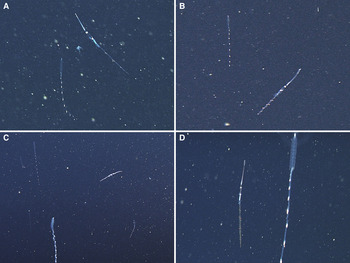
To test the hypothesis that juvenile C. calyx mimic N. bijuga, we compared the body orientations of juvenile and subadult C. calyx with those of N. bijuga in video footage of ROV encounters with both species. For this study, we used only footage recorded when the ROV was travelling quickly enough to document behaviour with the least disturbance possible. We examined 112 min of such footage from 37 ROV dives from 2005–2013 that documented C. calyx at 400 and at 500 m, the depths where the C. calyx juvenile and subadult life stages commonly co-occur with N. bijuga. From this footage, we recorded the tail orientation and depth (400 or 500 m) of 28 juvenile and 28 subadult C. calyx. We then examined the siphosome orientation and depth of all N. bijuga that appeared within the minute prior to and following every C. calyx encounter; a total of 1260 N. bijuga. The siphosome orientation was the approximate direction (up, intermediate or down) that the siphosome was pointed when a N. bijuga was encountered by the ROV. The tail orientation was the approximate direction (up, intermediate or down) that the tail (or posterior mantle tip if subadult) was pointed when a C. calyx was encountered by the ROV. The orientation ‘up’ occurred when the tail or siphosome clearly pointed at an angle greater than 25° above the horizontal, the orientation ‘intermediate’ occurred when the tail or siphosome was horizontal or not clearly pointing up or down, and the orientation ‘down’ occurred when the tail or siphosome clearly pointed at an angle greater than 25° below the horizontal (Figure 1). We examined similarities in the orientation of N. bijuga and C. calyx within and between depths using several two-way analyses of variance (ANOVAs). We tested the null hypothesis that orientation did not vary based on depth with a two-way ANOVA. Since we were unable to reject the null hypothesis (P > 0.5), the depth of occurrence was not considered to be significant and the data from both depths were pooled.
Juvenile Chiroteuthis calyx and Nanomia bijuga in similar orientations. (A) Juvenile C. calyx oriented tail-down and N. bijuga oriented siphosome-down. (B) Juvenile C. calyx oriented tail-down and N. bijuga oriented siphosome-down. (C) Juvenile C. calyx oriented tail-intermediate and several N. bijuga oriented siphosome-down. (D) Juvenile C. calyx oriented tail-down and N. bijuga oriented siphosome-down.

RESULTS
Behavioural ethogram for Chiroteuthis calyx
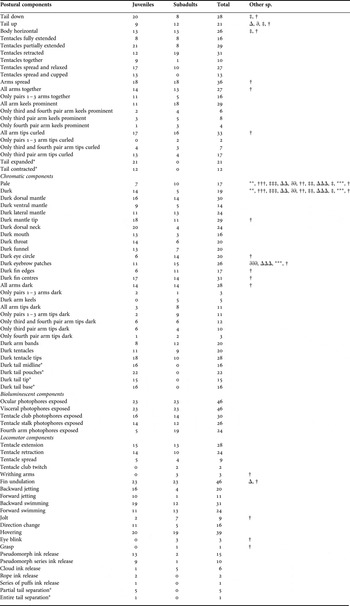
This ethogram is based on in situ observations of 23 juveniles and 23 subadults. Each behavioural component we identified is named and briefly described. The numbers of juveniles and subadults observed performing each component are listed in parentheses after the name. Behavioural components are subdivided into four categories: postural, chromatic, bioluminescent and locomotor; the total number of components within each subdivision is indicated by the number in parentheses after the category headings. See Table 1 for references to other species that perform similar components. Body patterns have their own subsection at the end of the ethogram, their descriptions consisting of behavioural components.
Number of Chiroteuthis calyx juveniles and subadults observed performing each of the 78 behavioural components complimented with papers referring to other species performing similar components. All behavioural components are ranked within their respective categories by behavioural similarity.

*Behavioural component that requires the possession of a tail in order to perform, and not included in NMDS analysis.
**Hanlon (Reference Hanlon1982) (Loligo plei).
†††Lipinski (Reference Lipinski1985) (Alloteuthis subulata).
‡‡‡Mauris (Reference Mauris1989) (Sepiola affinis).
ΔΔPorteiro et al. (Reference Porteiro, Martins and Hanlon1990) (Loligo forbesi).
∂∂Hanlon et al. (Reference Hanlon, Smale and Sauer1994) (Loligo vulgaris reynaudii).
∂∂∂Hunt (Reference Hunt1996) (Galiteuthis phyllura).
ΔRoper & Vecchione (Reference Roper and Vecchione1997) (Mastigoteuthis spp.).
∂Young et al. (Reference Young, Vecchione and Donovan1998) (Mastigoteuthis spp.).
††Hanlon et al. (Reference Hanlon, Maxwell, Shashar, Loew and Boyle1999) (Loligo pealei).
‡‡Hunt et al. (Reference Hunt, Zeidberg, Hamner and Robison2000) (Loligo opalescens).
ΔΔΔHunt & Seibel (Reference Hunt and Seibel2000) (Gonatus onyx).
‡Vecchione et al. (Reference Vecchione, Roper, Widder and Frank2002) (Mastigoteuthis spp.).
***Jantzen & Havenhand (Reference Jantzen and Havenhand2003) (Sepioteuthis australis).
†Bush et al. (Reference Bush, Robison and Caldwell2009) (Octopoteuthis deletron).
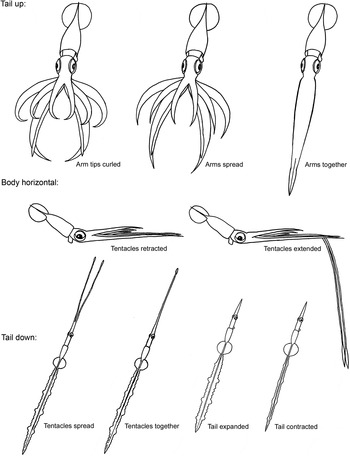
POSTURAL COMPONENTS (22; FIGURE 2)
Tail down (20, 8): The tail or posterior mantle tip is pointed down and the rest of the animal is oriented in a vertical or nearly vertical position
Postural components of Chiroteuthis calyx.

Tail up (9, 12): The tail or posterior mantle tip is pointed up and the rest of the animal is oriented in a near horizontal to vertical position.
Body horizontal (13, 13): The squid's dorsal mantle is up and the body axis is oriented horizontally in the water column.
Tentacles extended: Both of the feeding tentacle clubs and much of the tentacle stalks are released beyond the grooves of the sheathing fourth arms, often hanging beneath the arms or trailing anteriorly to the arms as the animal swims tail-first. Tentacles can be either (a) fully (8, 8) extended, with the length of tentacle stalk released greater than the length of the fourth arm, or (b) partially (21, 8) extended, with the length of tentacle stalk released equal to or less than the length of the fourth arm. This posture has been noted previously (Vecchione et al., Reference Vecchione, Robison and Roper1992).
Tentacles retracted (12, 19): Both of the feeding tentacle stalks and much, if not all, of the tentacle clubs are completely held within the tentacle-sheathing, fourth arm grooves; noted previously by Vecchione et al. (Reference Vecchione, Robison and Roper1992).
Tentacles together (9, 1): While tentacles are extended, they align in a straight line with the mantle and tail, touching along their entire length; cited previously by Vecchione et al. (Reference Vecchione, Robison and Roper1992).
Tentacles spread: While tentacles are extended, they remain separated along their entire length. In this posture, the tentacles are (a) relaxed (17, 10), and straight and flaccid while spread, or (b) cupped (13, 0) so that the distal portion of the tentacles curve outward and then inward; this almost points the distal tips of the clubs at each other with the space they encompass oval in shape. This posture (a) has been previously cited (Vecchione et al., Reference Vecchione, Robison and Roper1992).
Arms spread (18, 18): Each of the four pairs of arms is oriented such that each arm of a pair angles away from its counterpart while touching only proximally at their base, making a ‘v’ or ‘u’ shape. The first pair sits atop the second, the second above the third, and the third over the fourth. In this posture, each pair of arms can be in its own horizontal plane, or the first three pairs of arms can be spread in the same horizontal plane, with the fourth pair immediately below the first three. This posture has been noted previously (Vecchione et al., Reference Vecchione, Robison and Roper1992).
Arms together: Arms are held together across their entire length in line with body, thus producing a tapering point from their proximal end to their distal tips. Either (a) all of the arms (14, 13) are held together across their entire length, or (b) only the first–third pairs (11, 5) are held together while the fourth pair is spread to a minimal, but varying degree. This posture has been previously noted (Vecchione et al., Reference Vecchione, Robison and Roper1992).
Arm keels prominent: Arms have their keels stretched to their full width, thus maximizing the surface area of the animal. This can occur where either (a) all pairs (11, 18) of arms have prominent keels, (b) only the third and fourth pairs (2, 4) have prominent keels, (c) only the third pair (3, 5) has prominent keels, or (d) only the fourth pair (1, 3) arms has prominent keels.
Arm tips curled: While arms are spread or together, the tips of the arms curve inward toward the buccal cavity of the squid. This can occur where either (a) all pairs (17, 16) of arms are curled, (b) only the first – third pairs (0, 2) are curled, (c) only the third and fourth pairs (4, 3) are curled, or (d) only the third pair (13, 4) is curled. This posture (a) has been cited previously by Bush & Robison (Reference Bush and Robison2007) and often occurs while arm keels are prominent.
Tail expanded (21): Tissue attached to the gladius of the tail is stretched to its full potential width, making the tail wider in appearance. This postural component is unique to juveniles, as subadults do not possess a tail.
Tail contracted (12): Tissue attached to the extended gladius of the tail is constricted to its minimal width, making the tail narrower in appearance; unique to juveniles.
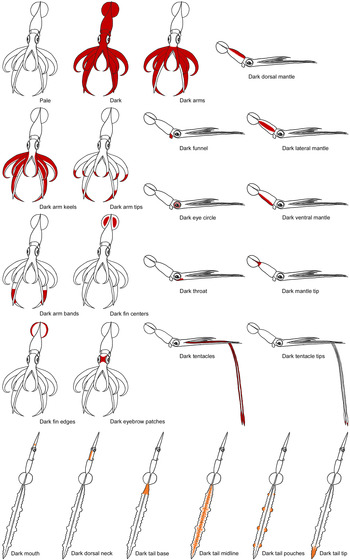
CHROMATIC COMPONENTS (29; FIGURE 3)
Pale (7, 10): No chromatophores on the entire animal are expanded, resulting in a mostly transparent appearance in juveniles and young subadults, and an opaque appearance in older subadults.
Chromatic components of Chiroteuthis calyx.

Dark (14, 5): All chromatophores on the entire animal are expanded, thus making the squid appear to be mostly brown-orange (if juvenile) to dark-red (if subadult) (Vecchione et al., Reference Vecchione, Robison and Roper1992; Hunt, Reference Hunt1996).
Dark dorsal mantle (16, 14): Chromatophores along the dorsal midline of the mantle are expanded, thus creating a brown-orange to dark-red stripe running from the posterior tip to the anterior edge of the mantle and above the internal digestive gland, organs and gills; previously noted by Vecchione et al. (Reference Vecchione, Robison and Roper1992), Hunt (Reference Hunt1996) and Bush & Robison (Reference Bush and Robison2007).
Dark ventral mantle (9, 5): Chromatophores along the ventral midline of the mantle are expanded, thus forming a brown-orange to dark-red patch below the internal digestive gland, organs, and gills. Vecchione et al. (Reference Vecchione, Robison and Roper1992) and Hunt (Reference Hunt1996) described patches of chromatophores on the mantle in this vicinity.
Dark lateral mantle (11, 13): Chromatophores along the lateral surface of the mantle are expanded, thus making a brown-orange to dark-red patch in the gill region at the anterior end of the mantle, with speckling to the posterior end. The presence of chromatophores in this vicinity has been previously cited by Vecchione et al. (Reference Vecchione, Robison and Roper1992).
Dark mantle tip (18, 11): Chromatophores at the tip of the mantle extending out into the distal portions of the fins nearest the tail are expanded, thus colouring this area a brown-orange to dark-red. The presence of chromatophores in this vicinity has been noted by Vecchione et al. (Reference Vecchione, Robison and Roper1992).
Dark dorsal neck (20, 4): Chromatophores along the dorsal midline of the neck are expanded, thus creating a brown-orange to dark-red stripe running from the posterior to the anterior end of the neck; noted previously by Vecchione et al. (Reference Vecchione, Robison and Roper1992), Hunt (Reference Hunt1996) and Bush & Robison (Reference Bush and Robison2007).
Dark mouth (13, 3): Chromatophores on the oral surface of the arm crown pillar surrounding the buccal region are expanded, thus colouring this area a brown-orange to dark-red.
Dark throat (14, 6): Chromatophores on the ventral surface of the brachial pillar, from the arm crown pillar to directly beneath the eyes are expanded, thus forming a brown-orange to dark-red stripe in this location. Vecchione et al. (Reference Vecchione, Robison and Roper1992) noted the presence of chromatophores in this vicinity.
Dark tail midline (16): The speckled pattern of chromatophores on the majority of the tail tissue is expanded, thus shifting the colour of this area from transparent to brown-orange or orange; unique to juveniles and mentioned by Vecchione et al. (Reference Vecchione, Robison and Roper1992) and Hunt (Reference Hunt1996).
Dark tail pouches (22): Chromatophores covering the 3–6 pairs of pouches running down the length of the tail are expanded, thus shifting the colour of the pouches from transparent to brown-orange or orange; unique to juveniles and noted by both Vecchione et al. (Reference Vecchione, Robison and Roper1992) and Hunt (Reference Hunt1996).
Dark tail tip (15): Chromatophores on the tissue of the tapering distal tip of the tail are expanded, thus changing the colour of this area from transparent to brown-orange or orange; unique to juveniles.
Dark tail base (16): Chromatophores on the tissue of the constricted, proximal base of the tail are expanded, thus altering the colour of this area from transparent to brown-orange or orange; unique to juveniles.
Dark fins edges (6, 11): Thin, tapering and arched stripes of chromatophores on the outside edges of both fins are expanded, thus darkening this area a brown-orange to dark-red (Vecchione et al., Reference Vecchione, Robison and Roper1992; Hunt, Reference Hunt1996).
Dark fin centres (17, 14): Semi-circular patches of chromatophores on the centre of the dorsal surface of both fins are expanded, thus colouring this area a brown-orange to dark-red. Vecchione et al. (Reference Vecchione, Robison and Roper1992) and Hunt (Reference Hunt1996) have previously cited this chromatic behaviour in C. calyx.
Dark funnel (13, 7): Chromatophores on and surrounding the funnel and collar of the squid are expanded, thus colouring these structures a brown-orange to dark-red; previously noted by Hunt (Reference Hunt1996).
Dark eyebrow patches (11, 15): Chromatophores running along the dorsal midline of the head, but most concentrated between the eyes, are expanded, thus creating a brown-orange to dark-red patch in this area; previously mentioned in C. calyx (Vecchione et al., Reference Vecchione, Robison and Roper1992; Hunt, Reference Hunt1996; Bush & Robison, Reference Bush and Robison2007).
Dark eye circle (6, 14): Bands of chromatophores encompassing and partially covering the reflective surface of the eyes are expanded, thus forming a brown-orange to dark-red circle in this area; noted by Bush & Robison (Reference Bush and Robison2007).
Dark arms: Chromatophores on the aboral surface of the arms are expanded, thus colouring all the arms a brown-orange to dark-red. This can occur in (a) all four pairs (14, 14) of arms or in (b) only the first–third pairs (2, 1). This chromatic behaviour (a) has been previously mentioned (Vecchione et al., Reference Vecchione, Robison and Roper1992; Hunt, Reference Hunt1996; Bush & Robison, Reference Bush and Robison2007).
Dark arm keels (0, 5): Chromatophores on the arm keels of all or some of the arm pairs are expanded, thus shading this region a brown-orange to dark-red. This occurs only when the arm keels are prominent.
Dark arm tips: Chromatophores at the distal tips of the arms on the aboral surface are expanded, thus colouring the arm tips a brown-orange to dark-red. The proximal end of the colouration on the arm tips during this chromatic component ends abruptly in a line perpendicular to the arm axis. This can occur in (a) all four pairs (3, 8) of arms, (b) only the first–third pairs (2, 9), (c) only the third and fourth pairs (6, 6), (d) only the third (6, 4), or (e) only the fourth pair (1, 2).
Dark arm bands (8, 12): Chromatophores are expanded on the aboral surface of the fourth arms, from the distal edge of the tentacular sheath to approximately one quarter of the way down the sheath in the posterior direction. This creates two (one on each fourth arm) brown-orange to dark-red bands with abrupt, linear edges on both the anterior and posterior edges.
Dark tentacles (11, 9): Lines of chromatophores on the aboral surface of the tentacle clubs and stalks are expanded, thus creating a brown-orange to dark-red colour that extends from the proximal bases of the photophores on the distal club tips down to the proximal ends of the stalks. The presence of chromatophores in this vicinity has been noted by Vecchione et al. (Reference Vecchione, Robison and Roper1992).
Dark tentacle tips (18, 10): Small, concentrated patches of chromatophores on the surface of the distal portion of the tentacle clubs, covering the photophores on the tips of the tentacle clubs, expand to form a dark orange to red patch in this area. The presence of chromatophores in this vicinity has been previously cited in C. calyx (Vecchione et al., Reference Vecchione, Robison and Roper1992).
BIOLUMINESCENT COMPONENTS (5)
Ocular photophores exposed (23, 23): Two photophores on the reflective tissue of the ventral surface of each eye are continually exposed (Hunt, Reference Hunt1996; Roper & Young, Reference Roper and Young2013). The eyes rotate to keep the ocular photophores pointed down when the body orientation changes (Hunt, Reference Hunt1996).
Visceral photophores exposed (23, 23): Two photophores on the ventral side of the ink sac and digestive gland are continually exposed (Roper & Young, Reference Roper and Young2013). The digestive gland and ink sac rotate to keep the visceral photophores pointed down when the body orientation changes (Hunt, Reference Hunt1996).
Tentacle club photophores exposed (16, 14): Photophores on the distal tips of the tentacle clubs are exposed when their concealing chromatophores are retracted (Hunt, Reference Hunt1996).
Tentacle stalk photophores exposed (14, 12): Chromatophores concealing each of the serial photophores that run the length of the tentacle stalks are retracted, exposing a row of light organs that run from the base of the club to the arm crown pillar (Hunt, Reference Hunt1996).
Fourth arm photophores exposed (5, 19): Chromatophores covering the row of photophores that run the length of the fourth arms are retracted, revealing the serial light organs that run from the arm tip to base. Occasionally, only the photophores occupying the distal quarter of the fourth arms are exposed, while the rest remain concealed by chromatophores.
LOCOMOTOR COMPONENTS (22)
Tail separation: The ornate extension of the gladius present on juveniles separates from the body. The tail is usually broken off by physical stress, but there is a possibility that in some situations the tail may be intentionally released (autotomized). The gladius can be removed (a) partially (5) at one of a multitude of points along the tail, or (b) entirely (1) at the proximal end of the tail where it attaches to the mantle (Vecchione et al., Reference Vecchione, Robison and Roper1992; Hunt, Reference Hunt1996); unique to juveniles.
Tentacle retraction (14, 10): The tentacle stalks are shortened, transporting the clubs toward the body and into the tentacle-sheathing grooves of the fourth arms. The tentacles can be constricted slowly or rapidly and the retraction can be complete or partial. Vecchione et al. (Reference Vecchione, Robison and Roper1992), Hunt (Reference Hunt1996), Robison (Reference Robison2004) and Bush & Robison (Reference Bush and Robison2007) have all previously noted this locomotor behaviour in C. calyx.
Tentacle extension (15, 13): The tentacle stalks are lengthened, releasing the tentacles from the sheathing fourth arm grooves. The tentacles can be extended slowly or rapidly and the extension can be complete or partial. Vecchione et al. (Reference Vecchione, Robison and Roper1992), Hunt (Reference Hunt1996), Robison (Reference Robison2004) and Bush & Robison (Reference Bush and Robison2007) have all cited this locomotor behaviour in C. calyx.
Tentacle spread (5, 4): During or after tentacle extension, the fourth arms are used to spread the tentacles laterally, away from the body (Hunt, Reference Hunt1996).
Tentacle club twitch (0, 2): While the tentacles are fully to partially extended, the tentacle club, along with the distal base of the tentacle stalk, is manipulated by the squid with the remainder of the stalk remaining stationary. The manipulations are brief and unpredictably interspersed.
Writhing arms (0, 3): While hovering or swimming with arms spread and arm keels prominent, some or all of the arms are crossed, curled and/or intertwined around one another while swaying in perpetual motion. During this behaviour, the arms may also reach posteriorly, sliding along the head and mantle while curling at the tips.
Fin undulation (23, 23): The fins are moved up and down around the mantle, curling dorsally on the upstroke and curling ventrally on the downstroke. Waves are created that run along the length of the fins and slowly propel the squid either forward (arms-first), backward (tail-first) or enable it to remain stationary. This locomotor behaviour was noted by Vecchione et al. (Reference Vecchione, Robison and Roper1992).
Backward jetting (16, 4): Discharges from the funnel, coupled with rapid backward fin undulation, are used to propel the squid tail-first at speeds over two body lengths per second.
Forward jetting (10, 1): Discharges from the funnel, coupled with rapid forward fin undulation, are used to propel the squid head-first at speeds over two body lengths per second.
Backward swimming (19, 12): Funnel discharges and/or backward fin undulations are used to propel the animal tail-first in any direction at speeds less than two body lengths per second.
Forward swimming (11, 13): Funnel discharges and/or forward fin undulations are used to propel the squid arms-first in any direction at speeds less than two body lengths per second.
Jolt (2, 7): A sudden and rapid convulsion, or series of convulsions, moving the whole body that occurs in the middle of a behavioural sequence or signals the transition into a new behavioural sequence. Jolts are vastly different from the fluid movements that C. calyx normally performs and were only observed when the animals were severely agitated.
Direction change (11, 5): A sudden alternation between forward and backward swimming or forward and backward jetting. This locomotor behaviour occurred when the animal was touched by the ROV or had been pursued for an extended period of time.
Hovering (20, 19): Minimal fin undulation and various body postures are used to keep the animal stationary in the water column; while hovering, the animal can be oriented head-up, head down or horizontal.
Eye blink (0, 3): The reflective tissue surrounding the left or right eye constricts, briefly covering the lens once.
Grasp (0, 1): While making contact with the ROV, the animal wraps its tentacles around the surface of the vehicle. This locomotor behaviour was followed by backward jetting.
Ink release: Ink is ejected from the ink gland through the siphon; inking animals were observed releasing several different forms. The first form is a pseudomorph (13, 2), a thin, sometimes wavering string of ink approximately the same length and diameter as the animal that produced it (Vecchione et al., Reference Vecchione, Robison and Roper1992; Bush & Robison, Reference Bush and Robison2007). Pseudomorphs are often associated with hovering or jetting (Hunt, Reference Hunt1996); they are thought to provide a visually oriented predator with an alternate target, or to mimic the siphonophore N. bijuga (Bush & Robison, Reference Bush and Robison2007). The second form is a long series of pseudomorphs (9, 1) that overlap to create a very long, twisting strand of ink roughly the same width, but many times the length of the animal that produced it. This form is also associated with hovering or jetting and could potentially mimic elongate siphonophores (Bush & Robison, Reference Bush and Robison2007), as these colonies were often nearby when this ink release occurred. The third form is a cloud (1, 5), or a diffuse layer of ink directly above or next to the individual that released it; clouds are associated with hovering and little movement, perhaps acting as a device of concealment (Bush & Robison, Reference Bush and Robison2007). The fourth form is a rope (2, 0), or a long, thin string of ink punctuated by occasional, small splotches of thicker ink. Ropes also resemble species of elongate, but thinner siphonophores that were nearby when this ink release occurred. The fifth ink form is a series of puffs (1, 0), occurring when an individual sequentially releases small, spherical pulses of ink in all directions, creating a scattering of small clouds surrounding the animal. This form is associated with hovering.
COMMON BODY PATTERNS (6)
Fishing: Body horizontal or tail up, all arms spread, all arm tips curled or not, all arm keels prominent, tentacles fully extended to retracted, pale or arm tips and arm bands dark, ocular photophores exposed, visceral photophores exposed, tentacle club photophores exposed or not, tentacle stalk photophores exposed or not, fourth arm photophores exposed or not, hovering, fin undulation and ink cloud present or absent (Figure 4A, B). This behavioural sequence has been described by Hunt (Reference Hunt1996) and Robison (Reference Robison2004).
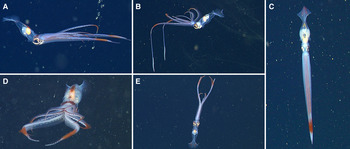
Common combinations of behavioural components in subadult Chiroteuthis calyx. These body patterns are named then described as an ordered list of the postural, chromatic, bioluminescent and locomotor behavioural components present. (A) Fishing (with tentacles retracted): tail up, tentacles retracted, arms spread, all arm keels prominent, only pairs 1–3 arm tips curled, dark dorsal mantle, dark mantle tip, dark mouth, dark eyebrow patches, only pairs 1–3 arm tips dark, dark arm bands, dark tentacle tips, ocular photophores exposed, visceral photophores exposed, fin undulation, hovering. (B) Fishing: tail up, tentacles partially extended, tentacles spread and relaxed, arms spread, all arm keels prominent, only pairs 1–3 arm tips curled, dark fin edges, dark arm keels, only pairs 1–3 arm tips dark, dark arm bands, dark tentacle tips, ocular photophores exposed, visceral photophores exposed, fourth arm photophores exposed, fin undulation, hovering, cloud ink release. (C) Swim down arms first: tail up, tentacles retracted, all arms together, dark fin centres, dark arm bands, dark tentacles, dark tentacle tips, photophores exposed, visceral photophores exposed, fin undulation, forward swimming. (D) Common response to threat (pseudo-fishing sequence): body horizontal, tentacles retracted, arms spread, all arm keels prominent, all arm tips curled, dark dorsal mantle, dark lateral mantle, dark fin edges, dark eyebrow patches, only pairs 1–3 arm tips dark, dark arm bands, dark tentacle tips, ocular photophores exposed, visceral photophores exposed, fourth arm photophores exposed, fin undulation, hovering. (E) Tail down hover 2: tail down, tentacles retracted, only pairs 1–3 arms together, only third and fourth pair arm keels prominent, only third and fourth pair arm tips curled, dark fin centres, only third and fourth pair arm tips dark, dark tentacle tips, ocular photophores exposed, visceral photophores exposed, fin undulation, hovering.

Spar buoy: Tail down (but body near horizontal), all arms spread, all arm tips curled or not, all arm keels prominent or not, tentacles fully or partially extended, pale or dark tail pouches, ocular photophores exposed, visceral photophores exposed, tentacle club photophores exposed or not, tentacle stalk photophores exposed or not, fourth arm photophores exposed or not, hovering and fin undulation (Figure 4B, E; Supplementary Material Video 1).
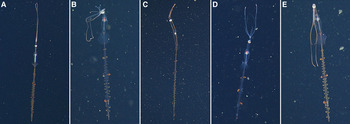
Swim down tail first: Tail down, backward swimming, fin undulation, arms range from all arms together to all arms spread, tentacles fully or partially extended, third pair arm tips curled or not, third pair arm keels prominent or not, dark tail pouches or not, only third pair arm tips dark or not, only third and fourth pair arm tips dark or not, all arm tips dark or not, ocular photophores exposed, visceral photophores exposed and tentacle club photophores exposed or not. Squid progressively expands additional chromatophores, thus turning more brown-orange to dark-red as observation time increases (Figure 5A, D; Supplementary Material Videos 1 and 2). A similar sequence has been described by Vecchione et al. (Reference Vecchione, Robison and Roper1992).
Common combinations of behavioural components in juvenile Chiroteuthis calyx. These body patterns are named then described as an ordered list of the postural, chromatic, bioluminescent and locomotor behavioural components present. (A) Swim down tail first 1: tail down, tentacles fully extended, tentacles spread and cupped, all arms together, tail expanded, dark, ocular photophores exposed, visceral photophores exposed, fin undulation, backward swimming. (B) Spar buoy 1: tail down, tentacles partially extended, tentacles spread and relaxed, arms spread, all arm tips curled, tail contracted, dark dorsal mantle, dark mantle tip, dark mouth, dark tail midline, dark tail pouches, dark funnel, only third and fourth pair arm tips dark, dark tentacles, dark tentacle tips, ocular photophores exposed, visceral photophores exposed, fin undulation, hovering. (C) Tail down hover 1: tail down, tentacles retracted, all arms together, tail expanded, dark, ocular photophores exposed, visceral photophores exposed, fin undulation, hovering. (D) Swim down tail first 2: tail down, tentacles partially extended, tentacles spread and relaxed, arms spread, all arm keels prominent, only pairs 1–3 arm tips curled, tail expanded, dark mantle tip, dark mouth, dark tail pouches, dark tentacle tips, ocular photophores exposed, visceral photophores exposed, fin undulation, backward swimming. (E) Spar buoy 2: tail down, tentacles partially extended, tentacles spread and relaxed, only pairs 1–3 arms together, only third and fourth pair arm keels prominent, only third and fourth pair arm tips curled, tail expanded, dark, ocular photophores exposed, visceral photophores exposed, fin undulation, hovering.

Swim down arms first: Tail up, tentacles retracted, all arms together, only third pair arm keels prominent or not, only fourth pair arm keels prominent or not, dark fin centres or not, dark arm bands, dark tentacles or not, ocular photophores exposed, visceral photophores exposed, fin undulation and forward swimming (Figure 4C; Supplementary Material Video 3).
Tail down hover: Tail down, tail expanded or not, arms spread to all arms together, all arm tips curled or not, all arm keels prominent or not, only third and fourth pair arm keels prominent or not, tentacles retracted to fully extended, tentacles together or not, tentacles spread and cupped or not, only dark fin centres and third and fourth pair arm tips dark to dark, ocular photophores exposed, and visceral photophores exposed, hovering and fin undulation (Figures 5C & 4E).
Dark when touched: Tail up, down or horizontal, all arms together, tentacles retracted to partially extended, dark, partial tail separation or not, entire tail separation or not, tentacle retraction or not, fin undulation, forward or backward jetting, forward or backward swimming, pseudomorph ink release or not, and grasp or not. This sequence is a typical response to contact with the ROV. A similar behavioural sequence has been described by Vecchione et al. (Reference Vecchione, Robison and Roper1992).
Juvenile and subadult C. calyx behavioural comparison
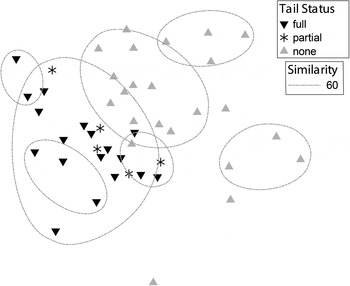
Across the four categories of behaviours, juvenile and subadult C. calyx were approximately 30% similar in the behaviours they exhibited. The behaviours within age class were similar at 50–70% for both juveniles and subadults. Juveniles and subadults form two distinct groups, with partial-tailed juveniles in the middle, grouping between juveniles possessing full tails and subadults (Figure 6).
Two-dimensional NMDS plot of 46 C. calyx across four behaviour categories: postural, chromatic, bioluminescent and locomotor. Chiroteuthis calyx juveniles possess full or partial tails and C. calyx subadults do not have tails. A clear separation of juveniles and subadults is apparent in this figure. Note that partial-tailed juveniles align in the middle, between full-tailed juveniles and tail-less subadults. Between the age classes the behavioural suites are 30% similar and within the age classes the behavioural suites are 50–70% similar. Some individuals of a tail status group demonstrated the same suite of behaviours; their symbols overlap in this two-dimensional representation. The two-dimensional stress = 0.22, and the three-dimensional stress = 0.15.

Both juveniles and subadults were typically pale when encountered; juveniles were in either spar buoy or fishing posture, subadults were in fishing posture and were usually associated with an ink cloud. When alarmed, juveniles began swimming downward, tail-first, while darkening the tail pouches. Alarmed subadults retracted their tentacles and expanded chromatophores around the digestive gland, eyes and photophores, but remained stationary. Further disturbance led juveniles to darken the areas around opaque organs, and led subadults to begin slowly swimming down either head- or tail-first. If the ROV maintained its distance, juveniles altered between tail-down swimming and hovering, while subadults stopped swimming down and hovered horizontally without deploying their tentacles. When contacted gently by the ROV, juveniles retracted their tentacles, held all arms together, and jetted backward while expelling an ink pseudomorph. Repeated gentle contact yielded repeated backward jetting with direction changes and ink release. Ultimately the tail separated from the body, which turned to dark, and the juvenile sped away head- or tail-first. In contrast, hovering subadults contacted by the vehicle faced the threat, flashed between pale and dark colouration, spread their arms and tentacles, and exposed the photophores on those limbs.
Orientation study of C. calyx and N. bijuga
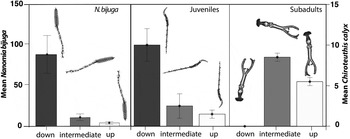
In the presence of the siphonophore N. bijuga, the tails of juvenile C. calyx were most often oriented in the same direction as the siphosome they resemble. Significantly more N. bijuga were oriented siphosome-down (N = 1057) than siphosome-up (N = 60) or -intermediate (N = 143) (P < 0.001 in both cases) at 400 and 500 m, with no significant difference in their orientation between depths (Figure 7). In the same survey depths, juvenile C. calyx were found to orient tail-down (N = 20) significantly more than tail-up (N = 3) or -intermediate (N = 5) (P = 0.003 and 0.006, respectively). In contrast, subadult C. calyx were observed to orient tail-up (N = 11) and –intermediate (N = 17), significantly more than tail-down (N = 0) (P = 0.026 and 0.003, respectively). Juveniles were found to orient tail-down significantly more than subadults (P < 0.001) and subadults were observed to orient tail-indeterminate and -up, significantly more than juveniles (P = 0.008 and 0.04, respectively) (Figure 7).
Comparison of orientation in the water column of Nanomia bijuga and juvenile and subadult Chiroteuthis calyx at 400 and 500 m depth. Note the similarity of juvenile C. calyx orientation to N. bijuga orientation. The number of N. bijuga oriented siphosome-down is significantly greater than the number oriented siphosome-intermediate or siphosome-up (P < 0.001 in both cases). The number of juvenile C. calyx oriented tail-down is significantly greater than tail-up or tail-intermediate (P = 0.003 and 0.006, respectively). The number of subadult C. calyx oriented tail-up and tail-intermediate is significantly greater than tail-down (P = 0.026 and 0.003, respectively). The number of juveniles oriented tail-down is significantly greater than subadults (P < 0.001). The number of subadults oriented tail-intermediate and tail-up is significantly greater than juveniles (P = 0.008 and 0.04, respectively). No C. calyx subadults were observed oriented tail-down during the orientation study. Bars represent standard error of the mean.

DISCUSSION
Chiroteuthis calyx exhibited an abundant array of postural, chromatic, bioluminescent and locomotor behaviours, comparable to or exceeding ethograms established for shallow-water cephalopods. Seventy-eight behavioural components and six body patterns are now described for C. calyx. Even though this diverse array of behaviours still falls within the confines of transparency, silvering, red colouration, counter-illumination and bioluminescence (Hanlon & Messenger, Reference Hanlon and Messenger1996), C. calyx can use their body patterns to produce a form of visual mimicry; this is a behavioural action far more complex than previously predicted for deep-sea cephalopods. Moreover, the behaviours we describe likely constitute just a portion of the total number of behaviours performed by this species, as much of what we witnessed, behaviours supporting mimicry included, were surely responses to the presence of the ROV (Hunt, Reference Hunt1996; Bush et al., Reference Bush, Robison and Caldwell2009). Therefore, it cannot be ruled out that C. calyx performs other complex behavioural sequences potentially aiding in interspecific and intraspecific communication (Bush et al., Reference Bush, Robison and Caldwell2009). While ROV use has vastly increased our knowledge of behaviour in the deep sea, it has the drawback of being a rather intrusive method of studying behaviour. ROVs are large, noisy and bright, thus eliciting defensive responses in the animals under observation (Hunt, Reference Hunt1996; Bush et al., Reference Bush, Robison and Caldwell2009). Nevertheless, ROV video footage enabled us to identify and describe many remarkable behaviours by C. calyx that could aid them in evading the predators of the mesopelagic zone.
Chiroteuthis calyx juveniles occupy a daytime depth range similar to the siphonophore N. bijuga and are often found within their aggregations (Vecchione et al., Reference Vecchione, Robison and Roper1992). Not only is the tail of juvenile C. calyx similar in appearance to the siphosome of N. bijuga (Vecchione et al., Reference Vecchione, Robison and Roper1992; Hunt, Reference Hunt1996; Seibel et al., Reference Seibel, Goffred, Thuesen, Childress and Robison2004; Bush & Robison, Reference Bush and Robison2007; Roper & Young, Reference Roper and Young2013), but juvenile C. calyx also orient their tails in the same manner as the neighbouring N. bijuga orient their siphosomes. At 400 and 500 m, it is far more common to find N. bijuga oriented with their siphosomes down, as is the case for the tails of juvenile C. calyx. In contrast, no C. calyx subadults, which lack elongate tails, were found oriented tail-down at those depths, although they were often found within aggregations of N. bijuga (Figure 7). Body orientation in C. calyx juveniles likely confers mimicry of this highly abundant and active siphonophore. Because siphonophores possess powerful nematocysts and lack sufficient nutrient density to warrant attack from most predators of mesopelagic squid (Vecchione et al., Reference Vecchione, Robison and Roper1992; Robison, Reference Robison1999), C. calyx juveniles probably experience reduced predation as a result of behaviourally and morphologically mimicking N. bijuga.
In addition to the characteristic orientations of juveniles and subadults, the propensity of C. calyx to remain still, or move very slowly when threatened, is one of the first noticeable behavioural traits in an encounter. We, like Bush & Robison (Reference Bush and Robison2007), not only found C. calyx to be slow to react to the presence of the ROV, but to also be disinclined to rapidly swim or jet away until physically touched by the vehicle. This tendency to move as little as possible when threatened is likely not only an energy-conserving adaptation to life in the mesopelagic zone where food and oxygen are scarce (Seibel et al., Reference Seibel, Thuesen, Childress and Gorodezky1997), but also an attempt to remain concealed from visually oriented predators in a habitat where easily triggered ambient bioluminescence is so prevalent (Herring, Reference Herring2002; Robison, Reference Robison2004). Additional locomotor behaviours also seem to address predator avoidance. We observed C. calyx performing five different ink release behaviours, with pseudomorphs being the most common in juveniles and clouds being the most common in subadults. It appears that inking juveniles produce pseudomorphs as an alternative target for visually cued predators. The clouds produced by subadults may be used as a structure to hide behind (Bush & Robison, Reference Bush and Robison2007). Similar to the squid G. onyx, which is thought to mimic elongate siphonophores with its ‘rope’ ink release (Bush & Robison, Reference Bush and Robison2007), it appears that juvenile C. calyx might also mimic longer siphonophores with their series of pseudomorphs and ropes. On the occasions that we witnessed juvenile C. calyx performing these behaviours, we invariably observed larger elongate siphonophores in the near vicinity. It has also been speculated by Bush & Robison (Reference Bush and Robison2007) that the single pseudomorph ink release performed by C. calyx could additionally be an attempt to mimic the siphonophore, N. bijuga. The pseudomorph ink release in juveniles is often accompanied by hovering or jetting. When C. calyx hovers to remain still, the wavering band of ink can remain next to the animal, effectively doubling its apparent length (Vecchione et al., Reference Vecchione, Robison and Roper1992; Bush & Robison, Reference Bush and Robison2007) (Supplementary Material Video 4).
The bioluminescent and chromatic behaviours that we observed in C. calyx seemed primarily reserved for predator avoidance and camouflage, although they likely use the photophores and chromatophores on their fourth arms, tentacle stalks and tentacle clubs for prey attraction (Hunt, Reference Hunt1996). Based on the brown-orange to dark-red colour of the chromatophores in C. calyx, it appears that they function in concealing the part of the body that they cover, as these wavelengths of light are not present in the mesopelagic zone (Robison, Reference Robison1999; Herring, Reference Herring2002). Accordingly, there are dense concentrations of chromatophores surrounding their photophores; these areas are often the first to darken when the animal is threatened by the presence of the ROV (Vecchione et al., Reference Vecchione, Robison and Roper1992; Hunt, Reference Hunt1996). It was impossible to view the brilliant blue light this animal produces under the bright lights of the ROV. Instead, it was assumed that if the photophores on the animal were exposed by contracted chromatophores, they were transmitting light (as Bush et al. (Reference Bush, Robison and Caldwell2009) assumed for O. deletron). Across both age groups of C. calyx, the ocular and visceral photophores were always oriented down and exposed, no matter what orientation the animal was in. This indicates that these photophores serve the function of counter-illumination, similar to those of Galiteuthis phyllura (Hunt, Reference Hunt1996) and other midwater squid (Kubodera et al., Reference Kubodera, Koyama and Mori2007). Aside from prey attraction, the photophores and chromatophores on the fourth arms and tentacles might also serve the purpose of predator distraction by operating as an alternative target for visually cued predators, akin to the bioluminescent arm tips of O. deletron (Bush et al., Reference Bush, Robison and Caldwell2009) and Taningia danae (Kubodera et al., Reference Kubodera, Koyama and Mori2007). The exposure of these photophores occasionally coincided with the rapid spread of the fourth arms and/or extension of the tentacles when the animal was touched by the ROV or had been followed for some time (Supplementary Material Video 3). Chromatophores could also be used to produce disruptive colouration, helping to break up the characteristic body shape of C. calyx and thus make them less recognizable to predators while keeping them hidden from their prey (Bush et al., Reference Bush, Robison and Caldwell2009). Hunt (Reference Hunt1996), Bush et al. (Reference Bush, Robison and Caldwell2009) and Kubodera et al. (Reference Kubodera, Koyama and Mori2007) noted that chromatophores covering bioluminescent organs on the tentacles and arms of deep-sea squid can be rapidly expanded and contracted, effectively flashing the photophores, for communication; the same is likely true for C. calyx.
Tail loss by juvenile C. calyx constitutes a last-resort defence against predation, offering not only a distractive target for visually cued predators, but also a possible target for acoustically oriented predators, such as cetaceans (Clarke, Reference Clarke1996; Bush, Reference Bush2012). Upon separation, we observed the tail to remain neutrally buoyant. Separated tails were also observed to retain the chromatic pattern that they had when detached from the body, with minute variations caused by sporadic chromatophore contractions. It was clear that a juvenile's tail could be unintentionally broken somewhere along its length and/or removed entirely by physical stress, such as ROV contact. However, there is also a possibility that the tail can be autotomized, or intentionally released, by a disturbed individual (Hunt, Reference Hunt1996) (Supplementary Material Video 4). Autotomy has been described in other species of deep-sea cephalopods including O. deletron, O. megaptera, O. neilseni and Vampyroteuthis infernalis (Bush et al., Reference Bush, Robison and Caldwell2009; Bush, Reference Bush2012). For C. calyx, potential cases of autotomy were observed exclusively in older juveniles. We hypothesize that tail attachment becomes weaker as C. calyx ages, likely coinciding with shifts in body proportions, ammonium sequestration, habitat and prey type (Hunt, Reference Hunt1996; Seibel et al., Reference Seibel, Goffred, Thuesen, Childress and Robison2004; Choy, unpublished data). It is also probable that the tail is more readily lost as it becomes less effective as a device for mimicry. At some point during their vertical ontogenic migration, C. calyx juveniles reach a depth where N. bijuga are no longer consistently abundant (Robison et al., Reference Robison, Reisenbichler, Sherlock, Silguero and Chavez1998). A dearth of models can severely limit the utility of structures used by the mimic that confer visual similarity to the model (Rettenmeyer, Reference Rettenmeyer1970), thus it would likely be less costly for the squid to separate from its tail at this depth than maintain it.
When C. calyx juveniles lose their conspicuous tails, this component of their ontogenetic transformation is accompanied by a behavioural change. Immediately after tail loss, we observed that individuals were more likely to swim forward (arms-first) than individuals with tails. When comparing C. calyx with and without tails (juveniles and subadults, respectively) we found markedly different suites of postural, bioluminescent, chromatic and locomotor behaviours (Figure 6). The relatively high two-dimensional stress in the NMDS analysis is, in part, a result of using presence/absence data (which weighs rare behaviours equally to the common ones). In spite of this, a clear distinction is apparent between juvenile and subadult C. calyx in our NMDS plot (Figure 6). Correspondingly, juveniles with partial tails constitute the middle ground, mostly performing behaviours characteristic of juveniles possessing full tails, but also performing some behaviours typical of subadults. Thus, the possession of a tail, or part of a tail, is a predictor of how C. calyx will react to a perceived threat, such as an ROV. While we observed many body patterns in both age classes, only six (‘fishing’, ‘spar buoy’, ‘swim down tail first’, ‘swim down arms first’, ‘tail down hover’ and ‘dark when touched’) were common enough to warrant description in our ethogram. All such descriptions will benefit by further video analysis, but we noted some interesting trends. For the most part, it was observed that juveniles and subadults had different foraging postures, escape responses and reactions to being touched by the ROV. Interestingly, the foraging posture (‘spar buoy’) and the escape response (‘swim down tail first’), both most commonly performed by juvenile C. calyx, enabled juveniles to closely resemble N. bijuga by orienting and colouring structures akin to those present on the siphonophore. Subadults, not possessing these structures, do not often demonstrate these orientations or colour patterns.
ACKNOWLEDGEMENTS
This research would not have been possible if not for the ship's crews of the RVs ‘Point Lobos’, ‘Rachel Carson’, and ‘Western Flyer’ and the pilots of the ROVs ‘Ventana’, ‘Tiburon’ and ‘Doc Ricketts’. We especially thank Stephanie Bush and Christine Huffard for editing and providing tremendously helpful feedback on drafts of the manuscript. The assistance and consultation of current and former members of the Midwater Ecology Lab at MBARI, Kristine Walz, Kim Reisenbichler and Henk-Jan Hoving, were essential for the completion of this study. Thank you also to the Video Lab staff of MBARI for providing immeasurable support throughout every phase of the project. Finally, we would like to thank two anonymous reviewers for sharing their expertise by way of comments on the manuscript.
FINANCIAL SUPPORT
The David and Lucile Packard Foundation provided the financial means for this research with funding for MBARI's Midwater Ecology Lab and summer internship programme.
Supplementary material
The supplementary material for this article can be found at http://www.journals.cambridge.org/MBI