Rheumatic fever/rheumatic heart disease is a connective tissue disease characterised by an inflammatory process involving the heart, joints, central nervous system, and subcutaneous tissues following the exposure of individuals to group A streptococci.Reference Guilherme, Köhler, Postol and Kalil 1
Despite the dramatic response nature of acute episodes of rheumatic fever, it leaves no long-term damage to the brain, joints, and skin; however, there is damage to the heart valves, particularly the mitral and aortic valves, which may persist after the resolution of an acute episode.Reference Stanevicha, Eglite, Sochnevs, Gardovska, Zavadska and Shantere 2 The residual and progressive valve deformity that occurs in rheumatic heart disease often may result in stenosis or a combination of stenosis and insufficiency that appears after an episode of acute rheumatic fever.Reference Harrington, Visvanathan, Skinner, Curtis, Currie and Carapetis 3
The precise pathogenic mechanisms of rheumatic heart disease are still unclear, but indirect evidence supports the concept of an abnormal, autoimmune host response following exposure of susceptible individuals to group A streptococcal antigens.Reference Carapetis, Brown, Wilson and Edwards 4 There is strong evidence that an autoimmune disease response to streptococcal antigens is implicated in the development of rheumatic fever and rheumatic heart disease in susceptible hosts.Reference Ayoub, Nelson and Shulman 5 Studies on individual host response together with the observation of familial incidence of disease suggest that genetic factors play a role in susceptibility to rheumatic fever.Reference Elahi, Asotra, Matata and Mastana 6 Genetic–environmental interaction, human leucocyte antigen, B-cell alloantigens, and blood group associations have been demonstrated in studies of rheumatic heart disease among Egyptians.Reference Settin, Abdel-Hady, El-Baz and Saber 7
The role of cytokines in the pathogenesis of rheumatic heart disease has been thoroughly investigated.Reference Guilherme, Cury and Demarchi 8 They appear to play a critical role in triggering immunological and inflammatory reactions in rheumatic fever. During active rheumatic carditis, the production of interleukins including IL-1, IL-2, IL-6, and IL-8 is reportedly increased. IL-4 and IL-10 expressions were characterised in heart tissue infiltrates from rheumatic heart disease patients by immunohistochemistry. It has been suggested that the effects of interleukins were involved in the pathogenesis of rheumatic heart disease.Reference Bennermo, Held and Stemme 9
IL-4 is a cytokine with anti-inflammatory properties. The gene for IL-4 has been mapped to the q arm (q23–31) of chromosome 5. A functional polymorphism representing a cytosine-to-thymine substitution at position -590 has been described in the promoter region of IL-4. Another polymorphism has been identified in intron 3, and is composed of a variable number of tandem repeats of a 70-bp sequence.Reference Wu, Chang, Wan, Tsai and Tsai 10
IL-10, which shares some of the anti-inflammatory action of IL-4, is mainly produced by macrophages, monocytes, and lymphocytes. The IL-10 gene is located on the long arm of chromosome 1 in the 1q32 band. The human IL-10 promoter gene is highly polymorphic; three single nucleotide polymorphisms within the IL-10 gene promoter, -1082 A/G, -819 C/T, and -592 C/A, were reported to be associated with different IL-10 expressions.Reference Rad, Dossumbekova and Neu 11
The IL-4 promoter and IL-4 (intron 3) polymorphisms were reported to exhibit distinct transcriptional activities in IL-4-positive T cells and to determine a modification of the resulting immune response.Reference Song, Casolaro, Chen, Georas, Monos and Ono 12 IL-10 is an important component of an anti-inflammatory cytokine network that suppresses gene expression and synthesis of pro-inflammatory cytokines.Reference Padyukov, Hytonen and Smolnikova 13 Therefore, the possible role of IL-4 or IL-10 genes was hypothesised to be involved in the pathogenesis of rheumatic heart disease as well as may contribute to a more severe form of the disease.
Taking into consideration that cytokine gene polymorphisms are population specific, we tested the association of IL-4 (intron 3) and IL-10 (-1082) gene polymorphisms in a case–control study among Egyptian patients with rheumatic heart disease, in order to test whether these polymorphisms might serve as markers of susceptibility to or severity of rheumatic heart disease among Egyptian affected cases.
Patients and methods
Study population
This study included 140 children with chronic rheumatic heart disease, who presented to the outpatient Cardiology Clinic or the inpatient wards of Abu-Elreesh Children Hospital, Faculty of Medicine, and Cairo University. Their presenting diagnosis was based on revised Jones criteria by examination and investigation, including anti-streptolysin O, C-reactive protein, erythrocytes sedimentation rate, and echocardiography. All patients had chronic rheumatic heart disease with residual valve affection at least 2 years after the first episode. The patients were further categorised by echocardiography into mitral valve disease or combined valve disease categories. The mitral valve disease category consisted of mitral stenosis plus mixed mitral stenosis and mitral regurgitation. Patients with predominant mitral regurgitation as well as patients with aortic or tricuspid valve disease alone were excluded from this study. The control group consisted of 100 age- and sex-matched unrelated healthy volunteers who were free of autoimmune diseases, had normal echocardiography results, and no family history of rheumatic heart disease. The study was approved by our hospital’s research ethics committee, and an informed consent was obtained from each patient and/or parent after explaining the purpose of the study.
Genotyping of the polymorphisms of IL-4 and IL-10 genes
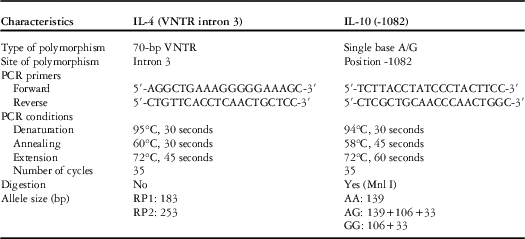
Blood samples of 5 ml were obtained from all the patients and were collected in sterile ethylenediaminetetraacetic acid-containing tubes, and then stored at −20°C until use. Genomic DNA was extracted from whole blood using an established protocol for DNA extraction from blood samples using a DNA extraction kit (Qiagen, Hilden, Germany). The polymerase chain reactions were carried out to a total volume of 25 μl containing 5 μl genomic DNA, 12.5 μl of master mix containing 0.1 units/μl Taq DNA Polymerase, 32 mM (NH4)2·SO4, 130 mM Tris HCl, 5.5 mM MgCl2, and 0.4 mM of each dNTP, 1 μl of each primer, and 6.5 μl distilled water. For IL-4 (intron 3) variable number of tandem repeats polymorphism, polymerase chain reaction products were directly analysed by electrophoresis as previously described.Reference Wu, Chang, Wan, Tsai and Tsai 10 The IL-10 (-1082) gene polymorphism was typed by the restriction fragment length polymorphism method as previously described.Reference Rasouli, Kiany and Behbin 14 Details for each polymorphism analysis are given in Table 1. The polymerase chain reaction amplifications were performed using the thermal cycler Applied Biosystems 9600 (Perkin-Elmer, Foster city, California, United States of America). For these two polymorphisms, the products or digested fragments were analysed by electrophoresis on 2% agarose gel stained with ethidium bromide (electro-4; Thermal Hybaid, Promega, Madison, WI,United States of America) and visualised using an ultraviolet transilluminator (wavelength 312 nm).
Main characteristics of interleukin gene polymorphisms and techniques used for screening.

PCR=polymerase chain reaction; VNTR=variable number tandem repeat
Interpretation of results
IL-4 (intron 3) polymorphism
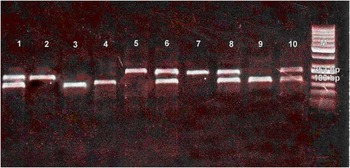
In individuals lacking the IL-4 gene polymorphism, a 183-bp band was detected and designated as RP1/RP1 genotype – that is, wild type. On the other hand, if one 253-bp band was detected due to a 70-bp insertion, it was designated as RP2/RP2 – that is, homozygous RP2 allele. If two bands, 183 and 253 bp, were detected, it was designated as RP1/RP2 – that is, heterozygous for RP2 allele – as shown in Figure 1.
Results of polymerase chain reaction of IL-4 (intron 3) polymorphism. Lanes 3, 4, and 9 show one band at 183 bp denoting RP1/RP1 genotype (i.e., wild type). Lanes 1, 6, 8, and 10 show two bands at 183 and 253 bp denoting RP1/RP2 genotype (i.e., heterozygous for RP2 allele). Lanes 2, 5, and 7 show one band at 253 bp denoting RP2/RP2 genotype (i.e., homozygous RP2 allele).

IL-10 (-1082) polymorphism
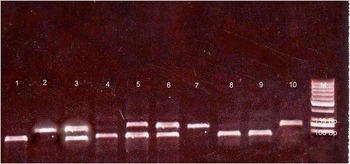
In individuals lacking this polymorphism, one band appeared at 139 bp and was designated as A/A genotype – that is, wild type. If two bands were detected at 106 and 33 bp, it was designated as homozygous GG genotype. If three bands appeared at 139, 106, and 33 bp, it was designated as heterozygous AG genotype as shown in Figure 2.
Results of IL-10 (-1082) polymorphism. Lanes 2, 7, and 10 show one band at 139 bp denoting AA genotype (i.e., wild type). Lanes 3, 5, and 6 show bands at 139, 106, and 33 bp denoting AG genotype (i.e., heterozygous mutant type). Lanes 1, 4, 8, and 9 show bands at 106 and 33 bp denoting GG genotype (i.e., homozygous mutant type). The band at 33 bp cannot be seen.

Statistical analysis
Data were statistically described by range, mean, standard deviation, frequencies, percentages, and odds ratio (OR) with a 95% confidence interval (CI) when appropriate. Quantitative variables between the study groups were compared using Student’s t-test for independent variables that were normally distributed and the Mann–Whitney U-test for independent variables that were not normally distributed. For comparing categorical data, the χ2 test was used, but Fisher’s exact test was used when the expected frequency was <5. A probability (p) value of <0.05 was considered statistically significant. Statistical calculations were performed using Microsoft Excel 2003 (Microsoft Corporation, New York, United States of America) and Statistical Package for the Social Science (SPSS Inc., Chicago, Illinois, United States of America) version 15 for Microsoft Windows.
Results
General characteristics of patients
The basic characteristics of the patients and the control group are summarised in Table 2. A total of 240 unrelated individuals, including 140 rheumatic heart disease patients (male: 72, female: 68; their mean age was 12.2±3.4) and 100 sex- and age-matched controls (male: 58, female: 42; their mean age was 10.3±3.4), was recruited for this case–control study. Out of the 140 rheumatic heart disease patients, 80 had mitral valve disease and 60 had combined valve disease.
Characteristics of patient and the control groups.

CVD=combined valvular disease; HC=healthy control; MVD=mitral valve disease; RHD=rheumatic heart disease
Frequencies and genotyping of IL-4 (intron 3) and IL-10 (-1082) polymorphisms
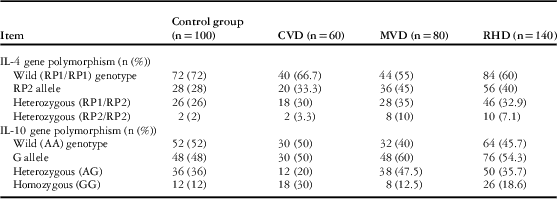
Table 3 shows the frequency of IL-4 (intron 3) and IL-10 (-1082) gene polymorphisms in rheumatic heart disease patients, the mitral valve disease, and combined valve disease categories, as well as the control group. Genotyping detected IL-4 (intron 3) RP1/RP1, RP1/RP2, and RP2/RP2 in 60.0, 32.9, and 7.1% of rheumatic heart disease patients, respectively. In the mitral valve disease subgroup, IL-4 (intron 3) RP1/RP1, RP1/RP2, and RP2/RP2 genotypes were detected in 55, 35, and 10%, respectively, whereas in the combined valve disease subgroup IL-4 (intron 3) genotypes were detected in 66.6, 30, and 3.3%, respectively. With regard to IL-10 (-1082) genotyping, among rheumatic heart disease patients, A/A, A/G, and G/G genotypes were detected in 45.7, 35.7, and 18.6%, respectively. In the mitral valve disease category, A/A, A/G, and G/G genotypes were detected in 40.0, 47.5, and 12.5%, respectively, whereas in the combined valve disease subgroup A/A, A/G, and G/G genotypes were detected in 50, 20, and 30%, respectively.
Frequency of IL-4 (variable number tandem repeat (VNTR) intron 3) and IL-10 (-1082) genotypes in rheumatic heart disease (RHD) patients and controls.

CVD=combined valvular disease; MVD=mitral valve disease
Association of IL-4 (intron 3) and IL-10 (-1082) polymorphisms with the risk of rheumatic heart disease
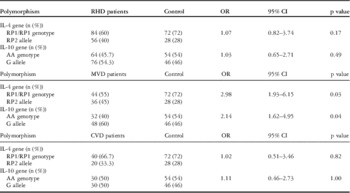
No statistical significant difference in either the genotype distribution or allelic frequencies for IL-4 (intron 3) (p=0.17; OR 1.07, 95% CI 0.82–3.74) polymorphisms and IL-10 (-1082) (p=0.49; OR 1.03, 95% CI 0.65–2.71) polymorphisms was found when rheumatic heart disease patients were compared with the control group as shown in Table 4, with no apparent liability of patients with IL-4 and IL-10 polymorphisms to develop rheumatic heart disease.
Comparison between IL-4 (variable number tandem repeat (VNTR) intron 3) and IL-10 (-1082) gene polymorphisms in rheumatic heart disease (RHD) patients, mitral valve disease (MVD), and combined valvular disease (CVD) subgroups with the control group.

CI=confidence interval; OR=odds ratio
Association of IL-4 (intron 3) and IL-10 (-1082) polymorphisms with mitral valve disease and combined valve disease subgroups
In our study, cases with mitral valve disease showed a significantly higher frequency of the RP2 allele of IL-4 (intron 3) (p=0.03; OR 2.98, 95% CI 1.93–6.15) and the G allele of IL-10 (-1082) (p=0.04; OR 2.14, 95% CI 1.62–4.95) when compared with controls. These genotypes show a possible susceptibility for mitral valve affection among cases of rheumatic heart disease. On the other hand, cases with combined valve disease showed no statistically significant differences when compared with the control group regarding IL-4 (intron 3) (p=0.82; OR 1.02, 95% CI 0.51–3.46) or IL-10 (-1082) (p=1.00; OR 1.11, 95% CI 0.46–2.73) gene polymorphisms. These genotypes appear to conform non-susceptibility to other valve lesions among cases of rheumatic heart disease (Table 4).
Discussion
Many authors have reported the presence of inherited immunoregulatory dysfunction in individuals susceptible to developing rheumatic fever, including the possibility of stimulation of certain cytokines, resulting in a specific clinical behaviour.Reference Sadiq, Islam and Abid 15 The implication of a heritable genetic basis of cytokine production could account for individual differences in the responsiveness of the immune system. Although the basis for these heritable differences is not known, gene polymorphism is one of the most reliable factors that might account for such variability.Reference Settin, Abdel-Hady, El-Baz and Saber 7
Understanding the impact of IL-4 and IL-10 gene polymorphisms on the susceptibility and severity of rheumatic heart disease will provide better insight into the role of cytokines in the pathogenesis of rheumatic heart disease. In this case-controlled study, we aimed at examining the relationship between IL-4 (intron 3) and IL-10 (-1082) gene polymorphisms with regard to patient susceptibility to rheumatic heart disease and correlate their frequency with the severity of rheumatic heart manifestations.
In our study, no association was found between IL-4 (intron 3) or IL-10 (-1082) gene polymorphisms and susceptibility to rheumatic heart disease. There was no significant difference in either the genotype distribution or allelic frequencies between cases and controls for the two polymorphisms. Our results are in accordance with the study by Chou et alReference Chou, Tsai, Chen and Tsai 16 who studied IL-4 (intron 3) and IL-10 gene polymorphisms in a cohort of 115 Taiwan Chinese patients and reported no evidence of an association for each of these gene polymorphisms with susceptibility to rheumatic heart disease among the Chinese population in Taiwan and concluded that IL-4 (intron 3) and IL-10 gene polymorphisms are not suitable genetic markers of rheumatic heart disease. Despite the agreement between our results, hereditary differences in both ethnicities are important factors that should be taken into consideration before establishing a confirmed conclusion regarding the role of IL-4 and IL-10 as a contributing factor in the pathogenesis of and susceptibility to rheumatic heart disease.
As the IL-4 or IL-10 gene polymorphisms were hypothesised to be associated with the severity of rheumatic heart disease, the distribution of IL-4 (intron 3) and IL-10 (-1082) gene polymorphisms was studied in the mitral valve disease and combined valve disease subgroups. Our results showed that the mitral valve disease patient subgroup had a significantly higher frequency of the RP2 allele of IL-4 (intron 3) and the G allele of IL-10 (-1082) when compared with the control group. On the other hand, cases with combined valve disease in our study showed no statistically significant differences when compared with the control group regarding IL-4 (intron 3) or IL-10 (-1082) gene polymorphisms. Our results partially correspond with that of Settin et alReference Settin, Abdel-Hady, El-Baz and Saber 7 who studied IL-10 (-1082) gene polymorphism in a cohort of 50 Egyptian children with chronic rheumatic heart disease and reported higher frequency of homozygous mutant G/G of IL-10 at position -1082 with rheumatic heart disease to indicate that this genotype was related to a more severe form of rheumatic heart disease with mitral valve disease and combined valve disease. Although both our study and that of Settin et al were carried out on a cohort of Egyptian patients, this difference in the association of IL-10 (-1082) polymorphisms within the same population may need more extensive studies with a larger sample of rheumatic heart disease patients, as any reported differences between studies might be attributed to sampling error. To our knowledge, this is the first study that evaluated the correlation between IL-4 (intron 3) gene polymorphism and rheumatic heart disease in Egyptian children.
As the basic rheumatic process is inflammation and destruction of connective tissue, the extent of original inflammation and recurrence of rheumatic fever are not the only predisposing factors that contribute to the progression of valve lesions.Reference Reuss, Fimmers, Kruger, Becker, Rittner and Hohler 17 The effects of interleukins on the pathogenesis of rheumatic heart disease were significantly studied.Reference Guilherme, Ramasawmy and Kalil 18 IL-4 and IL-10 expressions were characterised in heart tissue infiltrates from rheumatic heart disease patients by immunohistochemistry. IL-10-positive cells were consistently predominant, whereas IL-4 was scarce in the valves. The significantly lower IL-4 expression in the valvular tissue may contribute to the progression of rheumatic heart disease leading to permanent valve damage.Reference Chou, Tsai, Chen and Tsai 16
In this study, we showed that the mitral valve disease patient subgroup had a significantly higher frequency of the RP2 allele of IL-4 (intron 3) and the G allele of IL-10 (-1082). It has been proven that the IL-4 (intron 3) polymorphism may influence the production of IL-4, with the RP1 allele enhancing IL-4 expression compared with the RP2 allele that downregulates its expression.Reference Nakashima, Miyake and Inoue 19 In addition, IL-10 (-1082) polymorphism affects IL-10 gene expression, where the A allele at site -1082 of the promoter region of IL-10 gene is associated with low production of IL-10 and the G allele is associated with high production of IL-10, and thus a stronger inflammatory response.Reference Turner, Williams, Sankaran, Lazarus, Sinnott and Hutchinson 20 Our finding suggests an evidence of association between these gene polymorphisms with the severity of rheumatic heart disease involving the pathological effect on the mitral valve.
In conclusion, our study showed that IL-4 (intron 3) and IL-10 (-1082) genes are not significantly associated with susceptibility to rheumatic heart disease. On the other hand, these polymorphisms may be a contributing factor for disease severity and could serve as useful molecular biomarkers for evaluating the possibility of mitral valve affection in patients with rheumatic heart disease. As the study group size was quite small for a genetic association study, the present results should be confirmed by future studies performed on a larger number of patients with rheumatic heart disease. Furthermore, investigating other genetic polymorphisms is warranted to clarify the underlying genetic mechanisms that attribute to the susceptibility and severity of rheumatic heart disease.
Acknowledgement
The authors thank all the patients and controls enrolled in this study.
Financial Support
This study was funded by the authors only.
Conflicts of Interest
None.
Ethical Standards
The authors assert that all the procedures contributing to this work comply with the ethical standards of the relevant national guidelines and with the Helsinki Declaration of 1975, as revised in 2008, and has been approved by the Kasr Al Ainy Hospital ethics committee.