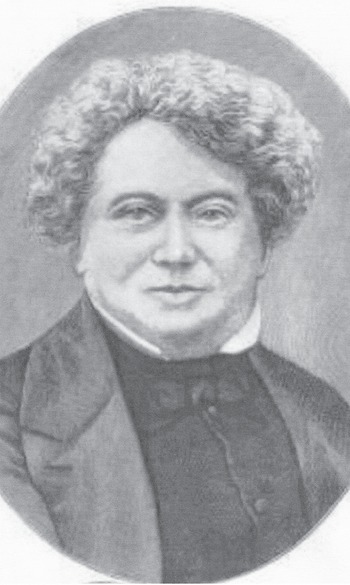
With the rise of the global book trade, Alexandre Dumas (1802–70) became one of the most popular authors not just in France but also throughout Europe and the United States. His works, such as The three musketeers (1844) and The Count of Monte Cristo (1845–46), were quickly translated for sale abroad. However, the transformation of literature as a form of ‘art’ to one of popular commercial entertainment was not greeted with universal praise by American critics. The nineteenth-century reviewer Albert Southwick noted of Dumas that ‘in the book trade no name of [a] modern author has had a higher marketable value than his’, yet ‘enlightened critics… lament that he has abused his talent … by degrading literature into a mere trade… in utter forgetfulness of any high motive or aim’.Footnote 1 Nevertheless, the rising global book trade enabled the works of popular writers from diverse European countries and the US to transcend more easily their own national literatures and become part of a Western body of global literature. Dumas was such a famous figure in the US that Charles Ranhofer, a noted nineteenth-century chef at New York’s Delmonico’s restaurant (then regarded as one of America’s finest dining locations), created the Salad à la Dumas to honour the French writer, and the biographer Jacques Lucas-Dubreton claimed in 1928, that Dumas ranked after Napoleon in an American newspaper’s survey of the most famous men of the nineteenth century.Footnote 2
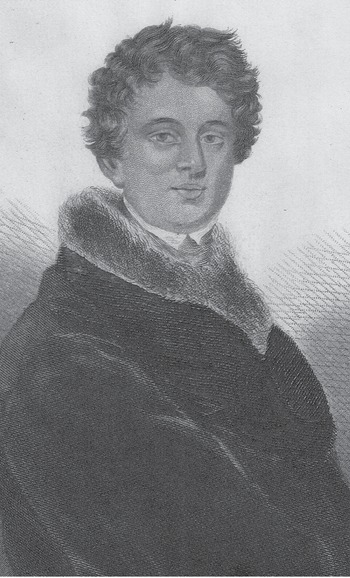
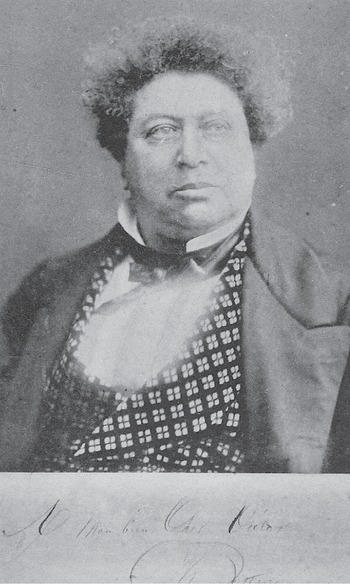
Despite his popularity, knowledge about Dumas’ black ancestry had been largely unknown in the US among the majority population during the 1830s and 1840s, the years in which he was at the peak of his fame. Many Americans generally assumed that such cultural acclivity was characteristic of ‘whites’. In describing Dumas’ family history, an 1843 edition of the North American Review declared simply that Dumas was ‘of honorable, though not of wealthy, parentage’. His father’s status as the son of a French nobleman and an African slave from Saint Domingue (now Haiti) was omitted, for he was described only as a ‘general in Napoleon’s army’ who ‘served with distinction in Egypt’.Footnote 3 This omission was not unique. For example, an 1849 review of Dumas’ novel The memoirs of a physician also recounted the writer’s background without mentioning his black ancestry and praised him as ‘a most extraordinary man’.Footnote 4 Moreover, the omission of Dumas’ black ancestry was often accompanied by images in English-language publications that emphasized his Caucasian features (see Figure 1), contrary to his image in later contemporary photographs (see Figure 2). Such a practice maintained the illusion that he was not of black descent.
Anonymous portrait of Dumas, c.1840. Mary Evans Picture Library.

French postcard, c.1907–15, reprinting a photo portrait of Dumas, c.1860s, published by J. L. C. – Legui. Author’s collection.

Dumas’ black ancestry became widely known in the US during the 1850s. From 1852 to 1855, Dumas published his multivolume memoirs, which gave details about his father’s life and black ancestry. The memoirs, readily available in French for the educated elite as well as francophone Americans, were translated into English in abridged form in 1890 and in a complete edition in 1907–09.Footnote 5 In the US, an advocate of the ‘one-drop rule’, individuals with any black ancestry were theoretically ‘black’. Therefore, as the French literary scholar Michel Fabre has noted, ‘in American terms he [Dumas] was a Negro’.Footnote 6 Not all American reviews of Dumas’ memoirs noted his black ancestry, but many, such as Littell’s Living Age’s 1852 review, certainly did. The review revealed that he had a grandmother ‘of color’ and a father who was ‘a mulatto giant’.Footnote 7
While the knowledge of Dumas’ black ancestry made him controversial among majority Americans, whose reactions ranged from disparaging Dumas and his works as ‘African’ to marginalizing his black ancestry by rationalizing that his ‘white’ ancestry was dominant, it made him popular with other components of the population who identified with him because of his racial status in American terms. Dumas did not treat the black condition explicitly in his most popular works. Yet many African Americans read The Count of Monte Cristo in particular as an allegory of their own condition and identified with the novel’s themes of justice, emancipation, and hope. They seemingly related to the title character, Edmond Dantès, an innocent sailor imprisoned in the Château d’If, who escapes, finds a secret treasure, and seeks justice against those who had him imprisoned. As Michel Fabre has suggested, Monte Cristo’s popularity stemmed from the fact that Dantès' victory ‘over injustice could function as a parable for black endurance and eventual freedom’.Footnote 8 The African American writer Charles W. Chestnutt, for example, noted in his journal in 1878:
In some things, I seem to be working in the dark. I have to feel my way along, but by perseverance I manage to make better headway than many who have the light; and besides, like Edmund [sic] Dantes in Dumas’ ‘Monte Cristo’, I have become accustomed to the darkness. As I have been thrown constantly on my own resources in my solitary studies, I have acquired some degree of self-reliance.Footnote 9
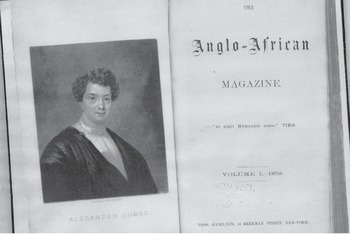
Fabre has noted that, as a result of such identifications with Dumas and his works, it ‘would be hard to overestimate the magnetic appeal’ the writer ‘exerted on black Americans … even before emancipation’.Footnote 10 As a testimonial to Dumas’ status among African Americans during the Civil War era, his portrait graced the first issue’s cover of the prominent African American publication Anglo-African Magazine in 1859 (see Figure 3).Footnote 11
Dumas’ portrait in the collected edition of Anglo-African Magazine. Manuscripts, Archives and Rare Books Division, Schomburg Center for Research in Black Culture, The New York Public Library, Astor, Lenox and Tilden Foundations.

In the following decades, Dumas held an increasingly significant role in the consolidation of an African American identity. This article focuses on how African American intellectuals constructed Dumas into an African American lieu de mémoire, which we can define as ‘any significant entity, whether material or non-material in nature, which by dint of human will or the work of time has become a symbolic element of the memorial heritage of any community’.Footnote 12 Dumas has not been the subject of much historical scholarship, and his perception and reception in the US in general has received minimal comments.Footnote 13 His popularity among African Americans has not gone unnoticed, but it has not been explored in any detail.Footnote 14 This article builds on the most significant item in this limited body of work, Fabre’s brief article ‘International beacons of African-American memory’, which first suggested the idea that Dumas could be analysed as an African American lieu de mémoire, although he provided few reasons for this appropriation.Footnote 15
Europeans placed their ‘civilized’ state as an idealized norm to which all others should aspire, and by which they should all be measured. Other cultures had to meet the European standard to be perceived as theoretically equal.Footnote 16 Since most cultures beyond Europe were perceived as falling short of this standard, it was generally imposed on ‘backward’ Others through ‘civilizing’ colonialism, although some Others attempted to reach the standard on their own. The pursuit of modernity therefore ‘legitimized the subjugation’ of Other cultures ‘to establish Western values’.Footnote 17 Western expansion and domination in the form of internal and external colonial systems dating from the Age of Exploration served as a form of globalization, spreading white hegemony across the globe, particularly to the western hemisphere. Therefore, as the social scientist Richard Mansbach has argued, ‘much of the global interconnectedness that we take for granted was produced by European [and American] imperialism’.Footnote 18
However, the hegemonic narrative of Western cultural development and global expansion, reinforced through colonial systems, did not include individuals of black descent, who were perceived as ‘outside’ Western culture and history. White Americans broadly perceived themselves as transplanted Europeans and therefore, along with Europe, comprised Western civilization. During the course of the nineteenth century, Western and white became synonymous. As a result, whites retained the monopoly on ‘modernity’, while African Americans were perceived as ‘backward’ individuals with a ‘primitive’ culture. As the African American intellectual W. E. B. Du Bois claimed, ‘according to white writers, white teachers, white historians, and white molders of public opinion, nothing ever happened in this world of any importance that could not or should not be labeled “white”’.Footnote 19 Beginning to think of blacks from the point of contact with Europeans at the birth of the modern age, thereby ignoring the great African civilizations and cultures of earlier eras, maintained the myth ‘that the Black man has always been reduced to slavery by the superior White race with which he has lived, wherever it may have been’.Footnote 20 Such perceptions solidified the West as the exclusive writer of historical progress. No African American individuals were perceived as succeeding in Western terms in the arts, humanities, and sciences. Consequently, African Americans remained alienated from mainstream American society – a ‘nation within a nation’ – despite formally gaining freedom and citizenship in the 1860s.
In the face of such discrimination, African American intellectuals forged a broad ‘counter-global’ bloc, or collective movement, that challenged globalization conceived as hegemonic Western domination.Footnote 21 They sought to insert African Americans as a whole into the history of America, (re)creating a local black American history that had been undocumented – and hence ‘forgotten’ – because of slavery and Western power. A goal of African American intellectuals was therefore to create a ‘usable past’, or counter-memory, that intentionally sought to reconstitute history through the inclusion of African Americans.Footnote 22 African American intellectuals sought to counter Western myths of black inferiority, which in turn supported white superiority, by arguing that being of black descent was not the reason for the lack of African Americans’ cultural achievements; that lack was, rather, the devastating legacy of slavery, which limited their abilities and created a break in their development. The want of nationally recognized African American historical figures of cultural achievement in Western terms during the nineteenth century forced intellectuals to rely on blacks of achievement such as Dumas from the Caribbean and Europe. From the mid nineteenth to the early twentieth century, African American intellectuals subsequently constructed Dumas as a lieu de mémoire as part of wider efforts to appropriate historical individuals of black descent across the globe within a transnational community produced by the Atlantic slave trade. Since all blacks were perceived as having a uniting ‘essence’, the existence of past individuals of achievement such as Dumas meant that all such individuals of black descent had these abilities. Such identification efforts intended to demonstrate African Americans’ social and cultural suitability in Western terms and the resulting right to be included in American society.Footnote 23
In the process of identifying individuals in the Caribbean and Europe as ‘black’ and ‘American’ like them, however, African Americans expressed a new local black identity by expanding an ‘African American’ identity to a wider range of individuals than was commonly applied, creating the foundations of a ‘black Atlantic’. African American intellectuals therefore created a ‘decisive rupture’ with the hegemonic geographic and cultural boundaries of ‘America’, exceeding ‘bounded forms of the local’ to create, ultimately, a transnational Atlantic community comprised of individuals of black descent from Africa, America, the Caribbean, and Europe united through a common history organized around the themes of slavery and emancipation, of Western domination and marginalization.Footnote 24 Such an application in turn served as a globalizing agent, prefiguring the complex transnational and hybrid identities characteristic of the global age.Footnote 25 In other words, while constructing a ‘usable past’ as part of their counter-global movement, African Americans redefined ‘America’ beyond the current hegemonic usage (which generally restricted the term geographically to the US) to encompass an ‘Atlantic’ world – a world in which Dumas was re-imagined as an integral component, transformed significantly into a figure of memory with strong connections to slavery and colonialism.
By this strategy, African Americans were not concerned with the goal of uniting all people of black descent around the globe into a transnational bloc. The ultimate objective of creating a ‘usable past’ was to reconfigure Western history to open up ‘possibilities for shaping different futures’ in which African Americans were integral components of American society.Footnote 26 By documenting black contributions to America’s development in the past, African Americans hoped to legitimize their right to be considered full members of the America of the present, for this new black American history would subsequently be integrated into mainstream American history. Forging a more counter-global transnational black memory would ultimately assist African Americans in their local struggle for equal rights and citizenship in the US. As time passed, African Americans gained increasing economic power, positions in elected office, cultural success, and support of liberal white reformers. Therefore, African Americans began to depend less on blacks from other parts of the globe (although not discarding them as ‘race heroes’) and more on their own recent figures of achievement.
The context of the African American struggle to ‘unveil’ the past
After the Civil War and emancipation, African Americans, despite gaining freedom and citizenship, generally remained outsiders to the national body, which was dominated by ‘white’, or Western, American culture, and quickly became aware of their ‘blackness’, or a sense of alienation from majority society because of their dark skin, which demonstrated the possession of an irremediable inferior essence that connected them to an imaginary and global monocultural ‘African’ ethnicity. White Americans perceived themselves as transplanted Europeans bonded as part of Western civilization. As Du Bois wrote in a 1922 article, it was white Americans’ alienation of African Americans that contributed to a ‘black’ identity. Consequently, the cultural theorist Paul Gilroy has argued that the black need ‘to acquire a supposedly authentic … and stable “rooted” identity … is perhaps best understood as a simple and direct response to the varieties of racism which have denied the historical character of black experiences and the integrity of black cultures’.Footnote 27 What was ‘white’, however, was not fixed and quite subjective. Nevertheless, since whiteness was associated with advanced civilization, ‘proximity to whiteness symbolized the civilizational quotient of a group’ and served as a way for majority American society to maintain the subservience of those deemed inassimilable, even while granting them citizenship.Footnote 28 African Americans were therefore forced into a paradoxical situation: born and raised in America, they found that they could not identify completely with non-Western African society and culture; yet, as a result of their ‘blackness’, nor could they identify completely with existing Western American society and culture.Footnote 29
Many scholars have viewed majority American society’s attempt to exercise hegemonic control over non-whites in the post-emancipation era as internal colonialism. In internal colonialism, a minority is ‘subjugated’ by a dominant majority, which defines, locates, and asserts its identity directly over the minority (rather than claiming identity and power from a distance).Footnote 30 Such hegemony was supported in part through control of the nation’s historical memory, which served as a tool to justify certain groups’ superior role and to determine who had the right to partake in being ‘American’ and hence Western. Although the US saw itself as an anti-colonial nation because of the American colonies’ rebellion against the British, it nevertheless ‘incorporated many of the defining features of European colonial networks (including the color line) into its economic and cultural life’.Footnote 31 As a result, mainstream America’s social system of internal colonialism acted as an agent of globalization conceived as Western hegemony. The Reconstruction amendments’ promises of democracy were short-lived. In the 1870s, white reactionary politicians regained a hold on the South. By the 1880s, faced with little federal opposition, the Reconstruction freedoms began to be eroded, enabling segregation and further limitations on African Americans’ rights as citizens.
In response to such broad developments, African American intellectuals began to develop a particular counter-global ideology to unite African Americans as a bloc, or collective movement, possessing solidarity; for it was crucial for African Americans to develop their own popular culture that could then undergo a transformation as part of the wider US mass culture.Footnote 32 African American intellectuals (such as Frederick Douglass, W. E. B. Du Bois, and Booker T. Washington) sought to speak as leaders of the African American bloc. While not intellectually homogenous, these scholars generally favoured African Americans’ incorporation into the national body as equals to reconcile their feelings of being trapped in two worlds. However, the question remained of how to achieve such goals.
A common theme of late nineteenth- and early twentieth-century African American intellectual discourse was a firm belief in racial progress made since emancipation. African Americans, socially conditioned to accept notions that blacks were lesser than whites, identified their Western inferiority as based on their possession of a transnational ‘backward’ culture. As the African American historian Arthur Schomburg noted in 1925, the ‘Negro has been a man without a history because he has been considered a man without a worthy culture’.Footnote 33 African American intellectuals consequently took strides to demonstrate their cultural acclivity and worthiness of being ‘American’, articulating the dawning of an era in which the global ‘gap’ between blacks and whites was decreasing rapidly in the US. Schomburg continued, ‘a new notion of the cultural attainment and potentialities of the African stocks has recently come about … [and] the mind of the Negro has leapt forward faster than the slow clearings of scholarship will yet safely permit’.Footnote 34 The African American newspaper Opportunity repeated such sentiments, calling African Americans ‘a progressive people’ making the ‘most remarkable advances … by any people in the world’.Footnote 35 Du Bois also commended ‘the negro race in America’, which had ‘more than indicated its ability to assimilate into modern [Western] culture’.Footnote 36 In addition, African American chronicles of black history in America frequently bore titles implying that African Americans were ‘catching up’ with whites because of education and cultural production.Footnote 37 Such sentiments were not confined to African Americans alone and gained credence among liberal-minded majority Americans. A 1912 New York Times article, for example, reported that African Americans were ‘making marvelous strides in all the elements of race building’ even in the South, where they faced segregation and racial prejudice. Leading newspapers commonly reported on the ways in which ‘the emancipated race met the trust bestowed upon it’ by proving their ‘capacity to develop and improve’.Footnote 38
The African American collective movement that emerged in the late nineteenth century increasingly sought to exert a counter-global hegemony to challenge majority America’s authority based on blacks’ inferiority and lack of assimilability. A central component was the use of popular culture to formulate a contested discourse of historical development that embodied the memory of a transnational black past and emancipation’s significance. Historical memory therefore emerged as the battleground on which Africans Americans fought to be ‘Americans’. We can broadly conceive the study of historical memory as one ‘of cultural struggle, of contested truths, of moments, events, or even texts in history that thresh out rival versions of the past which are in turn put to the service of the present’.Footnote 39 As Du Bois, a ‘creator of black counter-memory’, later argued in 1935, ‘with sufficient … agreement among the dominant classes, the truth of history may be utterly distorted … to any convenient fairy tale that the masters of men wish’.Footnote 40 Consequently, the movement in general used methods that forced a public negotiation of both Western and American history, demonstrating African Americans’ contributions to provide them with a present sense of legitimacy as ‘American’.Footnote 41
Slavery had not only robbed African Americans of their history but also of their cultural acclivity. Early African American intellectuals argued that their local preoccupation with achieving emancipation and equality prevented the pursuit of the arts for strictly creative purposes and thus the ability to achieve mainstream praise (like Dumas) for works of poetry, drama, and fiction. The pioneering twentieth-century African American historian J. A. Rogers noted that ‘luckily for the world, Dumas was… not [born] in America, where he would have been circumscribed and might have used his genius in the struggle for elementary liberty like his notable Negro contemporary, Frederick Douglass’.Footnote 42 Douglass, like other former African American slaves and prominent African Americans of the era, wrote ‘in the limited genres of slave narrative, protest oratory, and racial journalism’.Footnote 43 He had noted that it was ‘a marvel’ to him that, under such circumstances of racial inequality, he ‘learned to write at all’. He was amazed that ‘such men as … Dumas … could have produced’ such creative works, but ‘many have been the impediments with which I have had to struggle’.Footnote 44 Individuals of black descent like Dumas had still been affected by the Atlantic slave trade. However, as the African American scholar Carter Woodson argued in 1933, blacks of cultural achievement had risen to such ‘heights’ because they were ‘farther removed from the influence of slavery and segregation. For this reason, we do not find … [among African Americans] a Dumas.’Footnote 45 Du Bois had posed a similar argument, citing only the African American poet Phillis Wheatley as having comparable mainstream praise in the US as Dumas.Footnote 46 In Darkwater (1920), Du Bois also cited the black British musician Samuel Coleridge-Taylor, who was ‘fortunate … to be born in Europe … In America he could hardly have had his career … He was one with that great company of mixed-blooded men: Pushkin and Dumas … and many others.’Footnote 47 The argument was, therefore, that African Americans’ lack of creative production was not because of their dark skin but because of the late elimination of slavery, which prevented their development and left an enduring legacy of discrimination – the socio-cultural condition of ‘blackness’.Footnote 48 Dumas’ literary works were depicted as a precedent for the achievement of future African American writers in the US.Footnote 49
Linked to African American intellectuals’ pursuit to create a black past and document black achievements and contributions to America’s development was the need to demonstrate the suitability of African Americans as a whole for assimilation into the national body. To this end, African American intellectuals attempted to show that African Americans were on the ‘same level’ culturally and socially as white Americans. Since there were few to be found who succeeded according to Western standards within the traditional definition of ‘America’, African American counter-global discourse shifted its definitional criteria to refer to an Atlantic world in which ‘African Americans’ were united through the common history of slavery. As a result, African American intellectuals developed a more transnational outlook, which sought to identify ‘African American’ heroes of cultural merit beyond the limited local geographical confines of the US. African Americans used mainstream American conceptions of race to identify individuals ‘veiled’ from the historical record by their classification as ‘symbolically white’ in the US and elsewhere because of their Western accomplishments both as a means to counter notions of African Americans’ incapability with the national body and to create a black usable past. In the 1920s, Schomburg concluded that earlier individuals of achievement who were of black descent were ‘by virtue of their being regarded as something “exceptional” … unfairly disassociated from the group, and group credit lost accordingly’. In other words, individuals of black descent such as Dumas were categorized as ‘symbolically white’, reinforcing blacks’ incapacity for cultural achievement and inclusion in the Western narrative of global development. Du Bois even specifically cited Dumas in public lectures to American audiences as among the great black men across the globe ‘veiled from your knowledge’.Footnote 50
Many of Dumas’ majority American supporters had increasingly perceived him during the late nineteenth century as being predominantly ‘white’ and thus a component of Western culture through his accolades and literary works. As J. A. Rogers alleged in 1946, Dumas’ ‘English-speaking [supporters] … were anxious to prove that he wasn’t a Negro’.Footnote 51 An 1896 edition of Scribner’s, for example, argued that, despite the fact that Dumas’ grandfather ‘with all the insolent pride of blood and superb disregard for the laws of God and man’ settled in the Caribbean and married ‘a full-blooded negress’, it is the ‘old aristocrat’s pride [that] lives in … his descendants’.Footnote 52 In another example, the journalist Albert Southwick declared that Dumas, regardless of his ‘skin of a slight yellow tinge, and short, crispy, curling hair’, was a ‘true Frenchman’ and thus a member of modern Western culture.Footnote 53 In such a view, Dumas’ white ancestry was dominant and could ‘harness’ his wild African characteristics, the result of which was his works of literature. As a result, Dumas’ status as an individual of black descent could be rationalized as being insignificant, demonstrating how the ‘one-drop rule’ was not rigidly applied. In a lecture to the Society for Ethical Culture, Du Bois boldly declared that ‘you have [in] many great white men this negro element coming in to color and make wonderful the genius which they had’. He criticized majority America’s tendency to marginalize to the point of forgetfulness the black ancestry of prominent individuals, thereby making them ‘symbolically white’. The New York Times article on the event, which expressed alarm at the ‘startling statement’ that great ‘white’ men could be secretly ‘black’, bore the contradictory title ‘Mixed blood aided white geniuses’. If one strictly applied the ‘one-drop rule’, individuals with ‘mixed blood’ could not be classified as ‘white’ in the first place.Footnote 54 Other interpretations on Dumas’ biracial status existed, such as more ‘romantic racialist’ views that Dumas drew from his African origins to add to his creativity and the opinion that Dumas’ ‘Africanness’ was reflected in the fact that his works were carelessly constructed and poorly written. Others argued that Dumas did not write any of the works attributed to him, but in fact oversaw a ‘literary factory’ and placed his name on the work of subordinates. Harper’s Magazine’s 1871 obituary of Dumas, for example, described his works as being written ‘with a carelessness, recklessness, and audacious pursuit of excitement that, happily, has but few parallels in America’. He was criticized for using ‘scarcely any revision’ and of producing a vast quantity of works via a ‘joint-stock company’ that had no ‘scruple about plagiarizing … whenever literary theft … would serve a useful purpose’.Footnote 55
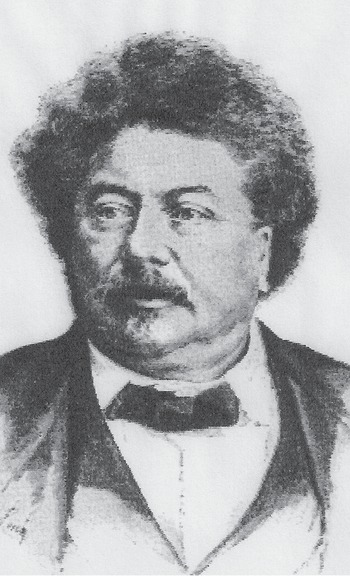
The conclusion that Dumas was essentially a ‘white’ writer, however, became increasingly hegemonic in the US during the decades following his death in 1870, as he became a topic for academics’ debates rather than contemporary gossip pages. Dumas’ works continued to be read by the American public but they largely concerned French history and had white heroes; consequently, readers assumed that he was French, which to them implied ‘white’. A testament to the strength and longevity of this image in the US throughout the twentieth century is provided by a 1991 New York Times article in which the activist Hugh B. Price (b. 1941), then vice president of the Rockefeller Foundation, admitted that he ‘was an adult’ before learning that Dumas was ‘partly black’, for ‘no literary anthologies in my high school or college courses mentioned’ this fact.Footnote 56 Images accentuating Dumas’ Caucasian features were still frequently depicted in nineteenth- and early twentieth-century American editions of his works and on postcards. While the era’s textual discourse (such as brief biographies that accompanied his works) admitted Dumas’ black ancestry, the visual images generally portrayed a physically ‘white’ Dumas, reinforcing the perception that he was not really a ‘black’ writer at all. Figures 4 and 5 provide examples of such images, which sought to limit the physical characteristics that contemporaries had described as ‘African’, including the kinkiness of Dumas’ hair, his skin tone, and the shape of his lips. The journalist B. Phillips, for example, who encountered Dumas at the writer’s Château de Monte Cristo, described Dumas as ‘about the average height, and portly … The trace of his African blood, though not appreciable in … [his ruddy] complexion …was evident in the hair, the lips, and the eyes.’ In another example from 1871, a Harper’s reviewer declared Dumas as a ‘man with wooly hair, and deficient calves, and black pigment in the creases of his joints and fingers’.Footnote 57 The visualization of Dumas and his racial conceptualization are inexorably intertwined. In such depictions, we see how the perceived moral, intellectual, or cultural accomplishments (or defects) of individuals of black descent could influence how they were imagined physically as either black or white. If, as the adage goes, ‘a picture is worth a thousand words’, such images negated the admission of his black ancestry, inscribing in the viewers’ minds a lasting conception of Dumas as a ‘white’ writer, not just symbolically but physically.
Image of Dumas from Scribner’s Magazine, September 1889. Author’s collection.

Image of Dumas from a 1905 American edition of The Count of Monte Cristo. Author’s collection.

As a result, Shomburg argued that the ‘first true writing of Negro history’, which had been in progress since the late nineteenth century, was the ‘rewriting of … our common American history’ to represent ‘historical truth’, and that ‘the American Negro must remake his past in order to make his future’.Footnote 58 In remaking this usable past, African American intellectuals increasingly expanded the African American bloc beyond hegemonically defined ‘America’. Slavery and emancipation remained the key themes of this new American history. Beginning in the late nineteenth century, the production of books featuring heroes of black descent from across the globe was a common means by which to create a counter-global black transnational collective memory. Such efforts built on the work of the French abolitionist Abbé Grégoire’s 1808 De la littérature des nègres (translated into English in 1810), which illuminated black achievements through biographies of prominent ‘American’ blacks who had gone to Europe.Footnote 59 Dumas consistently appeared in such collections, solidifying his reputation as a black writer among African Americans.Footnote 60 A 1921 piece on Dumas in The Crisis reflected the African American attitude that had developed toward Dumas, describing him as a ‘French and Negro’ author ‘notable among the world’s greatest writers’.Footnote 61
Dumas a ‘black’ symbol of modernity
Dumas was an obvious early candidate for incorporation into the reconstruction of a transnational black usable past because his works had been popular with majority American society, whose standards African American intellectuals aspired to meet. Therefore, although Dumas was ‘black’, he succeeded on Western, or white, terms. Further, he had a long-standing popularity among African Americans. The exodus of whites, blacks, and gens de couleur from the French Caribbean to the US, particularly as the result of the Haitian Revolution, linked parts of the US, especially in the south, with the French Atlantic. Not surprisingly, many African Americans of French Caribbean extraction retained the French language and kept abreast of French affairs and culture. Francophone African Americans often sent their children to France for educations then unattainable in the US. Consequently, African Americans learned about Dumas’ black ancestry through French newspapers and other media either at home or while abroad.
To such nineteenth-century African Americans, Dumas emerged as a heroic figure. For example, Martin Robinson Delany, an early black nationalist of French extraction, named his seven children after figures of black descent whom he admired, including Dumas.Footnote 62 Further, many francophone African Americans who sojourned in France sought him out. Examples include Pierre Dalcour, who associated with both Victor Hugo and Dumas, and Eugene Victor Macarthy, who attended the Paris Conservatoire in the 1840s before returning to the US, where he starred in adaptations of Dumas’ dramas Anthony and La Tour de Nesle.Footnote 63 The most famous francophone African American in France at the time was Victor Séjour, who emerged as a noted dramatist and poet in French literature. Séjour copied the lifestyle and literary style of Dumas, with whom he also socialized, and dedicated his 1856 play Le Fils de la Nuit to Dumas.Footnote 64 Dumas’ popularity among African Americans of French and francophone descent increased his appeal more generally to African Americans throughout the US. For example, African American acting troupes named themselves after notable figures involved in the dramatic arts. At least three during the late nineteenth and early twentieth centuries were named after Dumas.Footnote 65 In addition, there were ‘coloured schools’, particularly in the Midwest, named in his honour, and many African Americans named their children after him. An example is Alexandre Dumas Watkins, Princeton University’s first African American instructor in the 1890s.Footnote 66
William Wells Brown, a former African American slave and writer who travelled to England and France in the nineteenth century, described his first public encounter with Dumas. His account, published in the 1860s as part of a compilation describing the lives of prominent individuals of black descent, was cited frequently and did much to solidify Dumas as a celebrity among African Americans. Brown wrote:
In a double box opposite me [at the opera], containing a party of six or eight, I noticed a light-complexioned mulatto, apparently about fifty years of age, curly hair, full face, dressed in a black coat, white vest, white kids, who seemed to be the centre of attraction, not only in his own circle, but in others. Those in the pit looked up, those in the gallery looked down, while curtains were drawn aside at other boxes and stalls to get a sight of the colored man. So recently from America, where caste was so injurious to my race, I began to think that it was his wooly head that attracted attention, when I was informed that the mulatto before me was no less a person than Alexandre Dumas. Every move, look, and gesture of the celebrated romancer were watched in the closest manner by the audience. Even Mario [the opera performer] appeared to feel that his part on the stage was of less importance than that of the colored man in the royal box.Footnote 67
Brown remarked admiringly that no writer filled a more important place in the literature of his country than Dumas. Yet he clearly considered the writer’s success as a tribute paid to the whole race, which naturally included African Americans. As a result, the celebration of Dumas was simultaneously a celebration of all African Americans. As the historian Elizabeth Bethel has argued, by the Civil War era, ‘largely as a result of Brown’s compilation’, the figures included in its pages became ‘firmly embedded in the popular historical consciousness of African Americans as race leaders and race heroes’.Footnote 68 Such sentiments set the foundation on which lay Dumas’ symbolic value to African American intellectuals in their efforts to construct a transnational black usable past that they perceived as having been lost owing to their time as slaves.
African American intellectuals appropriated Dumas as a symbol of the cultural potential of all African Americans in the US to demonstrate that they were fully capable of achievement at the level of Western culture and of being assimilated into the American nation. Two aspects of this symbolic transformation were the assertion of Dumas’ black ancestry to counter his ‘symbolic whiteness’ in the hegemonic narrative of Western development. African Americans praised Dumas for the same accomplishments that majority Americans used as a rationale for his classification as ‘white’. However, they also emphasized a rigid application of the ‘one-drop rule’ to argue that Dumas’ black ancestry made him a ‘black’, rather than a ‘white’, writer. The purpose was to counter the common perceptions that linked biology to culture, or, in other words, to assert that there was nothing biologically, or naturally, inferior about being of black descent. Such individuals could attain the same cultural level as whites without having to explain their successes as ‘anomalies’ or, in the case of biracial individuals, as a result of their ‘white’ ancestry being dominant. Du Bois, for example, argued frequently that the ‘mulatto descendants of Louise Dumas and the Marquis de la Pailleterie were a great gift to mankind’ to counter global notions of black genetic inferiority, and that black blood had produced ‘mighty offspring’ such as ‘Dumas and Pushkin and Coleridge-Taylor’.Footnote 69
One major obstacle to be overcome in solidifying this perception of Dumas as an accomplished ‘black’ literary figure, however, was the long-standing accusation that he was not the ‘true’ author of the popular works ascribed to him. The unsuccessful French writer Eugène de Mirecourt’s 1845 pamphlet, Fabrique de romans: Maison Alexandre Dumas et compagnie, had declared that Dumas wrote none of the works attributed to him. Instead, he presided over a writing factory comprised of subordinates who produced works to which he ascribed his name.Footnote 70 Even though Dumas successfully sued de Mirecourt for slander, the charges continued to be made. As one nineteenth-century American paper claimed, Dumas, the ‘great leviathan of literature’, was in fact ‘a very shallow monster after all’.Footnote 71 As a result, Dumas came to be regarded as a popular writer, but someone whose work lacked style, sophistication, and originality.
African American intellectuals therefore went to great pains to vindicate Dumas’ literary reputation, almost as if they were defending their own. William Wells Brown, to name but one example, defended the French writer by posing the argument that, while Dumas’ works were not entirely his own, he took the collaborator’s initial idea, substantially revised it, vastly improved its dialogue, and added a ‘spirited scene’ here and there to make the work ‘his own’.Footnote 72 In the early twentieth century, the noted African American playwright Willis Richardson wrote an entire drama, The elder Dumas, to vindicate the French writer. The play, set in Paris in 1843, focused on charges that Dumas stole other writers’ ideas. Richardson used the drama to argue that Dumas’ contributions were substantial. What he received was ‘rubbish’ from unknowns that he ‘polished and painted and sent out under the name of Alexandre Dumas’.Footnote 73
However, some mid-nineteenth-century African Americans had mixed feelings about asserting Dumas’ identity as a ‘black’ writer and therefore a member of the expanding African American counter-global bloc, thereby implying fissures within the direction of the burgeoning collective movement. What were the criteria for belonging? Was being ‘black’ strictly a biological condition? Although many attempted to read The Count of Monte Cristo as an allegory of emancipation, Dumas, at the peak of his fame during the 1830s and 1840s, did not write much about the ‘black experience’ (that is, slavery, the African diaspora, and racial alienation) or take a highly active role in abolishing slavery, which occurred in France for the second and final time in 1848 and in the US in 1863.Footnote 74 Nor did he consistently identify himself as black. As Phillips noted upon meeting Dumas, he always identified himself simply as a ‘Frenchman’.Footnote 75
Frederick Douglass was the most prominent nineteenth-century African American intellectual to express dismay at Dumas’ lack of a ‘black consciousness’.Footnote 76 Douglass was an enthusiast for Dumas’ work, particularly The Count of Monte Cristo.Footnote 77 As one biographer has argued, ‘Douglass had long held up the black author [Dumas] as an exemplar for the race’s capacity for genius.’Footnote 78 Yet his feelings about Dumas were tarnished following a tour of France in the 1880s, when he met Victor Schoelcher, the French politician instrumental in abolishing French slavery in 1848. Schoelcher, who had been a political adversary of Dumas and his anti-slavery associates (such as Cyrille Bissette, a biracial abolitionist from Martinique), criticized Dumas, whom he portrayed as an individual who lived immorally and took no interest in working toward slavery’s abolition or in improving blacks’ social conditions.
Schoelcher’s portrait of Dumas, however, was an exaggeration. Dumas did make some efforts to assist the struggle against slavery and inconsistently showed sentiments of solidarity with individuals of black descent (particularly those who were of biracial descent and educated). During the American Civil War, Dumas received a letter from President Abraham Lincoln asking for an autographed picture to be sold at a June fair in Pittsburgh to benefit sick and wounded Union soldiers. As Lincoln wrote, ‘We know that we do not make our appeal in vain to you, whose heart and pen have always been in the service of humanity, kindness, and charity.’ In addition, he asked for ‘a small donation’.Footnote 79 Rather than send one autograph, Dumas sent one hundred. He even made ‘unfruitful’ attempts with the French press to open a subscription for the benefit of the fair and sent an offering of US$10 (FFr 50).Footnote 80 In France, Dumas may have written to the Bishop of Autun to thank him for his anti-slavery efforts.Footnote 81 In addition, an 1838 letter to Cyrille Bissette revealed his anger over the pro-slavery Revue coloniale’s incorrect claim that his poetry was to appear in its pages. Dumas hoped that Bissette would publish the letter to amend this error, for ‘all my sympathies are instinctively and nationally for the opponents of the principles that these gentlemen defend’. It was his hope to make this position known ‘not only in France, but everywhere I can count my brothers in race and friends of colour’.Footnote 82
Douglass, unaware of the complexities of French politics and the divisions that had existed within the French abolitionist movement, accepted Schoelcher’s account. He recorded his conversation with Schoelcher in a private letter, writing that ‘we have nothing to thank Dumas for … [This] brilliant colored man who could have let down sheets of fire upon the heads of tyrants and carried freedom to his enslaved people, had no word in behalf [of] liberty for the enslaved.’ When he visited the recently erected statue of Dumas in Paris, Douglass wrote that he perceived it as ‘an acknowledgement of the genius of a colored man’; yet he refused to ‘honor the character of the man himself’.Footnote 83 Schoelcher’s comments did not, however, prevent Douglass from voyaging with his wife to Marseilles to visit the Château d’If, the prison from which the fictitious Edmond Dantès, hero of Monte Cristo, escaped to seek his revenge on the men who had him falsely imprisoned. As Douglass recounted in an autobiography, he and his wife had an ‘irresistible’ desire to visit the ‘Château D’If, the old prison anchored in the sea around which the genius of Alexandre Dumas has woven such a network of enchantment’.Footnote 84
Douglass’ conflicted feelings about Dumas were thus shaped by the current African American struggles for emancipation and equality to which he devoted his life. His critique of Dumas at this early stage in the push for an African American counter-global movement revealed the opinion that it was the duty of all ‘black’ individuals across the globe to contribute to a collective push for the advancement of equality, overcoming their transnational historical alienation. Some argued that admittance into the African American bloc was not automatically based on being of black descent, or strictly a biological matter, but rather a sociocultural one. As a result, being ‘black’ became a flexible social construction, mixing biological and cultural determinants.
However, many late nineteenth- and early twentieth-century African American intellectuals found this perception unrewarding. Being a ‘black’ writer in the sociocultural sense was undesirable and ‘backward’, for it meant alienation from, rather than integration into, Western culture and American society. African Americans often praised their race and their distinctiveness through the creation of a clear-cut counter-global collective movement. At the same time, however, they aspired to succeed on Western terms to be considered equal and hence integrated with majority Americans in a ‘new’ America. Dumas’ perceived lack of a ‘black consciousness’, which had so offended the likes of Douglass, increased his cultural capital in the eyes of later African American intellectuals. While paradoxically asserting Dumas’ biological black heritage, such intellectuals simultaneously denied his sociocultural ‘blackness’ or sense of alienation from Western culture and society. Dumas was not a ‘black’ writer but rather a ‘French’ one who happened to be of black descent. As a result, as the early twentieth-century African American scholar Carter Woodson claimed, Dumas ‘had little reason for thinking of the race from which he sprang’. To Woodson, Dumas was first and foremost a Frenchman and therefore rarely expressed himself ‘on the question [of abolition] and then as a matter of sympathy rather in defense or advocacy of the cause’.Footnote 85 Such perceptions led to Dumas being taken as an emblem for those African Americans who hoped to transcend the global colour line, to be treated as ‘Americans’ rather than ‘African’ Americans. To them, Dumas was an incorporated ‘French’ writer, rather than an alienated ‘Afro-French’ writer who remained outside the French nation and Western culture. In the 1892 African American novel Iola Leroy, for example, the protagonist (who is of black descent) wants to settle in France, where he believes he can gain greater educational opportunities and equality. As proof, he cites Dumas, ‘who was not forced to conceal his origin to succeed as a novelist’.Footnote 86
At the same time, however, African American intellectuals wished to assert that Dumas had pride in having a black heritage. Since Dumas was linked conceptually to Africans Americans as a whole, such pride would help foster in African Americans a sense of pride in themselves. J. A. Rogers, for example, in a brief biography of Dumas, cited examples of dubious authenticity to demonstrate Dumas’ racial pride. First he made the claim that Dumas embraced ‘as a brother’ the Shakespearian African American actor Ira Aldridge after viewing the actor’s performance of Othello and declared himself a ‘negro’. In addition, Rogers attributed a quote to Dumas in which he reflected on the racism that he experienced in Paris during the aftermath of the Haitian Revolution (1791–1804). According to Rogers, Dumas said, ‘When I discovered that I was black I determined to so act that men should see beneath my skin.’Footnote 87
Owing to his success, Dumas emerged among African Americans as a strong symbol of the potential of all blacks across the globe to achieve the ‘modernity’ associated exclusively with the West and subsequent incorporation of African Americans into the American nation. As a result, he was used as a tool to criticize white racism. Du Bois argued that the ‘Negro … resents … any intimation that the Negro race is deficient in ability … compared with other races … [for] modern … Negro genius has shown itself in … Alexandre Dumas’.Footnote 88 This opinion was not restricted solely to African Americans. In 1865, the liberal Carson City Appeal asked: ‘Is color distinctive of talent? I wot not. Is not Frederick Douglass an orator and Alexander Dumas the chief of novelists? When will these invidious and unfair demarcations be obliterated in this free and enlightened Republic?’ In another example from 1870, Albert Southwick argued that Dumas, ‘so distinguished as a writer and a man, belongs to a race that is generally considered by us incapable of those distinctions in literature and society which he has gained’. As a result, he was ‘living refutation of those prejudices which would necessarily condemn people of color to intellectual inferiority’.Footnote 89
Constructing an Atlantic Dumas
By virtue of identifying Dumas as a ‘black’ writer (in either the biological or sociocultural sense), African American intellectuals affiliated him with the development of an African American counter-global collective movement, or bloc. A result of this affiliation was to extend ‘American’ themes of slavery and emancipation to their remembering of Dumas. African Americans therefore embellished his connections with the history of both slavery and the Caribbean, since they generalized ‘America’ to be synonymous with the Atlantic world. This African American identification with individuals of black descent across the globe altered the perception of such individuals in the sense that they came to hold much in common with African Americans. By overcoming slavery in the Americas and achieving great literary success, the black Dumas of counter-global memory became more ‘American’ and consequently more easily identifiable to African Americans in general. While this identification primarily provided a hero and pride to African Americans, it also generated greater sympathy from majority American reformers since Dumas was popular with both groups. Consequently, creating a counter-global argument that repositioned such a ‘white’ writer as ‘black’ created a ‘subversive rupturing of dominant geographical imaginations’ of America and the West.Footnote 90
By the mid to late nineteenth century, African American intellectuals had conceived a more ‘American’ Dumas, portraying him, along with the Haitian Revolutionary leader Toussaint L’Ouverture and the former slave Frederick Douglass, as one of the three great figures of an African Atlantic diaspora. Such connections demonstrated early attempts at conceptualizing a larger global community of ‘African American’ individuals of black descent to express transnational solidarity through the experience of the slave trade. As early as 1855, James M’Cune Smith connected Douglass to Dumas in his introduction to My bondage, my freedom, noting Douglass’ ‘versatility of talent with which he wields in common with Alexandre Dumas’. In a later example, George Ruffin wrote in his 1881 introduction to The life and times of Frederick Douglass that ‘I am glad … to present a work which tells the story of our most celebrated colored man. To the names of Toussaint L’Overture [sic] and Alexandre Dumas is to be added that of Frederick Douglass. We point with pride to this trio of illustrious names.’Footnote 91 As late as 1940, the African American scholar of French literature Mercer Cook noted that the black race in the Americas had ‘produced Alexandre Dumas to write about the world, and Toussaint-Louverture for the world to write about’. As we have seen, J. A. Rogers even alleged that Dumas wrote a letter to the Bishop of Autun thanking him for his efforts on behalf of blacks, for at that moment possibly his own relatives were ‘forming part of the cargoes of slave vessels’.Footnote 92 Such passages asserted Dumas’ black identity and connected him to America (via his association with the Atlantic world) and slavery (since Douglass and L’Ouverture had been slaves), even though it was Dumas’ father who had been born a slave in the Caribbean. The connections between Dumas and the Atlantic slave trade have persisted in the African American and Afro-Caribbean memory. In 2007, for example, the Massachusetts Historical Society hosted the Boston premiere of Jamaican-born Esther Anderson and Gian Godoy’s film The three Dumas, which was ‘presented in honor of the bicentennial of the abolition of the Atlantic slave trade’. The film chronicled Dumas’ life as the ‘grandson of a slave’ who ‘overcame all the obstacles of prejudice to become a role model’.Footnote 93
However, in many instances during the nineteenth century, African American intellectuals wholly fabricated Dumas’ ancestry to extend his links with the Caribbean (and by extension, America), thereby increasing his connections to the Atlantic world and slavery. In the 1860s, in his influential The black man, his antecedents, his genius, his achievements, William Wells Brown perceived Caribbean individuals of black descent as ‘American’, particularly the primary figures of the Haitian Revolution. Using a more Atlantic connotation for ‘American’, Brown attempted to portray the leaders of the first successful slave rebellion and first black republic as ‘African American heroes’, thereby appropriating heroes of black descent as part of a counter-global conception of ‘America’.Footnote 94 He aimed to do the same for Dumas, claiming that Dumas’ grandfather was the Marquis de la Pailleterie, ‘a wealthy planter of St. Domingo’, while his grandmother was ‘a negress from Congo’.Footnote 95 Citing the British writer Marcus Rainsford’s An historical account of the black empire in Hayti (1805), which was one of the first positive accounts of the Haitian Revolution, Brown made the false assertion that Dumas’ father, Thomas-Alexandre, served in the ‘army of his own native land’. In fact, Dumas’ aristocratic grandfather brought his biracial son to France as a boy. When the French Revolution broke out, Thomas-Alexandre joined the French revolutionary army. Brown correctly noted Dumas’ father’s command of the Black Legion, which was comprised of free individuals of black descent in France during the Revolution, and his service under Napoleon. However, Brown then falsely claimed that Dumas’ father, ‘at the conclusion of the wars … returned to his island home’. In fact, he was captured leaving Napoleon’s campaign in Egypt and held prisoner in Italy before returning to France, where he died in 1806. Brown’s account, however, maintained that after his father’s death in Haiti, Dumas ‘went to France destitute, where he obtained a situation as a writer’. Such a claim contradicted the fact that Dumas was born in France and never set foot in the Americas, and provided the false image that Dumas was born and raised in the Caribbean before moving to France to become a great writer.Footnote 96 In Brown’s version, therefore, Dumas was a francophone African American writer.
Such accounts further solidified Dumas’ connections with the Atlantic world. By the early twentieth century, pioneering works on French-speaking writers in the Caribbean by such literary scholars as Mercer Cook featured Dumas. For example, Cook’s classic work, Five French negro authors (1943) lists Dumas among its subjects, in addition to René Maran, Julien Raimond, Cyrille Bissette, and Auguste Lacaussade. In his review of the book, Carter G. Woodson argued that it depicted the ‘the higher strivings of five of the natives [of the French Caribbean] who under the impact of colonial enterprise contrived to reach a higher level of expression than the economic imperialists contemplated’. With specific regard to Dumas, Woodson argued that viewing Dumas in his ‘native’ Atlantic context would help intellectuals think of him ‘as a branch from a root in dry ground’.Footnote 97 Consequently, by the early twentieth century, Dumas had become firmly established in the African American counter-global movement as a black writer who overcame the adversities of slavery, had connections to the Atlantic world (and hence American), and symbolized the potential of all individuals of black descent to achieve ‘modernity’ on a global scale and of black contributions to Western development. As a result of the solidification of Dumas as lieu de mémoire within the African American collective movement, scholarly reference works up to the contemporary era often include Dumas as an ‘African American’ figure of merit.Footnote 98
Dumas’ status as one of the most prominent global black figures led many early twentieth-century African American sojourners to France to visit his grave and sites related to his works to honour his memory. In 1927, for example, the African American educator and civil rights leader Mary McLeod Bethune visited the Château d’If, noting in her journal (somewhat incorrectly) that it was ‘the palace where Alexandre Dumas wrote his last book’.Footnote 99 John Matheus, an African American playwright and scholar who edited A reader on Alexandre Dumas (1936), also visited the prison in the 1920s.Footnote 100 Harlem Renaissance writers, including Arna Bontemps, Langston Hughes, and Gwendolyn Bennett, were all attracted to the persona of Dumas.Footnote 101 Langston Hughes recounted in his autobiography the day that he told his father of his literary ambitions. In response to his father’s hesitations about such a career choice, Hughes could only think of Dumas as an example of a financially successful writer of black descent.Footnote 102 When Gwendolyn Bennett went to France, she visited sites familiar to her through Dumas’ works. When she entered Saint-Sulpice in 1925, for example, she noted that ‘with its marvellous organ [it] is a veritable stage for romance, set as it is in the very heart of the quarters of Dumas’ Three musketeers’.Footnote 103 Later, she visited Dumas’ grave, writing a notable poem on the topic.Footnote 104
Conclusion
African Americans argued that one could be both African and American – that Africanness, or being of black African descent, did not automatically exclude one from Western culture and society. African Americans sought to overcome the stigma of their blackness in the US by transcending the racial divide through the reimagining of the hegemonically conceived ‘American’ geographical space to appropriate blacks of achievement in a transatlantic world. The paradox that faced African Americans was that, to be accepted as fully integrated ‘Americans’, they had first to prove themselves independently according to Western standards. In declaring his statement of purpose, for example, Chestnutt defiantly wrote:
I will live down the prejudice. I will crush it out. I will show to the world that a man may spring from a race of slaves, and yet far excel many of the boasted ruling race. If I can exalt my race, if I can gain the applause of the good, and the approbation of God, the thoughts of the ignorant and prejudiced will not concern me.Footnote 105
As this journal entry implies, many African Americans affirmed their black identity (which they came to see themselves as sharing with other black individuals across the globe), sought to exalt their race, and proclaimed their independence. Yet they paradoxically attempted to praise their race while simultaneously demonstrating their actual and potential cultural acclivity in white terms in their efforts to achieve Western ‘modernity’. Such struggles remind us of the paradox of an individual trapped in two worlds. In The souls of black folk, Du Bois used Dumas to express such sentiments:
I sit with Shakespeare and he winces not. Across the color line I move arm in arm with Balzac and Dumas, where smiling men and welcoming women glide in gilded halls. From out the caves of evening that swing between the strong-limbed earth and the tracery of the stars, I summon Aristotle and Aurelius and what soul I will, and they all come graciously with no scorn or condescension … Is this the life you grudge us, O knightly America?Footnote 106
Du Bois, both black and white, refutes neither identity and is accepted by both, walking harmoniously and simultaneously with a great white writer (Balzac) and a great black writer (Dumas) to transcend the racial discrimination of his present America and enter a realm in which prejudice is displaced. He articulated the African American’s goal as being ‘to merge his double self into a better and truer self’ without losing either former self; ‘to make it possible for a man to be both a Negro and an American, without being cursed and spit upon by his fellows, without … the doors of Opportunity closed roughly in his face’.Footnote 107 The problem lay not in African Americans’ blackness but in the American nation’s whiteness. Consequently, African Americans such as Du Bois posed a more pluralist conception of American national identity.Footnote 108
In the pursuit of demonstrating African Americans’ capacity for cultural accomplishments equal to ‘whites’, African American intellectuals transformed the French Dumas (because of his celebrity status, cultural accomplishments, and popularity with both white and black Americans) into a francophone African American ‘cultural beacon’ that they hoped would help undermine the existing social structures of inequality, forming a component of a broad counter-global alternative to white hegemony to force a negotiation of ‘Americanness’ in the public sphere. Following his death, Dumas increasingly became an African American lieu de mémoire representative of blacks’ global potential for ‘modernity’ in Western terms, functioning as a black role model who evoked ‘a feeling of racial pride and “togetherness” on a worldwide scale’.Footnote 109 As a result, the Dumas of the African American usable past came to possess certain traits that were exaggerated from historical fact, including heightened connections to ‘America’ through his Caribbean heritage and to the Atlantic slave trade.
The rising efforts that emerged in the late nineteenth century to remove the hallmarks of US internal colonialism and white global hegemony in pursuit of an integrated national body reached their peak during the Civil Rights Movement of the 1950s and 1960s. Even at this time, Dumas was an established symbol within a collective African American memory of a global black past. For example, an issue of the publisher Bertram Fitzgerald’s 1960s Golden Legacy African American comic book series, which detailed the lives of prominent individuals of black descent, featured Dumas and his family. Early African American efforts against internal colonialism foreshadowed the era of post-war decolonization and identity struggles that faced contemporary western Europe. As the French sociologist Albert Memmi noted, ‘racism epitomizes and symbolizes the fundamental relationship between the colonist and the colonized’.Footnote 110 Individuals of African descent around the globe were therefore engaged in the first stages of a transformation that would result in their achievement of political, economic, and cultural advances during the second half of the twentieth century. Africa, colonized by Europe, would gain its independence and individuals of black descent in the US and the Caribbean – major centres of the African diaspora – would free themselves from the consequences of slavery and quasi-slavery, such as racial repression and discrimination. As the twentieth-century African American writer Richard Wright argued, ‘the history of the Negro in America … is the history of Western Man writ small. It is the history of men who tried to adjust themselves to a world whose laws, customs, and instruments of force were levied against them.’Footnote 111