Introduction
Even though consanguineous marriages can be encountered in any culture, they are often associated with developing countries and cultures that hold certain religious values. The World Health Organization (WHO) has reported that consanguineous marriage is traditionally common throughout the eastern Mediterranean region (Gunaid et al., Reference Gunaid, Hummad and Tamim2004). Research in this area strongly supports that prevalence of consanguineous marriages is strongly linked to socioeconomic and sociocultural status. Health problems caused by consanguineous marriage and the economical burdens they bring are the main concerns for many countries. Among many of the potential health problems of a high prevalence of consanguineous marriage are significantly increased risk for some genetic diseases, cancer, mental disorders, heart diseases, gastrointestinal disorders, hypertension and hearing deficit (Editorial, 1991; Bener et al., Reference Bener, Hussain and Teebi2007).
Although, for Turkey, the percentage of first and second degree consanguineous marriages among all marriages is 20.92%, there are differences among regions. The occurrence increases to 32.86% for the eastern region of Turkey, and decreases to 10.18% for first and second degree consanguineous marriages of all marriages in the western region (Ulusoy & Tunçbilek, Reference Ulusoy and Tunçbilek1987) and 25.6% in central Anatolia (Hancıoğlu & Tunçbilek, Reference Hancıoğlu and Tunçbilek1998).
In addition, due to the effects of different factors, variations can be seen between cities in the same region. The consanguineous marriage rates for Isparta and neighbouring Antalya, which receives migration from the east of Turkey, were reported as 16.8% and 35.2%, respectively (Güz et al., Reference Güz, Dedeoğlu and Lüleci1989; Kisioglu et al., Reference Kisioglu, Ozturk, Uskun and Ormeci2005).
Preventive measures in the form of genetic counselling or educational programmes have been reported to be the most effective approaches to reducing the number of health problems, from autosomal recessive hereditary diseases to hearing impairment (Zakzouk, Reference Zakzouk2002; Meyer, Reference Meyer2005). Meyer (Reference Meyer2005), however, points out that these programmes are most successful when they are sensitive to the cultural backgrounds of populations in which they are implemented. Furthermore, the form of education and the age it is offered are the other key concerns that need to be taken into account in order to increase the success of these programmes. Since marriage decisions are being made as early as the teenage years, it would be most effective to provide teenagers with formal educational programmes about consanguineous marriage. In some countries, this has been achieved by incorporating preventive medicine into the science curriculum throughout schooling (National Research Council, 1996). Parallel with these current global developments in education, Turkey is undergoing major changes in its educational system as well (Erdal & Ongel, Reference Erdal and Ongel2003). These developments are affecting both the structure and the curriculum. Therefore, in this study, the purpose was twofold. The primary purpose was to investigate the effects of a formal training programme on high school students' knowledge about consanguineous marriage and their attitudes toward the issue. The secondary purpose was to investigate peer interaction about consanguineous marriage among those students who had received the training and those who had not, in order to provide better feedback on the curriculum development efforts.
Methods
The study was conducted during the final term at three randomly selected high schools (HS-1, HS-2, HS-3) in Isparta, a city located in the Mediterranean region of Turkey. A questionnaire was given to all the students, both before and after the training programme. The education process was planned for all of the students in HS-1, half of the students in HS-2 and none of the students in HS-3.
According to the school government office data, a total of 907 students were recorded. The student number before and after the training period was 804 and analyses were progressed for these 804 students. In order to determine the effects of the training programme, a pre-test/post-test design was used.
The research was carried out over a 5-month period from January to May 2007. All the students in HS-1 (n=164), HS-2 (n=294) and HS-3 (n=346) were administered a questionnaire. Students were asked 37 questions. Seven questions were descriptive questions (name, gender, school name, classroom, school number) in order to recognize the student after 5 months. Fifteen questions were about socio-demographical features of the students and their families (birth place, educational status, job, monthly income, number of siblings, consanguinity). Fifteen were designed to measure students' knowledge of consanguineous marriage and their attitudes towards the issue. Later, the schools were randomly assigned to receive a training programme related to consanguineous marriage. The training included a 45 minute presentation and helpful handouts about the subject prepared by two medical doctors who were specialized in public health education. The presentation was then followed by a 30 minute discussion session in order to improve the effectiveness of the programme.
A consanguineous marriage was defined as the union of two people related as second cousins or closer (Bittles, Reference Bittles2001).
After a 5-month period, post-tests were administered to all groups. Data were analysed using the statistical package for social sciences SPSS 11.0. Differences between the groups were assessed by chi-squared and McNemar analysis and an α-level of 0.05 was used for all statistical tests.
Even though it was stated that students were allowed to leave questions unanswered if they wished, all of the questions except the one about ‘family income’ were answered completely. This outcome can be related to the fact that the study was performed in classrooms, and that students in Turkey tend to be well disciplined. Also, students stated orally that giving no answer to the ‘family income’ question was linked to the irregular income of their families. Most were tradesmen or farmers and had no regular income; moreover, they tend to consume their own products.
Results
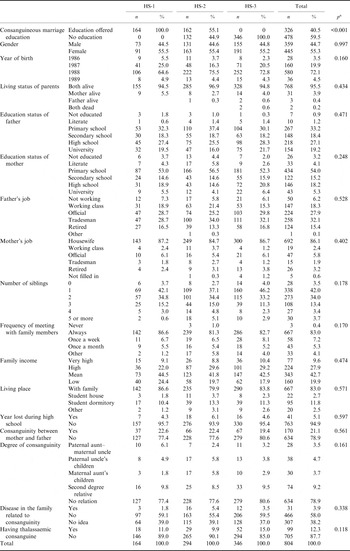
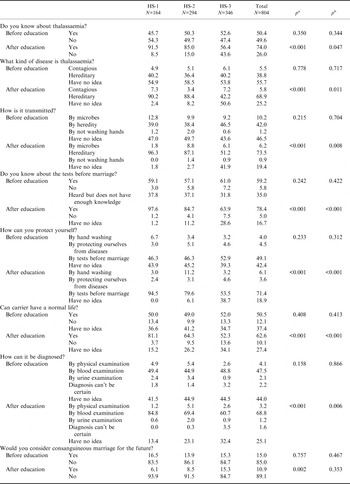
The descriptive features of the study group based on high school are presented in Table 1. Analysis of the pre-tests revealed no statistical differences in the sociodemographic features (Table 1), and knowledge and attitudes about consanguineous marriage and thalassaemia (Table 2) (p>0.05) among the participants who attended the three high schools.
Distribution of the characteristics of the study group by school

a Chi-squared; evaluation of descriptive features for all three schools.
Percentage distribution of the knowledge and attitude of students before and after the education periods

a Chi-squared; evaluation of knowledge for all three high schools.
b Chi-squared; evaluation of knowledge for HS-1 and HS-2.
Comparison of the three high schools on students' knowledge and attitudes about consanguineous marriage in the post-test period, however, showed statistically significant differences among the three schools (Table 2). The percentage of students who knew about thalassaemia differed by high school, being significantly higher in students from HS-1 and HS-2 than those from HS-3. Compared with students who attended HS-2 and HS-3, those who attended HS-1 were also more aware of the fact that thalassaemia is a hereditary disease. The percentage of students who knew that thalassaemia is transmitted to people through heredity differed by high school as well, and the students who attended HS-1 were more likely to know that the disease is hereditary. The students who attended HS-1 were more likely to be aware of the diagnostic tests that are conducted before marriage. They were also more aware that in order to prevent this disease, they need to take tests before marriage. The students who received the formal training programme were more likely to know that carriers can have a normal life, and that the disease can be diagnosed by blood tests. Furthermore, the proportion of students from HS-1 who would not consider consanguineous marriage for the future was 0.78, whereas this proportion from the control group was 0.57. The difference in proportions is significant at p<0.001.
Analysis of the post-test results showed statistical differences (p<0.05) between the students who attended HS-1 and HS-2 in all parameters except for the question ‘Would you consider consanguineous marriage for the future?’ (Table 2).
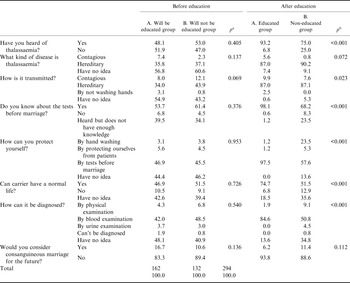
Table 3 shows the comparison of percentage distribution of knowledge and attitudes of students in HS-2 between pre-test and post-test periods. Analysis of Grp-A (the educated group) and Grp-B (the non-educated group) pre-tests showed that the two groups did not differ significantly in any of the parameters. However, in the post-test period there were differences between the groups in many parameters (Table 3). The percentage of students who knew about thalassaemia differed by group, being significantly higher for students in the educated group (Grp-A). The students in Grp-A were also aware that thalassaemia is a hereditary disease and there are diagnostic tests that are conducted before marriage. They also knew that the best way to prevent this disease is to take tests before marriage. Students in Grp-A knew that carriers can have a normal life, and that the disease can be diagnosed by blood tests.
Percentage distribution of the knowledge of students in HS-2 before and after the education periods

a Chi-squared; evaluation between groups that will be educated and those that will not before the education period.
b Chi-squared; evaluation between groups educated and not educated after the education period.
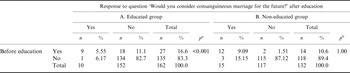
Table 4 compares students' attitudes in Grp-A and Grp-B about consanguineous marriage between the pre-test and post-test periods. The results from the pre-test showed that although 16.6% of the students in Grp-A (n=162) were considering consanguineous marriage, 11.1% changed their minds after receiving the training (p<0.05). In Grp-B (n=132), although the percentage of students who were considering consanguineous marriage declined from 9.09% to 1.51%, the change was not statistically significant (p=1.000).
Comparision of students in HS-2 for the question ‘Would you consider consanguineous marriage for the future?’ before and after education, among educated and non-educated groups

a Evaluation of the educated group before and after education periods, McNemar test.
b Evaluation of the non-educated group before and after education periods, McNemar test.
Discussion
The design of this study allowed not only a comparison of the effects of consanguineous marriage training through pre-test and post-test analysis, but also assessment of the degree of student interaction concerning the transfer of knowledge about consanguineous marriage.
The results of the study showed that the training provided at the three high schools was effective and positively influenced students' knowledge about, and attitudes towards, consanguineous marriage. While the pre-test comparisons showed no statistical differences in students' knowledge and attitudes, the post-test comparisons revealed statistical differences among the three schools (Table 2). Post-test, students who attended HS-1 were more knowledgable about consanguineous marriage than those who attended HS-2, and students who attended HS-2 were more knowledgable about the issue than students who attended HS-3.
Prior to the study it was hypothesized that there would be some degree of student interaction among the students who attended the same high school concerning the transfer of knowledge about consanguineous marriage. In order to examine this interaction the post-test results of students in HS-1 and HS-3, as well as the post-test results of students in HS-2 and HS-3, were compared. In both cases, pre-test results showed no statistical differences in any of the parameters; however, post-test results showed statistical differences in all parameters. This result indicates that even though only half of the students in HS-2 received training they were still significantly different in their knowledge and attitudes, like students in HS-1, from the students who did not receive any training. This finding supports the initial hypothesis that there is student interaction among high school students, even in subjects that are not commonly brought up in everyday conversations. It is concluded that this interaction could be beneficial in the training of students about consanguineous marriage; however, caution needs to be taken concerning the accuracy of information being transferred.
In order to determine the attitudes of students toward consanguineous marriage, students were asked the question ‘Would you consider consanguineous marriage for the future?’ Comparison of post-test results among high schools showed statistically significant differences (Table 2). The percentage of students who would consider consanguineous marriage in the future was significantly higher in HS-3 (15.3%) than in HS-1 (6.1%) and HS-2 (8.5%). Comparison of post-test results between HS-1 and HS-2 in this question, however, showed no statistical differences, which indicates that students not only influenced each others' knowledge but also their attitudes toward consanguineous marriage (Table 2).
Further analysis of HS-2 was also performed to understand better the attitude changes of students in the trained (Grp-A) and untrained (Grp-B) groups (Table 4). Contrary to expectations, no statistically significant differences were found between the pre-test and post-test periods on students' attitudes in Grp-B (Table 4). However, the number of students who would consider consanguineous marriage in the future in Grp-A decreased significantly between pre-test and post-test periods (Table 4). This finding indicates that student interaction was not as effective as receiving formal education in changing one's attitude about a subject. The former findings indicated that there has been a significant change in students' knowledge in Grp-B (Table 3); however, this change has not been transfered to student attitudes, yet (Table 4). The possible rationale for this result is embedded in the education literature. As described by Erdal et al. (Reference Erdal, Taskin and Gunhan2006), people's knowledge and self-belief in most cases are the foundations of their positive attitudes, which give rise to positive behaviour. Koballa & Crawley (Reference Koballa and Crawley1985) use the following example to describe this relationship in teacher education: ‘Elementary school teachers judged their ability to teach science to be low (knowledge/belief), resulting in a dislike for science teaching (attitude) that ultimately translated into teachers who avoided teaching science (behaviour).’ Considering the given example, it is expected that with continuing formal training, students might transfer their knowledge about consanguineous marriage into positive attitudes and behaviour in the future. However, in addition to the length of education, there might be some underlying influences that prevent them from changing their attitudes towards consanguineous marriage, such as the influence of the family, which also need to be further explored.
Conclusion
As the trends indicate, consanguineous marriages and the medical complications associated with them have not decreased in the last decade in Turkey. Therefore, it is evident that more drastic measures need to be taken both in Turkey and around the world. As part of a holistic approach, the benefits of a formal training programme on the knowledge and attitudes of high school students in Isparta, Turkey, were explored. The results showed that receiving formal education about consanguineous marriage influenced students' knowledge about the subject, which potentially in the future will transfer into positive attitudes and behaviour.
The findings of this study also indicate the existance of peer interaction among students. This interaction was more effective, however, in the transfer of knowledge than in the influence behaviour changes. This could simply be attributed to the nature of attitude or behaviour change processes; or to the underlying influences in subjects' lives, other than their friends.
It is often observed that even though mandatory tests conducted right before marriage inform people about the risks, they have very little effect on changing peoples' decisions about having consanguineous marriages. Similarly, it is not effective to urge people not to get married after a transmitter gene is found in any or both of the partners. Furthermore, there are certain social or economical factors that would undermine the effectiveness of these tests in many countries.
Therefore, in order to decrease the number of medical cases related to consanguineous marriage, it is strongly suggested that educational programmes for younger adults, possibly as part of the mandatory curriculum in high schools, should include information about consanguineous marriages and the potential medical complications. In order for this education to be effective, it is recommended that these instructions be continuous and inclusive regardless of students' academic study areas (maths, social, etc.).