Al-Zaki ordered [his men] to bring it [Yohannes's corpse] out of the box, and it was brought out. He ordered [them] to cut his head off and hang it on a spear. So they cut his head off and hung it on a spear. The anṣār were delighted and rejoiced at this victory, which would stand as an embroidery on the Muslim armies' flags for centuries to come.Footnote 1
This is how Ismaʿil bin ʿAbd al-Qadir, a Mahdist chronicler of late 19th-century Sudan, gave a broad Islamic significance to the defeat of Ethiopian armies by Mahdist forces at al-Qallabat in March 1889. Culminating in the death of Emperor Yohannes IV, the four-year confrontation between Mahdist Sudan and Christian Ethiopia (1885–89) had repercussions that transcended the local setting, reaching far into the intertwined history of Sudan, Ethiopia, and European imperialism in the Nile Valley and Red Sea regions.
On the historiographical scene, Sudanese–Ethiopian relations in the early Mahdist period have drawn little attention. Scarce studies have produced political and military histories.Footnote 2 I suggest examining Mahdist conceptions and attitudes toward Christian Ethiopia through an approach that highlights representations. Two distinct meanings of the term are particularly relevant for our study: representations as an object and representations as a tool of history.Footnote 3 This article addresses the following key issues: How did a Mahdist scholar represent Sudanese–Ethiopian relations and to what ends? Were his conceptions shared by the Sudanese ruling elite? How far do they reflect actual practice in interacting with Christian Ethiopia?
Applying these questions to the years 1885–89, I focus on the border zone spreading from the Atbara River to the Blue Nile. This area appears as a major theater of Mahdist–Ethiopian collision in most primary and secondary sources.Footnote 4 In addition to ʿAbd al-Qadir's writings, I have consulted Sudanese archives at the National Records Office in Khartoum and accounts of foreigners who traveled or lived in Sudan and Ethiopia during the Mahdist period,Footnote 5 as well as scholarly works by historians, notably, those of Sudanists Muhammad Ibrahim Abu SalimFootnote 6 and Muhammad Saʿid al-Qaddal.
FROM REVOLUTIONARY MILLENARIANISM TO STATE BUILDING
In Sudan, the revolution led by the Mahdist movement between 1881 and 1885 ended sixty years of Turco-Egyptian rule. Its leader—Muhammad Ahmad bin ʿAbdallah, who claimed to be al-mahdī al-muntaẓar Footnote 7—quickly achieved political and military victories against the established regime thanks to wide support from various groups within Sudanese society. The Turco-Egyptian government was resented by many because of its foreign nature, its reliance on Christian officials such as Samuel Baker and Charles Gordon, its oppressive fiscal policies, its attempts to suppress the slave trade, and its efforts to impose Azharite orthodoxy in Sudan.Footnote 8
The years 1881–85 can be seen as the formative period of the Mahdist state: the revolutionary movement expanded its control over vast territories while being transformed into a state apparatus. Khartoum's conquest in January 1885 made the Mahdist capital move from a rather peripheral zone (Jabal Qadir) to the very power center of Turco-Egyptian rule. In addition to the Mahdiyya's growing institutionalization, which was salient in the administrative, military, financial, and judicial fields, all decision-making powers were concentrated in the hands of the Mahdi. Indeed, the latter abolished the existing Sufi orders and the Islamic traditional schools of law (madhāhib), recognizing the sunna, the Qurʾan, and ilhām (prophetical inspiration) as the only sources for Mahdist law.Footnote 9
Muhammad Ahmad's death in June 1885 caused a momentary crisis in his community, which was resolved by the designation of ʿAbdullahi al-Taʿaishi as his successor. During the first part of his rule (1885–89), Khalifa ʿAbdullahiFootnote 10 had to face various internal and external challenges that had a significant impact on later evolutions in Mahdist Sudan. Among numerous opposition forces, the ashrāf (relatives and supporters of the Mahdi) led by Muhammad Sharif represented the greatest threat to the khalifa's rule. Other insurrection movements erupted in Darfur and on the Sudanese–Ethiopian border, the discourse of which often had messianic overtones. Besides these political menaces, a destructive famine ravaged the Sudan in 1889–90, which had dramatic social, demographic, and economic effects.Footnote 11
In the external arena, the Mahdist state maintained tense relations with two of its immediate neighbors: Egypt and Ethiopia. The former constituted the primary target of Mahdist territorial expansion. Although the Mahdi had already planned to attack his northern enemy, the campaign was postponed until 1889 on the grounds of physical and political difficulties.Footnote 12 The Sudanese forces were totally overwhelmed by Anglo-Egyptian troops at the famous battle of Tushki (3 August 1889), which put an end to Mahdist ambitions toward Egypt.
CONSOLIDATING AN IMPERIAL ORDER
Whereas Khalifa ʿAbdullahi completed the transformation of the Mahdist movement into a state structure, negusä nägäst Footnote 13 (king of kings) Yohannes IV (1872–89) pursued the imperial unification of Ethiopia that had been initiated by his predecessor Tewodros II (1855–68). Rather than uncompromising centralization, Yohannes IV opted for a policy of “controlled regionalism,”Footnote 14 which led to the submission of ʿAdal of Gojjam (October 1874) and Menelik of Shoa (March 1878), two prominent local commanders. The process of imperial unification had a significant religious dimension, which was reflected in mass Christianization policies.
In May–June 1878, Yohannes IV convened a council at Boru Meda, where the Tewahedo creed was proclaimed official doctrine while Christian heretical sects were harshly condemned.Footnote 15 The imperial edict did not merely address Ethiopian Christians. Muslims, pagans, Gallas, and Jews were called to convert lest they be banished.Footnote 16 Two famous Muslim leaders of the Wallo region adopted Christianity—Amade Liban (known as Abba Wataw) and Muhammad ʿAli. Whereas the former was baptized Hayla Maryam and obtained the title of dajjazmach, the latter became ras Mikaʾel and was given control over a large part of the Wallo central highlands.Footnote 17 Adhering to the official religion was indeed a necessary condition for advancement within the Ethiopian political and military hierarchy.
Yohannes IV's Christianization policy included building numerous churches in Wallo, excluding Muslims from the city of Aksum, and confiscating Islamic books.Footnote 18 In quantitative terms, 50,000 Muslims, 20,000 “pagans,” and half a million Gallas had supposedly been baptized by 1880.Footnote 19 The reactions of Wallo Muslims to the emperor's evangelist measures varied. Although most political leaders converted in order to keep their posts, some secretly continued practicing Islam. Others migrated south or west toward Sudan.Footnote 20 Military resistance was carried out on several occasions.Footnote 21
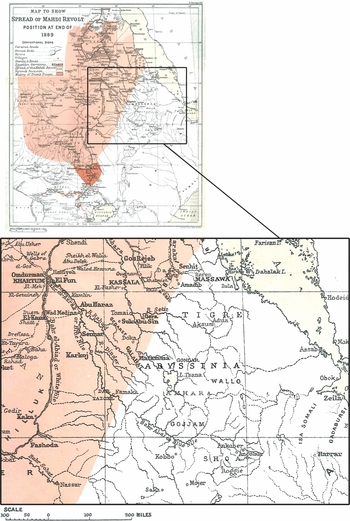
In the external arena, Ethiopia's unification was threatened by both European and Egyptian protagonists. The opening of the Suez Canal (1869) attracted European powers to the Red Sea, and khedive Ismaʿil (1863–79) directed his expansionist efforts toward Sudan and Ethiopia. He occupied the Bogos territory (also known as Senhit, see Figure 1) in 1872 and the city of Harar three years later. Yohannes IV managed to crush Turco-Egyptian ambitions by winning two decisive battles at Gundet and Gura (1875–76).Footnote 22 However, both France and Italy set foot on Ethiopia's eastern coast, in Obock and Assab, respectively, contemplating a future progression into the interior.
The Sudanese–Ethiopian border zone in 1889. Adapted from Mahdiism and the Egyptian Sudan.Footnote 26 [A color version of this figure can be viewed online at journals.cambridge.org/mes]

By the late 1870s, the emperor's power had reached a climax: potential internal rivals had been subdued, many of his Muslim subjects had been Christianized, and the Egyptian adversary had been defeated. Yet the early 1880s witnessed strategic changes that deeply affected Ethiopia. The Mahdist revolution and the simultaneous occupation of Egypt by the British created a new set of dynamics, challenging Yohannes IV's political and personal survival. Weakened Egypt was replaced by a militant Mahdist state as Ethiopia's immediate neighbor. The increasing British presence in the Nile Valley and the Red Sea eased Italian penetration into eastern Ethiopia.Footnote 23 The year 1885 was a turning point in the emperor's career: while Italy took control of the Massawa port town with British tacit agreement (3 February 1885), an armed conflict broke out between Sudan and Ethiopia. Regional commander Menelik's growing insubordination was a third factor weakening Yohannes IV's uncertain political position.Footnote 24
A CONFRONTATION ENTANGLED IN EUROPEAN IMPERIAL PROCESSES
Political and military tensions between Sudan and Ethiopia were catalyzed by the Hewett Treaty that Great Britain and Ethiopia signed on 3 June 1884. Yohannes IV committed himself to assist the evacuation of Turco-Egyptian troops stationed on his western border. In return, he regained the Bogos territory and was promised free transit of all goods through Massawa, an easy dispatch of bishops from Alexandria, and British arbitration in case of conflicts involving the khedive.Footnote 25 Hence, Ethiopian soldiers found themselves fighting against Mahdist forces in Kassala and in an area between the Atbara River and the Blue Nile. Three major Turco-Egyptian centers located in that zone fell under Mahdist control in 1884–85: al-Qadarif, al-Qallabat, and al-Jira.Footnote 27
From March 1885, bidirectional raids across the Sudanese–Ethiopian border significantly increased. Local Mahdist commander Muhammad wad Arbab was killed during an Ethiopian assault on al-Qallabat in January 1887, which caused the death of thousands of anṣār.Footnote 28 The next Mahdist governor of al-Qallabat, Yunis al-Dikaym, openly provoked Ethiopia when he arrested a caravan of Ethiopian merchants, sending them to Omdurman as if they were war captives. Intending to strengthen Mahdist positions on the eastern front, Khalifa ʿAbdullahi ordered amir Hamdan Abu ʿAnja to quit the Nuba Mountains and join al-Dikaym. Shortly after his arrival at al-Qallabat (early December 1887), political and religious troubles engendered tensions between the two commanders.Footnote 29 Al-Dikaym was eventually recalled to Omdurman and replaced by Abu ʿAnja.
During his one-year tenure, Abu ʿAnja organized two great campaigns into Ethiopian territory. The first was directed against Takla-Haymanot,Footnote 30 whose troops were defeated in Dambiya in January 1888. After sacking the ancient imperial capital of Gondar, the Sudanese forces quickly returned to al-Qallabat. Although this expedition constitutes the furthest Mahdist territorial expansion into Ethiopia, it was not pursued because of geographic, logistic, strategic, and religious factors.Footnote 31 The second was when Abu ʿAnja led his troops to the Balesa province, east of Lake Tana in June 1888. Heavy rains nevertheless constrained the anṣār, who retreated after a short while.
The amir's sudden death in January 1889 provoked a temporary confusion about his succession. A Mandala client of the Taʿaishi tribe, al-Zaki Tamal, was eventually appointed. Meanwhile, Yohannes IV prepared his armies to crush the Mahdist camp. He launched an attack on al-Qallabat on 9 March 1889, during which his troops managed to penetrate the town. The anṣār were on the verge of being overwhelmed when the emperor was hit by a bullet and collapsed. Horrified, the Ethiopian soldiers took flight, and victory turned into defeat.Footnote 32 Considerable booty fell into Mahdist hands, including many objects and clothes that had belonged to Yohannes IV.
The battle of al-Qallabat marked a peak in the conflict between Mahdist Sudan and Ethiopia. During the 1890s, relations between the two states gradually improved until a peace agreement was reached in 1897.Footnote 33
In spite of its limited territorial scope, the 1885–89 confrontation bore some major strategic implications on the regional level. First, Yohannes IV's death meant the end of Tigre as the political center of Ethiopia. Power shifted to Shoa as Menelik seized the imperial throne and espoused a conciliatory policy toward Sudan.Footnote 34 Second, Italian imperialist ambitions progressed thanks to the absence of both the emperor and his vassal Alula from Ethiopia's eastern front. Promptly formalized through the Wichale Treaty (2 May 1889), Italian expansion into northeastern Ethiopia led to the creation of the colony of Eritrea (1 January 1890). Thus, Italy can be held as the regional actor that most benefited from the Sudanese–Ethiopian conflict. Whereas Ethiopia experienced serious territorial amputation, Mahdist Sudan found itself frontally challenged by the Italian power.Footnote 35
THE TIRAZ: A LITERARY EMBROIDERY OFFERED TO KHALIFA ʿABDULLAHI
The Sudanese–Ethiopian conflict seems to have been of great importance to the khalifa, who wanted an official version of the facts to be written and distributed among his literate subjects. The work was left to Ismaʿil bin ʿAbd al-Qadir (1844–97), the author of a book about the Mahdi's life and the Mahdiyya's early years.Footnote 36 His chronicle was completed less than three months after the battle of al-Qallabat under the title Al-Tiraz al-Manqush bi-Bushra Qatl Yuhanna Malik al-Hubush (The Embroidery Inscribed with the Good News of the Slaying of Yohannes, King of the Ethiopians).Footnote 37 It was given wide diffusion throughout Sudan.
Born in the provincial capital of El Obeid, ʿAbd al-Qadir studied at al-Azhar for twelve years and was later appointed mufti of Kordofan under Turco-Egyptian rule. Although the reasons why he joined the Mahdist movement in September 1882 remain uncertain, it seems that he settled down in Omdurman after the fall of Khartoum (January 1885).Footnote 38 ʿAbd al-Qadir attained a high position within the judicial and religious system of the Mahdist state as a qadi and ʿalim enjoying a close relationship with the khalifa.
However, his career was abruptly interrupted by his banishment to al-Rajjaf (upper White Nile) in August 1893, where he died a few years later.Footnote 39 The khalifa ordered the burning of all copies of his books, which included several scientific, historical, and poetical writings.
How should we understand this decision, as the Tiraz praises ʿAbdullahi in multiple ways? At a time when Menelik II tried to establish friendly relations with his western neighbor, the head of the Mahdist state possibly sought to get rid of any writing associated with anti-Ethiopian propaganda. In addition, the elimination of a chronicle that stressed the role of men other than the khalifa contributed to consolidate the latter's personal grip on political power.Footnote 40
In a historiographical perspective, the Tiraz constitutes a primary source of major importance for the study of Sudanese–Ethiopian relations. It is chronologically the first work depicting the 1885–89 conflict and counts among the very few narrative-oriented sources that espouse a Mahdist viewpoint on Sudan. We know its existence thanks to the kātib Muhammad Ahmad Hashim, who secretly conserved one copy of the Tiraz despite the khalifa's order to destroy all of ʿAbd al-Qadir's writings.Footnote 41
Given that the chronicler did not personally witness most of the events he relates, what were his sources? He relied on his book about the early Mahdiyya and on various proclamations from the Mahdi and the khalifa, as well as on a small number of letters exchanged between the khalifa and Mahdist commanders posted at al-Qallabat. However, he privileged oral accounts of direct witnesses, such as the qadi al-Islam Ahmad ʿAli.Footnote 42
SUBORDINATING HISTORY TO PANEGYRIC ENDS
Written in literary Arabic and comprising numerous stylistic devices, the Tiraz is structured according to the following scheme:
Preamble Motives, objectives, and contents of the Tiraz
Preface Legitimization and glorification of Khalifa ʿAbdullahi
1st chapter Yunis al-Dikaym's command (Spring 1887–January 1888)
2nd chapter Hamdan Abu ʿAnja's command (December 1887–January 1889)
3rd chapter Al-Zaki Tamal's command (February–March 1889)
Conclusion Mahdist operations in Darfur, Equatoria, Suakin; military plan to conquer Egypt
Throughout his book, ʿAbd al-Qadir emphasizes Mahdist military victories not only against Ethiopia but also in Darfur, Equatoria, Egypt, and on the Red Sea coast. The glorification and idealization of these successes aimed at consolidating the khalifa's political and religious legitimacy, which was largely questioned by the ashrāf and other opposition forces. The Tiraz depicts the Mahdi's successor as a perfect model of statesman, military commander, and pious figure. ʿAbd al-Qadir's triumphal and optimistic tone stems from the particular historical circumstances in which he wrote the chronicle: after the Mahdist victories against Abu JummayzaFootnote 43 in Darfur and the Ethiopians at al-Qallabat (respectively, on 22 February and 9 March 1889) but before the anṣār's total failure at Tushki (3 August 1889).
As a panegyric work, how is the Tiraz connected to historical reality? ʿAbd al-Qadir's objective is clearly stated in the preamble: to convince the world of the Mahdiyya's ultimate truth. This assumed ahistorical approach remains consistent throughout the entire narrative. The author does not hesitate to alter certain aspects of historical reality to achieve his panegyric and persuasive ends. Some facts and processes are deformed and others are simply omitted. For instance, several expeditions into Ethiopian territory are related in an incorrect chronological order, and some of their commanders are not rightly named.Footnote 44 Among some crucial events that are silenced, let us mention the episode of al-Nabi ʿ Isa,Footnote 45 the quarrel it provoked between the amirs al-Dikaym and Abu ʿAnja, the activities of the ashrāf, Mahdist military defeats against Ethiopian forces (such as the one in Kufit in September 1885), and the intensive epistolary exchanges between various Sudanese and Ethiopian leaders.Footnote 46
How are we to explain these multiple deformations and omissions? What can they teach about ʿAbd al-Qadir's political, ideological, and religious orientations? First, specific deformations could result from unintentional human errors. Second, particularly threatening facts are omitted in order not to undermine the khalifa's position as the Mahdi's sole legitimate successor.Footnote 47 Third, ʿAbd al-Qadir distorts or leaves out events that could endanger the Mahdiyya's image as a united and victorious movement. Finally, his efforts to describe Sudanese–Ethiopian relations in an absolutely Manichean manner discard any complexity or nuances.Footnote 48 Hence, his position within the Mahdist state seems to suit Abu Salim's model: as a historian employed by the regime, he had to document the events in a way that glorified the government and legitimated the existing system.Footnote 49
Even though the Tiraz is not reliable from a classical historical stance, it becomes an extremely useful source for the study of representations when confronted with various historical documents.
THE SUDANESE–ETHIOPIAN CONFLICT: A VICTORY OF ISLAM OVER CHRISTIANITY
The Tiraz narrates the Sudanese–Ethiopian confrontation from a Mahdist perspective, which implies a sharp distinction between the anṣār and the kuffār (unbelievers including non-Mahdist Muslims).Footnote 50 Contrary to al-Qaddal's assumption, the infidels were not perceived as a homogeneous group of “Turks”Footnote 51: the Ethiopians were actually singularized among other unbelievers. ʿAbd al-Qadir names them kuffār or ʿabadat al-ṣalīb (cross worshippers) in some cases, but he mostly uses the more specific and less religiously connoted term of ḥabasha.Footnote 52
His book represents Sudanese–Ethiopian relations through three important stages. The first one consists of justifying Mahdist warfare against Ethiopia from 1887 to 1889. For this purpose, the author interprets a prophetical hadith in the light of events that occurred in Sudan before the Mahdist revolution. The Prophet's saying to the Muslims “utrukū al-Ḥabasha mā tarakūkum” (leave the Ethiopians alone as long as they leave you alone) was relevant in early Muslim history, a time when—according to ʿAbd al-Qadir—Ethiopia was not a priority target of Islamic expansion. However, strategic conditions had greatly changed by the late 19th century. Corrupted Turco-Egyptian rulers let Ethiopian unbelievers invade the “land of Islam” (Sudan), build churches, and collect taxes from its inhabitants.Footnote 53 In addition, Christian ruler Yohannes IV refused to submit to God and unjustly killed disciples of the Mahdi.Footnote 54 Relying on these arguments, ʿAbd al-Qadir claims the fight against the Ethiopians to be fully licit. It is not only a right but a compulsory duty falling to the Muslim community as a whole.
The second stage pertains to the attitude that the Mahdist state actually endorsed toward Ethiopia. A phase of verbal persuasion, materialized by two warning letters addressed by the khalifa to the emperor in 1887, is followed by a process of physical coercion. In ʿAbd al-Qadir's perspective, warfare constitutes the main instrument of Sudanese policy toward Ethiopia. As a holy war (jihad), it implies the fusion of military and religious aspects inherent to Mahdist ideology. Military actions and procedures, as well as victories and defeats, constantly express the will of God. The image of a tight and compact line of anṣār is crucial in the Tiraz, for it is associated with both a military and a spiritual posture.Footnote 55
The book is dominated by a Manichean representation of the Sudanese–Ethiopian conflict, which is attained through various literary and narrative processes. Hence, the battle of al-Qallabat (March 1889) is depicted with the help of an elaborate metaphorical and symbolic language. Whereas the rapid progression of the Ethiopians is successively compared to a waterfall and a cloud of locusts, the Mahdists are evoked through their superior moral qualities: they are firmly determined to fight and die for the cause of Islam.Footnote 56 The gap between victors and losers is mostly stressed after the cessation of hostilities. Countless Ethiopian corpses strew the ground; the survivors cowardly pretend that their king merely suffers from injuries, although a deadly bullet actually hit him. By contrast, the fallen anṣār are represented as a small group of martyrs (shuhadāʾ) honored by God. Whereas their blood looks like gold on their necks, Ethiopian blood soils the Atbara River and pollutes its water.
ʿAbd al-Qadir stresses the conflict's dramatic metaphysical implications by exploring semantic fields of terms such as nār (fire) and ẓulma (darkness). As the Ethiopian troops move toward al-Qallabat, they are identified with bad fate and hell:
They [the Ethiopians] started lighting fires to remove the grass and the trees so that they could get through these abrupt places. I say: lighting fires masked a bad omen, which God realized in this world by burning them with the fire coming from firearms shot by the anṣār. The fire of beyond is most intense! Accompanied by night fires lit to roast the food of the Ethiopian army, these fires could be seen from a three-day distance because of the intensity of their flames, which rose high into the sky [my emphasis throughout].Footnote 57
An immediate connection between the material and eschatological worlds appears as fighting between the Mahdists and the Ethiopians intensifies. The combination of firearm smoke, clouds of dust, and hand-to-hand fights between the two armies creates a particular type of apocalyptical darkness. ʿAbd al-Qadir also emphasizes the divine nature of Mahdist struggle against Ethiopia by describing miracles that occurred during the battle of al-Qallabat. Mentioning these wondersFootnote 58 contributes to the depiction of the conflict as a victory of Islam over Christianity.
The third stage relates to the outcome of Sudanese jihadist policy toward Ethiopia, which perfectly fits into ʿAbd al-Qadir's ideological reasoning: Yohannes IV dies on the battlefield. Both the causes and the meaning of his death are interpreted in such a way as to crystallize a double lesson in the reader's mind: Mahdist victory against Christian infidels is inevitable, for it expresses God's will, but it is also the work of Khalifa ʿAbdullahi. The chronicler explains the emperor's death by his exaggerated self-pride and hostile attitude toward Muslims. Its meaning is exceptional on several grounds. It not only eliminated a great threat to Islam, but it also counts among the most important conquests in Muslim history. According to ʿAbd al-Qadir, the death of a Christian Ethiopian emperor at the hands of Muslim forces was hitherto unseen in the history of interactions between Ethiopia and the Islamic world. Moreover, it occurred—thanks to divine will—during Khalifa ʿAbdullahi's reign.Footnote 59 At the end of the battle, the anṣār deal with Yohannes IV's corpse in a manner that strengthens the double message. The objects and clothes covering the body symbolize the Christian religion and the sybarite tendencies of the Ethiopian king: a golden cross, a matab (religious neck ribbon),Footnote 60 a gem-decorated crown, and embroidered garments. They are sent to Omdurman as a material evidence of Yohannes IV's scornful attitude toward God. As the most central war trophy of the Sudanese-Ethiopian conflict, the emperor's head is cut off and brought to the khalifa with heads of other Ethiopian commanders. In this way, the bloody message not only announces victory but also grants it to the head of the Mahdist state.Footnote 61
My analysis has shown that the Tiraz celebrates the victory of Mahdist Islam over Christianity in the shape of a panegyric dedicated to Khalifa ʿAbdullahi. Sudanese policy toward Ethiopia bears no ambiguity: as a Christian entity that has dared to attack the frontiers of Islam, Ethiopia deserves to sustain the wrath of Mahdist jihad. However, was this perspective widely shared among the Sudanese ruling elite? If this apparently rigid logic framed their policies, what did it mean in practice and how was it legitimized?
THE LIMITS OF A UNIVERSAL MISSION
Depicted in various primary and secondary sources, Mahdist attitudesFootnote 62 toward Ethiopia were much less obvious and linear than in ʿAbd al-Qadir's work. Their complexity resides in the gap between theory and practice but more fundamentally in the definition of Mahdist ideology on the Ethiopian issue. How did Sudanese leaders conceive of the scope of the Mahdist mission? Should it be limited to the struggle against Turco-Egyptian domination or be extended to other parts of the world?
Both historians and contemporaries of the Mahdiyya agree that the ambitions of the Mahdist revolution transcended the Sudanese arena. Whereas some scholars restrain its scope to the Islamic world, others extend it to the whole of humanity.Footnote 63 However, the distinction between these two conceptions is not clear-cut. We should examine how the Mahdist elites perceived the external world before formulating any hypothesis.
Two elements must then be stressed. First, the world lying outside Sudan was grasped in theological rather than geographical terms. Anyone who did not accept Muhammad Ahmad's divine mission was considered an infidel. Second, the Mahdi's horizon was quite narrow, for it was limited to Muslim countries whose existence he was aware of.Footnote 64 Like his predecessor, the khalifa sent letters to Muslim leaders in an attempt to convince them to submit to the Mahdiyya, yet he also included non-Muslim states such as Ethiopia and Britain.Footnote 65 Expansionist efforts were abandoned after the defeat at Tushki and the great famine that ravaged Sudan in 1889–90. Therefore, Mahdist ambitions significantly evolved according to political, military, and economic circumstances. Without being the main prey of the Sudanese appetite, Ethiopia counted among a number of regional actors whose existence the doctrine of the Mahdiyya could not easily accommodate.
THE AMBIGUITY OF THE JIHAD CONCEPT
The term “jihad” is frequently used to describe both the ideology and the foreign policy of the Mahdist state. What does this concept mean in the particular historical context of Sudanese–Ethiopian relations? Numerous scholars agree on the conditions that propelled the use of jihad. Warfare followed the failure of persuasive efforts attempting to convert an area or state to Mahdist Islam. However, what precisely were the ends of this jihad? Although some historians see it as an instrument of forced conversions, others view it as a means to punish the unbelievers or subjugate them through enslavement.Footnote 66 Jihad was also employed to fight against foreign rule (embodied by the Turco-Egyptian regime) or prevent unbelievers from invading the land of Islam.Footnote 67 Abu Shouk stresses an interesting economic function. Under the banner of jihad, the Mahdist state often massacred people considered as infidels (Muslims or not) and confiscated their property. This state booty was then appropriated by the public treasury (bayt al-māl).Footnote 68 Whatever its objectives, Mahdist jihad always conjured up a clash between the God led anṣār—the only possessors of divine truth—and a mass of unbelievers. Therefore, jihad pertains to the ideological representation of a struggle whose goals could vary. Warfare is made holy by the ways in which it is legitimized rather than by its specific ends.
Addressing the Sudanese–Ethiopian military confrontation, should we see jihad as the main cause of conflict or merely as a rhetorical instrument for its legitimization? A few historians espouse a view similar to ʿAbd al-Qadir's by identifying the jihadist orientation of the Mahdist state as a central explanatory factor. Because Ethiopia belonged to dār al-ḥarb, it was automatically the target of Mahdist attack. The religious obstacle between the two countries counted among the principal reasons underlying the conflict.Footnote 69
Conversely, many scholars depart from the jihadist perspective by suggesting historical, political, military, and economic motives. For some of them, the conflict has historical roots that can be traced to the Funj Sultanate (1504–1821).Footnote 70 This explanation seems particularly relevant when taking into account the works of Merid Wolde Aregay, Sergew Hable Selassie, and Mordechai Abir. They emphasize the persistence of certain sources of tension between the Sudanese and Ethiopian entities during the Funj and Turco-Egyptian periods: border-drawing issues, slave raids, and political support of rebels from each side.Footnote 71 Political and military dynamics of clash included activities of local landlords in the border zone, internal rivalries, the khalifa's willingness to keep his armies busy far from the capital, and the application of the Hewett Treaty, as well as Egyptian and British efforts to foster Ethiopian hostility toward Sudan.Footnote 72 Economic motives certainly greased the mechanism of conflict: opportunities to capture human and material booty in cross-border raids were enhanced by the commercial and strategic importance of al-Qallabat.Footnote 73 Discussing the origins of the Sudanese–Ethiopian confrontation allows us to relativize the role of jihad as the main catalyst of Mahdist policy toward its neighbor. We should consider it a legitimizing device rather than as a frozen, inflexible policy.
THE HERITAGE OF EARLY MUSLIM–AKSUMITE CONTACTS
Although jihad served as a general framework for legitimizing Mahdist policies, other instruments were more precisely adapted to the Ethiopian case. The Mahdist elites used various prophetical references to make their attitudes acceptable to Sudanese or even Ethiopian sensibilities. An important tool consisted of reactivating the ambivalent heritage resulting from the first contacts between Muslims and the Kingdom of Aksum.
Facing a hostile environment, the emerging Muslim community found refuge at the court of negus Adriaz in 615.Footnote 74 The Quraysh leaders of Mecca hostile to Muhammad sent a delegation to Aksum in order to ask the return of the refugees to Arabia. At the head of the exiled ṣaḥāba, Jaʿfar bin Abu Talib (Muhammad's cousin) successfully presented Islam as a form of Christianity in order to convince the negus to continue granting asylum to the Muslims.Footnote 75 Whereas a minority of refugees joined the Prophet on his hijra to Yathrib (subsequently renamed Medina), most of them remained in Aksum until the Muslim conquest of Mecca (631).
This historical plinth fed two great traditions within Islamic thought. The first one relies on a 9th-century hadith, according to which the Prophet had ordered his disciples: “Let the Ethiopians alone as long as they leave you alone” (utrukū al-Ḥabasha mā tarakūkum).Footnote 76 This saying is interpreted as a gesture of gratefulness for the assistance Ethiopia granted to the Muslims at a critical moment of their history. During the Middle Ages, a rich literature developed on the legal status of Ethiopia. Some Muslim jurists nuanced the traditional distinction between dār al-Islām and dār al-ḥarb by defining intermediary stages called dār al-ʿahd (abode of pact) and dār al-ṣulḥ (abode of conciliation).Footnote 77 These statuses were attributed to territories enjoying a temporary agreement with the abode of Islam. However, several areas were exempted from jihad without any accord with Islam. Grouped under the name dār al-ḥiyād (abode of neutrality), such exceptional cases were justified by doctrinal or practical motives. They included Ethiopia, Nubia, Cyprus, and the Turks' land.Footnote 78 In this regard, it is crucial to emphasize that their position was not chosen but rather imposed by Islam:
.–.–. [U]nder [a] legal system which regards all countries as inherently hostile save those which have obtained security by Islam's consent, only those states which Islam agreed to spare from the jihad might be regarded as neutral. Strictly speaking, such states were not neutral, in the sense of the modern law of nations, which recognizes the right of a state to declare [its] neutrality toward two or more belligerent powers; these states were neutralized states, that is, their neutrality was guaranteed by the powers, including the belligerent power or powers themselves [my emphasis].Footnote 79
Could this tolerant tradition toward Ethiopia explain the fact that the Muslims refrained from invading it during the first two centuries of Islam, or is the famous hadith a later fabrication meant to justify the incapacity of Islam to conquer Ethiopia? Most historians support the second hypothesis. In early Islamic times, Arabs' unsophisticated navigation techniques thwarted invasion of Ethiopia from the sea. The country's mountains constituted a second natural barrier to potential invaders.Footnote 80 Moreover, the relative poverty of the Aksumite kingdom made it less attractive than the wealthy Byzantine and Sassanid empires. Hence, the fact that Ethiopia remained untouched by Muslim forces for centuries, combined with the prophetical hadith (utrukū al-Ḥabasha mā tarakūkum), led Muslim thinkers to define a particular status for Ethiopia (dār al-ḥiyād).
A second tradition developed out of Muslim–Aksumite contacts, which also shaped the ways in which the Muslim world dealt with Ethiopia. It is rooted in a story reported by al-Tabari, according to which the Prophet sent a letter to the Aksumite negus, calling upon him to adopt Islam. Medieval Islamic sources state that al-Najashi put the letter on his head, descended from his throne, and pronounced the shahāda as a sign of submission to Islam. He then sent a message to the Prophet in order to confirm his conversion.Footnote 81 He even provided the Muslims of Medina with military support. When the negus died, “the Prophet prayed for him and implored God to forgive his sins.”Footnote 82 Contrary to this type of Islamic literature, Western and Ethiopian modern historiographies deny al-Najashi's conversion to Islam.
Stressing Ethiopia's submission, this Islamic tradition was later used to legitimize intolerant attitudes toward the Christian kingdom. For example, in 16th-century Ethiopia, where coastal areas had been gradually Islamized since the end of the 10th century, a local Muslim leader initiated a militant campaign against the Christian Solomonic Kingdom.Footnote 83 Imam Ahmad bin Ibrahim (nicknamed Grañ in Amharic, which means “the left-handed”) was motivated by a jihadist ideal to compel Ethiopia to enter dār al-Islām. Between 1527 and 1543, his Muslim armies occupied the highlands' main cities, burnt churches and monasteries, and converted a large number of Christians by force. Imam Ahmad managed to extend his power to three quarters of the Ethiopian territory.Footnote 84 His attempt at Islamization ended when Emperor Galawdewos (1540–59) defeated him near Lake Tana with Portuguese support.
Stressing the illegitimacy of Christian Ethiopia as a political and religious entity, imam Ahmad's jihad broke with the cautious attitude Muslims had traditionally espoused toward the Christian kingdom.Footnote 85 His militant project was closely connected to the tradition that denigrated Ethiopia's Christian identity through an emphasis on the negus's conversion to Islam.
MAHDIST REVIVAL OF AN AMBIVALENT LEGACY
How did the ruling elite of Mahdist Sudan reactivate the ambivalent legacy of early Muslim–Aksumite interactions? I address this question by analyzing letters sent to Emperor Yohannes IV by three central actors of the Mahdist state: the Mahdi, Khalifa ʿAbdullahi, and amir Hamdan Abu ʿAnja. Answering a letter in which the emperor expresses his willingness to be informed of Sudanese intentions toward Ethiopia, the Mahdi affirms the authority of Islam over all other religions and strives to convince Yohannes IV to convert. He legitimizes his attitude on the basis of two principles. First, he appropriates the militant tradition whose premise is the conversion of the Aksumite negus to Islam. Second, he uses analogical reasoning, stating that because he is the Prophet's successor, Yohannes IV is al-Najashi's successor and thus has to act like him. The Mahdi offers no other alternative: “If you choose disobedience and prefer blindness to guidance and the right path, it will be your fault and the fault of your followers, for you will inevitably fall into our hands. We were promised the possession of the whole earth, of which you represent only a small part.”Footnote 86 In light of this clearly aggressive stance, we do not agree with Erlich when he asserts that the Mahdi's letter includes “both contradictory messages of ancient times.”Footnote 87
Drawing from the precedent established by the Mahdi, the khalifa's attitude toward Ethiopia significantly evolved according to strategic, political, and military circumstances. A few months after his accession to power, he reactivated the tolerant tradition in order to restrain ʿUthman Diqna's ambitions in northern Ethiopia. He wrote to his commander:
We heard the news of your advance to Ethiopia. .–.–. Things should be arranged according to their importance and we have heard that the problems in Kassala are still unsettled .–.–. and so is the situation in [Suakin] .–.–. Do not attach great importance to the Ethiopian affair. .–.–. Leave the Ethiopians and do not enter their country now. .–.–. Return to [Suakin]; that is what we want.Footnote 88
The utrukū al-Ḥabasha tradition is less a cause for the khalifa's attitude than a legitimizing device. To the Mahdist leader, dealing with the Egyptians and the British seemed at that moment more urgent than escalating the conflict with Ethiopia. In 1887, the khalifa wrote two letters to Yohannes IV, whose comparison reflects a deep transformation of his attitude toward his eastern neighbor. In less than a year, political pragmatism was replaced by an uncompromising ideological religiosity.
The first letter was written after the Ethiopian attack on al-Qallabat (January 1887) and contains two levels of proposal. At the political level, the emperor can avoid a Mahdist attack by fulfilling three conditions set by the khalifa: returning Muslim war captives to Sudan, clarifying the position of Muslim “traitors” who took refuge in Ethiopia, and respecting the frontiers of the “land of Islam.”Footnote 89 Satisfying such conditions would preserve the status quo between Sudan and Ethiopia. The second proposal pertains to the spiritual and ideological spheres. The khalifa calls upon Yohannes IV to convert to Mahdist Islam but in a very different way than that of the Mahdi eight months earlier. Rather than mentioning the Aksumite negus, he refers to a Qurʾanic verse (3:64) enjoining the “people of the book” (ahl al-kitāb) to believe solely in Allah. If the emperor refuses, “the transgression of the borders [would lead to] disastrous consequences.”Footnote 90 A Mahdist assault would result from an Ethiopian incursion beyond what was considered the Christian kingdom's border—but not from Yohannes IV's rejection of Islam. Later in his letter, the khalifa explicitly refers to the utrukū al-Ḥabasha hadith to justify the “fact” that the anṣār refrained from fighting against Ethiopia.Footnote 91 His attitude is perhaps purposefully ambivalent. On the one hand, he seems to espouse a militant approach when he calls the emperor to convert to Mahdist Islam. On the other hand, he suggests the possibility of a political agreement whose legitimization is rooted in the famous hadith.
The second letter he addressed to Yohannes IV does not show any sign of moderation or readiness to compromise. This can be partially explained by the changing balance of power between Sudan and Ethiopia. Toward the end of 1887, the khalifa was preoccupied by Ethiopian moves in the border zone and opted for a more offensive stance. While Abu ʿAnja was joining forces with al-Dikaym in al-Qallabat (December 1887), the khalifa sent a hostile letter to his Ethiopian counterpart. It follows the logic previously espoused by the Mahdi, founded on Christian Ethiopia's illegitimacy. Mahdist raids (led by al-Dikaym in May–June 1887) are justified by the fact that the emperor did not respond to any of the Mahdi's and khalifa's injunctions. Unlike al-Najashi, the emperor refused to enter dār al-Islām. That is why “the Muslims attacked [his] land, destroyed the houses, killed the men, burnt the churches and the big cities, outraged the women, and made the children orphans. They came back with great booty and God's satisfaction.”Footnote 92 As an ultimate warning, this letter still allows Yohannes IV to change his mind and convert. However, if he persists in his disobedience, he should expect Ethiopia's total devastation at the hand of Mahdist forces.Footnote 93 In contrast to the first letter, this one constantly evokes divine will as the catalyst of human decisions and actions. Its religious militant rhetoric does not allow room for political negotiations.
Such a militant attitude lasted until the emperor's death (10 March 1889). Abu ʿAnja's reply to a peace proposal from the Ethiopian ruler (dated 25 December 1888) pushed the khalifa's logic to an extreme point. First, he introduces himself as “the commander of the armies of Islam [whose purpose is] to annihilate the vile unbelievers.”Footnote 94 Second, he recalls the militant tradition that the Mahdi assumed before him, condemning the emperor's refusal to accept the Mahdist message. The inflexibility of his ideological posture is most salient when he mocks the peace proposal:
As of your request for peace while you remain infidel, it is unattainable. It is a sign of your mental weakness and lack of intellect. How stupid and ignorant you are! Do you want peace and fraternity without having adhered to the true religion? The book of God forbids this; therefore I cannot satisfy your request. If you want peace, say from the bottom of your heart: “I testify that there is no God but Allah and that Muhammad is his Messenger.” For if not, we shall kill you, destroy your houses, make your children orphans—with God's permission—[and] we shall take your goods as booty. .–.–.Footnote 95
This Manichean representation of Sudanese–Ethiopian relations evokes the kind of jihadist ideology we have described earlier. The Christian kingdom must imperatively choose between dār al-Islām and dār al-ḥarb. Unlike the khalifa, Abu ʿAnja explicitly asserts the nonexistence of any alternative deriving from the utrukū al-Ḥabasha hadith. According to al-Qaddal, this letter expresses a feeling of powerfulness created by the success of the Gondar campaign one year before.Footnote 96 The emperor's peace proposal was interpreted as a sign of Ethiopian weakness, a conception that was not mistaken.Footnote 97
Ruling Mahdist elites reactivated the ambivalent heritage of Muslim–Aksumite contacts in order to legitimize evolving policies toward their Christian neighbor. Varying regional strategic configurations made them oscillate between the two Muslim traditional attitudes vis-à-vis Ethiopia.
PROPHETIC VISIONS
Besides the rather “theoretical” instrument of symbolic reactivation, a much more “practical” tool was used for legitimizing ends: prophetic visions (ḥaḍarāt nabawiyya).Footnote 98 With regard to Ethiopian affairs, the khalifa resorted to such visions on two occasions. The first one (5 January 1888) occurred at a critical moment in Sudanese–Ethiopian relations: between the second letter that he addressed to Yohannes IV (mentioned previously) and Abu ʿAnja's campaign to Gondar. Attached to a message sent to the amir, the vision granted him prophetic permission to attack Ethiopia. The khalifa depicts the Mahdist victory as if it had already taken place: “When prophetical authorization about the mentioned enemies [the Ethiopians] reached us, we ordered Hamdan Abu ʿAnja and the anṣār that are with him to raid them. They attacked them in the midst of their land and vanquished them with the help of God.”Footnote 99 The vision ends with the proclamation of the takbīr (“God is greatest”) against Ethiopia, a symbol of God's all powerfulness, which no human weapon can oppose. Abu ʿAnja started his campaign three days after the diffusion of this prophetic vision. The anṣār defeated Takla-Haymanot's forces at Dambiya and pillaged Gondar, burning its many churches.Footnote 100
The second ḥaḍra dates from April to May 1888 and addresses the Mahdist community as a whole. Its main objectives are to legitimize the khalifa's past domestic policies as well as his future foreign policies. The manner in which it deals with the Ethiopian issue reflects the strategic situation of Sudanese–Ethiopian relations: “The Prophet informed me in this vision that if the enemies of God, the Ethiopians, came to attack, their hands would be tied up to their necks and we would be victorious.”Footnote 101 The khalifa was preoccupied with possible Ethiopian reprisals in response to Abu ʿAnja's attacks. He sought to warn his subjects of such an eventuality, guaranteeing a defensive victory.
As a legitimizing device, prophetic visions had the advantage of irrefutability. Indeed, the bulk of the anṣār could not doubt either their validity or their divine nature lest they undermine the khalifa's status as successor of the Mahdi. They could even be accused of denying the Prophet himself. Conversely, the reactivation of Muslim traditions toward Ethiopia presented an ambivalent character that exposed it to diverging interpretations and critiques. The process of legitimization was thus divided into two distinct parts. Whereas the word of the Prophet was meant to justify the khalifa's Ethiopian policy in Mahdist eyes, Muslim traditions were reactivated in the framework of a dialogue with the Ethiopian enemy.
CONCLUSION
In the first part of this article, I examined how the Tiraz depicts Sudanese–Ethiopian relations in powerful ideological and religious terms, using them as a “panegyrization” instrument. Both the chronicle's title and contents are devoid of any nuance or ambiguity.
Confronting it with various primary and secondary documents achieved two major results. First, the critical use of sources has led me to underline the Tiraz's fundamentally ahistorical nature. The gap between ʿAbd al-Qadir's representations and a historically (re)constructed past reveals an implicit confrontation between two discursive systems: the persuasive ambition of a historian employed by the Mahdist regime on the one side and, on the other, my “truth” ambition as a historian in the early 21st century. Second, replacing the Tiraz within a wider Mahdist perspective has prompted me to nuance Mahdist attitudes toward Ethiopia.
Although—or perhaps because—ʿAbd al-Qadir was summoned to write an official account of Sudanese–Ethiopian hostilities, his manuscript does not draw a comprehensive picture of either Mahdist conceptualizations or actual policies toward Christian Ethiopia. The Tiraz reflects selective dimensions of Mahdist positions on the Ethiopian issue, such as the utrukū al-Ḥabasha hadith and the khalifa's two letters to Yohannes IV. However, even the mention of these items does not do justice to actual Mahdist attitudes: the hadith is interpreted in a fashion that can only justify warfare against the Christian empire; the letters' significance is minimized by their random appearance in the text.
The Tiraz's specific ideological framework masks a variety of factors underlying the Sudanese–Ethiopian conflict, including historical, political, military, and economic motives. Far from pretending that Mahdist leaders did not frequently resort to jihadist discourse, I argue that it should be recognized as a rhetorical instrument of legitimization rather than as the expression of a monolithic policy.
Focusing on representations, this study contributes to our understanding of limited aspects of Sudanese–Ethiopian relations in the early Mahdist period. We need further scholarly works discussing Ethiopian perspectives on the issue, examining various modes of exchange between the two countries, or evaluating the Mahdist–Ethiopian conflict's later repercussions with regard to the elaboration of Sudanese and Ethiopian national historiographies during the 20th century.