In his book On the Art of the Theatre (1911), Edward Gordon Craig recounted seeing a sign on the stage door at the Munich Künstlertheater that momentarily made him think he had discovered “heaven.” “Sprechen Streng Verboten” (speaking strictly forbidden), it read. So eager was he to find comrades who shared his radical vision of a wordless drama that Craig had misread an ordinary request for backstage silence as a ban on onstage speech. Although he sadly admitted that the German theatre was not as advanced as he had hoped, Craig insisted that the sign contained the “clue” to a modern theatrical renaissance—one he believed himself fully prepared to begin, if only someone else would provide the funds.Footnote 1
More than a century after his controversial career as the would-be redeemer of the European theatre began, Craig is still hailed for his innovative scenography, his advocacy of the role of the director, and his theory of acting, which hinges on the ambiguous concept of the “Über-marionette.” Scholars recall his collaboration with Stanislavsky's Moscow Art Theatre on an epochal production of Hamlet in 1911–12.Footnote 2 They analyze Craig's theatre periodical, The Mask, and delineate the influence of his modernist theories and stage designs on an exceptionally diverse group of playwrights and directors, who range from W. B. Yeats to Peter Brook and Robert Lepage.Footnote 3 Books on scenography never fail to describe his work and his ideas.Footnote 4 Yet many who knew Craig during his long life emphasized what he did not do—produce a substantial body of stage work.Footnote 5 Though he was far more inclined to engage in self-promotion than in self-reflection, even Craig occasionally admitted that his career was a disappointment marked by the discovery and elaboration of exciting theories that were realized in essays and designs rather than on stages.
About the designs, many of which he exhibited and published, Craig was ambivalent. They exist in several formats, including sketches and etchings, but there is no question that wood engraving was Craig's preferred graphic medium. Craig was devoted to engraving, and he became widely respected for his graphic work during a period when xylography (wood engraving and woodcutting) was being rediscovered as an expressive medium by artists across Europe, including the Brücke expressionists and Eric Gill.Footnote 6 Yet Craig wrote dismissively of the prints of his designs on more than one occasion, essentially charging them with being not-performance. In the preface to his book Scene (1923), he apologizes for presenting readers with a collection of etchings rather than stage productions: “I am very sorry I am able to offer so little when I wanted so much to give you much, . . . everything.”Footnote 7 Biographers and critics have generally agreed with him (though print historians and collectors have not). Scholars who comment on Craig's engravings tend to treat them as mere illustrations of his ideas, and deficient ones at that. Christopher Innes, for example, writes in his major critical biography that it is “unfortunate” that Craig had to make his living by exhibiting and publishing his designs.Footnote 8
But it is a mistake to disparage or downplay Craig's wood engravings. In his most productive years, about 1906–14, xylography, the very oldest print technology, was crucial to the conception, cultivation, and dissemination of his very modern theories of acting and stage design. Furthermore, far more clearly than his sometimes vague and contradictory essays, the engravings reveal Craig's theory of the theatre as an art—a subject of intense debate among the modernists and the avant-gardes. In what follows, I argue that it was in and through wood engraving that Craig most fully envisioned and developed his concepts of the “Art of the Theatre”—a nonverbal medium whose materials are space, light, and movement—and of the Über-marionette, the large puppet that was Craig's model for the ideal actor. Focusing on his engravings for a project called “Scene” (Craig's term for what critics have called his “kinetic” stage) and for the Moscow Hamlet, I will show how his rejection of one kind of theatrical print—dramatic literature—moved him to create another.Footnote 9
Of course, during this period all the traditional arts were redefining themselves and their place in a media ecology that had been profoundly altered by the emergence of the photograph, the phonograph, and the cinema. But for the theatre, this process of redefinition was (and is) particularly complex, because the relative status of each medium it incorporates has challenged theorists in the West from Aristotle to performance studies scholars.Footnote 10 Even as the modernists pursued medium specificity in the plastic arts, literature, and music, those who were attempting to reform the stage first had to determine the nature and functions of all of these media before they could theorize or produce what Craig called the “Art of the Theatre”—an autonomous multimedium newly distinguished from all other arts and thus made fit for survival in an increasingly crowded cultural landscape. The role of each of the components of theatre was debated, but perhaps none was more vigorously contested than the text.
This question of the text—and the closely related questions of the playwright's role in the theatre and the theatre's association with literature—produced a full spectrum of responses in the first decades of the twentieth century. On one end, the symbolists called for the elevation of the poet's dramatic text. On the other, the Italian futurists expressed an “unquenchable repugnance for drama created in a study,” while Artaud envisioned a theatrical language “intended for the senses and independent of speech.”Footnote 11 The broad avant-garde program of “retheatricalization” aimed to shift the locus of theatrical authority decisively from text to performance.Footnote 12 The avant-gardes' rejection of the conventional dramatic text produced not only innovative performances but also a great number of innovative texts, ranging from typographically groundbreaking futurist works such as Francesco Cangiullo's performance poem Piedigrotta (1916) and his genre-defying Caffèconcerto (1919) to the complex theatre notation invented by the expressionist Lothar Schreyer, which he published in Kreuzigung (Crucifixion, 1920). Despite Craig's disappointment, his engravings, particularly his work for “Scene” (1907–8) and Hamlet (1909–29), should be considered alongside these avant-garde publications and understood as an attempt to advance the nonliterary theatre through new kinds of nonliterary text.
Craig was an inconsistent thinker, but a coherent attitude toward dramatic texts emerges from his writings. That attitude is much closer to that of the avant-gardes than the politically conservative Craig would have liked to admit. In brief, he rejected almost all drama produced by playwrights, accusing them of oppressing the theatre by imposing essentially literary forms of communication and authority on an essentially spectacular performance medium. Craig focused his critique on stage directions and dialogue. Stage directions, he argued, are written in narrative prose appropriate only to the novel and they constitute an attempt by the playwright to remotely control the mise-en-scène through a surrogate, the printed text.Footnote 13 (Needless to say, he considered George Bernard Shaw to be his nemesis.)Footnote 14 Worse, Craig argued, since the time of the Renaissance, playwrights had increasingly come to rely upon the word to achieve the dramatic effects of their plays. In essay after essay, Craig conjured a prelapsarian, premodern theatrical world in which gesture, dance, music, and especially architecture subjugated or obliterated the written and spoken word. He praised all forms of performance in which the text was dominated by other theatrical media: ancient Greek tragedy (in which, he believed, the text was chanted or sung), commedia dell'arte, masques, Spanish dance, and Japanese nōh theatre.Footnote 15
To replace text-based drama, Craig proposed a new form of performance that would reinvent the theatre as a nonliterary and ideally a nonverbal medium. Around 1905, Craig began to envision and articulate his concept of a ritualized performance art in which words would either manifest as music or be entirely absent. He sketched scenes for masques and “mimo-dramas,” most of which retain recognizable characters and narrative structures. But the series of drawings entitled The Steps (1905) marks a major advance in Craig's thinking about the theatre.Footnote 16 A tall, wide stone staircase is itself the central “character” in a wordless drama consisting of a progression through four “moods”—four emotional states experienced not by the human figures that populate a space but by the space itself.Footnote 17 That same year, Craig published his pamphlet The Art of the Theatre, the first in a long series of essays in which he attempted to explain his ideas. In his 1908 essay “Geometry,” Craig described the Art of the Theatre: “Three Arts . . . Music, Architecture and Movement, together form the one great and perfect Religion in which we may see and hear all the Revelations of Truth.” There is no place in this post-Wagnerian “Religion” for conventional dialogue and preferably no place for the word at all. He proclaimed, “[I]t is the Word, that restless atom of knowledge, which begins to eat into Beauty and to destroy it if it can. For pure Beauty is a Silent Beauty. . . . We will surround the people with symbols in silence.”Footnote 18
Craig believed that the theatre of the future could not simply take up the methods of the past and present. Rather, theatre artists would have to invent a new “language of symbolic movement.”Footnote 19 At first, Craig directed his prodigious enthusiasm toward the search for a “universal language” of the human body. This search was heavily influenced by his relationship with Isadora Duncan, a dancer whom he judged to be “speaking her own language,” one learned from nature.Footnote 20 It was in movement, Craig believed, that the drama would discover the means to communicate the greatest human truths and so return the theatre to the prominence it had held before the fall into dramatic literature. Craig remained convinced that dance was the universal performance language throughout his relationship with Duncan, and her work continued to shape his for decades after their partnership ended in 1906. That same year, however, his theory and practice took a sharp turn toward abstraction when he extended this insight beyond the body to the space of the stage itself. To conceive and develop his vision of an autonomous architectural drama, Craig turned to wood engraving.
From Serlio to “Scene”
Seeing woodcuts inspired Craig's vision; making wood engravings advanced it. Craig was a voracious collector of theatrical books, and his most prized volume was a 1560 Italian edition of Sebastiano Serlio's Architettura.Footnote 21 Two pages in Book II, which was about perspective, proved to be especially valuable, for their illustrations inspired Craig to create not only his well-known “screens”—the mobile hinged flats that, when lit, could serve as an all-purpose stage set—but also the architectural drama he imagined as the theatre of the future.Footnote 22
The woodcuts in Serlio depict a plane divided into squares and viewed in perspective; two diagonal lines meet to mark the vanishing point. One of the illustrations shows a flat plane with two groups of shaded squares. In the other, those shaded squares are raised into cubes that appear to form two solid structures, which the text describes as a “cross” and as “a part of the foundations of a building.”Footnote 23 The images are intended to show how three-dimensional structures can be illustrated on two-dimensional surfaces through the adoption of a single point of view, the location of which determines the length of the lines and the degree of the angles that together produce an accurate portrayal of the structures and the ground from which they rise. Crucially, these are not images of a stage. In fact, almost immediately following the two woodcuts, Book II features a section on theatrical sets that details how illusionistic “Tragic,” “Comic,” and “Satiric” scenes could be produced using a series of flats painted in perspective. But the richly detailed woodcuts of these stage sets were not what inspired Craig (who despised painted flats). Rather, it was the Renaissance interpretation of classical architecture that moved him. Books I and II set out a series of seemingly irrefutable mathematical rules, describing how they may be used to create illustrations that in turn can be used to build structures that conform to the ancient Roman concepts of decorum, harmony, and symmetry found in the works of Vitruvius. While the form of theatre Craig envisioned in response to the Serlio woodcuts is radical in its abstraction, it reveals an impulse toward a thoroughly neoclassical sense of order.
Because Craig could not read Italian, he felt free to extract the woodcuts from their pedagogical context and to use them as he pleased. Thus, the image of a plane as a collection of contiguous cubes actually appeared to him as just that. It was this idiosyncratic interpretation of the woodcuts that motivated him to create the kinetic stage he called “Scene.” After one viewing of Serlio in 1906, Craig turned to the volume's flyleaves and began rapidly scrawling notes and drawing sketches. “The ceiling and the floor are movable cubes. Up & down only. The sides screens. [written vertically] 15 feet, 12 feet, 10′′, 8′′, 6′′, and 5′′.” In a note added later that year, Craig wrote, “I have found the soul of the theatre. It is here.”Footnote 24 The verso of an unnumbered page bearing swiftly executed drawings of his ideal stage confirms their source:
Learnt much by the enjoyable perusal of the plates cut in this book—The squares on pages 19 & 20 gave the idea of a floor which divided into squares—might be movable—thereby obtaining at any time as many variations of the form of the floor not only such as steps—platforms or seats etc. but such as deep wells—open spaces—raised squares of masonry all sizes—raised walls—
I desire wanted one “scene” so pliable that (within rules) it might move in all directions—tempos—in all things under the control of the one who could dream how to move its parts to produce “movements.”
The notes go on for several pages, becoming less descriptive and more rhapsodic. Both Craig's notes and several statements he later made reveal his belief that the Serlio woodcuts, along with “some unseen” power, had led him to discover “the instrument of the art of movement,” a purely symbolic and creatively inexhaustible instrument that would reinvent the theatre as a director-dominated art distinct from all others.
The drama, as Craig described it, would consist of an initially dark bare stage that the director would play like a keyboard, drawing up columns from the floor, dropping cubes from the ceiling, manipulating hinged screens at the wings, until a harmonious and “complete form” was assembled. “And then a pause . . . a perfect balanced thought is poised before us, and all is still. . . . All is accomplished. Silence. All rests . . . and only is it left now for the tender liquid light to feel its way across this form.”Footnote 25 This new form of performance is not merely a series of tableaux. In fact, while “Scene” dispenses with character and speech, it retains a fairly conventional dramatic structure. There is rising action, a climax, and falling action, though what is done is done not by people but by space (occupied and empty) and light. Craig occasionally suggested that “Scene” could function as an all-purpose stage set for symbolist dramas, but in his first and most ardent descriptions and illustrations, “Scene” does not represent a place: it is rather a nonrepresentational space.
Although it seems safe to say that Craig was the only modern stage innovator who turned to wood engraving to test his theatrical concepts, his adoption of the medium makes sense. Not only did an early modern woodcut inspire “Scene,” but “Scene” itself also adopts early modern principles—specifically, the Renaissance interpretation of classical architecture that Serlio's treatise presents. Craig's is a drama of carefully proportioned angular shapes arranged and rearranged in perspective. Both the “Scene” engravings and the stage they depict remediate old technologies for modernist theatrical purposes. Craig's later writings confirm that both the medium of the Serlio woodcuts and their neoclassical message quite literally shaped “Scene.” The illustrations had served as “my inspiration & my control” and “my lamp,” Craig wrote in the margins of the fateful pages. He used them “to puzzle about the diagrams. . . . I came gradually to understand (without words) what these forms signified. A box of bricks. . . . His diagrams are cut on wood. . . . Very simple outlines, for the most part—severe—delicate . . . [not] much that curves. To this I responded.”Footnote 26 Craig's appreciation of those woodcuts could very well be a description of his own designs for “Scene,” which consist of vertical, horizontal, and diagonal lines made by columns, screens, and shafts of light and in which the only curves are those provided by the occasional human-shaped form. The prints, most of which Craig published in The Mask in 1908, depict a vast stage viewed in perspective, with enormously tall screens and columns arranged toward a distant vanishing point.
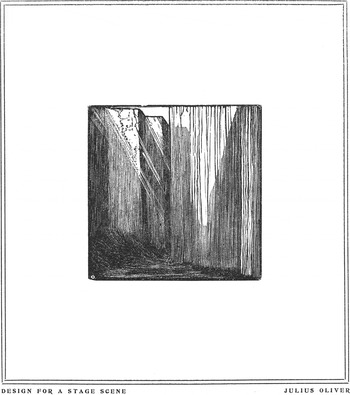
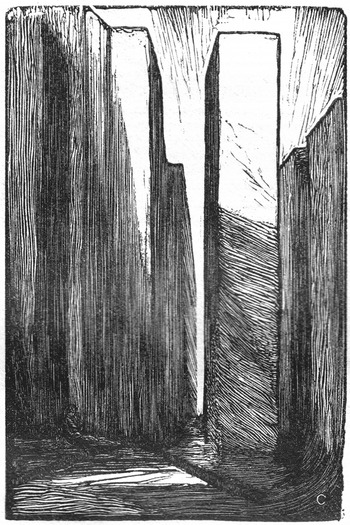
While “Scene” shares with futurism and constructivism a strong interest in the use of geometrical shapes in the service of nonrealist performance, it is above all a three-dimensional space. Moreover, it is a space that rigorously conforms to neoclassical architectural principles, despite its abstraction. One “Design for a Stage Scene” printed in The Mask (Figure 1) features beams of light directed at an angle from above and what looks like a scrim partially obscuring the screens and columns that define the edge of the stage. But as a whole it resembles nothing so much as Serlio's “Tragic Scene” stripped of windows, arches, and other ornaments.Footnote 27 Craig's screens and cubes form a series of rectangles arranged in perspective along a central thoroughfare toward a distant vanishing point, in a composition that hews closely to the form of Serlio's idealized urban landscape. In another “Design for Scene” (Figure 2), the light beaming from above shines more brightly upon the objects. The scrim has been removed and in its place a tall column has risen.Footnote 28 While this column has no clear analogue in Serlio's design, it mirrors the height and angles of the screen at stage right, so it serves to emphasize the geometrical regularity as well as the monumentality of Craig's stage. Critics have rightly seen in this “dialectic of voids and solids” an “ascetic and aseptic retreat” in which Craig attempts to replace the messy modern urban world with a “sterile” neoclassical order.Footnote 29 It is worth emphasizing, however, how much this order owes to xylography as Serlio's engraver and as Craig practiced it. Although woodcutting and wood engraving can produce an image of almost any kind, as a medium, xylography is best suited to creating images heavily dependent on line and angle; the engraver's incision of a series of lines produces the impressions of shapes, light, and shadow.
Craig first published this design under the name “Julius Oliver,” one of the many pseudonyms he used in his periodical. Source: Julius Oliver [Edward Gordon Craig], “Design for a Stage Scene,” The Mask 1.2 (April 1908): facing p. 8. Reproduced with the permission of the Edward Gordon Craig Estate.

Craig's designs feature his famous “screens,” the mobile hinged flats that he patented in 1910. Source: [Edward] Gordon Craig, “Design for Scene,” The Mask 1.5 (July 1908): facing p. 91. Reproduced with the permission of the Edward Gordon Craig Estate.

The centrality of lighting to the dramatic structure of “Scene” also makes wood engraving perfectly suited to its development. The columns and screens, Craig believed, were significant not only in their forms but also in their production of “Light obstructions & consequent shadows.” The shifting shadows would be “Alive—& expressive of all the words of man & nature.”Footnote 30 Wood engraving is, in a specific technological sense, exclusively concerned with the arrangement of light and dark. It is a relief process in which the uncut parts of the block are inked: “a xylograph is made by, literally, carving the light out of the dark.”Footnote 31 In “white-line” engraving, the method Craig usually practiced, the artist must imagine the image he or she desires from the first incision as a series of white lines against a dark background. (This is the opposite of drawing or painting, in which the artist adds colored pigment to blank white paper or canvas.) Just as Craig's ideal drama was to begin with a flat, dark floor, so the wood engravings through which Craig developed his creation began as flat, dark blocks. The stage lights would carve the lines of the cubes and screens out of the darkness, and so too would every incision Craig made in the block. And while the prints taken from the blocks could not move, the shapes drawn forth from the block did, at least in the sense that they emerged and then became increasingly visible with each cut.Footnote 32 Indeed, Craig titled the preface to the portfolio of etchings based on the engravings “Motion,” and his son and biographer, Edward Anthony Craig [aka Edward Carrick], has aptly called the prints “moments of arrested motion.”Footnote 33
Following the Serlio revelation, Craig increasingly experimented with his ideas for the three-dimensional stage through the two-dimensional image, itself created by the three-dimensional wood block. Essential as he considered these graphic experiments to be, he was very clear that neither the blocks nor the prints taken from them were to be treated as a substitute for performance.Footnote 34 Rather, he saw the engravings as the first step in a creative process that would enable the performance he envisioned—a step that was itself a process and that imparted to “Scene” the characteristics of its own xylographic medium. That “Scene” remained a series of blocks, etchings, and prints—a project realized only on the page—was Craig's own fault.Footnote 35 Despite his frequent and bitter statements that his project had been sabotaged by a theatre establishment that stole his ideas while refusing to fund their realization, Craig's obsession with retaining control over his productions was what ruined a number of promising partnerships (most notably with Max Reinhardt) that would have brought at least some aspects of his ideal wordless drama from the page to the stage.Footnote 36
From the Black Figure to the Über-Marionette
Craig's work on “Scene” established a precedent for using engraving to develop his ideas, a practice he continued with the Moscow Art Theatre's (MAT) production of Hamlet. When Stanislavsky wrote to Craig in May 1908 to propose that the two collaborate on a play to be staged in Moscow, Craig chose Hamlet. This may seem bizarre, considering that Shakespeare's tragedy is dominated by a notoriously talkative title character and that Craig had just published essays in The Mask in which he castigated European drama for its dependence on words. Moreover, Shakespeare sits at the center not just of the canon of dramatic literature but of the entire literary canon. But Craig's selection becomes explicable when one considers both his history with Hamlet as an actor and his objectives as a director. Craig knew the play intimately; he had played the title role several times to general approval in the mid-1890s. These performances included a brief run at London's Olympic Theatre in a traditional production (so traditional that Craig had even worn the costume of his onetime mentor, Henry Irving) that was very different from the modernist “mimo-drama” he envisioned for the MAT. Craig was obsessed with the play both before and after he stopped acting in 1896 to focus on designing and directing. In his darker moods he imagined himself as the frustrated prince of a theatrical kingdom that might have been ruled by his father, the architect and designer Edward W. Godwin, and his mother, the great actress Ellen Terry, had the couple not separated and had Godwin not died relatively young.Footnote 37 More relevant for my purposes here, though, is that Craig hoped that by staging Hamlet in accordance with his theories, he could conquer a play so thoroughly accepted as a literary work that critics such as Hazlitt and Coleridge had argued that it was only a reading text.
Early in the tumultuous rehearsal process, Craig made his move: “I should . . . like everything to be conveyed without words, by the movements of the actors illustrated by music,” he told Stanislavsky. Despite the language barrier—they were communicating through an interpreter—Stanislavsky immediately understood just how radical this proposal was. Correctly inferring that what Craig really wanted to create was not merely a scenographically innovative version of the dramatic theatre but also an art that would decisively separate the drama from literature, he responded, “That would not be Shakespeare's Hamlet. It would be a new art founded on the theme of Shakespeare's Hamlet.”Footnote 38 A production in which the story was rendered through symbolic gesture would draw on the massive cultural capital of Hamlet and of Shakespeare at the same time that it subverted the very idea of dramatic authorship. Stanislavsky found Craig's idea of a wordless Hamlet intriguing but not intriguing enough actually to attempt. The text remained (although in the end it was heavily cut), and every rehearsal worsened Craig's opinion of its stageworthiness.Footnote 39 Indeed, Craig became so frustrated by the actors' performance of the text that he scribbled a passage from Hazlitt in his Moscow rehearsal notebook: “‘There is no play that suffers so much on [sic] being transferred to the stage.’”Footnote 40
Unable to convince Stanislavsky of the merits of a wordless Hamlet, Craig again turned to wood engraving to manifest his ideas. This time, he used engravings to develop his concept of the actors who would populate the stage. The beginnings of this practice preceded his involvement with the MAT. In 1907, Craig had a carpenter build a large model stage in his studio in Florence, on which he conducted experiments. At first he tested the placement, movement, and lighting of miniature screens made of thin wooden or cardboard panels fused by linen hinges. Revealing again his classical sympathies, Craig's initial experiments with the model stage were for nonspecific “Greek” and “Roman” dramas. By 1908, however, he had moved on to Hamlet. He had realized early on that the model stage needed actors in order “to give an idea of scale to his scenes.”Footnote 41 Using a fretsaw, Craig fashioned a number of figures out of very thin wood, lightly engraving their bodies so as to make them identifiably human, though not clearly individuated.Footnote 42 Shortly thereafter, Craig decided to ink and take prints (by hand) from the wooden actors, and he found that they were as beautiful on paper as they were useful on the model stage. Now darkened by ink and named “Black Figures” by their creator, they resumed their places on Craig's model stage, bearing the indelible mark of the part they had played in the printing process. Their small wooden bodies now performed roles in two media: hybrid creatures, they lived separate but closely linked lives as three-dimensional “actors” and as two-dimensional prints.
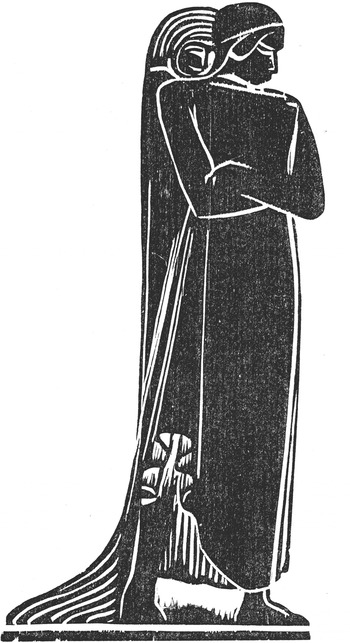
Although Craig later exhibited and sold prints of the Black Figures, they remained theatrical not only in their origin but also in the uses to which their creator put them. Craig brought his model stage actors, including “Hamlet and Daemon” (Figure 3), from Florence to Moscow for the first rehearsals in 1909, and he made several more during a visit to Moscow in 1910.Footnote 43 “Hamlet and Daemon” visually records not only Craig's take on the title character—a physically vigorous yet pensive prince—but also his concept of the play as a whole. Hamlet is shadowed by a lighter, androgynous “Daemon,” whom Craig identified in conversations with Stanislavsky as Death. In Craig's idiosyncratic interpretation, Hamlet was a monodrama in which the prince, aspiring to become pure “spirit” and constantly tempted by an apparition of death, slowly frees himself from the base and vulgar “matter” of the court. Although Stanislavsky rejected out of hand Craig's proposal that an actor play the Daemon onstage, Craig continued to use the Black Figure on the model stage while in Moscow, where it remained as a graphic exposition of his concept and a repository for his original vision of the production.Footnote 44
The engraving presents Craig's vision of Hamlet, shadowed by the androgynous “Daemon” who tempts him toward death. Source: William Shakespeare, The Tragedie of Hamlet, Prince of Denmarke . . . with which are also printed the Hamlet stories from Saxo Grammaticus and [François] Belleforest and English translations therefrom, ed. John Dover Wilson, illus. Edward Gordon Craig (Weimar: Printed by the Count Harry Kessler at the Cranach Press, 1930), 70. Provided by the Columbia University Rare Book and Manuscript Library; reproduced with the permission of the Edward Gordon Craig Estate.

But Craig did not employ the Black Figures merely to fuel and record his own thinking about the play. He used the prints, their wooden parents, and dozens of hastily made cardboard figures to show the MAT cast and crew what he wanted from them during the rehearsal period. Craig left the prints for the actors, student directors, and carpenters, and he arranged and rearranged the wood figures on the model stage to instruct Stanislavsky and his assistants. Although Craig's lack of Russian motivated his use of the Black Figures and their cardboard companions in Moscow, he also developed a belief that the engravings and prints were a more effective form of direction than spoken or written notes. “Into each engraving of each character in the play I have put what I saw in my mind's eye,” he later wrote, “not to exhibit as wood-cuts, but to show the actor what I had seen. . . . I think it is much better that an actor should have designs to look at, rather than that he should be annoyed by a great deal of talk.”Footnote 45 Language, for Craig, was a barrier to understanding both onstage and off-, and the easily reproducible wood engravings seemed to offer a way to reduce sharply the amount of “talk” in the theatre.Footnote 46
Never good with details, Craig neglected to explain to the MAT company exactly how they were supposed to fashion a live performance from a series of static wooden figures and prints, so they remained deeply confused by his ideas.Footnote 47 But the connections between the theory of acting Craig was struggling to articulate in his essays and the images of the performers depicted in his Black Figures and prints is clear. In his 1908 essay “The Actor and the Über-Marionette,” Craig famously rejected the notion that acting is a mimetic art, arguing that “creation,” and not “impersonation,” should be the actor's task. He should aim not for a lifelike representation of a recognizably human, psychologically individuated character but rather for “something entirely opposed to life as we see it”: a performance free of human emotion and its typical expressions, consisting primarily of symbolic gesture. Unconvinced that any conventionally trained actor could control his body so completely as to achieve such a performance, Craig proposed that humans be temporarily replaced on the stage by Über-marionettes, large wooden puppets whose movements, like those of the kinetic stage, would be fully controlled by the director. While the conventional actor “attempts to make a picture to rival a photograph” by mimicking the speech and gestures of everyday life, the Über-marionette aims for the very opposite: a “noble artificiality.”Footnote 48
Although Craig never built an Über-marionette, the Black Figures exhibit the characteristics he ascribed to his ideal actor. Their features and poses severely formalized, the Figures are so deindividuated that even those familiar with them frequently had trouble determining which character they represented.Footnote 49 Their facial expressions are indicated either very broadly or not at all, a graphic choice consistent with Craig's conviction that actors should always be masked to eliminate the temptation toward emotionally inspired facial mobility. For example, Ophelia, a character Craig thought to be stupid and submissive, is entirely faceless, her body shrinking back onto the chair that supports her weight. As L. M. Newman has noted, the Black Figures “conform entirely to the puppet aesthetic. . . . Impersonal, each wooden figure avoids the realism of the actor and his swaying passions.”Footnote 50 The “impersonal” Figures not only avoid the nearly unavoidable physical reality of the human actor's impassioned body, they also appear to shun his speech: like Ophelia, they are often depicted without mouths. Although Craig sometimes suggested that the Über-marionettes would “speak” through offstage voices, he often indicated his preference that they communicate only through movement, as he had hoped the actors in Moscow would do. Craig himself later noted the physical similarities between the wooden Black Figures and the puppets of which he dreamed: “I believe . . . small as they were, I saw them as the übermarionettes of which I had been at such pains to write in 1907–8 . . . sketches of the noble übermarionette.”Footnote 51 It was in the Black Figures that Craig first developed his acting theory, and his experiments with them on the model stage and on the page surpass his efforts to explain them in his often vague and hyperbolic prose.
The Black Figure engravings further correspond with Craig's concepts of acting and of the theatre in ways that go beyond the resemblance between their hieratic bodies and those of the unrealized Über-marionettes. Craig's rejection of pictorial and psychological realism was as fundamental to his practice of wood engraving as it was to his theatrical theory: neither art was meant to reproduce reality. As a graphic artist Craig firmly departed from the tradition initiated in the late eighteenth century by Thomas Bewick, whose method allowed him to produce engravings of hitherto unparalleled detail and accuracy for groundbreaking books of natural history.Footnote 52 In Bewick's wake, wood engraving became the medium of choice for news publications that aimed to offer readers realistic images of events. This type of engraving was replaced by photography, a medium Craig saw as merely reproductive of “life as we see it” and as such entirely without artistic potential.Footnote 53 The fact that Craig actually photographed the configurations into which he arranged his wooden and cardboard figures on his model stage did nothing to alter his judgment of photography as a medium.Footnote 54 Not surprisingly, Craig linked the photograph to the theatrical forms and trends he most disdained—to naturalism and realism and to the actors, directors, stage designers, and playwrights intent on achieving pictorial or psychological realism on stage. When he attempted to explain how wood engraving had shaped his theatrical practice, Craig could not resist a dig at Shaw, whom he imagined would “use a Kodak” to craft his plays.Footnote 55
As a theatre artist, Craig is the anti-Shaw; as an engraver, he is the anti-Bewick.Footnote 56 His antipathy to realism manifests itself in his work in each medium, all of which insists upon revealing its own artifice and on exposing and exploiting the materials and methods it shares with no other medium. All of Craig's Black Figure prints retain a visible trace of the wood from which they were carved. The grain of the “Hamlet and Daemon” plank provided the print with an almost palpable texture. It also offered Craig an evocative and thoroughly organic shading technique far removed from the cross-hatching engravers often use to achieve realistic tonal effects. So concerned was Craig with rendering the wood grain in later Hamlet prints taken from hard wood that he rubbed the blocks with sandpaper to further reveal their natural patterns.Footnote 57 Fierce of line, minimal in detail, and obviously produced through engraving, the Black Figures prints could not be less photographic.
Although the wooden figures and the prints taken from them and their cardboard companions failed to instruct the MAT actors how to perform their roles in the manner of Über-marionettes, Craig continued to believe that his engravings were capable of effective theatrical pedagogy. He was singular in many ways, but he was not alone in his estimation of the potential theatrical value of his graphic art. After viewing one of the Black Figures at an exhibition, none other than Shaw's close friend and collaborator Harley Granville-Barker wrote, “The study of such work is a lesson in the plastic aspect of drama which no student or lover of the art can afford to miss learning to the height of his appreciation.”Footnote 58
Craig was never able to clearly articulate it, but what he really wanted was to stage Hamlet as a wordless drama performed by Über-marionettes on his kinetic stage. Growing increasingly frustrated with the actors' recitation of the translated Shakespearean text during the first MAT rehearsals, Craig wrote in his notebook, “I sometimes wish to draw a I could write another play on [Hamlet]. I will one day—but he shall not talk then.”Footnote 59 The strikeout shows the tentative nature of the suggestion, but its radical nature remains intact. A wordless drama would eliminate two long-standing relationships: between readers and printed plays and between actors and the dramatic text. While the latter relationship has never been as literary as the former, Craig's idea was extreme because he favored jettisoning what is still largely a literary interpretive relationship between the actor and the text. His concept would overturn centuries of Western theatrical practice: actors would no longer perform line readings because there would be no lines to read.
Craig didn't push very hard for his wordless Hamlet, partly because it was Stanislavsky's theatre and partly because his enthusiasm veered so quickly toward other things (including a few of the MAT's actresses). Although Craig left Moscow disappointed in many aspects of the production, the engravings and models through which he had attempted to articulate his vision of a nonrealist and nonverbal theatre continued their multimedia lives. Craig exhibited both the Black Figure prints and the models in gallery shows in the years following the production; he published the “Scene” wood engravings in The Mask and sent the etchings to the 1922 International Theatre Exhibition, and he published a book of those etchings in 1923. Ultimately, the printed page would remain the only record of the silent Hamlet of which he dreamed. Fortunately, those pages are widely considered to be some of the most beautiful ever printed.
Craig's Silent Hamlet
The Black Figures enraptured Count Harry Kessler, the Weimar diplomat, arts patron, publisher, and cosmopolitan extraordinaire, when he first saw them during a visit with Craig in London during late October–November 1911.Footnote 60 Although Kessler did not formally establish his Cranach Press until 1913, an edition of Virgil's Eclogues with illustrations by Aristide Maillol was already under way, and he was eager to take on a new project. Convinced (ironically) that the Black Figures would make brilliant book illustrations, Kessler commissioned Craig to produce a series of engravings for an edition of Hamlet that was to be published in English and German.Footnote 61 The edition was conceived from the beginning as a sort of literary–theatrical hybrid: it would present a full-length Shakespearean text in a custom-designed blackletter typeface, Craig's Black Figures, and, set in slim columns along the margins, his notes about an ideal production. To accomplish this, Craig's figures and designs would be translated to the page in arrangements resembling the models Stanislavsky had largely ignored.Footnote 62 Convinced that the engravings and the playtext, if properly arranged, could create a “typographical equivalent” to Craig's stage designs, Kessler made plans for a large volume, engaging the services of two of the industry's best, the Belgian architect and designer Henry van de Velde and the great English printer Emery Walker.Footnote 63
Kessler's original idea was to set Shakespeare's text in a wide column of large type against the inner margin and to surround it on the outer and tail margins with Craig's notes, printed in a smaller font.Footnote 64 His models for this format were early modern Latin books in which the main text is framed by columns of scholarly commentary. After the Moscow production, Craig felt incapable of providing director's notes to accompany a playtext he believed was not stageable, and after years of indecision he suggested that Kessler fill the columns with the two source texts for Hamlet: books three and four of Saxo Grammaticus's early thirteenth-century Latin History of the Danes and François de Belleforest's version of the story in his Histoires tragiques, first published in French in 1571.Footnote 65 The English edition of the Cranach Press Hamlet presents Saxo in Latin toward the outer and tail margins of each verso and Oliver Elton's 1894 English translation of the Saxo toward the outer and tail margins of each recto, until page 56. Then it starts the Hamlet story over again with Belleforest in French on the verso and the English on the recto, until page 173. The book's presentation of Hamlet and its sources explicitly foregrounds the play's textual history in a format established to facilitate scholarly reading. Presented simultaneously with these three Hamlets, the reader naturally moves among them. Shakespeare's text is literally central, its importance reinforced by the fact that it commands a larger font than the sources that surround it. The composition of each page opening, however, urges the reader to treat the Renaissance tragedy not only as a literary text but as an intertext, part of a network of printed Hamlets that draw on and speak to one another across time.
Craig's engravings, however, are doing something quite different. The placement of many of the Black Figures on the page, particularly across the page spread, strongly suggests that Craig and Kessler were using the printed text of Shakespeare's play and its sources as a sort of two-dimensional set upon which they arranged the two-dimensional actors. The Black Figures frequently stand beside, on top of, or between the columns of text, visually mimicking their placement among the columns and screens of Craig's model-stage Hamlet sets. Many are depicted in the process of gesturing or moving across the page spread, which exists as both an intertextual space and as a nontextual stage design. Shakespeare's play and the sources, then, are not just reading material; the lines of text also form gray rectangles and squares that deliberately resemble Craig's columns and screens. Like the hybrid Black Figures who are denizens of both the page and the model stage, the printed text has two distinct functions: one can read the lines, and one can perceive them as a shifting arrangement of blocks—as architectural elements in Craig's stage designs.
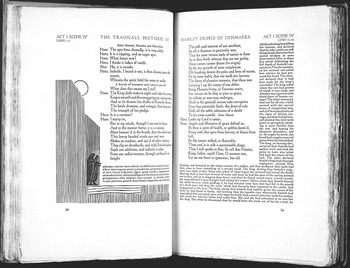
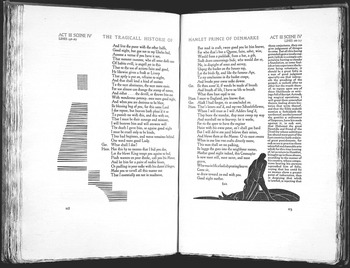
In several page openings, the columns of text seem at first glance to be extensions of or visual backdrops for the squares and rectangles Craig used in his engravings for “Scene.” Horatio and Hamlet emerge from gray columns near the outer margin of page 28, walking toward analogous columns made of text placed along the outer margin of page 29 (Figure 4). Hamlet drags Polonius's body across page 113, presumably from the staircase printed in the outer margin of page 112 (Figure 5). The staircase, which cunningly fills the left margin at a point at which Kessler had almost run out of Belleforest text, is made up of a stack of horizontal lines, like all of the other columns in the page spread, which happen to be made up of words.
Horatio and Hamlet. Source: William Shakespeare, The Tragedie of Hamlet, Prince of Denmarke . . . with which are also printed the Hamlet stories from Saxo Grammaticus and [François] Belleforest and English translations therefrom, ed. John Dover Wilson, illus. Edward Gordon Craig (Weimar: Printed by the Count Harry Kessler at the Cranach Press, 1930), 28–9. Reproduced with the permission of the Edward Gordon Craig Estate.

Hamlet drags Polonius's body across the tail margin; a staircase comprising horizontal lines echoes the gray lines of the texts. Source: William Shakespeare, The Tragedie of Hamlet, Prince of Denmarke . . . with which are also printed the Hamlet stories from Saxo Grammaticus and [François] Belleforest and English translations therefrom, ed. John Dover Wilson, illus. Edward Gordon Craig (Weimar: Printed by the Count Harry Kessler at the Cranach Press, 1930), 112–13. Reproduced with the permission of the Edward Gordon Craig Estate.

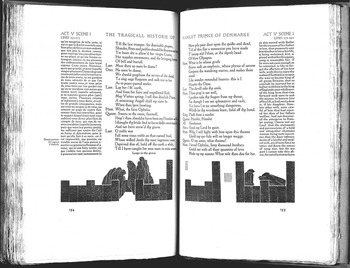
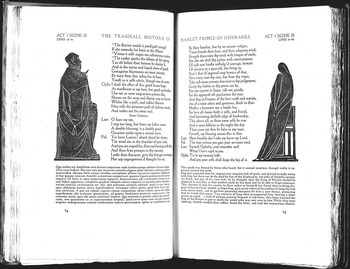
The foreground of the “set” for Ophelia's funeral on pages 154 and 155 is an arrangement of engraved dark gray rectangles, the peaks and valleys of which are echoed by the lighter gray columns formed by the Shakespeare and the Belleforest (Figure 6). Even the engravings that are less dependent upon the shape of the text columns to achieve their full visual effect make use of the page spread as a physical space across which the figures glance and gesture. Polonius, on page 24, lectures Ophelia, on page 25, about Hamlet's unsuitability as a suitor (alas for Ophelia, father and daughter are not on the same page when it comes to the prince) (Figure 7). Although some of the illustrations were designed as headpieces or tailpieces, the majority of the characters depicted in the Cranach Press Hamlet derived from the Black Figures and their cardboard fellows that Craig had used in Moscow. Most are mouthless, masked, and manifestly wooden in origin. Craig's illustrations function as the fourth Hamlet in the edition, a wordless drama that quite literally rests on Shakespeare's play and on its sources. As such, the book remains the record and the repository of the vision of the tragedy that Craig took to Moscow.Footnote 66
Hamlet and Horatio observe Ophelia's funeral from the outer margin of page 155. Source: William Shakespeare, The Tragedie of Hamlet, Prince of Denmarke . . . with which are also printed the Hamlet stories from Saxo Grammaticus and [François] Belleforest and English translations therefrom, ed. John Dover Wilson, illus. Edward Gordon Craig (Weimar: Printed by the Count Harry Kessler at the Cranach Press, 1930), 154–5. Reproduced with the permission of the Edward Gordon Craig Estate.

Polonius instructs Ophelia regarding her relationship with Hamlet. Source: William Shakespeare, The Tragedie of Hamlet, Prince of Denmarke . . . with which are also printed the Hamlet stories from Saxo Grammaticus and [François] Belleforest and English translations therefrom, ed. John Dover Wilson, illus. Edward Gordon Craig (Weimar: Printed by the Count Harry Kessler at the Cranach Press, 1930), 24–5. Reproduced with the permission of the Edward Gordon Craig Estate.

Although Craig complained until his death in 1966 that books and prints were inadequate substitutes for the work that should have come to life on the stage, he acknowledged the crucial role that graphic art, especially wood engraving, had played in the development of his ideas. Writing a decade after the Moscow Hamlet, Craig claimed that wood engraving had taught him “how to design scenes for the Drama,” serving as a kind of “apprenticeship.”Footnote 67 I have argued that Craig's engraving served as more than an “apprenticeship,” however. Wood engraving was a primary medium through which he envisioned and experimented with the wordless drama, and his graphic art imprinted the characteristics of its own xylographic medium on his theatre theory and practice. Craig's graphic work should be considered as part of the avant-garde assault on the literary drama: an assault that permanently altered—but did not end—the centuries-old relationship between the stage and the page.