Introduction
The collection of freshwater gastropods from a given region and their examination to detect larval trematode infections enhances our knowledge of the local parasitological fauna (Bock, Reference Bock1982). Among snail families, the Lymnaeidae are the most studied because members within this family can sustain larval development of more than 70 different trematode species (Brown, Reference Brown, Fretter and Peake1978; Mas-Coma et al., Reference Mas-Coma, Bargues and Valero2005). Many surveys on the distribution of these parasites in lymnaeid populations have been conducted in the majority of European countries from the mid-nineteenth century (for a review see Żbikowska & Nowak, Reference Żbikowska and Nowak2009). Most papers published from the 1990s (Toledo et al., Reference Toledo, Muñoz-Antoli, Pérez and Esteban1998; Faltýnková, Reference Faltýnková2005; Faltýnková & Haas, Reference Faltýnková and Haas2006; Faltýnková et al., Reference Faltýnková, Nasincová and Kablásková2007; Żbikowska, Reference Żbikowska2007; Soldánová et al., Reference Soldánová, Selbach, Sures, Kostadinova and Pérez-del-Olmo2010) were mainly carried out on large lymnaeids (>15 mm at the adult stage), such as Lymnaea stagnalis or Radix auricularia. Contrary to these studies, the papers reporting the presence of larval trematode infections in the mud snail Galba truncatula are more limited in number and concerned essentially the helminth species of medical and/or veterinary importance, such as Fasciola hepatica or Calicophoron daubneyi. In Spain, for example, natural infections with F. hepatica were noted in 11.4% of the 5486 G. truncatula collected from the Porma River basin in the province of León (Manga-González et al., Reference Manga-González, González-Lanza and Otero-Merino1991). However, larval forms of other trematode species were also found in the bodies of this species. According to Manga-González et al. (Reference Manga-González, González-Lanza and Kanev1994), natural infections with Notocotylus neyrai, Opisthoglyphe ranae and Plagiorchis elegans were found in 2.6%, 0.3% and 2.8%, respectively, of the 6291 G. truncatula collected from the same region.
Similar diversity in natural trematode infections of G. truncatula was also noted for snail populations living on crystallophyllian and metamorphic soils of the Limousin region, central France (Rondelaud et al., Reference Rondelaud, Vignoles and Dreyfuss2009). In a total of 18,792 adult G. truncatula collected between 1989 and 2000 from the swampy meadows of Corrèze, Mage et al. (Reference Mage, Bourgne, Toullieu, Rondelaud and Dreyfuss2002) found only larval forms of F. hepatica and C. daubneyi, with respective prevalences of 5.0% and 3.2%. In contrast, if snails were collected from wild watercress beds in Haute Vienne, the diversity of parasite species was greater (Rondelaud, Reference Rondelaud2004). According to this author, eight species were noted in a total of 19,249 G. truncatula collected between 1990 and 2004. Overall prevalence values were 1.7% for F. hepatica, 1.7% for C. daubneyi, 0.1% for Haplometra cylindracea, 0.03% for Echinostoma sp., 0.01% for Notocotylus sp. and 0.03% for a total of three unidentified species. In view of the results reported by Mage et al. (Reference Mage, Bourgne, Toullieu, Rondelaud and Dreyfuss2002) and Rondelaud (Reference Rondelaud2004) in Corrèze and Haute Vienne, one may wonder whether these findings would be the same in a nearby sedimentary area with numerous meadows and ponds. The aims of the present study were: (1) to determine the digenean prevalence and species composition in the region of study; and (2) to specify differences in prevalences, species composition and richness in the different types of snail habitats. Adult snails were thus collected for 3 years (2012–2014) from six types of habitat of G. truncatula located in the Brenne Regional Natural Park, department of Indre (central France). After collection, snails were dissected to identify parasite species and determine prevalences of natural infections.
Materials and methods
Area of study
Snail investigations were carried out on the close communes of Chitray, Ciron, Migné, Nuret le Ferron, Rosnay and Ruffec. Soils of these communes were composed of silt and sand, supported by an impervious subsoil generally formed by sandstones and/or clay. Most soils were hydromorphous and their capacity for water retention was low. They were very sensitive to summer drying and were waterlogged during winter and spring months (Dauphin, Reference Dauphin2012). On these soils, ponds, reedbeds, wet meadows, dry grasslands, heath, woods, marshes or sandstone outcrops are intricately mixed to form a natural mosaic characteristic of Grande Brenne. The climate was temperate of oceanic type and was frequently swept by humid winds which came from the west or the south-west (Dauphin, Reference Dauphin2012). Mean annual rainfall was about 800 mm, with small variations of 20–30 mm throughout the year. The mean annual temperature was 10.5–11°C with rather mild winters (Dreyfuss et al., Reference Dreyfuss, Vignoles and Rondelaud2010).
In these communes, six types of G. truncatula habitat were identified in 2010 and 2011: (1) the peripheral extremity of rainwater-draining furrows in meadows (24 habitats); (2) road ditches containing running or stagnant water during winter and spring (39); (3) small permanent pools ( < 50 m2) in meadows (16); (4) banks of larger ponds (up to 5000 m2), located close to water inflows (18); (5) habitats located along the overflow drain of ponds (15); and (6) habitats distributed along brooks, receiving water coming from upstream ponds, and the banks of three rivers (a total of 23). In these 135 habitats, the size of each snail population ranged from 44 to 187 adult overwintering snails at the beginning of these field investigations (April, May or June 2012, according to the type of snail habitat).
Furthermore, a total of 157 additional sites colonized by G. truncatula were also found in the area of study. They were not considered for this study because the number of overwintering snails ( < 40 per site) was too low at the beginning of snail investigations.
Protocol of snail investigations
During 3 years (2012–2014), samples of 20, 30, 40 or 50 overwintering G. truncatula, according to the abundance of each population, were collected randomly from each habitat in March (sites 1, 2 and 3), April (sites 4 and 5) or May (site 6). In most habitats, snails were sampled using a 20-cm diameter sieve (mesh size, 0.2 cm). In contrast, they were individually collected by sight hunting in habitats located along brook and river banks. Only adult snails, measuring more than 4 mm in shell height, were considered, so as not to endanger survival of each population over time. The choice of March, April or May for snail collection was based on the fact that most infected snails, belonging to the overwintering generation, contained free cercariae within their body during this period. After collection, the snails were transported to the laboratory at 10–14°C. They were dissected under a stereomicroscope to detect the presence of trematode larval forms. The foot of each snail was also examined to note the presence of furcocercariae and/or xiphidiocercariae.
Larval forms of C. daubneyi, F. hepatica and H. cylindracea were directly identified because of our 30-year experience acquired with experimental and/or natural infections of G. truncatula with digenean species (Vignoles et al., Reference Vignoles, Dreyfuss and Rondelaud2011a, Reference Vignoles, Rondelaud and Dreyfussb; Sanabria et al., Reference Sanabria, Titi, Mekroud, Vignoles, Dreyfuss, Rondelaud and Romero2012; Dar et al., Reference Dar, Lounnas, Djuikwo Teukeng, Mouzet, Courtioux, Hurtrez-Boussès, Vignoles, Dreyfuss and Rondelaud2013). When larval forms of another trematode were detected, neutral red and/or Nile blue were used to study their morphology. In the case of plagiorchiid species, cercariae were also heat killed and several lengths were measured with an ocular micrometer according to the reports by Combes (Reference Combes1968) and Grabda-Kazubska (Reference Grabda-Kazubska1970). Parasite identification was performed using the keys by Nasir & Erasmus (Reference Nasir and Erasmus1964), Frandsen & Christensen (Reference Frandsen and Christensen1984), Fuchs & Mannesmann (Reference Fuchs and Mannesmann2003) and Faltýnková et al. (Reference Faltýnková, Nasincová and Kablásková2007, Reference Faltýnková, Nasincová and Kablásková2008). The morphological identification of these parasites was not checked in this study by the use of molecular tools. After identification, the prevalence of each parasite infection was determined.
Parameters studied
The frequency of sites containing snails infected by any digenean was determined for each type of habitat using the ratio: number of habitats with infected snails/total number of snail habitats. Another parameter was species richness in each type of habitat. This species richness did not take into account snails harbouring immature infections, nor xiphidiocercariae in their foot. The prevalence of each digenean infection and the overall prevalence of parasite species for each type of snail habitat were also noted. In the case of snail co-infections, prevalence was calculated for each parasite species. Values of the latter parameters were determined using the ratio: number of infected snails/total number of sampled G. truncatula.
A χ2 test was used to determine levels of statistical significance. First, the prevalences noted in the same type of habitat were compared. Secondly, the differences between values recorded for C. daubneyi and F. hepatica infections in several types of habitats were analysed because of the importance of these parasites in the pathology of local livestock. All the analyses were done using Statview 5.0 software (SAS Institute Inc., Cary, North Carolina, USA).
Results
Parasite species in Galba truncatula
Of the 11,025 adult snails collected from the 135 habitats during the 3 years, four echinostomatid, three plagiorchiid, one fasciolid, one notocotylid and one paramphistomid species were found (table 1). Most cercarial characteristics of Echinoparyphium sp. and Plagiorchis sp. were close to those reported for E. recurvatum and P. elegans, respectively. Immature infections without free cercariae were also noted. Those belonging to C. daubneyi, F. hepatica and H. cylindracea were easily recognized because of our experience and were classified with the corresponding snails harbouring mature infections. In contrast, those of the other digenean species were considered separately, taking into account the presence of rediae or secondary sporocysts. Xiphidiocercariae were also noted in the foot of several snails but their characteristics, particularly the length of their often broken stylet, did not allow precise identification of the plagiorchiid species. No furcocercaria was noted in the foot of these snails after their dissection.
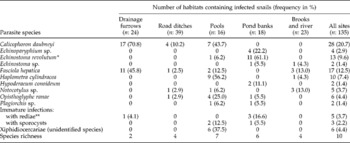
Frequency of sites colonized by Galba truncatula and containing infected snails in relation to the type of habitat and digenean species; n, total number of habitats colonized by G. truncatula.

* One pond drain.
** One drain (out of the 15 sites investigated).
Six double infections were noted: five snails with C. daubneyi and F. hepatica, and one individual with C. daubneyi and O. ranae.
Frequency of habitats with infected snails
Table 1 gives the distribution of habitats from which infected G. truncatula were collected. Snails with C. daubneyi and/or F. hepatica were found in 20.7% and 12.5% of sites investigated, respectively. The percentages were lower for snails with Echinostoma revolutum (9.6%), H. cylindracea (7.4%) and were less than 5% for individuals parasitized by any of the other five species. Most snails infected with C. daubneyi were collected from rainwater-draining furrows (70.8%) and small pools (43.7%) in meadows. Similar observations can be noted for F. hepatica-infected individuals (45.8% of furrows, 12.5% of pools). These pools were also the main habitats for snails infected with H. cylindracea (56.2%) and O. ranae (25.0%). Snails harbouring an echinostomatid infection were mainly collected from banks of ponds: 61.1% of these habitats for individuals with E. revolutum, 22.2% for those with Echinoparyphium sp. and 11.1% for those with Hypoderaeum conoideum. The frequency of habitats with snails infected with other parasite species, particularly those with Notocotylus sp., was clearly lower. The highest richness in parasite species was noted in pools located in meadows (7 species) and in ponds (6).
During the 3 years of study, the presence of C. daubneyi infection was regularly noted in snails living in 11 furrows (out of 17 habitats with infected G. truncatula) and 4 pools (out of 7). This finding was also observed for E. revolutum (1 pond/11), F. hepatica (7 furrows/11), H. cylindracea (4 pools/9) and O. ranae (1 pool/4). In the other types of habitats, the presence of snail infections was more sporadic (data not shown).
Prevalence of natural digenean infections
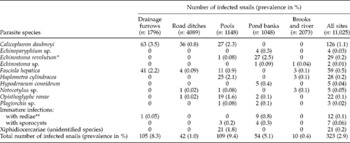
The different values noted for each type of snail habitat and each digenean infection are given in table 2. Of the 11,025 snails collected from the six types of habitats, a total of 323 infected G. truncatula was found. The highest overall prevalence of all digenean infections was noted in pools (9.4%), followed by furrows (8.3%) and ponds (5.1%) in decreasing order. In the other three types of habitats, prevalence was ≤ 1%. The percentage noted for each digenean infection varied with the type of habitat. In furrows located in meadows, prevalence of C. daubneyi in snails (3.5%) was significantly higher (χ2= 4.81, P< 0.05) than that of F. hepatica (2.2%). In pools, values greater than 1.5% were noted for C. daubneyi, H. cylindracea and O. ranae, but the difference between these three percentages was not significant. In ponds, prevalence of E. revolutum in snails was 2.5% (with 17 infected snails found in the same pond during 3 years), whereas the rate of each other parasite in snails was less than 0.5%. If the values recorded for C. daubneyi and F. hepatica in the different types of habitats were compared, that of C. daubneyi infection was significantly greater (χ2= 51.40, P< 0.001) in snails living in furrows and pools than in road ditches, whereas there was no significant difference between values noted in furrows and pools. In the same way, the value noted for F. hepatica infection was significantly higher (χ2= 102.96, P< 0.001) in snails living in furrows than in those collected from the other three types of habitat.
Number of Galba truncatula infected by each digenean species and prevalence of natural infection in six types of habitat located in the southern part of Brenne, department of Indre (central France); n, total number of adult snails collected during the 3 years of study.

* One snail.
** Two snails (out of 871 snails collected from the pond drains).
Discussion
The results reported in the present paper demonstrate that the presence of digenean species in G. truncatula was closely related to the type and, consequently, the location of snail habitats along the same hydrographical network. In meadows and road ditches which bordered them, all snails infected with C. daubneyi and/or F. hepatica were found. The four echinostomatid species were noted in snails collected from ponds. The case of pools located in meadows is different because the three plagiorchiid species were found, with C. daubneyi and F. hepatica in snails living in this type of habitat. This last result may be explained by the fact that these sites were colonized by frogs for reproduction and were also used by local cattle and/or sheep for drinking water. The scarcity of parasite infections, i.e. ten infected snails and four digenean species only, in G. truncatula collected from brooks and river banks might be partly explained by the fact that most snail habitats were submersed by running water from October to the next May in this region (Dreyfuss et al., Reference Dreyfuss, Vignoles and Rondelaud2012).
Prevalence values noted for C. daubneyi infections in snails collected from furrows and pools (3.5% and 2.3%, respectively) were noted in adult snails ( ≥ 4 mm in shell height at collection). As the same protocol was used by our team in previous investigations on G. truncatula populations, these percentages agreed with the values reported by Mage et al. (Reference Mage, Bourgne, Toullieu, Rondelaud and Dreyfuss2002) and Rondelaud (Reference Rondelaud2004) for snails living on the acid soils of the Limousin region. The significantly lower prevalences found for F. hepatica in the same types of habitat (2.2% in snails collected from furrows and 0.9% in those coming from pools) are more difficult to explain. In our opinion, the most reliable hypothesis is to relate these findings to conditions of local treatment for infected cattle. Indeed, paramphistomosis due to C. daubneyi had only been detected in local cattle since 2001 (Dreyfuss et al., Reference Dreyfuss, Vignoles and Rondelaud2010) and several farmers living in the Brenne Regional Natural Park had not treated their ruminants by the beginning of these snail investigations (2010). In contrast, most farmers had used a specific anthelminthic (triclabendazole) to treat cattle against fasciolosis since the 1990s (Reynal, Reference Reynal2001), which had induced a progressive decrease in prevalence of natural infections of G. truncatula with F. hepatica (Dreyfuss et al., Reference Dreyfuss, Vignoles and Rondelaud2014). The presence of several F. hepatica-infected snails in road ditches, brooks and on river banks might be due to rainwater flowing from meadows, which would have carried F. hepatica miracidia towards these sites; and/or to the presence of F. hepatica-infected hares and rabbits in Brenne, as demonstrated by Rondelaud et al. (Reference Rondelaud, Vignoles, Abrous and Dreyfuss2001) in the vicinity of wild watercress beds in the Limousin region.
In Brenne, the presence of H. cylindracea was noted in snails living in pools and was never found in snail populations colonizing road ditches. In contrast, this parasite was often found in snails living in road ditches on acidic soils (Goumghar et al., Reference Goumghar, Abrous, Ferdonnet, Dreyfuss and Rondelaud2000; Vignoles et al., Reference Vignoles, Dreyfuss and Rondelaud2011a). This difference may be explained mainly by the higher richness of water bodies in Brenne, so that frogs (the definitive host of this parasite) preferentially selected pools, more permanent than water present in road ditches, for their reproduction and did not use ponds because of predators which are more numerous in this type of habitat. Prevalences noted for H. cylindracea (2.1%) and O. ranae (1.6%) in these pools were clearly higher than those reported by Rondelaud (Reference Rondelaud2004) for the former species (0.1%) and Manga-González et al. (Reference Manga-González, González-Lanza and Kanev1994) for O. ranae (0.3%). This difference between our values and the results of the above authors might be due to the fact that infected frogs would infect numerous individuals of the snail population during their stay in the pool. An argument supporting this approach was the finding of numerous H. cylindracea-infected snails in the populations of G. truncatula studied by Vignoles et al. Reference Vignoles, Dreyfuss and Rondelaud(2011a) between 2001 and 2009 on acidic soils. Even if xiphidiocercariae found in snails collected from pools were unidentified, these cercariae would probably originate from the other infected snails of the same population. According to Smyth (Reference Smyth1994), cercariae of H. cylindracea and O. ranae can penetrate and encyst in the foot of other freshwater snails living in the same site.
In ponds, E. revolutum was the dominant digenean species, with 2.5% prevalence. This echinostomatid generally uses L. stagnalis, Stagnicola corvus or members of the Radix genus for the development of its larval forms (Fuchs & Mannesmann, Reference Fuchs and Mannesmann2003; Faltýnková, Reference Faltýnková2005). Galba truncatula was also cited as an experimental intermediate host for E. revolutum (Manga-González et al., Reference Manga-González, Morronde Pelayo and Cordero del Campillo1986) but no information on prevalence of natural infections in G. truncatula is available in the literature. Under this condition, the present paper constitutes the first record of E. revolutum in several wild populations of this lymnaeid. Like E. revolutum, three echinostomatid species were also noted in G. truncatula, and this finding poses the question of their respective prevalences in G. truncatula populations living in other ponds, and comparison of these data with those found in lymnaeids of greater size (L. stagnalis, Radix sp. and Stagnicola sp.).
In conclusion, the list of digenean species in G. truncatula located in the Brenne Regional Natural Park was greater than that reported by Rondelaud (Reference Rondelaud2004) for the Limousin region (ten species instead of eight). The distribution and prevalence of each parasite species were dependent on the type and, consequently, the location of each snail habitat. Further investigations are still necessary to confirm the results noted in meadows and ponds in other French regions rich in ponds.
Conflict of interest
None.