

In 2011, the debts of Canadian provinces ranged from 15 per cent to 212 per cent of their annual operating revenues (Moody’s 2012). It was a sizeable gap, to say the least, and far wider than the equivalent range for US states or Spanish regions. Observers could have been forgiven for assuming that bondholders would be far more cautious about lending to Ontario, the most indebted province, than to Alberta, the least. But in fact, lenders barely seemed to notice. Interest rates on Ontario and Alberta’s 10-year bonds never differed by more than a fifth of a percentage point the entire year.Footnote 1 It was as if lenders assigned Ontario, North America’s most indebted subnational borrower by most measures,Footnote 2 virtually zero probability of default.Footnote 3 How could this be?
The answer, according to one influential strand of the fiscal federalism literature, is not immediately obvious. The provinces belong to a small group of subnational governments that rely to a limited extent on transfers from the central government. They fund the brunt of their activities through own-source revenues, and this relatively sharp or dualist division of intergovernmental finances is supposed to send credit markets a clear signal: that the provinces approach credit markets as ‘miniature sovereigns’Footnote 4 or the ultimate guarantors of their own debt. There is little expectation, in other words, that the centre would bail out a distressed province.Footnote 5 But why, if this is true, did Ontario and other high-debt provinces have little difficulty borrowing during the global financial and sovereign debt crises of 2008 to 2012? Was their experience, which allowed them to avoid the market-induced austerity inflicted on so many governments during this period, a fluke? Or does it suggest something awry with a widely held claim about subnational default risk?
Drawing on insights from the comparative and fiscal federalism literatures, this article argues that transfer dependence, considered by many to be the aspect of intergovernmental fiscal relations most likely to lower perceived default risk, often fuels it.Footnote 6 I develop this argument in two steps. First, I argue that dependent governments are generally less capable, on account of their limited revenue-raising authority, of raising additional revenues in the event of fiscal distress. This weakens their standalone creditworthiness or capacity to repay debts in the absence of bailouts. Secondly, I argue that this incapacity does not, contrary to the claims of many, necessarily strengthen investors’ bailout expectations. Transfer systems are highly diverse. They differ significantly in terms of their stability, predictability, and risk-sharing and redistributive properties. Some transfers, including stable equalization payments, support local creditworthiness (whether through bailout expectations or other means). Others, including volatile and pro-cyclical arrangements, do not. Transfer dependence should not, therefore, bestow a general advantage on subnational borrowers.
I test these claims by analysing two unique and broadly cross-national datasets: bailout expectations and standalone credit ratings issued by Moody’s Investors Service, one of the big three international credit rating agencies. I supplement these analyses with a review of rating methodologies and other materials published by each of the major agencies (Fitch, Moody’s and Standard and Poor’s (S&P)). The analyses broadly support my claims. First, I find a negative relationship between transfer dependence and Moody’s standalone ratings, which, according to my reading of rating materials, reflects dependent units’ inability to generate emergency revenues as well as their vulnerability to transfer cuts in the event of sovereign distress. Secondly, I find no evidence of a positive relationship between transfer dependence and bailout expectations. A review of rating reports suggests no relationship, while a cross-national statistical analysis reveals a negative, but modest and statistically uncertain, relationship (which I interpret as suggestive evidence of a non-effect). Finally, the rating materials suggest that rating agencies look favourably upon stable and predictable transfers, including robust equalization systems, and unfavourably upon volatile and unpredictable payments. They also reveal that transfers need not dominate local revenues to signal meaningful national support.
This study contributes to two strands of literature. The first is the limited body of research on subnational default risk. A number of studies have examined the political determinants of public creditworthiness, but the vast majority of these focus on the national, rather than subnational, level.Footnote 7 This asymmetry is surprising given the large and, in many cases, growing levels of subnational borrowing in many countries (S&P 2017). My study provides one of the broadest cross-national analyses of subnational creditworthiness to date.Footnote 8
It also contributes to work on the fiscal discipline of subnational governments and the broader second-generation literature on fiscal federalism to which this work belongs.Footnote 9 Many working in this area claim that transfer dependence undermines fiscal discipline by signalling to creditors, as well as local voters and politicians, that local debts are centrally guaranteed.Footnote 10 This article does not analyse the bailout expectations of voters and politicians. However, it finds no evidence of a straightforward link between transfer dependence and rating agencies’ bailout expectations.
The remainder of the article proceeds as follows. The next section draws on implicit and explicit insights from the comparative and fiscal federalism literatures to hypothesize the relationship between transfer dependence and two aspects of default risk: standalone default and bailout expectations. I then test these hypotheses using data from international rating agencies. The final section summarizes the results and their theoretical implications. It also suggests paths for future research.
Transfer Dependence and Default Risk
Many argue, often implicitly, that transfer dependence bolsters subnational creditworthiness by signalling a higher likelihood of subnational bailouts. I argue that dependence fails to bestow general benefits on local borrowers because it suggests an inability to generate additional revenues in the event of fiscal distress, and because this inability does not, contrary to the expectations of many, necessarily translate into higher bailout expectations. Ultimately it is nature, not the level, of transfers that affects local creditworthiness, whether through bailout or non-bailout channels. Stable and predictable payments, including robust equalization systems, support local creditworthiness, while volatile and unpredictable transfers do not.
Transfer Dependence, Bailout Expectations and Standalone Default Risk
The ability to raise taxes, fees and other sources of own-source revenue varies considerably across subnational governments. Some subnational units, including the Canadian provinces and Swiss cantons, have virtually no limits on their revenue-raising authority, while others, including the German Länder, are highly constrained. Many, if not most, subnational governments therefore tend to rely heavily on revenue streams they do not directly control. Above all, these include grants or revenues subnationals share with the central government.
The implications of various revenue sources for local default risk are unclear. Virtually all local borrowers rely, to some extent, on transfers, and most observers agree that local creditworthiness benefits from a robust and well-designed transfer system, particularly one that redistributes to poor regions and insures local revenues against macroeconomic or local shocks. But it is less obvious – once we get beyond some unspecified level of transfers – what benefits additional transfers provide. After all, dependent units generally rely on transfers for a reason: their powers to raise taxes, fees and other own-source revenues are limited. They are generally incapable, therefore, of independently coping with fiscal distress. Research on the credit conditions of US states suggests lenders and rating agencies are wary of governments with limited revenue-raising capacity. Several studies show that states pay higher borrowing costs and incur lower credit ratings when revenue increases require referenda or legislative supermajorities (Johnson and Kriz Reference Johnson and Kriz2005; Deller et al. Reference Deller2012; Wagner Reference Wagner2004), while others show that these constraints increase the positive relationship between bond yields and unexpectedly high state deficits (Poterba and Rueben Reference Poterba and Rueben1999). This leads to my first hypothesis:
Hypothesis 1: Transfer dependence – or any factor that limits units’ autonomy to raise revenues – undermines perceived standalone creditworthiness or the ability to repay debts in the absence of bailouts.
But some suggest that this very feature – the inability of transfer-dependent units to independently cope with distress – increases the odds of central bailouts, which could, in theory, bolster local creditworthiness.Footnote 11 Rodden (Reference Rodden2006), building on von Hagen and Eichengreen (Reference von Hagen and Eichengreen1996), develops one commonly cited rationale. When a local fiscal crisis strikes, the inability of dependent units to raise revenues leaves central governments with a difficult choice: bail out the unit, which is costly and may foster moral hazard, or let it default, which may result in school closures, cancelled infrastructure projects and other painful adjustments. The latter option is often unpalatable, explains Rodden, because voters and representatives of dependent regions can claim, often with justification, that the central government is responsible for their fiscal ills.
Political pressure is stronger still if, as a considerable body of literature suggests, voters are under the ‘fiscal illusion’Footnote 12 that transfers are funded by non-residents.Footnote 13 This illusion stems from the weak connection between the costs and benefits of spending. Many believe the benefits of transfers are visible, while the costs are obscured by ‘motley’ (Bird and Slack Reference Bird and Slack2018) and opaque sets of rules (Wibbels Reference Wibbels2005b). Therefore voters generally fail to fully internalize the costs of transfers and over-demand them as a result.Footnote 14 Fiscal illusion is a common concern among second-generation fiscal federal scholars, many of whom characterize intergovernmental transfers as common pools of national resources that are vulnerable to over-fishing by local politicians (Weingast Reference Weingast2009). The central government is accountable to a broader coalition than regional governments, and is therefore generally assumed to have an incentive to limit over-fishing and other sources of macroeconomic instability (Rodden and Wibbels Reference Rodden and Wibbels2002).Footnote 15 Its resolve is put to the test, however, where units rely heavily on national grants.
Incentives differ where units raise most of their revenues on their own. The centre does not fund significant shares of local services, diminishing expectations of support from central governments and non-residents. Meanwhile, voters observe local officials adjusting taxes, which suggests they are responsible for (and capable of) resolving the crisis (Wibbels Reference Wibbels2005a; Wibbels Reference Wibbels2005b). With popular expectations and blame focused on local politicians, the demand for bailouts declines and central officials’ ability to walk away increases. Presumably, creditors and rating agencies understand these incentives – or have observed the process play out – and form their bailout beliefs accordingly, assigning higher bailout probabilities to dependent units.Footnote 16
Transfer Dependence and Bailout Expectations: Empirical Shortcomings
Claims linking bailout expectations and transfer dependence are not without empirical support. One broad category of studies links the vertical fiscal imbalance – or the proportion of transfers over total subnational revenues – to weaker fiscal performance at the national and subnational levels, and interprets this relationship as evidence that dependence fuels bailout expectations and larger deficits in turn (the assumption being that dependent units are not balancing their budgets, because local voters, politicians or creditors assume their debts are implicitly guaranteed) (Bordignon and Turati Reference Bordignon and Turati2009; Nicolini et al. Reference Nicolini2002; Plekhanov and Singh Reference Plekhanov and Singh2007; Rodden Reference Rodden2003; Rodden Reference Rodden2002; Rodden and Eskeland Reference Rodden and Eskeland2003; Rodden and Wibbels Reference Rodden and Wibbels2002; Stein Reference Stein1999; Wibbels Reference Wibbels2005b).Footnote 17 A second set of studies examines the relationship between dependence and two indicators of default risk: credit ratings and risk premiums on government bonds (Booth, Georgopoulos and Hejazi Reference Booth, Georgopoulos and Hejazi2007; Schuknecht, von Hagen and Wolswijk Reference Schuknecht, von Hagen and Wolswijk2009). Some of these studies find a negative relationship between dependence and default risk or a weaker relationship between fiscal performance and default risk when units depend heavily on transfers or equalization payments. These results, like the studies above, suggest the presence of bailout beliefs. Finally, Rodden (Reference Rodden2006) examines local credit ratings, but takes a closer look at the sources of rating agencies’ beliefs. He examines documents issued by the major international credit rating agencies and plots the Standard and Poor’s (S&P) ratings of five groups of subnational governments (Australian states, Canadian provinces, German Länder, Spanish regions and US states) against their debt-to-revenue ratios. He observers flatter slopes in countries with high levels of transfer dependence and concludes, on the basis of the plots and his reading of rating materials, that rating agencies consider dependence to be the best indicator of central governments’ bailout intentions (Rodden Reference Rodden2006, 80–94).
But the evidence linking bailout expectations and transfer dependence is not beyond reproach, not least because measures and tests of bailout expectations are indirect. The first set of studies described above regresses local deficits and other measures of fiscal performance on the vertical fiscal imbalance and interprets a positive relationship as evidence of bailout beliefs. But a fiscal outcome does not tell us whether dependence influences fiscal behaviour through bailout expectations or another channel (it is possible, for example, that dependent units run higher deficits because they have minimal capacity to raise taxes.) It also does not tell us whether pressure for fiscal discipline comes from creditors, voters or other groups. The second approach examines the effects of dependence on subnational credit ratings and risk premiums. It has the virtue of isolating market beliefs from those of voters and politicians, but not all of these studies find a positive relationship between creditworthiness and dependence, and none tells us whether market pressure operates through bailout beliefs or another aspect of default risk.Footnote 18 Finally, Rodden’s study of rating methodologies and reports represents a more direct analysis of bailout beliefs, but it does not quantify bailout expectations or examine them across a large number of countries.
Transfer Dependence and Bailout Expectations: Theoretical Shortcomings
This work also rests on shaky theoretical grounds. It assumes that dependence bolsters bailout expectations by increasing the political costs that the centre incurs for local default. But it is plausible that dependence might, under certain conditions, undermine the prospect of bailouts. As Treisman (Reference Treisman2007) notes, if dependence is partly due to past bailouts, central officials may be more, not less, resolved to let units fail. This is particularly true if bailouts are unpopular among the residents of fiscally prudent or wealthy regions, which they almost always are.
More broadly, this logic overlooks the diversity and complexity of transfer systems. Transfers differ significantly in terms of their stability, predictability, and redistributive and risk-sharing properties.Footnote 19 Some equalize fiscal capacity and service provision across local units, while others exacerbate regional inequities. Some insure revenues against negative regional or macroeconomic shocks, while others are fiscally destabilizing and pro-cyclical. Finally, some are governed according to clear, stable and predictable rules, while others are unpredictable and ad hoc. Each of these factors plausibly shapes bailout expectations and other forms of central government support.Footnote 20 They also imply that dependence potentially undermines local creditworthiness (think of volatile, unpredictable or pro-cyclical transfers) and that even relatively lows levels of transfers can signal significant central government support (consider, for example, a government that combines a small but stable base of transfers with a robust base of own-source revenues). It is difficult, given this diversity, to imagine what, if any, information investors glean from the level of dependence alone.
Several scholars acknowledge one or more of these differences. The textbook solution to soft budget constraints, for example, is to allocate transfers according to criteria that recipients cannot game (more on this below). And even Rodden (Reference Rodden2006) finds that rating agencies look most favourably upon predictable and non-discretionary equalization payments designed to ensure that all residents, regardless of where they live, enjoy comparable levels of services at comparable levels of taxation. To be clear, equalization systems rarely obligate national officials to roll over subnational debt; in fact, many are designed to avoid bailing out profligate units.Footnote 21 But equalization puts a floor under the revenues of all units and provides a degree of insurance against negative fiscal shocks (Rodden Reference Rodden2006).Footnote 22 And it may – given its commitment to equalizing service provision and fiscal capacity – suggest the central government is reluctant to let units default (even if the formula governing equalization payments suggests otherwise).
Yet despite these and other differences across transfer systems, many insist there is a relatively straightforward relationship between transfer dependence and bailout beliefs. Rodden (Reference Rodden2006, 9), for example, argues that in the ‘guidelines used by rating agencies to assess subnational governments, transfer dependence is clearly viewed as the best indicator of the central government’s implicit guarantee’.
To reiterate, this article challenges the notion that there is a simple relationship between transfers and local creditworthiness. Not only does dependence make it difficult to raise additional revenues in the event of fiscal distress (thereby undermining standalone creditworthiness), it also fails – on account of the complexity and variability of transfer arrangements – to send unconditional bailout cues. Ultimately it is the nature, not the level, of transfers that shapes perceptions of local creditworthiness.
Data and Empirical Approach
Testing these arguments is challenging for two reasons. First, transfer dependence affects perceptions of default risk through two channels: (1) bailout expectations and (2) standalone default risk – or the likelihood of default in the theoretical absence of bailouts. But standard measures of default risk – risk premiums on government bonds and credit ratings – incorporate both. Secondly, the effects of transfer dependence are potentially conditional. Transfer dependence could undermine standalone creditworthiness by restricting local capacity to cope with fiscal shocks. But transfers could also support standalone creditworthiness by providing a stable and predictable source of revenue (not all transfers, after all, are bailouts). Finally, the relationship between bailout expectations and transfers may also, as I have suggested, depend on the latter’s design.
To address the first challenge – disaggregating default risk – I leverage two unique datasets generated by Moody’s Investors Service, one of the big three international rating agencies. In 2006, Moody’s revised its rating methodology to explicitly consider the possibility of external support for distressed borrowers. Ratings for banks, local and regional governments, and other government-supported entities became a function of four inputs, two of which serve as dependent variables in my analysis. The first is the probability that a supporting government will prevent a unit on the verge of default from missing a debt payment (what Moody’s calls ‘extraordinary support’). This provides a measure of bailout expectations. The second dependent variable is the government’s credit rating in the theoretical absence of extraordinary support (what Moody’s calls its baseline credit assessment). This provides a measure of standalone creditworthiness. The data were assembled from reviews of nearly 300 rating reports downloaded by the author at Moody’s Canadian headquarters in Toronto. The other major rating agencies – Fitch and S&P – also consider the likelihood of extraordinary support, but do not quantify these likelihoods in rating reports, making a similar analysis of their expectations impossible. It is worth noting, however, that the correlation between the ratings of Moody’s and other rating agencies is high. For the 71 units Moody’s and S&P rate in common,Footnote 23 the correlation is 0.98. For the 55 Moody’s and Fitch rate in common, the correlation is 0.97.Footnote 24
Unfortunately, the second challenge, identifying the conditional effects of transfers, is not one I can fully address quantitatively. My data, like most cross-national measures of local revenues, do not distinguish between supportive and non-supportive transfers. I can, however, examine the relationship between transfer dependence and my two dependent variables: bailout expectations and standalone default risk. A negative relationship with standalone creditworthiness would suggest that transfer dependence can undermine local creditworthiness by restricting local capacity to raise own-source revenues, while a weak or non-relationship with bailout expectations would suggest that dependence does not, in and of itself, send clear bailout signals. Finally, I can corroborate these interpretations – as well as claims about the conditional effects of transfers – with a review of rating methodologies and reports issued by the major rating agencies. This is the approach I take.
Before proceeding, it is worth identifying another advantage of Moody’s data. Subnational debt is not as globalized as the market for sovereign bonds. Indeed, most subnational governments continue to rely primarily on domestic investors (S&P 2017). It would therefore be difficult to identify, let alone sample from, a population of investors with a broadly global view of the subnational sector. By contrast, each of the big three rating agencies rates hundreds of subnational governments around the world. This presents a major advantage over hypothetical surveys of investors’ beliefs.
It is also worth addressing a potential concern with Moody’s assessments. The agency seriously underestimated the default risk of asset-backed securities in the 2000s, helping to precipitate the global financial crisis and calling the quality of its ratings into question. This would potentially undermine the validity of the analysis if I were interested in the objective probability of default. Fortunately, I am not. Rather, I am interested in agencies’ expectations of default risk. It is these perceptions and not objective risks, after all, that determine the price of credit and the fiscal consequences that flow from it. Of course, rating performance and influence are not unrelated. It is possible that the influence of ratings is waning as investors and financial regulators, wary of their quality, develop and seek out alternative sources of information. But even these concerns appear overblown. Government ratings perform better than those of corporate and structured securities (Kiff, Sylwia and Schumacher Reference Kiff, Sylwia and Schumacher2012, 4–5) and even where the performance of sovereign ratings has faltered (as they did, for example, during the eurzone debt crisis), they continue to affect market access and borrowing costs (Abdelal and Blyth Reference Abdelal and Blyth2015).Footnote 25
It is also plausible that ratings influence policy decisions independent of their effects on borrowing costs. The media pays careful attention to ratings in certain jurisdictions, often using them as indicators of governments’ fiscal competence. As Abdelal and Blyth (Reference Abdelal and Blyth2015: 45) note, rating downgrades remain ‘front-page news’.
The remainder of the empirical section proceeds as follows. First, I analyze the relationship between transfer dependence and Moody’s standalone ratings. Secondly, I analyze the relationship between transfer dependence and Moody’s bailout probabilities. Finally, I complement these analyses with a review of materials published by the major international rating agencies, which helps me interpret and augment the quantitative analysis.
Analysis of Standalone Default Risk
This section tests my first hypothesis – that transfer dependence undermines standalone creditworthiness. The dependent variable is Moody’s standalone credit ratings, which capture creditworthiness in the theoretical absence of bailouts. They are scored at the level of individual governments from 0 (least creditworthy) to 17 (most creditworthy).Footnote 26 All ratings were issued in 2010 and taken from credit reports downloaded by the author at Moody’s Toronto office. Moody’s only began issuing standalone ratings in late 2006, and annual reports are issued at different times throughout the year, making construction of a time-series dataset difficult. Thus the data are cross-sectional.
Moody’s standalone ratings are not pure measures of standalone risk. While they exclude the probability of bailouts in the event of imminent default, they may include the possibility of another, less dramatic form of bailout: gap-filling transfers designed to narrow budget deficits and to avoid imminent default. Another potential problem is that standalone ratings are influenced by Moody’s bailout probabilities: high probabilities may weaken local incentives for fiscal discipline and standalone creditworthiness in turn. Both of these issues potentially bias my results. As I explain below, however, I can control for both.Footnote 27
The independent variable is discretionary own-source revenues as a percentage of total operating revenues – the rough inverse of transfer dependence. It comes from Moody’s Statistical Handbook: Non-US Regional and Local Governments and ‘captures all revenue, including taxes, charges and other sources, controlled, at least partially, by the government’ (Moody’s 2012, xxvii). Distinguishing between discretionary and non-discretionary revenues is helpful, given the limited capacity of certain units to set or influence own-source rates (Rodden Reference Rodden2003). Unfortunately, the handbook does not provide a detailed account of how discretionary and non-discretionary revenues are operationalized, making it difficult to compare the data to other international sources. But the variable is measured at the level of individual governments, a welcome departure from other international data (including the Organisation for Economic Co-operation and Development’s tax autonomy indicators and the International Monetary Fund’s Government Finance Statistics), which classify revenues at the sectoral (central, state and local) levels.
I now turn to the statistical model. Some scholars model ratings as ordinal (Ederington Reference Ederington1986; Gaillard Reference Gaillard2009), while others treat them as continuous (Archer, Biglaiser and DeRouen Jr. Reference Archer, Biglaiser and DeRouen2007; Biglaiser and DeRouen Jr. Reference Biglaiser and DeRouen2007; Block, Vaaler and Schrage Reference Block, Vaaler and Schrage2006; Cantor and Packer Reference Cantor and Packer1996). But the substantive results of linear and non-linear models should not differ significantly if the scale of the dependent variable is sufficiently fine-grained. Accordingly, I fit a linear model. But I estimate non-linear models (reported in the online appendix) as robustness checks.
Ratings are nested in two groups: countries and subnational groups within those countries. It is possible, therefore, that the residuals are not independently and identically distributed, which will tend to bias the standard errors of regression coefficients downwards. I address this potential problem by estimating a three-level hierarchical linear model.
In some respects, the sample properties are less than ideal for multilevel estimates. Problems lie in the small number of national and subnational groups and their small and unbalanced sizes. Few groups make variance components and their standard errors less reliable (Maas and Hox Reference Maas and Hox2008), while few groups and small group sizes increase type-1 error in the t-statistics of group-level predictors. But these issues are of little concern here, as I am only interested in the fixed-effects estimates of individual-level variables, not group-level predictors or variance components. Simulations suggest the point and interval estimates of individual-level regressors are not biased by these otherwise unfortunate sample properties (Bell et al. Reference Bell, Ferron and Kromrey2008).
The following random-intercept specification provides a baseline:
 $$CR_{{ijk}} {\equals}\delta _{{0j}} {\plus}\delta _{1} I_{1} {\plus}...{\plus}\delta _{{10}} I_{{10}} {\plus}{\epsilon}_{{ijk}} $$
 $$\delta _{{0j}} {\equals}\gamma _{{00}} {\plus}\gamma _{{00}} Sub_{{01}} {\plus}u_{{0jk}} $$
 $$\gamma _{{00}} {\equals}\pi _{{000}} {\plus}\pi _{{001}} N_{{001}} {\plus}r_{{00k}} $$
I 1 through I 10 in Equation 1 refer to individual-level variables, which include the variable of interest (discretionary revenue) and several controls (for example, debt to operating revenues, short-term over total debt, surplus to operating revenues, and interest payments to operating revenues – all measured as percentages – and the log of local GDP per capita adjusted for purchasing power parity). These data, described in the online appendix, also come from Moody’s Statistical Handbook. I use 2008 values for all fiscal data. Coverage for 2009 and 2010 is spotty, so the two-year lag is necessary for practical reasons. Fortunately, it also makes theoretical sense. Moody’s uses two-year lags to generate baseline estimates of ratings. It then uses forecasts, more recent fiscal data and qualitative considerations to adjust those estimates.
I also control for the quality of governance and the transparency of government finances. These variables include the accuracy of budget forecasts (fiscal management), the comprehensiveness and frequency of financial reporting (financial transparency), the quality of the issuer’s debt and investment management (debt management) and the jurisdiction’s capacity to pass budgets without significant delay or gridlock (conflict resolution). The measures come from rating reports and take one of three values: 1, 8.5 and 15 for low, moderate, and high levels of transparency or capacity, respectively (this is a reversal of Moody’s scale). It may, given the ordinal nature of the variables, make sense to break them into dummies. But Moody’s designs the scales to linearly correspond to specific ratings, that is, 1 should result in the highest rating, all else equal, while 15 should result in the fifteenth-highest rating. Accordingly, I leave the variables intact (using dummies does not significantly affect the coefficients of interest anyway).
The baseline specification models individual-level coefficients as fixed, and group-level intercepts as functions of subnational- and national-level variables (see Equations 2 and 3). I employ one subnational-level variable, a measure of the stability, predictability and responsiveness of the fiscal federal framework (institutional stability). This variable is constant within groups (for example, Canadian provinces and Italian regions) but varies across groups within countries (Italian regions and cities, for example, receive different scores). It, like the governance indicators, is measured on a scale of 1 to 15, taking values of 1, 8.5 and 15 for low, moderate and high levels of stability, respectively. The national-level equation contains the final variable, the sovereign credit rating, a broad measure of systemic risk.
In the online appendix, I rerun the baseline models with another variable: Moody’s bailout probabilities or probabilities of extraordinary support. The motivation is twofold. First, this approach controls for the possibility that bailout expectations undermine standalone ratings by weakening incentives for fiscal discipline. Secondly, although standalone ratings do not incorporate the possibility of a bailout in the face of imminent default, they do incorporate the possibility of gap-filling transfers intended to prevent an imminent default scenario from arising. The literature often defines such transfers as bailouts, meaning the standalone ratings may incorporate aspects of investors’ bailout beliefs. But if we assume (as seems reasonable) that last-minute and pre-emptive bailouts are highly correlated, then the bailout variable helps control for bailout expectations broadly conceived.
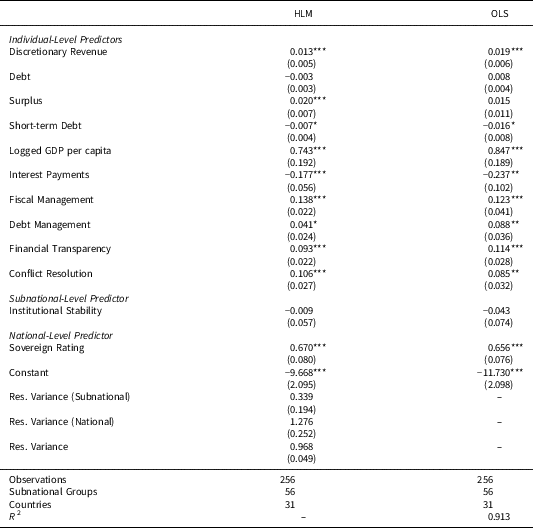
I now turn to the statistical results. Table 1 presents baseline estimates. The discretionary revenue coefficient is positive, as expected, and statistically significant at the 0.01 level. The effect is robust to several other specifications, which appear in the online appendix. These include fixed-effect hierarchical linear and OLS models (in which I control for unobserved group effects by demeaning values of the dependent and independent variables by subnational group),Footnote 28 ordered probit and tobit models, and models in which I control for Moody’s expectations of extraordinary support.Footnote 29
Determinants of Moody’s standalone ratings HLM and OLS estimates

Note: standard errors in parentheses, clustered by country in OLS model. *p<0.10, **p<0.05, ***p<0.01.
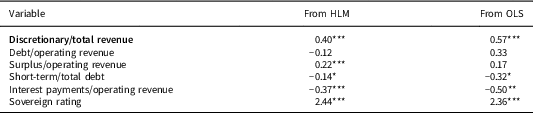
Admittedly, the magnitude of the coefficient is modest, ranging from 0.013 to 0.19 in Table 1. This implies that a 100-percentage-point increase in discretionary over total revenues (or a movement across the entire empirical range of the variable) increases ratings by a mere 1.3 to 1.9 notches. Recall, however, that much of the literature predicts a negative relationship between revenue autonomy and creditworthiness. In that light, the results are notable. Also note the effects relative to economic and fiscal variables. Table 2 reports the impacts of one-standard-deviation increases in selected variables using the results from Table 1. The absolute impacts for discretionary revenue (0.40, 0.57) exceed those of the debt (−0.12, 0.33), surplus (0.22, 0.17), short-term debt (−0.14, −0.32) and interest payment variables (−0.37, −0.50). Moody’s appears to place more stock in governments’ revenue autonomy than their fiscal performance. Not surprisingly, however, the sovereign rating exerts the largest effects. A one-notch increase boosts standalone ratings by nearly 0.70 notches, while a one-standard-deviation increase boosts them by over two notches.
Impact of standard deviation increase in X on standalone ratings

Note: increases calculated using results from Table 1. Asterisks indicate level of statistical significance in Table 1. *p<0.10, **p<0.05, ***p<0.01.
In short, the analysis reveals a positive relationship between discretionary own-source revenues and standalone ratings, suggesting that the inability of dependent governments to raise own-source revenues can negatively affect their standalone creditworthiness. The review of rating materials below provides additional evidence to support this interpretation.
Analysis of Bailout Expectations
The previous section finds a negative relationship between transfer dependence and standalone creditworthiness. But I have yet to test whether this effect is offset by increased bailout expectations, which a lack of revenue autonomy is believed to entail. My hypothesis is that transfer dependence fails to send such signals.
For this analysis, the dependent variable is the expected probability that an external government will ensure that a unit on the verge of default repays its debts in full and on time (what Moody’s calls extraordinary support). Moody’s does not care what form this support takes,Footnote 30 only that it prevents default. Support may come from the central government. But it could also come from a higher tier subnational government. Moody’s expects a Canadian province, and not the federal government, to assist a distressed municipal government, for example. Extraordinary support differs, in certain respects, from bailouts conventionally defined. It does not, for example, include gap-filling transfers intended to prevent an imminent default scenario, only measures that prevent imminent default. This does not pose a major problem, however, as expectations of pre-emptive and last-minute support are likely highly correlated.Footnote 31
The probabilities range from 0.05 to 1, typically in increments of 0.15.Footnote 32 Only entities with explicit guarantees receive scores of 1. Probabilities do not differ within groups (all Canadian provinces, for example, receive probabilities of 0.8), except for well-defined reasons that do not appear to have anything to do with transfer dependence.Footnote 33 Because within-group variation is limited and because Moody’s accounts for deviant cases within groups in its rating methodology and reports, I drop these deviant cases and conduct a group-level analysis. Countries often contain more than one group. For example, Moody’s assigns different scores to Italian regions and Italian cities. Finally, because probabilities rarely vary over time, I analyze the data as a cross-section.
At first glance, a group-level indicator seems problematic because it does not allow us to explain within-group differences in bailout expectations. But the structure of the data makes the point moot. Again, we are interested in rating agencies’ perceptions – not the objective probability of bailouts – and Moody’s does not differentiate witin groups, except for the reasons listed in footnote 33.Footnote 34
The lack of time-series data is, perhaps, more problematic, as Moody’s only started assigning probabilities of extraordinary support in late 2006. We cannot know, therefore, whether expectations vary over a longer period. It is worth noting, however, that as of December 2010 (the time of data collection), the overwhelming majority of scores had not changed. They remained stable well into the financial crisis, a period of intense financial uncertainty, suggesting that probabilities are highly stable over time. At first glance, this stability seems implausible, as the ratings of several sovereign governments (the implicit guarantors of most subnational governments) plunged during this period. The credibility of bailout guarantees should have plunged with them. Moody’s bailout probabilities did not change significantly, however, because of the way it models local default risk. Bailout probabilities are one input in it rating algorithm. Sovereign default risk is another. The latter does not determine bailout probabilities in Moody’s model; it discounts them. In other words, bailout probabilities control for changes in sovereign default risk.
I now turn to the independent variable. Moody’s rating reports provide a broad, group-level measure of sectors’ own-source revenue autonomy. The variable reflects both the degree of transfer dependence (which helps capture the scope of own-source revenues relative to expenses) and the legal and political discretion over the rates and objects of own-source revenues. The latter feature is useful, as it is as much the inability to raise own-source revenues (as it is dependence on transfers per se) that explains bailout expectations in Rodden and von Hagen and Eichengreen’s story.
The Moody’s variable is measured on a scale from 1 to 15, but only takes three values (1, 7.5 and 15). Rather than assume a linear effect, I break it into two indicators, one that takes a value of 1 for moderate levels of revenue autonomy or transfer dependence and 0 otherwise, and another that takes a value of 1 for low levels of revenue autonomy or high levels of transfer dependence, and 0 otherwise. This leaves high levels of revenue autonomy or low levels of transfer dependence as a baseline.
A group-level variable may seem odd given the variability of transfers within groups, but it is standard in cross-national analyses, where data are almost never disaggregated to the level of individual governments (Rodden Reference Rodden2004). It is also theoretically reasonable given that it covers multiple countries (within-group differences often appear small in an international context) and captures the legal capacity to adjust revenues, which, unlike transfers, varies little within groups.Footnote 35 Ultimately, however, a group-level measure is simply necessary. Moody’s bailout expectations vary little within groups, and the variation that does exist is not a function of transfer dependence, leaving only group-level differences and their group-level causes to explain.
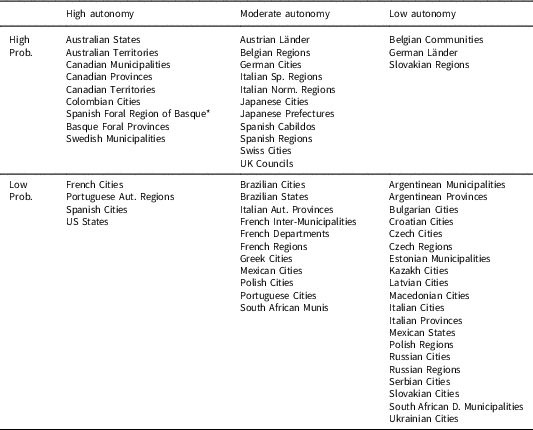
I begin the analysis with cross-tabulations of bailout probabilities and revenue autonomy. Table 3 splits groups between those with probabilities of 0.5 or more and those with scores below 0.5. The literature predicts a negative (positive) relationship between bailout probabilities and revenue autonomy (transfer dependence), but the table suggests, if anything, the opposite effect. Of the 23 groups with low levels of revenue autonomy, only three (Belgian communities, German Länder and Slovakian regions) receive a high bailout score. Of the 13 groups with high levels of revenue autonomy, only four receive a low bailout score (French cities, Portuguese autonomous regions, Spanish cities and US states).
Moody’s bailout probabilities and revenue autonomy

* Refers to expected support from the region’s provinces, not the central government.
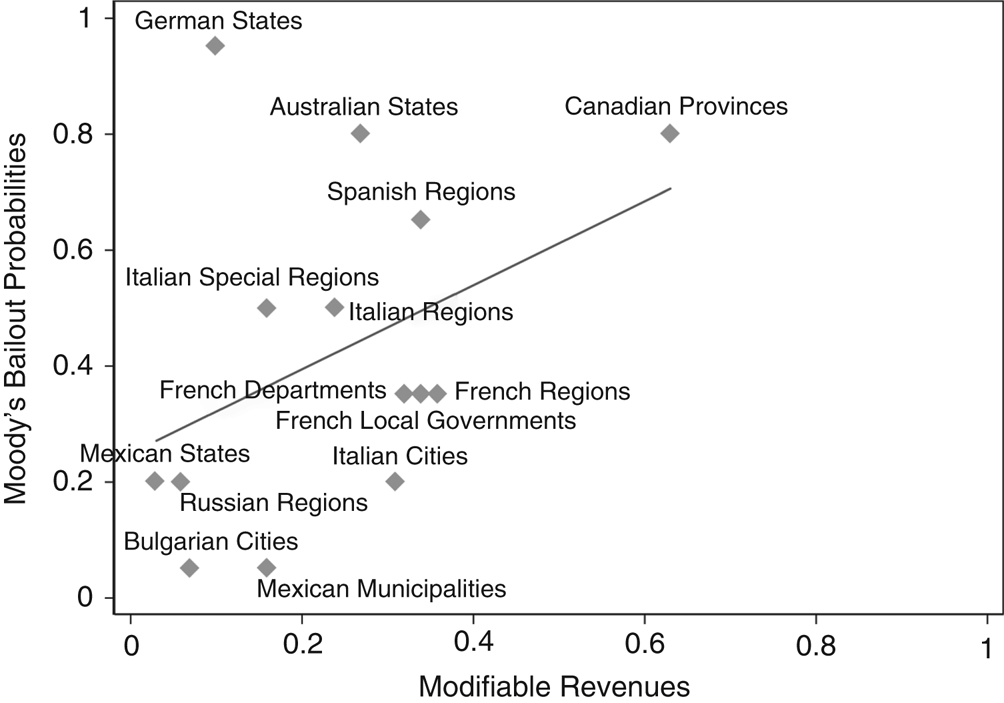
Figure 1 plots bailout probabilities against an alternative measure of revenue autonomy developed by S&P. S&P provides group-level averages of the proportion of modifiable (or discretionary own-source) over total revenues. The S&P measure is more fine-grained, but covers fewer cases. Again, the bivariate relationship is negative.
Bailout probabilities and revenue autonomy.

Next, I examine these relationships in a regression framework. The dependent variable ranges from 0.05 to 1, but only takes eight values, suggesting that a non-linear specification may be appropriate. I do not report ordered probit estimates, however, given the small sample size and the fact that several observations are completely determined by a key control variable (default history). The fractional logit model, designed explicitly to handle bounded proportions, provides another natural framework (Papke and Wooldridge Reference Papke and Wooldridge1996). However, it is a partial maximum likelihood (ML) approach, and the asymptotic properties of ML estimators are not realized in small samples (Long Reference Long1997). Accordingly, I estimate a series of OLS models. The following specification provides a baseline:
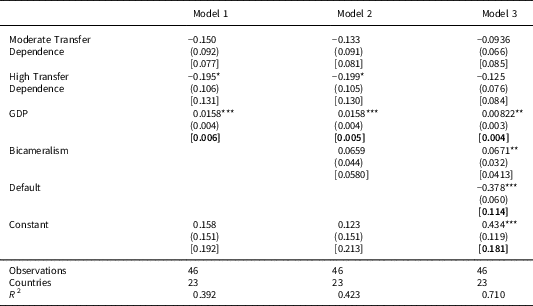
 $$BP{\equals}\beta _{0} {\plus}\beta _{1} MTD{\plus}\beta _{2} HTD{\plus}\beta _{3} GDP{\plus}\beta _{4} Bicameralism{\plus}\beta _{5} Default{\plus}{\varepsilon}$$
BP refers to the probability of a bailout. The data come from Moody’s rating reports and press releases. MTD and HTD refer to moderate and high levels of transfer dependence, respectively, or the dummy variables described above. GDP refers to national GDP per capita measured in thousands of current US dollars. It ranges from 6.7 (Ukraine) to 44 (Switzerland). The figures are annual averages from 2006 (the year bailout scores were issued) to 2010 (the year the data were collected) and come from the World Bank. Higher levels of GDP suggest a greater capacity to deliver bailouts. I expect a positive and statistically significant result. Bicameralism reflects subnationals’ influence over the fiscal policy-making process. The variable, a numerical transformation of ordered categories assigned by Swenden (Reference Swenden2012), measures the strength of subnational governments within the upper chamber. It ranges from 0 to 3 in increments of 0.5. Scores for federal regions range from 1 to 3, while regions within unitary systems and local governments receive scores of 0.Footnote 36 I have observations for all federal regions except Mexican states. This group is dropped from the sample. Legislative influence increases subnationals’ veto power and capacity to form bailout coalitions, and should therefore generate higher bailout scores.Footnote 37Default controls for a history of multiple defaults at the subnational level. It takes a value of 1 if the sector has a history of such defaults, and 0 otherwise. This variable was constructed from references to regular defaults found in Moody’s rating reports. A history of defaults signifies a clear no-bailout policy or tendency. Thus I predict a negative and statistically significant effect. β 0 is the intercept and ε is a stochastic error term. β 1, β 2, β 3, β 4 and β 5 are the coefficients for MTD, HTD, GDP, Bicameralism and Default, respectively. A description of variables and their sources is found in the online appendix.
Estimation is complicated by country-level clustering of subnational groups. Clustering inflates t-statistics, resulting in unwarranted rejection of the null hypothesis (Moulton Reference Moulton1986). The standard solution is to calculate cluster-robust or sandwich errors that allow for heteroskedasticity and general within-cluster correlation (White Reference White1980). But these errors are only asymptotically valid (they inflate t-values when the number of groups is small) (Bertrand, Esther and Mullainathan Reference Bertrand, Esther and Mullainathan2004), and they are even less valid if the groups are unevenly sized, which mine are (MacKinnon and Webb Reference MacKinnon and Webb2014). Cameron, Gelbach and Miller (Reference Cameron, Gelbach and Miller2008) test the ability of various cluster-bootstrapping methods to reduce over-rejection rates and show that a wild bootstrap-t procedure works best when observations are distributed across a small number of groups. MacKinnon and Webb (Reference MacKinnon and Webb2014) show the same approach performs well when groups are unevenly sized. Accordingly, Table 4 reports OLS coefficients with classical standard errors in parentheses and wild cluster-robust standard errors in brackets. (Observations are fewer in Table 4 than Table 3 because of missing values of the dependent variable. See the online appendix for details.)
Determinants of Moody’s probabilities of extraordinary support OLS estimates

Note: classical standard errors in parentheses. Clustered wild bootstrap standard errors in brackets. Boldface indicates p<0.05 for bootstrapped standard errors. *p<0.10, **p<0.05, ***p<0.01.
The dependence coefficients are negative across all models, providing strong evidence against the literature’s prediction of a positive effect. A movement from low to high levels of dependence increases the expected probability of default by 0.13 in the full model. The results fail, however, to reach statistical significance at the 0.05 level or even the 0.10 level in the full model. This does not definitively support my hypothesis of no relationship, but the uncertainty is suggestive. Robustness checks in the online appendix reinforce this uncertainty. The dependence coefficients are consistently negative, but their magnitudes are sensitive to the inclusion of particular countries and still fail to reach statistical significance at the 0.05 level when missing values of the dependent variable are imputed. Statistical and substantive significance increase in a subset of robust regression models (which down weight the impact of influential cases), but the coefficients fail to reach statistical significance at the 0.05 level in the full model.Footnote 38
Evidence of a non-effect is reinforced by a review of the rating reports that explain why groups receive particular bailout scores. Although these explanations occasionally reference transfer systems (in three cases), there is no suggestion of a straightforward relationship between dependence and bailout beliefs. Moody’s (2008: 9) says, in its rating methodology, that it assigns a higher probability of external support to subnationals with ‘responsive intergovernmental arrangements’; for example, ones that allow for ‘emergency transfers [or] liquidity’ in periods of distress’. This suggests that Moody’s assigns higher probabilities to units with some level of transfer dependence. But there is no indication of what that level is or whether bailout expectations increase beyond it. It would appear, however, that the baseline is low: Moody’s suggests Canada’s transfer system sends positive bailout signals despite the fact that provinces rely primarily on own-source revenues.
In short, I find no evidence of a positive relationship between transfer dependence and bailout beliefs. There is only modest and unstable evidence of a negative relationship, which is suggestive, at least, of a non-effect. Nevertheless, I examine, as a final robustness check, the relationship between transfer dependence and units’ final credit rating, which is a function of both bailout expectations and standalone ratings. This increases the sample size and allows me to control for within-group effects. It also provides another way to test whether the purported benefits of transfer dependence (that is, bailout expectations) outweigh the negative effects on revenue autonomy. The results appear in Appendix Table A5. The coefficient is positive and statistically significant in both models: more discretionary own-source revenue results in higher credit ratings, on average.
Review of Credit Rating Documents
The previous sections provide support for the hypothesis that transfer dependence often undermines standalone creditworthiness and fails to send clear bailout signals. But I have also argued that the effects of transfers ultimately depend on their nature, not their level. Some transfers, including payments designed to equalize service provision across local units, support local creditworthiness, while others, including volatile and unpredictable transfers, do not. Unfortunately, I cannot test this hypothesis quantitatively, as my data do not make fine-grained distinctions among transfer systems. Accordingly, this section reviews documents published by the major international rating agencies (Fitch, Moody’s and S&P). It relies primarily on the agencies’ rating methodologies. However, it supplements these with other rating materials available online or provided to the author by rating analysts. The documents help fill gaps in the quantitative analysis. They also help interpret the quantitative results.
It is difficult, on balance, to conclude that rating agencies view intergovernmental transfers as either inherently good or bad. Clearly, the agencies associate transfers with a number of potential benefits. For example, each examines the long-term balance between local expenditures and revenues (Fitch Reference Fitch2015, 3–4; Moody’s 2017; ad S&P 2014a, 10–11), and transfers are an important source of revenue for most subnationals. Agencies also study historical patterns of transfers and whether they respond to fiscal needs. S&P, for example, examines whether central governments tend to increase transfers in the event of economic crises and natural catastrophes and uses this information to predict the likelihood of similar support in the future (S&P 2014, 11).
Rating agencies also take comfort in robust equalization systems. According to S&P, equalization is an expression of ‘intergovernmental solidarity’. It provides subnationals ‘with greater resilience to fiscal stress’ and ‘compensate [units] with a weaker or reduced revenue base’ (S&P 2010, 14), statements broadly consistent with the redistributive and risk-sharing function the literature often attributes to equalization arrangements. And transfers need not, it would appear, comprise a significant share of overall revenues to signal meaningful support. Even in the case of Swiss cantons, which are among the most autonomous subnational units in the world, S&P (2014c, 4) thinks the equalization system plays a supportive role, explaining that ‘The combination of large revenue responsibilities and supportive equalization mechanisms allows cantons to achieve a [...] comparatively strong [revenue-expenditure balance]’.Footnote 39
Moody’s does not explicitly reference equalization in its rating methodology, but it emphasizes equalization’s positive effects in a number of reports, including commentary on Australian states, Norwegian municipalities, Swedish subnationals, UK councils, Japanese subnationals, Swiss cantons, Turkish cities, German Länder and Canadian provinces (Moody’s 2009, 2010a, 2010b, 2010c, 2010d, 2014, 2016a, 2016b). Note that three of these groups – Swedish subnationals, Swiss cantons and Canadian provinces – rely heavily on own-source revenues.
Fitch appears to place the most stock in this variable, identifying equalization as one of a handful of features that determine the strength of subnationals’ broader institutional environment. ‘Any equalisation mechanisms [...] that [...] mitigate a weaker socio-economic profile are’, in Fitch’s (Reference Fitch2015, 3) view, a credit ‘positive’. If the equalization system is strong enough – and if it coexists with national controls on subnational finances and liquidity provisions – Fitch may even place a floor under the ratings of the entire sector, as ‘there would be a strong likelihood of extraordinary support’ (Fitch Reference Fitch2005, 16). Thus in some cases, equalization may (in combination with other factors) signal an implicit bailout guarantee, as it appears to do in the case of the German Länder (Fitch Reference Fitch2005).Footnote 40
Cleary, however, not all transfers are created equal. Stable and predictable transfers are viewed favourably, while unstable and volatile transfers are not (S&P 2014b, 11). According to Moody’s, ‘transfers provided by a highly rated central government in a balanced fiscal position, which are predictable, are viewed, generally, as a credit positive’ (Moody’s 2012, xvii).
It is also clear that rating agencies value broad access to own-source revenues, suggesting, yet again, that transfer dependence fails to bestow general benefits. Fitch (Reference Fitch2015, 4), for example, considers the ‘authority and power to raise tax rates and modify the tax base’ a key indicator of local creditworthiness. The more authority governments have to adjust this base, and the less it is determined by the central government, the better, says Fitch (Reference Fitch2015, 4). According to Moody’s (2012, xvii), high levels of discretionary own-source revenue ‘indicate that a government possesses financial flexibility to address fiscal pressures as they arise’. Finally, S&P has developed a fiscal flexibility index measuring governments’ capacity to adjust revenues and expenditures in the face of negative fiscal shocks. It measures revenue flexibility as the proportion of modifiable over total revenues, where modifiable refers to ‘local taxes, fees and operating nontax revenues which may be raised by a [local or regional government]’ (S&P 2007, 11). ‘In certain cases’, according to S&P (2007, 6), the level of revenue flexibility ‘can have a marked influence on [subnational] ratings’.
The ability to raise revenues is not the only benefit agencies ascribe revenue autonomy. It also insulates units from deep and sudden transfer cuts, which often come on the heels of deteriorations in the central government’s fiscal performance. This recognition is reflected in agencies’ criteria for rating subnationals above their central governments. These criteria are telling: agencies rarely allow subnationals to pierce the sovereign ‘cap’. However, all three will consider it if units have, among other things, significant and stable (for example, constitutionally protected) authority to raise revenues (S&P 2014b, 5; Fitch Reference Fitch2015, 14; Moody’s 2017, 19). According to Fitch, ‘it is highly likely that national government under stress would be tempted to impair the finances of its [subnationals] by reducing transfers [...] in an attempt to bolster its own budget’. Local governments that rely overwhelmingly on discretionary own-source revenue may therefore be ‘more resilient to external shocks affecting the national government’ (Fitch Reference Fitch2015, 15).
Conclusion
Cross-national differences in local credit conditions only weakly correspond to variation in local fiscal performance. According to an influential strand of the fiscal federalism literature, these differences reflect basic differences in the sources of subnational revenue. Default risk is higher when units generate the brunt of revenues through own-source taxation and user fees. It it lower when dependence on central transfers suggests local debts are implicitly guaranteed.
This article challenges this thinking on theoretical and empirical grounds. It argues that transfer dependence can, under many circumstances, lead to lower credit ratings and higher risk premiums for two main reasons. First, dependent units are generally incapable, given their limited revenue raising powers, of coping with severe fiscal stress. Secondly, it is not obvious, given the complexity and variability of their transfer systems, that their debts are implicitly guaranteed. It is likely that the nature, rather than the level, of dependence affects perceptions of local default risk, whether through bailout expectations or other channels.
The empirical analysis broadly supports these claims. I find a positive relationship between standalone ratings and discretionary own-source revenues, which, according to my reading of rating methodologies and reports, reflects autonomous units’ capacity to cope with negative fiscal shocks and their insulation from transfer cuts. I find no evidence of a positive relationship between transfer dependence and bailout beliefs: a review of Moody’s rating materials reveals no effect, while cross-national analyses reveal a negative, but modest and uncertain relationship. Finally, a reading of rating materials suggests rating agencies look favourably upon stable and predictable transfers, including robust equalization systems. It also reveals that transfers need not dominate local revenues to signal the central government’s support.
The findings contribute to two strands of literature. The first is work on subnational default risk. As I note at the outset, a number of studies have examined the political determinants of public creditworthiness, but this is one of the first broadly cross-national analyses at the subnational level. The second is research on the fiscal discipline of subnational governments – work that belongs to a much broader ‘second generation’ of fiscal federal research on the relationship between economic outcomes and political incentives (Weingast Reference Weingast2009).Footnote 41 Scholars working in this area often claim that transfer dependence undermines fiscal discipline by signalling to creditors, as well as local voters and politicians, that local debts are centrally guaranteed. This perception weakens the link between fiscal performance and risk premiums, encouraging units to borrow more than they can independently sustain. This article cannot speak to the perceptions of local voters and politicians. (Nor does it assume a credible no-bailout guarantee unconditionally leads to superior fiscal outcomes.Footnote 42) But it finds no evidence that rating agencies interpret dependence as an implicit bailout guarantee.
Clearly, however, we have much to learn. I have argued that transfer dependence is unlikely, in and of itself, to send powerful bailout signals, but that certain types of transfers – including stable and predictable equalization payments – might. Unfortunately, I cannot test this claim using cross-national quantitative data, which are too blunt to examine the finer details of transfer systems. My review of rating reports suggests that agencies look favourably upon robust equalization systems, but the reports are rarely clear about whether equalization suggests a higher likelihood of bailouts or whether it simply supports creditworthiness through other channels (for example, risk sharing and redistribution). It is also unclear whether bondholders share rating agencies’ views. These questions are not merely academic. If markets interpret certain transfers as implicit guarantees, then they are less inclined to punish fiscal excess.
One way to address this problem is to interview investors, not unlike Mosley did (2003) in her analysis of the factors bondholders use to evaluate sovereign default risk. Researchers could, for example, ask lenders about the factors that shape their bailout expectations. One would need, however, to adopt a different sampling procedure than Mosley, who spoke to lenders with global portfolios. Since subnational debt markets are far more fragmented than their sovereign equivalents, it would be virtually impossible to identify a sample of investors with a broadly global view of the sector, let alone one representative of lenders in multiple national markets. Researchers would therefore need to speak to investors in particular debt markets. They would also need to select their cases wisely. One effective strategy might be to identify a country with a relatively limited equalization system and treat it as a boundary case: if investors infer bailout guarantees from this system, one might reasonably conclude that they would infer even stronger guarantees from stronger equalization systems.
Interviews could also shed light on the effects of other aspects of transfer systems (for example, their stability, conditionality and risk-sharing properties) and the broader fiscal federal environment (for example, the nature of subnational spending responsibilities). But research should not stop with lenders and rating agencies. Existing theory suggests transfers affect the bailout expectations of multiple actors – including local voters, politicians and creditors – in similar ways. But these and other micro-foundational assumptions linking transfers and economic and fiscal outcomes remain untested. Examining them represents a promising path for second-generation fiscal federalism research.
Acknowledgements
The authors would like to thank Adam Auerbach, Richard Bird, Doug Brown, Mark Copelovitch, Alan Fenna, Tracy Beck Fenwick, Daniel Kelemen, Scott Gehlbach, Elizabeth Goodyear-Grant, Mark Hallerberg, Lisa Martin, Marc Ratkovic, Nils Ringe, Jonathan Rodden, Geneviève Tellier, Dave Weimer and the anonymous reviewers for comments and guidance on previous drafts. I also acknowledge financial assistance from a National Science Foundation Dissertation Improvement Grant. Finally, I thank Moody’s Investors Service and CIBC World Markets for generously supplying data.
Supplementary material
Data replication sets are available in Harvard Dataverse at: https://doi.org/10.7910/DVN/8FHRCQ and online appendices at: https://doi.org/10.1017/S000712341800042X