1. INTRODUCTION
There are manifold ways in which narratives of spaces might emerge, as there exist different conceptual approaches that link sound and site, music and place, as well as different ways in which stories are told and political statements are made through the lens of a certain engagement of sounds and sites.
I am going to discuss four particular viewpoints that shed light on the understanding of space in/and sound. These are:
-
∙ sonic narrative of space
-
∙ sonic activism
-
∙ sonic preservation
-
∙ sonic participatory action.
It must be noted, however, that these do not constitute exclusive ways of thinking about sites and sounds, nor are they rigidly delineated categories; rather, I am hoping to examine different potential ways of intervention, thinking about how sounds might be used in a particular site, or how a specific place incites sonic action and shapes certain narratives.
I build on some of the pivotal discussions in Georgina Born’s edited volume (2013) on the politics of sound and space, where several authors have examined how music, sound and space can transform the nature of public and private experience. Born’s ‘social phenomenology of music and sound’ (Born Reference Born2013: 7), drawing on the notion of social mediation in a process where music, sound and space become intertwined, is implicit in all four viewpoints that I examine here.
Born argues that, rather than a singular sociality, there exist four planes of social mediation that
enter in dynamic ways into musical and sonic assemblages. The four are irreducible to each other and each has a certain autonomy; yet they are articulated in contingent ways through relations of synergy, affordance, conditioning or causality. (Born Reference Born2013: 32)
I stress that Born identifies the limits of her own topological metaphor of the plane, with its absence of embodied, fleshy and human qualities that are present in the socialities reflected within the planes. Whereas Born’s first plane considers the intimate microsocialities of musical performance, that is, the social and corporeal interactions between performers and audiences, the second proposes that music animates communities (with listeners aggregating into virtual communities); her proposed third plane highlights the wider social formations, that is, social relations to do with difference of gender, class, age, ethnicity, religion and race; and finally, in her fourth plane music is mediated by institutional forms (Born Reference Born2013: 32).
I acknowledge one of the central ideas in Born’s book – that any auditory experience has the capacity to reconfigure space and is thus able to give way to plural and permeated space, as opposed to singular, perspectival space. My thinking is more concerned with plural and permeated space than with people’s personal experiences or their emotional responses to a particular place, or how music, sound and space might engender modes of publicness and privacy (as Dibben, Haake or Rice pursue in Born’s volume).
2. PLACE OR SPACE
Before exploring the four ‘categories’ that I propose here, it is worth noting that I will be mixing quite liberally ideas around place, space and site. This is not to ignore the extensive debates around the space–place conundrum (Agnew Reference Agnew2011; or Bird et al. Reference Bird, Curtis, Putnam and Tickner2012), but to acknowledge the close-knit relation between place, space and human agency – a relation that, through rapid movement but also through constantly changing human commitments, can become blurred easily.
For the purpose of this article, it is worth recalling several significant ideas surrounding the debate on the meaning of place and space, especially as it is very common for place to be standing in for ‘the local (and traditional)’, while space (but also location) represents ‘the global, and thus the modern’ (Jessop, Brenner and Jones Reference Jessop, Brenner and Jones2008).
John Agnew, in his Handbook of Geographical Knowledge (2011), further elaborates that place is the setting for social rootedness and tends to be associated with the world of the past, whereas space ‘represents the transcending of the past by overcoming the rootedness of social relations in place […] through mobility and the increased similarity of everyday life from place to place’ (Agnew Reference Agnew2011: 8). Space is thus linked with the world of the present and future, seen to be progressive and radical, while place can often have something nostalgic, but also regressive or even reactionary (2011: 7).
Already in the mid-1970s, cultural geographer Tuan not only explained place in terms of its spatiality, but, by referring to ideas of social position and moral order (Tuan Reference Tuan1974a), also put to the fore the affective bond between people and places, which he examined in his work Topophilia (Tuan Reference Tuan1974b). He considered how place gives and also acquires meaning by taking into account what a place might offer socially and morally, anticipating Born’s notion of social mediation.
Agnew states that the radical social sciences have tended to devalue place, arguing that the effects of capitalism, and with it people’s detachment from their self-creation in place and their geographical alienation from the world around them, have meant that places become reduced to locations.
Writers such as Lefebvre, with his significant work on the production of space (Lefebvre Reference Lefebvre1974/1991), focused on how social life plays out in the creation of space, and Elden’s (Reference Elden2004) contemporary reading of Lefebvre positioned space as a ‘historical production’, understood as both ‘a material and a mental process’ (2004: 184). Both their readings provide a theoretical shift away from a Kantian categorical conception of space and time, while foregrounding elements of the social, spatial and temporal as shaping one another.
Edward Casey speaks out against the idea that place tends to become subsumed by a plane of ‘abstract perfection and purity’ [attributed to space and time] (Casey Reference Casey1996: 45). Casey critiques the thinking that ‘generality, albeit empty, belongs to space; [while] particularity, albeit mythic, belongs to place’ (1996: 15). Rather, Casey argues, ‘space and time are themselves coordinated and co-specified in the common matrix provided by place’ (1996: 36).
And finally, Robert Sack eloquently weaves place and space together through movement. In his view, places are constantly changing through different human commitments, capacities and strategies. Sack’s relational view of space, which posits space as plural and as a co-product of the proceedings of the world, is also emphasised as such a few years later by Thrift (Reference Thrift2009). Sack suggests that,
Place implies space, and each home is a place in space. Space is a property of the natural world, but it can be experienced. From the perspective of experience, place differs from space in terms of familiarity and time. A place requires human agency, is something that may take time to know, and a home especially so. As we move along the earth we pass from one place to another. But if we move quickly the places blur; we lose track of their qualities, and they may coalesce into the sense that we are moving through space. (Sack Reference Sack1997: 16)
3. SONIC NARRATIVE OF SPACE
I now turn to the first of the four viewpoints, which is preoccupied with the creation of sonic narratives, the urban condition and the everyday. It is a ‘category’ that can be situated in the lineage of Cage’s experimental practices that set ‘the stage for a heightened consideration of listening and “the place” of sound’, by which music became positioned ‘in relation to a broader set of questions to do with social experience and everyday life’ (LaBelle Reference LaBelle2006: xii–xiii). Sonic narrative of space interweaves sites with sounds or sounds with sites, drawing out narratives from the sonic-spatial potential of sites, as heard, imagined and performed by a listener, something what Rebelo refers to as ‘performing space’ (Rebelo Reference Rebelo2003), albeit in the context of interactive sound installations.
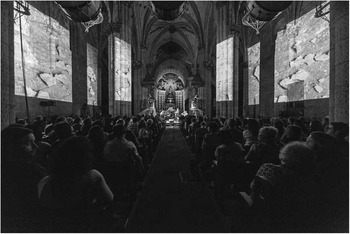
The performance/sonic project I take as exemplifying this viewpoint is entitled ‘Museum City (Cidade Museu)’. It was developed for the 2015 Portuguese festival ‘Jardins Efémeros’, a festival that joins local, national and international arts events and local communities in Viseu, a city in the north of Portugal (Figure 1). The 2015 festival was dedicated to the theme of ‘Light of the City’, where citizens were urged to think of light not as an absolute and total truth, but as a plurality – as the result of a combination of different colours.Footnote 1
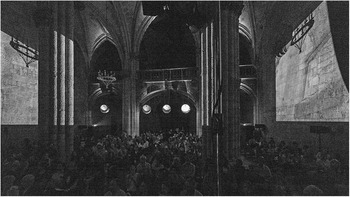
‘Museum City’: musicians and wall projection at the final performance, July 2015 (http://jardinsefemeros.pt/eventos/cidade-museu). Photo: Fernando Carqueja.

‘Museum City’ can be situated on the border of conceptual, performance, intermedia and digital arts practices, an artistic interstice which Douglas Kahn and Brandon LaBelle see as embracing sound installation, site-specific and public sound works (Kahn Reference Kahn1999; LaBelle Reference LaBelle2006), and indeed ‘Museum City’ has facets of all of these. Georgina Born refers to this particular artistic space as the third lineage, which she associates with soundscape composition and sound art, but also with live and experimental computer music, and mainly with sound installation, site-specific and public sound works, where a different conception of space in/and music is presented, one that radically departs from the Euclidean orientation of pitch space and timbre space (Born Reference Born2013: 14–15). In this third lineage,
space moves out beyond the musical or sound object to encompass ‘exterior’ spatialities: the spatiliaties configured by the physical, technological and/or social dimension of the performance event. (Ibid: 16)
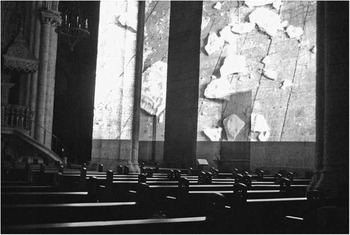
‘Museum City’ falls into Born’s third lineage as it involved six distinct sites in Viseu, five of these being culturally, aurally and sonically embraced at a preparatory stage of the project, during which four artists explored – through improvisatory performative and recording actions – the sonic properties of each of five selected sites. This preparatory stage informed the design for a technological and social dimension of a final, different performance space – the cathedral of the city of Viseu. The fact that three of the involved artists were Portuguese, one from the city of Viseu, meant that there was a particularly close connection to the sites and their cultural significance in a local context. ‘Museum City’, a highly collaborative work conceived for a festival of citizens, particularly emphasised ideas of space as multiple and constellatory; it moved beyond sound itself to embrace notions of participation, interactivity, collaboration and community. This was certainly true in the way the artists reconfigured the traditional division of labour between composer and performer, as the artists were all (to some degree) composers, performers, computer programmers, sound recordists and designers (Figure 2).
‘Museum City’: wall projection of videos at the final performance, July 2015 (http://jardinsefemeros.pt/eventos/cidade-museu). Photo: Pedro Rebelo.

I will describe the six physical sites that were used in more detail in section 3.1 below, but first I point to a further distinction with regards to the orchestration of space, or the understanding of space in/and music, as elaborated by Born. Whereas Born’s first distinction includes events that focus on the performance space or situation, the second distinction includes events that encompass the wider sounding environment or acoustic ecology and listeners attentive to a specific site or place.Footnote 2 The third distinction Born makes with regards to orchestration of space includes those events that, by means of digital technologies, ‘configure several simultaneous and shifting locations or virtual spatialities’ (Born Reference Born2013: 16). The work ‘Museum City’ plays with the orchestration of space in multiple ways, being on one level very much focused on a particular performance space (the cathedral where the final performance took place), while also feeding the overall artistic concept off the wider acoustic ecology of the five specifically selected sites and their resonant sonic properties. The final form of the work attended to a spectrum between the space of sonic performance practice and, by engaging with local sites of the city and with objects in those sites, ‘the space of everyday, “found”, designed or technologically enhanced sonic environments’ (Born Reference Born2013: 16–17). At the heart of ‘Museum City’ was the notion of the everyday, as five physical sites were selected specifically according to their ordinary meaning for local inhabitants of the city of Viseu, as well as for their sonic properties, which were of musical interest to the artists. As ‘Museum City’ was made for a festival of a specific local community, the inherent social, ethical and political matters formed a necessary part of the conception of the work.
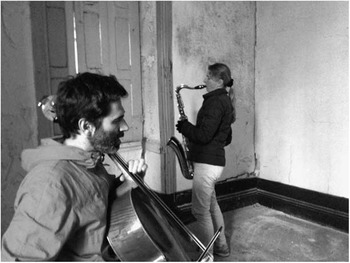
In preparation for a final performance of the work, which took place in the local cathedral (seating over 800 people), three musicians (Pedro Rebelo, piano/electronics; Ricardo Jacinto, cello/electronics; and Franziska Schroeder, saxophones) explored, through improvisatory musical actions, the acoustic and sound characteristics of five derelict sites located in and around Viseu. A visual artist, André Cepeda, conducted his own photographic exploration of the sites in parallel. The five sites had been chosen according to their immanent transitionality, that is, all spaces were either derelict and/or about to undergo major changes in their architectural, and thus sonic, make-up. Such spaces undergoing architectural transitioning were of particular interest to the artists and to the festival, as it allowed conceptual room for capturing aural memories while creating a narrative for the piece that could simultaneously engender memories (albeit highly subjective ones) of these transitional spaces, and allowed the artists to produce a kind of frozen aural picture of a specific moment in time.
3.1. Developing ‘Museum City’
In the development stage for ‘Museum City’, audio recordings of improvised live instrumental performance in each of the five chosen derelict sites in the city of Viseu were captured and later underwent a process of iterative convolution. This process multiplied the spectrum of the original instrumental recordings with the impulse responses of the site in which the recording took place; by doing this iteratively, the instrumental articulation of the original recording gradually gives way to the natural resonances of each site as activated by the instruments. In this way, each space becomes described through its sonic/harmonic characteristics. Sound, in echoing throughout each space, defines each site from a multiplicity of perspectives and spatial locations, since each space is, as Brandon LaBelle has argued, here (close to the sound’s source) and also there (along the trajectory that the sound travels), and what we hear close to the sound source is always ‘more than a single sound and its source, but rather a spatial event’ (LaBelle Reference LaBelle2006: x).
During the preparatory stage, the photography artist Cepeda captured visual details of each space and the musicians’ performative and improvisatory engagement within each site.
The five sites in ‘Museum City’ were:
-
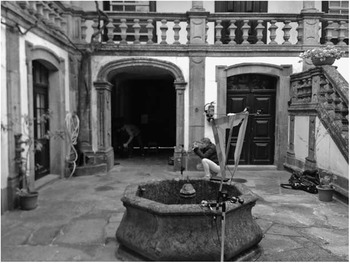
1. An old mansion home that belonged to the Portuguese national road services (called ‘Casa Pais’), which had been sold to a hotel developer who will be transforming the mansion into a five-star hotel (Figure 3). The mansion consisted of several beautiful stone staircases, leading up to two floors of offices, and a courtyard with a water fountain, which was overlooked by stone balconies on each of the two floors. The materials were mostly stone and there were some internal facing windows and rooms.
-
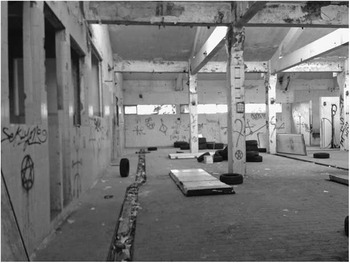
2. A former slaughterhouse, which had been derelict for some time, and which had no roof and hardly any windows (Figure 4). It consisted of many corridors (abattoirs), some tiled walls with several concrete slabs and walls, as well as discarded rubber tyres and surplus plastic materials covered in a lot of dust. A carcass of a deceased cat further emphasised the abandoned nature of this space.
-
3. An abandoned music hall (the old Orfeão) with (now) precarious wooden floors and exposed wooden walls, a derelict theatre stage set in an alcove plus several wooden doors and windows that were still intact. At the back of the hall were remains of the previous lavatories, with a few of the latrines still working.
-
4. A three-storey family house with its grounds in Rua Silva Gaio, an abandoned domestic dwelling which had already found a new buyer by the time of the July 2015 festival (Figure 5). Most of the materials here were wood and glass, with wooden staircases leading up to each floor and pigeons nesting in many of the house’s small, ruined and abandoned rooms.
-
5. The building of the local wine federation, which had long been abandoned and was on the market for sale. As one can imagine, there were huge warehouse and storage spaces over two floors, filled with (mostly) empty wine bottles covered in dust, wooden wine barrels, and also some tables and chairs that had been discarded in situ. Gigantic wine tanks with over 1000 litre filling capacity built into the walls were an exciting sonic feature of this site.
‘Museum City’: preparatory stage of recording in the former Portuguese national road services offices, Easter 2015. Photo: Pedro Rebelo.

‘Museum City’: preparatory stage of recording in the local, abandoned former slaughterhouse, Easter 2015 (https://pedrorebelo.wordpress.com/2015/07/04/cidade-museu-museum-city). Photo: Pedro Rebelo.

‘Museum City’: preparatory stage of recording in a local abandoned house, Easter 2015 (https://pedrorebelo.wordpress.com/2015/07/04/cidade-museu-museum-city). Photo: Pedro Rebelo.

This preparatory work of visiting each of the five abandoned sites, spending days improvising acoustic musical materials and listening to the sites’ intrinsic acoustic responses, and finally capturing and then exposing the natural resonances of each site through convolution processes, allowed the artists to explore the intimate relations in the five spaces and the sonic-musical connection between the five spaces.
The working processes involved, concerned with the relational, spatial and temporal nature of sound in each site, are reminiscent of Brandon LaBelle’s idea of sound as intrinsically relational. According to LaBelle, at the core of sound art is the
activation of the existing relation between sound and space … Sound and space converse by multiplying and expanding the point of attention, or the source of a sound: the materiality of a given room shapes the contour of sound, moulding it according to reflection and absorption, reverberation and diffraction. (LaBelle Reference LaBelle2006: ix, xi)
In this reading, ‘Museum City’, experienced from the subjective, embodied and social locations of four different artists, was concerned with the sonic-spatial politics of the urban conditions and the everyday objects and meanings of each site. The intention was, by means of the activation and capture of these derelict spaces, to develop an audiovisual narrative that could reflect architectures, inherent memories and stories, as well as individual listening experiences, while creating a sense of place through sounds and images. An audiovisual story was crafted into an overall 50-minute final performance event in the main cathedral of Viseu. The images derived from the photographs, taken in each of the five derelict spaces, were projected onto the stone walls of the cathedral during the final performance in order to illuminate the performance space, while also exposing details, symbols, lines and textures, so characteristic of each derelict space.
3.2. Performing ‘Museum City’
The final performance of ‘Museum City’ constituted a fairly traditional setting, with an elevated stage area built in front of an 800-seat audience in a Catholic cathedral. Although the artists’ concerns with everyday objects of the five derelict sites and their sonic narrative potential were integral in developing the work, in order to produce a ‘final product’ (a live performance for an audience) the artists felt the need to develop a firmer structure – a compositional framework that was flexible enough to enable improvisatory approaches during the final, live performance. Enabling improvisation within a slightly more set compositional structure was essential in order to guide the final performance, as it allowed better alignment of video and audio aspects, enabling the videographer, technicians, lighting designers and musicians to communicate more easily. Improvisation was an important component of the final performance of ‘Museum City’, as it had been integral in the development stage, that is, in the recordings and activation of the existing relations between sounds and the five derelict spaces. Further creative decisions involved the overlaying of multiple stories/narrative planes to represent the sonic characteristics of each site, while also taking into account another narrative layer, that of performing in and performing the opulent cathedral itself.
Local cultural artefacts – traditional Portuguese bass drums associated with local festivities – were suspended at the back of the cathedral for the final performance (Figure 6). These bass drums served both as a visual counterpoint to the frontal optical stimulus of the three performing musicians and as an acoustic counterpoint to the spatial resonances of the five derelict sites, as the drums, through an electro-acoustic device, ‘played’ rhythms which were derived by slowing down the impulse responses of the derelict sites, thus bringing acoustic reflections of the abandoned spaces into the cathedral performance.
‘Museum City’: final performance in July 2015, showing the suspended drums at the back of the cathedral. Photo: Fernando Carqueja.

In line with Born’s third lineage, space in ‘Museum City’ was conceived as multiple, as mediated and mediating – not only because five abandoned sites were recorded and performed through sound, but also because the artists’ conceptual approach of linking each space to a suspended drum in the final performance space, and by selecting (composing) musical materials that were closely linked to each space. In other words, the specific resonant frequencies of each of the five derelict spaces informed the loose compositional framework for the final performance – an improvisatory approach nested within a loosely conceived compositional framework. The final live performance made use of computer music elements based on site-specific sounds, live improvised compositional materials played by three musicians and projected photographic materials of each of the five abandoned sites. It exposed many contrasting elements, including the juxtaposition between the splendour and opulence of the cathedral and the five derelict spaces spread across the city of Viseu.
By interweaving sites with sounds and sounds with sites, ‘Museum City’ is most closely associated with the viewpoint of sonic narrative of space; however, it is also connected to the other three categories, which I will now examine, beginning with sonic activism.
4. SONIC ACTIVISM
I now turn to the second of my proposed viewpoints, that of sonic activism, which entails the idea of a public site, perceived to be politically or culturally meaningful (such as a church or a significant town square), being infiltrated with, or appropriated by sonic activities in order to voice political messages. In sonic activism practitioners embed themselves in a place to shape political narratives using sound. Sonic activism has certain parallels, or indeed might be read as a subset of what Goodman has explored at length under the notion of ‘Sonic Warfare’ (Goodman Reference Goodman2010). Goodman specifically constructs a concept of a ‘politics of frequency’ that questions the underlying vibrations, rhythms and codes that affect bodies. He defines sonic warfare as ‘the use of force, both seductive and violent, abstract and physical, via a range of acoustic machines (biotechnical, social, cultural, artistic, conceptual), to modulate the physical, affective, and libidinal dynamics of populations, of bodies, of crowds’ (Goodman Reference Goodman2010: 10).
It might be worth noting that both sonic activism and sonic warfare, due to their inherent relations with noise, could be seen to have traces in experimental music, specifically the sonic avant-garde movements fronted by Luigi Russolo’s Futurist manifesto (Russolo 1913/Reference Russolo2004), which heralded noise as something radical and as that which, by means of its glorification of dissonant industrial machinery sounds, introduced much needed new energies into a decaying bourgeois classical music trend. Following the Futurists, Attali suggested that noise, before it was further developed in information theory,
had always been experienced as destruction, disorder, dirt, pollution, an aggression against the code-structuring messages. In all cultures, it has been associated with the idea of the weapon, blasphemy, plague. (Attali Reference Attali1985: 27)
For the purpose of my discussion, I understand sonic activism as bearing slightly less violent connotations, where physical violence is not the primary object (as in the bin Laden or Hitler examples referred to in footnote),Footnote 3 but rather where sound is used to voice a specific narrative, and used as an affective, mobilising, cultural weapon, as opposed to an acoustic weapon intended to kill. However, I certainly acknowledge Goodman’s description of the potentially deadly effect of noise when he says that ‘noise, like anything else that touches you, can be a source of both pleasure and pain and that beyond a certain limit, it becomes an immaterial weapon of death’ (Goodman Reference Goodman2010: 10). Sonic activism can result in aural and emotional assaults (depending on which side of the political fence one observes from) – a ‘politics of frequency’ being employed to monopolise physical spaces and to modulate physical and affective dynamics of populations within those sites.
To mind come coordinated parades of ‘sound trucks’ as used in Japan by right-wing activists (also referred to as ‘rightist sonic activism’ by Hankins and Stevens Reference Hankins and Stevens2013). Sound here is used to trace boundaries of space, in order to produce ethno-nationalist sentiments; thus, through sound and movement, activists move through the streets of Japan, creating or delineating emotionally powerful territorial boundaries. They put political messages across that bear intimidating aural charges.
Other forms of sonic activism can be seen in the ways the Brazilian special police unit of the military police of Rio de Janeiro, the Batalhão de Operações Policiais Especiais (BOPE), has been seen to enter some of Rio’s shanty towns (favelas) with their fleet of armoured fighting vehicles (also known as ‘Pacificador – Peacemaker’ or ‘Caveirão – Big Skull’), while playing very loud funk carioca music. In a move to ‘pacify’ the favelas, sound, particularly played at very high volume, is used to intimidate and frighten the favela’s population. Murray Schafer once stated that ‘noise equals power; it induces fear’ (Schafer Reference Schafer1994: 50). Sound imposed onto a particular territory (the living places of the favelados) thus becomes one of the weapons employed by the BOPE.
‘Museum City’, although placed more concretely under the above category of sonic narrative of space, has clear linkages with sonic activism in that one could easily argue that musicians bringing their instruments and digital devices – alongside a highly elaborate 8-channel loudspeaker system – and suspended bass drums into a sacred place (the cathedral of Viseu) is a way of ‘imposing’ onto a site. (Indeed, lengthy discussions with the local priest and archbishop of the diocese of Viseu took place leading up to the performance in order to gain access privileges to suspend the five bass drums from the rather fragile back choir gallery of the cathedral.)
And finally, one might see traces of sonic activism in the political protest songs and performances by the Russian feminist punk/rock group Pussy Riot. The band’s activities are sometimes referred to as ‘dissident art’ and understood as civic performative activity, voicing anger and frustration against perceived oppression by the Russian political system, which, under the leadership of President Vladimir Putin, has been criticised many times for the violation of basic human rights, discrimination against women, as well as intrusion on civil and political liberties. Pussy Riot stage mostly unauthorised, provocative guerrilla performances, often involving blasphemous lyrics, in unusual civic spaces, such as churches or public squares. In this type of sonic activism, sites are selected according to their political significance (churches), and song is used for voicing political messages (‘Virgin Mary, Mother of God, banish Putin’), as in Pussy Riot’s song ‘Punk Prayer’Footnote 4 or ‘Putin ignites the fires of revolution. He was bored and frightened people in silence’ as in the song ‘Putin Lights up the Fires’.Footnote 5
Pussy Riot’s performance in Moscow’s Cathedral of Christ the Saviour, located very close to the Kremlin, is part of a series of actions protesting against Putin and particularly against the relationship between church and state. Pussy Riot are known to have selected other, more controversial, performance sites, including the roof of a detention centre where anti-Putin protesters were held, as well as Moscow’s Red Square.
Stone-Davis writes, in an article on worldmaking and worldbreaking in Pussy Riot, how the context and sites are so integral to their performances, with the band symbolically disrupting ‘the “normality” of the chosen location and [attempting] to alter the usual mode of engagement that onlookers have with it’ (Stone-Davis Reference Stone-Davis2015: 108).
In short, in sonic activism, sites that are politically or culturally perceived as meaningful or significant become occupied or filled with sound – often reaching levels closer to noise and thus frightening, shocking or upsetting inhabitants in the respective sites. Sound is used in order to rewire the body and its sonic sensations, that is as Goodman describes it, ‘to modulate the physical, affective, and libidinal dynamics’ of crowds (Goodman Reference Goodman2010: 10). Sonic activities are designed and used in order to voice political discontent (as in Pussy Riot), and often, to intimidate (as in the favela example). The site becomes appropriated through sound, with sound being imposed onto the space as a cultural-political weapon, with no particular direct concern for a site’s architectural make-up or meaning. There tends to be an overt delineation between those who produce and project sounds and those who (often involuntarily) receive and listen.
Thus, in sonic activism, through an enactment of power, the performing of spatial boundaries and an assertion of identities, sound is used as means of social regulation and control.Footnote 6
5. SONIC PRESERVATION
In contrast, in sonic preservation, a real concern for the architectural, emotional or social meaning of the site is highly relevant. Whereas in sonic activism sounds are created for the purpose of political and cultural subversion, in sonic preservation artists tend to use sound recording as a primary means to preserve a particular space and its sonic properties, and with it preserve what Marques and De Araújo refer to as ‘an acoustic memory of habitats and ecosystems’ (Marques and De Araújo Reference Marques and De Araújo2014: 3). Sound is not produced, appropriated or made specifically for, nor imposed onto, a culturally or politically meaningful site, but is extracted as an essential feature of an environment, with the values, associations and memories that humans give to these sounds being an essential focus. There is a real concern with the psychological, physiological and at times even pathological impact that soundscapes can have on humans. The work of sound artist John Levack Drever comes to mind, whose work and thinking around acoustic ecology take evident influences from Murray Schafer’s seminal work The Soundscape: Our Sonic Environment and the Tuning of the World (Schafer Reference Schafer1977) and Schafer’s research group the World Soundscape Project (Schafer Reference Schafer2016).
‘Museum City’ bears resemblances to the idea of sonic preservation, in that the five chosen derelict spaces in Viseu were somewhat preserved and archived by means of recordings of improvised acoustic sounds of the three musicians. However, the sounds that were captured as part of this recording stage were later mixed and re-appropriated for the final performance of the work, and thus became less ‘authentic’ or less recognisable. The final performance of ‘Museum City’ in the sixth space, the opulent cathedral of Viseu, made use of selected improvised materials of the five abandoned spaces in order to sonically represent the intimate relations of the five sites selected by the musicians.
However, in contrast to most works that align with sonic preservation in my argument here, the sonic materials in ‘Museum City’ were not intended as a way of preserving a site or of creating an ‘accurate’ acoustic memory of the sonic make-up of a place, but rather the original sounds of each site in ‘Museum City’ were processed and changed significantly to suit a creative purpose.
Also, in sonic preservation the focus tends to be on the outside environment (the italics acknowledge that this might not be exclusively so), which is seen as both culturally determined and, as a result, as determining culture. Acoustic ecologists are partly preoccupied with ‘endangered’ sounds, with probing questions such as, what are the sounds that we might potentially lose in the future, with environments constantly changing? Drever’s sonic preservation work, specifically his impressive recordings in national parks, particularly in south Devon’s Dartmoor National Park, has been detailed in his publication ‘Sounding Dartmoor: A case study on the soundscapes of rural England at the opening of the 21st Century’ (Drever Reference Drever2002). Drever is interested in understanding whether soundscapes of a particular site should be seen as an integral part of our heritage, in the same light that we think about preserving historic buildings (BBC Worldservice Interview 2009).
Also worth mentioning are the works by sound artist Peter Cusack, in particular his 2012 sonic preservation work that documents sounds of ‘dangerous’ (not necessarily ‘endangered’) places, including the Chernobyl exclusion zone in the Ukraine, the Caspian oil fields in Azerbaijan, and the Tigris and Euphrates river valleys in South Eastern Turkey.Footnote 7
When thinking of sonic preservation, I am particularly drawn to the highly sensuous sound recordings by Steve Feld and his method of what has come to be termed ‘anthropology of sound’ – a representation of a culture in and through sound, both ‘as a pleasure and an intellectual provocation’ (Feld Reference Feld2004), something that allows one’s ears to come close to the people that are being recorded. In particular, Feld’s recordings in the rainforests of the Kaluli people in Papa New Guinea, entitled Bosavi (2001a) and Rainforest Soundwalks (2001b), clearly fall under my category of sonic preservation, with its concern for the architectural, emotional or sociocultural meaning of a place and its people. Specifically, through Feld’s ethnographic work, we come to understand the notion of ‘acoustic epistemology’ (acoustemology), or ‘acoustic knowing’, as a central aspect of the experience of the Kaluli people. ‘Acoustic knowing’ is an experiential knowledge based on the Kaluli’s relations between sound, space and place (Feld Reference Feld1996). Sounds, and the sensual bodily experience of sound, are the Kaluli’s way of knowing; they are integral and constitutive of their environment, their collective experience of space and time, as well as of their rituals, emotions and social relations.
In short, in sonic preservation, sites and cultures become preserved in a process of creating an acoustic memory of the sonic make-up of places and people. The sites tend to be selected in accordance with whether these might be meaningful for natural or cultural heritage purposes. Sounds are extracted rather than imposed; sounds are considered as culturally and politically meaningful as they appear in a particular site and within a specific culture. One might say that the chosen site is not so much appropriated through the use of sound, as in the Brazilian favela example above, but rather that the site’s meaning and significance are selected and interpreted by means of sound recordings, often carried out by one single artist rather than by a community of people. The sonic make-up of the site’s architecture, as heard by the artist, can become the defining characteristics of place. Place and culture become represented, and later remembered by others, through recorded sounds, selected as part of a highly personal listening experience and choice by one artist.
6. SONIC PARTICIPATORY ACTION
The often highly personalised representation through sound recordings in sonic preservation becomes more of a matter for communities in the next category, that of sonic participatory action. Here, one of the main foci is to engage a variety of people, usually from within a specifically selected community, through sound recordings and listening, in questioning and re-examining their immediate environment via sonic activities. The communities often tend to be less familiar with (or interested in) the idea of listening to sounds and their particular places in their everyday life. Sound thus becomes a medium for enabling community action and the telling of personal stories, carried out in meaningful spaces for these particular communities.
Hand in hand with sonic participatory action goes a fascination with the ‘local’ as a site of action, of tension, resistance and human living, but also the ‘local’ as somewhat representing tradition (as Jessop et al. (Reference Jessop, Brenner and Jones2008) has argued). There can be a sense of nostalgia of places, of memories of places past or changed, and a melancholic preoccupation with sounds disappeared, forgotten or about to disappear.
The project ‘Sounds of the City’,Footnote 8 carried out in Belfast and Rio de Janeiro, is one such project where everyday relationships of sound and place were teased out and captured, allowing people to understand a different facet of their environment or to question – and, at times, revive – their memories of places through the experience of listening. It must be noted that the communities involved in ‘Sounds of the City’ were themselves integral in setting the creative agenda, deciding what sounds to record and when, and, indeed, they were responsible for producing collaborative research as part of their involvement. This type of research, carried out by a community of people rather than by a single author, is a model that was made prominent through the work of Brazilian ethnomusicologist Samuel Araújo and his work in ‘Musicultura’ (Rebelo Reference Rebelo2014), a model based on the pedagogical tradition of Paulo Freire (Reference Freire1993). Rebelo further referred to such a collaborative way of researching as ‘distributed production’ and ‘horizontal decision making’, with different tasks being self-assigned amongst participants (Rebelo Reference Rebelo2014).
These two participatory sonic art projects, ‘Sounds of the City, Belfast’ and ‘Som da Maré’,Footnote 9 build on a mix of methodologies for engaging communities through reflecting on everyday relationships between sound and places that are meaningful for the involved community members. The methodologies employed aim to engage participants in activities that enable the articulation and awareness of their listening experiences. Sonic participatory action is here enabled through sound walks, field recording, sound diaries, annotation of photographs with sounds and informal interviews. In both the UK and the Brazil project, a team of sonic artists worked over several months with specific communities. In Belfast these were a catholic and a protestant community, and in Brazil the team worked with a community in Maré, one of the largest clusters of favelas in Rio de Janeiro. The Rio project ran in partnership with a museum situated within the favela, the ‘Museu da Maré’. The main aim was to tease out sonic participatory action, using listening as a way of linking daily life, identity and memory, sounds of places or events and people’s personal stories. Sounds were captured through workshops that represented sonic materials including sounds from Belfast’s industrial heritage (the building of the Titanic and associated factory sounds recalled by those working in the shipyards at that time) and from local family homes, while in Rio de Janeiro the sonic material was informed by the exploration of the relationships between sound and the everyday. In the Rio project, sonic participatory action resulted in using sound materials including street vendor calls, children playing outside, sounds of the favela’s football pitch, and rain water entering poorly built houses.
Both projects ended in a shared creation, presented as installations with themes focusing on the relationship between sound and memory, sound and place, and the documentation of everyday personal auditory experience. The final design of both exhibitions was rooted in the experiences of the participants and enabled by the artists’ contributions.
It is not difficult to see links between sonic participatory action and sonic preservation, in that people engage, even if sometimes initially unknowingly, in the preservation of sounds and sonic memories. However, it is desirable, and central to the idea of sonic participatory action, that authorship is moved from a single author (as tends to be the case in sonic preservation) to become distributed amongst a whole community. Artists working in the area of sonic participatory action celebrate notions of horizontality, with the community inputting in a distributed fashion, celebrating their sites, places and the everyday meaningful objects and stories belonging to them.
‘Museum City’ exemplifies work marked by multiple authorships, as it engaged a variety of people, not only the artists and technicians, but also the larger community of the city of Viseu. In this way ‘Museum City’ also bears resemblances to my proposed viewpoint of sonic participatory action, in that it was conceived in a collaborative fashion, with the artists performing in a multiplicity of spaces and performing various spaces themselves. ‘Museum City’ most certainly displayed a fascination with the ‘local’ as a site of action, of tension and human living and abandon.
In the process of recording in the abandoned five sites, many stories were told by locals who had known the original sites, bringing a sense of nostalgia of places and a melancholic preoccupation with sounds forgotten.
7. FINAL REMARKS
I have proposed four different viewpoints that allow us to reflect on how places tell stories, as well as on how practitioners embed themselves in a space in order to shape cultural, social and/or political narratives through the use of sound.
The four viewpoints shed light on ways in which we might understand space in/and sound, allowing us to examine different ways of thinking about how sonic activities are used in particular sites, or how a specific place in turn might incite sonic action and shape spatial and cultural narratives. The four proposed viewpoints trace elements of Georgina Born’s ‘social phenomenology of music and sound’, building on the notion of her four planes of interconnected and inherently non-linear social mediation, which embrace the intimate microsocialities, that is, the social and corporeal as well as institutional interactions, inherent in any sonic event.
Although I have focused in greater detail on the viewpoint of Sonic Narratives of Space, as it allowed me to discuss and reflect upon the performative project ‘Museum City’, it has become clear that the work showed elements of each of the four viewpoints.
In discussing ‘Museum City’ in detail, I have aligned it with Born’s proposal for a third lineage that provides a different understanding of space in/and music. This is a proposal for conceiving space as multiple, as mediated and mediating, where a different conception of space is presented.
In ‘Museum City’, the recorded sounds of the five abandoned spaces and the overall final improvised musical materials were conceived for their capacity to catalyse and to augment relational predispositions of lived, unlived and deserted spaces. The artists moved their intention from a single object of attention towards a multiplicity of viewpoints, from performing in a multiplicity of spaces, to performing different spaces themselves. ‘Museum City’ attempted the creation of a poetics of space, using sounds as conduits for spatial experiences, with the intention to bestow a capacity both to compound and to orchestrate in creative ways the spatial affordances of social life of the collective community of Viseu.