Introduction
Urogenital schistosomiasis is a lifetime disease acquired primarily in childhood by exposure to Schistosoma haematobium, one of the two main schistosomes transmitted in Africa (WHO, 2009). Approximately 120 million people in Africa are estimated to be infected with S. haematobium, which causes pathology in the urinary and genital tract. Urogenital schistosomiasis (US) is predominantly caused by S. haematobium and has been estimated by the World Health Organization (WHO) to affect up to 45 million women living in sub-Saharan Africa (WHO, 2009). Since the urinary and genital tracts are almost always simultaneously affected, the WHO has recently renamed this disease urogenital schistosomiasis (US), with detection of S. haematobium in the urine or genital tract determining diagnosis (WHO, 2009).
Chronic female genital-tract inflammation caused by S. haematobium has been associated with vaginal itching and discharge (Kjetland et al., Reference Kjetland, Kurewa, Ndhlovu, Midzi, Gwanzura, Mason, Gomo, Sandvik, Mduluza, Friis and Gundersen2008), post-coital bleeding (Poggensee et al., Reference Poggensee, Kiwelu, Weger, Goppner, Diedrich, Krantz and Feldmeier2000), genitopelvic discomfort (Leutscher et al., Reference Leutscher, Ramarokoto, Hoffmann, Jensen, Ramaniraka, Randrianasolo, Raharisolo, Migliani and Christensen2008), marital discord (Kjetland et al., Reference Kjetland, Poggensee, Helling-Giese, Richter, Sjaastad, Chitsulo, Kumwenda, Gundersen, Krantz and Feldmeier1996) and infertility (Poggensee et al., Reference Poggensee, Sahebali, Van Marck, Swai, Krantz and Feldmeier2001; Kjetland et al., Reference Kjetland, Ndhlovu, Gomo, Mduluza, Midzi, Gwanzura, Mason, Sandvik, Friis and Gundersen2006). In a number of clinical studies of women living in areas where S. haematobium is endemic, Schistosoma eggs have often been observed to be associated with characteristic sandy patch lesions on the cervix and vagina (Kjetland et al., Reference Kjetland, Poggensee, Helling-Giese, Richter, Sjaastad, Chitsulo, Kumwenda, Gundersen, Krantz and Feldmeier1996, Reference Kjetland, Ndhlovu, Mduluza, Gomo, Gwanzura, Mason, Kurewa, Midzi, Friis and Gundersen2005; Poggensee et al., Reference Poggensee, Kiwelu, Weger, Goppner, Diedrich, Krantz and Feldmeier2000, Reference Poggensee, Sahebali, Van Marck, Swai, Krantz and Feldmeier2001; Swai et al., Reference Swai, Poggensee, Mtweve and Krantz2006). Genital S. haematobium infection has been associated with the human immunodeficiency virus (HIV) infection in one cross-sectional study (Kjetland et al., Reference Kjetland, Ndhlovu, Gomo, Mduluza, Midzi, Gwanzura, Mason, Sandvik, Friis and Gundersen2006) and it has been postulated to be a risk factor for HIV infection (Feldmeier et al., Reference Feldmeier, Krantz and Poggensee1994; Hotez et al., Reference Hotez, Fenwick and Kjetland2009).
Clinically apparent vulval, vaginal and cervical schistosomiasis are common gynaecological findings in areas where S. haematobium is prevalent (Friedberg, et al., Reference Friedberg, Berry and Schneider1991), with urogenital schistosomiasis affecting up to 50.0% of women in highly endemic areas (Kjetland et al., Reference Kjetland, Ndhlovu, Gomo, Mduluza, Midzi, Gwanzura, Mason, Sandvik, Friis and Gundersen2006). Heavy infection with S. mansoni has also been shown to contribute to anaemia in pregnant women in an area in Tanzania (Ajanga et al., Reference Ajanga, Lwambo, Blair, Nyandindi, Fenwick and Brooker2006). If egg-antigen-inflammatory processes contribute to poor pregnancy outcomes, then treatment during pregnancy could be too late, requiring health initiatives to keep women of reproductive age (16–45 years) free from infection (Friedman et al., Reference Friedman, Priya, Hemal, Olds and Kurtis2007).
Urogenital schistosomiasis has been neglected during a period when considerable progress has been achieved in almost all other fields of schistosomiasis research. Community-based epidemiological studies on the patho-physiological changes caused by S. haematobium infections have not been conducted specifically on women of reproductive age (16–45 years). In the Coast Province of Kenya, S. haematobium is prevalent (between 2.0 and 75.0%) in school-age children (Brooker et al., Reference Brooker, Kabatereine, Gyapong, Stothard and Utzinger2009; Kihara et al., Reference Kihara, Mwandawiro, Waweru, Gitonga and Brooker2011). We conducted a study on women of childbearing age in five villages (known for their high prevalence of infection of S. haematobium) in Kwale County: Lutsangani, Mienzeni, Mwachinga, Mwaluphamba and Rabai. None of the women had received treatment for at least 4 years prior to enrolment in this study.
The objective of this study was to estimate the prevalence and intensity of infection with S. haematobium in women of reproductive age (16–45 years) and to investigate whether S. haematobium had any effect on kidney function.
Materials and methods
Sampling in village sites
A cross-sectional study was conducted in Kwale County, Coast Province, located in the south-eastern corner of Kenya, bordering Tanzania to the south and the Indian Ocean to the east (latitude 3.558°–4.675°S and longitude 38.452°–39.663°E). Specific grid references for the five villages selected for the study are: Lutsangani (latitude 4.06 201; longitude 39.51 173), Mienzeni (latitude 3.98 453; longitude 39.4872), Mwachinga (latitude 4.1268; longitude 39.42 398), Mwaluphamba (latitude 4.22 243; longitude 39.36 777) and Rabai (latitude 3.98 453; longitude 39.56 329). Kwale County covers an area of 8295 km2, with an approximate population of 496,133 (Kenya National Bureau of Statistics, 2009). Kwale County experiences continuous rain almost throughout the year in the higher parts of the region. Most inhabitants are subsistence farmers. The arid areas have several dams and seasonal streams that are good breeding sites for snails − the intermediate host of schistosomiasis.
Between September and November 2011, women of reproductive age (16–45 years) were recruited to the study, and classified as pregnant, breast feeding or non-pregnant at the time of sample collection. Villages were selected primarily for their high S. haematobium prevalence (>40.0%), as determined by a study conducted by Kihara et al. (Reference Kihara, Mwandawiro, Waweru, Gitonga and Brooker2011) in schoolchildren. All participants were sensitized during a public Baraza (group gathering), where details of the study were explained in the local language by research team members. All women who agreed to take part in the study were asked to provide written informed consent or to place a mark (X) on the consent form. Permission to conduct the study was obtained from the District Medical Officers and clinicians/nurses stationed at participating dispensaries and health centres. Women diagnosed with urogenital schistosomiasis, if not pregnant, received free treatment immediately. Women who were pregnant and diagnosed positive for S. haematobium were treated, free of charge, immediately after post-term birth (after 40 weeks).
Parasitological procedures
The intensity of eggs in urine was examined using a nuclear pore filtration technique, as described by Kahama et al. (Reference Kahama, Kremsner, Van dam and Deelder1998). Samples were collected between 10.00 and 14.00 h. A duplicate 10 ml aliquot of urine was filtered through 13 mm diameter, 12 μm pore size polycarbonate filters (SPI supplies, West Chester, Pennsylvania, USA). The filter was placed on a labelled slide and examined under a microscope within 6 h. The mean counts of the two filters were recorded and expressed as eggs per 10 ml of urine.
The presence or absence of soil-transmitted helminth (STH) (ascariasis, trichuriasis and hookworm infections) ova in stools was determined by the Kato–Katz method (Katz et al., Reference Katz, Chaves and Pellegrino1972). A 41.7 mg stool smear was prepared using a sieve and a calibrated template. The smear was placed on to a glass slide and covered with glycerine-impregnated cellophane. This preparation was left to clear for a minimum of 45 min (Peters et al., Reference Peters, El Alamy, Warren and Mahmoud1980). To identify hookworm eggs, the sample was examined within 1 h of preparation.
Blood-stage malaria parasites were detected in blood smears using a Giemsa solution (10.0%) in buffered distilled or deionized water, pH 7.2. The stain was gently poured on to the slide or by use of a Pasteur pipette. The stain was allowed to work for 10 min before being gently flushed off the slide using drops of clean water. The slides were placed in a slide rack to drain and dry (film side down, making sure the film did not touch the rack). The slides were examined using a compound microscope at 100 × magnification. Malaria parasites were identified – demonstrating a deep red chromatin and pale purplish blue cytoplasm. A slide was determined to be negative if no malaria parasites were identified after counting against 200 white blood cells.
Venous blood samples were collected in unsequestrenated bottles at the same time as urine samples were collected for parasitological examination. Seven millilitres of blood were drawn from the veins of each subject: 2 ml of blood were placed in a sequestrenated vial and 5 ml in an unsequestrenated bottle (with no anticoagulant). Sequestrenated blood samples were placed into a cooler box with ice packs (at a temperature of about 8°C) until analysis in the laboratory within 2 h. Blood samples in the unsequestrenated bottles were allowed to clot and sera were collected by separation using a Pasteur pipette, for analysis in the laboratory.
Kidney function analysis
‘Kidney function tests’ is a collective term for a variety of individual tests and procedures used to evaluate how well the kidneys are functioning. Eggs of S. haematobium are found in the blood of infected individuals and are excreted via the kidneys into the bladder. Eggs of schistosomes have been found in many organs of the body of infected people, including kidneys, where they cause patho-physiological changes that can be diagnosed through testing urine or blood.
Samples were analysed using the Clinical Chemistry Auto Analyser Olympus AU640 (Olympus Diagnostica GmbH, Hamburg, Germany). This is a discrete, random-access clinical chemistry autoanalyser capable of performing a wide range of chemical tests, including urea and creatinine, in a single run. Methods for specific analytes were programmed and stored in the microprocessor of the instrument. The autoanalyser proportioned the required amount of reagent and sample using the reagent and sample probes, respectively. Reagent volumes were in the range of 50–300 μl and the sample volumes in the range of 2–20 μl. The various reactions occur in the reaction compartment of the instrument at 37°C. Urea was analysed using glutamate dehydrogenase (GLUDH). Blood urea nitrogen (BUN) reagent was used to measure the concentration of urea by an enzymatic rate method. In the reaction, urea was hydrolysed by urease to ammonia and carbon dioxide. Glutamate dehydrogenase (GLDH) catalysed the condensation of ammonia to glutamate with the concomitant oxidation of reduced β-nicotinamide adenine dinucleotide (NADH) to nicotinamide adenine dinucleotide (NAD+). The creatinine reagent (CREAT) was used to measure the creatinine concentration by a modified rate Jaffe method. In the reaction, creatinine combined with picrate in an alkaline solution to form a creatinine–picrate complex.
Data analysis
Generalized linear mixed-effect models (GLMM) were used to explore the impact of pregnancy status on the prevalence and intensity of infection of schistosomiasis in Kwale County, Coast Province, Kenya. Data were collected from a total cohort of 394 women of known pregnancy status (158 pregnant women and 236 non-pregnant women) in the Coast Province of Kenya. The GLMM allowed the prevalence and intensity of infection of schistosomiasis to vary between different areas (the random effect), but allowing any trend between pregnant and non-pregnant women (the fixed effect) to be identified. It allowed the impact of other variables to be adjusted for, such as host age, STH infection or malaria status. When examining the prevalence of infection, binomial regression analysis was used to account for the binomial character of the variable, i.e. either pregnant or non-pregnant. When examining intensity of infection, a negative binomial regression analysis was used to control for the non-normal (non-Gaussian) distribution of intensity of infection between individuals. Intensities of helminth infections are typically highly overdispersed: the minority of the human population harbour heavy infection and the majority have light infection or are uninfected. Such a dispersion can often reasonably be approximated by the negative binomial distribution.
Results
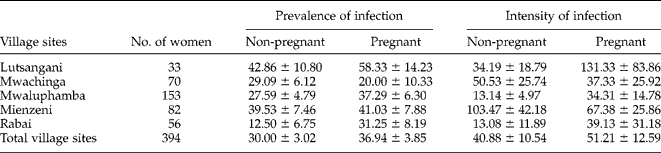
The prevalence and intensity of urinary schistosomiasis varies substantially between the different villages (table 1).
The prevalence (%) and intensity (eggs/10 ml urine) of infection with Schistosoma haematobium in non-pregnant and pregnant women from five villages in Kwale County, Kenya; mean values±SE (standard error).
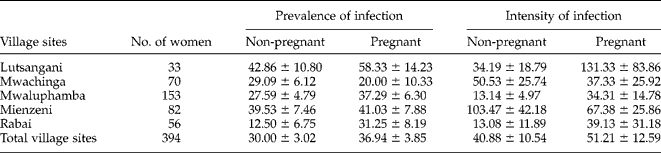
The prevalence of infection in pregnant women ranged from 20.0% in Mwachinga to 58.3% in Lutsangani (table 1). Correspondingly, the intensity of infection in pregnant women ranged from 34.3 eggs/10 ml in Mwaluphamba to 131.3/10 ml in Lutsangani, with 50 eggs/10 ml being the criterion for ‘high’ intensity of infection as set out by the WHO (1999). For non-pregnant women the prevalence of infection ranged from 12.5% in Rabai to 42.9% in Lutsangani, and the intensity of infection ranged from 13.1 eggs/10 ml in Rabai to 103.5 eggs/10 ml in Mienzeni.
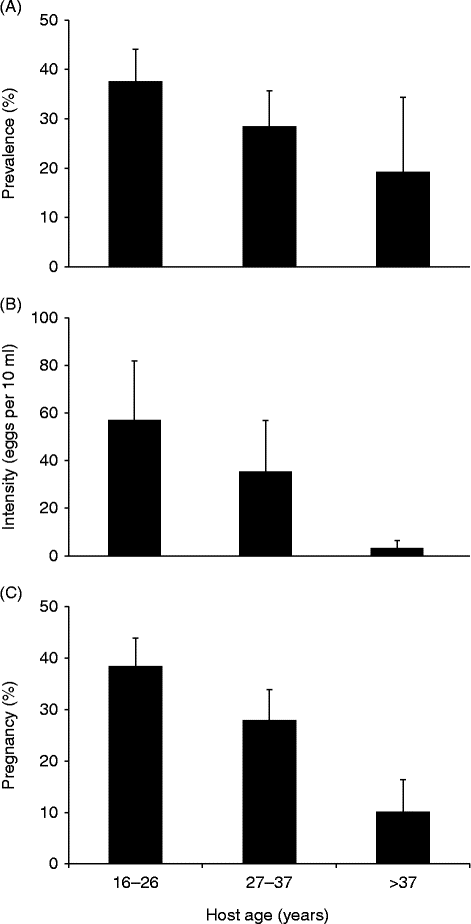
As in other studies, both the prevalence and the intensity of infection of urinary schistosomiasis peaks in late adolescence to young adulthood (in our case, 16- to 26-year-olds, although we did not have any younger adolescents in the sample, to observe whether infection would be higher in a younger group) and then declines in the 27- to 37-year-old age-group, and even further in the >37-year-old age-group (fig. 1). The proportion of pregnant women infected decreases with age, indicating that age is likely to be a confounding variable in that it correlates with both the dependent variable (S. haematobium infection) and the independent variable (pregnancy) (fig. 1). The GLMM was used to estimate the prevalence and the intensity of infection of schistosomiasis in pregnant and non-pregnant women, taking into account their age. Co-infections with either malaria (Plasmodium sp.) or STH was zero or very low (0.0% and 2.6%, respectively) and were excluded from analysis.
The prevalence (A) and intensity (B) of infection of women with urogenital schistosomiasis, and the proportion of pregnant women (C) in a cohort of women of reproductive age between 16 and 45 years; bars indicate the 95% confidence interval estimates.

The GLMM indicates that, on average, across all villages the prevalence and intensity of infection of S. haematobium was not statistically different between pregnant and non-pregnant women. Adjusting for age, the prevalence of infection was 32.8% in pregnant women and 32.7% in non-pregnant women. Similarly, the mean intensity of infection was 41.91 eggs/10 ml in pregnant women and 38.22 eggs/10 ml in non-pregnant women. The analysis was repeated dividing pregnancy into three trimesters: first trimester 0–13 weeks; second trimester 14–26 weeks; and third trimester 27–40 weeks. The results showed that prevalence and intensity of infection was highest in the first trimester of pregnancy, then dropped in the second trimester, and rose again in the third trimester.
Of the total 394 women in the study, 250 serum samples were collected and analysed for BUN and creatinine to determine kidney function. However, out of the total 394 samples, 161 blood samples were not analysed either because the amount of blood was not enough or the blood was haemolysed. None of the women showed higher than normal serum creatinine (>115 μmol/l; normal ranging between 55 and 115 μmol/l) or urea (>8.3 mmol/l; normal ranging between 1.7 and 8.3 mmol/l) in their blood.
Not all women in the study were screened for soil-transmitted helminths. However, out of the 394 women, 102 women (25.9%) had hookworm infection. All slides were examined for malaria parasites and all 394 women were found to be negative for any Plasmodium spp.
Discussion
This cross-sectional study demonstrated that S. haematobium infection is highly prevalent in women of reproductive age (16–45 years) in Kwale County, Coast Province, Kenya. The intensity of infection follows the same trend as the prevalence of infection, where younger women aged 16–35 years consistently harbour heavier parasitic burdens, as measured by excreted egg counts. This association between age and schistosomiasis infection has also been demonstrated by other researchers who reported US in younger women aged 18–29 years, consistent with the natural history of the disease and which has important public health ramifications (Downs et al., Reference Downs, Mguta, Kaatano, Mitchell, Bang, Simplice, Kalluvya, Changalucha, Johnson and Fitzgerald2011). Results of the GLMM in this study indicate that the prevalence and the intensity of infection of S. haematobium are not statistically different between pregnant and non-pregnant women. Downs et al. (Reference Downs, Mguta, Kaatano, Mitchell, Bang, Simplice, Kalluvya, Changalucha, Johnson and Fitzgerald2011) state that women between the ages of 18 and 29 years are not the focus of school-based anti-schistosomal treatment campaigns in sub-Saharan Africa, but the substantial burden of US in this age group argues strongly for targeted treatment.
Kwale County has contrasting climatic and topographical terrain, which ranges from hilly to low, flat lands mostly characterized by hot and dry weather. Although our choice of villages was not determined by any of these factors, those chosen villages were lower in altitude, thus being suitable for snail breeding. In Kwale County, there are clusters of villages with common water points for domestic and animal use. Despite this, the prevalence and the intensity of infection of S. haematobium varied substantially among villages − typical of the focal nature of schistosomiasis. Other studies have also reported on focality and seasonality of schistosomiasis transmission (Ozumba et al., Reference Ozumba, Christensen, Nwosu and Nwaorgu1989; Sturrock et al., Reference Sturrock, Diaw, Talla, Niang, Piau and Capron2001). Lwambo and colleagues (Lwambo et al., Reference Lwambo, Siza, Brooker, Bundy and Guyatt1999) observed that transmission of S. haematobium is generally more widespread than S. mansoni and is more seasonal, with highest transmission occurring after the rainy season when snails are no longer aestivating.
Previously, deworming using praziquantel has been avoided during pregnancy and lactation because of safety concerns. However, women aged between 18 and 25 years who live in schistosomiasis-endemic regions might spend at least 25.0% of their reproductive life pregnant and 60.0% of their reproductive time lactating. The effects of delays to praziquantel treatment could be exacerbated in pregnant women, who have increased micro- and macro-nutrient requirements (Coutinho et al., Reference Coutinho, Acosta, McGarvey, Jarilla, Jiz, Pablo, Su, Manalo, Olveda, Kurtis and Friedman2006; Leenstra et al., Reference Leenstra, Coutinho, Acosta, Langdon, Su, Olveda, McGarvey, Kurtis and Friedman2006). In 2002, the WHO recommended the use of praziquantel during pregnancy (after the first trimester) in areas where schistosomiasis is endemic, in addition to the evaluation of birth outcomes (WHO, 2002). However, treatment of pregnant women with praziquantel has not been embraced in healthcare delivery systems in Kenya.
This study is the first in Kenya to report the prevalence and the intensity of infection of S. haematobium in pregnant women according to the varying stages of pregnancy (trimester). The level of infection was higher in the first trimester of pregnancy, then declined in the second trimester and increased again in the third trimester. This study attributed no particular reason to this observed decline.
The serum creatinine and urea levels were within the normal range in all women analysed. This conforms to a study by Mohamberry et al. (Reference Mohamberry, Kotiswari and Ishwarlall1987) who also reported normal creatinine, urea and urates in schoolchildren infected with S. haematobium. However, a study in Egypt (Lehman et al., Reference Lehman, Farid and Bassily1970), found evidence of functional renal impairment in a high proportion of patients, who showed bilateral obstructive uropathy on pyelography or bacterial infection, or both. In our case, these conditions were not investigated; however, more detailed studies on renal and liver function of infected subjects in endemic areas could assist in understanding the patho-physiological changes that may be manifested in patients infected with S. haematobium.
Praziquantel treatment of human schistosomiasis during pregnancy and lactation did not occur from the time the drug became available in 1979 until an informal consultation by the WHO in 2002 (WHO, 2002), which recommended treatment of pregnant women after the first trimester. Another study (Tweyongyere et al., Reference Tweyongyere, Mawa, Emojong, Mpairwe, Jones, Duong, Dunne, Vennervald, Katunguka-Rwakishaya and Elliott2009), suggests that praziquantel treatment against S. mansoni during pregnancy has similar efficacy as praziquantel treatment in non-pregnant women (despite the presence of lower levels of anti-schistosomal antibodies and the reduced boosting of antibody and cytokine responses observed during pregnancy). The WHO based the cost of withholding treatment on expected morbidity in non-pregnant women of reproductive age (16–45 years) who might be left untreated during long periods of pregnancy and lactation. In the cost–benefit analysis, the WHO emphasized that women would be expected to experience schistosomiasis-induced organ damage (which can progress over relatively short periods of time), anaemia and pathologies that are largely reversible if treated early, such as hepatomegaly and urinary tract infections (Friedman et al., Reference Friedman, Priya, Hemal, Olds and Kurtis2007).
In summary, this study demonstrates the high prevalence and intensity of infection of S. haematobium in women of reproductive age (16–45 years) in Kwale County, Coast Province, Kenya. Urogenital schistosomiasis could have deleterious consequences during pregnancy and can cause debilitating nutritional, haematological and cognitive deficits, hence the need to treat infected women during gestation. Despite the WHO recommendation in 2002 for infected pregnant women to be treated with praziquantel after the first trimester (WHO, 2002), many clinicians have not adhered to this recommendation, thus denying infected women treatment through service delivery of mass drug administration.
In this particular study, infected women were not treated with praziquantel before delivery as clinicians still adhere to the old teachings that pregnant women infected with schistosomiasis should not be treated during term, but after delivery. We therefore suggest that the age-group of reproductive women from 16 to 45 years of age in endemic areas be treated as high-risk groups during any mass drug administration, especially in sub-Saharan Africa. Furthermore, this study has shown that pregnant women are equally infected with schistosomiasis as non-pregnant women and their treatment will relieve them of the burden of disease during gestation.
Acknowledgements
This research would not have taken place without the women from the five villages who agreed to participate in this study and to whom we are very grateful. We are also grateful to Professor Simon Brooker of the Kenya Medical Research Institute (KEMRI)/Wellcome Trust Research Programme and Dr Lesley Drake of The Partnership for Child Development, Imperial College London for providing technical assistance. Our gratitude extends to the Provincial administration (District Commissioner, Chiefs, assistant chiefs and village elders) for organizing the women, both during the Baraza and the actual days of sample collection. We also thank the various members of health institutions that supported us by providing both personnel (community health workers) and space for sample collection. Finally, our sincere appreciation goes out to all laboratory technologists/technicians involved in this study in Kwale County and at KEMRI and to Dr Stanley Waithaka Kinge for assistance with the kidney function tests.
Financial support
This work was supported by the Ministry of Public Health and Sanitation, Government of Kenya.
Conflict of interest
All authors have no conflict of interest concerning the publication of the work reported in this paper.
Ethical standards
Ethical approval was granted by the Kenya Medical Research Institute (KEMRI), Ethical Review Committee, Scientific Steering Committee No. 1319.