Introduction
Early diagnosis and intervention in dementia has received increasing emphasis in countries experiencing a rapid increase in the aging population. In South Korea, which is one of the most rapidly aging countries, the number of people with dementia is projected to increase fourfold from about 470,000 in 2010 to 2,130,000 in 2050 (Kim et al., Reference Kim2011). The cost of dementia care also has increased: according to the Health Insurance Review and Assessment Service (HIRA, 2015), the medical cost for patients with dementia has increased by 129% from 2009 to 2013. The average total cost for a patient with dementia per year, including hospitalization and medicine, was about 10,400 USD in 2015, thus ranking as the highest in terms of cost of the ten leading causes of death in older Koreans (HIRA, 2015). In light of these factors of the increased prevalence and cost of dementia, the Korean government has established and implemented the Dementia Comprehensive Management Measures (2008) and the Second and Third National Dementia Management Comprehensive Plan (2012; 2016).
These national strategies aim to reduce the social and economic cost of dementia, as well as improve the quality of life for individuals with dementia and their family caregivers by providing community-based psychosocial interventions. Early psychosocial interventions might be an effective tool to achieve such aims because early interventions prevent future distress and promote the maintenance of meaningful activities and valued relationships (Cahill et al., 2008).
To ensure that early interventions for people with dementia and their family members are of good quality, it is important to consider the impact of dementia on relationships with others, especially spousal relationships. According to Kitwood (Reference Kitwood1997), providers of dementia care need to pay attention to preserving the personhood of individuals with dementia, which can be facilitated by providing positive social interactions. As one's cognitive functioning declines, however, both individuals with dementia and their family caregivers often experience a reduced quality of their relationship and strained communications (Wadham et al., Reference Wadham, Simpson, Rust and Murray2016). In particular, spouses are the one who experience greater distress than adult-child caregivers because spouses are less likely to ask for help from others and, further, are also dealing with issues of changes in the marital relationship (Hong and Kim, Reference Hong and Kim2008). Thus, it is crucial to provide effective interventions for people with dementia and their spouses so that they may better adjust to and cope with the condition.
Previous psychosocial interventions focused either on people with dementia or on family caregivers. Recent studies have shown that dyad-based interventions addressing both persons with dementia and their family caregivers were also promising (Van't Leven et al., Reference Van't Leven, Prick, Groenewoud, Roelofs, De Lange and Pot2013). The Couples Life Story Approach (CLSA), a structured, brief psychosocial intervention involving both people with dementia and their caregiving spouses, was developed to enhance the quality of the marital relationship for couples in the USA and improve their quality of life (Ingersoll-Dayton et al., Reference Ingersoll-Dayton, Spencer, Kwak, Scherrer, Allen and Cambell2013). Life review, which refers to a process of recalling, organizing, and evaluating one's life, was a primary tool used in the CLSA to facilitate mutual and meaningful engagement between people with dementia and their spouses. Life review has been shown to be beneficial for older adults with dementia by creating a sense of continuity in personal identity and increasing well-being and self-esteem (Haight et al., Reference Haight, Gibson and Michel2006; Wang et al., Reference Wang, Yen and Ouyang2009). Prior to the CLSA, there were life review interventions involving both persons with dementia and family caregivers (Haight et al., Reference Haight, Bachman, Hendrix, Wagner, Meeks and Johnson2003); however, these interventions focus primarily on the life of persons with dementia while family caregivers took the role of giving assistance for review. The CLSA focuses on life review as a couple together, while using strength perspectives and incorporating training on communication skills in the process of the life review. In doing so, couples engage in pleasurable joint activities (i.e. reminiscences), evaluate their strengths as a couple, and improve their communication during the life review, which in turn may promote positive relationships in couples dealing with dementia.
Given the importance of the marital relationship in dementia care, we adapted and replicated the CLSA for older couples where one partner has mild Alzheimer's disease (AD). To date, few interventions for couples affected by dementia have been developed in South Korea. Existing psychosocial interventions for family caregivers focus on education while non-pharmacologic interventions for persons with mild dementia focus on cognitive rehabilitation (Kim et al., Reference Kim, Kim, Sohn and Min2007; Hwang et al., Reference Hwang2012). Implementation of a culturally adapted dyadic intervention for older Korean couples is expected to fill the gap in existing services and address older Korean couples’ needs to improve their relationship.
The aim of this qualitative study is to explore how older couples experience the CLSA. Understanding older couples’ experiences in the CLSA will help further develop and improve dyadic interventions for couples dealing with dementia.
Method
Intervention
The CLSA was developed to improve the quality of the marital relationship and individual psychological well-being for both persons with dementia and their spouses in the USA (Ingersoll-Dayton et al., Reference Ingersoll-Dayton, Spencer, Kwak, Scherrer, Allen and Cambell2013). The CLSA aimed to create pleasurable activities shared by couples by adapting Legacy Therapy (Allen et al., Reference Allen, Hilgeman, Ege, Shuster and Burgio2008) and Structured Life Review (Haight and Haight, Reference Haight and Haight2007). In the Legacy Therapy, individuals with life-limiting illnesses and their caregivers work together on a meaningful project with mental health practitioners to retrieve positive memories. The CLSA adapted this model and used life review as a pleasurable activity for couples affected by dementia. The Structured Life Review guided the process of reminiscence. In addition, the CLSA incorporated a strengths perspective and communication skills with life review so that participants could highlight their strengths as a couple and improve their communication. We replicated the CLSA in South Korea and revised the life review questions to be culturally appropriate for older Korean couples. The primary researcher (MK) and five MSW students served as interventionists for the CLSA in South Korea. The primary researcher received training from the original intervention developers in the USA and provided training for MSW students in South Korea. This training included watching a documentary film about the firsthand experiences of Koreans with early dementia, reading and discussing articles and books about dementia care and the theoretical background of the CLSA, and shadowing the primary researcher. Students were also trained to assist or encourage the participation of the persons with AD in conversations by referring to old photographs, repeating questions and giving enough time to respond when necessary, and by asking caregivers to give their spouse a chance to talk. In the last session, MSW students took a more active role as an interventionist while being observed by the primary researcher. Weekly team meetings were held to discuss the cases.
The CLSA consists of weekly 1 hour sessions over a period of 5 weeks that are conducted with persons with dementia and their spouses. In these weekly sessions, the interventionist visits couples in their own homes or at a clinic, and helps couples review different time periods in their life together, such as the early, middle, and recent years of their marriage. Between sessions, the couple reviews reminiscence questions and finds photos or mementoes (e.g. love letters, wedding gifts, or awards). The interventionist documents the couple's story and compiles photos and mementoes to generate a life story book. In the last session, the couple reads the life story book together with the interventionist and discusses how to use the book in the future.
Communication skills are introduced either in the beginning or end of the session depending on the couple's interests and needs. The skills are associated with reviewing a life together, such as understanding how long-term memory works, providing cues, and time for persons with dementia to encourage their involvement in conversations, active listening, and focusing on strengths of spouses. The couple is asked to practice the skills during the session and to utilize them between the sessions (Kwak et al., in press).
Recruitment
Patients with mild AD were recruited between December 2013 and October 2015 from the dementia clinics of two university hospitals (Seoul National University Bundang Hospital and Dankook University Hospital). Dementia was diagnosed according to the Diagnostic and Statistical Manual of Mental Disorders, 4th Edition (DSM-IV) criteria (American Psychiatric Association, 1994). AD was diagnosed according to the criteria of the National Institute of Neurological and Communicative Disorders and Stroke, and the AD and Related Disorders Association (NINCDS-ADRDA; McKhann et al., Reference Mckhann, Drachman, Folstein, Katzman, Price and Stadlan1984). All patients had a Clinical Dementia Rating (CDR) of 0.5 or 1. The AD diagnosis and CDR rating were made prior to the recruitment by geropsychiatrists in the clinic of SNUBH and Dankook University Hospital using the Korean version of the Consortium to Establish a Registry for Alzheimer's Disease (CERAD-K) assessment packet (Lee et al., Reference Lee2002) and confirmed at a consensus committee meeting. Patients with Axis I disorders listed in the DSM-IV, any neurological disorders that could affect cognitive function, or any physical condition that could preclude regular attendance were excluded. Illiterate patients were also excluded.
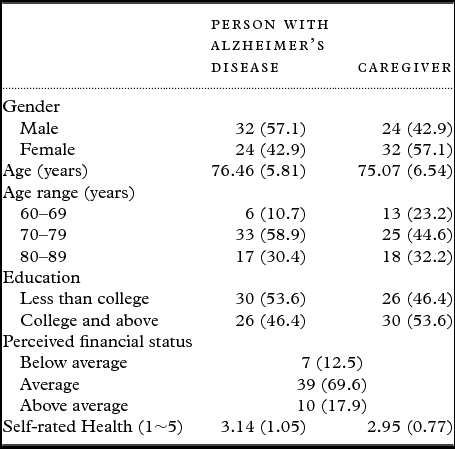
Sixty eight pairs of patient and his/her spouse were ultimately enrolled. Among the enrolled pairs, 56 dyads completed the intervention. The reasons for 14 couples dropping out are as follows: either the person with AD or the caregiver had health problems (5 couples); the person with dementia did not want to participate (4 couples); the person with dementia had a hearing impairment (1 couple); the person with AD was reluctant to share a personal story (1 couple); and the couple did not indicate a specific reason (1 couple). Sociodemographic characteristics of the patient–spouse pairs who completed the study are presented in Table 1. All participants were fully informed of the study protocol, and provided written informed consent, signed by the participants or their legal guardians. This study protocol was approved by the Institutional Review Board of SNUBH.
Sociodemographic characteristics of completed participants (n = 56)

Data collection and analysis
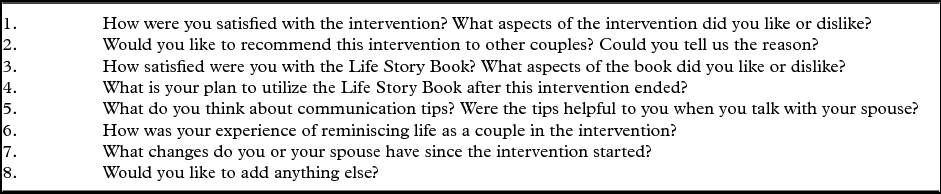
This study used part of the data collected for a larger research project to develop a CLSA that was culturally appropriate for Korean couples and evaluate its effectiveness. The research project employed a mixed method to collect data, including a survey that contains standardized measures of outcomes, as well as a short interview with open-ended questions about the participants’ experiences of the intervention. The present study analyzed data from the interview only. Persons with dementia and caregiving spouses were separately interviewed using a semi-structured interview technique. A trained research assistant who was not part of the intervention conducted the interview and took notes on the responses. To facilitate responses of participants with AD, the research assistant utilized the Life Story Book created after the intervention and used short sentences to help participants with AD understand the interview questions. The responses of four participants with AD who did not remember the intervention were excluded from the analysis. The open-ended questions, shown in Table 2, cover the participants’ experiences related to reminiscing, communication tips, perceived changes in marital relationship, and reactions to the Life Story Book. The interview took place in a location preferred by the participants, such as their home or a clinic.
Interview questions

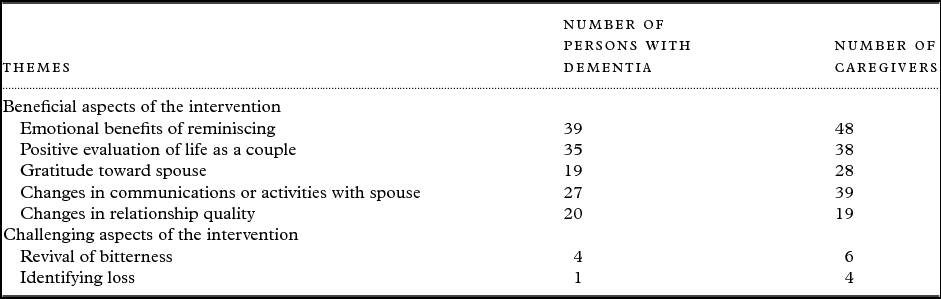
The data were analyzed using thematic content analysis (Green and Thorogood, Reference Green and Thorogood2013), which includes familiarization with the data, generating initial codes, making notes, and consolidating and developing themes (Braun and Clarke, Reference Braun and Clarke2006). One researcher led the analysis in an inductive way. Codes were first identified line by line based on raw data, such as feelings of achievement as a couple and satisfaction with one's life in the past, and then categorized into themes, such as a positive evaluation of life as a couple, if the codes showed similar topics. Themes were labeled based on the content of codes. Following this coding of themes, two researchers reviewed the codes and themes in comparison with the raw data to check the consistency of coding. Disagreements on codes and themes were resolved through discussion among the research team. After identifying themes, we grouped these themes into the two categories of benefits and challenges. In the results section, we will discuss sub-themes within benefits and challenges. Nvivo10.0 was utilized to analyze the data (Table 3).
Themes emerged in the interviews, including a count of the number of participants

Results
Benefits
Emotional benefits of reminiscing
The majority of participants (PwD = 38, CG = 46) reported that they experienced positive feelings of pleasure and joy from reminiscing. Most participants enjoyed reminiscing because the process of retrieving old memories refreshed their feelings.
Remembering good times in life was a pleasant experience for participants. Some participants felt nostalgic for times when they were young, even with respect to negative memories related to difficult times and hardship. Using pictures in the process of reminiscence facilitated couples’ discussion of their life and helped couples focus on positive memories. In addition, participants felt that using photos as a basis for reminiscing vitalized and stimulated them.
“Just the two of us live at home, so we don't have much time to laugh. During the intervention, we laughed together a lot. It was pleasant.” [PwD62]
“When I see the photos in the book, I feel the same emotions we had in the past when we took the picture. Good memories come alive, and I feel a deeper connection with our kids.”[CG27]
In addition, participants reported that the intervention helped them relax. Some participants with dementia became calm and gained comfort from the intervention. Comments of wives with or without memory loss indicated that fully expressing and releasing their emotions was a kind of catharsis. They appreciated the opportunity the intervention gave them to talk about their life with someone else.
“[The intervention] consoled me, and emotional baggage in my mind was resolved. This comfort cannot be provided by a doctor.”[PwD53]
“I haven't talked about my life stories to others. After confiding my life stories in someone else, I felt calm and good.”[CG10]
Positive evaluation of life as a couple
The CLSA helps participants construct meanings in their lives by using a strengths perspective. Interventionists facilitate couples’ discussion of how they overcome or deal with difficulties if they show negative memories and emotions during life review. During the intervention, most of the participants reported that they experienced economic hardship in the early years of their marriage and often recalled how hard they worked to meet basic living expenses (Kwak et al., in press). This is because participants belonged to the older generation in South Korea who had experienced dramatic changes in social and economic systems (e.g. the Korean War) when they were young. Reminiscing about their life as a couple in a chronological order may have helped them realize how much they have accomplished during their life. In the interview, participants reported that reminiscences enhanced their sense of achievement and self-worth. Financial success, self-sufficiency, and children were referred to as sources of achievement for the couples.
“Although we went through crises in our marriage, we didn't divorce, endured difficult times, and lived together. I enjoyed reminiscing about stories in the past and felt that we have lived well as a couple because we have brought up our children very well as we wanted to do.” [PwD27]
“[Reminiscing] was interesting and fun. We overcame all difficulties when we were poor. Now our efforts have born fruit, so I feel proud.” [CG25]
Reflecting the value placed on humility in Asian culture, some participants reported at the first session that they had insufficient stories in their marriage to write a book about. However, the intervention reminded the couples of the values of ordinary life.
“I thought our marriage was nothing special. When I looked at our photos during our marriage, I realized again that we have a history together and I felt great.” [CG35]
“By reviewing our life, I felt that ordinary things in everyday life were very valuable and rewarding.”[CG61]
Gratitude toward spouse
In reviewing their life as a couple together, the intervention highlighted couples’ strengths. Interventionists encouraged couples to talk about their strengths by asking how they worked together to achieve a goal and what praise they would like to give. In addition, one of the communication skills focused on in the intervention was giving compliments to a spouse. Through practicing this communication skill together during the session, the intervention provided opportunities for couples to express their appreciation to each other and affirm each other's strengths.
In the post-interviews, participants affirmed spouses’ strengths, which were often related to fulfilling duties as a spouse, a parent, or a child-in-law. Persons with memory loss tended to express gratitude for spouses’ caregiving in the immediate present while caregiving spouses, especially husbands, showed appreciation for their partner's dedication to family.
“I appreciate my wife in that she always stays with me and takes care of me. I think she is better than any doctor. I feel both grateful and sorry because she has made sacrifices for me. She is the kind of person who likes to live freely because she is the youngest child in her family, but she bears all these difficulties when life is like a hell and looks after me.”[PwD39]
“My wife has been supportive when there were difficult times and motivated me to overcome the difficulties. Thanks to her, I had a good life. I thought I would try to live for her, remembering her devotion and service.”[CG62]
Changes in communications or activities with spouse
One of the core components in the intervention was introducing communication skills that promote greater engagement between spouses. Caregiving spouses were able to understand the cognitive conditions of persons with memory loss and acquired ideas about how to respond to memory loss. Caregiving spouses tended to be more patient and considerate after the intervention because they then understood how memory works for persons with memory loss. Communication tips were helpful not only for caregivers but also for the individuals with memory loss. Some participants with memory loss remembered the communication tips and resolved conflicts by applying them. As participants utilized the communication skills, caregivers reported having a greater understanding of mistakes made by their spouses with memory loss and that their spouses were more cooperative than before, and both caregivers and their spouses reported changes in each other's attitudes:
“I used to refute him even before he said something, but now I have become more patient and wait for him. I say good words to him, such as ‘please help me’ and ‘thank you’.[CG27]
“I decided to get less angry, and my husband is more considerate to me.”[PwD29]
By combining life review with training in communication skills the participants reported that conversations or activities with their spouses changed after the intervention. Participants experienced improved communication by increasing the amount of conversation and widening the scope of the conversations to cover a greater variety of topics than before. Couples became more talkative and formed a bond of compassion between them. In addition, couples tried to focus on positive topics and avoid arguments by speaking in a kind and gentle manner.
“We used to talk only when necessary before the intervention; however, now we talk to each other every day. My husband often says “I am sorry,” “I love you,” and “thank you” to me. He also comforts me a lot by saying that he understood what I went through in the past.” [CG10]
“We didn't show each other that we cared before. Through this intervention, we now ask each other about the day and care about each other more.”[PwD10]
Participants recognized the importance of joint activities shared by the couple after the intervention. The intervention itself served as a pleasant joint activity in that couples looked at pictures and shared stories together. Participants sometimes utilized ways of reminiscing with photos as they had learned to do in the intervention and thereby enriched their communication. Some couples tried to go out together more often than before, and others planned to spend more time together, such as planning to attend programs in community center or religious activities and traveling together. For example, one couple joined other activities in addition to looking at pictures in their album. During the intervention, they visited the local districts where they lived in their early years of marriage. At the end of the intervention, they also planned to travel to their hometown where they had first met each other (Couple2).
“[The intervention] was pleasant. We visited the neighborhood where we lived a long time ago. It was fun [CG2].”
Changes in relationship quality
Participants reported that they understood each other better and felt closer to each other through the intervention. The intervention encouraged equal participation of each spouse in reminiscing about their lives. Couples had opportunities to hear their partner's thoughts and feelings about life events. Couples who had not had the time or inclination to openly discuss their thoughts before became more aware of their spouse's thoughts through this intervention.
“I thought my wife was very stubborn before the intervention; however, after the intervention I thought differently about it. And I decided to understand and accept her.”[PwD35]
“[The intervention] was an opportunity to understand my husband's thoughts. I learned to stop judging my husband for not seeing things the way I did.” [CG35]
In addition, couples’ life review created greater emotional bonding with each other. As discussed earlier, couples affirmed their spouses’ strengths and recognized the importance of the roles their partner played in their life. Reviewing their family life often led couples to find they were interdependent on each other.
“What I felt [for my husband] was well-described [in the life story book]. It was a good opportunity to express our affection for each other that has been hidden for a long time.”[PwD28]
“We are getting closer after this intervention because we interact closely with each other. As time goes by, I have realized my husband is a lovely man. Before this intervention, there were wild waves in my mind, and this intervention brought me a sense of peace.” [CG39]
Challenges
Revival of bitterness
A number of participants (PwD = 4, CG = 6) experienced negative emotions when they reminisced. One caregiver had difficulty integrating negative life events, such as financial hardship, into her life story because of her distress about her husband's illness (i.e. dementia). The caregiver identified these feelings of sadness as a difficult part of the intervention.
“When I talked about the past, I cried because of many hardships in the past. I remembered every detail of those hardships. I have talked about the stories that I felt less shameful about, but recalling the past was still hard for me.”[CG53]
A few husbands, with or without memory loss, reported feelings of guilt after the intervention. The caregiving husbands among this group tended to think that their wife got dementia because of hardships in the marriage, which in turn may increase their feelings of guilt. They reported that they regretted they did not behave well toward their wives when they were young (CG1, CG28). One husband with memory loss regretted not fulfilling his duties as the head of family, such as providing financial support for family.
“Looking back on my life, there were a lot of regrets about things I should have done differently. . . . . . . I was not a husband that my wife can be proud of. I felt guilty that I didn't provide well financially for my family.”[PwD49]
There was one case in which conflicts between spouses were reignited during the life review. The wife repeated complaints about her husband having been authoritative and not having helped her to raise their children in the early and middle years of marriage whereas the husband thought he worked very hard and did his best to make a living for family.
“My husband had changed recently before the intervention. I became happy. However, because of this intervention, disagreement arose between us. I am afraid that our relationship will get worse.”[PwD58]
Identifying loss
A few participants were saddened by identifying losses related to aging, death of a family member, and gaps in memory. Two wives with or without memory loss reported that they longed for good times in the past and recognized losses (e.g. changes in physical appearance or financial situations) in the present. One caregiving wife expressed mixed emotions because she was both deeply pained by recalling her son who had died recently and also proud of raising the other surviving children successfully. The couple also had feelings of guilt about children because they had not been able to provide appropriate food and clothes to their children because of poverty.
“I was overwhelmed with regrets when I looked back on my life. Although I feel proud of educating my children, I feel empty now because they got married and live apart from us. Educating children was meaningful, but losing my son was almost too terrible for us to bear.” [CG49]
One caregiving husband became more aware of his wife's cognitive decline after the intervention. As the intervention reminded him of her earlier self, the caregiving husband felt afraid of her changes in memory.
“Since this intervention, I have paid greater attention to my wife. And I became aware of her (cognitive) limitations and got embarrassed. . . When I looked back, I realized her importance in my life; at the same time, I am afraid of her changes.”
Although the intervention included persons with mild dementia, a small number of participants were not able to recall memories in the past or had difficulties in expressing their ideas verbally. Some caregiving spouses were disappointed that their partners were not able to fully participate in the intervention given memory loss.
“It was difficult to retrieve old memories.”[PwD28]
“It would have been great if he could listen to and think of stories as well so we could have done this together.”[CG40]
Discussion
The aim of the present study was to explore how the dyadic intervention that uses couples’ life review as a pleasurable joint-activity is experienced by the couples where one partner has mild AD. The qualitative method used in this study deepened our understanding of the acceptability of the CLSA as perceived by Korean couples dealing with AD. These findings gave valuable information about how a dyadic intervention involving both persons with AD and their spouses can provide both benefits and challenges.
Overall, positive themes around reviewing life together emerged. A key factor that contributed to these positive responses was reviewing life together based on a strength perspective. The couples in this study expressed feelings of enjoyment and joy as well as a positive evaluation of their lives, which is in line with existing research on reminiscence and life review for older adults (Webster and McCall, Reference Webster and Mccall1999; Gonzalez et al., Reference Gonzalez, Mayordomo, Torres, Sales and Melѐndez2015). In the previous reminiscence interventions, including both individuals with dementia and their caregivers, the role of caregivers was limited to helping individuals with dementia reminisce (Haight et al., Reference Haight, Bachman, Hendrix, Wagner, Meeks and Johnson2003), or else the reminiscence was conducted in a group format (Woods et al., Reference Woods2012). The CLSA invited both individuals with dementia and their spouses to reminiscence together and review their common history in marital life within an individualized setting. In particular, the strength perspectives used in the CLSA also enabled the couples to focus on positive aspects of their life and affirm affection and appreciation for each other.
Learning communication skills appears to be an important component that led to the couples’ positive experiences. The finding related to improved communication in our study is consistent with the previous US study, which reported caregiving spouses’ positive reaction to communication skills (Ingersoll-Dayton et al., Reference Ingersoll-Dayton, Spencer, Kwak, Scherrer, Allen and Cambell2013). Interestingly, in our study, some individuals with mild AD also utilized communication skills when they face situations of disagreement or conflict with their partners or wanted to express their gratitude for the caregiving partner's efforts. These changes in both parties may facilitate the improvement of communication and further contribute to enhancing the marital relationship.
Although our findings suggest positive aspects of the intervention, it should be noted that some couples found aspects of this intervention problematic. Reminiscing reminded couples of negative memories and emotions in the past. Couples had control over what they wanted to talk about in their life reviews, but a few participants focused on reviewing disturbing events and marital conflicts in the past or evaluated the past negatively due to current distress related to dementia. For these participants who suffer from painful memories in the past, professional help might need to be arranged and provided. Accordingly, before the intervention starts, it is important to have referral resources for couples who need professional help. Given that mental health services such as counseling and couples therapy are stigmatized in Korean culture, especially among older people (Park et al., Reference Park2015), it is important that the interventionist be aware of the couple's potential negative attitudes toward mental health services and the need to suggest any such services with sensitivity to minimize feelings of stigma.
Identifying loss has been found to be a problematic aspect of the CLSA in the present study, as well as in the USA (Ingersoll-Dayton et al., Reference Ingersoll-Dayton, Spencer, Kwak, Scherrer, Allen and Cambell2013). Before the intervention starts, it should be noted that couples can have potential feelings of sadness and grief during life review (Ingersoll-Dayton et al., Reference Ingersoll-Dayton, Spencer, Kwak, Scherrer, Allen and Cambell2013). For Korean couples, the interventionist needs to explain concrete examples that can raise feelings of sadness during life review so that the couples have the information to decide whether or not the intervention might be helpful for them. The interventionist also should have cultural competence to handle issues related to loss and grief. In the previous study in the United States, the interventionist facilitated couples’ abilities to express feelings of grief and find meaningful ways to honor those who have died (Ingersoll-Dayton et al., Reference Ingersoll-Dayton, Spencer, Kwak, Scherrer, Allen and Cambell2013). Our experience suggests that older Korean couples were likely to be reluctant to share stories and emotions about people who died and usually did not want to include the pictures of those individuals in the Life Story Book (Kwak et al., in press). The interventionist should respect the couple's decision to share the stories about people who died and, if they want, the couple should be able to continue to talk during life review about the person who died until they feel it is enough.
It should be noted that about half of the participants did not express improvement in either communication or relationship quality. For the couples who already had a good communication and relationship quality, there was little room to improve the quality of their relationship through the CLSA. For other couples who had a long history of a poor marital relationship or little communication, the current intervention was not sufficient to make changes. Given this heterogeneity of the relationship quality among the couples, an individually tailored approach might be needed (Zarit and Femia, Reference Zarit and Femia2008). Future replication of the CLSA may consider adding booster sessions for couples who have difficulties in communication so that they can have enough time to begin conversations between them and practice communication skills. Having individual sessions separately for persons with AD and their spouses prior to the CLSA also may be helpful so that couples first resolve in individual sessions issues that cannot be discussed in the presence of a spouse, such as caregiving distress. In doing so, couples can fully focus on life review and positively interact with each other in the joint sessions.
There are several limitations to this study. First, the evidence in the present study is based on a small-scale project without a control group; it would thus be informative to conduct a larger scale evaluation with a rigorous group comparison design to assess the effectiveness of quantitative outcomes in the CLSA. In particular, future research is needed to assess whether or not specific subgroups of participants (e.g. subgroups organized by different levels of satisfaction with the marital relationship) receive greater benefits from the CLSA than others. The information obtained by subgroup analysis would be a useful source for screening to determine who will be most benefited by the intervention. Second, the findings of the present study are based on data collected from participants one week after the intervention was completed. Examining the long-term effects of the CLSA would be valuable in understanding how the improvement or maintenance of relationship quality influences long-term outcomes in dementia care. It would be informative to investigate couples who reported no changes in their relationship or communication with each other right after the completion of the CLSA because the CLSA may have long-term effects on maintaining their relationship quality and helping them better adjust to changes as AD progresses. Third, the current study utilized the data derived from participants. It also would be helpful to assess interventionists’ perceptions and observations of how the participants experience the CLSA or which components of the CLSA were well received by the participants. Last, most participants in the current study lived in urban areas, had a long history of marriage, and were at a higher socioeconomic status than that of the average older Korean couple. Future study is needed to include more diverse population (e.g. those living in rural areas or institutions, those who have lower levels of education, and those who have remarried) and examine the applicability of the CLSA to a more diverse population.
Taken together, our study highlighted the importance of involving a couple in psychosocial interventions in dementia care and providing the opportunity for the couples to engage with each other in significant ways and focus on each other's strengths. As older Korean couples with dementia are not likely to utilize mental health services for couples or are less concerned about the quality of life for both partners than the patients’ cognitive rehabilitation, this couple-oriented psychosocial intervention can uniquely contribute to enhancing the couples’ awareness of the importance of relationships when they cope with the illness in the future. The challenges that emerged in the CLSA should be carefully addressed in future implementation to maximize the benefits of this intervention with couples.
Conflict of interest
None.
Description of authors’ roles
All authors formulated the research questions, designed the study, and collected the data. M. Kwak and J. Han analyzed the data and wrote the manuscript. J. Ha assisted with analyzing the data and writing the manuscript.
Acknowledgments
This paper was supported by a Research and Development Grant from the South Korea Health Industry Development Institute (Grant no. HI13C1652; PI: Jung-Hwa Ha).
The authors are grateful to Professor Berit Ingersoll-Dayton and Beth Spencer for their permission and support to replicate the CLSA in South Korea.