INTRODUCTION
Severe dermatitis is a common toxicity that presents late after chemoradiation therapy. However, the extensive development of squamous cell carcinoma (SCC) in the vicinity of post-radiation dermatitis is rare.Reference Aubin, Puzenat, Arveux, Louvat, Quencez and Humbert1 Furthermore, management of such extreme cases in the head and neck region presents a unique challenge due to the lack of mobility and anaesthesia risk. Such extensive SCC would be better managed under general anaesthesia due to the amount of local anaesthetic required and the limitations of permeation of local anaesthetic in the fibrosed tissue.
Here we report a case of chronic extensive radiation dermatitis on the neck and new SCC on the head in a patient who received radiation therapy (RT) for SCC of the right tonsil (stage T1, N2b) 8 years before. This case presents Mohs micrographic surgery (MMS) as a way to effectively manage extensive head and neck SCC in a patient who is at high risk for intubation due to severe post-radiation fibrosis.
CASE REPORT
A 63-year-old Caucasian gentleman with a history of SCC of the tonsil (status after chemoradiation in 2000) presented to our clinic in May 2008 with a lesion on the tip of the epiglottis. The patient denied dysphagia, otalgia, hemoptysis, dysarthria, and sore throat.
Past medical history was significant for post-radiation hypothyroidism treated with levothyroxine at the time of initial presentation. The patient also had a history of actinic keratoses (AKs), radiation dermatitis, and SCC of the larynx. Past surgical history was significant for excision of multiple non-melanoma skin cancers from his body, most recently a basal cell carcinoma (BCC), nodular pattern on the right radial forearm. Medications included calcium, levothyroxine, multivitamins, nifedipine, and ezetimibe and simvastatin. For his severe chronic non-healing radiation dermatitis, the patient took pentoxifylline (Ptx) 400 mg three times daily in the past; he takes vitamin E as part of his daily multivitamin.
The patient’s SCC of the right tonsil was treated with RT in April 2000 (68 Gy in 34 fractions over 7 weeks). As a result of RT, he developed moderate redness and erythema in the treated area with small areas of patchy desquamation. Aquaphor® was prescribed and controlled his skin irritation. The patient also developed moderate patchy mucositis and erythema in the mouth and oropharynx, causing moderate sore throat that was well controlled with pain medications.
Physical exam revealed severe sclerosing radiation dermatitis of the right lateral neck (resulting in woody texture) accompanied by limited neck mobility. The patient’s neck range of motion was limited to <45° in any one direction. Palpable adenopathy of the neck was not detected, although the severe fibrosis may have precluded an accurate assessment. A non-healing ulcer with drainage on the right neck was being managed with application of aloe vera. Examination of the oral cavity revealed trismus. Examination of the eyes, nose, heart, and lungs was unremarkable.
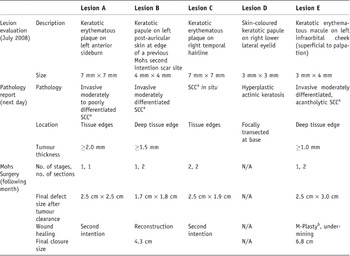
In July 2008, five suspicious cutaneous lesions (termed lesions A–E) on the patient’s head and neck that correlated with the RT field were evaluated and skin shave biopsies were performed. Lesion characteristics, pathology evaluation, and MMS details are summarised in Table 1. An appointment with an ocular plastic surgeon was scheduled to assess how to treat lesion D. Anaesthesia for all MMS included lidocaine (1.0%) with epinephrine (1:100,000 buffered with sodium bicarbonate) and topical eutectic mixture of local anaesthetic (EMLA) cream. Blood loss was non-extant to minimal during all surgeries and there were no complications.
Summary of (i) evaluation of, (ii) skin shave biopsy pathology report on, and (iii) Mohs surgeries on the five head and neck lesions

a Squamous cell carcinoma. b Procedure to suture a fusiform incision.
DISCUSSION
Hymes et al. extensively reviewed the presentation, pathophysiology, and treatment of radiation dermatitis.Reference Hymes, Strom and Fife2 Cases of BCC after RT have been reported (see, for example, ref.Reference Wagamon and Li3) and a population-based case–control study by Lichter et al. of 592 cases found an increased risk of BCC (odds ratio: 3.30) and SCC (odds ratio: 2.94) at the sites of exposure to therapeutic ionising radiation.Reference Lichter, Karagas, Mott, Spencer, Stukel and Greenberg4 The work of Lichter et al. reaffirms the earlier results of Karagas et al.,Reference Karagas, McDonald, Greenberg, Stukel, Weiss, Baron and Stevens5 who reported that the average number of cutaneous BCC and SCC tumours per patient site of radiation was 2.6 and 1.5, respectively. An elaboration on the management of post-RT complications is minimal in the RT literature. We believe that the novel contribution of our case report to the literature includes the extensive number of SCCs, the hindrance of therapeutic options due to intubation risk from severe chronic radiation fibrosis, and the presentation of the use of MMS to effectively manage extensive SCC after RT.
Eight years after chemoradiation, the numerous SCCs detected on the patient’s head raise the issue of dermatological side effects of RT. In a study of 61 patients who developed chronic radiation dermatitis and years later RT-induced skin cancer of the face (n = 60, 98.4%) or scalp (n = 1, 1.6%) after being treated for benign dermatoses, six patients (9.8%) were found to have one or more SCC lesions.Reference Davis, Hanke, Zollinger, Montebello, Hornback and Norins6 Despite the results of Bonner et al.’s multinational randomised study comparing RT alone to RT plus cetuximab in advanced head and neck SCC,Reference Bonner, Harari, Giralt, Azarnia, Shin, Cohen, Jones, Sur, Raben, Jassem, Ove, Kies, Baselga, Youssoufian, Amellal, Rowinsky and Ang7 severe skin reactions have been reported in patients receiving combined RT and cetuximab for SCC of the head and neck: grade 4 ulcerative dermatitis in a 57-year-old female and a 50-year-old male.Reference Bölke, Gerber, Lammering, Peiper, Müller-Homey, Pape, Giro, Matuschek, Bruch-Gerharz, Hoffmann, Gripp, Homey and Budach8 Unlike our patient’s 8-year experience of radiation dermatitis, the pati ents in ref.Reference Bölke, Gerber, Lammering, Peiper, Müller-Homey, Pape, Giro, Matuschek, Bruch-Gerharz, Hoffmann, Gripp, Homey and Budach8 experienced relief from dermatitis within 3 months of chemoradiation. A related impressive feature of our patient’s case was the inability to intubate due to tonsilar hypertrophy, thereby increasing the risks from MMS. In addition to a history of AK as noted in this case, patients exposed to RT need to be considered to have a predisposition to the development of multiple skin cancer lesions that may require a more complex level of management with a multidisciplinary approach. This requires a higher level of awareness and coordination amongst caretakers.
In addition to dermatitis, mucositis, pain, laryngectomy, tracheostomy, and gastrostomy tube were reported as additional toxicities and outcomes by Milano et al. in a Phase II study of 69 patients with stage 4 head and neck cancer.Reference Milano, Vokes, Kao, Jackson, List, Stenson, Witt, Dekker, MacCracken, Garofalo, Chmura, Weichselbaum and Haraf9 Although a recent prospective randomised controlled trialReference Mosterd, Krekels, Nieman, Ostertag, Essers, Dirksen, Steijlen, Vermeulen, Neumann and Smeets10 found that MMS is preferable to surgical excision for recurrent facial BCC, similar studies for recurrent SCC have not been reported. In the inopportune event that our patient’s SCC of the head becomes inoperable or unaffected by future Mohs micrographic surgeries, the potential exacerbation of the patient’s severe neck dermatitis would become an important factor in considering future therapies.
CONCLUSION
In conclusion, complex cases of multiple head and neck SCC after RT should be approached by the radiation oncologist in consultation with colleagues from dermatology. Because not all patients respond equally to repeated RT, the treatment approach should be tailored to the individual patient. Although MMS was not able to treat the patient’s persistent radiation dermatitis, it effectively removed the SCC from four sites on his head and neck.