Effortful control is a relatively recently described dimension of temperament, developed by Rothbart and colleagues (Rothbart, Reference Rothbart2007; Rothbart, Ahadi, Hershey, & Fisher, Reference Rothbart, Ahadi, Hershey and Fisher2001; Rothbart & Bates, Reference Rothbart, Bates, Damon, Lerner and Eisenberg2006) and others (Eisenberg et al., Reference Eisenberg, Zhou, Spinrad, Valiente, Fabes and Liew2005). Effortful control is related to executive control, and most research has focused on the abilities to inhibit a dominant response, activate a subdominant response, and focus and shift attention; the abilities to plan and detect errors, also included in the definition, have received less research attention (Zhou, Chen, & Main, Reference Zhou, Chen and Main2012). Effortful control can be reliably assessed in early childhood via parental report and laboratory tasks (e.g., Murray & Kochanska, Reference Murray and Kochanska2002; Olson, Sameroff, Kerr, Lopez, & Wellman, Reference Olson, Sameroff, Kerr, Lopez and Wellman2005) and is posited to play a major role in the development of regulation of emotion (Rothbart & Bates, Reference Rothbart, Bates, Damon, Lerner and Eisenberg2006) related to moderation of environmental stimuli by the individual's responses to those stimuli (e.g., shifting attention and inhibiting a dominant response) and the expression of emotion (e.g., activating a subdominant response).
Poor effortful control is a key temperamental factor underlying problems with externalizing behaviors (Olson et al., Reference Olson, Sameroff, Kerr, Lopez and Wellman2005; Ormel et al., Reference Ormel, Oldehinkel, Ferdinand, Hartman, De Winter and Veenstra2005), which are related to poor behavioral regulation (Prior, Smart, Sanson, & Oberklaid, Reference Prior, Smart, Sanson and Oberklaid2001). A number of studies have established a link between effortful control and externalizing in different developmental periods (Doan, Fuller-Rowell, & Evans, Reference Doan, Fuller-Rowell and Evans2012; Hardaway, Wilson, Shaw, & Dishion, Reference Hardaway, Wilson, Shaw and Dishion2012; Karreman, de Haas, van Tuijl, van Aken, & Dekovic, Reference Karreman, de Haas, van Tuijl, van Aken and Dekovic2010). For example, Olson et al. (Reference Olson, Tardif, Miller, Felt, Grabell and Kessler2011) found that low effortful control at age 3 years contributed uniquely to prediction of aggression toward peers at ages 3 and 6 years, whereas another dimension of difficult child temperament, negative reactivity, did not. Similarly, in early adolescent boys, conscientiousness (which is related to effortful control; Evans & Rothbart, Reference Evans and Rothbart2007) was inversely associated with externalizing or antisocial behaviors (John, Caspi, Robins, Moffitt, & Stouthamer-Loeber, Reference John, Caspi, Robins, Moffitt and Stouthamer-Loeber1994). Poor effortful control has also been found to be associated with substance use (MacDonald, Reference MacDonald2008). Effortful control in adolescence has been found to be negatively associated with problematic tobacco and marijuana use in early adulthood, controlling for adolescent substance use (Piehler, Véronneau, & Dishion, Reference Piehler, Véronneau and Dishion2012).
Although temperament, including aspects of effortful control, is related to genetic heritability (Gagne, Saudino, & Asherson, Reference Gagne, Saudino and Asherson2011; Posner, Rothbart, & Sheese, Reference Posner, Rothbart and Sheese2007) and is a relatively stable, upstream aspect of human behavior, there is also evidence that temperamental experience and expression is shaped by context and experience (Rothbart & Bates, Reference Rothbart, Bates, Damon, Lerner and Eisenberg2006). Parenting is a key aspect of such experience in childhood and has been shown to be related to the development of effortful control (Kiff, Lengua, & Zalewski, Reference Kiff, Lengua and Zalewski2011). As discussed by Belsky, Fearon, and Bell (Reference Belsky, Fearon and Bell2007), the robust, replicated findings of beneficial effects of positive parenting and detrimental effects of harsh coercive parenting for externalizing problems in children (Dishion & Patterson, Reference Dishion, Patterson, Cicchetti and Cohen2006) draw attention to the mediating psychological mechanisms that might account for such an association, and effortful control is hypothesized to be a likely mechanism (NICHD Early Child Care Research Network, 2003). Consistent with this, Chang, Olson, Sameroff, and Sexton (Reference Chang, Olson, Sameroff and Sexton2011) found that boys’ effortful control at age 3 years mediated effects of parenting (higher warmth and less corporal punishment) at age 3 years on externalizing symptoms at age 6 years.
Bidirectional Theory
Most research on parenting and child behaviors defaults to unidirectional prediction models; in most longitudinal models, parent behaviors temporally precede child behaviors, and cross-sectional associations are commonly interpreted as likely reflecting effects of parenting on child behavior. Nevertheless, most researchers assume parents and children have bidirectional influences on one another over the short and long term (Kiff et al., Reference Kiff, Lengua and Zalewski2011). Seminal work in this area includes that of Bell (Reference Bell1979), who emphasized the need to study parent–child reciprocal influences, as well of that of Patterson (Reference Patterson1982), who posited that in coercive family process there is bidirectional influence at the moment-by-moment level (parent and child show mutual escalation during a given conflict) and at the developmental level (parent and child shape each other's behaviors in subsequent periods and in new contexts). Further, these bidirectional influences involving a child and a caregiver are but a subset of the transactional causal exchanges the child and parent have within larger contexts (Sameroff, Reference Sameroff2009).
One way in which children may affect parenting behaviors is through evocative gene–environment effects (Scarr & McCartney, Reference Scarr and McCartney1983), which is a process within the broader category of gene–environment correlations (Knafo & Jaffee, Reference Knafo and Jaffee2013; Plomin, DeFries, & Loehlin, Reference Plomin, DeFries and Loehlin1977). In the case of effortful control, a child lower in effortful control (at least partially due to genetic factors) may tend to frustrate their parents and elicit more and more negative discipline episodes and lower levels of positive parenting, whereas a child high in effortful control may tend to elicit less discipline and more positive reactions. In a twin study, Klahr, Thomas, Hopwood, Klump, and Burt (Reference Klahr, Thomas, Hopwood, Klump and Burt2013) found that maternal control was influenced by evocative gene–environment correlational processes whereby genetic influences on maternal control and child control were overlapping. There is evidence from molecular genetic studies supporting this theory. Penner-Tessler et al. (Reference Pener-Tessler, Avinun, Uzefovsky, Edelman, Ebstein and Knafo2013) found that for boys (but not for girls) the serotonin transporter linked polymorphic region gene predicted mothers’ levels of positive parenting, and the effect was mediated by boys’ self-control. Thus, although gene–environment associations are not tested in the current study, this theory and process underlies the expected evocative effect of child effortful control on parenting.
In a review of bidirectional and interactional developmental effects of temperament and parenting, Kiff et al. (Reference Kiff, Lengua and Zalewski2011) argue for the importance of examining such associations, given the tenets of bioecological frameworks (Wachs & Kohnstamm, Reference Wachs, Kohnstamm, Wachs and Kohnstamm2001). However, Kiff et al. point out that regarding temperament and parenting, “interestingly, researchers have come to assume the presence of both interactive and bidirectional effects despite a lack of comprehensive examination” (p. 252). Similar to the bioecological framework, in our own work regarding the lifespan development of externalizing and related behaviors, we have argued for the need of a dynamic developmental systems approach to examining the ways in which behavior is shaped by constant feedback across systems, including between parents and children (Capaldi & Eddy, Reference Capaldi, Eddy, Gullotta, Evans and Plant2014). Tests of bidirectionality, in particular, are hampered by the relatively demanding and expensive study designs that are needed for such tests, particularly if they are to cross multiple developmental periods. Kiff et al. conclude that while the studies they reviewed generally found support for such effects for parenting and child temperament, including effortful control, the ability to draw conclusions regarding specific mechanisms was limited by the lack of rigorous studies of bidirectional effects. They went on to recommend that “future research would benefit from longitudinal designs that include three (or more) time points, assess parenting and temperament across developmental periods, and include indicators of adjustment outcomes” (p. 269).
A number of other researchers posit that the developmental association between parental socialization and children's effortful control is bidirectional (Belsky et al., Reference Belsky, Fearon and Bell2007; Eisenberg, Smith, & Spinrad, Reference Eisenberg, Smith, Spinrad, Vohs and Baumeister2011). Belsky et al. tested the hypothesis that attentional control mediated the association between maternal sensitivity toward the child and externalizing problems, using measures spanning four time points from ages 4 to 10 years, and found evidence of the hypothesized mediation. They also found some evidence of reciprocal effects of attentional processes on parenting. There is some evidence that parenting may mediate the effects of contextual risk factors on children's effortful control. Lengua et al. (Reference Lengua, Kiff, Moran, Zalewski, Thompson and Cortes2014) found for children across the ages of approximately 3 to 5 years that maternal scaffolding mediated the effects of income and cumulative risk on executive control. Doan et al. (Reference Doan, Fuller-Rowell and Evans2012) found that, for adolescents, cumulative contextual risk predicted maternal responsiveness and adolescent self-regulation with an additional effect of maternal responsiveness on self-regulation.
Parenting and the Development of Effortful Control Across Childhood
As reviewed by Eisenberg et al. (Reference Eisenberg, Smith, Spinrad, Vohs and Baumeister2011), the capacity for effortful control increases considerably in the preschool years. Components of effortful control, including attention span (Gaertner, Spinrad, & Eisenberg, Reference Gaertner, Spinrad and Eisenberg2008), as well as the broader construct of effortful control itself (Kochanska & Knaack, Reference Kochanska and Knaack2003; Kochanska, Murray, & Harlan Reference Kochanska, Murray and Harlan2000), have been found to show interindividual stability in early childhood, supporting the conceptualization of effortful control as an aspect of temperament (Rothbart & Bates, Reference Rothbart, Bates, Damon, Lerner and Eisenberg2006). However, caregivers are believed to play a role in the development of behavioral regulation (Calkins, Reference Calkins1994). A number of studies have found that responsive, supportive parenting is associated with children's effortful control. For example, Gilliom, Shaw, Beck, Schonberg, and Lukon (Reference Gilliom, Shaw, Beck, Schonberg and Lukon2002) found positive maternal control was associated with preschoolers’ ability to shift their attention away from sources of frustration. Spinrad et al. (Reference Spinrad, Eisenberg, Gaertner, Popp, Smith and Kupfer2007) found that maternal support, including sensitivity, warmth, and supportive responses, were positively associated with children's effortful control, both concurrently and over time, and also in the preschool years. Belsky et al. (Reference Belsky, Fearon and Bell2007) found that maternal sensitivity predicted better attentional control on a task of attention regulation 2 years later (at ages 6–9 years). Such associations have also been found for older children. Eisenberg et al. (Reference Eisenberg, Zhou, Spinrad, Valiente, Fabes and Liew2005) examined the association of parental warmth/positive expressivity and children's effortful control 2 years later. They found that caregiver (predominantly mothers and some fathers) positivity at age 9 years predicted child effortful control at age 11 years, controlling for child effortful control at age 9 years. Doan et al. (Reference Doan, Fuller-Rowell and Evans2012) found that maternal responsiveness as reported by adolescents was related to self-regulation assessed by teacher report and a puzzle task. Positive parental behaviors thus appear to foster the development of effortful control. Much of this work, however, has involved examining effects of maternal positivity, with relatively little work examining effects of paternal positivity.
Aspects of parental discipline have also been found to be related to children's effortful control. Harsh and inconsistent discipline makes an unpredictable and aversive environment for a child, which relates to emotional dysregulation and to failure to encourage positive development (Dishion & Patterson, Reference Dishion, Patterson, Cicchetti and Cohen2006). Kochanska, Aksan, Prisco, and Adams (Reference Kochanska, Aksan, Prisco and Adams2008) found that higher levels of parental power assertion in toddlerhood were associated with lower levels of effortful control in the preschool years. Similarly, Olson et al. (Reference Olson, Sameroff, Kerr, Lopez and Wellman2005) found maternal use of corporal punishment was linked with lower levels of effortful control as demonstrated on lab tasks and by parent reports at age 3 years. Zhou, Eisenberg, Wang, and Reiser (Reference Zhou, Eisenberg, Wang and Reiser2004) found that authoritarian parenting involving verbal hostility and physical punishment was associated with lower levels of effortful control in older children (Grades 1 and 2). Again, paternal influences tend to be underrepresented in this literature. Eisenberg et al. (Reference Eisenberg, Smith, Spinrad, Vohs and Baumeister2011) conclude that whereas supportive parenting encourages the development of effortful control in early childhood, overly harsh and controlling parenting that is intrusive interferes with the development of effortful control.
It is possible that the strength and direction of associations between parenting and child effortful control depend on the child's developmental stage. In early childhood, children show relatively rapid development in the skills involved in effortful control, including in attentional skills (Eisenberg et al., Reference Eisenberg, Smith, Spinrad, Vohs and Baumeister2011). Thus, it might be expected that parenting may be particularly related to individual differences during this sensitive developmental period, and less so in later childhood and adolescence. Kiff et al. (Reference Kiff, Lengua and Zalewski2011) concluded from their review of bidirectional effects that whereas parental responsiveness, consistency, and warmth in early childhood consistently predicted developmental increases in effortful control in early childhood, findings were less consistent in later childhood. They also speculated that there might be a sensitive period in the infant and preschool years in which parenting has its greatest effect on effortful control. By early adolescence, these parental behaviors do not appear to relate to changes in effortful control or self-regulation. However, given the aforementioned obstacles to studies of bidirectional processes, it is not surprising that changes in the strength of these associations with development have not been tested formally.
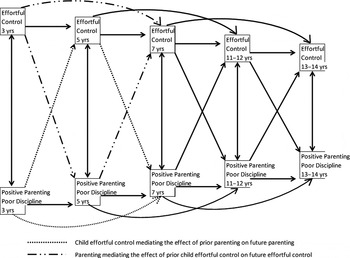
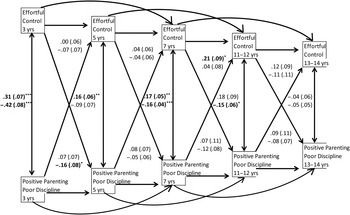
It was the purpose of the current study to examine the bidirectional association of child effortful control with (a) positive parenting and (b) negative discipline from ages approximately 3 to 13–14 years involving five time points. The three primary hypotheses, as shown in Figure 1, were that beyond stability in each construct across multiple developmental periods
-
• there would be (a) concurrent associations between parenting and child effortful control and (b) bidirectional effects across time from each aspect of parenting to effortful control and from effortful control to each aspect of parenting;
-
• concurrent associations, as well as bidirectional effects across time involving parenting and child effortful control, would be more robust in early childhood, from ages 3 to 7 years, and would diminish as indicated by significantly weaker effects at the older ages, 11–12 to 13–14 years; and
-
• feedback or transactional effects, a logical extension of bidirectional effects, would be found, for example, whether children's effortful control at age 3 years would be positively associated with their effortful control at age 7 years due to not only stability over time but also via effects on and from positive parenting at age 5 years.
Conceptual model relating parenting behaviors and child effortful control from child ages 3 to 13–14 years. The model accounts for (a) dependence within the same constructs over time, (b) concurrent correlations, (c) bidirectional cross-lagged predictions between child effortful control and parenting, and (d) bidirectional longitudinal transactions between child effortful control and parenting (i.e., mediated effects highlighted in dotted and dashed lines). In addition, (e) a time-invariant correlation between positive parenting and poor discipline was also estimated but is not shown.

Given that children born to younger parents are known to be at heightened risk for poorer impulse control (which is highly related to effortful control) and poorer parenting practices (Coley & Chase-Lansdale, Reference Coley and Chase-Lansdale1998; Florsheim et al., Reference Florsheim, Sumida, McCann, Winstanley, Fukui and Seefeldt2003), alternate models were estimated in which father's age at the time of the child's birth (fathers were the initial focus of this intergenerational study) was controlled. Thus, we assessed whether associations between child effortful control and parenting behaviors were attenuated by additional risk due to father's younger age.
Method
Participants
The fathers were, as boys, participants in the Oregon Youth Study (OYS). All boys in the fourth-grade classes (aged 9–10 years) of schools in neighborhoods with higher-than-average rates of delinquency in a medium-sized metropolitan area in the Pacific Northwest were invited to participate (74%, n = 206 were recruited); 90% were White, and most were from families of low socioeconomic status (Hollingshead, Reference Hollingshead1975). Of the living men, 89% or more participated at each of the yearly assessments from ages 9–10 to 40–42 years.
The ongoing Three Generational Study (3GS) recruited offspring of the OYS men and these children's mothers (some of whom were still in a romantic relationship with the father). Originally, all children and cohabitating stepchildren were allowed to participate. Because of budget limitations, recruitment was later limited to only the first two biological children per pairing of an OYS man with a woman (i.e., OYS men who fathered children with more than one woman could have more than two children followed in 3GS). The N available for each wave is determined by the ages of the maturing children, as well as child and parent participation at each assessment. The present study included 318 children (92% biological children of the OYS men) who originated from 150 families including 149 biological fathers and 192 biological mothers. (Note that some of the OYS men participated with more than one partner and no paternal data was available for one child whose father was deceased.) At the child age 3, 5, 7, 11–12, and 13–14 assessments, respectively, child sample size equaled N = 285, 280, 247, 176, and 147, with maternal parenting data available for N = 281, 273, 241, 172, and 147 of the children, and paternal parenting data available for N = 260, 253, 222, 150, and 147 of the children, respectively. Both mothers’ and fathers’ parenting behaviors were available for 91%, 88%, 87%, 83%, and 100% of the children at each successive assessment, respectively. In early childhood (age 5 years), 54% of the children lived with both biological parents; 18% and 2% with only the biological mother or father, respectively; 17% with the biological mother and a stepfather; 1% with the biological father and a stepmother; 4% part time with each biological parent; and 4% with other guardians. One-half of the children in 3GS (n = 160) were girls. Parents identified the children as European American (n = 236, 74.2%), African American (n = 17, 5.4%), Asian American (n = 7, 2.2%), Native American (n = 24, 7.5%), Hispanic or Latino (n = 16, 5.0%), or biracial (n = 18, 5.7%).
Procedures
The assessments involved two visits (one with the mother and child and one with the father and child) that included interviews, questionnaires, and observed interaction tasks (e.g., free play and cleanup tasks at younger ages; social teaching tasks and homework tasks at older ages). Assessments of children and parents in the 3GS included parent and child questionnaires and interviews, and laboratory parent and child tasks that provided observational data.
Measures
Sample items and the psychometric properties of each subscale by assessment and reporting agent (i.e., mother, father, child, or interviewer report) are reported in detail for all constructs by age in an appendix available from the authors (see https://www.oslc.org/wp-content/uploads/2016/05/TiberioCapaldiEtAl2016_MsTable.pdf). As the children matured from age 3 to 13–14 years across the study period, developmentally appropriate measures were used; thus, measures were not identical across waves for all constructs. To equate measures that varied by child age (and correct for differences in response scales from different questionnaires, e.g., binary vs. 5-point Likert scaled items), all measures were standardized within reporters, questionnaires, and assessments. Specifically, individual items from questionnaires were averaged within reporting agent to create subscales, which were then standardized for each dimension of each construct. When multiple reporting agents were available for the same measure, the subscales were correlated to check for congruence in reports (e.g., self- and partner reports of mothers’ poor discipline) and then averaged. Subscale scores and component items were then standardized within assessments. The correlations among the standardized subscale scores for each dimension of each construct were then assessed at each assessment (e.g., the correlations among the three dimensions of poor discipline, given by harsh discipline, low confidence in discipline, and poor implementation of discipline) and averaged.
Child effortful control
Child effortful control was measured using mother and father reports at child ages 3 and 5 years, and both parent and self-reports at ages 7, 11–12, and 13–14 years. The four dimensions of effortful control were activation control (e.g., “I do something fun for a while before starting my homework, even when I'm not supposed to”), inhibitory control (e.g., “Do you say things you shouldn't before you can stop yourself”), attention shifting (e.g., “My child has an easy time leaving play to come to dinner”), and attention focusing (e.g., “My child sometimes becomes absorbed in a picture book and looks at it for a long time”). Items were drawn from temperament questionnaires covering early childhood to adolescence; namely, the Child Behavior Questionnaire (Rothbart, Reference Rothbart1989); the Early Adolescent Temperament Questionnaire—Revised (Ellis & Rothbart, Reference Ellis and Rothbart1999); and the Late Childhood Temperament Questionnaire (based on the Child Behavior Questionnaire and the Early Adolescent Temperament Questionnaire—Revised in order to be age appropriate), including both parent (Capaldi, Reference Capaldi2000b) and child (Capaldi, Reference Capaldi2000a) versions. Congruence in mothers’ and fathers’ reports of each component of child effortful control was observed across all assessments (r = .35–.50, p = .001 to p < .001 for inhibitory control; r = .25–.51, p < .01 to p = .001 for attention shifting; and r = .22–.52, p = .001 to p < .001 for attention focusing); separately for each component, mothers’ and fathers’ scores were then averaged within assessments. The effortful control scores used in the analyses were obtained by averaging parent and child reports of inhibitory control, attention shifting, and attention focusing (r = .13–.41, p = .054 to p < .001) for associations between reporters.
Poor discipline
Mothers’ and fathers’ poor discipline was measured via self- and partner report using three subscales from the Discipline Questionnaire (Capaldi, Reference Capaldi1995): harsh discipline (six items; e.g., “How often do you scold or yell at your child when s/he won't mind you or breaks a rule”), poor implementation of discipline (seven items; “If you tell your child s/he will get punished if s/he doesn't stop doing something, and s/he keeps doing it, how often will you punish him/her?”), and low confidence in discipline (five items; “How much of the time do you feel confident that you can change or correct your child's behavior?”). Separately for each reporter, constituent items of each subscale were averaged. Congruence in self- and partner reports of mothers’ behaviors was observed across all assessments for low confidence in discipline (r = .31–.48, all ps < .001), poor discipline implementation (r = .13–.33, p = .058 to p < .001), and harsh discipline (r = .21–.30, p = .036 to p < .001); the one exception was for mothers’ harsh discipline at the final assessment at child ages 13–14 years (r = .05, p = .65). For fathers’ behaviors, congruence in self- and partner reports was observed for low confidence in discipline across all assessments (r = .34–.52, all ps < .001); for harsh discipline across the first three assessments (r = .20–.37, p = .004 to p < .001); at the final two assessments (r = .11, p = .23 and r = .01, p = .907, respectively); for poor discipline implementation at the first, third, and fourth assessments (r = .08–.34, all ps < .001); and at the second and final assessments (r = .08, p = .24 and r = .15, p = .16, respectively). Each of the three subscales was significantly related at the p < .001 level to one another across all assessments for mothers (r = .47–.53 for harsh discipline and poor implementation; r = .41–.52 for harsh discipline and low confidence; and r = .53–.64 for poor implementation and low confidence) and fathers (r = .40–.57 for harsh discipline and poor implementation; r = .39–.46 for harsh discipline and low confidence; and r = .42–.62 for poor implementation and low confidence). The poor discipline scores for mothers and fathers used in the analyses were obtained by averaging the harsh discipline, poor implementation of discipline, and low confidence in discipline subscales.
Positive parenting
Positive parenting was assessed by items from 13 questionnaires in total (measures used varied across time points); namely, the Child Rearing Practices Report (Block, Reference Block1965), the Parent Daily Report (Chamberlain & Reid, Reference Chamberlain and Reid1987), Monitor and Parent–Child Relationship (Capaldi & Wilson, Reference Capaldi and Wilson1998), the Parent Interview (Capaldi, Pears, Wilson, & Bruckner, Reference Capaldi, Pears, Wilson and Bruckner1998), Parent Interviewer Ratings (Capaldi & Wilson, Reference Capaldi and Wilson1994), Coder Ratings for Clean-Up Task (Pears & Ayres, Reference Pears and Ayres2000), the Experimenter Ratings Inventory (Pears & Ayres, Reference Pears and Ayres2000), Play Task Experimenter Ratings (Pears & Ayres, Reference Pears and Ayres2000), Cognitive Task Experimenter Ratings (Fagot & Gauvain, Reference Fagot and Gauvain1997), Communication Task Experimenter Ratings (Pears & Ayres, Reference Pears and Ayres2000), Discussion Task Ratings (Oregon Social Learning Center, 1985), Homework Task Ratings (Knutson & Forgatch, Reference Knutson and Forgatch1990), Parent Interview Ratings (Capaldi & Wilson, Reference Capaldi and Wilson1994), the Parent Interview (Capaldi et al., Reference Capaldi, Pears, Wilson and Bruckner1998), and Child Interviewer Ratings (Capaldi, Pears, Wilson, & Bruckner, Reference Capaldi, Pears, Wilson and Bruckner2001).
The scales assessed involved the following: age 3 years: parent report of enjoyment of parenting (e.g., how much they enjoy playing with the child) and observed positive behaviors with the child (e.g., during a cleanup task); age 5 years: parent reports of their relationship with their child (e.g., how well they get along), observed positive behaviors with the child (e.g., from a parent–child communication task), and parental reports of monitoring of the child (e.g., “How well do you keep track of your child”). Assessment of positive parenting remained relatively similar at later ages to the age 5 assessment, although the tasks during which positive parenting was observed varied by age (e.g., a social teaching task and a discussion task).
The positive parent–child relationship subscales showed significant associations; parental reports were significantly associated with the composite scores from the observational ratings across all assessments (r = .20–.33, p < .001 to p = .003 for mothers; r = .14–.24, p < .001 to p = .052 for fathers). Regarding the associations between the two positive parenting subscales at the older ages, parental monitoring and positive parent–child relationships were significantly associated at all assessments for mothers (r = .13–.37, p < .001 to p = .042) and fathers (r = .21–.40, p < .001 to p = .001). At child age 3 years, the pleasure in parenting and positive responsiveness to child subscales were significantly associated for fathers (r = .23, p = .002) but not mothers (r = .10, p = .152). The positive parenting scores for mothers and fathers used in the analyses were obtained by averaging the two subscales.
Data Analytic Plan
Hypotheses were tested using autoregressive cross-lagged panel (ACLP) models (Dwyer, Reference Dwyer1983; see Figure 1), which account for stability in each construct over time (e.g., longitudinal associations of child effortful control from early childhood to early adolescence), in addition to concurrent correlations (e.g., contemporaneous associations among child effortful control and each of the parenting behaviors) and cross-lagged predictions across constructs (e.g., the prediction of child effortful control from prior parenting behaviors). Maternal and paternal models were always run separately, and included simultaneous prediction from and to both aspects of parenting (while allowing for concurrent associations between parenting behaviors, i.e., mothers’ poor discipline and mothers’ positive parenting at child age 5 years). Regarding model estimation, dependence among siblings' scores (i.e., N = 318 children were nested within 150 families) was accounted for by adjusting the standard errors using a sandwich estimator using the complex samples option in Mplus versions 7.3 (Muthen & Muthen, Reference Muthén and Muthén1998–2012). In addition, given that sample size varied across assessments as a function of the maturing children, all models were fitted using maximum likelihood estimation with robust standard error estimation (Muthen & Muthen, Reference Muthén and Muthén1998–2012), which is known to yield unbiased estimates when data are missing at random (MAR; Muthen & Muthen, Reference Muthén and Muthén1998–2012). The MAR assumption seems reasonable given that missing data at older ages is highly dependent on child's age. Thus, to improve the plausibility of the MAR assumption, the auxiliary option was used in Mplus version 7.3 to specify child's age as of December 31, 2015, as an additional missing data correlate (in addition to the other study variables; Muthen & Muthen, Reference Muthén and Muthén1998–2012). It should be noted that the date selected to calculate differences in children's ages is arbitrary, and any other date would have yielded the same proportional relation among the scores. Finally, model fit was examined using the following fit indices: the comparative fit index, the Tucker–Lewis index, and 90% confidence intervals for the root mean square error of approximation.
In order to test the first hypothesis (depicted in Figure 1), maternal and paternal ACLP models were separately fit using all five waves of data from early childhood to early adolescence and all effects were free to vary over time. Specifically, both child effortful control and the two parenting behaviors were modeled simultaneously in the ACLP models to evaluate (a) concurrent correlations between child effortful control and parenting behaviors and (b) time-lagged effects of child effortful control on parenting and vice versa (parenting on child effortful control) across multiple periods of the children's development. Thus, these models yielded time-variant effects, specifically for each aspect of parenting, eight cross-lagged effects, and five concurrent associations denoting relations among child effortful control and parenting behaviors across approximately a 10-year period from early childhood to early adolescence. Next, to address the second hypothesis that contemporaneous associations and bidirectional predictions between child effortful control and parenting behaviors would both decrease as children aged, all concurrent and cross-lagged effects that were found to be statistically significant across multiple periods of children's development were examined further. Specifically, in two separate models, effects at different periods of children's development (i.e., concurrent or time-lagged effects) were either freely estimated or constrained to be equal (after accounting for differences in elapsed time between assessments for the time-lagged effects), and overall change in model fit was evaluated via the Wald statistic. For example, if parents’ poor discipline practices during two points in early childhood (e.g., child ages 5 and 7 years) were negatively predicted by children's effortful control 2 years prior (e.g., child ages 3 and 5 years, respectively), we would next examine if the strength of such associations significantly differed from one another across the different ages via equality constraints and the Wald statistic. Thus, effects were either freely estimated across assessments or set to be equal over time (e.g., stability in cross-time associations). Equality constrains for the cross-lagged effects were imposed on the parameter estimates such that the strength of the association was dependent on the elapsed time between assessments (which occurred biannually except for the 4-year gap between child ages 7 and 11 years). Thus, cross-lagged coefficients involving predictions from the child age 7 years variables to the child age 11–12 year variables were constrained to be half as large as all of the other cross-lagged predictions that spanned approximately a 2-year period. For example,
 $${b_{{\rm Age}5, {\rm Age}7}} = \displaystyle{1 \over 2}\times{b_{{\rm Age}7, {\rm Age}11}}$
Equality constraints were imposed in Mplus version 7.3 using the model constraint command (Muthen & Muthen, 1998–2012).
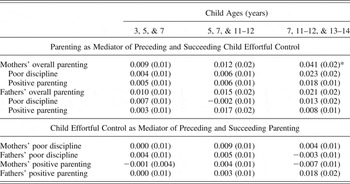
Tests of the third hypothesis regarding transactional processes between child effortful control and parenting behaviors (parental discipline and positive parenting, or the aggregate of both, run separately for mothers and fathers) were assessed by examining mediated effects, which were via the cross-lagged effects (see Figure 1, dashed lines). These mediational tests allowed for assessment of (a) whether parenting behaviors mediated the association between children's prior and future effortful control and (b) whether children's effortful control mediated the associations between prior and future parenting behaviors. Specifically, for each parenting behavior, we examined whether lower child effortful control predicted poorer parenting at the next time point, and then whether the poorer parenting predicted lower child effortful control for children at one more subsequent time point. Likewise, for the converse associations, we examined whether poorer parenting predicted lower child effortful control at the next time point, and then whether the lower child effortful control in turn predicted poorer parenting at the third (in this sequence) time point. When the two parenting behaviors were examined as the mediators of preceding and succeeding child effortful control, this yielded a two mediator model (MacKinnon, Reference MacKinnon2008); and the total mediated effect was examined to test whether the combination of poor discipline and lack of positive parenting mediated the development of child effortful control.
Finally, for those cross-lagged effects that were found to vary over children's development, transactional processes were tested across three time periods: in early childhood (ages 3, 5, and 7 years), from early to middle childhood (ages 5, 7, and 11–12 years), and midchildhood to early adolescence (ages 7, 11–12, and 13–14 years). In other words, the model yielded three possible sets of mediated effects related to child age that were examined separately.
Results
Correlations
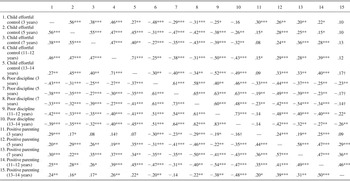
The bivariate correlations among the study variables are given in Table 1. All longitudinal associations among repeated measures of the same construct (i.e., child effortful control and each of the maternal and paternal parenting behaviors) were positively associated across all assessments. For child effortful control, variables were significantly associated across all developmental periods, with the largest association of r = .71 observed across child ages 11–12 and 13–14 years and the smallest association of r = .27 observed for measures spanning approximately 10 years from child ages 3 to 13–14 years. Likewise, for both positive parenting and poor discipline, each was significantly associated across all developmental periods. Associations for poor discipline ranged from moderate to large for both fathers (r = .51–.83) and mothers (r = .40–.73), and for positive parenting associations ranged from small to moderate for both fathers (r = .20–.57) and mothers (r = .19–.58). However, the one exception was that mothers' positive parenting behaviors at child ages 3 and 13–14 years were not significantly associated.
Correlations among the study variables

Note: Associations involving maternal and paternal parenting behaviors are given above and below the diagonal, respectively.
†p < .10. *p < .05. **p < .01. ***p < .001.
The concurrent associations of child effortful control with each of the parenting behaviors are also shown in Table 1. Higher levels of poor discipline and lower levels of positive parenting were both associated with poorer concurrent child effortful control, both for fathers (r = –.35 to –.45 and r = .22–.39, respectively) and for mothers (r = –.43 to –.50 and r = .28–.39, respectively). However, the one exception was that mothers' positive parenting and effortful control were not significantly associated at child ages 13–14 years.
The cross-lagged, bidirectional effects involving child effortful control and parenting are also provided in Table 1. They indicate positive associations for positive parenting and negative associations for poor discipline. For associations where parenting behaviors temporally preceded child effortful control at adjacent assessments, associations for mothers ranged from r = –.31 to –.52 for poor discipline and r = .15–.40 for positive parenting; similarly for fathers, associations ranged from r = –.27 to –.41 for poor discipline and r = .17–.45 for positive parenting. For the opposite associations where child effortful control temporally preceded parenting behaviors at adjacent assessments, associations for mothers ranged from r = –.29 to –.43 for poor discipline and r = .12 (which was nonsignificant) to .28 for positive parenting; for fathers, associations ranged from r = –.32 to –.40 for poor discipline and r = .22–.26 for positive parenting. In sum, these bivariate associations provide support for stability in all constructs across time, contemporaneous association across constructs, and potentially for bidirectional associations of child effortful control and parenting behaviors. The results from the maternal and paternal multivariate ACLP models are now considered, which denote simultaneous estimation of all effects in order to determine whether certain effects are attenuated by the other effects in the model.
Multivariate path analyses
Model fit
Both the maternal and paternal path models relating parenting behaviors to child effortful control from child ages 3 to 13 years fit the data well, respectively, for mothers and fathers, comparative fit index = 0.95 and 0.93, Tucker–Lewis index = 0.90 and 0.85, 90% confidence interval for root mean square error of approximation = (0.04, 0.08) and (0.05, 0.08).
Dependence within the same construct over time
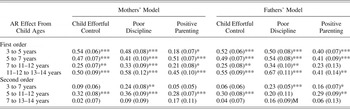
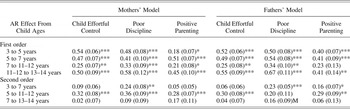
Standardized parameter estimates and associated standard errors for the first- and second-order autoregressive effects from the multivariate path models are shown in Table 2. First, for all five constructs (i.e., child effortful control and each of the parenting behaviors), all first-order effects were positive and significant; the one exception was for fathers' positive parenting, which was not significantly associated across the child age 7 and 11–12 years assessments. First-order predictions denoting the stability of constructs over time ranged from moderate in size across successive adjacent 2-year intervals (from child ages 3 to 5, 5 to 7, and 11–12 to 13–14 years) to small in size across the adjacent 4-year interval (from child ages 7 to 11–12 years) for all constructs; the only exceptions were for positive parenting, which was estimated to be a small, significant effect for mothers from child ages 3 to 5 years and nonsignificant for fathers from child ages 7 to 11–12 years.
For second-order effects (see Table 2) estimated over the 4-year interval from early to middle childhood (child ages 3 to 7 years), support for higher order stability (i.e., stability over a 4-year period beyond what was explained over a 2-year period) was found for maternal and paternal poor discipline and paternal (but not maternal) positive parenting. In contrast, no support for higher order stability was found for child effortful control from early to middle childhood (child ages 3 to 7 years). For second-order effects denoting predictions over the subsequent 6-year intervals, evidence for higher order stability was found from child ages 5 to 11–12 years, such that all constructs yielded positive and significant effects except for fathers’ poor discipline; however, no evidence of second-order stability was found for any of the constructs across the last developmental period from child ages 7 to 13–14 years. In sum, for the majority of constructs, significant dependence across time was observed, with adjacent time points yielding significant associations and adjacent +1 time points yielding at least one significant association per construct from child ages 3–13 years.
Concurrent associations between child effortful control and parenting behaviors
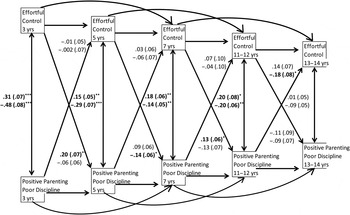
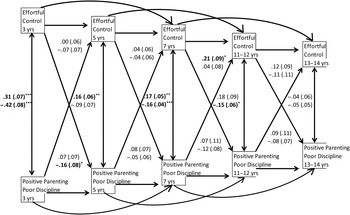
The first hypothesis included the prediction that there would be concurrent associations between parenting and child effortful control. Figures 2 and 3 provide the significance, standardized parameter estimates, and associated standard errors for the concurrent associations between child effortful control and each of the parenting behaviors for mothers and fathers, respectively. For mothers and fathers, at child ages 3, 5, 7, and 11–12 years, children's effortful control was positively related to positive parenting and negatively related to poor discipline; the two exceptions were that fathers’ poor discipline at child age 5 years and fathers’ positive parenting at child ages 11–12 years were not significantly associated with concurrent measures of child effortful control. At child ages 13–14 years, none of the parenting behaviors were significantly related to children's concurrent effortful control. In sum, these results suggest that concurrent parenting behaviors and child effortful control were significantly related in early through middle childhood, but not in early adolescence.
Path model results for maternal positive parenting and poor discipline behaviors and child effortful control from child ages 3 to 13–14 years. Figured numbers denote standardized parameter estimates and associated standard errors of effects for positive parenting (first line) above poor discipline (second line); significant associations observed between concurrent positive parenting and poor discipline (r = –.13, p = .04 to r = –.35, p < .001). *p < .05. **p < .01. ***p < .001.

Path model results for paternal positive parenting and poor discipline behaviors and child effortful control from child ages 3 to 13–14 years. Figured numbers denote standardized parameter estimates and associated standard errors for effects for positive parenting (first line) above poor discipline (second line); significant associations observed between concurrent positive parenting and poor discipline (r = –.15, p = .02 to r = –.36, p = .01). *p < .05. **p < .01. ***p < .001.
The second hypothesis included the prediction that concurrent associations involving parenting and child effortful control would be more robust in early childhood, from ages 3 to 7 years, and would diminish as indicated by significantly weaker effects at the older ages, 11–12 to 13–14 years. To address this hypothesis, four omnibus tests were examined that imposed equality constraints for the concurrent associations between each parenting behavior and child effortful control across all five time points. Support was found that contemporaneous associations varied across early childhood to early adolescence as overall model fits were improved with relaxed equality constraints: for child effortful control and (a) mothers’ poor discipline Wald (4) = 22.01, p < .001; (b) fathers’ poor discipline Wald (4) = 15.21, p = .004; (c) mothers’ positive parenting Wald (4) = 15.83, p = .003; and (d) fathers’ positive parenting Wald (4) = 19.90, p < .001. The largest and smallest associations between child effortful control and the parenting behaviors were observed at the initial (age 3 years) and final (age 13–14 years) assessments, respectively. However, as children matured, the patterns did not monotonically decrease for poor discipline or increase for positive parenting. Next, each of the bivariate associations across assessments was examined to test whether concurrent associations between child effortful control and each of the parenting behaviors were significantly different across two different time periods (e.g., at child ages 3 vs. 13–14 years). Results indicated that concurrent associations between positive parenting and child effortful control were significantly weaker in early adolescence (child ages 13–14 years) than at child age 3 years, Wald (1) = 15.72, p < .001 for fathers, Wald (1) = 13.01, p < .001 for mothers; 5 years, Wald (1) = 6.36, p = .01 for fathers, Wald (1) = 4.39, p = .04 for mothers; 7 years, Wald (1) = 10.07, p = .002 for fathers, Wald (1) = 5.42, p = .02 for mothers; and 11–12 years, Wald (1) = 4.24, p = .04 for mothers only. In addition, for mothers’ positive parenting only, associations at child age 3 years were significantly stronger than associations at child age 5 years, Wald (1) = 4.45, p = .03. No other bivariate tests involving positive parenting indicated significant differences across time periods. Results for poor discipline and child effortful control indicated that concurrent associations at child age 3 years were significantly greater than concurrent associations observed at child age 5 years, Wald (1) = 9.65, p = .002 for fathers only; 7 years, Wald (1) = 8.45, p = .003 for fathers, Wald (1) = 11.62, p < .001 for mothers; 11–12 years, Wald (1) = 7.77, p = .005 for fathers, Wald (1) = 7.88, p = .005 for mothers; and 13–14 years, Wald (1) = 14.43, p < .001 for fathers, Wald (1) = 18.42, p < .001 for mothers. No other bivariate tests indicated significant differences between the strength of the concurrent associations between fathers’ poor discipline and child effortful control at different developmental periods; whereas for mothers, the only other significant effect indicated that associations were significantly greater at child age 5 years than at child age 13–14 years, Wald (1) = 5.98, p = .01. In sum, these results suggest that (a) concurrent associations between child effortful control and positive parenting behaviors were significantly greater during three periods from early to middle childhood (age 3, 5, and 7 years) than in early adolescence (age 13–14 years), and (b) concurrent associations between child effortful control and poor discipline were significantly greater in early childhood (age 3 years) than in late childhood and early adolescence (ages 11–12 and 13–14 years).
Cross-lagged predictions between child effortful control and parenting behaviors
The first hypothesis, that bidirectional effects across time from each aspect of parenting to effortful control and from effortful control to each aspect of parenting would be found, was partially supported (see cross-lagged effects in Figures 2 and 3). Starting with the prediction of mothers’ parenting behaviors (Figure 2), greater child effortful control at child ages 3 and 7 years was associated with greater maternal positive parenting at child ages 5 and 11–12 years, respectively, and poorer child effortful control at age 5 years predicted greater maternal poor discipline at age 7 years. These were the only significant cross-lagged effects for mothers. For the prediction of fathers’ parenting behaviors (Figure 3), the only significant effect was that poorer child effortful control at age 3 years was associated with greater poor discipline at age 5 years. For the converse predictions of child effortful control from prior parenting behaviors, significant effects were found at the last two time points only. Specifically, greater paternal positive parenting predicted better child effortful control from ages 7 to 11–12 years, and greater maternal poor discipline predicted poorer child effortful control in early adolescence (from ages 11–12 to 13–14 years). Thus, when considering all effects simultaneously, contrary to predictions, no support was found that parenting behaviors affected children's development of effortful control across middle childhood (ages 5 and 7 years), and support was limited in late childhood and early adolescence.
Next, the second hypothesis regarding a reduction with age in the magnitude of the cross-lagged paths was tested. Given that mothers’ positive parenting was the only construct involved in significant cross-lagged effects across at least two different developmental periods, only one test was needed, specifically, whether the effects of prior child effortful control on mothers’ positive parenting significantly differed from child ages 3 to 5 years versus 7 to 11–12 years. To account for differences in the elapsed time between adjacent assessments, a Wald test was conducted such that the cross-lagged effect involving prediction from the child age 7 years variables to the child ages 11–12 year variables was constrained to be half as large as the cross-lagged effect from the child age 3 years to 5 years assessments. Results indicated a nonsignificant difference between the estimated cross-lagged paths, Wald (1) = 3.28, p = .07.
All in all, these results indicated limited support for the hypothesis regarding expected significant bidirectional longitudinal associations (while accounting for concurrent associations and stability effects). Although some results suggested that child temperament influences parenting (and vice versa), this was not true across all ages and constructs. Prior child effortful control influenced current poor discipline in only early to middle childhood (age 5 years for fathers and 7 years for mothers), and only mothers’ positive parenting was predicted by prior child effortful control from ages 3 to 5 years and 7 to 11–12 years. For the prediction of child effortful control from prior parenting behaviors, significant effects were found at the last two time points only (ages 11–12 year for fathers’ positive parenting and ages 13–14 years for mothers’ poor discipline). Thus, contrary to predictions, no support was found for parenting behaviors affecting child effortful control across middle childhood (ages 5 and 7 years).
Transactional processes between child effortful control and parenting behaviors
Next, the third hypothesis was evaluated by examining transactional processes involving mediated effects between parenting and child effortful control (see Table 3). Regarding parenting as the mediator, the only significant transactional effect found was for mothers across the last three time periods; the aggregate effect of mothers’ poor discipline and lack of positive parenting at child ages 11–12 years was a significant mediator of associations between their children's prior (age 7 years) and future (ages 13–14 years) effortful control. Fathers’ parenting behaviors (examined both separately and together) did not significantly mediate relations between children's prior and future effortful control. Likewise, for both mothers and fathers, child effortful control was not a significant mediator between prior and future parenting behaviors during any period from middle childhood to early adolescence.

In sum, only limited support was found for longitudinal transactional processes between child effortful control and parenting behaviors, with a combination of both poor discipline and lack of positive parenting by mothers playing the most salient role across middle childhood to early adolescence. Thus, after accounting for stability in constructs and contemporaneous associations, transactional processes do not appear to operate in tandem; only maternal parenting behaviors mediated the associations between children's prior and future effortful control across the last three assessments.
Controlling for the effects of fathers’ age on parenting and child effortful control
Finally, the maternal and paternal ACLP models were estimated such that father's age at the time of the child's birth was included as a time-invariant control on each of these factors, thus assessing whether any significant associations between child effortful control and parenting behaviors were attenuated by additional risk due to father's younger age. Main effects of fathers’ age were significant in the expected directions; children born to younger fathers had poorer effortful control (b = 0.09, p = .005 and b = 0.10, p = .002 for the paternal and maternal models, respectively) and were more likely to experience greater poor discipline (b = –0.08, p = .01 for fathers; b = –0.08, p = .015 for mothers) and less positive parenting (b = 0.19, p < .001 for fathers; b = 0.13, p < .001 for mothers). However, all significant autoregressive, concurrent, and mediated effects persisted and were not attenuated by father's younger age. Regarding the significance of cross-lagged associations, all effects involving the prediction of parenting behaviors from prior child effortful control remained unchanged. However, the one difference to note involved the prediction of child effortful control in early adolescence (ages 13–14 years) from mothers’ prior parenting behaviors at ages 11–12 years; poor discipline was reduced to marginal significance (b = –0.17, p = .058), whereas positive parenting reached significance (b = 0.14, p = .038). In sum, for almost all effects, associations between child effortful control and parenting behaviors persisted beyond additional risk in each of these factors attributable to father's younger age.
Discussion
Transactional associations of child effortful control and two key aspects of parenting, namely, poor discipline and positive parenting of both mothers and fathers, were examined from the preschool (age 3 years) to early adolescent (ages 13–14 years) periods. The models provided rigorous tests of transactional effects across time and developmental periods as they also accounted for associations within constructs across time and concurrent associations between effortful control and parenting. Evidence was found for some of the hypothesized bidirectional effects over time. Parenting predicted children's later effortful control, but this was only true at the older ages for mothers’ poor discipline (from ages 11–12 to 13–14 years) and fathers’ positive parenting (from ages 7 to 11–12 years). At the earlier ages, the converse was true, with effortful control predicting later positive parenting and poor discipline for mothers, and poor discipline for fathers. Support for a transactional effect involving mothers also was found, with the aggregate of both greater positive parenting and less poor discipline at ages 11–12 years mediating the association between children's prior (age 7 years) and future (ages 13–14 years) effortful control. In addition, effortful control was concurrently associated with each aspect of mothers’ and fathers’ parenting at essentially every period from early to late childhood, but not in early adolescence (age 13–14 years).
Although associations maternal and paternal parenting had with child effortful control were not compared directly, there was evidence of differential effects. That is, poor maternal discipline, involving harsh and inconsistent discipline, was linked with the development of poorer effortful control in early adolescence. Whereas for fathers, positive parenting had positive associations with children's effortful control in late childhood (ages 11–12 years). However, at the younger ages (5 and 7 years), neither mothers’ nor fathers’ parenting behaviors from the previous 2 years predicted child effortful control. Considering that all of the bivariate associations involving adjacent measures of child effortful control and each of the parenting behaviors were significant in early and middle childhood, these null results from the multivariate models could suggest that stability within effortful control across time and contemporaneous associations between parenting and effortful control outweigh any influences that prior parenting may have on the development of subsequent effortful control. Thus, the development of effortful control in early childhood appears to be more determined by prior levels of effortful control and concurrent parenting behaviors than by prior maternal and paternal poor discipline and low levels of positive parenting.
The significant concurrent associations between effortful control and parenting, for both poor discipline and positive parenting and for both mothers and fathers, is further evidence that parent behavior and this aspect of child temperament are intimately related within time across multiple developmental periods. Note that at age 3 years, the first time point of the study, with no prior predictors either from child effortful control or from parenting competing for variance, the concurrent associations were considerably higher than at later ages. Concurrent associations involving child effortful control and positive parenting were significantly weaker in early adolescence (ages 13–14 years) than in the preschool years and early to middle childhood (ages 3, 5, and 7 years). Similarly, for poor discipline, concurrent associations observed during late childhood and early adolescence (ages 11–12 and 13–14 years) were both significantly weaker than the association observed during the preschool years (age 3 years). By ages 13–14 years, concurrent associations of child effortful control and parenting were nonsignificant. These findings may indicate that, by early adolescence, levels of effortful control are relatively established or stable and are less affected by concurrent parenting. This is consistent with findings and interpretations of other researchers that by early adolescence there is less influence of parenting on effortful control (Kiff et al., Reference Kiff, Lengua and Zalewski2011). It is also possible that by early adolescence, competing influences on effortful control, such as peer influences, are more salient than in earlier childhood.
Prediction from mothers’ positive parenting to child effortful control was observed in early adolescence (from ages 11–after accounting for 12 to 13–14 years), but this was only supported after accounting for additional risk for poorer child effortful control and poorer parenting behaviors due to fathers’ younger age in the model. Such limited support was not expected, given such effects have been found in prior studies (e.g., Eisenberg et al., Reference Eisenberg, Zhou, Spinrad, Valiente, Fabes and Liew2005; Spinrad et al., Reference Spinrad, Eisenberg, Gaertner, Popp, Smith and Kupfer2007). However, our models simultaneously examined poor discipline, whereas most prior studies have only studied a single aspect of parenting at a time. When mothers’ positive parenting was the only parenting variable in the model (i.e., poor discipline was omitted from the model; results available upon request from the authors), mothers’ prior positive parenting was predictive of child effortful control in early adolescence (ages 13–14 years). Note, however, that concurrent poor discipline and positive parenting were significantly negatively associated in the maternal model (as well as in the paternal model); therefore, it is more realistic that those children growing up in homes with less positive parenting are also more likely to experience poorer discipline practices. All in all, these findings are consistent with the notion that maternal poor discipline had a stronger (and disruptive) effect on the development of effortful control (Eisenberg et al., Reference Eisenberg, Smith, Spinrad, Vohs and Baumeister2011) than did maternal positive parenting.
The finding regarding the significance of paternal positive parenting for the development of their children's effortful control in late childhood (ages 11–12 years) emphasizes the beneficial role that ongoing positive father engagement with a child may have in a child's life (Parke, Reference Parke and Bornstein2002). The OYS men are predominantly lower and working class and with relatively low levels of education (e.g., very few attended a 4-year college). Further, as men from at-risk neighborhoods in childhood, they had relatively high levels of antisocial behavior and arrests, particularly in adolescence and young adulthood (Wiesner, Capaldi, & Kim, Reference Wiesner, Capaldi and Kim2007). Thus, it is notable that the men could be positive forces in their children's development.
Few prior studies have examined multiple aspects of transactional associations of child temperament and parenting across such a long period. We noted considerable stability of individual differences in effortful control as well as positive parenting and poor discipline across the 10–11 years of childhood from age 3 years to early adolescence, spanning periods of rapid growth and developmental change. This would seem to be consistent with the contention of Kiff et al. (Reference Kiff, Lengua and Zalewski2011) that there is a sensitive period in the infant and preschool years when genetic tendencies, early parenting, and context, or a combination of these factors influence effortful control, which then shows some stability over time. Kiff et al. also considered that parenting might have the greatest effect on the development of effortful control in these early years. However, we did not find time-lagged effects of parenting on effortful control in early to middle childhood, which tends not to support the notion of a sensitive period for the influence of parenting. On balance, however, we are cautious about interpreting these null effects that may reflect relatively low statistical power. In addition, the first prediction over time in the present study from parenting to child effortful control was across the ages of 3–5 years; thus, prediction from prior parenting was not examined in the first 3 years of life. Child effortful control showed malleability across the entire developmental stages examined in the present study from early childhood to early adolescence, particularly to detrimental effects over time from maternal poor discipline in early adolescence and beneficial effects from father's positive parenting in late childhood.
Better child effortful control predicted lower levels of future (as well as concurrent) poor paternal and maternal discipline and higher levels of maternal positive parenting. These patterns are consistent with theories regarding gene–environment correlations where differential genetic risks among children are posited to evoke differential parenting, as well as with a dynamic model of social influence processes (Capaldi & Eddy, Reference Capaldi, Eddy, Gullotta, Evans and Plant2014) and with other studies showing that child behavior affects parenting (Belsky et al., Reference Belsky, Fearon and Bell2007). These findings are encouraging in that both mothers and fathers appear to be responsive to their children and change their parenting behaviors in relation to their children's development. However, it also reinforces the well-known observation that it is challenging to deal with children who are less skilled in controlling their behavior. Effortful control, as assessed in the present study, involved activation control, attentional focus and shifting, and inhibitory control. Higher levels of these temperamental skills will relate to overall stronger behavioral regulation and responsiveness of the children, making them easier to interact with, teach, and manage. These findings emphasize the importance of assisting parents of children with lower levels of effortful control to improve their discipline and positive parenting practices. The significance of the concurrent associations of parenting and child effortful control at age 3 years, along with the significant predictions of poor discipline from prior child effortful control from ages 3 to 5 years for fathers and ages 5 to 7 years for mothers, indicates that such assistance should occur early in childhood, whereas, the effects across time for maternal positive parenting from ages 3 to 5 years and from ages 7 to 11–12 years indicate that intervention may continue to be beneficial into late childhood.
There was no evidence for the second hypothesis regarding reductions in the associations of parenting and child effortful control across time points with child age. Only fathers’ positive parenting at age 7 years and mothers’ poor discipline at ages 11–12 years was predictive of children's future effortful control. Conclusions regarding decreased associations with age (specifically for positive parenting and child effortful control) have been estimated from reviews of different studies (Kiff et al., Reference Kiff, Lengua and Zalewski2011), because no other studies of which we are aware have spanned the preschool years through early adolescence. Regarding the prediction of parenting from prior effortful control, effects were found for maternal positive parenting across two time periods from ages 3 to 5 years and ages 7 to 11–12 years. Although the prediction was higher from ages 3 to 5 years, estimates across the two developmental periods were not found to significantly differ from one another. This could suggest that maternal positive parenting is equally influenced by child effortful control in middle and late childhood.
Regarding the third hypothesis, only limited support was found for longitudinal transactional associations between effortful control and parenting across early childhood to early adolescence. Specifically, results supported that the aggregate of mothers’ poor discipline and lack of positive parenting in late childhood (ages 11–12 years) is a mechanism that explains children's development of effortful control from middle childhood to early adolescence. Poorer effortful control at age 7 years predicted poorer discipline practices and less positive parenting by mothers at age 11–12 years, which in turn leads to poorer child effortful control in early adolescence (age 13–14 years). However, no evidence was found that fathers’ parenting mediates associations between children's prior and future effortful control at any point from early childhood to early adolescence. Mothers usually spend more time with children than do fathers (Craig, Reference Craig2006), and this may partially explain the effect found for mothers. Regarding the converse association, child effortful control was not found to significantly mediate the effect of prior parenting on subsequent parenting practices for mothers or fathers.
The findings regarding limited longitudinal transactional associations should be considered in light of the fact that specific transactional effects are likely to be relatively modest in magnitude, given that they trace only a single strand in a web of influences. For example, it is possible that child effortful control could mediate effects between parents (e.g., of mothers’ prior parenting on fathers’ future parenting) or across different types of parenting (e.g., prediction of future positive parenting from prior poor discipline). Thus, it is possible that poor discipline practices (or lack of positive parenting) could create environments for children that hinder the development of regulation skills (such as effortful control) and, given the known challenges of interacting with children who are less skilled in controlling their behavior, this could lead to less pleasure in parenting and less positive parenting (or poorer discipline practices). Future research may examine these possibilities in larger samples that are adequately powered to detect what may be small effects.
Maternal and paternal models were also considered that included father's age at the time of the child's birth as a control on each of the constructs. Children born to younger fathers had poorer effortful control and were more likely to experience greater poor discipline and less positive parenting by both mothers and fathers. However, these additional risks attributable to father's younger age did not account for the associations between child effortful control and parenting behaviors: stability in each construct across time, concurrent associations between effortful control and parenting behaviors, bidirectional associations, and the transactional effect of mothers’ overall parenting in explaining children's development of effortful control all persisted. However, it should be noted that the only effects that did change in significance involved the prediction of child effortful control in early adolescence (ages 13–14 years) from mothers’ prior parenting behaviors at ages 11–12 years; poor discipline was reduced to marginally significant, whereas positive parenting changed from marginal to statistically significant. Thus, although one cross-lagged effect involving mothers’ poor discipline was attenuated by additional risk due to father's younger age, another significant cross-lagged effect was found for mothers’ positive parenting in the prediction to children's future effortful control. These findings suggest that associations between effortful control and parenting behaviors are robust. However, they should be interpreted in light of the fact that father's younger age is only one of many possible risk factors for poorer parenting practices and children's development, and the present study did not include other personal and contextual risk factors, which are often present for younger parents (Coley & Chase-Lansdale, Reference Coley and Chase-Lansdale1998).
The present study had a number of strengths, including five measurement time points spanning ages 3 to 13–14 years, and assessment of two complementary aspects of parenting, namely, discipline and positive parenting, for both mothers and fathers. Models were also considered that included father's age at the time of the child's birth as a control on each construct. Nonetheless, the study also had some limitations. A relatively small sample size precluded direct comparisons of most maternal and paternal models or examination of differential effects by child gender or ethnicity. Because the children were offspring of participants in another longitudinal study, they were not all from one cohort and sample sizes were smaller at the older ages. In addition, the positive parenting and child effortful control measures were not identical by child age, but rather reporters and items varied to be developmentally appropriate. For effortful control, differences in measures by assessments predominately related to which of the four subscales (i.e., inhibitory control, attention shift, attention focus, and activation control) were available. For example, effortful control subscales related to attention and inhibitory control were included at every assessment, but activation control was only available at the two oldest ages; in addition, child self-reported effortful control was included (along with parents’ reports) at the last three assessments only (once children had matured enough to provide reliable answers). In contrast, differences in the positive parenting measures by assessment were more pronounced with measures comprising two sets of subscales: pleasure in parenting and positive responsiveness to child behaviors at child age 3 years, and positive parent–child relationship and parental monitoring of child at child ages 5 to 13–14 years. Thus, excluding findings related to maternal and paternal poor discipline (which did not vary by assessments), differences in measures by assessment could be a confounding factor in explaining the observed differences in the estimated associations among child effortful control and each parenting across the different developmental periods. Finally, the current study included a combination of child-, parent-, and partner-reported measures, as well as observational ratings of parent–child interactions. For the majority of the constructs, associations between different reporters were significant but estimated to be small to moderate in size. Low congruence between parents’ reports could reflect that one parent may spend more time with, and thus be a more accurate reporter of, child temperament and parenting behaviors, whereas low associations involving observational ratings could reflect that parents and children may act in a more socially desirable manner when under direct observation than when completing questionnaires that afford anonymity. Thus, findings should be interpreted in light of these limitations.
Overall, the findings of the present study involving a relatively rigorous test across developmental periods from preschool to early adolescence emphasize that associations between children's temperament and parenting practices known to predict future risk for the child, such as externalizing behaviors (Olson et al., Reference Olson, Sameroff, Kerr, Lopez and Wellman2005; Ormel et al., Reference Ormel, Oldehinkel, Ferdinand, Hartman, De Winter and Veenstra2005) and substance use (MacDonald, Reference MacDonald2008), are bidirectional. The long-term effects on the child's adjustment of evocative child effects could be of large magnitude as influences accumulate across development (Beam & Turkheimer, Reference Beam and Turkheimer2013). These findings emphasize that further work is needed that examines bidirectional parent–child effects over time, and their association to critical outcomes. Although findings reinforce the importance of discipline practices and positive parenting for the development of effortful control in children, they also emphasize that parents may need extra help to deal with evocative child effects in the form of more customized parenting interventions. Findings also emphasize the importance of skilled parenting by both mothers and fathers for children's positive development.