Depression and anxiety are among the most common forms of psychopathology in adolescence and adulthood (Costello, Mustillo, Erkanli, Keeler, & Angold, Reference Costello, Mustillo, Erkanli, Keeler and Angold2003). Recent estimates suggest that depression will become the second leading medical cause of disability in the world by 2020 (World Health Organization, 2001), and that the prevalence rate is rising among young people (Collishaw, Maughan, Goodman, & Pickles, Reference Collishaw, Maughan, Goodman and Pickles2004). It is known that adolescent emotional problems have long-term negative consequences across multiple domains (Richards & Abbott, Reference Richards and Abbott2009), maintain a chronic course for a significant proportion of youth affected (Colman, Wadsworth, Croudace, & Jones, Reference Colman, Wadsworth, Croudace and Jones2007; Copeland, Shanahan, Costello, & Angold, Reference Copeland, Shanahan, Costello and Angold2011), and can increase risk for other mental and physical health problems (Copeland et al., Reference Copeland, Shanahan, Costello and Angold2011; Gaysina, Hotopf, et al., Reference Gaysina, Hotopf, Richards, Colman, Kuh and Hardy2011; Gaysina, Pierce, et al., Reference Gaysina, Pierce, Richards, Hotopf, Kuh and Hardy2011). Therefore, adolescence can be considered as a high-risk developmental period for the onset and intensification of depression and anxiety symptoms (Inderbitzen & Hope, Reference Inderbitzen and Hope1995; Macaulay & Kleinknecht, Reference Macaulay and Kleinknecht1989). Identification of pathways and processes through which negative outcomes are explained can provide information about modifiable targets for the development of intervention programs aimed at remediating risk outcomes among youth at risk.
Current developmentally sensitive etiologic models of affective disorders consider the potential role of pubertal maturation in development of psychopathology in adolescence (e.g., Angold & Costello, Reference Angold and Costello2006). A growing body of evidence suggests that early pubertal maturation is associated with increased risk of depressive symptoms in girls, while the evidence in boys is limited and inconsistent (for review, see Reardon, Leen-Feldner, & Hayward, Reference Reardon, Leen-Feldner and Hayward2009). Moreover, very little attention has been paid to effects of pubertal timing on affective disorders across the life course. Therefore, it remains unclear whether the association between pubertal timing and affective symptoms in adolescence persists into adulthood, and what potential sociobehavioral mechanisms underlie this association. The present research is therefore timely, because it addresses this gap in the literature by investigating associations between pubertal timing and affective symptoms across the life course using data from a prospective UK birth cohort.
Pubertal Maturation and Risk of Affective Disorders
Puberty can be considered as a “sensitive period” (Romeo, Reference Romeo2003), during which experiences exert particularly potent effects on brain development and related behavioral patterns (Andersen & Teicher, Reference Andersen and Teicher2008). As such, the typical changes of puberty make it a high-risk phase of the life course for vulnerable youth, rendering puberty a potentially important time for screening and intervention. Most studies of pubertal development and affective disorders focus on maturation stage or timing. Maturational stage refers to the degree of physical maturation at a given time point, often indexed by level of breast (in girls), genital (in boys), and pubic hair (in both boys and girls) development, and sometimes indexed by levels of pubertal hormones (e.g., Shirtcliff, Dahl, & Pollak, Reference Shirtcliff, Dahl and Pollak2009). Timing describes the relative rank of an individual's stage of development compared with same age and sex peers or the age at which an individual enters a particular stage of maturation (e.g., Marceau, Ram, Houts, Grimm, & Susman, Reference Marceau, Ram, Houts, Grimm and Susman2011). Pubertal timing has been most commonly examined for association with affective symptoms (for a review, see Reardon et al., Reference Reardon, Leen-Feldner and Hayward2009). This measure is particularly valuable because it can be used to identify subgroups of youth who might be at particular risk for affective disorders later in life.
Most of the longitudinal studies following adolescent girls through puberty have found that early age at menarche was associated with increased risk of depressive symptoms during adolescence (Canals, Marti-Henneberg, Fernandez-Ballart, Cliville, & Domenech, Reference Canals, Marti-Henneberg, Fernandez-Ballart, Cliville and Domenech1992; Laitinen-Krispijn, van der Ende, & Verhulst, Reference Laitinen-Krispijn, van der Ende and Verhulst1999; Patton et al., Reference Patton, Olsson, Bond, Toumbourou, Carlin and Hemphill2008). There have been fewer studies in boys, and the evidence that exists is more inconsistent than that for girls, with some studies reporting a significant association between early pubertal maturation and affective symptoms (Ge, Conger, & Elder, Reference Ge, Conger and Elder2001), while others report an association between later pubertal maturation and depression (Angold, Costello, & Worthman, Reference Angold, Costello and Worthman1998; Conley & Rudolph, Reference Conley and Rudolph2009; Laitinen-Krispijn et al., Reference Laitinen-Krispijn, van der Ende and Verhulst1999), or no association (Graber, Seeley, Brooks-Gunn, & Lewinsohn, Reference Graber, Seeley, Brooks-Gunn and Lewinsohn2004; Patton et al., Reference Patton, Olsson, Bond, Toumbourou, Carlin and Hemphill2008). The inconsistency in the results may be due to differences between studies in the measures of depression, anxiety, or combinations of both, and the small sample sizes of some studies, meaning that they might lack statistical power to detect an association.
The prevalence of depression in adulthood is twice as high in women as in men (Angold & Costello, Reference Angold and Costello2006). Because sex differences emerge around the age of puberty, it has been suggested that interactions between pubertal hormones and the adolescent brain may affect risk for psychopathology across the life course (Sisk & Zehr, Reference Sisk and Zehr2005). However, few studies have considered pubertal timing in relation to affective disorders in adulthood (Graber et al., Reference Graber, Seeley, Brooks-Gunn and Lewinsohn2004; Harlow, Cohen, Otto, Spiegelman, & Cramer, Reference Harlow, Cohen, Otto, Spiegelman and Cramer1999; Herva et al., Reference Herva, Jokelainen, Pouta, Veijola, Timonen and Karvonen2004; Ryan, Carriere, Scali, Ritchie, & Ancelin, Reference Ryan, Carriere, Scali, Ritchie and Ancelin2008), and the existing results are conflicting. One study found increased risk of current depressive symptoms in adult females to be associated with younger age at menarche (Harlow et al., Reference Harlow, Cohen, Otto, Spiegelman and Cramer1999); another found higher risk for depression in those with particularly late menarche (Herva et al., Reference Herva, Jokelainen, Pouta, Veijola, Timonen and Karvonen2004), and another found no association (Ryan, Carriere, Scali, Ritchie, & Ancelin, Reference Ryan, Carriere, Scali, Ritchie and Ancelin2008). The inconsistency in the findings may be explained by differences in age and/or ethnic origins of the samples of females (Hamlat, Stange, Abramson, & Alloy, Reference Hamlat, Stange, Abramson and Alloy2014), as well as by differences in the measures of affective symptoms and pubertal timing used across the studies. Moreover, the existing studies did not distinguish groups of females with different age at onset of the symptoms (i.e., adolescent onset vs. adult onset).
The evidence relating pubertal timing and later psychological distress in adult males is very limited. A study by Graber et al. (Reference Graber, Seeley, Brooks-Gunn and Lewinsohn2004) observed that late-maturing men had elevated rates of lifetime history of disruptive behavior disorder and current substance use, but not depressive disorders, in young adulthood (age 24 years). In another study, Natsuaki, Biehl, and Ge (Reference Natsuaki, Biehl and Ge2009) demonstrated that earlier maturing boys were at risk of manifesting the highest levels of depressed mood particularly around ages 15–16, but at older ages (up to age 23 years), the adverse effect of early maturation decreased.
Therefore, it remains unclear whether differences in the timing of physical maturation have any long-term consequences for affective disorders in both men and women. It has been hypothesized that the negative impact of early puberty may not persist into adulthood (Dick, Rose, Viken, & Kaprio, Reference Dick, Rose, Viken and Kaprio2000), or that those with later puberty can “catch up” and experience similar risk of mental health problems in adulthood to those with early or normative pubertal timing (Stattin & Magnusson, Reference Stattin and Magnusson1990).
Risk Factors for Pubertal Maturation and Affective Disorders
There are several theories proposed to explain the observed associations between pubertal maturation and affective disorders, including biological (i.e., genetic and neuroendocrine) and sociobehavioral explanations (e.g., Angold, Costello, Erkanli, & Worthman, Reference Angold, Costello, Erkanli and Worthman1999; Costello et al., Reference Costello, Mustillo, Erkanli, Keeler and Angold2003; Ge & Natsuaki, Reference Ge and Natsuaki2009; Paikoff & Brooks-Gunn, Reference Paikoff and Brooks-Gunn1991). It has been suggested that the association between pubertal maturation and affective symptoms might be explained by common environmental risk factors (Marceau et al., Reference Marceau, Humbad, Burt, Klump, Leve and Neiderhiser2012). For example, adverse prenatal and early postnatal experiences may have long-term consequences on growth and brain development that in turn can influence pubertal maturation and emotional health (dos Santos Silva et al., Reference dos Santos Silva, De Stavola, Mann, Kuh, Hardy and Wadsworth2002; Colman, Ploubidis, Wadsworth, Jones, & Croudace, Reference Colman, Ploubidis, Wadsworth, Jones and Croudace2007). Risk factors can also mediate the association between pubertal maturation and affective disorders. Risk factors potentially important for associations between pubertal maturation and affective symptoms in adolescence include perception of maturation status and change in social relationships (Cyranowski, Frank, Young, & Shear, Reference Cyranowski, Frank, Young and Shear2000; Natsuaki, Klimes-Dougan, et al., Reference Natsuaki, Klimes-Dougan, Ge, Shirtcliff, Hastings and Zahn-Waxler2009). In addition to these, a range of other sociobehavioral factors needs to be considered to explain the association with affective symptoms in later life. Early-maturing adolescents, and particularly girls, are at increased risk for unhealthy behaviors, including low levels of physical activity (Baker, Birch, Trost, & Davison, Reference Baker, Birch, Trost and Davison2007; Lanza & Collins, Reference Lanza and Collins2002; van Jaarsveld, Fidler, Simon, & Wardle, Reference van Jaarsveld, Fidler, Simon and Wardle2007) and smoking (Jaszyna-Gasior et al., Reference Jaszyna-Gasior, Schroeder, Thorner, Heishman, Collins and Lo2009; Lanza & Collins, Reference Lanza and Collins2002; van Jaarsveld et al., Reference van Jaarsveld, Fidler, Simon and Wardle2007). Girls with early age at puberty are also at risk for higher levels of central adiposity (Hardy, Kuh, Whincup, & Wadsworth, Reference Hardy, Kuh, Whincup and Wadsworth2006; Lakshman et al., Reference Lakshman, Forouhi, Luben, Bingham, Khaw and Wareham2008). They are more likely to start sexual practice earlier than normal developers and are at higher risk of teen pregnancy and early first childbearing (Talashek, Montgomery, Moran, Paskiewicz, & Jiang, Reference Talashek, Montgomery, Moran, Paskiewicz and Jiang2000). These behaviors have also been associated with subsequent affective disorders (Chaiton, Cohen, O'Loughlin, & Rehm, Reference Chaiton, Cohen, O'Loughlin and Rehm2009; Herva et al., Reference Herva, Laitinen, Miettunen, Veijola, Karvonen and Laksy2006; Lancaster et al., Reference Lancaster, Gold, Flynn, Yoo, Marcus and Davis2010; Roshanaei-Moghaddam, Katon, & Russo, Reference Roshanaei-Moghaddam, Katon and Russo2009). Early puberty is associated with lower school achievement and educational attainment in girls (Cavanagh, Riegle-Crumb, & Crosnoe, Reference Cavanagh, Riegle-Crumb and Crosnoe2007), with lower educational attainment being associated with higher prevalence of mood and anxiety disorders and symptoms (Lorant et al., Reference Lorant, Deliège, Eaton, Robert, Philippot and Ansseau2003). Therefore, educational attainment may mediate the link between timing of pubertal maturation and affective symptoms.
Taken together, the existing evidence suggests that pubertal timing can be associated with affective psychopathology in adolescence and adulthood due to common risk factors; therefore, these factors need to be taken into account when studying the relations between pubertal maturation and affective psychopathology.
Present Study
The present study examined the effects of pubertal timing on affective symptoms from adolescence to midlife using data from the Medical Research Council National Survey of Health and Development, a prospective birth cohort study originally of 5,362 men and women born in Britain in 1946. Specifically, the study assessed whether any long-term association was dependent on the time at onset of affective symptoms and the persistence of symptoms (i.e., those present only in adolescence, or only in adulthood, or in both adolescence and adulthood). The study also explored whether any observed association with adolescent-onset symptoms could be explained by common risk factors, such as prenatal and prepubertal growth, or socioeconomic disadvantage; and whether any association with adult-onset symptoms could be explained by specific sociobehavioral mechanisms.
Method
Sample
The Medical Research Council National Survey of Health and Development is a birth cohort study of 2,547 women and 2,815 men born in Britain in 1 week in March 1946. There have been 22 follow-ups of the whole cohort between birth and age 53 years. The data collection received ethical approval from the North Thames Multi-Centre Research Ethics Committee, and informed consent was given by respondents to each set of questions and measures. A total of 1,972 men (69% of the original sample of men) and 1,809 women (71% of the original sample of women) had information on affective symptoms across the life course and on pubertal timing at age 15 years.
Measures
Affective symptoms
At ages 13 and 15 years, teacher ratings were collected using a forerunner of the Rutter Teacher Questionnaire (Rutter, Reference Rutter1967). Teachers described aspects of the children's personality, behavior, and mood on a 3-point scale. These questionnaires have previously been subjected to classical linear factor analysis, with one factor comprising 11 items being identified as affective symptoms (depression and anxiety; Colman, Wadsworth, et al., Reference Colman, Wadsworth, Croudace and Jones2007; van Os, Jones, Lewis, Wadsworth, & Murray, Reference van Os, Jones, Lewis, Wadsworth and Murray1997). This factor has been shown to be a good predictor of adult depression and anxiety (Colman, Wadsworth, et al., Reference Colman, Wadsworth, Croudace and Jones2007). Frequency and severity of affective symptoms were assessed in adulthood, with the Present State Examination (Wing, Cooper, & Sartorius, Reference Wing, Cooper and Sartorius1974) at 36 years, the Psychiatric Symptom Frequency Scale (Lindelow, Hardy, & Rodgers, Reference Lindelow, Hardy and Rodgers1997) at 43 years, and the 28-item General Health Questionnaire (Goldberg & Hillier, Reference Goldberg and Hillier1979) at 53 years.
Utilizing these measures from adolescence to midlife (age 53 years), latent class analysis was previously employed to develop longitudinal profiles of affective symptoms (Colman, Ploubidis, et al., Reference Colman, Ploubidis, Wadsworth, Jones and Croudace2007). A single factor score representing affective symptoms at each of the five ages was estimated after confirmatory factor analysis. Due to the skewed distributions of these scores, a categorical variable with four groups (absence of symptoms, occasional symptoms, moderate symptoms, and severe symptoms) was defined at each age. Using latent class analysis, six distinct profiles were identified (N = 4,627): absence of symptoms (44.8% of sample), repeated moderate symptoms (33.6%), adult-onset moderate symptoms (11.3%), adolescent symptoms with good adult outcome (5.8%), adult-onset severe symptoms (2.9%), and repeated severe symptoms over the life course (1.7%). Because of our interest in the relationship between pubertal timing and onset and persistence of affective symptoms we defined four groups according to these two criteria: Group 1, absence of symptoms (44.8% of sample); Group 2, symptoms in adolescence only (5.8%); Group 3, symptoms in adulthood only (moderate and severe; 14.2%), and Group 4, symptoms in both adolescence and adulthood (moderate and severe; 35.3%). Groups 2 and 4 represented adolescent-onset symptoms, whereas Group 3 represented adult-onset symptoms. We have previously used this four-profile classification in order to test for association between affective symptoms and body mass index (BMI) across the life course and have demonstrated that these four profiles have distinctive BMI trajectories in both men and women (Gaysina, Hotopf, et al., Reference Gaysina, Hotopf, Richards, Colman, Kuh and Hardy2011).
Pubertal maturation
Age at menarche was used as the primary marker of pubertal timing for girls, and was obtained from mothers' reports at a medical examination by a school doctor at age 15 years. Five pubertal timing groups were defined based on age at menarche: ≤11.11 years, 12–12.11 years, 13–13.11 years, 14–14.11 years, and ≥15 years. Girls who had not reached menarche at the time of the examination were included in the latest group. In addition, other markers of pubertal maturation were collected during the examination: signs of breast development (yes or no); visible pigmented pubic hair (yes, profuse; yes, sparse; or no); and visible axillary hair (yes or no). Information on presence of visible pigmented pubic hair and axillary hair was also collected for the boys, as were the development of genitalia (infantile, early, or advanced) and voice breaking (no, starting, or completely broken). Based on these observations, boys were classified as fully mature (advanced development of genitalia, and profuse pubic hair and axillary hair, and voice broken), advanced puberty (advanced development of genitalia, but at least one other indicator not fully mature), early puberty (early development of genitalia, and some pubic or axillary hair or voice starting to break), and infantile (infantile genitalia or early adolescent genitalia, no pubic or axillary hair and voice not broken; Hardy, et al., Reference Hardy, Kuh, Whincup and Wadsworth2006).
Risk factors
Birth weight, recorded to the nearest quarter of a pound, was extracted from the medical records within a few weeks of delivery and converted into grams. Birth order was reported by mothers of study members (included as a continuous measure). Height and weight measured at age 7 years, and BMI, defined as weight (kg)/height (m)2, were used as indicators of prepubertal body size. Childhood socioeconomic position (SEP) was defined using fathers' occupation classified as nonmanual (professional, managerial, or intermediate) or manual (skilled manual, semiskilled manual, and unskilled) when the participant was aged 11 years, or if this was unknown, occupation at age 4 years or 15 years.
Level of physical activity at age 36 years (most active, less active, or nonactive) was derived from responses to questions on level of participation in leisure activities. Life course smoking status (lifelong smoker, predominantly smoker, predominantly nonsmoker, or never smoker) was based on reports of smoking behavior at all contacts since age 20 years (Clennell, Kuh, Guralnik, Patel, & Mishra, Reference Clennell, Kuh, Guralnik, Patel and Mishra2008). Similarly, age at birth of first child was obtained from reports at all adult follow-ups. Measured waist circumference at age 36 years was considered as a marker of abdominal adiposity. Adult SEP at age 36 years was defined as own occupation, classified as manual (skilled manual, semiskilled manual, and unskilled) and nonmanual (professional, managerial, or intermediate). The highest qualification achieved by cohort members by age 26 years was classified on the Burnham scale, and was grouped into five levels: degree level and equivalents (reference group), “A” level and equivalents, “O” level and equivalents, less than “O” level, and no qualifications.
Analytical strategy
Multinomial logistic regression models were fitted to examine the associations between pubertal timing and the longitudinal profiles of affective symptoms in males and females separately. Each of the three affective symptom profiles was compared with the “absence of symptoms” profile as the reference group. Tests for trend across the pubertal timing groups were carried out. To assess whether any observed associations with adolescent-onset affective symptoms were explained by early life risk factors, childhood SEP, birth weight, birth order, BMI, and height at age 7 years were added to the regression models. To assess whether any observed associations between age at puberty and adult-onset affective symptoms were explained by behavioral or social mechanisms, the model was adjusted for adult SEP, educational attainment, exercise, smoking, age at birth of first child, and waist circumference. We carried out additional analyses using similar models to assess whether each of the three other markers of pubertal development in girls (breast development, pigmented pubic hair, and axillary hair) was associated with the affective symptom profiles.
Results
A total sample of 1,972 boys and 1,809 girls with valid measures of pubertal status and affective symptoms was used for the analyses. Those participants excluded from the analyses because of missing data were not different in terms of pubertal status (p = .06 for boys, p = .56 for girls) or childhood SEP (p = .73 for boys, p = .07 for girls) compared with those included. With regard to affective symptoms, among boys, those included in the analyses did not differ from those excluded on any of the affective symptoms profiles (all ps > .05). Among girls, those excluded because of the missing data were more likely to have adolescent and adult symptoms (p = .03) and less likely to have adolescent-only symptoms (p = .01).
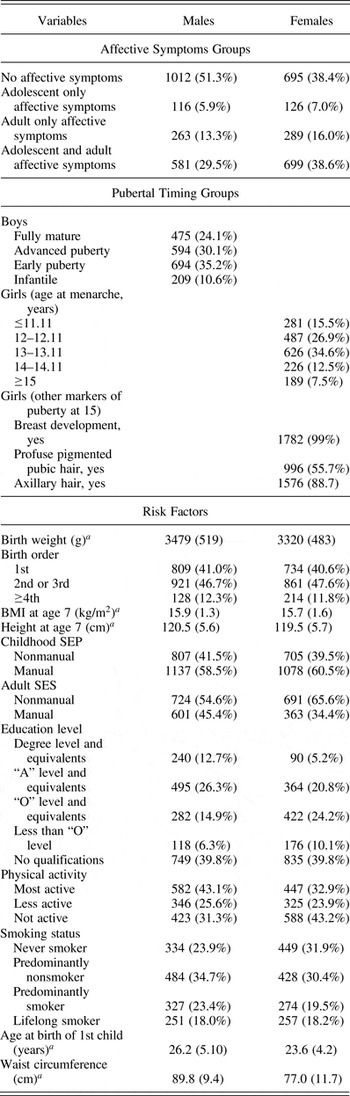
Descriptive data for affective symptoms and pubertal timing, as well as for risk factors, are presented in Table 1, for males and females separately. There were sex differences in the affective symptoms groups, with a greater proportion of females being allocated to one of the three groups with symptoms (p < .001). Among both males and females, those with the latest pubertal timing represented the smallest group, with frequency of 10.6% for the infantile group in boys and 7.5% with the age at menarche ≥15 year in girls.
Descriptive statistics for males and females in the British 1946 birth cohort

Note: Numbers and frequencies are shown unless specified.
a These descriptive statistics are means (standard deviations).
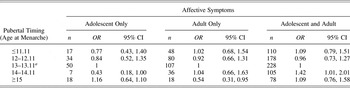
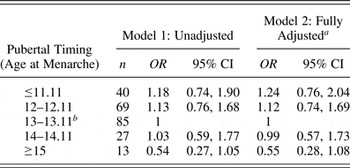
The results of the association analysis between pubertal timing and affective symptoms in females are presented in Table 2. There was no evidence that those with early age at menarche (≤11.11 years) were any more likely to have adolescent-onset affective symptoms than normal developers (13–13.11 years). Similarly, late developers (≥15 years) were not at a higher risk for adolescent-onset affective symptoms than normal developers. Moreover, there was no clear linear trend for increasing risk of adolescent-onset affective symptoms across the groups with different pubertal timing (p = .60 for adolescent symptoms only; p = .33 for adolescent and adult symptoms). Those with the latest age at menarche (≥15 years) were less likely to have adult-onset affective symptoms than were normal developers: odds ratio (OR) = 0.54, 95% confidence interval (CI) = 0.31, 0.95; p = .03; or early developers: OR = 0.53, 95% CI = 0.29, 0.83; p = .04. However, there was no clear linear trend for increased risk of adult-onset affective symptoms across the five groups with different pubertal timing (p = .21). The association between pubertal timing and adult-onset affective symptoms was hardly altered after adjusting for the potential confounders and mediators (i.e., adult SEP, education level, smoking status, physical activity, age at birth of first child, and waist circumference; Table 3).
Associations between pubertal timing and affective symptoms in females (n = 1,752)

a Reference group.
Associations between pubertal timing and adult-onset affective symptoms in females, controlling for adulthood risk factors

Note: The sample includes those with complete data; n = 1,167 (total). a Model adjusted for adult SEP, education, smoking status, level of physical activity, age at birth of first child, and waist circumference. b Reference group.
Additional analyses using other markers of pubertal development at age 15 years in girls did not reveal any significant effects of pubertal development on risk of affective symptoms (online-only supplementary Table S.1). However, these analyses were likely to lack statistical power due to the small number of girls who were not showing signs of pubertal development (i.e., breast development) at age 15 years, and therefore these findings are inconclusive.
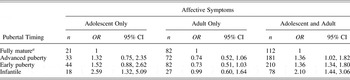
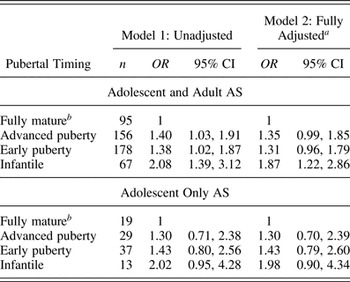
The results of association analysis between pubertal timing and affective symptoms in males are presented in Table 4. In males, in contrast with females, late pubertal timing was associated with increased risks of affective symptoms with onset in adolescence compared to early puberty, with a clear linear trend observed across the four groups with different pubertal timing: OR = 1.31, 95% CI = 1.07, 1.60; p = .010 (for symptoms in adolescence); and OR = 1.21. 95% CI = 1.08, 1.34; p = .001 (for symptoms in adolescence and adulthood). Males with the latest pubertal timing were at increased risk of adolescent-onset affective symptoms compared to those with the earliest pubertal timing: OR = 2.59, 95% CI = 1.32, 5.09 (for adolescent only symptoms); and OR = 2.10, 95% CI = 1.44, 3.06 (for symptoms in adolescence and adulthood). There was no significant association between pubertal timing and adult-onset affective symptoms in males (p for trend = .35). Associations between pubertal timing and affective symptoms with onset in adolescence were somewhat attenuated in the models controlling for childhood SEP, birth weight, birth order, BMI, and height at age 7 years. However, in this fully adjusted model, the association between late pubertal timing and risk for affective symptoms in adolescence and adulthood remained statistically significant: OR = 1.87, 95% CI = 1.22, 2.86; p = .004 (Table 5). In this model, among all childhood risk factors only BMI at age 7 years showed a significant association with affective symptoms in adolescence and adulthood; those with higher BMI at age 7 years had a decreased risk of affective symptoms: OR = 0.87, 95% CI = 0.79, 0.96 (per 1 kg/m2 increase; online-only supplementary Table S.2).
Associations between pubertal timing and affective symptoms in males (n = 1,972)

a Reference group.
Associations between pubertal timing and adolescent-onset affective symptoms (AS) in males, controlling for childhood risk factors

Note: The sample includes those with complete data; n = 1,709 (total).
a Model adjusted for childhood SEP, birth weight, birth order, height and BMI at age 7.
b Reference group.
Discussion
The present study revealed that late pubertal timing (age at menarche of 15 years or later) was associated with decreased risk of adult-onset, but not adolescent-onset, affective symptoms in females. This association was not mediated or confounded by adult sociobehavioral factors. In contrast, in males, late puberty was associated with increased risk of adolescent-onset affective symptoms that continue through adult life, but not with adult-onset symptoms. This association was partially explained by low prepubertal BMI.
Our results suggest that in males, the negative effect of late puberty on emotional health persists into adulthood, possibly due to tracking of affective symptoms from adolescence to adulthood. To the best of our knowledge, there have not been any comparable studies following up males with different pubertal timing from adolescence through adulthood. The literature on the effects of pubertal maturation on emotional health in adolescent males is very mixed (Reardon et al., Reference Reardon, Leen-Feldner and Hayward2009). In general, our findings are consistent with the results from several studies demonstrating that late maturing boys had a higher prevalence of internalizing symptoms (Angold et al., Reference Angold, Costello and Worthman1998; Conley & Rudolph, Reference Conley and Rudolph2009; Graber, Lewinsohn, Seeley, & Brooks-Gunn, Reference Graber, Lewinsohn, Seeley and Brooks-Gunn1997; Laitinen-Krispijn et al., Reference Laitinen-Krispijn, van der Ende and Verhulst1999). For instance, a study in a sample of Dutch adolescents found that boys who showed greater pubertal development through the study were half as likely as late developers to exhibit parent-reported anxious and depressive symptoms (Laitinen-Krispijn et al., Reference Laitinen-Krispijn, van der Ende and Verhulst1999). Another more recent study demonstrated that depression was associated with less mature pubertal status and late timing (actual and perceived) in boys (Conley & Rudolph, Reference Conley and Rudolph2009). However, a number of studies showed that early puberty in boys was associated with higher risk of emotional problems (Ge, Conger, et al., Reference Ge, Conger and Elder2001; Kaltiala-Heino, Marttunen, Rantanen, & Rimpela, Reference Kaltiala-Heino, Marttunen, Rantanen and Rimpela2003). On the whole, empirical evidence for boys suggests that both early and late maturing is associated with increased risk of affective psychopathology in adolescence. The present study adds to the existing evidence that late maturing boys can represent a high-risk group for persistent affective symptoms across adolescence and adulthood. It has been suggested that different individual vulnerabilities prior to puberty may operate in interaction with pubertal timing in predicting adolescent outcomes, including affective psychopathology (Benoit, Lacourse, & Claes, Reference Benoit, Lacourse and Claes2013; Gaysina, et al., Reference Gaysina, Xu, Barnett, Croudace, Wong and Richards2013), and this moderating hypothesis needs to be further explored in relation to life course symptoms of depression and anxiety.
We found no evidence that early pubertal maturation (measured as age at menarche) was a risk factor for adolescent-onset affective symptoms in females. This conflicts with the generally held view of earlier pubertal maturation being associated with adolescent emotional problems in girls (Reardon et al., Reference Reardon, Leen-Feldner and Hayward2009). However, it is worth mentioning that findings for depression (Joinson, Heron, Lewis, Croudace, & Araya, Reference Joinson, Heron, Lewis, Croudace and Araya2011; McCabe, Ricciardelli, & Banfield, Reference McCabe, Ricciardelli and Banfield2001; O'Dea & Abraham, Reference O'Dea and Abraham1999) and anxiety (Hayward et al., Reference Hayward, Killen, Hammer, Litt, Wilson and Simmonds1992; Huerta & Brizuela-Gamino, Reference Huerta and Brizuela-Gamino2002) are not entirely consistent. For example, a longitudinal study observed a tendency for increased anxiety in Spanish girls in Tanner stage 1 (least developed) at age 12 years (Canals et al., Reference Canals, Marti-Henneberg, Fernandez-Ballart, Cliville and Domenech1992). A study of 286 German girls (13–14 years of age) showed that early maturing girls had higher risk of anxiety symptoms but not depressive symptoms (Silbereisen, Kracke, Schulenberg, Maggs, & Hurrelmann, Reference Silbereisen, Kracke, Schulenberg, Maggs and Hurrelmann1997). Another study failed to confirm the association between perceived pubertal timing and internalizing symptoms in 890 girls aged 14–18 years, but did report higher risk for depressive symptoms among early maturing girls (Graber et al., Reference Graber, Lewinsohn, Seeley and Brooks-Gunn1997). Therefore, this research question requires further exploration, in relation to the possible factors that could confound or mediate the observed associations. For example, BMI and/or body perception might explain the relationship of puberty with adolescents' depressive symptoms (Yuan, Reference Yuan2007), and these traits also vary across different samples (Ge, Elder, Regnerus, & Cox, Reference Ge, Elder, Regnerus and Cox2001).
In the present study, while there was no clear trend between pubertal timing and adult-onset affective symptoms in females, we found that the group of late developers (menarche at age 15 or later) was at lower risk than the group of on-time developers (menarche at age 13 years). In line with our finding, a US community-based cohort study of more than 4,000 premenopausal women (aged 36 to 44 years) showed that later age at menarche was associated with lower risk of current depression (test for trend across four age groups: p = .03; Harlow et al., Reference Harlow, Cohen, Otto, Spiegelman and Cramer1999). Contrary to these findings, a study using data from the Northern Finnish 1966 birth cohort reported that women with particularly late menarche (16 years and over) had increased prevalence of depression by age 31 years (Herva et al., Reference Herva, Jokelainen, Pouta, Veijola, Timonen and Karvonen2004). Another longitudinal study found higher prevalence of lifetime depression and anxiety in young women (age 24 years) who perceived themselves as early maturing as compared with on-time developers (Graber et al., Reference Graber, Seeley, Brooks-Gunn and Lewinsohn2004).
Combined with previous findings, our results show that the association between pubertal maturation and emotional problems is different for males and females. In females, the association between early age at menarche and depression in later life was not due to tracking of this association from adolescence to adulthood, because the association was observed with adult-onset rather than with adolescent-onset symptoms. Early menarche was shown to be related to higher BMI and waist circumference in adulthood in a number of studies, including the British 1946 birth cohort (Hardy et al., Reference Hardy, Kuh, Whincup and Wadsworth2006), which were shown to be risk factors for affective disorders (Herva et al., Reference Herva, Laitinen, Miettunen, Veijola, Karvonen and Laksy2006). However, as previously reported for this cohort, those with adult-onset affective symptoms did not differ in their BMI trajectories from those without affective symptoms (Gaysina, Hotopf, et al., Reference Gaysina, Hotopf, Richards, Colman, Kuh and Hardy2011). This may explain why adiposity did not mediate the association between late age at puberty and reduced risk of adult-onset affective symptoms in the present study.
In males, there was an association between late age at puberty and affective symptoms with adolescent onset. The associations were partly explained by childhood risk factors, particularly childhood BMI. As reported previously, adolescent-onset affective symptoms were associated with lower BMI throughout the life course in males (Gaysina, Hotopf, et al., Reference Gaysina, Hotopf, Richards, Colman, Kuh and Hardy2011). It is widely thought that slower childhood growth is a marker of early adverse experiences (e.g., malnutrition or chronic illness), which are also associated with affective symptoms. However, the effects of early adversity on growth have been shown to be similar in boys and girls in both population-based and adoption samples (Li, Manor, & Power, Reference Li, Manor and Power2004; Palacios, Román, & Camacho, Reference Palacios, Román and Camacho2011). Thus, one would expect to find similar associations between lower childhood BMI and depressive symptoms in boys and girls if the association between late puberty and depressive symptoms was fully explained by early adversity.
Sex differences in the association between pubertal maturation and affective symptoms might be explained by differential effects of hormonal influences (Martel, Klump, Nigg, Breedlove, & Sisk, Reference Martel, Klump, Nigg, Breedlove and Sisk2009). Gonadal hormones can affect behavior and mood differently in males and females. Gonadal hormones are known to influence hypothalamus–pituitary–adrenal axis reactivity and, therefore, susceptibility to depression. Testosterone tends to reduce the peak and recovery time of the hormonal stress response in males, while ovarian steroids increase these parameters in females (Carey, Deterd, de Koning, Helmerhorst, & de Kloet, Reference Carey, Deterd, de Koning, Helmerhorst and de Kloet1995; McCormick, Linkroum, Sallinen, & Miller, Reference McCormick, Linkroum, Sallinen and Miller2002). Thus, higher levels of estrogen in women with earlier age at menarche might increase the long-term risk for affective symptoms, and lower levels of testosterone in later maturing men may lead to increased risk of affective symptoms.
Puberty is marked by changes in neuroendocrine axes, resulting in altered hormonal output. The existing literature indicates that adolescent maturation is associated with substantial changes in stress reactivity. Specifically, it was shown that prepubertal rats take longer than adults to terminate an endocrine response to an acute stressor, suggesting that the negative-feedback mechanisms regulating the hypothalamus–pituitary–adrenal axis undergo a maturational process during puberty (Romeo, Reference Romeo2010). Furthermore, human studies have shown that hormonal stress reactivity increases from childhood to adolescence (Stroud et al., Reference Stroud, Foster, Papandonatos, Handwerger, Granger and Kivlighan2009), and that 13- and 15-year-olds show greater stress reactivity than 9- and 11-year-olds (Gunnar, Wewerka, Frenn, Long, & Griggs, Reference Gunnar, Wewerka, Frenn, Long and Griggs2009). Thus, different stress reactivity in pre- and postpubertal stages in life may explain the differences in the association between puberty and depression in adolescence and in adulthood. However, it is difficult to explain why stress reactivity and risk for affective symptoms vary by age at puberty. Future studies of the effects of pubertal timing and gonadal hormones on stress reactivity across the life span have the potential to illuminate risk and protective mechanisms for affective disorders.
Strengths and limitations
The present study is unique in assessing the association between pubertal timing and affective symptoms across the life course and, to our knowledge, is the first to investigate the long-term impact of timing of puberty on affective symptoms in men. Pubertal maturation in boys and girls was assessed prospectively, using both maternal report and medical examination, because age at menarche has shown to be only moderately well recalled in adulthood (Cooper et al., Reference Cooper, Blell, Hardy, Black, Pollard and Wadsworth2006). In this study, we were able to adjust for prepubertal risk factors and to investigate pathways linking age at puberty with affective symptoms in adulthood by adjusting for a range of prospectively measured sociobehavioral factors.
The present study utilized multiple measures of symptoms of depression and anxiety assessed across the 40-year period. These multiple measures were combined using a psychometric approach that allowed using different scales for the measurement of affective symptoms at different ages, and made it possible to identify groups of individuals with differing experience of depression and anxiety over the life course (Colman, Ploubidis, et al., Reference Colman, Ploubidis, Wadsworth, Jones and Croudace2007). Life course phenotypes derived from repeated measurements may provide more reliable definitions of mental health phenotypes because they capture temporal aspects of an individual's vulnerability to disorder, not just diagnosis at a single time point (Leoutsakos, Zandi, Bandeen-Roche, & Lyketsos, Reference Leoutsakos, Zandi, Bandeen-Roche and Lyketsos2010). However, one disadvantage of this approach is that people were assigned to groups according to probability. It is also worth noting that phenotypes of affective symptoms, and not clinically diagnosed affective disorders, were used in the current study, and that the pattern of results might be different in samples with a clinical diagnosis. Moreover, given that the measures of affective symptoms used in the current study were unable to distinguish between symptoms of anxiety and depression, they might mask differences in associations with pubertal timing.
Missing data and dropouts are unavoidable in long-running cohort studies such as the NSHD. The latent class approach used to define the longitudinal profiles does not require for each individual to have all outcome measures recorded, which means that the sample size for the current analyses is maximized. There were differences for affective symptoms groups in girls: those excluded because of the missing data were more likely to have adolescent-onset repeated symptoms. However, there were no differences in terms of pubertal status compared with those included and those excluded from analyses. There is no reason to suspect that the missing data would have influenced the pattern of our findings.
Although some potential confounders and mediators (e.g., SEP and health behaviors) were included in the current study, residual confounding remains a possibility, and there may be other social mechanisms involved. Other factors relevant to the effect of late menarche on adult-onset affective symptoms should be considered in the future.
In conclusion, the timing of pubertal maturation could have long-term effects on emotional problems, particularly in males. Investigating plausible biological and social mechanisms underlying these associations may lead to the development of novel suitable intervention strategies to improve mental health across the life course.
Supplementary Materials
The supplementary materials for this article can be found online at http://journals.cambridg.org/dpp.