


Introduction
Treatment guided by case formulation can provide a distinct and superior alternative to diagnostically led psychotherapy (Malatesta, Reference Malatesta1995; Bruch, Reference Bruch, Bruch and Bond1998). In many areas of psychological treatment the specificity of treatment according to diagnostic categories has been emphasized (Andrews et al. Reference Andrews, Crino, , Lampe and Page1994). However, where importance is placed on individual patient care it could be argued that diagnosis-led treatment is too generalized. There are many cases where diagnosis is either not clear or where different clinicians differ in their conclusions regarding diagnosis. The importance of diagnosis in psychotherapy would be further undermined by current trends towards transdiagnostic treatments (Harvey et al. Reference Harvey, Watkins, Mansell and Shafran2004; Hyer, Reference Hyer2008; Mansell et al. Reference Mansell, Harvey and Watkins2009; Carey, Reference Carey2008a).
However, the acceptance of the benefit of case formulation in psychotherapy still leaves us with unanswered questions. How, for example, can we can sit in a peer supervision group and come up with as many different formulations as there are members of the group? Surely they cannot all be right, and if not, which one is? Clinicians find it much easier to agree on the presenting symptoms of patients’ problems, and even the correct intervention to take, than the implications of those symptoms and what exactly is ‘going on’ with the patients (Kuyken et al. Reference Kuyken, Fothergill, Musa and Chadwick2005).
What we were looking for was a way to conceptualize an individual's psychological problems, which provides a model of their current experience and to formulate treatment from the patient's perspective rather than from that of the therapist. As observers we can only guess what motivates people to act as they do and therefore true objectivity is impossible (Marken, Reference Marken2002). Even the most collaborative approach is weak when it relies upon the therapist's interpretation rather than the patient's experience.
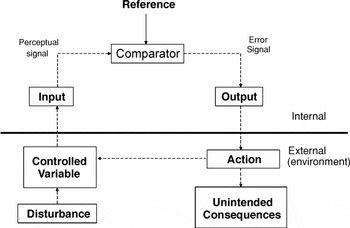
People, from a Perceptual Control Theory (PCT) perspective, like all other living organisms, control their perceptions and continually influence their experience of life through their behaviour (Powers, Reference Powers2005). This is illustrated in the closed loop diagram (see Fig. 1) adapted from Runkel (Reference Runkel2003) and others. A reference or goal is held for all aspects of living and a comparison is made between it and our experience or perception. Action reduces any error this comparison reveals and thereby brings the perceived experience closer to the desired goal.
The Perceptual Control Theory closed loop.

A simple example of how this control occurs can be seen in the way the body controls its core temperature in the same way as a radiator thermostat functions. PCT suggests these control loops are arranged both in parallel and in a hierarchy of levels where the output from a higher level becomes the reference or goal of control loops at a lower level. In the example relating to body temperature some of this control will involve higher levels such as whether we believe ourselves to have a right to feel comfortable. The output from this level may become a reference which influences whether we put on a coat to stay warm. At a lower, and by now subconscious, level the shiver reflex to combat cold is controlled.
If, according to PCT, control is what people do, and all that they do (Runkel, Reference Runkel2003), then psychological problems must involve control (Carey, Reference Carey2008b) and case formulation must necessarily take into consideration the patient's own control system. Only then can we claim to be providing truly individualized treatment. Error in control stimulates change in action in order to achieve optimum perceptions. Distress occurs if the reference is not achievable through action or if conflict exists between references. The consideration of personal or internal conflict in the conceptualization of psychological distress has long been recognized in cognitive behaviour therapy (CBT) (Casper, Reference Casper1996; Grawe, Reference Grawe1998). Psychological conflict is thought to be defined by a person's contradicting goals and/or conflicting strategies (Renner & Leibetseder, Reference Renner and Leibetseder2000). A person's distress, which may at times be variously described as ‘depression’, ‘anxiety’, ‘anger problems’, etc., depending on the symptoms experienced, will almost invariably stem from some such conflict which has become chronic in nature due to being unresolved. Psychotherapy is an appropriate intervention in order to assist in the resolution of these conflicts through cognitive reorganization. The Method of Levels (MOL; this will be explained in more detail later in the paper) is a simple and appropriate way to help people achieve this (Carey, Reference Carey2006).
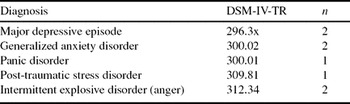
This paper looks at the problems of eight people referred by General Practitioners (GP), under the National Health Service, to a local community mental health team for psychotherapy and treated by the first author (C.G.S.). The only exclusion criteria were those suffering from severe and enduring mental illness and those taking antipsychotic medication. The people were seen chronologically by referral in local health clinics. The diagnoses, as described by the referrers, are given in Table 1.
Diagnoses of patients in study

The last of these diagnoses illustrates one of the problems with diagnostically based treatment as neither DSM-IV-TR (APA, 2000) nor ICD-10 (WHO, 1992) has a diagnostic category for anger. Both of these patients clearly described distress directly relating to their anger. Intermittent explosive disorder may closely describe anger as a disorder but raises many questions in this respect (DiGiuseppe, Reference DiGiuseppe2005). However, if we treat based upon a case formulation approach then such issues are less relevant.
When we approach case formulation there are two distinct aspects to be considered. The first, commonality, will enable us to view patients in the same way as each other. If, as PCT proposes, all people function physiologically according to the same principles, then we can consider that all cognitions occur in the same way for all. This would include the way in which people control their perceptions (Powers, Reference Powers2005) and the fact that distress, at least the degree of distress that brings people to therapy, is a product of chronic unresolved internal conflict. That is to say, the conflict may relate to interpersonal relationships, for example, but ultimately the distress the individual experiences is as a result of internal conflict between references or goals. Therefore from the perspective that all people control and all problems are problems of control, there will be an underlying commonality for patients referred for psychotherapy.
While commonality is the first aspect of case formulation, uniqueness is the second. No two people ever experience the world in exactly the same way. Even though psychological problems have a common underlying form, the presentation of each problem will be unique. According to the principles of PCT individual variability will be evident in aspects such as the combination of our references and the degree of tolerance we have to control error (Powers, Reference Powers and Powers1992). This explains why, when we deal with and communicate with others, we are really at best only guessing what they are expressing, trying to achieve, or control for. Equally we can only guess what we would mean if we were to use the words they use, or perhaps rather, guess what we think they might mean when they use those words. Therefore we can only conclude that, however expert we might be, we cannot truly know what the patient knows or perceives and at best we are, as therapists, facilitators of a process that the patients must undertake themselves. Clearly the more we attempt to guess what a patient is experiencing or what they mean by what they tell us, without verifying these guesses with the patient, the less helpful our interventions are likely to be.
According to Bohart & Tallman (Reference Bohart and Tallman1996) all psychotherapy is ultimately self-help. They view the source of therapeutic change as being located in the patient and regard the therapist simply as a provider of opportunity, ideas and experiences. In other words, and from a PCT perspective, patients actually get themselves better (Carey, Reference Carey2008b). Thus, the formulation which is going to be most accurate and therefore most helpful is that which describes their experience, from their point of view and also facilitates the process within them which will lead to the resolution of their problems. As many psychotherapeutic intervention techniques are designed by, and from the perspective of, the therapist, the fewer of these we use the less likely we are to get it wrong and at best delay recovery. MOL (Carey, Reference Carey2006) is specifically designed to achieve this degree of limited interference whilst at the same time encouraging the patient to consider issues, which they themselves discover, either during therapy or thereafter on reflection, as those relevant to their distress.
Assessment
Some form of assessment is generally considered desirable at the outset of therapy (Beck et al. Reference Beck, Ward, Mendelson, Mock and Erbaugh1961; Appelbaum, Reference Appelbaum1990; Mace, Reference Mace1995). However, when considering assessment and the tools to achieve it we must ask what we consider ourselves to be assessing or measuring, and indeed whether it is possible to regard any aspect of assessment as a definitive measurement. In view of Marken's (Reference Marken2002) observations regarding the impossibility of true objectivity with respect to people's behaviour we must recognize the limitations of any rating scale when applied to an individual. In spite of much work done by Beck and others to rate patients’ degree of illness by scoring them with regard to specific symptoms it is evidently impossible to calibrate or compare patients’ problems. So what is an achievable aim when commencing therapy if truly objective assessment is not? If conflict causes distress (Runkel, Reference Runkel2003; Mansell, Reference Mansell2005; Carey, Reference Carey2006; Higginson, Reference Higginson and Mansell2008) then rating scales may, to some degree of accuracy, be seen as a record of an individual's subjective level of distress. The extent to which we can compare such a record between patients, or even from the same patient, given that the circumstances or perceived objectives at the various times of completion may vary considerably, will be limited. However, while recognizing the limitations of comparisons we still considered it to be of some value to learn about the patient's reported level of distress at various points of treatment.
With this aim we used three assessment tools during the treatment of the eight patients included in this small study. These were the Patient Health Questionnaire (PHQ9), the Generalized Anxiety Disorder Questionnaire (GAD7) (Spitzer et al. Reference Spitzer, Kroenke and Williams1999) and the Clinical Outcomes in Routine Evaluation (CORE) assessment tools (Mellor-Clark et al. Reference Mellor-Clark, Barkham, Connell and Evans1999). The CORE Goal Attainment form was used to obtain qualitative satisfaction data. Whilst some of these were designed to be condition specific, the symptoms they asked about were quite generally applicable as symptoms of distress and the CORE questionnaires also provided ‘before and after’ observations from the patients about levels of perceived distress and their impressions of the therapy received. They are all questionnaires routinely used prior to this study and are in the public domain. These questionnaires were all used prior to therapy and then completed by patients and returned by post 1 month after the last therapy session attended. This provided some degree of assessment of effectiveness of treatment.
Treatment
The treatment used for these eight cases was MOL. Being informed by the principles of PCT, it is accepted by MOL therapists that the cause of distress is conflict and that both this distress and conflict can be experienced or understood only by the individual. Therefore instead of paying attention to the detail that the patient describes, the therapist's task in MOL is to help direct the patient's attention to the distress-causing thoughts in order that further thoughts might come forward and the patient discover why the distress is caused and, by considering ‘upper level’ thoughts (Runkel, Reference Runkel2003; Carey, Reference Carey2006) achieve resolution of the conflict and consequently reduce their distress.
In MOL, therefore, the process of therapy remains constant across treatment and patients, even though no two sessions are ever identical because of the content that patients bring to each session. Encouragement is given to the patient to think about why things happen (in terms of higher level goals), or cause distress, rather than simply how or what happened or happens. The former helps maintain the focus of awareness on the problem and will tend to direct the thinking upwards to causal cognitions. The latter can lead to, what we have all experienced at times, patients talking at length about their problems without apparently gaining any benefit from so doing. Indeed such ruminative thinking can add to distress by the re-experiencing of past trauma or apparent exaggeration or catastrophizing of current problems.
In MOL therapy patients are given freedom to speak about whatever they feel is currently their source of distress. The aim is to keep them in the ‘here and now’ (Beck, Reference Beck1985; BABCP, 2007). In MOL patients are responsible for the content of the conversation while therapists are responsible for the process of the conversation. Speaking about their problem/s helps patients focus on the area that needs to be addressed. This is in contrast to what many patients spend much time doing, i.e. avoiding thinking about their problem, which would appear to be a maintaining factor in itself. This is clearly seen in post-traumatic problems (Resick, Reference Resick2001).
Meta-cognitions are an important aspect of psychotherapy. First postulated by Flavell (Reference Flavell and Resnick1976) and now widely considered in practice (Wells, Reference Wells1997), these thoughts or knowledge about one's own thoughts or expressed ideas (as people listen to themselves) are often indicated by body language [gaze aversion (Morency et al. Reference Morency, Christoudias and Darrell2006), crying, laughing, etc.] or apparently unrelated interjections. These upper level thoughts are usually helpful in therapy and questions are asked about them in order to keep the awareness at that point.
This practice is in contrast to that of encouraging patients to keep diaries of their thoughts and talk about these in therapy. Reflection on such records during therapy is clearly not truly ‘here and now’ and the experience of recalling past thoughts is not as relevant or effective as focusing on ‘hot thoughts’ as is encouraged in CBT (Greenberger & Padesky, Reference Greenberger and Padesky1996) and exclusively practised in MOL. If patients were interested in reflecting on diary entries or recalling past thoughts, the focus on MOL would be exploring the process of reflecting and recalling regardless of the specific content that was being reflected or recalled.
As mentioned above, patients were treated in routine clinical work. All patients booked their own sessions after the initial appointment and were free to choose if, how often, and when they were seen. All patient identifiers were anonymized and where case details might lead to individuals being identified this was omitted. All these details were recorded exclusively in the patient's medical notes.
Cases
Patient no. 1 was a 54-year-old man referred with generalized anxiety disorder who had first been seen by a clinical psychologist 12 years previously. He had been treated for work-related stress but continued to be very anxious. He had suffered a myocardial infarction 2 years previously and not returned to work since. There were, apparently no current significant stressors but he was again presenting to his GP with acute anxiety. He described his problems as, depression, feelings of fear and panic attacks and a build-up of anger and aggression. He attended six sessions of therapy, initially at 2- to 3-week intervals.
It appeared, from his description of what was troubling him, that he had no desire, or plans to return to work but at the same time he believed that ‘other people’ might think that he should return as he was still relatively young. He had a pension after an agreement with his employers that he was not fit to return to work after the heart attack and there was therefore no pressure on him to work again. However, he appeared unhappy to accept this situation mainly due to the conflict between ‘not working’ and ‘thinking other people thought he should be working’. He was avoiding going out for fear of meeting ex-colleagues and could not understand why he was not happy to be retired and adapt to his new lifestyle. He appeared to engage well in MOL therapy and spoke freely about the thoughts that occurred to him.
At the end of therapy he presented as markedly brighter in mood and reported significantly increased activity levels and social contact. All rating scores were greatly reduced and he felt therapy had helped ‘quite a bit’ and was ‘very satisfied’ with the service. He did report intermittent periods of low mood but said that he no longer saw this as a problem.
Patient no. 2, a 42-year-old married woman, was thought to be suffering post-traumatic stress disorder (PTSD) after an incident when her young daughter was ‘snatched’ by a man in a shopping centre. She and her husband had apparently been with the child, who had wandered a short distance and been approached and led away by a man. The child had shouted out and had not apparently suffered at all; the incident being over in moments. However, the mother had been traumatized and now, 1 year later, frequently re-experienced the event and was excessively protective of her daughter. This was interfering with her daily life and she appeared very distressed. In spite of her very obvious distress, she scored below the cut-off for clinical significance on anxiety and depression rating scales but did appear to meet the criteria for PTSD in the re-experiencing and the extent to which it interfered with daily life.
She described her problems as, difficulty relaxing and concentrating, avoiding going out, flashbacks often triggered by TV news items, obsessive door locking and checking and over- protectiveness of her daughter. She participated well in therapy and readily verbalized the background thoughts which occurred to her whilst answering questions. Initially a recurring cause of distress appeared to be thinking that everywhere she looked she could see the face of the individual who had attempted to abduct her daughter. She said she knew that rationally this could not be true but she found it upsetting and therefore tried not to think about it. We looked at what it was like to spend time trying not to think about thoughts which were constantly occurring to her. As therapy progressed this appeared to diminish and she appeared increasingly less anxious. She said she found that when she allowed herself to think about the thoughts which came into her head at these times that she felt less threatened and distressed than she had imagined she would be.
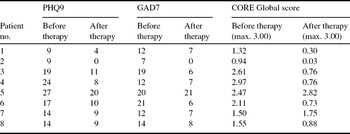
By session 5 she said she had ‘nothing to talk about’ and did not book any further appointments. Her Global CORE follow-up questionnaires were almost zero (see Table 2) and she felt that therapy had been ‘extremely’ helpful.
Pre- and Post-treatment PHQ9, GAD7 and CORE Global scores

CORE, Clinical Outcomes in Routine Evaluation; GAD7, Generalized Anxiety Disorder Questionnaire; PHQ9, Patient Health Questionnaire.
Patient no. 3 was a 49-year-old man, referred by a consultant psychiatrist. He was thought to have a long-term problem with anger and his doctor had prescribed major tranquillizers in an attempt to address this. In therapy he focused mainly on his problems with what he described as ‘pent up anger, frustration and violence’.
During a total of five sessions he spoke much about his relationship with various people in his life but principally about his relationship with his teenage daughter, who clearly did not ‘play by his rules’. He spoke about constantly thinking how other people should or should not behave and how it upset him and ‘made him angry’ when his view of things conflicted with theirs (see Appendix for how this was formulated). Between sessions 1 and 2 there was a marked improvement in his appearance and the reported level of distress. In session 2 he spoke of feeling better and getting on considerably better with his daughter. He also said that people where much better towards him. He laughed and said ‘You will say that it's me that has changed’, but through subsequent questioning he appeared to recognize that it was change in him which had effected change in his relationship with others. During therapy he suddenly discontinued his sedative medication which appeared to cause a temporary resurgence of the anger. However, by the end of treatment, which he attended at approximately 4-week intervals, he had progressively reduced his prescription whilst facing the conflicts which appeared to be causing his distress.
By the end of therapy he had been free of medication for some time and all rating scores had reduced including scores for those questions which are thought to indicate thoughts or plans for self-harm or suicide, for which he now scored zero. He found therapy ‘extremely helpful’ and was ‘very satisfied’ with the service overall and thought he would recommend the service, based on his own experience of it.
Patient no. 4 was a 42-year-old woman whose partner lived and worked away from home. She had previously been widowed due to a former husband's suicide. She had apparently received some help after that occurred but was now described by her referring GP as ‘quite depressed’ and she scored 24 out of a possible 27 on the PHQ9 rating scale. She also scored highly in the risk questions on the CORE Outcome Measure with several ‘most or all of the time’ responses marked and she admitted to practising self-injurious behaviours. However, whilst she spoke about feeling depressed, the conflicts she mainly verbalized, and which were therefore most relevant from a PCT perspective, were:
• Experiencing flashbacks relating to her former husband's death: whilst thinking that she should not be preoccupied with this, as she was now in another relationship.
• Lying to her daughters (about various issues): yet believing that she herself set great store by the truth and desired an open, honest relationship with her daughters.
• Feeling low in mood (probably as a result of the above conflicts): and feeling it was important that she did not ‘get depressed again’.
She attended all five sessions which she booked and appeared to participate well in all sessions. By session 3 she spoke about feeling better and a significant reduction in self-harming.
By the end of therapy she described herself as feeling happy and said she was much more self-confident. It appeared that she attributed this improvement in her confidence and self-image to having addressed the conflicts regarding her relationship with her daughters; which neither she nor any professional had previously considered. At her last session she was anticipating a return to work. CORE Outcome Measure risk score was zero and all other rating scale scores were significantly reduced.
Patient no. 5, a single, 26-year-old woman, had been under the care of a consultant psychiatrist who had diagnosed her most recently as suffering, ‘Mild depressive episode in a background of adversity and trauma’ and ‘Comorbid codeine misuse currently abstinent’. Interestingly the consultant reported that she was not ‘actively suicidal’ nor had any ‘suicidal ideation’. However, in the CORE Outcome Measure at the commencement of therapy she marked ‘Sometimes’ for ‘I have thought it would be better if I were dead’. She identified her ‘Main Difficulties’ as wanting help with, ‘Feeling normal again rather than just existing’ and feelings of worthlessness and lack of self-confidence. She mainly spoke about fear when going out and of the memories of being attacked, a fairly recent event, and subsequently feeling that she and her children were being threatened. She scored a maximum 27 on the PHQ9 rating scale. She attended two sessions of psychotherapy.
In the first session she verbalized numerous background thoughts regarding being attacked and whether or not she was in any real current danger of being attacked again. In the second session she described herself as feeling better and made no reference to these fears. As usual she was free in that session to speak about whatever was on her mind and she spoke about her mother. She said that she had not had any contact with her but felt no guilt about this. There was, however, some apparent ambivalence as she spoke about this relationship. It appeared that this was something about which she had previously been quite distressed although little mention of her mother appeared in her medical notes and this had never featured in any previous treatment.
She failed to keep two subsequent appointments but did return the ‘end of therapy’ questionnaires. Her PHQ9 score had reduced and she scored zero for all risk and self-harm questions on the CORE rating scale. On the Goal Attainment form she rated therapy as being ‘extremely helpful’ and although she rated overall satisfaction with the service as ‘mixed feelings’ she said she would ‘definitely’ recommend the service to a friend. In apparent conflict with what she reported and her bright presentation she scored a maximum 21 on the GAD7 at the end of therapy.
Patient no. 6 was referred by her GP for treatment for panic disorder. She was reluctant to take medication and preferred the ‘talking therapy’ option to deal with her problems. A 53-year-old divorcee, she was clearly quite stressed by numerous current life events and said that she had been told at work that she ‘blew things out of proportion’. It was doubtful if she met the criteria for panic disorder but she was clearly very anxious (she scored a maximum 21 on the GAD7 rating scale at the outset of treatment) and consequently distressed. As treatment with MOL is transdiagnostic this was not an issue and treatment progressed routinely. She spoke about worries at work where she had a very responsible role. She described irritability, recently deteriorated sleep pattern and feeling that her performance at work had suffered.
At the first session she spoke freely about her problems and appeared to readily access and talk about her background thinking. She spoke of numerous conflicts regarding her work and life ambitions. She said she felt she worked hard in this session but gave no indication of any resolution achieved at that time. On attending for her second session, 4 weeks later, she felt she had no issues to discuss. She said she had resolved her problems at work and felt much improved. She also said that she no longer worried about her lack of relationship with her mother or the fact that her mother had apparently rejected her. She had not previously mentioned any problem in the relationship, or lack of one, with her mother, but appeared to have discovered this issue when exploring her thinking and also achieved resolution prior to the second appointment.
She did not make any further appointments. Her GAD7 score fell from 21 to 6 after therapy and like all patients in the sample group, her CORE Risk score was zero on follow-up. She rated therapy as ‘extremely’ helpful, said she was ‘very satisfied’ with the service she had received and would ‘definitely’ recommend it to a friend.
Patient no. 7 was a 28-year-old single, unemployed male. He was referred for problems with anger for which he had received treatment in the past prior to moving to the area. The assumption had been made that his problems stemmed from the fact that his son had been taken from him in an unpleasant custody battle.
However, as the first session progressed he spoke primarily about thoughts relating to the fact that he felt he had been made to look a fool by the social workers when his son was removed from his custody. He also verbalized background thoughts about not liking being told what to do by other people. This latter whilst speaking about how he found it impossible to hold down a job and invariably left within the first few days of starting with a new employer.
He did not attend any further appointments but did complete and return the post-treatment questionnaires. He described his treatment as ‘slightly helpful’ and that he had ‘mixed feelings’ about the service. Interestingly in these questionnaires he complained that appointments were ‘too early in the morning’, although he had made the two subsequent appointments, that he failed to keep, whilst having complete freedom to chose his appointment date and time. However, his scores on the PHQ9 and the GAD7 improved significantly as can be seen in Table 2.
Patient no. 8 was referred with generalized anxiety disorder. This 37-year-old woman was referred by her GP for CBT for anxiety. She described herself as ‘a bit of a worrier’ and said she had previously suffered from postnatal depression. However, her main problem currently was acute anxiety which appeared to have increased considerably since her partner had developed an undiagnosed neurological disorder which apparently caused him to become amnesic and disorientated and often led to angry outbursts as a result of the confusion which, understandably, distressed him. Her anxiety had become more generalized and was affecting her ability to function to the degree that she could not work and was clearly very distressed.
However, when therapy commenced it became clear that the cause of her distress was a perceived lack of control in her life and conflicts between this and an apparent need to feel in control. The unpredictable nature of her husband's illness had led her to spend much time ‘babysitting’ him and this appeared to have created further conflicts with regard to confidence and trust. She spoke freely and verbalized background thoughts that occurred to her. As she listened to her own observations she appeared to recognize how the changes in her life had affected her and also how she might overcome this negative effect and regain some of the confidence and happiness which she felt she had lost. By session 4 she was coping much better even ‘though her husband at that time planned to spend some time on his own, thus reducing the degree to which she felt she could support him. This also involved him travelling abroad which further tested her. She attended at approximately 2- to 3-week intervals for a total of seven sessions.
When she felt she had achieved her goals in therapy she had returned to work, she stated she had found treatment ‘moderately helpful’ and described herself as ‘very satisfied’ with the treatment and that she would ‘definitely’ recommend the service to a friend (based on comments from the CORE questionnaire). Her PHQ9 score had improved slightly and GAD7 score had improved more significantly.
Formulation
It should be noted that in most cases the content of treatment from the patients’ perspective was either slightly or greatly distinct from the problem as identified by the referrer. What patients were doing before therapy, during therapy and after therapy is control. What they thought important to control and to what degree they felt the need to control for their specific goals or references was very individual. It may be helpful, therefore, to conceptualize cases and formulate the treatment of them in view of this similarity and individuality. Now if distress is generally a result of conflict then all patients coming for psychotherapy presumably have at least one conflict. Rather than focus on the problem as defined by a referrer the patient is given freedom and guidance through questioning to explore their conflicts and by going up levels through the process of MOL to achieve cognitive re-organization in order to resolve their conflict.
Of the eight cases in this study some with apparently very similar problems spoke about perceiving their problems very differently and speaking about experiencing widely differing conflicts. Others with differing diagnoses and apparent problems often spoke about similar conflicts. Patient nos. 5 and 6 were examples of this where the relationship with their mother had clearly been a major issue but only they could have discovered this. They both appeared to have references for ‘a daughter should have a close relationship with her mother’ and neither was achieving this because they had current conflicting references. They had not mentioned this previously nor was the information provided on referral. For this reason the therapist paid attention to the visible evidence of the process of the patient's thinking, rather than the content of those expressed thoughts.
Just as the patient defined the number of sessions for treatment, as was evident from the variations in our eight cases, so they were free to speak about whatever they felt was important and what was troubling them at that time. This practice resulted in each session standing alone without dependence on the previous session or reliance on the patient attending another session thereafter. However, annotation of session content can be helpful, particularly, for example, where there may be a legal obligation to report on it at a later date (Jenkins et al. Reference Jenkins, Keter and Stone2004) and therefore some record or form is desirable. As MOL is in its infancy there are no such established forms, although Carey and Mansell have proposed a number of pro forma (personal communication, 2008) which variously record what happened in therapy sessions.
An example of a simple record used in the current study can be seen in the Appendix completed for study patient no. 3. Note that the arrows link conflicting references or thoughts. It can be seen that some conflicts are one-to-one where others can be more complex and potentially involve more than one reference. Bearing in mind the comments above, there is no intention to do other than record the basic conflicts as identified by the patient, as to include further detail, interpreting reported problems, would conflict with the principles of PCT and MOL and, however informed and skilled, would be speculative. In this case these conflicts were identified at the first session but frequently other conflicts will come forward at later sessions. In order to clarify the ‘stand-alone’ nature of each session it is suggested that a separate form be used for each session.
Conclusions
The practice of MOL in psychotherapy, informed as it is by PCT, is still in its early days. However, the outcome data from this study do suggest that MOL is an effective intervention warranting further study to test efficacy. It is also apparent that it can both challenge some more traditional approaches to case conceptualization and formulation, whilst also bringing something very constructive and helpful to the genre. MOL has been referred to as ‘ultra’ cognitive therapy and it would appear that this control approach is a simple but effective therapy which has much to offer with regard to our understanding of the patient's experience. Therapy becomes entirely patient-centred and, for the most part, patient led.
For this reason the practice of offering formulations to the patient to check and in order that modifications can be made in both conceptualization and treatment becomes less relevant. All that is recorded is that which relates to the conflicts the patient talks about, relating to the references or goals they appear be controlling for and the only perspective represented is that of the patient. Thus the formulation is unique and, along with the assessment questionnaire data, can itself be viewed as a record of an individual's experience in therapy.
The PCT and MOL practice in psychotherapy is therefore presented as a fresh but, we believe, valid approach to helping people with their problems and both in concept and formulation can offer an alternative to current treatment options. Further study and practice will assist in producing alternative ways in which to record and document such an approach with the present study providing a useful foundation step in the development of this way of helping people.
Appendix

Acknowledgements
Many thanks to Warren Mansell and Margaret Spratt for their comments on early drafts of this paper.
Declaration of Interest
None.
Learning outcomes
After reading this paper people will be able to:
(1) Understand the basic principles of Perceptual Control Theory (PCT).
(2) See how PCT and the Method of Levels (MOL) can both clarify and simplify the conceptualization and treatment of those in psychological distress.
(3) Recognize the transdiagnostic application of MOL and therefore its use in the generic practice of psychotherapy.



Comments
No Comments have been published for this article.