Introduction
Childhood adversity is a well-examined risk factor for later psychopathology. The effect of childhood adversity on mental disorder onset persists across the life course, with elevated risk of first onset disorders observed in childhood, adolescence, and adulthood (Kessler et al. Reference Kessler, McLaughlin, Green, Gruber, Sampson, Zaslavsky, Aguilar-Gaxiola, Alhamzawi, Alonso, Angermeyer, Benjet, Bromet, Chatterji, de Girolamo, Demyttenaere, Fayyad, Florescu, Gal, Gureje, Haro, Hu, Karam, Kawakami, Lee, Lépine, Ormel, Posada-Villa, Sagar, Tsang, Üstün, Vassilev, Viana and Williams2010). Individuals exposed to childhood adversity have increased risk of mood, anxiety, behavioral and substance abuse disorders, which do not display specificity to the type of adversity (Kessler et al. Reference Kessler, Davis and Kendler1997; McLaughlin, Reference McLaughlin2016). Additionally, the likelihood of these disorders increases with the number of adversities experienced (McLaughlin, Reference McLaughlin2016). Childhood adversities are widely prevalent and often co-occur in general populations (Kessler et al. Reference Kessler, Davis and Kendler1997; Finkelhor et al. Reference Finkelhor, Turner, Shattuck and Hamby2015). Investigations into the processes through which childhood adversity increases the risk of psychopathology are numerous and broad. One such hypothesized process involves the interaction between childhood adversity and proximal risk factors, formalized as the stress sensitization theory (Hammen et al. Reference Hammen, Henry and Daley2000).
The stress sensitization theory posits that among individuals experiencing a depressive reaction, those exposed to early childhood adversities would require lower episodic stress levels preceding the depression than those who did not experience early adversity (Hammen et al. Reference Hammen, Henry and Daley2000). The stress sensitization hypothesis has since been tested in several populations with inconsistent results. In a population of young women, Hammen and colleagues found evidence of stress sensitization to a narrow range of childhood adversities at low levels, but not high levels, of adult stressful life events. Similar effects were reported in an examination of independent events (outside of one's control) on the risk of first episode of depression in a cross-sectional study of adolescents (Harkness et al. Reference Harkness, Bruce and Lumley2006). Other investigations into the risk of a major depressive episode (MDE) found stress sensitization only at high levels of adult stressful events (Kendler et al. Reference Kendler, Kuhn and Prescott2004; Espejo et al. Reference Espejo, Hammen, Connolly, Brennan, Najman and Bor2007; McLaughlin et al. Reference McLaughlin, Conron, Koenen and Gilman2010a ). In contrast, there was no evidence of stress sensitization in a recent study of depressive symptoms in recurrently depressed individuals (Kok et al. Reference Kok, van Rijsbergen, Burger, Elgersma, Riper, Cuijpers, Dekker, Smit and Bockting2014). Although less common, interrogations of the stress sensitization theory have occurred with other mental health outcomes, including past year episodes of generalized anxiety disorder (GAD) and post traumatic stress disorder (McLaughlin et al. Reference McLaughlin, Conron, Koenen and Gilman2010a ), the perpetration of intimate partner violence (Roberts et al. Reference Roberts, McLaughlin, Conron and Koenen2011) and recurrence of bipolar I disorder (Dienes et al. Reference Dienes, Hammen, Henry, Cohen and Daley2006).
To our knowledge, the stress sensitization theory has never been tested in a military population, which is unique in exposure to both childhood adversity and stressors. At least three studies have found that military service members in the USA and Canada report higher numbers of adverse childhood experiences (ACEs) compared with civilians (Blosnich et al. Reference Blosnich, Dichter, Cerulli, Batten and Bossarte2014; Afifi et al. Reference Afifi, Taillieu, Zamorski, Turner, Cheung and Sareen2016; Katon et al. Reference Katon, Lehavot, Simpson, Williams, Barnett, Grossbard, Schure, Gray and Reiber2016). Service members are also exposed to unique stressors, including those specific to pre-deployment, deployment, and post-deployment periods (Esposito-Smythers et al. Reference Esposito-Smythers, Wolff, Lemmon, Bodzy, Swenson and Spirito2011). Additionally, there is a high prevalence of MDE and GAD among service members (Kessler et al. Reference Kessler, Heeringa, Stein, Colpe, Fullerton, Hwang, Naifeh, Nock, Petukhova, Sampson, Schoenbaum, Zaslavsky and Ursano2014; Rosellini et al. Reference Rosellini, Heeringa, Stein, Ursano, Chiu, Colpe, Fullerton, Gilman, Hwang, Naifeh, Nock, Petukhova, Sampson, Schoenbaum, Zaslavsky and Kessler2015; Stein et al. Reference Stein, Kessler, Heeringa, Jain, Campbell-Sills, Colpe, Fullerton, Nock, Sampson, Schoenbaum, Sun, Thomas and Ursano2015), which have been associated with substantial morbidity and severe role impairment (Rosellini et al. Reference Rosellini, Heeringa, Stein, Ursano, Chiu, Colpe, Fullerton, Gilman, Hwang, Naifeh, Nock, Petukhova, Sampson, Schoenbaum, Zaslavsky and Kessler2015). Further, there is an increased risk of suicide (LeardMann et al. Reference LeardMann, Powell, Smith, Bell, Smith, Boyko, Hooper, Gackstetter, Ghamsary and Hoge2013; Shen et al. Reference Shen, Cunha and Williams2016) and suicidal behaviors (Nock et al. Reference Nock, Stein, Heeringa, Ursano, Colpe, Fullerton, Hwang, Naifeh, Sampson, Schoenbaum, Zaslavsky and Kessler2014) associated with major depression in the military. An improved understanding of risk factors for major depression and GAD may further inform efforts to reduce the burden in this population.
We therefore chose to test the stress sensitization theory on the risk of 30-day MDE and 30-day GAD in a sample of new soldier recruits in the Army Study to Assess Risk and Resilience (Army STARRS). Commensurate with the theory, we predicted that the difference in risk of 30-day MDE or GAD for individuals exposed to high v. low stressful experiences would be greater in those exposed to childhood maltreatment.
Methods
Study design and participants
Subjects included in this analysis are a sample of 30 436 new soldier recruits (Army component: Regular = 17 985, Guard = 8522, Reserve = 3929) in the Army Study to Assess Risk and Resilience (Army STARRS). The New Soldier Study (NSS), a component study of Army STARRS, assessed new recruits attending Basic Combat Training (BCT) at Fort Benning, GA, Fort Jackson, SC, and Fort Leonard Wood, MO between April 2011 and November 2012. Details of the study design and methodology are available elsewhere (Kessler et al. Reference Kessler, Colpe, Fullerton, Gebler, Naifeh, Nock, Sampson, Schoenbaum, Zaslavsky, Stein, Ursano and Heeringa2013a ; Ursano et al. Reference Ursano, Colpe, Heeringa, Kessler, Schoenbaum and Stein2014). Briefly, 200–300 new soldiers were selected weekly at each installation site to attend a study overview and informed consent session. Among these soldiers, 99.9% consented to the self-administered questionnaire (SAQ) and 93.5% of consented participants completed the full SAQ. Most participants (77.1%) with full SAQ data further consented to linkage of responses to their Army/Department of Defense Administrative records. All analyses employed a combined analysis weight that adjusts for differential administrative record linkage consent among soldiers who completed the survey. The weights include a post-stratification of these consent weights to known demographic and service characteristics of the population of new soldiers attending BCT during the study period (Kessler et al. Reference Kessler, Heeringa, Colpe, Fullerton, Gebler, Hwang, Naifeh, Nock, Sampson, Schoenbaum, Zaslavsky, Stein and Ursano2013b ). Recruitment, consent, and data protection procedures were approved by the Human Subjects Committees of all collaborating institutions.
From the initial sample of 38 507 respondents with complete SAQ data and successful linkage to administrative records, we restricted analyses to individuals with age-at-enlistment at or below the 99th percentile (⩾33 years), resulting in a sample of 38 237 soldiers. Inquiries into stressful experiences in the previous 12 months were added to the survey in version three; thus analyses were further restricted to participants who completed the third or fourth survey administration (n = 30 436), resulting in 25 619 males and 4 817 females.
Measures
Childhood maltreatment
Childhood maltreatment variables were derived in a prior NSS study devoted to this topic and details are available elsewhere (Stein et al. Reference Stein, Campbell-Sills, Ursano, Rosellini, Colpe, He, Heeringa, Nock, Sampson, Schoenbaum, Sun, Jain and Kessler2016). Briefly, the NSS survey contained fifteen items assessing childhood emotional, physical and sexual maltreatment. Questions were prefaced with ‘How often did you have each of the following experiences up through age 17?’ with a 5-point response scale of ‘never’ through ‘very often.’ Missing responses were imputed with 0's (indicating an absence of the type of maltreatment under consideration). Parallel analysis and exploratory factor analysis (EFA) were performed using the maltreatment item ratings; however, one item was eliminated in preliminary analysis to improve discriminability of two factors representing well-established constructs (emotional abuse and physical abuse). Parallel analysis of the 14 retained maltreatment items indicated that 5 factors should be extracted. EFA with specification of 1–6 factors also showed that a 5-factor model provided the best fit for the data. All maltreatment items loaded strongly on one of the five factors, no salient cross-loadings were evident, and overall model fit was good (RMSEA = 0.066, 90% CI 0.065–0.068; RMR = 0.02; TLI = 0.95). The five factors corresponded to Sexual Abuse, Physical Abuse, Emotional Abuse, Physical Neglect, and Emotional Neglect. Total scores on each range from 1 (average per-item response of ‘never’) to 5 (average per-item response of ‘very often’).
Childhood maltreatment profiles
To characterize co-occurrence of childhood maltreatment exposures, Stein et al. (Reference Stein, Campbell-Sills, Ursano, Rosellini, Colpe, He, Heeringa, Nock, Sampson, Schoenbaum, Sun, Jain and Kessler2016) also performed latent class analysis (LCA) was using the Sexual Abuse, Physical Abuse, Emotional Abuse, Physical Neglect and Emotional Neglect scores as latent class indicators. LCA circumvents statistical problems observed in other studies that aimed to identify unique effects of maltreatment subtypes [e.g. due to low base rates of certain traumas in conjunction with high rates of trauma co-occurrence (Kessler et al. Reference Kessler, Davis and Kendler1997; Vachon et al. Reference Vachon, Krueger, Rogosch and Cicchetti2015)]. This approach, which permits assignment of individuals to mutually exclusive classes, maximizes homogeneity within groups and heterogeneity between groups – a strength when investigating complex exposures such as maltreatment (Roesch et al. Reference Roesch, Villodas and Villodas2010). A 5-class model was selected by Stein et al. (Reference Stein, Campbell-Sills, Ursano, Rosellini, Colpe, He, Heeringa, Nock, Sampson, Schoenbaum, Sun, Jain and Kessler2016) due to interpretability, superiority of fit relative to the 4-class model (entropy = 0.972; LMR p = 0.0003), and lack of evidence of improved fit with a more complex (6-class) model (non-significant LMR; p = 0.73). The five latent profiles were labeled: No Maltreatment, Episodic Emotional Maltreatment, Episodic Emotional and Sexual Abuse, Frequent Emotional and Physical Maltreatment, and Frequent Emotional, Physical, and Sexual Maltreatment (see Stein et al. Reference Stein, Campbell-Sills, Ursano, Rosellini, Colpe, He, Heeringa, Nock, Sampson, Schoenbaum, Sun, Jain and Kessler2016 for additional details).
Past 12-month stressful experiences
Soldiers were queried about recent stressful experiences by asking, yes or no, ‘Did you have any of the following experiences in the past 12 months?’ Six events followed, including life threatening illness or injury of a close friend or family member, death of a close friend/family member, separation or divorce from a spouse/partner, infidelity of a partner/spouse, serious betrayal by someone close, and serious arguments or break-ups with close friends/family. These events were adapted from the Life Events Questionnaire (Brugha & Cragg, Reference Brugha and Cragg1990). Additionally, soldiers were asked if any of the following seven events happened in the past 12 months: motor vehicle accidents, other accidents with injury/property damage, failure of expected promotion, trouble with the police, time in jail/correctional custody, other serious legal problems, and other stressful events. These seven events were adapted from the 2008 Department of Defense Survey of Health-Related Behaviors among Active Duty Personnel (Bray et al. Reference Bray, Pemberton, Lane, Hourani, Mattiko and Babeu2010). Past 12-month stressful experiences were summed and categorized based upon the distribution of responses and comparability to other literature (McLaughlin et al. Reference McLaughlin, Conron, Koenen and Gilman2010a ), resulting in 0, 1–2 and 3+ events endorsed.
Mental disorders
The two primary outcomes assessed were past 30-day MDE and past 30-day GAD. These outcomes were measured with the Composite International Diagnostic Interview screening scales and evaluated for concordance with DSM-IV diagnoses within the Army STARRS clinical reappraisal study (Kessler et al. Reference Kessler, Santiago, Colpe, Dempsey, First, Heeringa, Stein, Fullerton, Gruber, Naifeh, Nock, Sampson, Schoenbaum, Zaslavsky and Ursano2013c ).
It is possible that individuals with childhood maltreatment experience early onset MDE or GAD, and are thus at risk for recurrent episodes following stressful events compared with individuals with no childhood maltreatment, who would be at risk for first onset disorders. To explore this possibility, individuals with reported age of onset of MDE or GAD equal to age at enlistment were defined as ‘recent onset.’ This definition was used in the absence of detailed information regarding timing of onset or duration of the past 30-day disorder. Sensitivity analyses were conducted to exclude individuals with recent onset MDE or GAD in stress sensitization models.
Socio-demographic covariates
Potential confounders selected for model adjustment include age at survey, gender, education, and race-ethnicity.
In sensitivity analyses, models were further adjusted for other exposure to lifetime trauma. The purpose of this analysis was to exclude potential effects of other previous traumatic events on the risk of 30-day MDE or GAD. Exposure to trauma was defined as any of the following events happening at least once: (1) serious physical assault; (2) sexual assault or rape; (3) witnessed someone being seriously injured or killed; (4) discovered or handled a dead body; (5) life-threatening illness or injury; (6) in a disaster; (7) any other experience that put you at risk of death or serious injury; (8) murder of a close friend or relative; (9) suicide of a close friend or relative; (10) combat death of a close friend or relative; (11) accidental death of a close friend or relative.
Statistical analyses
Weighted frequencies and standard errors were estimated for childhood maltreatment profiles, past 12-month stressful experiences, and socio-demographic covariates.
The independent effects of childhood maltreatment and past 12-month stressful experiences on the risk of past 30-day MDE and past 30-day GAD were estimated with a modified Poisson regression with robust standard errors (Zou, Reference Zou2004). Models were analyzed using generalized linear models (GLM) with a Poisson distribution and log link function; standard errors were estimated using R library sandwich (Zeileis, Reference Zeileis2004).
According to stress sensitization theory, individuals who experienced greater childhood maltreatment will have stronger risk of adverse outcomes given the same level of adult stressful experiences when contrasted with individuals with lesser/no childhood maltreatment. In order to test stress sensitization, the interaction between childhood maltreatment and past 12-month stressors is tested on an additive scale (Rothman et al. Reference Rothman, Greenland and Walker1980). Accordingly, adjusted probability (risk) estimates from a Poisson GLM that included a maltreatment × stressful experience interaction term were extracted for each maltreatment profile-stressful experience level combination. A chi-square test of this 3 × 5 table was conducted to determine if probabilities varied by childhood maltreatment profile and stressful experience category. Adjusted risk differences and 95% confidence intervals were then estimated for each childhood maltreatment profile with 0 past 12-month stressors serving as the reference. Finally, to test for statistically significant interactions, t tests of the corresponding risk differences (e.g. 3+ past 12-month stressors v. none) were performed between childhood maltreatment profiles. Models were first constructed with past 30-day MDE as an outcome, and subsequently with 30-day GAD.
In sensitivity analyses, all models were repeated with further adjustment for other lifetime exposure to trauma. In a second set of sensitivity analyses, models were restricted to exclude individuals with recent onset MDE or GAD.
All analyses were performed in R, version 3.3.0.
Results
Description of sample
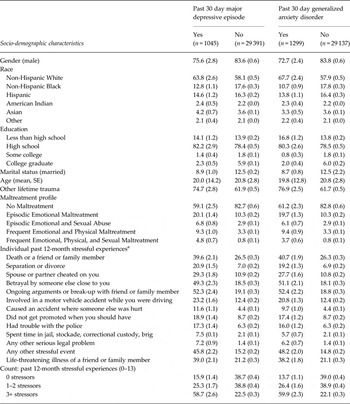
The sample was majority Non-Hispanic White males with a high-school education (Table 1). The weighted prevalence of past 30-day MDE or GAD was 3.6% (s.e. = 0.02) and 4.4% (s.e. = 0.02), respectively. In the current sample, proportions of respondents belonging to childhood maltreatment profiles were: No Maltreatment (82.3% of respondents), Episodic Emotional Maltreatment (10.6%), Episodic Emotional Abuse And Sexual Abuse (2.9%), Frequent Emotional And Physical Maltreatment (3.5%), and Frequent Emotional, Physical And Sexual Maltreatment (0.8%). Exposure to stressful experiences in the past 12 months was common; 35.1% reported no exposure, 36.2% experienced 1–2 stressful experiences, and 21.8% reported three or more stressful experiences. Respondents with missing data in the 13 stressful experiences (n = 2084, 6.8%) were excluded from analyses. Among the 12-month stressful experiences, death of a friend of family member (26.7%), life-threatening illness of a friend or family member (21.8%), ongoing arguments or break-up with a friend or family member (19.9%), and betrayal by someone else close to you (19.3%) were the most often reported.
Weighted prevalence estimates (%, SE) of demographic characteristics from a sample of new soldiers surveyed in the Army STARRS New Soldier Survey (n = 30 436)

a Missing between 536 and 987 responses to stressful experience questions.
Independent risk estimates of childhood maltreatment and past 12-month stressful experiences
In multivariate adjusted models, both childhood maltreatment profile and 12-month stressful experiences independently predicted 30-day MDE. Results were similar for the risk of 30-day GAD, although generally childhood maltreatment effects were weaker and 12-month stressful experiences were stronger predictors of 30-day GAD compared with MDE (online Supplemental Table S1).
Stress sensitization models
Past 30-day MDE
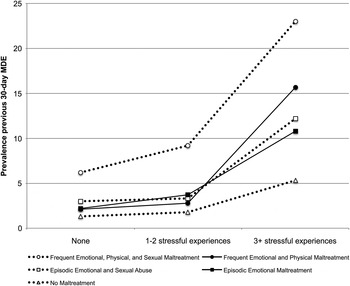
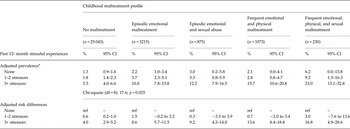
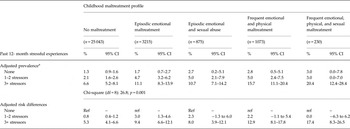
Stress sensitization was detected (χ2 8 = 17.6, p = 0.025) in models of 30-day MDE (Fig. 1). This sensitization was only statistically significant at high levels of stressful experiences v. no stressful experiences. Specifically, the adjusted risk difference of 30-day MDE for 3+ stressful experiences (v. 0 stressful experiences) for those exposed to Frequent Emotional, Physical And Sexual Maltreatment (aRD: 16.8, 95% CI 4.9, 28.6) was higher compared with the reference group with No Maltreatment (aRD: 4.0, 95% CI 2.9, 5.2, t = 2.1, p = 0.03). Similarly, the adjusted risk difference for Frequent Emotional and Physical Maltreatment (aRD: 13.6, t = 3.5, p = 0.0004), Episodic Emotional and Sexual Abuse (aRD: 9.2, t = 2.0, p = 0.04), and Episodic Emotional Maltreatment (aRD: 8.6, t = 2.8, p = 0.005) were all statistically higher compared with individuals with No Maltreatment. The only statistically significant differences between maltreatment profiles were when the adjusted risk differences for each profile were compared with No Maltreatment. Among individuals who experienced some form of childhood maltreatment, there were no statistically significant between-profile differences in adjusted risk difference of 30-day MDE for 3+ v. 0 stressful experiences (i.e. there was no statistical evidence of a dose-response). For example, when comparing the adjusted risk differences of 3+ v. 0 stressful experiences in those with Frequent Emotional and Physical Maltreatment compared with those with Episodic Emotional Maltreatment, the results did not reach statistical significance (t = 1.7, p = 0.10). Further, there was no evidence of stress sensitization for any of the childhood maltreatment profiles among individuals exposed to 1–2 stressful experiences (v. 0) (Table 2).
Prevalence of 30-day major depressive episode by childhood maltreatment profile and level of past 12-month stressful experiences in a sample of 30 436 new soldier recruits in the Army Study to Assess Risk and Resilience. Weighted prevalence estimates are adjusted for age at survey, gender, education, race/ethnicity, and interaction term between childhood maltreatment and level of past 12-month stressful experiences.

Adjusted probability and risk differences of past 30-day MDE by exposure to past 12-month stressful experiences and childhood maltreatment profile

a Probabilities from logistic models adjusted for age at survey, gender, education, race/ethnicity, and interaction term between childhood maltreatment and 12-month stressor.
Complete case analysis n = 28 352; CI, confidence interval; df, degrees of freedom; ref, reference category.
Past 30-day GAD
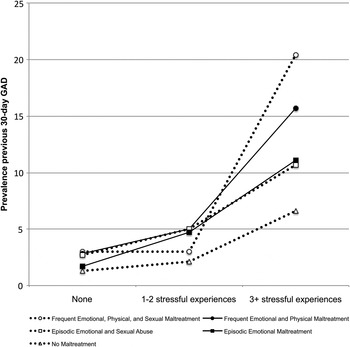
Stress sensitization was also detected (χ2 8 = 26.8, p = 0.001) in models of 30-day GAD (Fig. 2). Likewise, this sensitization was only observed at high levels of stressful experiences v. no stressful experiences. Specifically, the adjusted risk difference of 30-day GAD for 3+ stressful experiences (v. 0 stressful experiences) for those exposed to Frequent Emotional, Physical And Sexual Maltreatment (aRD: 17.4) was higher compared with the reference group with No Maltreatment (aRD: 5.3, t = 2.6, p = 0.01). Similarly, the adjusted risk difference for Frequent Emotional and Physical Maltreatment (aRD: 12.9, t = 3.0, p = 0.003), and Episodic Emotional Maltreatment (aRD: 9.4, t = 2.6, p = 0.009) were all statistically higher compared with individuals with No Maltreatment. Unlike models of 30-day MDE, the risk difference for Episodic Emotional and Sexual Abuse (aRD: 8.0, t = 1.2, p = 0.22) was not statistically different from that of No Maltreatment. There was no evidence of stress sensitization for any of the childhood maltreatment profiles in individuals exposed to 1–2 stressful experiences (Table 3).
Prevalence of 30-day generalized anxiety disorder by childhood maltreatment profile and level of past 12-month stressful experiences in a sample of 30 436 new soldier recruits in the Army Study to Assess Risk and Resilience. Weighted prevalence estimates are adjusted for age at survey, gender, education, race/ethnicity, and interaction term between childhood maltreatment and level of past 12-month stressful experiences.

Adjusted probability and risk differences of past 30-day GAD by exposure to past 12-month stressful experiences and childhood maltreatment profile
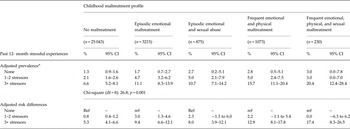
a Probabilities from logistic models adjusted for age at survey, gender, education, race/ethnicity, and interaction term between childhood maltreatment and 12-month stressor.
Complete case analysis n = 28 352; CI, confidence interval; df, degrees of freedom; ref, reference category.
Sensitivity analyses
Lifetime trauma
When stress sensitization models for past 30-day MDE and GAD were further adjusted for exposure to lifetime trauma, there was slight attenuation of all risk estimates. This attenuation did not change the sensitization findings overall (MDE: χ2 8 = 17.4, p = 0.026; GAD: χ2 8 = 24.8, p = 0.002) or in pairwise comparisons (data not shown).
Previous onset MDE
Exposure to childhood maltreatment was greater in soldiers with previous onset MDE (42.8%) than recent onset MDE (33.3%). Excluding 105/1045 recent onsets of MDE (10.0%) resulted in slight attenuation of all probabilities of 30-day MDE (χ2 8 = 26.2, p = 0.001; online Supplemental Table S2). All pairwise comparisons between maltreatment profiles and No Maltreatment remained statistically significant except for those in Episodic Emotional and Sexual Abuse (t = 1.7, p = 0.09).
Previous onset GAD
Childhood maltreatment was common in recent onset (29.3%) and previous onset GAD (39.9%). After excluding 205/1299 recent onsets of GAD (15.8%), the overall chi-square remained significant (χ2 8 = 25.0, p = 0.002; online Supplemental Table S3). The pairwise comparison of Frequent Emotional, Physical and Sexual Abuse v. No Maltreatment was no longer statistically significant (t = 1.6, p = 0.12). Other results were unchanged.
Discussion
The enduring effects of childhood adversity on mental health have been amply documented. Investigations into the processes by which this occurs are important in efforts to prevent the onset and recurrence of mental health disorders and the cascading effects. In a sample of new soldiers entering the US Army, we found evidence of stress sensitization on the risk 30-day MDE and GAD at high, but not low, levels of recent stressful experiences. This interaction between childhood maltreatment and recent stressful experiences was observed across all types of maltreatment profiles, and was robust to multivariate adjustment, including exposure to other lifetime trauma.
Our analysis was novel in the use of childhood maltreatment profiles. Utilizing latent class analysis to quantify maltreatment exposure is becoming more prevalent in maltreatment literature (Roesch et al. Reference Roesch, Villodas and Villodas2010; Ballard et al. Reference Ballard, Van Eck, Musci, Hart, Storr, Breslau and Wilcox2015). In the case of the NSS analysis (Stein et al. Reference Stein, Campbell-Sills, Ursano, Rosellini, Colpe, He, Heeringa, Nock, Sampson, Schoenbaum, Sun, Jain and Kessler2016), this technique yielded profiles that captured both co-occurrence and severity of the different maltreatment types. These profiles compared favorably with maltreatment category count variables in terms of their clinical relevance and interpretability, and to our knowledge have not been employed in stress sensitization investigations. Previous investigations have focused on narrow classes of adversity such as sexual abuse or emotional abuse (Hammen et al. Reference Hammen, Henry and Daley2000; Kendler et al. Reference Kendler, Kuhn and Prescott2004; Espejo et al. Reference Espejo, Hammen, Connolly, Brennan, Najman and Bor2007; Shapero et al. Reference Shapero, Black, Liu, Klugman, Bender, Abramson and Alloy2014) or have collapsed over broader classes into count variables (McLaughlin et al. Reference McLaughlin, Conron, Koenen and Gilman2010a ). Although a broad range of childhood adversities have demonstrated stress sensitization with the risk of psychopathology, select adversities (including family violence, physical abuse, sexual abuse, and neglect) have shown stronger independent effects with mental disorder onset (Green et al. Reference Green, McLaughlin, Berglund, Gruber, Sampson, Zaslavsky and Kessler2010). In an effort to allow investigation into both the types and frequencies of adversities, our analyses focused on derived maltreatment profiles that varied by frequency and type of adversity from no maltreatment to frequent emotional, physical and sexual maltreatment. With no precedent for hypothesis formulation, we nonetheless suspected there might be differences between the maltreatment profiles in a dose-response fashion. While there was visual evidence of dose-response at high levels of exposure to stressful experiences for both 30-day MDE and GAD, the only statistical differences in pairwise comparisons were between each childhood maltreatment category and No Maltreatment. This lack of specificity from a statistical standpoint may be due to the small numbers that reported sexual abuse, resulting in wide confidence intervals for the profiles of Episodic Emotional and Sexual Abuse and Frequent Emotional, Physical and Sexual Maltreatment. Indeed, the only pairwise comparison between individuals who experienced a form of childhood maltreatment that approached statistical significance was between the larger categories of Frequent Emotional And Physical Maltreatment (aRD:13.6) compared with Episodic Emotional Maltreatment (aRD: 8.6, t = 1.7, p = 0.10) for the risk of 30-day MDE. Nonetheless, in the absence of co-factors such as measures of coping and resilience, and timing and duration of adversity, these maltreatment profiles remain incomplete.
Our findings were not without limitations. First, both childhood adversity and stressful experiences were recalled and collected in a cross-sectional manner, precluding causal inference. Individuals with mental disorders, particularly those with recent or current episodes, may recall these painful events differently, potentially biasing estimates away from the null. Second, we attempted to minimize temporal ambiguity between exposures and outcomes by analyzing 12-month stressful experiences and 30-day MDE or GAD. However, the assumption that the stressful experience preceded the recent episode of major depression or generalized anxiety cannot be tested. Third, the survey assessed exposure to stressful events, which does not necessarily predict perceived stress or biological response to stress. Further, we were not able to distinguish between independent (outside of one's control) and dependent stressors. Shapero et al. (Reference Shapero, Black, Liu, Klugman, Bender, Abramson and Alloy2014) observed stress sensitization by childhood emotional abuse only with dependent stressors, suggesting a mediating role between childhood adversity and later depressive symptoms. We could not contrast independent and dependent stressors as 11 out of 13 stressful experiences queried could arguably be influenced by the individual. Fourth, to our knowledge, only one paper has focused on the first episode of depression (Harkness et al. Reference Harkness, Bruce and Lumley2006). The vast majority of 30-day episodes of depression (90.0%) and generalized anxiety (84.2%) in our sample reported age of first onset prior to the age at enlistment, precluding our statistical ability to test our hypothesis in recent onset episodes. Understanding if the stress sensitization theory applies equally to recent onset and recurrent or persistent mental disorders is worthy of further study. Finally, incorporating biologic samples into analyses would greatly advance the field as we consider underlying pathways.
The biologic mechanisms underlying stress sensitization to childhood adversity and the risk of psychopathology are still being investigated. To date, the majority of research into the underlying biological processes has focused on early modifications to hypothalamic-pituitary-adrenal (HPA) axis in response to early exposure to adversity. Both rodent and primate models have shown early life stress produce enduring changes to the corticotropin releasing factor-containing neural circuits, increasing the risk of later onset mood disorders (Nemeroff, Reference Nemeroff2004). Alterations to the HPA axis functioning have also been observed in humans exposed to childhood adversity, although variation in the timing, duration and type of adversity have led to differences in strength and direction of response (Nemeroff, Reference Nemeroff2004; Bosch et al. Reference Bosch, Riese, Reijneveld, Bakker, Verhulst, Ormel and Oldehinkel2012; McCrory et al. Reference McCrory, De Brito and Viding2012). Neuroimaging studies have revealed structural differences in the corpus callosum, cerebellum and hippocampus, and functional differences in regions associated with emotional and behavioral regulation, including the prefrontal cortex, amygdala and anterior cingulate cortex (McCrory et al. Reference McCrory, De Brito and Viding2010, Reference McCrory, De Brito and Viding2012). Genetic variation may also contribute to stress sensitization through gene-environment–environment interactions. Polygenic risk scores have been investigated as modifiers of depression risk with both childhood adversity (Peyrot et al. Reference Peyrot, Milaneschi, Abdellaoui, Sullivan, Hottenga, Boomsma and Penninx2014; Mullins et al. Reference Mullins, Power, Fisher, Hanscombe, Euesden, Iniesta, Levinson, Weissman, Potash, Shi, Uher, Cohen-Woods, Rivera, Jones, Jones, Craddock, Owen, Korszun, Craig, Farmer, McGuffin, Breen and Lewis2016) and adult stressful events (Mullins et al. Reference Mullins, Power, Fisher, Hanscombe, Euesden, Iniesta, Levinson, Weissman, Potash, Shi, Uher, Cohen-Woods, Rivera, Jones, Jones, Craddock, Owen, Korszun, Craig, Farmer, McGuffin, Breen and Lewis2016) with inconsistent results. To our knowledge, polygenic risk scores have never been evaluated as a predictor of stress sensitization. Further investigation into genetic and environmental modifiers will help identify those at highest risk of psychopathology and expand our understanding of stress sensitization observed in survey data.
These findings have implications for both future research and practice. As a literature these studies suggest an increased emotional and physiologic reactivity to stressors following childhood maltreatment (McLaughlin et al. Reference McLaughlin, Kubzansky, Dunn, Waldinger, Vaillant and Koenen2010b ; Heleniak et al. Reference Heleniak, Jenness, Vander Stoep, McCauley and McLaughlin2016), but this is not often measured. Longitudinal studies with measures of emotional and physiologic reactivity are important in our understanding of the underlying biologic pathways, with ultimate interest in identifying areas of intervention or mitigation. We also see practical application in a military population. Suicide, homelessness and substance abuse, among other adverse outcomes, have been associated with major depression or GAD and are concerns for active military personnel and/or veterans (Nock et al. Reference Nock, Stein, Heeringa, Ursano, Colpe, Fullerton, Hwang, Naifeh, Sampson, Schoenbaum, Zaslavsky and Kessler2014; Hoggatt et al. Reference Hoggatt, Jamison, Lehavot, Cucciare, Timko and Simpson2015; Tsai & Rosenheck, Reference Tsai and Rosenheck2015). Our findings of increased risk of MDE and GAD from the interaction of childhood adversity and stressful experiences suggest soldiers who have suffered childhood maltreatment may be a group requiring specific adaptations of a wide range of interventions. Further focus on those exposed to stressful experiences and efforts to reduce stress reactivity may prove useful in the effort.
Supplementary material
For supplementary material accompanying this paper visit https://doi.org/10.1017/S0033291717001064
Acknowledgements
Army STARRS was sponsored by the Department of the Army and funded under cooperative agreement number U01MH087981 with the US Department of Health and Human Services, National Institutes of Health, and National Institute of Mental Health (NIH/NIMH), Bethesda, MD, USA. Gretchen Bandoli is supported by a National Institutes of Health, Grant TL1TR001443. Dr Stein has in the past 3 years been a consultant for Actelion, Dart Neuroscience, Healthcare Management Technologies, Janssen, Oxeia Biopharmaceuticals, Pfizer, Resilience Therapeutics, and Tonix Pharmaceuticals. In the past 3 years, Dr Kessler received support for his epidemiological studies from Sanofi Aventis; was a consultant for Johnson & Johnson Wellness and Prevention, Shire, Takeda; and served on an advisory board for the Johnson & Johnson Services Inc. Lake Nona Life Project. Kessler is a co-owner of DataStat, Inc., a market research firm that carries out healthcare research. The remaining authors have no financial disclosures. The authors would like to thank Sonia Jain, PhD for her assistance with database and statistical support.
Other acknowledgements
The Army STARRS Team consists of Co-Principal Investigators: Robert J. Ursano, MD (Uniformed Services University of the Health Sciences) and Murray B. Stein, MD, MPH (University of California San Diego and VA San Diego Healthcare System)
Site Principal Investigators: Steven Heeringa, PhD (University of Michigan) and Ronald C. Kessler, PhD (Harvard Medical School)
National Institute of Mental Health (NIMH) collaborating scientists: Lisa J. Colpe, PhD, MPH and Michael Schoenbaum, PhD
Army liaisons/consultants: COL Steven Cersovsky, MD, MPH (USAPHC (Provisional)) and Kenneth Cox, MD, MPH (USAPHC (Provisional))
Other team members: Pablo A. Aliaga, MA (Uniformed Services University of the Health Sciences); COL David M. Benedek, MD (Uniformed Services University of the Health Sciences); K. Nikki Benevides, MA (Uniformed Services University of the Health Sciences); Paul D. Bliese, PhD (University of South Carolina); Susan Borja, PhD (NIMH); Evelyn J. Bromet, PhD (Stony Brook University School of Medicine); Gregory G. Brown, PhD (University of California San Diego); Laura Campbell-Sills, PhD (University of California San Diego); Catherine L. Dempsey, PhD, MPH (Uniformed Services University of the Health Sciences); Carol S. Fullerton, PhD (Uniformed Services University of the Health Sciences); Nancy Gebler, MA (University of Michigan); Robert K. Gifford, PhD (Uniformed Services University of the Health Sciences); Stephen E. Gilman, ScD (Harvard School of Public Health); Marjan G. Holloway, PhD (Uniformed Services University of the Health Sciences); Paul E. Hurwitz, MPH (Uniformed Services University of the Health Sciences); Sonia Jain, PhD (University of California San Diego); Tzu-Cheg Kao, PhD (Uniformed Services University of the Health Sciences); Karestan C. Koenen, PhD (Columbia University); Lisa Lewandowski-Romps, PhD (University of Michigan); Holly Herberman Mash, PhD (Uniformed Services University of the Health Sciences); James E. McCarroll, PhD, MPH (Uniformed Services University of the Health Sciences); James A. Naifeh, PhD (Uniformed Services University of the Health Sciences); Tsz Hin Hinz Ng, MPH (Uniformed Services University of the Health Sciences); Matthew K. Nock, PhD (Harvard University); Rema Raman, PhD (University of California San Diego); Holly J. Ramsawh, PhD (Uniformed Services University of the Health Sciences); Anthony Joseph Rosellini, PhD (Harvard Medical School); Nancy A. Sampson, BA (Harvard Medical School); CDR Patcho Santiago, MD, MPH (Uniformed Services University of the Health Sciences); Michaelle Scanlon, MBA (NIMH); Jordan W. Smoller, MD, ScD (Harvard Medical School); Amy Street, PhD (Boston University School of Medicine); Michael L. Thomas, PhD (University of California San Diego); Leming Wang, MS (Uniformed Services University of the Health Sciences); Christina L. Wassel, PhD (University of Vermont); Simon Wessely, FMedSci (King's College London); Christina L. Wryter, BA (Uniformed Services University of the Health Sciences); Hongyan Wu, MPH (Uniformed Services University of the Health Sciences); LTC Gary H. Wynn, MD (Uniformed Services University of the Health Sciences); and Alan M. Zaslavsky, PhD (Harvard Medical School).
Disclosure of Interest
None.
Disclaimer
The contents are solely the responsibility of the authors and do not necessarily represent the views of the Department of Health and Human Services, NIMH, the Veterans Administration, Department of the Army, or the Department of Defense.
Public use Dataset
Available to qualified investigators at: http://www.icpsr.umich.edu/icpsrweb/ICPSR/studies/35197