“A human life has the same value wherever he or she is born. There should be the same attention to northern Uganda as to northern Iraq, the same attention to the Congo as there was to Kosovo, and that is not the case today.”1
Humanitarian emergencies have received increasing press and public policy attention in recent years.2 There was a rise in the number of conflicts after the end of the Cold War, then a decline in the number of conflicts and the estimated number of combatants killed in conflicts to the lowest levels in a century.3 This has brought increased attention to the declining number of remaining conflicts, along with a increased interest in rendering assistance during disasters around the world. The total funding for humanitarian activities has doubled each decade since 19704 and is on track to rise further as the United States, the European Union, Japan, and other countries address the goal of reaching 0.7% of gross domestic product for international development and assistance. (The average contribution for developed countries in 2005 was 0.33%, and only 4 countries exceeded the 0.7% goal, but rates are rising for most countries.)5
The ability to monitor assistance, define humanitarian needs, and approach equity in the distribution of assistance has lagged behind the world’s growing commitment to responding to humanitarian emergencies.6 To breach this ability gap, the humanitarian community must answer several critical questions: Which groups are in greatest need of assistance? Which indicators, or numerical measures for monitoring, have the sensitivity to identify the multiple and varied threats in countries in crisis? The Good Humanitarian Donorship initiative,7 the SMART (Standardized Monitoring and Assessment of Relief and Transition) initiative,8 and planning for a United Nations health and nutrition tracking service9 address these questions in part, but great inequalities and inefficiencies in humanitarian assistance remain. Better tools and measures are needed.
This article highlights relevant data sources that elucidate elements of an operational definition of humanitarian need. New and refined measures are proposed to assist in assessing the level of need among affected populations. An original measure that combines data on conflict and disasters to summarize the cumulative magnitude of 4 types of humanitarian threat is presented.
METHODS
Data for 4 major aspects of humanitarian need were collected for 2002–2006. The magnitude of the population exposed to these events per country was calculated using 2004 population data drawn or estimated from the Central Intelligence Agency’s World Factbook.10 Data on the number of people killed in conflicts were drawn from the Project Ploughshares Armed Conflicts Report.11 The number of people displaced or who became refugees each year was drawn from data gathered by the Norwegian Refugee Council12 and the US Committee for Refugees and Immigrants.13 Data on the number of people killed and affected by disasters was drawn from the EM-DAT Emergency Disasters Database.14
RESULTS
Conflict Deaths
There are hundreds of potential contests around the world for power by opposing and armed forces.Reference Marshall15 Accounting for the numbers of combatants killed is difficult because it usually depends on combatant forces themselves (because it is from the combatants themselves that the information is received). The majority of deaths occur each year in a few, large conflicts.16 Although various research organizations rate these conflicts somewhat differently, they show a declining trend in conflicts over the last decade following a short-term rise in the early 1990s, as conflicts (eg, those in Bosnia, Chechnya, Kosovo) suppressed by Cold War–era politics and policies emerged and then ended.
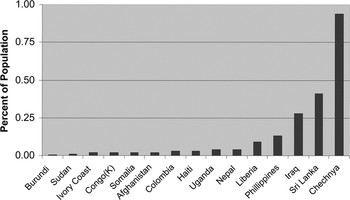
Data sources on the numbers of people killed or affected vary widely because few of these countries have adequate vital registration systems and conflict deaths are seldom recorded by neutral agencies. Figure 116 shows the 14 countries in the world with the greatest estimated percent of population killed in conflicts during 2002–2006 according to the most widely used source for such data. It demonstrates that in those relatively few places where conflict rages, it can still claim the lives of a high proportion of a country’s population. Because some conflicts have gone on for ≥30 years, whereas others resolve within 1 or 2 years, there is poor comparability of data for the total deaths during the entire period of a conflict. The best indicators for conflict deaths, then, are multiyear averages. Many of these same countries would appear in previous time periods as well because conflicts tend to reoccur in relatively few regions of the world. Notably, almost all conflicts occur in developing countries; wars in developed countries since the end of World War I have tended to be few and brief.
Percentage of national population killed in conflict, 2002–2006 total

Conflict was responsible for the deaths of close to 1% of the population during 2002–2006 in only 3 areas, Iraq, Sri Lanka, and Chechnya. Half of the largest conflicts were in Africa. The Americas and the Pacific were the regions with the least number of conflict deaths since 2002.
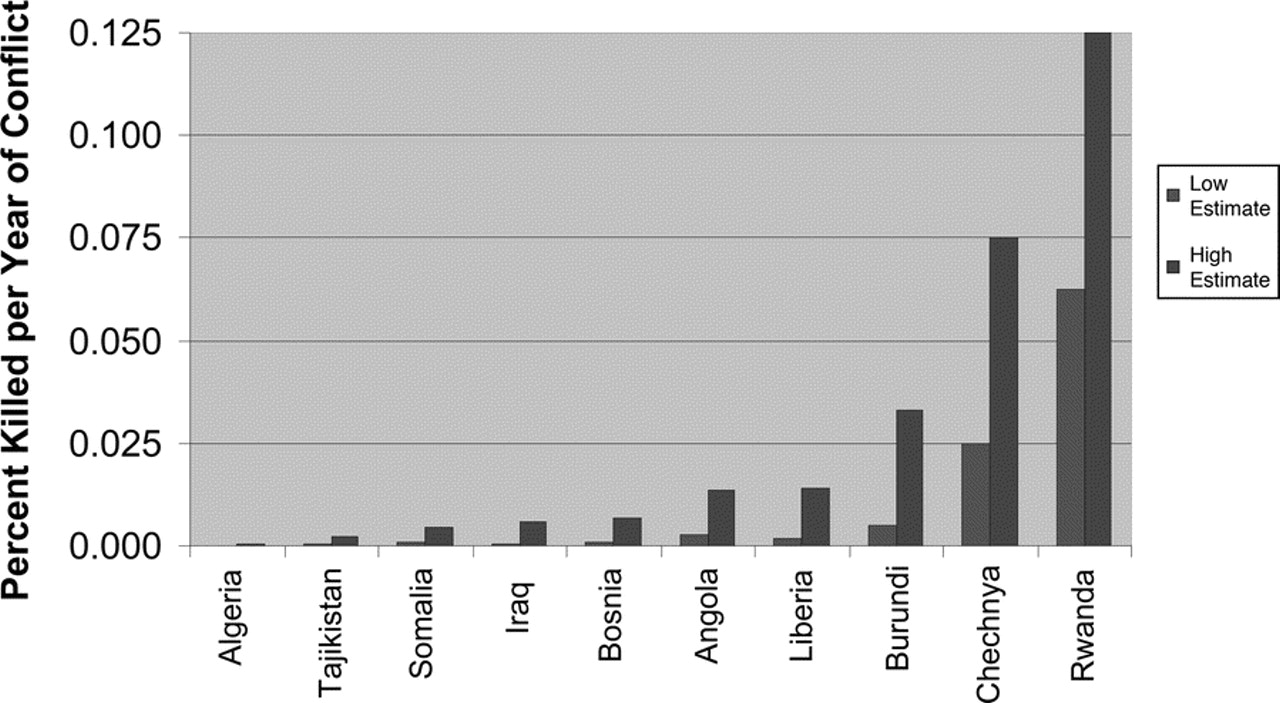
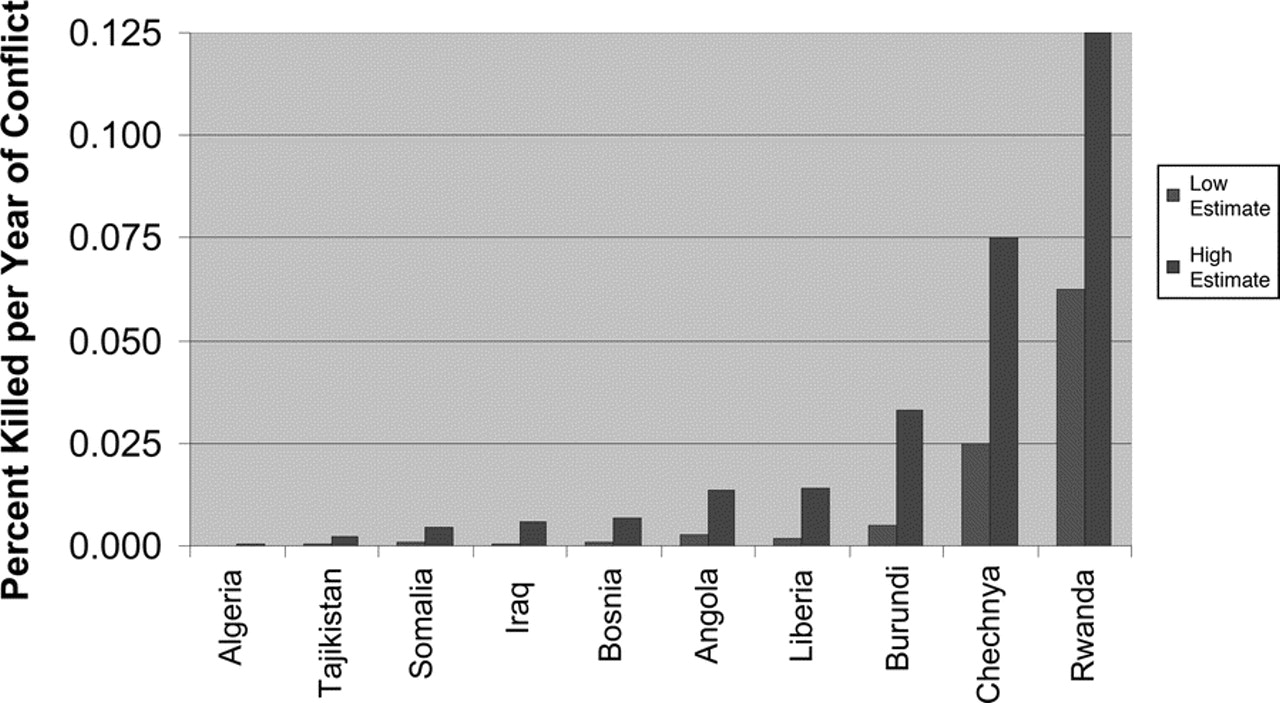
Deaths recorded as being the result of conflict include almost exclusively those deaths that occur among combatants or victims of genocide. Although estimates of the total number of combat- or genocide-related deaths vary widely, the relative magnitude of deaths by country remains stable. Figure 2 shows the range of estimated annual conflict-related deaths in the 10 most deadly conflicts of the 1990s.Reference Murray, King, Lopez, Tomijima and Krug17
Range of annual estimated death rates due to conflict in the 1990s
The measurement of civilian deaths in conflict is poorer than the accounting of combatant or genocide deaths. This is, in part, because most civilian deaths that occur in excess of expected rates during conflict are not injury deaths, but instead are excessive levels of the major prewar causes of death. To date, only in the Democratic Republic of Congo,Reference Coghlan, Brennan, Ngoy and Dofara18 Iraq,19, 20 and Darfur are data from epidemiological studies sufficiently good to estimate with any precision the excess burden of death due to noninjury-related causes. Estimates from epidemiological and other specialized studies suggest that excess deaths to civilians from noninjury-related causes in areas of conflict may vary from a low of 10% in highly developed countries to as much as a 10-fold excess of total deaths in the least developed countries, where basic public health infrastructure for many people is easily lost (Fig. 3).
FIGURE 3 No caption available.

Because most conflicts occur in developing countries, it is likely that most conflict-related deaths occur among civilians and are virtually absent from existing databases in most countries. For measurement purposes, deaths counted among combatants must function as a proxy measure for the total excess death burden of conflict. Where data on excess deaths are limited, useful sources on nonmortal injuries is nearly nonexistent. This is complicated by the lack of verifiable methods to determine diagnostic groups by verbal recall except for injuries.Reference Soleman, Chandramohan and Shibuya22
Conflict Displacement
In nearly all countries with conflict, there are many more refugees (ie, outside the borders) or displaced people (ie, within the border) than conflict deaths. A rule of thumb is that for each death, there may be 10 injured people and 100 people who become displaced. Displacement (including the displaced within the borders and refugees outside) may be the most sensitive measure of humanitarian crisis, but accumulated data on displacement are often late and inexact because registration is influenced by local politics and, like genocide, implies legal obligations for the national or host country.
During short-term, acute emergencies, data on displacement may be timely and accurate.Reference Spiegel and Salama23 A downward bias in these data exist in that many of the people who are internally displaced are never registered, causing collected data to seriously undercount those forced to move. A countervailing upward bias in some countries exists when displaced or refugeed people develop new communities and stabilize their lives. Functionally they may stop being displaced, but once entered into the system they may stay on lists of the displaced for many years.
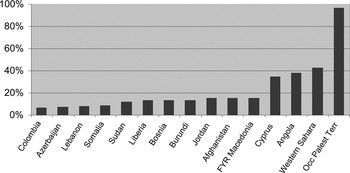
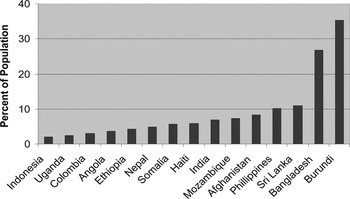
Figure 4 provides a combined measure that attempts to account for these biases. It provides an average of the total number of displaced or refugeed people during 2002–2006, modified by the number of newly displaced or newly returned home in 2006. Consistent with the 1-to-100 rule of thumb, it shows that a much higher proportion of people in the most affected countries were displaced or refugeed than were killed.24 Unlike the war dead, most of these countries are in central Europe or the Middle East, where more people have options to flee than those in sub-Saharan Africa. Yet 9 of the 14 countries with the highest percentage of their population killed also are among those with the highest displacement figures.
Proportion of population displaced or refugeed, 2002–2006; average weighted for net change in displacement in 2006

Disasters
Whereas the number of countries experiencing conflict has declined, the number experiencing disasters has risen. An increasing proportion of all disasters are taking place in less developed countries. Indeed, it is the process of economic development, with rapid urbanization, increased exploitation of natural resources, and the lack of investment in protective infrastructure, that appears to be driving the major increase in the number of the world’s disasters.25 Thus, the major areas experiencing disasters are not necessarily the major areas experiencing conflict.
Deaths Resulting From Disasters
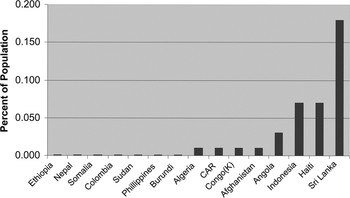
Most disasters result in a small number of injury deaths. The disasters that cause the greatest number of injury deaths are concentrated in the poorest countries. Figure 526 highlights 4 countries where a disaster caused the direct death of ≥0.01% of a country’s population during 2002–2006.
Percentage of population killed in disasters, 2002–2006

As with conflict, injury deaths are only the tip of the iceberg of the humanitarian impact of disasters. Also like conflict, the ability to count or estimate the burden of indirect deaths or nonfatal health effects of disasters is limited, especially in the least developed countries. Indirect deaths are greatest among populations that are experiencing multiple disasters or disasters of long duration. Far easier is an estimation of the proportion of people affected (eg, displaced, refugeed) within the geographic boundaries of an area experiencing a disaster (Fig. 6). The 4 countries (Fig. 5) with high rates of deaths due to disasters also are among those with a high proportion of population displacement or people killed by conflict.
People affected by disaster as a percentage of the total population, 2002–2006

SEEKING A CUMULATIVE SUMMARY MEASURE OF THE MAGNITUDE OF HUMANITARIAN NEED
Four measures of humanitarian need were examined above. Each measure represents a unique indicator of need, and the quality of the data and the relative importance of each indicator may vary depending on the cultural and historical context of the country.
Most of the conflicts were of protracted duration. In every region, most of the people affected by conflict or disaster reside in poor or near-poor zones. Because deaths due to conflict or disaster are so important and so likely to be underreported, we multiply these indicators by 10 for a combined measure. The indicator of displaced people has already been modified by the addition or subtraction of newly displaced or returned refugees, as described above. The measure of disaster-affected people may overrepresent the magnitude of impact on people relative to other measures because the “largest” disasters (eg, droughts, floods) occur in widespread geographic areas but have less of a impact on mortality than some focal disasters (eg, earthquakes, tsunamis). For this reason this measure, averaged for 5 years, is reduced by a factor of 5 for our combined measure of humanitarian need.
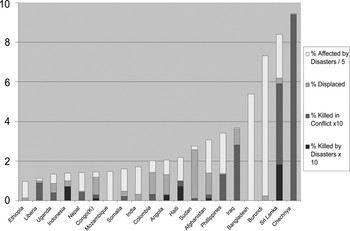
Combining information on multiple threats to humanitarian conditions over a period of 5 years and scaling them according to population denominators creates a broad measure of humanitarian need. The 4 measures, as modified, are combined in Figure 7. Although each measure started with the percentage of population affected, modifications have made the measures lose the intuitive relationship to a population denominator when combined. Figure 7 provides an index of the cumulative magnitude of humanitarian need, on a scale of 1 to 10, combining information on those killed by conflict and disaster, those displaced or refugeed, and those affected by disasters during 2002–2006.
Index of the cumulative magnitude of humanitarian need: a relative measure of populations affected by conflicts and disasters, 2002–2006

Most of the countries represented in Figure 7 are affected by multiple threats while one threat predominates. The geographic distribution around the world of these countries in the greatest humanitarian need is wider than for any of the 4 original measures used. One territory (Chechnya) is in Europe, 2 are in Latin America, 2 are in Asia, 2 are in the Middle East, and 3 are in South Asia. Almost half of the countries are in Africa. Some of the results are surprising. Chechnya and Sri Lanka are not typically considered to be among the countries with the greatest humanitarian need. Chechnya is included because a high proportion of the resident population has died or was displaced by the conflict of the 1990s. Sri Lanka and the Philippines are high on the index because they experienced a moderate level of each of the 4 threats included in the index. They lead the index because they experienced these threats throughout the 5 years examined. Burundi and Bangladesh follow in magnitude, mainly because of the impact of repeated environmental disasters during those years.
The Democratic Republic of Congo and Iraq are surprisingly low on this list because the databases used did not include information from epidemiological studies on the extent of excess deaths among noncombatants. This underscores the importance, and the difficulty, of ensuring representative data for the 4 measures included in the index.
The Occupied Palestinian Territories (OPT) scored too low to appear on the index because the major threat in the period examined was displacement alone; the inclusion of data from 2007 would likely change its ranking. Perhaps the weakest aspect of the index is the poor quality of information on deaths to noncombatants. The index could be enhanced with information on stagnation or worsening of infant mortality rates, per capita income, and food security. Including too many indicators of limited data quality could complicate comparisons, however.
There are serious limitations to this approach. Any summary combined measure of major possible threats will be arbitrary because there is no theory-based method to allocate the relative importance of 1 harmful event as compared to another or of deaths compared to nonmortal humanitarian harm. Data quality is variable and limited. It provides at best a crude approximation of the relative magnitude of humanitarian need across countries. Despite these limitations, it appears that a summary measure of these four threats—to be killed in conflict, to be displaced or refugeed, to be killed in a disaster, and to be affected by a disaster—successfully captures the magnitude of humanitarian need and facilitates comparisons of the level and source of that need across countries.