Introduction
It is well documented that individuals with schizophrenia have various sleep abnormalities (Andreasen, Reference Andreasen1991), with sleep disturbances being a common complaint throughout the course of the illness (Lieberman et al., Reference Lieberman, Stroup, McEvoy, Swartz, Rosenheck and Perkins2005; Palmese et al., Reference Palmese, DeGeorge, Ratliff, Srihari, Wexler, Krystal and Tek2011). Disrupted sleep has serious negative effects on the brain, especially on neurocognitive functions. Several studies have focused on sleep-dependent memory consolidation in schizophrenia to further explore the association between sleep and cognition. It has been reported that procedural learning in schizophrenia is intact, but sleep-dependent procedural memory consolidation is impaired (Manoach et al., Reference Manoach, Cain, Vangel, Khurana, Goff and Stickgold2004, Reference Manoach, Thakkar, Stroynowski, Ely, McKinley, Wamsley and Stickgold2010; Manoach & Stickgold, Reference Manoach and Stickgold2009). Memory consolidation performance was reported to be associated with sleep spindle density during stage 2 non-rapid eye movement sleep (NREM; Wamsley et al., Reference Wamsley, Tucker, Shinn, Ono, McKinley, Ely and Manoach2012). This suggests that cognitive ability could be potentially hindered by sleep abnormalities or other impaired processes during memory consolidation in schizophrenia.
A large body of research suggests that the hippocampus plays an important role in memory consolidation. The causality relationship has been demonstrated by the patient H.M. case study, for which the ability to consolidate memory has lost after undergoing the bilateral hippocampal lesion surgery (Scoville & Milner, Reference Scoville and Milner1957). Specifically, the association was strong between the hippocampus and the consolidation of declarative memory (McClelland, McNaughton, & O'Reilly, Reference McClelland, McNaughton and O'Reilly1995; McNaughton & Wickens, Reference McNaughton and Wickens2003). On the contrary, it was found that the hippocampus also has roles in both acquisition and consolidation of procedural memory (Albouy et al., Reference Albouy, Sterpenich, Balteau, Vandewalle, Desseilles, Dang-Vu and Maquet2008; Albouy, King, Maquet, & Doyon, Reference Albouy, King, Maquet and Doyon2013).
In schizophrenia, there is often reported reduced hippocampal volume (Adriano, Caltagirone, & Spalletta, Reference Adriano, Caltagirone and Spalletta2012; Fukuzako et al., Reference Fukuzako, Fukazako, Hashiguchi, Hokazono, Takeuchi, Hirakawa and Fujimoto1996; Nelson, Saykin, Flashman, & Riordan, Reference Nelson, Saykin, Flashman and Riordan1998), which could result in similar but less severe impairments of memory consolidation domains including long-term memory (Boyer, Phillips, Rousseau, & Ilivitsky, Reference Boyer, Phillips, Rousseau and Ilivitsky2007), short- and long-delayed declarative memory retention (Pohlack et al., Reference Pohlack, Meyer, Cacciaglia, Liebscher, Ridder and Flor2014), verbal episodic memory recollection (Heckers et al., Reference Heckers, Rauch, Goff, Savage, Schacter, Fischman and Alpert1998), and memory consolidation (Genzel et al., Reference Genzel, Rossato, Jacobse, Grieves, Spooner, Battaglia and Morris2017). Therefore, the impaired procedural memory consolidation in schizophrenia could potentially be associated with hippocampus-related cognitive impairments.
Sleep deficiency in general is one of the contributing factors of hippocampal atrophy and also impacts hippocampal functions (Prince & Abel, Reference Prince and Abel2013). Therefore, sleep impairments in schizophrenia, such as disrupted circadian rhythm (He et al., Reference He, Cornelissen-Guillaume, He, Kastin, Harrison and Pan2016; Monnet, Reference Monnet2002) and insomnia (Joo, Kim, Suh, & Hong, Reference Joo, Kim, Suh and Hong2014), could also contribute to the reduced hippocampal volume. Taken together, it is possible that the hippocampal atrophy was indirectly associated with sleep abnormalities in schizophrenia, and resulted in decline (or further decline) of hippocampus-related memory consolidation. Thus, abnormal sleep could be an indirect factor that contributes to the sleep-dependent procedural memory consolidation impairment in schizophrenia. Such an association between sleep and memory consolidation could be investigated by the finger-tapping motor sequence task (MST), which is a well-documented approach for testing procedural memory consolidation (Karni et al., Reference Karni, Meyer, Rey-Hipolito, Jezzard, Adams, Turner and Ungerleider1998).
Interestingly, it was reported that aerobic exercise in individuals with schizophrenia could increase the hippocampal volume and was accompanied by improved verbal memory (Lin et al., Reference Lin, Chan, Lee, Chang, Tse, Su and Chen2015; Pajonk et al., Reference Pajonk, Wobrock, Gruber, Scherk, Berner, Kaizl and Falkai2010). This suggests that physical exercise might have a general positive effect on hippocampal-related memory functions. The benefits of physical exercise are not limited to memory and hippocampal volume, and positive effects on sleep quality were also observed in healthy individuals (de Aquino-Lemos et al., Reference de Aquino-Lemos, Santos, Antunes, Lira, Luz Bittar, Caris and de Mello2016; Maculano Esteves, Ackel-D'Elia, Tufik, & De Mello, Reference Maculano Esteves, Ackel-D'Elia, Tufik and De Mello2014) and people with insomnia (e.g. Baron, Reid, & Zee, Reference Baron, Reid and Zee2013; Passos et al., Reference Passos, Poyares, Santana, Teixeira, Lira, Youngstedt and de Mello2014). It was also reported that 8 weeks of bi-weekly exercise increased subjective sleep quality in individuals with schizophrenia (Lalande, Theriault, Kalinova, Fortin, & Leone, Reference Lalande, Theriault, Kalinova, Fortin and Leone2016). The above findings suggest that physical exercise can potentially benefit both sleep and memory consolidation in schizophrenia.
The aim of the current study was to investigate the effectiveness of physical exercise of different intensities on sleep-dependent procedural memory consolidation in schizophrenia. Moreover, the study aimed to investigate whether exercise intensity had any effects on subjective sleep quality and whether there was an association between subjective sleep quality and memory consolidation performance in schizophrenia.
Methods
Individuals with a diagnosis of schizophrenia spectrum disorder (SSD) receiving psychiatric care at the Department of Psychiatry in Queen Mary Hospital, Hong Kong were recruited to participate in an open-labeled randomized controlled trial (RCT) with a 1:1 allocation ratio. The diagnosis of SSD was determined by the Structured Clinical Interview for DSM-V.
This study was approved by the Institutional Review Board of the University of Hong Kong/Hospital Authority Hong Kong West Cluster (HKU/HA HKW IRB) and conformed to the Declaration of Helsinki. This study was conducted from 29th November 2015 to 30th June 2016. No changes were made to the methods after trial commencement, except that the trial ended early due to insufficient funding for the study. All participants gave written informed consent before the start of the trial and received financial compensation upon completion of the study.
The inclusion criteria were: (1) aged 18–55 years, (2) diagnosis under the category of Schizophrenia Spectrum and Other Psychotic Disorders in DSM-V, (3) the ability to understand the nature of the study and had given written informed consent, and (4) currently under the care of the outpatient department of the psychiatric unit in Queen Mary Hospital, Hong Kong.
The exclusion criteria were: (1) severe physical illness (e.g. myocardial infarction, hypertension, fracture, and spinal problems which contraindicated exercise), (2) seizure disorders, (3) self-reported comorbid substance dependence, (4) clinically significant unstable medical or any clinical condition that in the opinion of the investigators would limit the participant's ability to complete the study, (5) self-reported known pregnancy, (6) history of brain trauma or organic brain disease, (7) known history of intellectual disability or special school attendance, or (8) not suitable for physical exercise according to the Physical Activity Readiness Questionnaire (PAR-Q) without doctor's approval or recommendation for exercise.
Sample size
A previous study investigating the effect of exercise on procedural memory consolidation (i.e. Roig, Skriver, Lundbye-Jensen, Kiens, & Nielsen, Reference Roig, Skriver, Lundbye-Jensen, Kiens and Nielsen2012) reported an achieved effect size (Cohen's d) of 1.65. Using the statistical significant level 0.05 and the power 0.95, a sample size of 11 for each arm is sufficient to achieve a good effect size. With an anticipation of 50% attrition rate, it was proposed to have a sample size of 17 or more for each arm. Thus, it was decided to aim for a total sample size of 60.
Randomization and intervention allocation
Using a computer-generated list, study participants were randomized to the high-intensity-interval-training (HIIT) group, the aerobic-endurance exercise (AE) group, or the psychoeducation control group. The list had a block size of six (i.e. for every six subjects, two were assigned to the HIIT, two were assigned to the AE, and two were assigned to psychoeducation). This sequence of randomization continued again for the next six subjects and repeated until all 60 subjects were allocated. All randomization procedures, including list generation, participants’ enrolment, and intervention assignment were completed by the primary investigator. The intervention lasted for 12 weeks. Participants that had been randomized to the HIIT or AE group were required to participate in indoor cycling exercises.
Functional threshold power
Cycling performance in HIIT and AE groups were monitored and supervised by a professional staff using a power meter (Garmin Vector 2S). The power meter measured the cadence and torque of the left pedal of the stationary bike. A Garmin Premium Heart Rate Monitor was strapped around the abdominal area of the subjects to record the heart rate during each session. The calories expenditure was calculated in watts, taking into account individual variance including age, gender, weight, and heart rate. A Garmin Edge 520 was used to record and display the real-time power and calories expenditure during the intervention. Subjects were invited to participate in three sessions of the cycling intervention per week for 12 weeks (total of 36 sessions). The duration of each session was tailored to each individual's calories expenditure, further explained in later parts.
The independent variables in HIIT and AE groups were defined by the exercise level, solely relying on the calculation of the functional threshold power (FTP). Power meters measuring FTP test had been implemented to replace the traditional respirator and electrocardiogram used to measure maximum oxygen uptake (VO2Max) or the cardiopulmonary exercise test (CPET) due to limited resources. CPET is a conventional method to evaluate an individual's fitness through the analysis of the cardiopulmonary system under certain exercise stress. In the same manner, the FTP test was aimed to measure the individual's fitness by using the recorded power and heart rate under certain exercise stress. The FTP testing method had been previously adopted in professional athletic training (Allen & Coggan, Reference Allen and Coggan2010; Coggan et al., Reference Coggan, Kohrt, Spina, Kirwan, Bier and Holloszy1992; Martin, Milliken, Cobb, McFadden, & Coggan, Reference Martin, Milliken, Cobb, McFadden and Coggan1998), and similar measurement using a traditional Windgate device has also been recently tested to have moderate-to-strong positive correlation with the CPET output (Denham, Scott-Hamilton, Hagstrom, & Gray, Reference Denham, Scott-Hamilton, Hagstrom and Gray2020).
The FTP test required each individual to participate in a 30-min warm up cycling period and a 30-min 70% heart rate (70% of 220 minus age) cycling period. The FTP was then calculated from 95% of the average power during the last 20 min of the test, and the estimation of lactate threshold (LT) for each individual was defined as the range between 91% and 105% of the FTP. This estimation was used as a reference to define an individual's range of aerobic or anaerobic activity for later training sessions. An FTP test was provided to the participants every 2 weeks (every 4–6 sessions). All FTP test sessions were conducted in a one-on-one setting.
Aerobic endurance
The AE intervention was designed to only involve aerobic activity. Participants were instructed to maintain their energy exertion to within their individual aerobic level (below 91% of the FTP), and were not allowed to reach their anaerobic level (above 105% of the FTP). The session was terminated after 150 kJ of energy expenditure had been reached. All AE sessions were conducted in a one-on-one setting.
Hyper intensity interval training
The HIIT intervention involved aerobic–anaerobic activity. Participants were instructed to start with a 10-min warm up at a performance remaining below their estimated lower LT (i.e. 91% of the FTP). Participants were instructed to proceed to a high-intensity interval period, in which they cycled as hard as they could, with the aim to increase their power higher than their upper LT (i.e. 105% of FTP) for as long as they could. Participants were then allowed to have a recovery period, in which they were instructed to maintain their performance below their lower LT for 1–3 min depending on the physical readiness of the next upper LT interval. The routine was repeated until the session was terminated. The session was terminated when the target of 150 kJ of energy expenditure had been reached. All HIIT sessions were conducted in a one-on-one setting.
Psychoeducation
The psychoeducation group served as the active control group. Mental and physical health content was delivered to the participants by the professional staffs in a 15–30-min session. Subjects were invited to participate in three classes of psychoeducation per week for 12 weeks (total of 36 classes). All psychoeducation sessions were conducted in a one-on-one setting.
Primary and secondary outcomes
Participants were instructed to arrive at the research center for assessment only when they were in good health, and without taking any pro-re-nata medicine within the past 24 h. This was to ensure the outcome measures were not affected by the presence of other medications.
The primary outcome was the sleep-dependent procedural memory consolidation performance, which was measured by the finger-tapping MST (Karni et al., Reference Karni, Meyer, Rey-Hipolito, Jezzard, Adams, Turner and Ungerleider1998). The MST is designed to test the learner's progress in a fixed sequence task using four fingers of their non-dominant hand. The handedness scale was used to determine the non-dominant hand (Table 1). Participants were asked to perform the task to measure sleep-dependent memory consolidation on two consecutive days 24 h apart. On the first day, a total of 12 trials were conducted, with the first 10 trials as training blocks and trials 11 and 12 as the first testing block. On the second day, trial 13 was presented as a rehearsal block, and trials 14 and 15 were presented as the second testing block. Each trial lasted for 60 s and consisted of a 30-s action period and a 30-s resting period. The accuracy and response latency were recorded during the action period, followed by a resting period. The participants were instructed to leave the laboratory and continue their usual sleeping routine after trials 1–12. They returned to the laboratory 24 h later after sleeping to complete trials 13–15.
Participant characteristics at baseline

BMI, body mass index; MET, metabolic equivalent of task
a Chlorpromazine equivalents (mg/day).
b The Chinese Pittsburgh Sleep Quality Index (PSQI) is from Chung and Tang (Reference Chung and Tang2006).
c The Chinese Insomnia Severity Index (ISI) is from Chung, Kan, and Yeung (Reference Chung, Kan and Yeung2011).
d The Positive and Negative Syndrome Scale (PANSS) is from Kay, Fiszbein, and Opler (Reference Kay, Fiszbein and Opler1987).
e The Chinese International Physical Activity Questionnaire (IPAQ) is from Booth (Reference Booth2000).
The secondary outcomes included logical memory (immediate recall, 30-min delayed recall), sleep-dependent logical memory consolidation (24-h delayed recall), sleep quality (PSQI; score range, 0–21), insomnia severity (ISI; score range, 0–28), physical activities in the past 7 days (IPAQ, calculated MET), body mass index (BMI), hip–waist ratio, and symptoms severity (PANSS). To determine the relationship between memory consolidation and sleep in schizophrenia, participants were instructed to record their self-reported sleep quality between assessment day 1 and day 2 using a sleep diary. The sleep diary included the go-to-bed time, sleep latency, awake time, frequency of sleep awakening, and total duration of awakening. The total time in bed and sleep efficiency were determined according to their reported go-to-bed time, sleep latency, and awake time.
Statistical analysis
One-way analysis of variance (ANOVA) was used to determine group differences for each baseline characteristic during baseline assessment with a 95% confidence interval (CI). Chi-squared test was used to examine between group differences for categorical variables. A mixed-model ANOVA with intention-to-treat analysis was implemented to investigate the main effect of time and the interaction between intervention groups and time with a 95% CI. Bonferroni post-hoc analysis was used to examine the between and within group differences in the sleep-dependent memory consolidation function. Significance level was set at 0.05. The same analyses were performed for all secondary outcomes.
Two individual linear regression models with intention-to-treat analysis were conducted to investigate the relationship between (i) the subjective sleep quality report and sleep-dependent memory consolidation as measured by the performance in the MST, and (ii) the subjective sleep quality report and 24-h delayed recall as measured by the performance in the logical memory test.
Results
Of the 79 outpatients recruited and screened, 51 were enrolled in the study, 43 completed the study, two dropped out before participating in the interventions, and six dropped out during the intervention period. The reasons for drop out included lack of time and interest.
The baseline characteristics of all variables are detailed in Table 1. Participants were randomized into HIIT (n = 17; female = 14), AE (n = 16; female = 8), or psychoeducation (n = 18; female = 9) groups under a three-arm open-labeled RCT paradigm (Fig. 1). The age [F (2,48) = 1.76, p = 0.183], gender distribution [χ2(2) = 4.98, p = 0.083], years of education [F (2,48) = 0.62, p = 0.543], handedness [F (2,48) = 0.08, p = 0.923], total IPAQ MET level [F (2,48) = 0.05, p = 0.954], PANSS total score [F (2,48) = 0.04, p = 0.960], body weight [F (2,48) = 0.44, p = 0.644], hip circumference [F (2,48) = 1.06, p = 0.354], waist circumference [F (2,48) = 0.97, p = 0.387], BMI [F (2,48) = 1.34, p = 0.270], and hip–waist ratio [F (2,48) = 0.18, p = 0.838] were not significantly different between the three groups during baseline assessments. Two participants remitted and discontinued their antipsychotic and antidepressant treatments. Forty-five participants were taking atypical antipsychotics and four participants were taking typical antipsychotics. One-way ANOVA indicated that the mean antipsychotic dosage with chlorpromazine equivalents were found to have non-significant difference between groups [F (2,47) = 1.50, p = 0.233]. Chi-squared tests indicated that the groups had non-significant differences in terms of their antipsychotic prescription [χ2(18) = 15.66, p = 0.616], the antipsychotic prescriptions and dosages are detailed in Table 1. The attendance rate of the 36 intervention sessions in the HIIT group (63.82%), AE group (44.75%), and psychoeducation group (57.39%) were not significantly different from each other [F (2,48) = 1.57, p = 0.218] with a mean attendance rate of 55.57%. Among the two exercise groups, the average duration of each intervention sessions to reaching 150 kJ or having the FTP test completed, were not significantly difference between the HIIT (mean = 0.739 h, s.d. = 0.141) and AE (mean = 0.776 h, s.d. = 0.106) group [t (31) = −0.831, p = 0.413].
Consort flow diagram of the RCT design.

Primary outcome: procedural memory consolidation
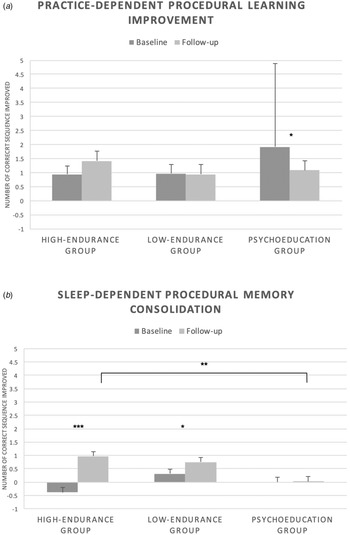
The mixed-model ANOVA with intention-to-treat analysis showed a significant main effect for sleep-dependent procedural memory consolidation [F (1,48) = 15.297, p < 0.001, η p2 = 0.242], whereas a non-significant main effect was observed for practice-dependent procedural memory improvement [F (1,48) = 0.496, p = 0.485, η p2 = 0.010]. The Bonferroni post-hoc analysis indicated that both HIIT (p < 0.001) and AE (p < 0.05) groups demonstrated a significant improvement in sleep-dependent memory consolidation within the groups, whereas the psychoeducation group showed no changes in the consolidation performance after the intervention (p = 0.023, see Fig. 2b).
Improvement of procedural memory performance during baseline and follow-up. (a) Practice-dependent improvement (illustrating how much the subjects have improved solely from the first 10 trials of practice). (b) Sleep-dependent improvement (illustrating how much the subjects have improved after overnight sleep without further practice). Error bars are s.e.m. Asterisks represent significance (p): *≤0.05; **≤0.005; ***≤0.001.

Furthermore, significant time × group interactions were observed for both practice-dependent memory improvements [F (2,48) = 4.287, p < 0.05, η p2 = 0.152] and sleep-dependent memory consolidation [F (2,48) = 5.171, p < 0.01, η p2 = 0.177]. The Bonferroni post-hoc analysis indicated that both HIIT (p < 0.999) and AE (p < 0.999) groups were not significantly different compared to the psychoeducation group in terms of practice-dependent improvement during the follow-up. The sleep-dependent memory consolidation performance of the HIIT group was significantly higher (p < 0.01) during the follow-up compared to the psychoeducation group, whereas the AE group was not significantly different compared to the psychoeducation group (p = 0.057). Table 2 shows the results of the Bonferroni post-hoc analysis.
Bonferroni pairwise comparison for the primary and secondary outcomesa

a Bonferroni pairwise comparison for the primary outcomes (i.e. results of the MST) and secondary outcomes.
b Practice-dependent improvement was the difference in the number of correct sequences between the initial performance and test block I.
c Sleep-dependent consolidation was the difference in the number of correct sequences between test block I and test block II.
*p < 0.05; **p < 0.005; ***p < 0.001.
Secondary outcomes: logical memory, ISI, PSQI, PANSS, physical measurements, and IPAQ
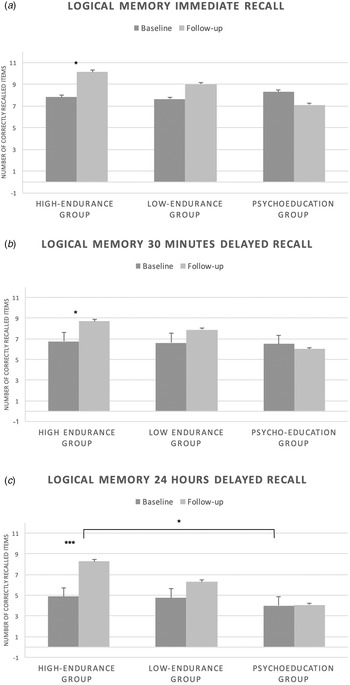
The mixed-model ANOVA with intention-to-treat analysis showed a significant main effect for the 24-h delayed recall in the logical memory test [F (1,48) = 11.940, p < 0.005, η p2 = 0.199]. The HIIT group demonstrated a significant within-group improvement (p < 0.001), whereas both the AE (p = 0.077) and psychoeducation (p = 0.946) groups showed no significant differences. In the Bonferroni post-hoc analysis, the HIIT group showed a significant improvement in immediate recall (p < 0.05), 30-min delayed recall (p < 0.05), and 24-h delayed recall (p < 0.001). Furthermore, significant time × group interactions were observed for the immediate recall [F (2,48) = 3.870, p < 0.05, η p2 = 0.139] and 24-h delayed recall [F (2,48) = 4.117, p < 0.05, η p2 = 0.146]. However, only the HIIT group showed a significantly higher number of correctly recalled items in the 24-h delayed recall during follow-up compared to the psychoeducation group (p < 0.05). Figure 3 shows the between and within group differences in the performance of logical memory tests.
Changes in verbal memory performance within each group. (a) Immediate recall (the logical memory performance during immediate recall from baseline to follow-up). (b) 30-min delayed recall (the logical memory performance during 30-min delayed recall from baseline to follow-up). (c) 24-h delayed recall (the logical memory performance during 24-h delayed recall from baseline to follow-up). Error bars are s.e.m. Asterisks represent significance (p): *≤0.05; **≤0.005; ***≤0.001.

The ISI total score, PSQI global score, PANSS total score, body weight, hip circumference, BMI, and hip–waist ratio did not demonstrate any significant main effects or time × group interactions. However, a significant time × group interaction was observed for waist circumference [F (2,48) = 5.117, p < 0.05, η p2 = 0.066]. No between group differences were observed according to the Bonferroni post-hoc analyses (Table 2).
Relationship between reported sleep and memory consolidation performance
Two individual linear regressions with intention-to-treat analysis were conducted. The linear multiple regression model was not significant [F (7,43) = 1.16, p = 0.348; R 2 = 0.021] in predicting the procedural memory consolidation by total time in bed, sleep latency, sleep duration, sleep efficiency, frequency of sleep disturbance, total duration of sleep disturbance, and sleep quality. The linear multiple regression model was also not significant [F (7,43) = 1.86, p = 0.101; R 2 = 0.107] in predicting the declarative memory consolidation by total time in bed, sleep latency, sleep duration, sleep efficiency, frequency of sleep disturbance, total duration of sleep disturbance, and sleep quality.
Discussion
To the best of our knowledge, this is the first RCT that provides evidence to support that physical exercise can improve sleep-dependent procedural memory consolidation in schizophrenia. Regardless of the exercise intensity, both HIIT and AE exercise were able to demonstrate within-group improvements on the impaired sleep-dependent memory consolidation compared to at-baseline. This suggests that regular physical exercise, regardless of the intensity, could be beneficial for procedural memory consolidation in schizophrenia. Moreover, this improvement was only limited to sleep-dependent memory consolidation, as there was no evidence to support the hypothesis that exercise could improve practice-dependent procedural learning. These findings were in line with a previous study that used a single session of exercise to improve procedural memory consolidation in healthy individuals as tested by the visuomotor accuracy-tracking task (Roig et al., Reference Roig, Skriver, Lundbye-Jensen, Kiens and Nielsen2012). They found that a single session of high-intensity exercise (20 min of intense cycling according to individual's VO2Max and blood lactate) could improve motor skills 7 days after practice in healthy individuals. They also found consistently that exercise had no significant effects on procedural learning within the first hour of learning, with effects seen only after 24 h. Therefore, our study is the first to demonstrate significant exercise effects on procedural memory consolidation in a clinical population.
Interestingly, the logical memory test demonstrated a different pattern. The HIIT group showed a better overall performance in the logical memory test, including better immediate memory, 30-min delayed memory, and 24-h delayed memory. Moreover, the 24-h delayed memory showed a more prominent effect on the HIIT group compared to the control group. The findings from the logical memory test and MST showed patterns consistent with the literature, in that the declarative memory and procedural memory are two independent neural circuits. The process of procedural learning involves multiple circuits, such as the frontal/basal ganglia circuits and the premotor regions, which are not associated with the declarative memory system (Schacter & Tuvling, Reference Schacter and Tuvling1995; Ullman, Reference Ullman2004). The striatum within the basal-ganglia has been reported to be responsible for procedural memory (Squire and Knowlton, Reference Squire and Knowlton1994), and the supplementary motor area (SMA) and pre-SMA have been reported to be associated with motor sequence learning (Boecker et al., Reference Boecker, Dagher, Ceballos-Baumann, Passingham, Samuel, Friston and Brooks1998; Hikosaka, Nakamura, Sakai, & Nakahara, Reference Hikosaka, Nakamura, Sakai and Nakahara2002; Jenkins, Brooks, Nixon, Frackowiak, & Passingham, Reference Jenkins, Brooks, Nixon, Frackowiak and Passingham1994). On the contrary, the declarative learning and memory system directly involves the medial temporal lobe structure (Squire & Zola-Morgan, Reference Squire and Zola-Morgan1991; Suzuki & Eichenbaum, Reference Suzuki and Eichenbaum2000), particularly that of the hippocampus (Eichenbaum, Reference Eichenbaum2000). Although it has been well defined that these two systems are dissociated during the initial learning stage, in recent years, studies have argued that both declarative and procedural memory consolidation both depend on hippocampal activities during the emergence of offline gain (Albouy et al., Reference Albouy, King, Maquet and Doyon2013). This new argument suggests that hippocampus functions are not just limited to processing declarative information, but it also has functions in processing procedural information during a specific sleep stage, possibly correlated with sleep spindle density, as it has been found to be associated with the quality of sleep-dependent memory consolidation (Schabus et al., Reference Schabus, Gruber, Parapatics, Sauter, Klosch, Anderer and Zeitlhofer2004; Sirota, Csicsvari, Buhl, & Buzsaki, Reference Sirota, Csicsvari, Buhl and Buzsaki2003). These findings support our current findings that the exercise-improved memory functions may only be limited to hippocampal-related functions (i.e. declarative memory and sleep-dependent declarative/procedural memory consolidation).
Furthermore, the current study showed 3 months of exercise, regardless of exercise intensity, did not induce any changes in subjective sleep quality in schizophrenia, as we found no associations between subjective sleep quality and exercise-induced procedural memory consolidation. These findings may suggest that the effects of exercise on sleep may be obscured by the effects of antipsychotics and symptoms. A previous study demonstrated that the impaired procedural memory consolidation in schizophrenia was associated with abnormal sleep spindle activity during stage 2 NREM sleep (Wamsley et al., Reference Wamsley, Tucker, Shinn, Ono, McKinley, Ely and Manoach2012). Therefore, detecting any subjective or behavioral changes associated with sleep spindle activity would require a much larger sample size with sufficient statistical power to reveal any differences. Future studies should also include polysomnography to investigate the association between exercise, sleep spindle density, and procedural memory consolidation performance.
However, the results have to be interpreted with caution due to a few limitations. First of all, the female ratio is higher in the HIIT group. Previous studies have demonstrated gender differences in hippocampal response to learning (Cahill, Reference Cahill2006). It has been pointed out that the gender differences were only found in verbal learning (Loprinzi & Frith, Reference Loprinzi and Frith2018), but not in procedural learning (Moreno-Briseno, Diaz, Campos-Romo, & Fernandez-Ruiz, Reference Moreno-Briseno, Diaz, Campos-Romo and Fernandez-Ruiz2010), unless it was cued by verbal or symbol stimulus (Weiss, Deisenhammer, Hinterhuber, & Marksteiner, Reference Weiss, Deisenhammer, Hinterhuber and Marksteiner2005; Weiss, Kemmler, Deisenhammer, Fleischhacker, & Delazer, Reference Weiss, Kemmler, Deisenhammer, Fleischhacker and Delazer2003). Although the current MST has eliminated most female advantage components (i.e. verbal components), the menstrual cycle in women mediates female hormonal levels, and may impact sleep spindle activity (Genzel et al., Reference Genzel, Kiefer, Renner, Wehrle, Kluge, Grozinger and Dresler2012). This study was not designed to test for gender differences, and therefore, menstrual cycle data had not been collected. Second, given the number of sessions per week was quite high, and the location of the center is considerably remote, some participants had difficulties attending most of the sessions, and therefore the attendance rate is low. Future studies may need to consider a better logistic approach to enhance the attendance rate. Finally, the VO2Max and FTP were not calculated via a direct cardiopulmonary measure, but solely relied on an indirect estimation based on a single-sided pedal power measure. The power measurement in the current study highly relied on the exercise effort the participants given, and it is difficult to rule out the possibility that some participants may not have been giving their full effort during each intervention session. Although the relationship between the measurement of power and VO2Max has been tested to have significant linear relationship (Denham et al., Reference Denham, Scott-Hamilton, Hagstrom and Gray2020), using cardiopulmonary measures to detect and monitor in-session physiological changes is recommended. Therefore, the in-session intervention fidelity could be a potential limitation to the study outcome, given previous research has mentioned that effort on exercise behavior might be linked to cognitive improvement in schizophrenia (Kimhy et al., Reference Kimhy, Lauriola, Bartels, Armstrong, Vakhrusheva, Ballon and Sloan2016). Other in-session exercise effort measurements, such as the Borg scale (Stendardi, Grazzini, Gigliotti, Lotti, & Scano, Reference Stendardi, Grazzini, Gigliotti, Lotti and Scano2005), had not been included; and the pre- and post-heart rate changes that were measured from each intervention session were too distal to represent exercise effort. Thus, future studies are recommended to prioritize using cardiopulmonary measures to calculate VO2Max to monitor in-session exercise effort if resources are available.
In conclusion, the exercise-improved sleep-dependent procedural memory consolidation in schizophrenia was more apparent with more intensive exercise type. This finding is consistent with previous studies on healthy controls (Eich & Metcalfe, Reference Eich and Metcalfe2009; Roig et al., Reference Roig, Skriver, Lundbye-Jensen, Kiens and Nielsen2012). By using a long-term exercise intervention paradigm, it is suggested that the improvement in memory function would not be limited to an immediate effect due to intensive exercise-induced stress (Eich & Metcalfe, Reference Eich and Metcalfe2009), but would result in a more long-term effect. The improved procedural memory consolidation can potentially be explained by the interaction between exercise and the hippocampus (Genzel et al., Reference Genzel, Rossato, Jacobse, Grieves, Spooner, Battaglia and Morris2017; Schendan, Searl, Melrose, & Stern, Reference Schendan, Searl, Melrose and Stern2003), as exercise is positively associated with hippocampal volume in schizophrenia (Lin et al., Reference Lin, Chan, Lee, Chang, Tse, Su and Chen2015; Pajonk et al., Reference Pajonk, Wobrock, Gruber, Scherk, Berner, Kaizl and Falkai2010) and the hippocampus is now considered to have a role in both declarative and procedural memory consolidation (Schendan et al., Reference Schendan, Searl, Melrose and Stern2003). The logical memory test result also supported these potential changes. Although most of the previous literature has reported that procedural learning is largely dependent on the interaction within the cortico-cerebellar and cortical-striatal circuits (Doyon & Benali, Reference Doyon and Benali2005; Hikosaka et al., Reference Hikosaka, Nakamura, Sakai and Nakahara2002; Penhune & Steele, Reference Penhune and Steele2012; Ungerleider, Doyon, & Karni, Reference Ungerleider, Doyon and Karni2002), so far, no evidence has shown that exercise can improve brain plasticity or activities in these brain regions in humans. Therefore, future research should focus on investigating the interaction between the hippocampus and other cortical and subcortical regions during procedural memory consolidation in schizophrenia after a certain amount of physical exercise.
Acknowledgements
This research was supported by the Department of Psychiatry, University of Hong Kong. We thank all our colleagues from the department for all their kind support. We would also like to thank Dr Nestor Vinas for his suggestions and technical support on using a power meter to quantify cycling performance, which was an essential element of this study. Finally, we would like to thank our research team in the Department of Psychiatry, University of Hong Kong for their support throughout the project. Trial registration ClinicalTrials.gov identifier: NCT03800368.
Conflict of interest
The authors declare no conflicts of interest in relation to the subject of this study.