Body image among older adults
Body image, defined as ‘a multidimensional construct encompassing self perceptions and attitudes regarding one's physical appearance’ (Cash et al. Reference Cash, Morrow, Hrabosky and Perry2004: 1081), is thought to ‘[hold] important premises for understanding fundamental issues of ageing and identity’ (Krauss-Whitbourne and Skultety Reference Krauss Whitbourne, Skultety, Cash and Pruzinsky2002: 83), but in the research literature body image has been viewed primarily as a young women's issue. As a result, while body concerns amongst women aged 18–25 years are well documented (Grogan Reference Grogan1999), very little is known about men's attitudes to body image, and much less about those of older adults of either gender. Given the many implications of the rise in the proportion of older people (in the Australian population from 12.4% in 2004 to 25% by 2052), the examination of factors related to older adults' wellbeing is important.
Whilst ageing inevitably takes a person's body away from western societies' cultural ideals of thinness (Lamb et al. Reference Lamb, Jackson, Cassidy and Priest1993), muscularity (Lien, Pope and Gray Reference Lien, Pope and Gray2001) and youthfulness (Bordo Reference Bordo1993), Feingold and Mazzella (Reference Feingold and Mazzella1998) suggested that women are likely to benefit from ageing because they reach a stage where they are no longer exposed to social pressures that emphasise appearance. It has also been suggested that ‘signs of ageing in men may be seen to make them look distinguished’ (Grogan Reference Grogan1999: 128), but the few studies that have considered older adults' body image only partially support these notions. The majority of the research evidence suggests that women's discontent with their bodies is relatively stable across the lifespan (Stevens and Tiggemann Reference Stevens and Tiggemann1998; Tiggemann and Lynch Reference Tiggemann and Lynch2002), although different findings have emerged from the few studies that included women aged 65 or more years. Öberg and Tornstam (Reference Öberg and Tornstam1999), for example, surveyed more than 1,000 women aged 20–85 years and found that women aged 65–85 years rated the item, ‘I am satisfied with my body’, more positively than younger women. Similarly, Hetherington and Burnett's (Reference Hetherington and Burnett1994) investigation of desired weight and body satisfaction in a sample of 50 women aged 60–78 years (mean 67.3) found increased body satisfaction in this age group. It should be noted that the general statement, ‘I am satisfied with my body’, may be interpreted differently by older women (who might relate it to functional abilities) and by younger women (who might relate it to physical appearance). This shift in the basis of the assessment from appearance to function has been recognised by several studies (Franzoi and Koehler Reference Franzoi and Koehler1998; Janelli Reference Janelli1993; Reboussin et al. Reference Reboussin, Rejeski, Martin, Callahan, Dunn, King and Sallis2000; Underwood Reference Underwood2005).
Perhaps as a result of the common belief that cultural influences and pressures of appearance and beauty standards apply only to women, research on men's body-image concerns has been neglected, with the consequence that they have generally been reported as insignificant. The implication is that men are exempt from the pressures of having the ideal body shape as experienced by women (Cash and Green Reference Cash and Green1986). Recent research has suggested, however, that men from a young age want to lose weight and become larger and more muscular, wishing to conform to the cultural ideal of a mesomorphic V-shaped body with broad shoulders and a slim waist (e.g. Kostanski, Fisher and Gullone Reference Kostanski, Fisher and Gullone2004; McCabe and Ricciardelli Reference McCabe and Ricciardelli2004; Olivardia Reference Olivardia, Cash and Pruzinsky2002). As Dutton (Reference Dutton1995) suggested, in western societies muscles symbolise traditional masculine traits such as strength, power, dominance and sexual virility. For this reason, it could be argued that the shift in women's position in society has resulted in a loss of traditional gender roles for men who, in order to maximise their potential for mate selection, seek to achieve a physical appearance that accords with masculinity (cf. Etcoff Reference Etcoff2000). Whether older men respond in this way is unclear, but some evidence suggests that the ageing process negatively affects older men's body image.
Paxton and Phythian's (Reference Paxton and Phythian1999) study indicated that as men age, they are more likely than women to experience a sense of decreased attractiveness, and that the factors that influence men's perceptions and attitudes regarding their physical appearance change (as for women) (cf. Franzoi and Koehler Reference Franzoi and Koehler1998; Underwood Reference Underwood2005). Thus, elderly men are more likely than younger men to express less positive attitudes about their body, but do so in terms of factors associated with body functioning (e.g. physical co-ordination, agility and health) rather than appearance. Janelli (Reference Janelli1993) investigated gender differences in body image among a sample of 89 older adults aged 60–98 years (mean 76), and found that older women were most dissatisfied with not only their weight but also their eyes, hands, fingers and legs. All these body parts are usually exposed and very important for physical functioning. Men were also dissatisfied with their eyes and legs and mentioned teeth and health (Janelli Reference Janelli1993), which are all directly related to body function. Reboussin et al. (Reference Reboussin, Rejeski, Martin, Callahan, Dunn, King and Sallis2000) examined correlates of body-image satisfaction among 580 middle-aged adults (35–54 years) and 274 older people (aged 55–75 years) and concluded that there is a clear distinction between body function and body appearance for older adults, and that they value the former more than the latter.
By using various body-image scales, the aforementioned studies focused on appearance-related measures and neglected other aspects of body image such as health and fitness. The importance of including such factors was demonstrated by Paxton and Phythian (Reference Paxton and Phythian1999) through their survey of 159 men and 122 women aged 40–79 years (mean 56). They found that the way women viewed their bodies was significantly influenced by the way they evaluated their health, and that physical fitness was a significant determinant of how men viewed their bodies. Hence, while appearance is an integral part of body image and should not be ignored, it is important to conceive body image as a multi-dimensional construct.
The relationship between body image and self-esteem among older adults
Of all the personal attributes that influence the development of body image, Cash (Reference Cash, Cash and Pruzinsky2002: 41) suggested that ‘self-esteem may be the most pivotal’. This relationship between body image and self-esteem has been verified by several studies (e.g. Paxton and Phythian Reference Paxton and Phythian1999; Webster and Tiggemann Reference Webster and Tiggemann2003). It has also been demonstrated that particular aspects of body image positively correlate with self-esteem, e.g. perceived physical attractiveness (Davidson and McCabe Reference Davidson and McCabe2005). Despite indications that self-esteem and body image contribute significantly to one's general wellbeing (Cash and Fleming Reference Cash and Fleming2002), neither the development of self-esteem in old age nor the relationship between body image and self-esteem among older adults have received much attention. Viewed as an essential component of mental health (Kling et al. Reference Kling, Hyde, Showers and Buswell1999), self-esteem can be defined as ‘the overall affective evaluation of one's worth, value or importance’ (Blascovich and Tomaka Reference Blascovich, Tomaka, Robinson, Shaver and Wrightsman1991: 125). Although few studies have provided a clear indication of changes in self-esteem across the lifespan, a large cross-section study of 326,641 individuals aged 9–90 years suggested that during adulthood, self-esteem rises gradually until the age of 65 years, and that it declines sharply after 70 years of age (Robins et al. Reference Robins, Trzesniewski, Tracy, Gosling and Potter2002). While this pattern was similar for men and women, it was also shown that men reported higher self-esteem throughout adulthood until 70 years of age, after which the gender difference reversed, with women aged in the eighties reporting slightly higher self-esteem than men of the same age.
Several reasons for these age and gender variations have been proposed; for example, spousal loss, decreased social support and a fall in socio-economic status are thought to contribute to the observed decline in self-esteem in later life (Baltes and Mayer Reference Baltes and Mayer1999). Pearlman (Reference Pearlman, Davis, Cole and Rothblum1993: 2) theorised that a developmental transition labelled ‘late mid-life astonishment’ – the reaction to the physical changes that occur between the ages of 50 and 60 years and that affect one's physical and sexual attractiveness – disrupted women's self-esteem. A number of studies have reported that body dissatisfaction associates with low self-esteem (Stormer and Thompson Reference Stormer and Thompson1996; Stowers and Durm Reference Stowers and Durm1996), but few have specifically investigated the relationship between body image and self-esteem among older adults and even fewer included men in their samples.
Assuming that appearance and weight become less important in older adulthood, it might be expected that the relationship between body image and self-esteem weakens with age (Tiggemann Reference Tiggemann2004). Studies that have included middle-aged and older women in their samples have indicated, however, that body-image dissatisfaction is still related to lower self-esteem at these ages. For instance, Paa and Larson (Reference Paa and Larson1998) predicted levels of restrained eating in a sample of 145 women aged 30–60 years (mean 43), and found a negative correlation between body-image dissatisfaction and self-esteem. Whilst the research evidence suggests that self-esteem and body image remain highly correlated in older adulthood, only a few studies have investigated the relationship among people aged 65 or more years, and these few have used ill-defined age groups that vary greatly (e.g. middle age, old age). It is therefore difficult to generalise about fluctuations in body-image concerns as a function of age (Striegel-Moore and Franko Reference Striegel-Moore, Franko, Cash and Pruzinski2002).
Design of the empirical study
Given the gap in the literature regarding older adults' body image and self-esteem, the aims of the current study were to investigate the relationship between several body-image variables and self-esteem in a sample of older adults, and to examine age and gender variations. More specifically, employing a sample of men and women aged 65–85 years, it has addressed the following research questions:
A: Are there significant differences in body-image satisfaction as people age?
B: Are there gender differences in body-image satisfaction as people age?
C: Is self-esteem stable as people age and is that so for both males and females?
D: Which body-image variables best predict self-esteem and are they the same for both males and females?
Method and sample
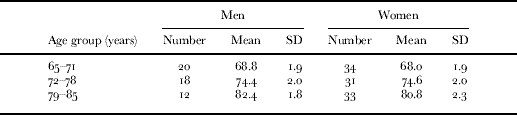
Fifty males and 98 females aged 65–85 years living independently in the Perth Metropolitan Area, Western Australia, were recruited to the study. Following the methodology of the Seattle Longitudinal Study (Schaie Reference Schaie1996, Reference Schaie2000, Reference Schaie2004), the participants were divided into three groups, to enable the ages at which particular body-image concerns apply, and to identify changes with age (Table 1). The participants were recruited through a weekly ‘Variety Programme for Seniors’, advertisements and by word-of-mouth. Participation was voluntary and completion of the questionnaire took approximately 15 minutes. The participants' postal addresses indicated that several metropolitan areas and diverse socio-economic backgrounds were represented (Australian Bureau of Statistics 2000). Fifty-seven per cent of the sample were Australian-born, 25 per cent were born in the United Kingdom, and most of the remaining 18 per cent were born in other European countries. Of the 205 questionnaires distributed, 157 were returned, a response rate of 76.6 per cent. Nine incomplete questionnaires were discarded, leaving 148 for analysis.
Age and gender of the study sample
Note: SD: standard deviation.
Measures
Self-esteem was measured with the Rosenberg Self-Esteem Scale (RSES), a 10-item self-report scale (Rosenberg Reference Rosenberg1965). Respondents rated each item on a five-point Likert scale, from ‘1’ (‘definitely disagree’) to ‘5’ (‘definitely agree’). This order was reversed from the original scale so that the RSES and Multidimensional Body Self Relations Questionnaire (MBSRQ; Cash Reference Cash2000) presented similar scales for clarity and to facilitate ease of responding. The RSES items were scored in accord with this modification, with the positive items reversed. Items from the scale included ‘I feel that I have a number of good qualities’ and ‘I take a positive attitude toward myself’. The final scores ranged from ‘1’ to ‘5’, with high scores indicating higher levels of self-esteem. The measure demonstrated good internal consistency (Cronbach's alpha reliability coefficients were 0.85 for men and 0.74 for women), consistent with published estimates (seeBlascovich and Tomaka Reference Blascovich, Tomaka, Robinson, Shaver and Wrightsman1991).
Nine sub-scales of the MBSRQ were used to measure two dispositional dimensions, evaluation and orientation, in each of the three somatic domains of appearance, fitness and health/illness, as well as attitude towards being or becoming overweight and self-perceived weight. The Appearance Evaluation (AE) subscale has seven items and assesses feelings about one's physical attractiveness, with higher scores indicating greater satisfaction with appearance. The Appearance Orientation (AO) subscale has 12 items and assesses investment in one's appearance, with higher scores indicating that more importance is placed on appearance and grooming behaviour. The Fitness Evaluation (FE) subscale has three items and assesses feelings about one's fitness level, with higher scores indicating that the respondent perceives being physically fit. The Fitness Orientation (FO) subscale has 13 items and assesses level of investment in fitness activities, with higher scores indicating more involvement. The Health Evaluation (HE) subscale has six items and assesses feelings about one's health, with higher scores indicating a perception of good physical health. The Health Orientation (HO) subscale has eight items and assesses investment in healthy behaviours, with higher scores indicating a perception of a healthy lifestyle. The Illness Orientation (IO) subscale has five items and assesses awareness and reactivity to being or becoming ill, with higher scores indicating a greater awareness of illness symptoms and a greater likelihood of seeking medical attention. The Overweight Preoccupation (OP) subscale has four items that indicate level of anxiety about being or becoming overweight, with higher scores indicating greater weight preoccupation; and the Self-Classified Weight (SCW) subscale of two items assesses how a person perceives and labels their own weight, from ‘very underweight’ to ‘very overweight’.
Responses to the 60 items of the MBSRQ are on a five-point Likert scale that ranges from ‘1’ (‘definitely disagree’) to ‘5’ (‘definitely agree’). For the SCW subscale only, the scale is from ‘1’ (‘very underweight’) to ‘5’ (‘very overweight’). Items from the MBSRQ scale included ‘Before going out in public I always notice how I look’ and ‘I often feel vulnerable to sickness’. The final MBSRQ subscale scores are the means of the constituent items after reversing contra-indicative items (Cash Reference Cash2000). The MBSRQ has good psychometric properties with alpha internal consistency scores ranging between 0.70 and 0.89 (Cash Reference Cash2000). For this study, the overall internal validity for the MBSRQ subscales was 0.91 for men and 0.89 for women.
Data analysis
To answer research questions A, B and C, and to examine sex and age differences in body-image variables and self-esteem, a multivariate analysis of variance (MANOVA) was conducted with gender (male or female) and age group (65–71, 72–78 and 79–85 years) as the independent variables. The dependent variables were the respondents' scores on the RSES and MBSRQ subscales. To answer research question D and to examine the relationship between self-esteem and the body-image variables, two multiple regressions were estimated with self-esteem as the criterion variable and the nine body-image variables as predictors. The first regression was for men and the second for women. In accord with Tabachnick and Fidell (Reference Tabachnick and Fidell2001), no adjustments for alpha were required.
The results
Prior to analysis, all entries were examined for accuracy and missing values. Instances of missing data were replaced by the mean value of the appropriate age/gender group, as recommended by Tabachnick and Fidell (Reference Tabachnick and Fidell2001). No univariate outliers were identified. Detection of multivariate outliers was assessed using the Mahalanobis distance. Two multivariate outliers (with p<0.001) were detected and deleted, leaving 146 cases for final analysis. A two-by-three MANOVA was estimated with gender (male or female) and age group (65–71, 72–78 or 79–85 years) as the independent variables and respondents' scores on the RSES and nine MBSRQ subscales as the dependent variables. As the cells had unequal numbers of cases and because it was assumed that differences in cell sizes reflected real processes in the population sampled, the regression method was used (Tabachnick and Fidell Reference Tabachnick and Fidell2001). Hence, each cell mean was given an equal weight regardless of its sample size and each main effect and interaction was assessed after adjustments were made for all other main effects and interactions.
With the use of Pillai's trace criterion, which is considered both conservative and robust against unequal cells for MANOVA (Tabachnick and Fidell Reference Tabachnick and Fidell2001), the combined dependent variables were significantly affected by both gender (F (10, 131 degrees of freedom)=5.44, p<0.05) and age (F (20, 264)=2.21, p<0.05), and a significant age by gender interaction was detected (F (20, 264)=2.13, p<0.05). These results reflected a high association between gender and the combined dependent variables (DVs) (η2=0.71), as well as a high association between age and the combined DVs (η2=0.71). The association between the interaction of gender and age and the combined DVs was also high (η2=0.72). The age by gender interaction was statistically significant at the univariate level for the following variables: self-esteem, appearance evaluation, fitness evaluation, fitness orientation, health orientation, and illness orientation. While these interactions were statistically significant, it should be noted that the cell frequencies ranged from 12 to 34 with a mean of 24.7. The largest significant difference, in relation to the range of scores on the Likert scale employed was 0.72, which means that although statistically significant, the difference could have been masked by the Likert scale. Future research will test this further.
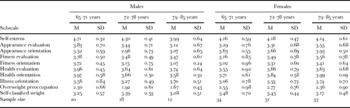
As the assumption of homogeneity of variance for a post hoc test was violated (Levene's test <0.05), the Games–Howell procedure was used (Tabachnick and Fidell Reference Tabachnick and Fidell2001). It revealed that the 65–71 years group reported significantly lower levels of illness orientation than those aged 79–85 years (mean=3.25, standard deviation (SD)=0.82 and mean=3.73, SD=0.65, respectively). The 72–78 years age group's score for self-classified weight was significantly higher than that for the 79–85 years group (mean=3.42, SD=0.47 and mean=3.14, SD=0.48, respectively). In answer to research question A, it can thus be said that there were significant differences on measures of body image between each of the age groups, particularly in terms of illness orientation and self-classified weight.
Further univariate analyses revealed significant effects for self-esteem, appearance evaluation, appearance orientation, fitness orientation, illness orientation, and overweight preoccupation. Games–Howell's post hoc testing pertaining to the RSES indicated that males aged 65–71 years reported significantly higher levels of self-esteem compared to all other groups. The means and SD are presented in Table 2. Post hoc tests of the MBSRQ subscales indicated that on measures of appearance orientation, males aged 65–71 years scored significantly lower than females aged 79–85 years. Males aged 72–78 years also reported being significantly less concerned with making an effort to improve their physical appearance than did all other female groups. Males aged 79–85 years also scored significantly lower on the appearance evaluation scale than their female counterparts.
Means and standard deviations of scores on the Rosenberg Self-Esteem Scale and Multidimensional Body Self Relations Questionnaire subscales by gender and age group

Notes: M: mean. SD: standard deviation.
Post hoc pairwise comparisons also showed that men aged 65–71 years scored significantly higher than women of the same age on measures of fitness evaluation and fitness orientation. Males aged 65–71 years reported significantly higher levels of investment in being physically fit than those aged 79–85 years. With regards to health orientation, post hoc tests revealed that males aged 79–85 years reported significantly less interest in leading a healthy lifestyle than their female counterparts. The post hoc pairwise comparisons of illness orientation showed that females aged 65–71 were significantly less alert to symptoms of physical illness than females aged 79–85 years. With regards to overweight preoccupation, males aged 65–71 reported significantly higher levels of anxiety towards being or becoming overweight than males aged 79–85 years. On this same scale, males aged 72–78 scored significantly lower than their female counterparts and males aged 79–85 reported significantly lower levels of preoccupation with their weight than females in all age groups.
In answer to research question B pertaining to gender differences in body-image satisfaction as people age, the results therefore showed that there were significant differences between men and women. Specifically, in some age groups males and females were significantly different on: levels of satisfaction with their physical appearance; the evaluation of their physical fitness and investment in activities to maintain or increase their fitness level; their orientation towards the importance of leading a healthy lifestyle; their responsiveness to signs of physical illness; and their preoccupation with being or becoming overweight. In answer to research question C concerning the stability of self-esteem as people age, the results showed that females' self-esteem remained stable from the age of 65–85 years. Males' self-esteem, however, decreased significantly through this age span.
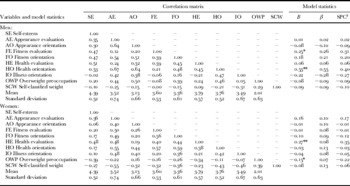
To answer research question D and to examine the relationships between self-esteem and body-image variables, two standard multiple regressions were conducted with self-esteem as the criterion variable and the nine body-image variables as predictors. Table 3 displays the correlations between the variables and the associated test statistics. The upper panel has the statistics for men, and shows that the explained variance (R 2) was significant (F (9, 40)=4.78, p<0.001). Health orientation and fitness evaluation were the only two variables that contributed significantly to the prediction of self-esteem in males, and they accounted for 14 per cent of the variance. The lower panel of Table 3 has the statistics for the female regression, which was also significant (F (9, 86)=4.80, p<0.001), but only health evaluation and overweight preoccupation were significant predictors, accounting for 13 per cent of the variance. In answer to research question D, the results showed that whilst body-image variables do influence self-esteem, these differ as a function of gender.
Correlation matrix of body-image variables and standard multiple regression coefficients of self-esteem across gender

Notes: Other model statistics are: (a) for men, intercept 1.98, r=0.72, R 2=0.52 (unique variability=0.14, shared variability=0.38), adjusted R 2=0.41; and (b) for women, intercept 3.95, r=0.58, R 2=0.33 (unique variability=0.13, shared variability=0.20), adjusted R 2=0.26. 1. SPC: semi-partial correlation coefficients: squaring an SPC value yields the amount by which R 2 would be reduced if its related independent variable was removed (Tabachnick and Fidell Reference Tabachnick and Fidell2001).
Significance levels: * p<0.05, ** p<0.01.
Discussion
Body image
This study has examined variations in self-esteem by a number of body-image variables among people aged 65–85 years. The results indicate that body-image concerns are significant to self-esteem in older adulthood, but that these vary by age and gender. In accordance with previous research, the findings suggest that women are likely to benefit from the ageing process as they reach a stage when they are no longer exposed to the social pressures that emphasise the importance of appearance (Feingold and Mazzella Reference Feingold and Mazzella1998). Women aged 79–85 years evaluated their physical appearance more positively than those aged 65–71 years, but those in the oldest age group also reported investing more time in their appearance as they aged, suggesting that physical appearance remained important. As previously suggested (e.g. Jackson and O'Neal Reference Jackson and O'Neal1994), it is likely that to counter the effects of ageing, older women engage in the more controllable aspects of personal grooming such as hair care, clothing and make-up.
Also in accordance with previous research findings, men in this study reported becoming increasingly dissatisfied with their physical appearance as they aged, but in contrast to previous reports, and despite their increasing dissatisfaction with their appearance, they were less likely than women to engage in appearance-enhancing activities. It is likely that this inconsistency stems in part from the different age range examined by the current study compared with previous research and from the use of different measuring scales that may have different sensitivity. Fitness is often viewed as a high priority for men, and indeed men aged 65–71 years reported feeling significantly more ‘in shape’ than women, and being more involved in fitness-related activities. One plausible explanation is that the motivation for men of this age to engage in physical activity is to maintain a certain body-shape ideal. Interestingly, women aged 79–85 years evaluated their level of fitness more positively than women aged 65–71 years, whereas men's evaluation of their physical fitness declined as they aged (but the differences were not statistically significant).
Significant differences in fitness orientation that directly reflected those of fitness evaluation confirmed the consistency of the respondents' overall feelings about physical fitness. Indeed, with greater age men reported becoming significantly less involved in physical activities. Given that physical fitness and muscularity are said to symbolise traditional masculine traits such as strength, power, dominance and sexual virility (Dutton Reference Dutton1995), the progressive decline in men's evaluation of, and investment in, their physical fitness may reflect their increased frustration as ageing takes their body further away from western societies' cultural ideal. Alternatively, and in accord with previous research (Franzoi and Koehler Reference Franzoi and Koehler1998; Underwood Reference Underwood2005), these results may reflect older men's tendency to express negative attitudes toward their body, but to do so in terms of factors associated with body functioning.
That fitness and health are closely related concepts was confirmed by their similar patterns of variation. While overall men evaluated their physical health more positively than women, the latter reported becoming increasingly health conscious as they aged, whereas among men this pattern was reversed. As a result, women aged 79–85 years were significantly more alert to personal symptoms of physical illness than women aged 65–71 years. These findings support the notion that older adults' body-image satisfaction is largely mediated by health and physical abilities (Franzoi and Koehler Reference Franzoi and Koehler1998; Underwood Reference Underwood2005). These findings are consistent with the increase with age in vulnerability to a range of health challenges (Janelli Reference Janelli1993).
Although no significant differences by gender were found for perceived weight, women reported higher levels than men of anxiety about being or becoming overweight. This gender difference was statistically significant among those aged 72–78 and 79–85 years, and is consistent with previous findings (e.g. Hurd Clarke Reference Hurd Clarke2002; Paxton and Phythian Reference Paxton and Phythian1999). It suggests that older women are more affected by cultural pressures to conform to a slim ideal (Hetherington and Burnett Reference Hetherington and Burnett1994). It may be that, despite their vulnerability to nutritional deficiencies (Hetherington and Burnett Reference Hetherington and Burnett1994; Tiggemann Reference Tiggemann2004), older women are likely to practise dieting and to restrain eating in the belief that losing weight will make them look younger (Hubley and Quinlan Reference Hubley and Quinlan2005). Congruent with the majority of prior research on gender differences (e.g. Franzoi and Koehler Reference Franzoi and Koehler1998; Hurd Clarke Reference Hurd Clarke2002; Paxton and Phythian Reference Paxton and Phythian1999), the current study found that women put more emphasis on appearance than men, but the fact that men reported becoming progressively dissatisfied with their physical appearance indicates that the cultural pressures to conform to youthful ideals are experienced by both genders.
Self-esteem
The results of the presented analysis indicate that whilst older women's self-esteem remained stable between the ages of 65 and 85 years, older men's self-esteem declined significantly. In accord with previous research on age and self-esteem (Kling et al. Reference Kling, Hyde, Showers and Buswell1999; Robins et al. Reference Robins, Trzesniewski, Tracy, Gosling and Potter2002; Trzesniewski, Donnellan and Robins Reference Trzesniewski, Donnellan and Robins2003), men aged 65–71 years reported significantly higher self-esteem than those aged 79–85 years, and significantly higher self-esteem than all studied age groups of women. Several explanations can be proposed, for example, changes that are generally associated with old age, including shifting roles (e.g. retirement), decreased social support and a decline in socio-economic status, may contribute to reduced self-esteem (Baltes and Mayer Reference Baltes and Mayer1999) and may affect men more substantially than women. Alternatively, as suggested by Pearlman (Reference Pearlman, Davis, Cole and Rothblum1993), it may be that the physical changes between the ages of 50 and 60 years affect one's physical and sexual attractiveness and disrupt self-esteem. Whilst the present findings do not support this explanation for women, it is possible that women experience a decline in self-esteem prior to the age of 65, but at older ages it stabilises as they adopt various strategies to counter the effects of ageing.
The relationship between body image and self-esteem
In accord with previous findings about the importance of health and functional abilities for older adults' body image (Franzoi and Koehler Reference Franzoi and Koehler1998; Underwood Reference Underwood2005), this study found that significant predictors of men's self-esteem were health orientation and fitness evaluation. This finding supports the notion that men have a tendency to become less interested in their health and, perhaps as a consequence, to reduce their physical activity. Whilst consistent with previous research, it may also be that older men's self-esteem is affected by culturally-defined aspects of general physical appearance that they can no longer achieve (Dutton Reference Dutton1995). In addition to health evaluation, the strongest predictor of self-esteem among women was a preoccupation with being overweight. This is consistent with previous evidence that although older women's perceived ideal figure is larger than that of young women (Stevens and Tiggemann Reference Stevens and Tiggemann1998), changes in body shape, weight awareness, and anxiety about being overweight are important throughout the lifespan (Janelli Reference Janelli1993; Tiggemann and Lynch Reference Tiggemann and Lynch2002). Despite claims that physical appearance is strongly associated with self-esteem (Paxton and Phythian Reference Paxton and Phythian1999; Pliner, Chaiken and Flett Reference Pliner, Chaiken and Flett1990), this variable was not found to be a significant predictor of self-esteem in the current study. This does not imply that appearance becomes unimportant but suggests that as people age they shift the focus of their concern from physical appearance to physical condition (health and fitness).
Limitations of the research and future directions
In light of new research by Rusticus and Hubley (Reference Rusticus and Hubley2006), the findings presented here need to be interpreted with caution. Arguing that measures used to make age and gender comparisons must have cross-group equivalence, Rusticus and Hubley examined the configural, metric and scalar invariance of the MBSRQ to determine if this measure was appropriate for age and gender comparisons. Using data for 1,262 adults aged 18–98 years, they concluded that although evidence of configural and metric invariance was found for most MBSRQ subscales, evidence of scalar invariance among older adults (which is necessary to make comparisons of group means) was found only for the fitness orientation and overweight preoccupation subscales. It should nonetheless be noted that the 315 older adults in their study were aged 55–98 years, different from the present study. Further research is needed to confirm Rusticus and Hubley's findings.
Given that older adults may perceive certain questionnaire items differently to younger adults, the current form of the MBSRQ may not be the most suitable measure for body image among older people. Given the global trend of population ageing, the need to optimise the examination of factors related to older adult's wellbeing is paramount. It is recognised that variables such as education, socio-economic status, marital status and sexual orientation may influence one's body image and self-esteem. While this information was not collected from participants in this study, future research should consider its inclusion. Although the narrow age range used in the current study is likely to have minimised cohort effects (Schaie Reference Schaie1996), the use of a cross-sectional design leaves it possible that cohort effects influenced the results. Future longitudinal research will be able to explore further the underlying mechanisms that explain the role of body image in older adults' wellbeing.
Practice and research recommendations
This study has extended previous studies by considering a wider range of influences on body image among older people. Given the different pattern of change in body-image development identified, it has also demonstrated the relevance of investigating the influence of body-image variables and self-esteem separately for men and women and for narrower age groups. Doing so has enabled changes during older adulthood in the development of body image and shown that the associations of certain body-image variables with self-esteem are a function of age and gender. The salience of health issues as predictors of self-esteem indicates the close association between physical and psychological wellbeing. While the causal direction of this relationship has not been established, promoting physical activity in older adulthood, in particular among older men, may be an effective preventive measure, which could enhance their self-esteem and overall sense of wellbeing. Likewise, promoting personal-grooming strategies that women use to counter the effects of ageing may be protective.
Shedding light on the relationship between body image and self-esteem in older adulthood, the findings of the current study are immediately relevant to older adults, and their wide dissemination would enable older adults to realise that body-image concerns are shared by many of their peers. This is particularly important because, given the widely held perception that the importance of body image relaxes with ageing, older adults who are concerned about their body image may feel isolated and abnormal. The relationship between body image and self-esteem does not appear to weaken as people age. Whilst the variables that influence body image may vary with age and gender, the presented findings indicate that body image remains a central issue for older adults who continue to experience cultural pressures to conform to youthful ideals. Further understanding of body image, self-esteem and their relationship is necessary to help older people develop a positive body image that will promote psycho-social strengths and enhance their quality of life.