Introduction
Abdominal angiostrongiliasis (AA) is a zoonotic disease caused by the parasitic nematode Angiostrongylus costaricensis, which is endemic to southern Brazil although it was first described in Costa Rica (Morera and Céspedes, Reference Morera and Céspedes1971). Wild rodents are the final hosts of A. costaricensis, and molluscs the intermediate hosts (Graeff-Teixeira et al., Reference Graeff-Teixeira, Camillo-Coura and Lenzi1991). In the intermediate host, first-stage larvae (L1) undergo two molts, after which infectious third-stage larvae (L3) are excreted by the host admixed with intestinal mucus in faeces. The adult parasite lives in branches of the superior mesenteric artery of rodents infected by way of ingesting L3-contaminated molluscs. Infected rodents then shed L1 in their faeces (Morera and Céspedes, Reference Morera and Céspedes1971).
Humans become accidental hosts of A. costaricensis if they ingest L3-contamined food (Mota and Lenzi, Reference Mota and Lenzi2005). Typical symptoms of AA in humans include abdominal pain and the presence of a palpable tumour-like mass that may be misinterpreted as appendicitis or a neoplasia (Rodriguez et al., Reference Rodriguez2008). AA is of major importance in the State of Rio Grande do Sul (RS) in southern Brazil, where the majority of AA cases are diagnosed. The disease is particularly prevalent in northern RS and has a seasonal pattern in this geographical region. Most cases of AA are diagnosed during the summer, when molluscs are most active and reproducing (Graeff-Teixeira et al., Reference Graeff-Teixeira, Camillo-Coura and Lenzi1991).
Because Swiss mice develop AA, with high mortality rates (Morera, Reference Morera1985), they have become animal models of the disease (Ishih and Nishimura, Reference Ishih and Nishimura1997). The high L1 counts in the faeces of these mice indicate a highly robust interaction with the A. costaricensis parasite (Canali et al., Reference Canali, Goulart and Graeff-Teixeira1998). A greater understanding of the pathogenesis of AA and the underlying parasite–host relationship is needed, especially for public health applications. In particular, the relationship between L3 dose and host infection presentation, factors affecting faecal L1 shedding, and survival of infected animals after natural or experimental infection have yet to be elucidated. Here, our aim was to test the hypotheses that infected animals with higher parasite doses would have greater faecal L1 shedding and faster mortality than lower dose animals. We evaluated the faecal L1 shedding rate of Swiss model mice exposed to different doses of A. costaricensis and examined whether mortality correlated with parasite doses.
Materials and methods
Animals
Thirty-two male Swiss mice (Mus musculus), 8–10 weeks of age, were obtained from the animal laboratory of the Institute of Biological Sciences of Universidade de Passo Fundo (UPF). They were given the antiparasitic medication ivermectin prophylactically for 30 days before being subjected to experimental infection.
Isolation of A. costaricensis larvae
L3 were obtained from Biomphalaria glabrata snails infected with A. costaricensis (Parasitology Laboratory at the Pontifical Catholic University of RS, Brazil). The snails were euthanized and digested in pepsin solution 0.03% and hydrochloric acid 0.7% at 37°C. Mice were infected with L3 by gavage (Bender et al., Reference Bender2003).
Experimental design
Thirty-two mice were divided into four L3 infection dose level groups as follows (n = 8 per group): 0 L3, non-infected control (NI-Con); 5 L3, low-dose infection (LD-Inf); 15 L3, medium-dose infection (MD-Inf); and 30 L3, high-dose infection (HD-Inf). All four groups were treated exactly the same beyond the L3 injection. At the end of the experiment, mice that survived the infection were euthanized humanely by inhalation with isoflurane (Isoforine®). They were subjected to minimal stress during euthanasia, and showed no signs of experiencing any pain (e.g. vocalization) during this procedure.
Faecal sampling
Twenty-four infected mice were housed individually in cages and provided with water and food ad libitum. To prevent faeces from becoming dehydrated, cage floors were coated with moist paper and metal grids. Faecal sampling followed a consistent schedule to assure that the total amount of stool specimens collected per day was similar. Faecal samples were weighed on a precision scale, placed into a funnel with water, and stored overnight to allow sedimentation to occur. Then, 10 ml of the homogenized sediment was centrifuged and aliquoted into three 10-μl samples that were examined under a light microscope for L1 counting. The sum of the sample counts was multiplied by 100 and divided by 3 to estimate the total number of L1 individuals in 1 ml of suspension. The absolute count of L1 individuals in faecal samples was divided by the weight of the faecal sample in grams and expressed as number of L1/g of faeces (Azevedo et al., Reference Azevedo2010).
Statistical analyses
Because a Kolmogorov–Smirnov test showed that the larval excretion data had a non-normal distribution, the groups were compared using the Kruskal–Wallis test followed by Dunn's multiple comparison test. The Kaplan–Meier statistical method was used to obtain a cumulative survival curve, after which the groups were compared with a log-rank test. Data were considered significantly different at P < 0.05. The statistical software GraphPad Prism, version 6.01, was used for statistical analysis and graphing.
Results
Shedding of L1
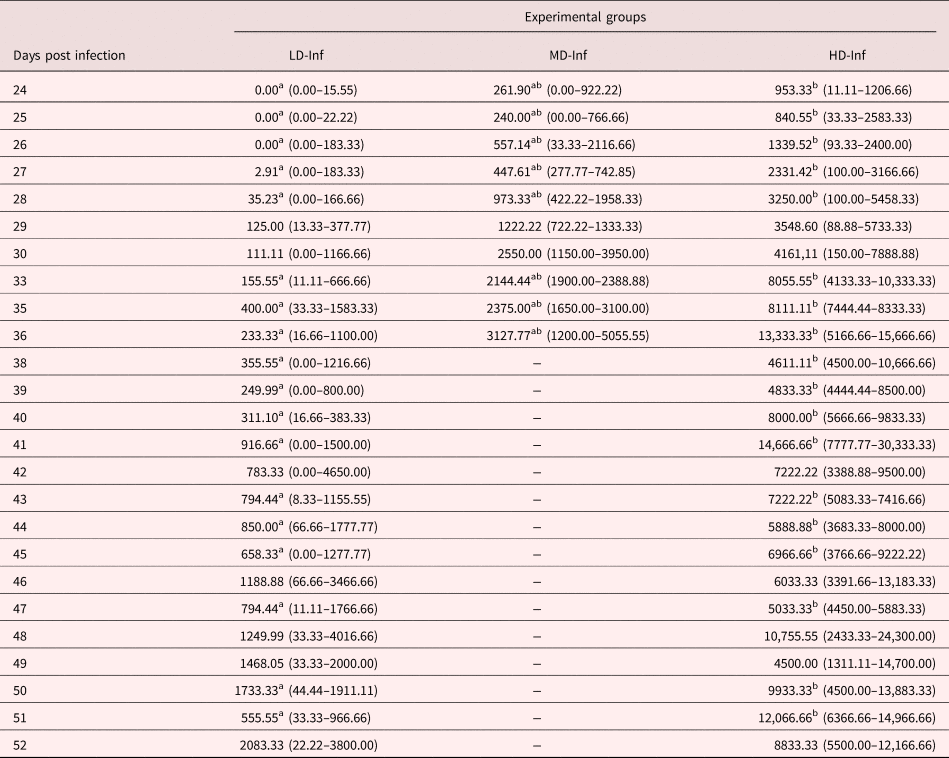
Starting 23 days post infection (DPI), all surviving infected mice were confirmed to be shedding L1 in their faeces; three animals from the MD-Inf group and two from the HD-Inf group died before faecal shedding of larvae began (i.e. before 20 DPI). Animals in the LD-Inf, MD-Inf and HD-Inf groups shed L1 until 66 DPI, 39 DPI and 61 DPI, respectively. The HD-Inf group had significantly higher L1 shedding levels than the LD-Inf group on most of the compared days; MD-Inf group L1 shedding levels were intermediate between the LD-Inf and HD-Inf groups’ levels, not differing significantly from either. The L1 faecal shedding quantities are reported and compared among the three experimental groups in table 1.
Shedding of Angiostrongylus costaricensis L3 in faeces of Swiss mice infected with 5 L3 (LD-Inf), 15 L3 (MD-Inf) or 30 L3 (HD-inf), by days since infection.

a,b Different letters indicate significant differences (P < .05, Kruskall–Wallis, Dunn test).
Mortality rates
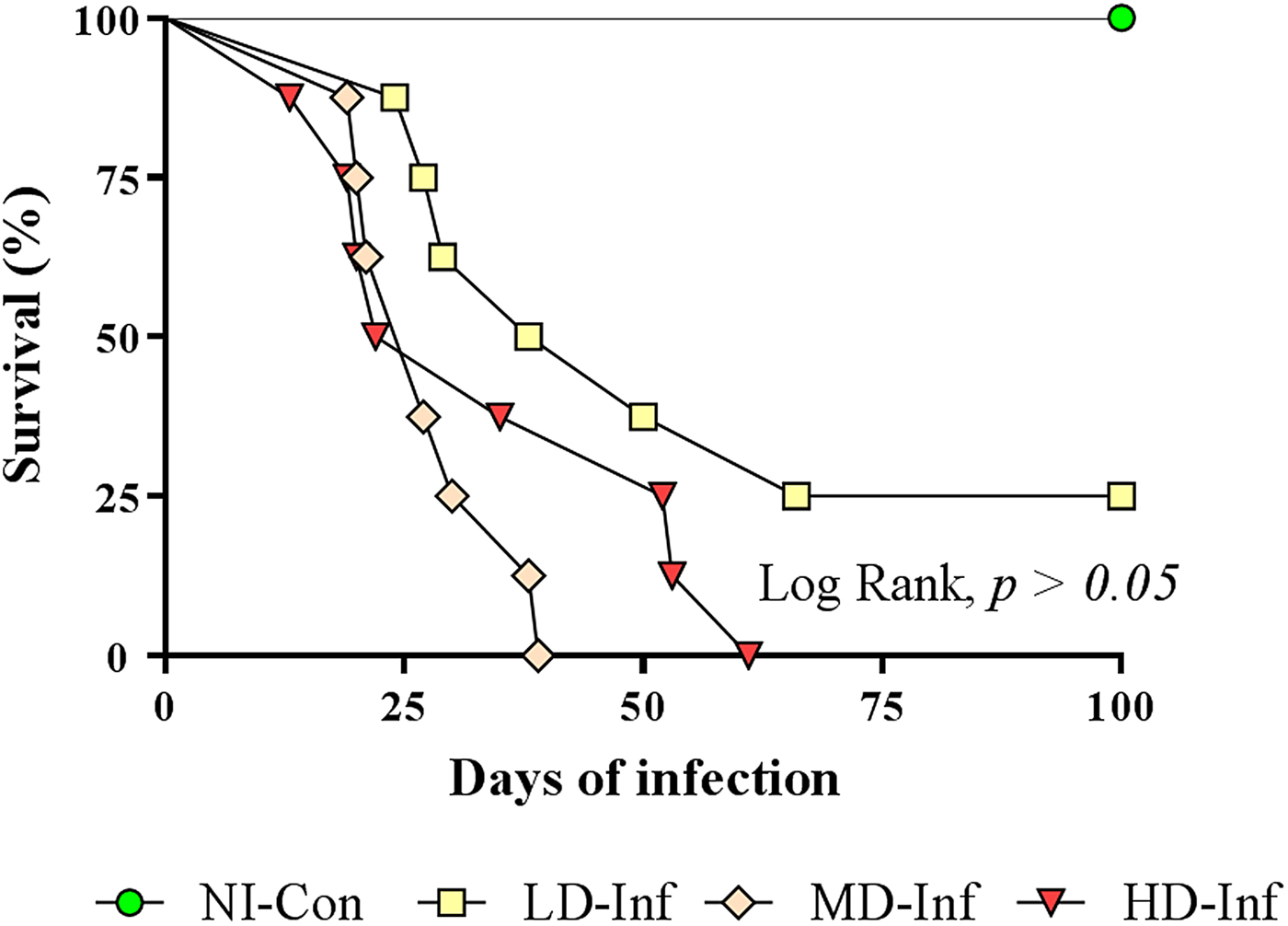
As shown in fig. 1 (Log Rank, P > 0.05), the survival time ranges of the LD-Inf, MD-Inf and HD-Inf groups were 24–100 DPI, 19–39 DPI and 13–61 DPI, respectively. The mean survival times for the three experimental groups were as follows: LD-Inf, 47.7 ± 9.6 DPI; MD-Inf, 27.6 ± 2.7 DPI; and HD-Inf, 34.4 ± 6.6 DPI. Only two animals, both in the LD-Inf group, survived through the end of the experiment and were euthanized humanely 100 DPI with the NI-Con group. The mortality patterns of the MD-Inf and HD-Inf groups appeared generally similar, especially in the early DPI period. However, there were several animals in the HD-Inf group that far outlived all of the MD-Inf group mice. Notwithstanding, there were no statistically significant differences in survival time between the infected groups.
Comparison of mortality rates across experimental groups infected with 5 (LD-Inf), 15 (MD-Inf) or 30 (HD-inf) Angiostrongylus costaricensis L3.

Discussion
In the present study, we evaluated faecal L1 shedding in Swiss mice experimentally infected with three infective doses of A. costaricensis L3, and examined whether infective doses were related to mortality. We observed substantial variation in L1 shedding levels both between and within the experimental groups. This irregularity in shedding levels was consistent with that observed by Canali et al. (Reference Canali, Goulart and Graeff-Teixeira1998), who infected Swiss mice with a dose of 10 A. costaricensis L3. To the best of our knowledge, there are no prior studies reporting parasite rates of mice infected with different doses of A. costaricensis larvae. We found that our HD-Inf group shed significantly larger amounts of L1 than the LD-Inf group, without a significant difference in survival time. NI-Con mice were all alive and healthy at the end of the experiment, indicating that the mortality of the mice in the experimental groups was due to A. costaricensis infection. To our knowledge, this is the first study to compare faecal L1 shedding data across animals infected with different experimental doses of A. costaricensis.
In a study of mice infected with 10 L3, Azevedo et al. (Reference Azevedo2010) found greater L1 shedding at night than during the day due to more defecation at night, and a direct correlation between L1 shedding level and survival. Their finding of better survival in animals with higher L1 shedding levels suggests that the animals with longer survival had an innate ability to better tolerate the infection. Differences in infection tolerance highlight the coevolutionary relationship between parasite and host wherein the parasite benefits from the host surviving long enough to allow the parasite to reproduce and propagate (Gandon et al., Reference Gandon2008). The variation in host survival time may be attributed to inter-individual genetic variability of infection susceptibility and/or resistance traits (Ishih and Sano, Reference Ishih and Sano1989). Rodents such as Sigmodon hispidus and Rattus rattus are considered natural hosts of this parasite. There are no published reports of natural cases of A. costaricensis infection in M. musculus (Tesh et al., Reference Tesh1973). Nonetheless, analyses of L1 shedding in the faeces of experimentally infected mice may help to elucidate A. costaricensis–host interactions (Canali et al., Reference Canali, Goulart and Graeff-Teixeira1998).
Infections with helminth species, such as A. costaricensis, appear to be influenced by major histocompatibility complex (MHC) factors in the host (Ishih et al., Reference Ishih2000). Mice with an MHC-II deficiency were found to shed larger numbers of L1 in their stools than mice with a fully functional immune system, although L1 shedding levels did not correlate with length of survival in these mice (Geiger et al., Reference Geiger2003). Likewise, the present results support the conclusion that higher infective doses of L3 A. costaricensis increase the quantity of faecal L1 shedding in Swiss mice without hastening mortality significantly.
Author ORCIDs:
M.I.B. Vieira https://orcid.org/0000-0002-0896-6446
Acknowledgements
The authors thank the University of Passo Fundo (UPF), Brazil for supporting this study, which was carried out in its laboratory animal facility, and the Parasitology Laboratory of the Pontifical Catholic University of RS, Brazil.
Conflict of interest
None.
Ethical standards
The study was conducted at the laboratory animal facility of the Institute of Biological Sciences of the UPF, RS, Brazil. The research proposal was approved by the UPF Committee on Animal Research and Ethics (protocol no. 034/2016).