Cardiac surgery, especially intra-cardiac or open heart surgery, is associated with massive bleeding owing to systemic heparinisation and suffuse diffusive damage during cardiopulmonary bypass.Reference Hussain, Reddy, Prasad and Madhavi 1 Particularly, the damage via the cardiopulmonary bypass is time dependent and is known to increase if the pump time crosses an hour. Indeed, the red blood cells, white blood cells, platelets, and clotting factors are damaged, thereby leading to intense bleeding in the post-bypass period. For these reasons, large amount of allogeneic blood is required in heart surgeries.Reference Engoren, Habib, Zacharias, Schwann, Rioderdan and Durham 2 , Reference Teker and Cinar 3 Worldwide, intra-cardiac or extra-cardiac surgery accounts for about 10% of all blood products utilisation.Reference Graves 4
Availability of allogeneic blood in our sub-region is low because many youths who should have been voluntary donors are unemployed and usually not fit to donate. Thus, transfusion of blood products is cheaper and more effective. More than 80% of platelet donations are collected by aphaeresis.Reference Goodnough 5 When conventional method is used, the platelets from four donations have to be pooled to make an adult therapeutic dose for transfusion to a patient, but when aphaeresis is used a full adult therapeutic dose can be taken from one donor, thereby reducing the number of donor exposures.
In addition, autotransfusion has reduced the allogeneic requirement from an average of 7–8 units to 1–2 units.Reference Korukcu, Karabulut and Tosun 6 Moreover, autotransfusion is safe in surgical interventions in patients with rare blood groups, Jehovah Witness patients, those who require emergency surgery, and those with hypersensitivity.Reference Korukcu, Karabulut and Tosun 6 Banked refrigerated blood has reduced platelets and markedly reduced 2,3-diphosphoglycerate, which shifts oxygen dissociation curve to the left, thereby preventing oxygen release to the tissues. The use of autologous blood transfusion such as pre-deposit autologous donation and autologous normovolewmic haemodilution to decrease allogeneic blood requirements and improve coagulation during cardiac surgery is still controversial.Reference Kaplan, Canarella, Jones, Kutner, Hatcher and Dunbar 7
Pre-surgical erythropoietin treatment is approved worldwide for anaemic patients or Jehovah Witnesses scheduled for non-cardiac and non-vascular surgery. Its role in open heart surgery is under investigations.Reference Speiss 8
In this study, we wish to highlight our experiences in the use of allogeneic blood, blood products, and autologous blood via intraoperative cell saver during open heart surgery.
Materials and methods
In a period of 3 years (March, 2013–February, 2016), a retrospective review of those who had open heart surgery in our institution was performed. Data were obtained from our hospital information technology department. Data obtained were demography, types of open heart procedures, the average units of blood, and blood products transfused per procedure, including details regarding utilisation of cell saver, as well as those patients who had significant bleeding that necessitated excessive blood transfusion. Inclusion criteria were those patients treated within the study period. Those patients treated thereafter when the aphaeresis machine broke down were excluded from the study. Data were analysed using Microsoft Excel and expressed in arithmetic of percentages, using tables.
The definition of excessive bleeding is empiric and varies among institutions. In the operating room, it is often defined as diffuse bleeding from multiple tissue surfaces without an identifiable surgical source and in the absence of visible clot formation. In the cardiac ICU, excessive bleeding is defined in terms of chest tube drainage output. Examples are as follows: more than 200 ml/hour in any hour, or more than 150 ml/hour for two consecutive hours, or more than 100 ml/hour for three consecutive hours. In addition, any sudden increase in chest tube drainage to any level above 100 ml/hour is considered severe bleeding. The differential diagnosis of severe bleeding is wide and is based on the pathologic disturbances attendant to cardiopulmonary bypass.
Results
During the study period, 102 patients had OHS, an average of 34 cases per year. There were 75 (73.53%) males and 37 (36.27%) females, giving a ratio of 2:1. The age of patients involved was from 0.6 (7/12) to 74 years. Mitral valve procedure was the most common (n=22, 21.6%) surgery type. Transfusion requirements averaged 1.9 units of fresh frozen plasma, 0.36 units of platelet concentrate, and 1.68 units of packed cells per procedure, respectively. The least common surgery type was common atrium repair (n=1, 0.01%). Transfusion requirement averaged four units of fresh frozen plasma, two units of platelet concentrate, and nine units of packed cell. About 2.94% of the procedures required additional use of autogenous blood by cell saver system. Moreover, two patients (Jehovah Witness) were treated with autogenous blood only.
Summary
Number of patients managed→102 (adults→61 and children→41).
Number of units of fresh frozen plasma used in adults→ 100 and children→1180 ml.
Number of units of platelet concentrates used in adults→48 units and children→540 ml.
Number of units of packed cell used in adults→69 units and children→940 ml.
Number of units of whole blood used in adults→12 units and children→0.
Number of patients where cell saver was used in adults→3 and children→0.
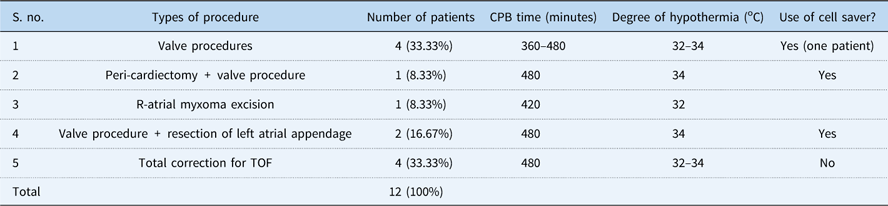
A total of 12 out of the 102 patients (11.77%) were noticed to have developed severe bleeding that necessitated excessive blood transfusion. Isolated valve procedure and repair of intra-cardiac repair of tetraology of Fallot were the most common (33.33%) surgery type, and the least common was atrial myxoma excision, combined valve procedure, and resection of left atrial appengage, each of which was reported to be 8.33%. Cardiopulmonary bypass time was prolonged averaging 360–480 minutes. Mild-to-moderate hypothermia was used. A total of three patients (25%) required autologous transfusion by cell saver technique.
Analysis of risk factors for amounts of blood and blood products administration was performed. There are many risks, such as incompatibility, human error, disease transmission, and transfusion reactions, associated with transfusion of blood and blood products. These risks were analysed at the stages of preparing, initiating, and completing the transfusion. During the preparatory stages, the registrar/specialist cardiac surgeon in training withdrew the blood sample, labelled it, and sent it to the blood bank. In the blood bank, grouping and cross-matching were done and infections transmitted through transfusion were checked for. Thereafter, blood or blood product ready for transfusion was brought to the operating room or the ICU. The transfusion form and the blood must be checked by the anaesthetist and the perfusionist in the OR and, in the case of ICU, the intensivist and the attending ICU nurse. Baseline vital signs (blood pressure, pulse rate, temperature, and respiratory rate) were recorded and subsequently monitored during the transfusion. In cases of adverse reactions, transfusion was stopped, intravenous access was maintained with 0.9% normal saline, and blood was returned to the blood bank for investigations. Symptoms were usually treated.
In analysing the risk factors for excessive bleeding, two types are readily evident. The surgical factors are anastomotic suture lines, side branches of arterial and venous conduits, substernal soft tissues, sternal wound suture lines, redo surgery, and associated pericarditis. The medical risk factors are known and are sub-divided into preoperative, intraoperative, and postoperative. Haemodilution, use of antiplatelet drugs (aspirin/clopidogrel), and thrombocytopaenia, as well as hepatic dysfunction causing vitamin K-dependent coagulation deficiency, are the preoperative risk factors. Intraoperatively, prolonged cardiopulmonary bypass time, hypothermia, and intraoperative cell salvage system cause excessive bleeding. Postoperatively, heparin rebound and heparin-induced thrombocytopaenia are the main risk factors. In the study, preoperative causes were analysed and antiplatelet drugs, such as aspirin, were implicated in one patient. Constrictive pericarditis was a factor in another patient. Generally, prolonged cardiopulmonary bypass time was the major risk factor.
Discussion
Patients undergoing open heart surgery are at risk for excessive perioperative bleeding, both surgically and non-surgically, leading to increased usage of allogeneic blood and haemostatic blood products with attendant complications.Reference Speiss 8
The most common indications for blood transfusion in Nigeria, like other sub-Saharan African countries, are malaria, malnutrition, pregnancy-related complications, road traffic accident, communal clashes, insurgency/terrorism, armed robbery attacks, and heavy burden of infections such as human immunodeficiency virus and tuberculosis.Reference Erhabor 9 There are very few national blood transfusion services in the country. Thus, assessing safe blood to meet the aforementioned indications is a very big challenge. The demand became more critical by the need to provide a huge amount of blood required for open heart surgery, which is becoming regular owing to the efforts of humanitarian cardiac surgery missions in the country.
The situation is further worsened by the absence of uncontrolled power supply and challenges of cold chain management.Reference Arobieke, Osafehinti, Ouwajiobi and Oni 10 There are no blood products to meet the transfusion requirements of certain patients, and there is absence of stock of O negative blood group for emergencies. There is absence of evidence-based approach to the management of major bleeding resulting from non-cardiac surgery indications.
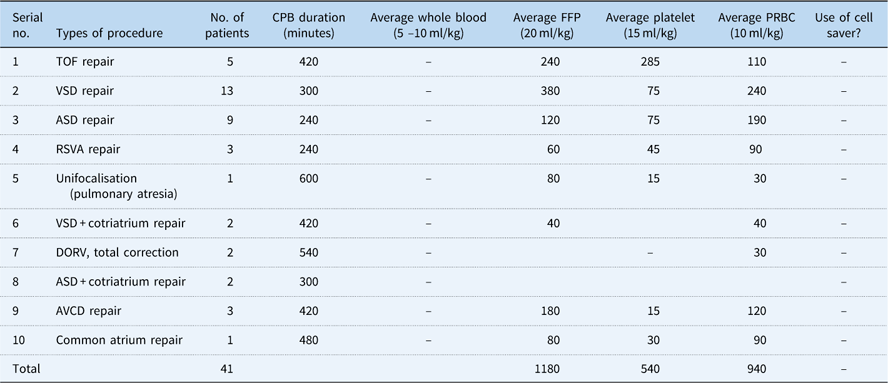
In our study, 102 patients had surgical interventions during the 3 years. The total number of units of fresh frozen plasma, platelet concentrate, and packed cells including the whole blood component is as shown in Table 1. Our protocol for each patient scheduled for elective cardiac surgery is usually four units of whole blood. This number is to be provided by patients’ relatives. However, most of the time, patients’ relatives are few and those available may not qualify. Those patients’ relatives who do not qualify pay ‘touts’ (commercial blood donors) to donate blood. Thus, paying ‘touts’ and paying processing fees charged by the hospital make the cost of the blood high. This has significantly affected the cost of open heart surgery in Nigeria.Reference Falase, Sanusi, Majekondunmi, Ajose, Idowu and Oke 11
Types of surgical interventions, number of patients, average units of blood and blood products, and use of cell saver among children.

ASD=atrial septal defect; AVCD=atrio-ventricular defect; CPB=cardiopulmonary bypass; DORV=double-outlet ventricle; FFP=fresh frozen plasma; PRBC=packed red blood cell; RSVA=ruptured sinus of Vasalva aneurysm; TOF=tetraology of Fallot; VSD=ventriculaseptal defect
Calculations were based on the formula:
 $${{\rm total{\rm }amount{\rm }of{\rm }blood{\rm }product{\rm }transfused{\rm }\left( {ml} \right)} \over {\rm total{\rm }weight{\rm }\left( {kg} \right){\rm }of{\rm }children{\rm }transfused}}$$
Some public-spirited individuals do come to donate blood freely for open heart surgery patients. Such people include medical students of college of medicine, University of Nigeria, Enugu Campus and seminarians from Bisgaard Seminary School, Enugu. In addition, the Management of the University of Nigeria Teaching Hospital, Ituku/Ozalla, where the Cardiothoracic Center of Excellence is situated, mandates each pregnant woman coming for antenatal clinic to donate a unit of blood before delivery. The pooled donor blood units are used during deliveries, but the left over blood units are transferred for use in open heart surgery.
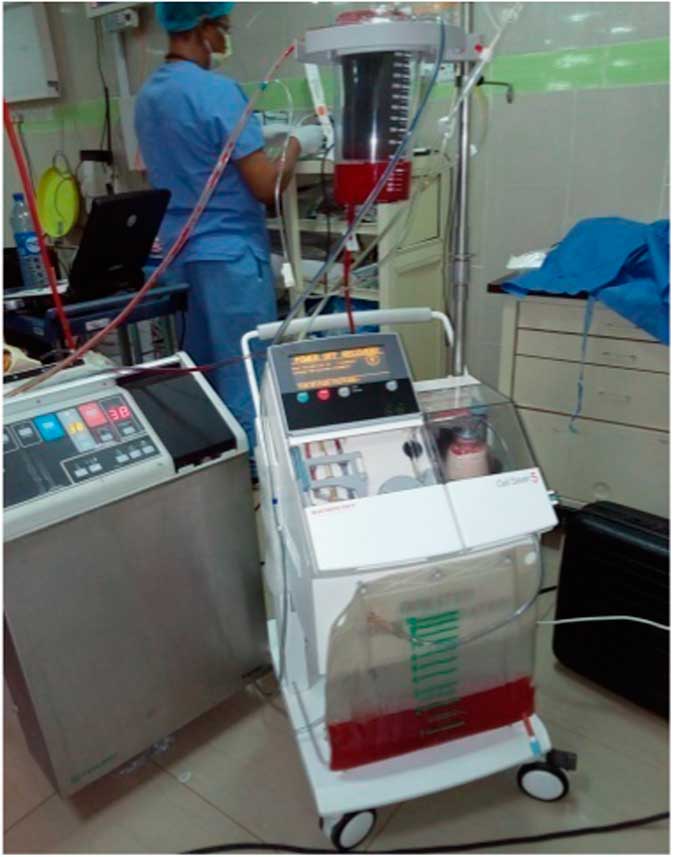
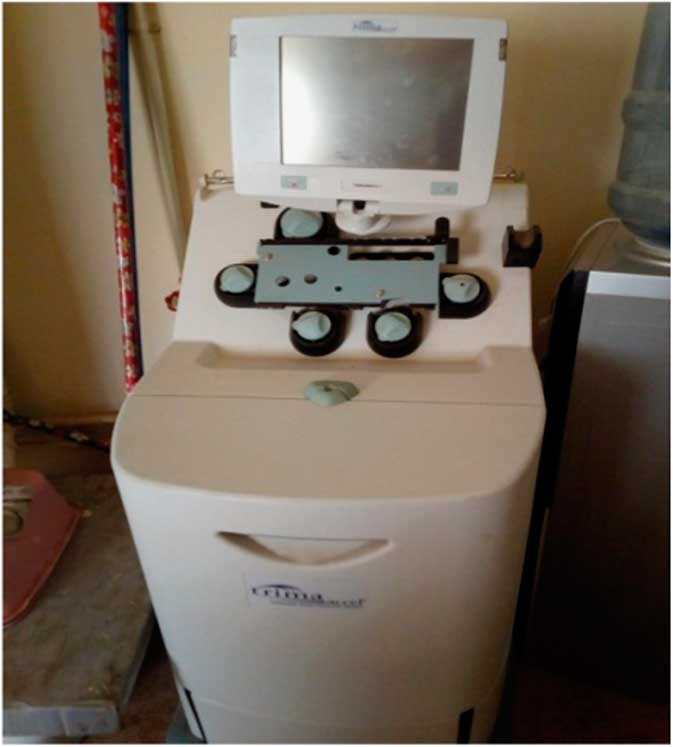
To further reduce the amount of allogeneic blood requirement in open heart surgery, our centre procured aphaeresisReference Burgster and Winters 12 and cell saver machinesReference Wee, Thomas, Jones, Catling, Howard and Milton 13 (Figs 1 and 2). The former makes it possible to get a full therapeutic dose of platelets from one donor instead of four donors.Reference Goodnough 5 The latter equally makes it possible to salvage autologous blood intraoperatively, which is washed and the red blood cell infused back into the patients.Reference Bowley, Barker and Boffard 14
Cell saver machine.

Aphaeresis machine.

In our centre, most of the open heart surgeries are performed by International Cardiac Surgery Missions.Reference Nwafor, Eze, Anyanwu and Ezemba 15 They come at different times in a year. To reduce intraoperative blood loss and consequently blood requirements during the perioperative period, proper preoperative assessment is the key. One of the key points in minimising perioperative blood loss is an index of suspicion and the identification of patients who are at increased risk of bleeding.Reference Speiss 8 Those undergoing moderate- or high-risk procedures such as open heart surgery should have their prothrombine time, activated partial prothrombine time, and platelet count determined.Reference Francis and Kaplan 16 Simple measures may include stopping aspirin in patients 7 days before surgery, other non-steroidal, anti-inflammatory drugs 2 days prior, and warfarin at least 3–4 days prior, commencing post surgery when haemostasis is secured. 17 Alternatively, if anti-coagulation is required, patients could be switched over to either intravenous unfractionated heparin for prosthetic heart valves or subcutaneous low-molecular-weight heparin. Indeed, according to our protocol, the local team works in conjunction with the international cardiac surgery team to provide desirable anticoagulation perioperatively.
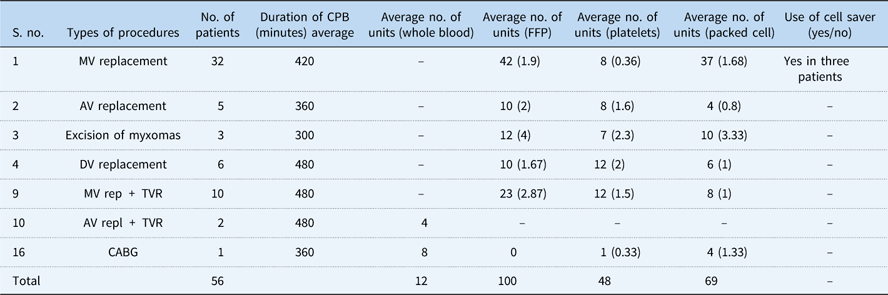
The intraoperative strategies have a bearing on the blood loss and consequently blood requirements. The duration of cardiopulmonary bypass, see Table 1, surgical technique, complexity of the surgery, and duration of anaesthesia among other factors played a vital role in the degree of blood loss in our study as in other studies.Reference Ranucci, Castelvecchio, Frigiola, Scolletta, Giomarelli and Biagioli 18 – Reference Paone, Brewer, Theurer, Bell, Cogan and Prager 20
In this study, out of the 12 (11.8%) patients studied with excessive perioperative bleeding, those with valve procedures and total correction for tetraology of Fallot constituted the highest with 33.3% each, respectively. They were followed by those with peri-cardiectomy and valve procedure and valve procedure with resection of left atrial appendage with 8.3% each, respectively. In all of them, cardiopulmonary bypass time was prolonged, averaging 6–8 hours (Table 2). Among the patients, 2 of the 12 (16.7%) were on aspirin preopertively, which was stopped 4 days before surgery. In another study, it was found that perioperative bleeding complications in cardiac surgery can have multiple aetiologies. Invasiveness of the procedure, induced hypothermia, extended use of cardiopulmonary bypass, and increasing age were the major reasons for increased blood loss and higher incidence of blood transfusions.Reference Brucner, Blan and Rodriguez 21
Types of surgical interventions, number of patients, average units of blood and blood products, and use of cell saver among adultsFootnote *.

AV=aortic valve; CABG=coronary artery bypass graft; CPB=cardiopulmonary bypass; DV=double valve (artic + mitral); FFP=fresh frozen plasma; MV=mitral valve; TVR=tricuspid valve repair
* Here 56 patients received on the average 12 units of whole blood, 100 units of cell FFP, 48 units of platelet, and 69 units of packed red blood cell. Only one patient who underwent mitral valve replacement received autologous blood transfusion via cell saver
The intraoperative variables showed parallelism among intraoperative estimated blood loss, intraoperative requirement of packed red blood cell, use of local haemostatic agents such as surgical or microporous polysaccharide haemosphere haemostat, transfusions of fresh frozen plasma, and platelet concentrate, as well as cardiopulmonary bypass time. The greater the estimated blood loss, the more the packed red blood cell required with the attendant morbidity and mortality, except in the case of a Jehovah witness, who underwent peri-cardiectomy with valve procedure. His large estimated blood loss was not corrected with packed red blood cell, and this led to the patient’s death. In a similar study, Christensen et alReference Christensen, Krapf, Kempel and Avon 22 demonstrated that 22% of patients with excessive perioperative haemorrhage died compared with 6% of patients without excessive perioperative bleeding.
The postoperative period showed variables such as chest tube output, packed red blood cell requirement within some hours in the immediate postoperative period, platelet requirements, and ICU median stay, as well as 30-day mortality. There were correlations among the chest tube out and packed red blood cell, fresh frozen plasma, and platelet requirements. There was also increased morbidity, and 30-day morality was statistically notable in patients with higher output, degree of blood, and blood product requirements.Reference Levy and Depotis 23 , Reference Lapar, Crosby and Ailewadi 24 Postoperatively, inadequate reversal of heparin, degree of hypothermia, thrombocytopaenia, and reduced clotting factors played significant roles in our study, as in other studies.Reference Lopes, Santos, Brunori, Moorhead, Lopes and Barros 25 This is because thromboelastography and platelet function analyser are not available in our centre for point of care diagnostic tests.Reference Nwafor, Nwafor, Eze, Ezemba and Ngene 26
Blood haemoglobin level is the current trigger used for packed red blood cell transfusion, although commonly admitted to be sub-optimal. An increase in haemoglobin level is likely to be associated with an increase in blood oxygen content and blood oxygen delivery. Platelet infusion should be restricted to bleeding patients with thrombocytopaenia and without surgical bleeding (Table 3).
Patients who had excessive perioperative non-surgical bleeding.

CPB=cardiopulmonary bypass; TOF=tetraology of Fallot
Fresh frozen plasma is one way to address the coagulation factor deficiency induced by haemodilution, consumption, or hepatic insufficiency. The volume needed to increase these factors is not negligible. To avoid dilution and/or fluid overload, the use of clotting factor concentrate is recommended.Reference Irio, Paccetti and Makris 27 This is not available in our centre.
Guidelines cannot replace clinical judgment, and the decision to transfuse is left to individual discretion of the multi-disciplinary cardiac team preoperatively, intraoperatively, or postoperatively. In our practice, cardiologists, cardiothoracic surgeons, anaesthesiologists, perfusionists, and cardiac critical care nurses are involved in the decisions regarding blood transfusion, completion of blood request forms, administering of blood, and monitoring transfusion reactions including the signs and symptoms of adverse reactions. The guidelines do enhance the implementation of standard clinical transfusion practices for improved patient safety.
In addition, other healthcare professionals involved in the transfusion chain are responsible for careful selection of donors, screening donations, compatibility testing, haemapheresis of blood products by aphaeresis machine, and storage of blood for clinical use.
The impact of lack of availability of blood and blood products on access to cardiac surgery in Nigeria is very significant. In Nigeria, like other African countries, there are few or no available national blood transfusion services, policies, appropriate infrastructure, trained personnel, and financial resources to support the running of voluntary non-remunerated blood transfusion services.Reference Osaro and Charlse 28 This, in addition to transfusion transmitted infections, makes availability of allogeneic blood a very scarce commodity. The demand for allogeneic blood transfusion from sources other than cardiac surgery, such as anaemia, pregnancy-related complications, victims of armed robbery and terrorist attacks, as well as motor vehicle crash, is very high. In other not to worsen the situation further, commercially remunerated blood donors proliferated but blood transfusion transmitted infections like human immunodeficiency virus, hepatitis, syphilis and malaria escalatedReference Isaah, Mamman, Bababdoko and Ahmed 29 , Reference Muktar, Jones and Ashime 30 increased. Apart from our centre, which is relatively active in cardiac surgery in Nigeria, courtesy of cardiac missions and few others, there are no aphaeresis machines in virtually other hospitals, and therefore transfusion of blood products is highly limited especially in cardiac surgery. Elective cardiac surgeries are sometimes postponed or out-rightly cancelled because of non-availability of blood and blood products. Moreover, two deaths have occurred on the operating room table and in the ICU among patients with rarer blood groups owing to insufficient blood and blood products to combat severe or massive bleeding.
Conclusion
Open heart surgery is relatively complex and has multiple challenges especially in low-income countries with scarce resources. Large proportion of blood transfusions given during the procedures including management of the engendered complications additionally increases the cost of surgery. The use of aphaeresis and cell saver machines, as well as adoption of sound perioperative management, has a great bearing in reducing the total allogeneic blood requirement in cardiac surgery.
Acknowledgements
The authors hereby express their profound gratitude to the members of the international cardiac surgery team for their assistance in caring for patients with cardiac diseases, the head of blood bank, Mrs Osiri for providing the necessary logistics and the seminarians, medical students, as well as the pregnant mothers, for their altruistic blood donations.
Financial Support
The research received no specific grant from any funding agency or from commercial or not-for-profit sectors.
Conflicts of Interest
None.