Dairy cow fertility has declined in recent decades, coincidental with large increases in milk yield (Lucy, Reference Lucy2001; Diskin et al. Reference Diskin, Murphy and Sreenan2006; Veerkamp & Beerda, Reference Veerkamp and Beerda2007; Friggins et al. Reference Friggins, Disenhaus and Petit2010). The reduction in fertility is the result of cows taking longer to return to oestrus, displaying poorer signs of oestrus, lower conception rates and a high incidence of early embryo loss (Lucy, Reference Lucy2001; Diskin et al. Reference Diskin, Murphy and Sreenan2006; Friggins et al. Reference Friggins, Disenhaus and Petit2010). The greatest proportion of losses are due to early embryo mortality (Diskin et al. Reference Diskin, Murphy and Sreenan2006) with the period of pregnancy recognition identified to be of primary importance.
Inhibition of pulsatile prostaglandin F2α (PGF2α) secretion during pregnancy recognition is pivotal to the maintenance of luteal function and the establishment of pregnancy (Mattos et al. Reference Mattos, Staples and Thatcher2000; Thatcher et al. Reference Thatcher, Bilby, Bartolome, Silvestre, Staples and Santos2006; Weems et al. Reference Weems, Weems and Randel2006; Wathes et al. Reference Wathes, Abayasekara and Aitken2007). The effect of pregnancy on prostaglandin synthesis includes both the inhibition of pulsatile PGF2α synthesis and the increased synthesis of prostaglandin E2 (PGE2) to support luteal function (Okuda et al. Reference Okuda, Miyamoto and Skarzynski2002; Arosh et al. Reference Arosh, Banu, Chapdelaine, Madore, Sirois and Fortier2004a; Arosh et al. Reference Arosh, Banu, Kimmins, Chapdelaine, Maclaren and Fortier2004b). Long-chain fatty acids (FA) are important in the main reproductive processes including PGF2α synthesis (Wathes et al. Reference Wathes, Abayasekara and Aitken2007) and luteolysis; as such, modulation of endometrial FA has been suggested as a strategy to support early pregnancy (Mattos et al. Reference Mattos, Staples and Thatcher2000; Binelli et al. Reference Binelli, Thatcher, Mattos and Baruselli2001). This is supported by reports of lower 20:4ω6 concentrations and greater 20:3ω6 and 18:2ω6 concentrations in endometrium from pregnant cows compared with endometrium from cows at a similar stage of the oestrous cycle (Thatcher et al. Reference Thatcher, Staples, Danet-Desnoyers, Oldick and Schmitt1994; Thatcher et al. Reference Thatcher, Meyer and Danet-Desnoyers1995; Meier et al. Reference Meier, Peterson, Mitchell, Littlejohn, Walker and Roche2009).
These findings have led to the proposition that modifying the availability of long-chain ω6 FA will support suppression of PGF2α. Modification of tissue FA profiles, by changing dietary FA, has successfully reduced the availability of ω6 FA (Mattos et al. Reference Mattos, Staples and Thatcher2000; Bilby et al. Reference Bilby, Guzeloglu, MacLaren, Staples and Thatcher2006; Childs et al. Reference Childs, Hennessy, Sreenan, Wathes, Cheng, Stanton, Diskin and Kenny2008). In addition, previous studies have shown a reduction in PGF2α synthesis or plasma metabolite 13,14-dihydro-15-keto PGF2α (PGFM) concentrations when the availability of ω6 FA was reduced (Oldick et al. Reference Oldick, Staples, Thatcher and Gyawu1997; Thatcher et al. Reference Thatcher, Binelli, Burke, Staples, Ambrose and Coelho1997; Mattos et al. Reference Mattos, Staples, Williams, Amorocho, McGuire and Thatcher2002; Mattos et al. Reference Mattos, Staples, Arteche, Wiltbank, Diaz, Jenkins and Thatcher2004; Wamsley et al. Reference Wamsley, Burns, Engle and Enns2005; Caldari-Torres et al. Reference Caldari-Torres, Rodriguez-Sallaberry, Greene and Badinga2006). Additionally, when endometrial ω6 FA are reduced through supplementation with ω3 FA the expression of endometrial genes pivotal to the synthesis of PGE2 (Coyne et al. Reference Coyne, Kenny, Childs, Sreenan and Waters2008) and genes involved in tissue (e.g. progesterone receptor, IGF pathway and peroxisome proliferator-activated receptors) are reduced (Bilby et al. Reference Bilby, Jenkins, Staples and Thatcher2006; Coyne et al. Reference Coyne, Kenny, Childs, Sreenan and Waters2008; Coyne et al. Reference Coyne, Kenny and Waters2011).
Yet, when extended to examine the effects of altering ω6 FA availability on embryo survival, conception and pregnancy rates the outcomes were variable (Staples et al. Reference Staples, Burke and Thatcher1998; Ambrose et al. Reference Ambrose, Kastelic, Corbett, Pitney, Petit, Small and Zalkovic2006; Petit & Twagiramungu, Reference Petit and Twagiramungu2006; Petit et al. Reference Petit, Cavalieri, Santos, Morgan and Sharpe2008; Zachut et al. Reference Zachut, Dekel, Lehrer, Arieli, Arav, Livshitz, Yakoby and Moallem2010). The variability in these outcomes may be due to the complex and various roles that prostaglandins have during early pregnancy (Weems et al. Reference Weems, Weems and Randel2006; Wathes et al. Reference Wathes, Abayasekara and Aitken2007), and a greater understanding of how endometrial FA profiles are modified with pregnancy may lead to FA manipulations that substantially improve reproductive success.
It was therefore hypothesized that the presence of the pre-implantation conceptus modified the profiles of endometrial fatty acids. Hence, the aim of the current study was to describe localized endometrial FA changes associated with the presence of the pre-implantation conceptus by examining differences in endometrial FA concentrations in the endometrium obtained from the uterine horn containing the pre-implantation conceptus (gravid horn) compared with that obtained from the uterine horn without the pre-implantation conceptus (non-gravid horn).
Materials and Methods
All animal manipulations were approved by the Ruakura Animal Ethics Committee (Hamilton, New Zealand). This work was conducted at No. 5 Dairy, DairyNZ Ltd (Hamilton, New Zealand) and is part of a larger study and as such is a preliminary investigation.
Animal management
Fourteen lactating Holstein-Friesian (HF) dairy cows (2nd to 5th lactation), of mixed genetic strain grazed fresh pasture as a single herd. The two genetic strains represented included: New Zealand [NZ; n=7; <23% North American (NA) genetics] and NA (n=7; >92% genetics NA genetics). A detailed description of the breeding scheme used to generate these cows is described by Macdonald et al. (Reference Macdonald, Verkerk, Thorrold, Pryce, Penno, McNaughton, Burton, Lancaster, Williamson and Holmes2008). Cows were grouped by calving date and an oestrous-synchrony programme was initiated at 59±4·6 d post-calving (mean±sed). The synchrony programme involved inserting a controlled intra-vaginal drug-release device containing progesterone (1·38 g, CIDR-B™ Pfizer Animal Health Group, Auckland, New Zealand) for 8 d (day of insertion day −8), with 2 mg oestradiol benzoate administered i.m. (2 ml, CIDIROL Bomac Laboratories Limited, Auckland, New Zealand) at the time of CIDR-B insertion. All animals received two (a.m. and p.m.) i.m. 500-μg injections of sodium cloprostenol (2 ml, EstroPlan, Parnell Laboratories NZ Ltd, Auckland, New Zealand) on day 6 following CIDR-B insertion, and a 10-μg injection of the GnRH analogue buserelin (2·5 ml, Receptal, Intervet Limited, Auckland, New Zealand) 24 h after CIDR-B removal. The day after the GnRH injection was designated day 1 of the synchronized oestrous cycle. Embryos were produced using oocytes isolated from ovaries collected from the abattoir (Meier et al. Reference Meier, Peterson, Mitchell, Littlejohn, Walker and Roche2009). High quality (Grade 1) expanded blastocysts were transferred non-surgically into the uterine horn ipsilateral to the palpable corpus luteum (CL) on day 7 of the oestrous cycle.
Endometrial tissue collection and fatty acid analyses
Cows were slaughtered at the AgResearch Abattoir (Hamilton, New Zealand) on day 17 of the synchronized cycle (10 d after embryo transfer). Uterine horns were separated, flushed with 20 ml saline, and the location of the conceptus and corpus luteum recorded. Concepti were recovered from 12 of 14 cows. Ten of the 12 cows had single ovulators (single corpus luteum) and the remaining two cows were double ovulators (corpus luteum on each ovary). The length of the recovered conceptus was measured (using a microscope) before being frozen in liquid nitrogen and stored at −80°C awaiting further processing. Frozen conceptus weight (embryonic disc plus trophoblast tissues) were recorded. Inter-caruncular endometrial samples (0·5–1·0 g) were dissected from the middle section of each horn, immediately transferred into cryo-tubes, snap frozen in liquid nitrogen and stored at −80°C awaiting FA analyses.
Methods used to process the tissues and determine FA concentrations were reported by Meier et al. (Reference Meier, Peterson, Mitchell, Littlejohn, Walker and Roche2009). Briefly, endometrial tissues from each uterine horn underwent a combined fat extraction and transmethylation (Sukhija & Palmquist, Reference Sukhija and Palmquist1988). Commercially available FA standards were used as qualitative methyl ester reference standards. The detector response was corrected using theoretical response factors according to AOCS Ce 1e-91 (AOCS, 1998). Endometrial FA concentrations are expressed as g FA/100 g total FA.
Uterine luminal fluid and interferon-tau analyses
Analyses of the uterine luminal fluids (ULF) were undertaken by AgResearch (Ruakura, Hamilton, New Zealand). ULF were centrifuged to remove cellular debris, lyophilized, and ULF proteins reconstituted with distilled water containing a cocktail of proteinase inhibitors (Complete, Roche, USA) before being dialysed. Protein concentrations were measured (Bradford, Reference Bradford1976) and samples stored at −20°C until analysed.
Western blotting procedures were used to quantify interferon-tau (IFN-τ) concentrations in ULF as previously reported (Peterson et al. Reference Peterson, Ledgard and Hodgkinson1998). Briefly, ULF samples containing 20 μg of total protein and 2 μl human serum control in 50% glycerol, 0·5 m-Tris–HCl, and pH 6·8 loading buffer were applied to 12% SDS-polyacrylamide gel and subjected to electrophoresis, and then electroblotted onto a reinforced nitrocellulose membrane (Pall BioTrace NT, USA). Interferon-tau was detected using anti-IFN-τ (gift from Dr Roberts, University of Missouri, USA) at 1:2000. Bound antibody was measured by chemiluminescence (luminol, Sigma-Aldrich) or SuperSignal West Femto Maximum Sensitivity Substrate (Pierce, Rockford IL, USA), and bands quantified using Quantity One software (Bio-Rad Laboratories, Hercules CA, USA). Interferon-τ concentrations were expressed as optical density (OD) units per 20 μg total protein.
Statistical analyses
Of the 12 cows where concepti were recovered, FA analyses were carried out in 22 samples (11 gravid and 11 non-gravid samples). Fatty acid extractions failed from two endometrial samples owing to the volume of tissue available. Eleven endometrial samples collected from the gravid horn were obtained from nine cows with single samples and one cow with two gravid horns, as trophoblast tissues were recovered from both horns. Eleven endometrial samples collected from the non-gravid horn were from 11 cows. Statistical analyses were undertaken using GenStat Release 11 (Payne et al. Reference Payne, Harding, Murray, Soutar, Baird, Glaser, Channing, Welham, Gilmour, Thompson and Webster2008). Uterine horn differences in FA concentrations were analysed using linear models in restricted maximum likelihood (REML), including uterine horn (gravid or non-gravid), cow genetic strain, and their interactions as fixed effects, and cow as a random effect. Two cows were excluded as no visible embryo was recovered.
Both trophoblast weight and IFN-τ concentrations were log-transformed prior to analyses. The relationships between trophoblast weight and IFN-τ were examined using linear regression with the coefficient of determination (R 2) being presented. Initially relationships were explored using linear regression analyses to examine the relationships between specific FA and both log of trophoblast size, log ULF IFN-τ concentration and log trophoblast length. Where the linear regression was significant, quadratic regression analyses were also investigated. The quadratic regression analyses were not significant, hence only data from the linear regression analyses are presented as R 2, slope and the standard error of the slope (Slope se). Fatty acids included in these analyses were stearic acid, oleic acid, linoleic acid, dihomo-γ-linolenic acid, arachidonic acid, total ω6 FA, total ω3 FA and the ω6 to ω3 ratio.
Results
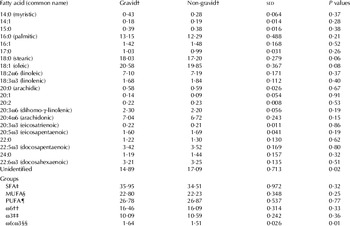
Endometrial FA concentrations in the gravid and non-gravid uterine horns are presented in Table 1. The ratio of ω6:ω3 FA was greater (P<0·01) in endometrium from the gravid horn compared with the non-gravid horn. In addition, both 18:0 (P=0·06) and 18:1 (P=0·08) were slightly increased in the gravid horn. There were no differences in endometrial FA concentrations for the remaining individual or grouped FA examined.
Endometrial fatty acid concentrations in the gravid (pregnant) and non-gravid uterine horn, on day 17 of pregnancy, in lactating dairy cows grazing fresh pasture. Values are means with sed

† Gravid=uterine horn containing the pre-implantation conceptus, non-gravid=uterine horn not containing the pre-implantation conceptus; values expressed as g/100 g total fatty acids
‡ SFA=14:0+15:0+16:0+17:0+18:0+20:0+22:0+24:0
§ MUFA=14:1+16:1+18:1+20:1
¶ PUFA=18:2ω6+18:3ω3+20:2+20:3ω6+20:4ω6+20:3ω3+20:5ω3+22:5ω3+22:6ω3
†† ω6=18:2ω6+20:3ω6+20:4ω6
‡‡ ω3=18:3ω3+20:3ω3+20:5ω3+22:5ω3+22:6ω3
§§ ω6:ω3 ratio=(18:2ω6+20:3ω6+20:4ω6)/(18:3ω3+20:3ω3+20:5ω3+22:5ω3+22:6ω3)
The weight of the recovered conceptus varied greatly, ranging from 4·8 to 312 mg (n=12; 100±27·9 mg; mean± sem). The log of conceptus weight and log of the ULF IFN-τ concentrations were positively correlated (P<0·01) for both the gravid (R 2=0·82) and non-gravid (R 2=0·81) uterine horn. Interferon-τ concentrations in ULF were more than six-times greater in the gravid horn than non-gravid horns (gravid: 70±15·8 OD units/20 μg protein, non-gravid: 11±5·1 OD units/20 μg protein, respectively).
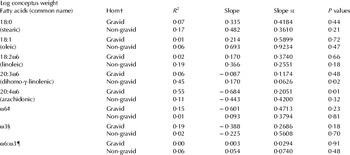
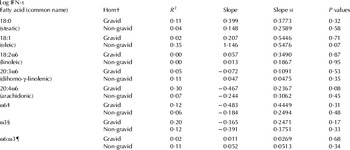
Correlations between endometrial FA concentrations and both conceptus weight and IFN-τ concentrations in ULF are presented in Tables 2 and 3. A negative correlation between endometrial 20:4ω6 concentrations in the gravid horn and conceptus weight (P=0·01, R 2=0·55) was noted, indicating that as conceptus weight increased concentrations of 20:4ω6 declined in the gravid but not the non-gravid horn. A similar negative correlation was recorded for IFN-τ concentrations and 20:4ω6 (P=0·08; R 2=0·30). There was a positive correlation between conceptus weight and 20:3ω6 concentrations in the non-gravid horn (P=0·02, R 2=0·45); however, there was no such correlation between IFN-τ concentrations and 20:3ω6 in the non-gravid horn. A weak positive correlation (P<0·10, R 2=0·35) between endometrial 18:1 and IFN-τ concentrations in ULF of the non-gravid horn was observed. None of the other correlations investigated were significant.
Coefficient of determination (R 2), slope and the standard error of the slope (Slope se) following linear regression between selected endometrial fatty acid concentrations (g/100 g of total fatty acids) and the log of conceptus weight on day 17 of pregnancy, in lactating dairy cows grazing fresh pasture

† Gravid=uterine horn containing the pre-implantation conceptus, non-gravid=uterine horn not containing the pre-implantation conceptus
‡ ω6=18:2ω6+20:3ω6+20:4ω6
§ ω3=18:3ω3+20:3ω3+20:5ω3+22:5ω3+22:6ω3
¶ ω6:ω3 ratio=(18:2ω6+20:3ω6+20:4ω6)/(18:3ω3+20:3ω3+20:5ω3+22:5ω3+22:6ω3)
Coefficient of determination (R 2), slope and the standard error of the slope (Slope se) following linear regression between selected endometrial fatty acid concentrations (g/100 g of total fatty acids) and the log of uterine luminal fluid interferon-tau (IFN-τ) concentrations on day 17 of pregnancy, in lactating dairy cows grazing fresh pasture

† Gravid=uterine horn containing the pre-implantation conceptus (n=11), non-gravid=uterine horn not containing the pre-implantation conceptus (n=11)
‡ ω6=18:2ω6+20:3ω6+20:4ω6
§ ω3=18:3ω3+20:3ω3+20:5ω3+22:5ω3+22:6ω3
¶ ω6:ω3 ratio=(18:2ω6+20:3ω6+20:4ω6)/(18:3ω3+20:3ω3+20:5ω3+22:5ω3+22:6ω3)
Discussion
These results support the hypothesis that presence of the conceptus modifies endometrial FA concentrations, as the ω6:ω3 FA ratio was increased in the gravid horn. These data also suggest that this difference was associated with an increase in ω6 FA, specifically 20:4ω6 (Table 1). Arachidonic acid (20:4ω6) is the primary FA precursor for the synthesis of biological regulators, the eicosanoids, which includes prostaglandins (PGF2α, PGE2, PGI2), thormboxane and leukotrienes (see review by Wathes et al. Reference Wathes, Abayasekara and Aitken2007). The tendency for 20:4ω6 to be increased was not expected, as endometrial 20:4ω6 concentrations are reportedly lower in pregnant compared with non-pregnant cows (Thatcher et al. Reference Thatcher, Meyer and Danet-Desnoyers1995). This difference may reflect the inherent differences in the experimental models. The current study reports lower 20:4ω6 concentrations than previously reported in endometrium from cows at an equivalent stage of the oestrous cycle (Meier et al. Reference Meier, Peterson, Mitchell, Littlejohn, Walker and Roche2009). In addition, previous research reported that the endometrium from pregnant cows had higher concentrations of 20:3ω6 and 18:2ω6 (Meier et al. Reference Meier, Peterson, Mitchell, Littlejohn, Walker and Roche2009; Thatcher et al. Reference Thatcher, Staples, Danet-Desnoyers, Oldick and Schmitt1994) compared with endometrium from non-pregnant cows. A similar effect was not evident for endometrium gravid and non-gravid horns, a clear indication of the fundamental differences between these experimental models. The small changes in endometrial FA concentrations reported here reflect the unique nature of the animal model used compared with previous studies. It is feasible to expect smaller variability within the gravid and non-gravid horn compared with cows in different reproductive states (pregnant and non-pregnant). Data from the current study suggest localized effects on endometrial FA concentrations associated with the presence of the conceptus. Such a localized effect is supported by Emond et al. (Reference Emond, MacLaren, Kimmins, Arosh, Fortier and Lambert2004) who reported differences in responsiveness to IFN-τ between endometrium from the gravid and non-gravid horn. The physiological significance of these small changes in endometrial FA concentrations associated with the presence of the conceptus requires further investigation. A greater understanding of the physiological importance of these local changes in endometrial FA during the establishment of pregnancy may provide information that supports refinement of the strategies that improve the establishment of pregnancy.
Although the presence of the pre-implantation conceptus had little effect on endometrial FA concentration overall, localized effects of the conceptus, within the gravid horn, were evident. Within the gravid horn, larger concepti and greater IFN-τ concentrations were associated with lower endometrial 20:4ω6 concentrations. These variables explained 55% and 30% of the variation in endometrial 20:4ω6 concentrations, respectively. A primary role for IFN-τ is the suppression of pulsatile PGF2α synthesis via the inhibition of the oestradiol and oxytocin receptors (Spencer & Bazer Reference Spencer and Bazer2004). Interferon-τ modifies the activity of the cyclooxygenase enzyme (COX-2), the enzyme that converts 20:4ω6 into prostaglandin intermediates (see review by Wathes et al. Reference Wathes, Abayasekara and Aitken2007). Low concentrations of IFN-τ have decreased COX-2 expression (Xiao et al. Reference Xiao, Liu, Sirois and Goff1998; Xiao et al. Reference Xiao, Murphy, Sirois and Goff1999; Pru et al Reference Pru, Rueda, Austin, Thatcher, Guzeloglu and Hansen2001; Parent et al. Reference Parent, Villeneuve, Alexenko, Ealy and Fortier2003; Guzeloglu et al. Reference Guzeloglu, Michel and Thatcher2004), whereas elevated IFN-τ increased COX-2 expression and PGE2 synthesis (Asselin et al. Reference Asselin, Drolet and Fortier1997a; Asselin et al. Reference Asselin, Lacroix and Fortier1997b; Parent et al. Reference Parent, Villeneuve, Alexenko, Ealy and Fortier2003; Emond et al. Reference Emond, MacLaren, Kimmins, Arosh, Fortier and Lambert2004; Guzeloglu et al. Reference Guzeloglu, Michel and Thatcher2004). Additionally, differential effects of IFN-τ on the gravid and non-gravid horn have been reported. Emond et al. (Reference Emond, MacLaren, Kimmins, Arosh, Fortier and Lambert2004) reported that IFN-τ unregulated COX-2 expression in endometrial tissue from the gravid horn only. Hence, the reduction in 20:4ω6 associated with greater IFN-τ concentrations, in the gravid horn, may reflect the stimulation of COX-2 expression and PGE2 synthesis. This study supports differences in prostaglandin signalling in the gravid and non-gravid horn.
The present results suggest that endometrial FA concentrations may change as the conceptus develops, although it remains unclear whether these changes are essential to the success of pregnancy.
The authors acknowledge the technical help from farm and technical staff at DairyNZ Ltd and AgResearch (Ruakura, Hamilton, New Zealand). The FA analyses were carried out by Mr Michael Agnew (AgResearch) and the uterine luminal fluid protein analysis were carried out by Mrs Anita M Ledgard (AgResearch). Statistical support was provided by Barbara Dow. At the time of this work, Professor Mitchell was a recipient of a James Cook Research Fellowship from the Royal Society of New Zealand. This work was funded by New Zealand dairy farmers through DairyNZ Inc. (Hamilton, New Zealand) and the Foundation for Research, Science, and Technology (Wellington, New Zealand).