Introduction
The cryptothecioid Herpothallon Tobler is a pantropical genus growing abundantly on bark in the high humid, shady understorey of tropical rainforests (Aptroot et al. Reference Aptroot, Thor, Lücking, Elix and Chaves2009). Aptroot et al. (Reference Aptroot, Thor, Lücking, Elix and Chaves2009) reinstated the genus and redefined the generic circumscription, and recognized 29 species worldwide. Since then, Frisch et al. (Reference Frisch, Thor and Elix2010a , Reference Frisch, Elix and Thor b ), Jagadeesh Ram et al. (Reference Jagadeesh Ram, Sinha and Singh2009), Jagadeesh Ram & Sinha (Reference Jagadeesh Ram and Sinha2009, Reference Jagadeesh Ram and Sinha2011) and Cheng et al. (Reference Cheng, Ning, Xu, Zhang, Wang and Zhao2012) have added eight more species to the genus. Recently, Frisch & Thor (Reference Frisch and Thor2010) placed two species (Herpothallon albidum and H. mycelioides) in the newly established genus Crypthonia Frisch & G. Thor (Arthoniaceae), because of the morphological resemblance with Crypthonia. Nelsen et al. (Reference Nelsen, Lücking, Rivas Plata and Mbatchou2010) established Heiomasia Nelsen et al. (Graphidaceae) to accommodate H. sipmanii Aptroot et al. and also transferred Herpothallon antillarum (Vain.) Aptroot et al. to Diorygma Eschw. (Nelsen et al. Reference Nelsen, Lücking, Andrew, Rivas Plata, Chaves, Cáceres and Ventura2012) based on molecular analyses.
The genus Herpothallon is characterized by the byssoid pigmented or non-pigmented prothallus and hypothallus, a ±felty heteromerous loosely or closely adnate thallus with felty pseudisidia, pustules, soredia-like granules, or minute granules, a trentepholioid photobiont and by lacking patchy amyloidity (Aptroot et al. Reference Aptroot, Thor, Lücking, Elix and Chaves2009). The observations of weak to strong amyloidity in the thallus of most of the species, and Cryptothecia-like ascospores in some species, have raised the uncertainty over its delimitation from Cryptothecia (Frisch et al. Reference Frisch, Thor and Elix2010a , Reference Frisch, Elix and Thor b ). Now, the present concept of the genus is too narrow and is distinguished from Cryptothecia only by the heteromerous byssoid thallus with isidioid structures (pseudisidia).
The recent molecular analyses by Nelsen et al. (Reference Nelsen, Lücking, Grube, Mbatchou, Muggia, Rivas Plata and Lumbsch2009, Reference Nelsen, Lücking, Andrew, Rivas Plata, Chaves, Cáceres and Ventura2012) using H. rubrocinctum, the type species of the genus, showed a close relationship with the species of Cryptothecia and suggested that Herpothallon may be embedded in Cryptothecia. The authors also proposed that larger taxon and gene sampling including all the cryptothecioid genera (Crypthonia, Cryptothecia, Herpothallon and Stirtonia) is needed to resolve the Cryptothecia-Herpothallon complex.
The other cryptothecioid genera (Cryptothecia and Stirtonia) in the Arthoniaceae have been extensively studied and documented from India as well as from the Andaman Islands (Makhija & Patwardhan Reference Makhija and Patwardhan1985, Reference Makhija and Patwardhan1987, Reference Makhija, Patwardhan, Sarma, Saini, Trivedi and Sharma1994, Reference Makhija and Patwardhan1998). The sterile, allied species presently referred to Herpothallon had been overlooked.
Since its reinstatement, ten species of Herpothallon including five newly described species (H. flavominutum Jagadeesh et al., H. granulosum Jagadeesh & G. P. Sinha, H. himalayanum Jagadeesh & G. P. Sinha, H. isidiatum Jagadeesh & G. P. Sinha and H. sticticum Jagadeesh & G. P. Sinha) have been reported from India. Herpothallon australasicum (Elix) Elix & G. Thor, H. cinereum G. Thor, H. echinatum Aptroot et al., H. granulare (Sipman) Aptroot & Lücking and H. philippinum (Vain.) Aptroot & Lücking were added as new records for India (Jagadeesh Ram et al. Reference Jagadeesh Ram, Sinha and Singh2009; Jagadeesh Ram & Sinha Reference Jagadeesh Ram and Sinha2009, Reference Jagadeesh Ram and Sinha2011). All these reports are based on material from a few parts of Eastern India (Arunachal Pradesh, Assam, Meghalaya, Sikkim and West Bengal).
During a floristic study on lichens in the Andaman Islands, the author has made good collections from the larger as well as the small, unexplored islands and reserve forests. While studying the genus Herpothallon, eight species including four new to science have been recognized. As these new species show a byssoid thallus with weak to strong amyloidity (I+, KI+ blue in patches) similar to Cryptothecia s. lat. (Thor Reference Thor1997), and have isidia-like structures (pseudisidia), they are included in Herpothallon. All the new species are described in detail and the others are given a short description. A key to the species known from India is provided.
The number of Herpothallon species from India reaches 14, and 22 from the Paleotropics. It is obvious that the genus is predominant in the Paleotropics, similar to other cryptothecioid genera (Crypthonia, Cryptothecia and Stirtonia). However, the pigmented taxa show their richness in the Neotropics, the non-pigmented in the Paleotropics.
Additionally, an undescribed byssoid taxon with a disc-shaped isidioid structure similar to Heiomasia sipmanii (Aptroot et al.) Nelsen et al. has also been discovered. It is included in Heiomasia (Graphidaceae) and described as Heiomasia pallescens.
Materials and Methods
Specimens collected from the Andaman Islands by the author and deposited in PBL and CAL were investigated. External morphological features were observed with a Nikon SMZ1500 stereomicroscope. Thin hand-cut sections of thalli were mounted in water, 10% KOH, Lugol's iodine and lactophenol cotton blue (LCB) solutions and examined with a Nikon Eclipse 50i light transmission microscope. The thallus colour reactions were carried out using 10% aqueous potassium hydroxide solution (K), aqueous calcium hypochlorite solution (C), Steiner's stable solution (P) and long wavelength UV. Calcium oxalate crystals in the thallus were identified by 25% sulphuric acid mounts. The lichen substances were identified by thin-layer chromatography using solvents A and B (Orange et al. Reference Orange, James and White2001), microcrystallography (Huneck & Yoshimura Reference Huneck and Yoshimura1996) and some specimens by high performance liquid chromatography (Feige et al. Reference Feige, Lumbsch, Huneck and Elix1993).
The Species
Herpothallon coralloides Jagadeesh sp. nov.
MycoBank No.: MB 804910
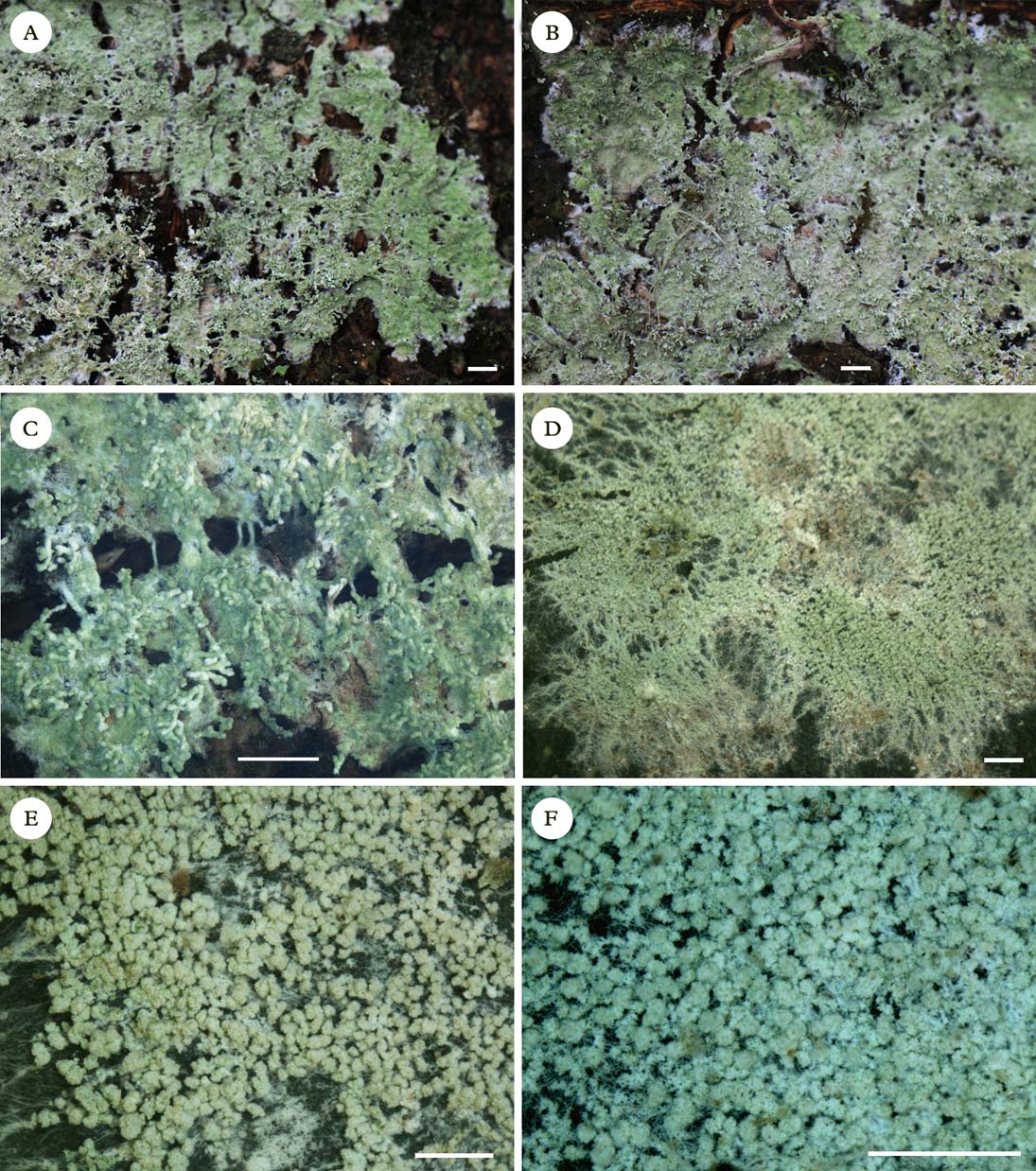
Herpothallon with pale green to whitish grey firmly to loosely attached thallus, white prothallus and hypothallus, cylindrical coralloid up to 1·0×0·1 mm pseudisidia and norstictic and confluentic acids.
Type: India, Andaman Islands, South Andaman, Baratang Island, Naya Dera, mangrove forest, 12°05′97·1″N, 92°44′52·5″E, alt. 10 m, on Rhizophora mucronata, 14 July 2012, T. A. M. Jagadeesh Ram 2240 (CAL—holotype; PBL—isotype).
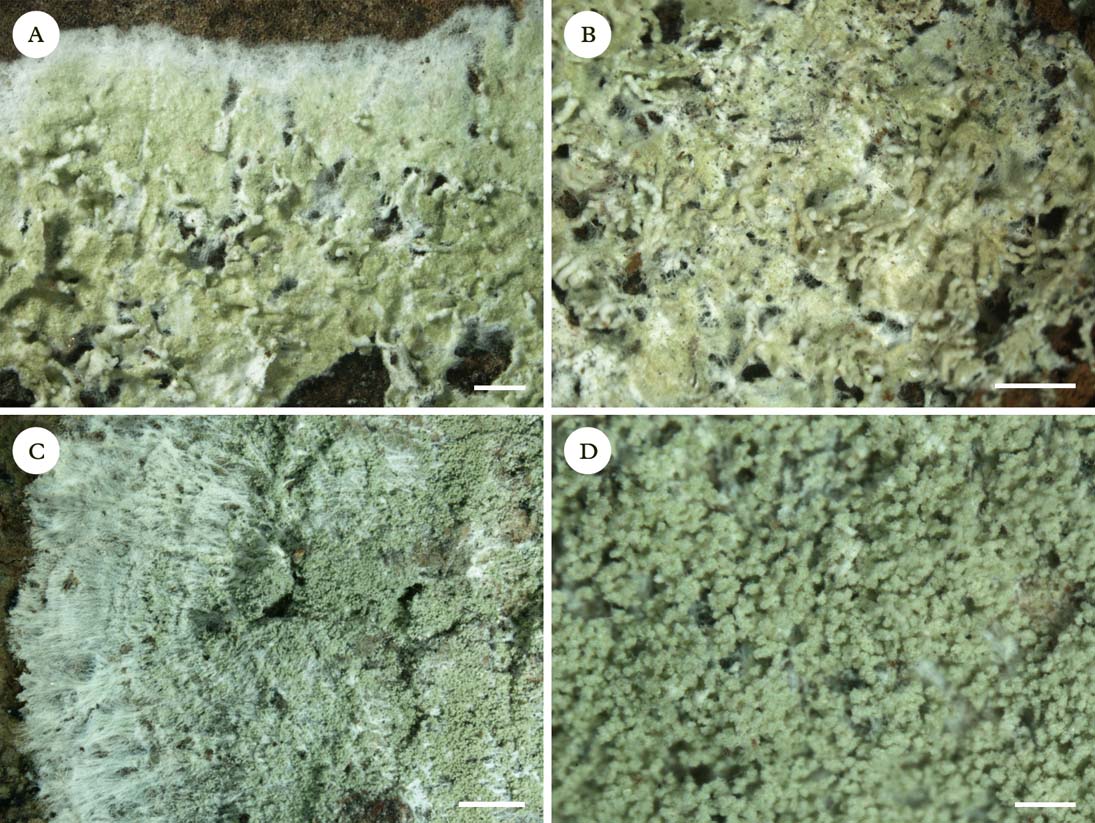
Herpothallon species. A–C, H. coralloides (holotype); A & B, thallus with prothallus; C, central thallus with pseudisidia. D–F, H. globuliferum (holotype); D, thallus with prothallus; E & F, central thallus with pseudisidia. Scales: A & B=5 mm; C & D=1 mm; E & F=0·5 mm. In colour online.
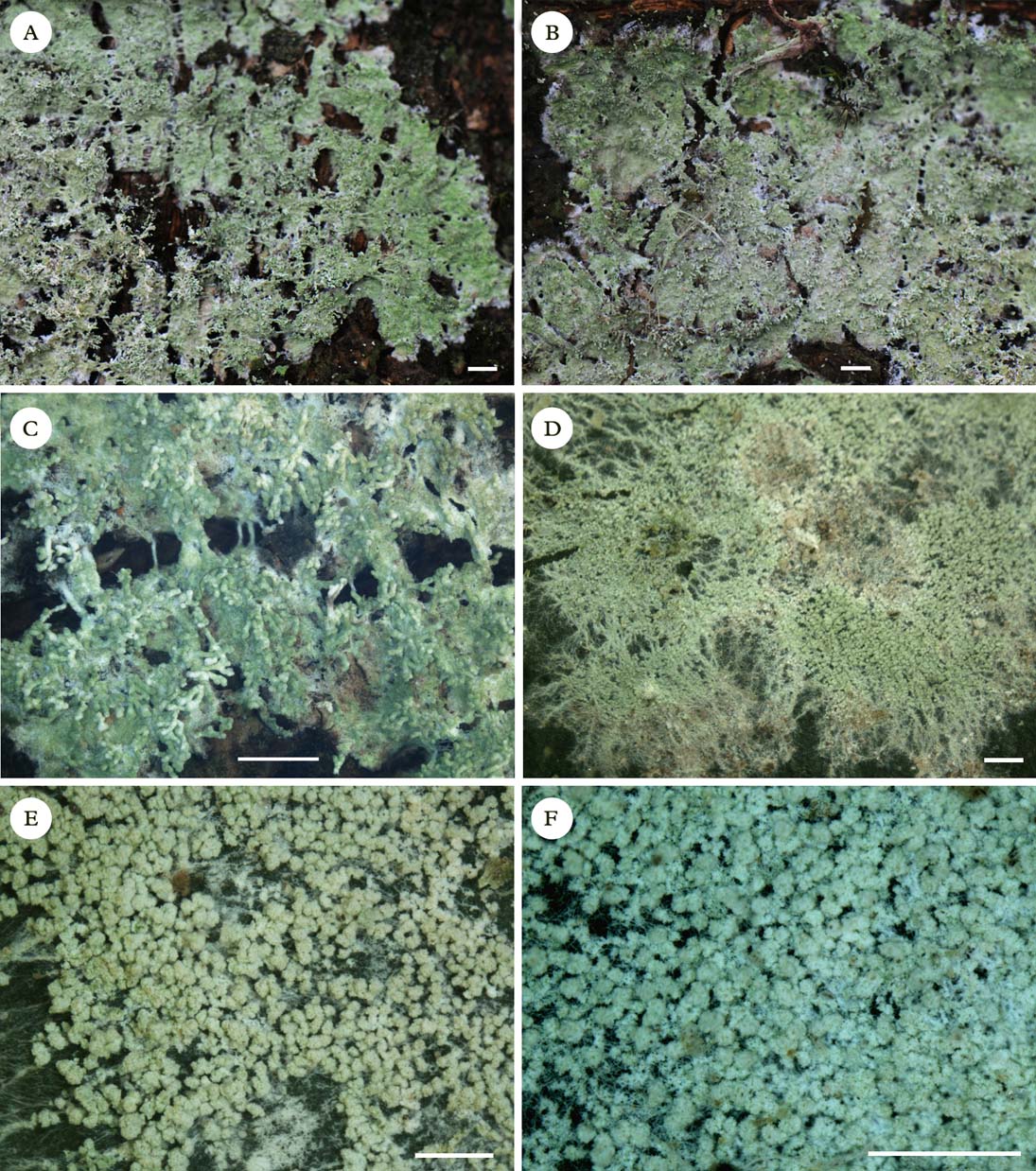
Thallus corticolous, firmly to loosely attached, 1·5–6·0 cm diam., pale green to whitish grey, byssoid, minutely felty, thin, flaking off, 35–100 µm thick, with colourless calcium oxalate crystals; crystals few to moderate, 3–15 µm wide. Photobiont layer thin, 8–12 µm thick; photobiont Trentepohlia, cells in short, irregular threads, 8–17×6–12 µm. Hypothallus white, below the entire thallus, 20–40 µm thick. Medulla white, 30–85 µm thick, medullary hyphae 1·5–2·0 µm wide. Prothallus white, up to 1·5 mm wide, byssoid, composed of thin ±spiny radiating hyphae. Pseudisidia numerous, dense, cylindrical, simple to irregularly branched, coralloid, up to 1·0×0·1 mm, felty with projecting hyphae.
Asci and pycnidia not seen.
Chemistry
Thallus K+ orange, C−, P+ yellow, UV−; I− or I+ pale blue and KI+ blue in patches (section); norstictic acid (major) and confluentic acid (major) detected by TLC.
Remarks
Herpothallon coralloides is characterized by the pale green to whitish grey, firmly to loosely attached thallus, white prothallus and hypothallus, cylindrical coralloid up to 1·0×0·1 mm pseudisidia and the presence of norstictic and confluentic acids. It resembles H. isidiatum Jagadeesh & G. P. Sinha and H. philippinum (Vain.) Aptroot & Lücking in having a similar non-pigmented prothallus and cylindrical pseudisidia. However, both species differ in their chemistry. Herpothallon isidiatum has stictic and constictic acids and H. philippinum has gyrophoric, confluentic and lecanoric acids (Aptroot et al. Reference Aptroot, Thor, Lücking, Elix and Chaves2009; Jagadeesh Ram et al. Reference Jagadeesh Ram, Sinha and Singh2009).
This new species is known only from the type locality, where it grows commonly on the mangrove tree, Rhizophora mucronata, along with and over a thin layer of mosses.
Herpothallon echinatum Aptroot et al.
Thallus corticolous, firmly attached, up to 8 cm across, pale green to greenish grey, byssoid, minutely felty, without calcium oxalate crystals. Hypothallus white, byssoid. Prothallus white, byssoid, up to 2 mm wide. Pseudisidia numerous, dense, cylindrical, up to 0·5×0·1 mm.
Asci and pycnidia not seen.
Chemistry
Thallus K−, C−, KC−, P+ yellow, UV−; I+, KI+ blue in patches (section); psoromic acid detected by TLC.
Remarks
This species is known from Australia, Costa Rica, India, Indonesia, Norfolk Islands, Papua New Guinea, Taiwan and Thailand (Aptroot et al. Reference Aptroot, Thor, Lücking, Elix and Chaves2009; Jagadeesh Ram & Sinha Reference Jagadeesh Ram and Sinha2011). In India, it was reported from Sikkim Himalaya and now it has been found in a high humid evergreen forest in the Andaman Islands.
Specimen examined. Andaman Islands: Little Andaman: Krishna Nala forest, 10°42′15·6″N, 92°29′82·8″E, on base of tree, alt. 45 m, 2013, Jagadeesh Ram 2688 (PBL).
Herpothallon globuliferum Jagadeesh sp. nov.
MycoBank No.: MB 804911
Herpothallon with whitish to whitish grey, firmly to ±loosely attached thallus, white prothallus and hypothallus, globular 0·045–0·080 mm wide soredia-like, pseudisidia and perlatolic acid.
Type: India, Andaman Islands, South Andaman, Baratang Island, Naya Dera, mangrove forest, 12°05′97·1″N, 92°44′52·5″E, alt. 10 m, on leaves of Heritiera littoralis, 14 July 2012, T. A. M. Jagadeesh Ram 2265 (CAL—holotype; PBL—isotype).
Thallus foliicolous, epiphyllous, firmly to ±loosely attached, orbicular to suborbicular, scattered to aggregated, (0·3–)0·5–1·0(–1·2) cm diam., whitish to whitish grey, byssoid, minutely felty, thin, 18–40 thick, with calcium oxalate crystals; crystals numerous, 5–18 µm wide. Photobiont layer thin, 6–10 µm thick; photobiont Trentepohlia, cells in short, irregular threads, 5–9×4–5 µm. Medulla thin to indistinct. Hypothallus white, below the thallus, closely adnate, hyphae 1·5–2·0 µm wide. Prothallus white, up to 2(–3) mm wide, byssoid, composed of thin, ±spiny radiating hyphae. Pseudisidia numerous, dense, minute, globular, granular, soredia-like, or merged into soredia-like granules, felty with spiny projecting hyphae, 0·045–0·080(–0·100) mm diam.
Asci and pycnidia not seen.
Chemistry
Thallus K−, C−, KC−, P−, UV−; I− or I+ pale blue and KI+ blue in patches; perlatolic acid (major) detected by TLC.
Remarks
Herpothallon globuliferum is distinguished by the foliicolous whitish to whitish grey, firmly to ±loosely attached thallus, with white prothallus and hypothallus, globular, 0·045–0·080 mm diam. pseudisidia and the presence of perlatolic acid. Herpothallon australasicum (Elix) Elix & G. Thor and H. queenslandicum (Elix) Elix are the other foliicolous species in the genus. Herpothallon australasicum has a white prothallus with red pigments, cylindrical up to 1·0×0·1 mm pseudisidia, and psoromic acid as the major lichen substance. Herpothallon queenslandicum (Elix) Elix is distinct from this new species by having cylindrical, up to 0·30×0·07 mm pseudisidia and confluentic acid as the major substance (Aptroot et al. Reference Aptroot, Thor, Lücking, Elix and Chaves2009).
Herpothallon granulare (Sipman) Aptroot & Lücking is the only species which has perlatolic acid and granular soredia-like pseudisidia. However, it is corticolous and lacks calcium oxalate crystals in the thallus. Herpothallon granulosum Jagadeesh & G. P. Sinha is another species having granular soredia-like pseudisidia, but differs in having barbatic acid as the lichen substance (Aptroot et al. Reference Aptroot, Thor, Lücking, Elix and Chaves2009; Jagadeesh Ram et al. Reference Jagadeesh Ram, Sinha and Singh2009).
Herpothallon globuliferum is known only from the type locality. It is common on the leaves (upper surface) of the mangrove tree, Heritiera littoralis. Its occurrence on the leaves of any other mangrove or non-mangrove trees in the type locality has not been observed.
Additional specimens examined. Andaman Islands: South Andaman: Baratang Island, Naya Dera, mangrove forest, 12°05′97·1″N, 92°44′52·5″E, alt. 10 m, on leaves of Heritiera littoralis, 2013, Jagadeesh Ram 2396, 2796 (PBL).
Herpothallon granulare (Sipman) Aptroot & Lücking
Thallus corticolous, firmly attached, up to 10 cm across, whitish grey, byssoid, minutely felty, without calcium oxalate crystals. Hypothallus white byssoid. Prothallus white byssoid, up to 1·5 mm wide. Pseudisidia numerous, dense, granular to globose, merging into soredia-like granules, up to 0·05 mm diam.
Asci and pycnidia not seen.
Chemistry
Thallus K−, C−, KC−, P−, UV−; I+, KI+ blue in patches (section); perlatolic acid (major) detected by TLC.
Remarks
This species is known from China, Costa Rica, India, Singapore and Thailand (Aptroot et al. Reference Aptroot, Thor, Lücking, Elix and Chaves2009; Jagadeesh Ram et al. Reference Jagadeesh Ram, Sinha and Singh2009). In India, it was previously reported from the Tea Gardens of Assam. Now, it has been recorded from a Horticulture farm in the Andaman Islands.
Specimen examined. Andaman Islands: South Andaman: Port Blair, Shippighat, State Horticulture Farm, 11°36′31·8″N, 92°40′17·5″E, alt. 25 m, on Anacardium occidentale, 2013, Jagadeesh Ram 2773 (PBL).
Herpothallon granulosum Jagadeesh & G. P. Sinha
Thallus corticolous, firmly attached, up to 8 cm across, pale green to greenish grey, byssoid, minutely felty, with calcium oxalate crystals. Hypothallus white, byssoid. Prothallus white, byssoid, up to 2 mm wide. Pseudisidia numerous, dense, granular to globular, merging into soredia-like granules, 0·04–0·08 mm diam.
Asci and pycnidia not seen.
Chemistry
Thallus K−, C−, KC−, P−, UV−; I+, KI+ blue in patches (section); barbatic acid detected by TLC.
Remarks
This species is known from India (Meghalaya and West Bengal) and Australia. It has been reported from an altitude of 685 m (Australia) to 2166 m (West Bengal, Eastern Himalaya, India) (Jagadeesh Ram et al. Reference Jagadeesh Ram, Sinha and Singh2009; Elix Reference Elix2010). Now, it is recorded from sea level.
Specimens examined. Andaman Islands: Middle Andaman: Bakulta, Shyankund, 11°29′20·1″N, 92°50′36·7″E, alt. 10 m, on Rhizophora, Jagadeesh Ram 1133 (PBL). South Andaman: John Lawrence Island, seashore forest, on base of tree, alt. 5 m, 2012, Jagadeesh Ram 2045 (PBL).
Herpothallon lutescens Jagadeesh sp. nov.
MycoBank No.: MB 804912
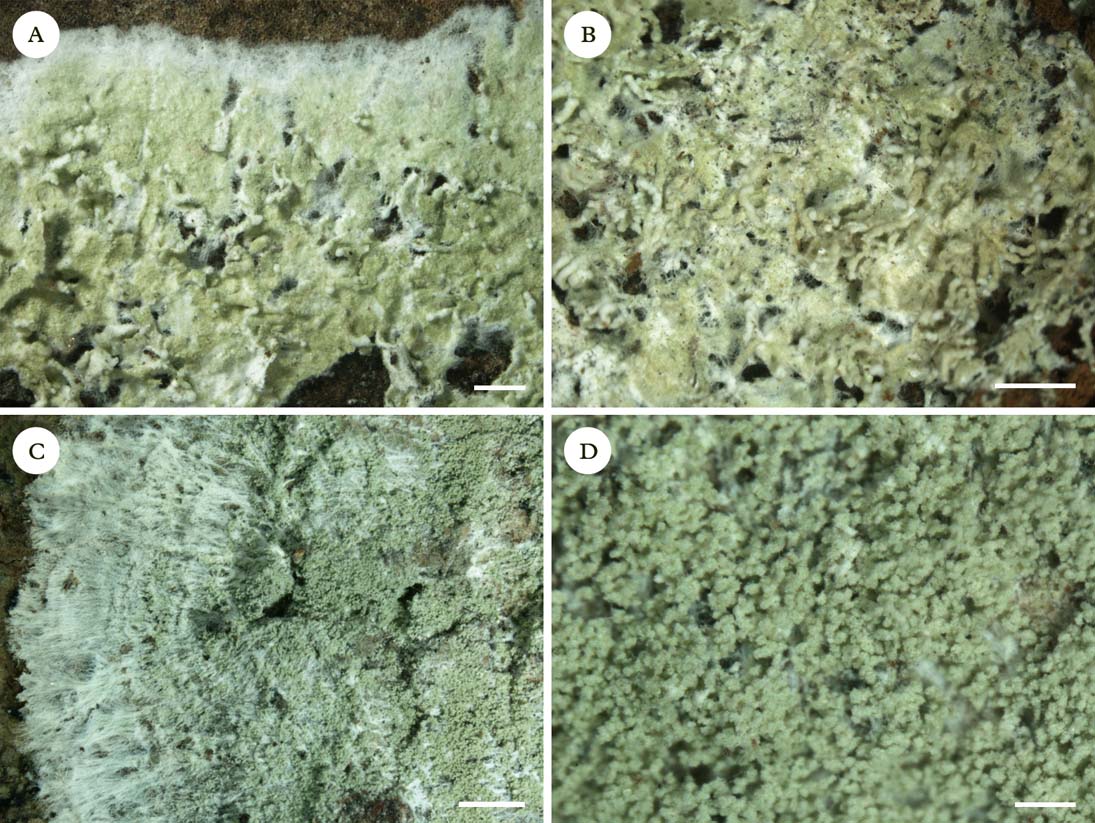
Herpothallon with pale yellow to pale yellow-green, firmly to loosely attached thallus, white prothallus and hypothallus, and cylindrical simple to coralloid up to 1·50×0·12 mm pseudisidia.
Type: India, Andaman Islands, Little Andaman, Hut Bay, Nanjappa Nagar, evergreen forest, near White Surf Waterfall, 10°37′N, 92°31′E, alt. 70 m, on base of tree, 2 May 2012, T. A. M. Jagadeesh Ram 1547 (CAL—holotype; PBL—isotype).
Herpothallon species. A & B, H. lutescens (holotype); A, lateral thallus with prothallus; B, central thallus with pseudisidia. C & D, H. minutum (holotype); C, lateral thallus with prothallus; D, central thallus with pseudisidia. Scales: A–C=1 mm; D=0·5 mm. In colour online.
Thallus corticolous, firmly to loosely attached, up to 10 cm diam., pale yellow to pale yellow-green, byssoid, felty, not flaking off, 48–120 µm thick, with calcium oxalate crystals; crystals few to many, 5–12 µm wide. Photobiont layer 8–15 µm thick; photobiont Trentepohlia, cells 8–15×5–10 µm. Medulla white, 42–105 µm thick, medullary hyphae 1·5–2·0 µm wide. Hypothallus white to dark brown, below the entire thallus, 20–40 µm thick, hyphae hyaline to brown, 1·5–2·5 µm wide. Prothallus white, up to 2·0(–2·5) mm wide, byssoid, composed of radiating loosely interwoven smooth hyphae. Pseudisidia few to numerous, sparse to dense, concolourous with the thallus, paler at tips, cylindrical to clavate, simple to branched, subcoralloid to coralloid, mostly slanting, thin to slightly flattened at base, up to 1·50×0·12 mm, felty with projecting smooth hyphae.
Asci and pycnidia not seen.
Chemistry
Thallus K−, C−, KC−, P−, UV−, I− or I+ pale blue, KI+ blue in patches (section); no lichen substance, or with an unidentified minor substance (yellow-grey spot at Rf value 44 in solvent A and B) detected by TLC. Major peaks were not obtained in HPLC analysis. Prominent lichen crystals were not noticed in GE and PY. Small stellate, up to 20 µm diam. crystals were observed in GAW (See Orange et al. Reference Orange, James and White2001 for explanation of contractions of chemicals).
Remarks
Herpothallon lutescens is characterized by the pale yellow to pale yellow-green, firmly to loosely attached thallus, white prothallus and hypothallus, and cylindrical simple to coralloid up to 1·50×0·12 mm pseudisidia. Externally, it somewhat resembles Herpothallon coralloides Jagadeesh and H. philippinum (Vain.) Aptroot & Lücking in having a similar non-pigmented prothallus and cylindrical pseudisidia. However, Herpothallon coralloides Jagadeesh contains confluentic and norstictic acids, whereas H. philippinum has gyrophoric acid (Aptroot et al. Reference Aptroot, Thor, Lücking, Elix and Chaves2009).
This species has been found to be common in high, humid, dense lowland evergreen forests near White Surf Waterfall, Krishna Nala Waterfall and Vishnu Nala Dam in Little Andaman Island. It has been found on live as well as slightly decaying bark, and also over a thin layer of mosses on the whole trunks of larger trees along the streams.
Additional specimens examined. Andaman Islands: Little Andaman: Ramkrishnapur, Vishnu Nala Dam forest, 10°43′N, 92°32′E, on base of tree, alt. 120 m, 2012, Jagadeesh Ram 1667 (PBL); Hut Bay, Nanjappa Nagar, evergreen forest around White Surf Waterfall, 10°37′33·1″N, 92°31′39·4″E, 25 m, 2013, Jagadeesh Ram 2638 (PBL); ibid., 10°37′78·5″N, 92°31′19·9″E, 32 m, Jagadeesh Ram 2641 (PBL); ibid., 10°38′18·6″N, 92°31′07·6″E, 40 m, Jagadeesh Ram 2645 (PBL); ibid., 10°38′54·4″N, 92°31′25·0″E, 38 m, Jagadeesh Ram 2654 (PBL); ibid., Krishna Nala forest, 10°42′26·9″N, 92°30′01·1″E, 25 m, 2013, Jagadeesh Ram 2682 (PBL).
Herpothallon minutum Jagadeesh sp. nov.
MycoBank No.: MB 804913
Herpothallon with greenish grey to greyish yellow, firmly to loosely attached thallus, white prothallus and hypothallus, granular globular to short cylindrical 0·02–0·06 mm wide pseudisidia and gyrophoric acid.
Type: India, Andaman Islands, Middle Andaman, Rampur Beach, 12°52′19·8″N, 92°55′44·2″E, alt. 10 m, on base of tree, 7 March 2012, T. A. M. Jagadeesh Ram 716 (CAL—holotype; PBL—isotype).
Thallus corticolous, firmly to ±loosely attached, orbicular to suborbicular, 3–13 cm diam., whitish grey to greyish yellow, byssoid, not flaking off, minutely felty, 25–100 µm thick, with calcium oxalate crystals; crystals few to many, 3–8 µm wide. Photobiont layer 10–30 µm thick; photobiont Trentepohlia, cells in short, irregular threads, 8–15×5–10 µm. Medulla indistinct or poorly developed, lower algal free layer 20–80 µm thick. Hypothallus white, below the entire thallus, loosely to firmly adnate, hyphae 1·5–2·5 µm wide. Prothallus white, up to 5 mm wide, byssoid, composed of radiating loosely interwoven ±spiny hyphae. Pseudisidia numerous, dense, minute, granular, globular to short cylindrical, aggregated, crowded, mostly simple, felty with projecting hyphae, 0·02–0·06 mm diam., or 0·03–0·08 mm long, 0·02–0·06 mm wide.
Asci and pycnidia not seen.
Chemistry
Thallus K−, C+ red, KC+ red, P−, UV−; I− or I+ pale blue, KI+ blue in patches (section); gyrophoric acid (major) detected by TLC.
Remarks
Herpothallon minutum is characterized by the greenish grey to greyish yellow, firmly to loosely attached thallus, white prothallus and hypothallus, granular, globular to short cylindrical, 0·02–0·06 mm diam. crowded pseudisidia and the presence of gyrophoric acid. This species closely resembles Herpothallon flavominutum Jagadeesh et al., a species known from Eastern Himalaya and the Khasi Hills of India, which has a similar prothallus, hypothallus and pseudisidia. However, H. flavominutum can easily be distinguished by the UV+ yellow thallus (lichexanthone and norlichexanthone). Herpothallon adnatum G. Thor is the other species known from Peru having similar pseudisidia, but differs in having a red prothallus and confluentic acid as the lichen substance (Aptroot et al. Reference Aptroot, Thor, Lücking, Elix and Chaves2009; Jagadeesh Ram & Sinha Reference Jagadeesh Ram and Sinha2009).
This species is widely distributed in open beach forest to dense lowland evergreen forest.
Additional specimens examined. Andaman Islands: North Andaman: Aerial Bay Forest, alt. 79 m, 2011, Jagadeesh Ram 105 (PBL); Reef Island Wildlife Sanctuary, 13°30′09·4″N, 92°52′15·9″E, alt. 15 m, 2012, Jagadeesh Ram 1194, 1234 (PBL); Coffee Dera, Lamba Baalu, alt. 10 m, 2012, Jagadeesh Ram 1331 (PBL); Paget Island Wildlife Sanctuary, alt. 10 m, 2012, Jagadeesh Ram 1390 (PBL); Saddle Peak National Park, 13°09′52·3″N, 93°01′56·3″E, alt. 53 m, 2012, Jagadeesh Ram 1508 (PBL); Lamia Bay, 13°11′47·9″N, 93°02′10·3″E, alt. 20 m, 2012, Jagadeesh Ram 1526 (PBL). Middle Andaman: Rampur Beach, 12°52′19·8″N, 92°55′39·8″E, alt. 12 m, 2012, Jagadeesh Ram 705 (PBL); Sound Island, 12°56′35·2″N, 92°58′21·3″E, alt. 5 m, 2012, Jagadeesh Ram 899 (PBL); ibid., 12°56′26·5″N, 92°54′03·1″E, alt. 10 m, 2012, Jagadeesh Ram 924 (PBL); Long Island, 12°22′42·4″N, 92°55′12·7″E, alt. 15 m, 2013, Jagadeesh Ram 2450 (PBL); Guitar Island, 12°20′39·7″N, 92°54′56·5″E, alt. 5 m, 2013, Jagadeesh Ram 2480 (PBL). South Andaman: Wandoor, alt. 15 m, 2011, Jagadeesh Ram 556, 559 (PBL); Outram Island, alt. 5 m, 2012, Jagadeesh Ram 1863 (PBL); Hentry Lawrence Island, alt. 10 m, 2012, Jagadeesh Ram 1901, 1906 (PBL); John Lawrence Island, alt. 10 m, 2012, Jagadeesh Ram 2064 (PBL). Little Andaman: Hut Bay, evergreen forest around White Surf Waterfall, alt. 65 m, 2012, Jagadeesh Ram 1542, 1545 (PBL); Butler Bay Beach Forest, 2012, Jagadeesh Ram 1617, 1645, 1658 (PBL); South Bay Forest, alt. 8 m, 2012, Jagadeesh Ram 1721, 1734 (PBL); Vivekanandapur, Red Oil Palm Plantation, alt. 200 m, 2012, Jagadeesh Ram 1796 (PBL).
Herpothallon philippinum (Vain.) Aptroot & Lücking
Thallus corticolous, firmly to loosely attached, up to 7 cm diam., minutely felty, pale grey, with many calcium oxalate crystals. Hypothallus whitish, byssoid. Prothallus whitish, up to 1·5 mm wide, byssoid. Pseudisidia numerous, cylindrical, up to 1·0×0·1 mm.
Asci and pycnidia not seen.
Chemistry
Thallus K−, C+ red, KC+ red, P−, UV−, I+ and KI+ blue in patches (section); gyrophoric acid (major) detected by TLC.
Remarks
This common pantropical species was reported from Assam and Sikkim (Jagadeesh Ram & Sinha Reference Jagadeesh Ram and Sinha2009, Reference Jagadeesh Ram and Sinha2010), and now has been recorded from the seashore montane rainforests in North and Little Andaman Islands.
Specimens examined. Andaman Islands: North Andaman: Diglipur, Lamia Bay Forest, alt. 10 m, 2011, Jagadeesh Ram 223 (PBL); Reef Island Wildlife Sanctuary, 13°30′09·9″N, 92°52′15·9″E, alt. 15 m, 2012, Jagadeesh Ram 1228 (PBL); Thorn Hill Island, 2012, Jagadeesh Ram 1275 (PBL). Little Andaman: South Bay Beach forest, alt. 10 m, 2012, Jagadeesh Ram 1764 (PBL).
Heiomasia pallescens Jagadeesh sp. nov.
MycoBank No.: MB 804914
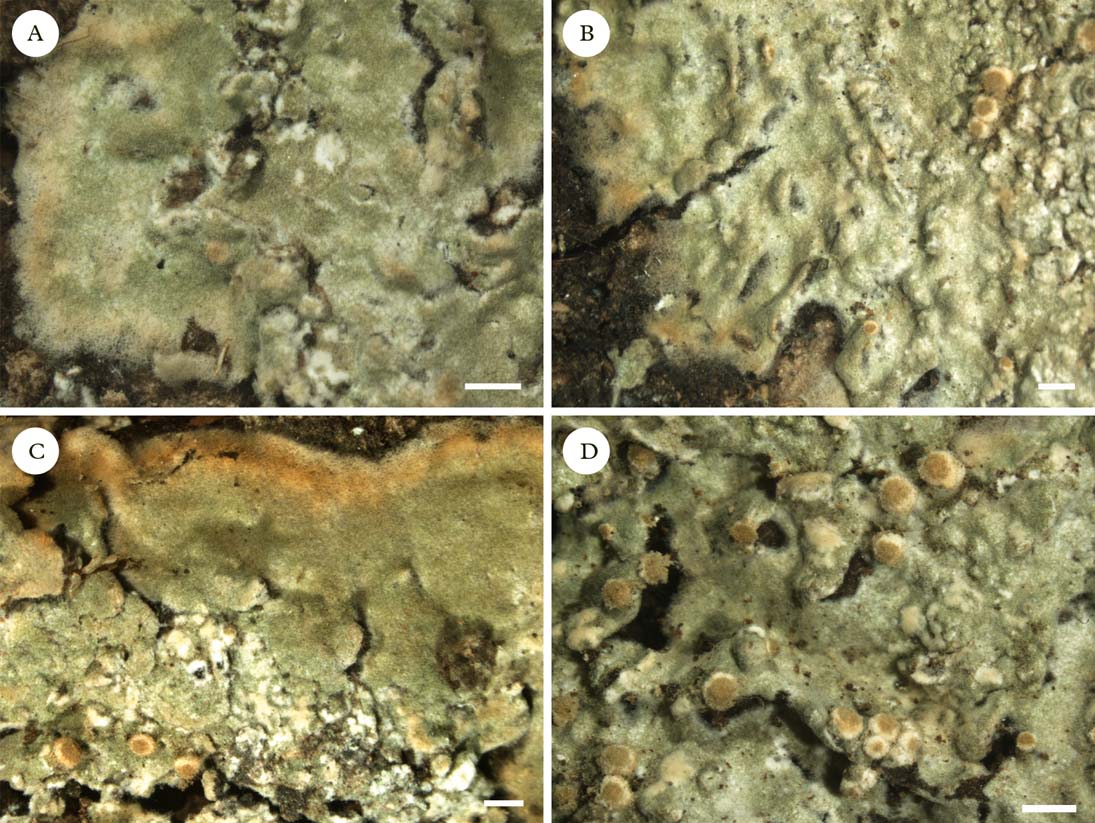
Heiomasia with pale mineral grey to greyish green, firm to loosely attached thallus, dirty whitish to pinkish prothallus, brown-black hypothallus, disc-shaped 0·4–0·8 mm wide isidioid structures, and salazinic and norstictic acids.
Type: India, Andaman Islands, Little Andaman, Hut Bay, Nanjappa Nagar, evergreen forests around White Surf Waterfall, 10°37′N, 92°31′E, alt. 70 m, 2 May 2012, T. A. M. Jagadeesh Ram 1550 (CAL—holotype; PBL—isotype).
(Fig. 3)
Heiomasia pallescens (holotype). A–C, lateral thallus with prothallus; D, central thallus with isidioid structures. Scale=1 mm. In colour online.
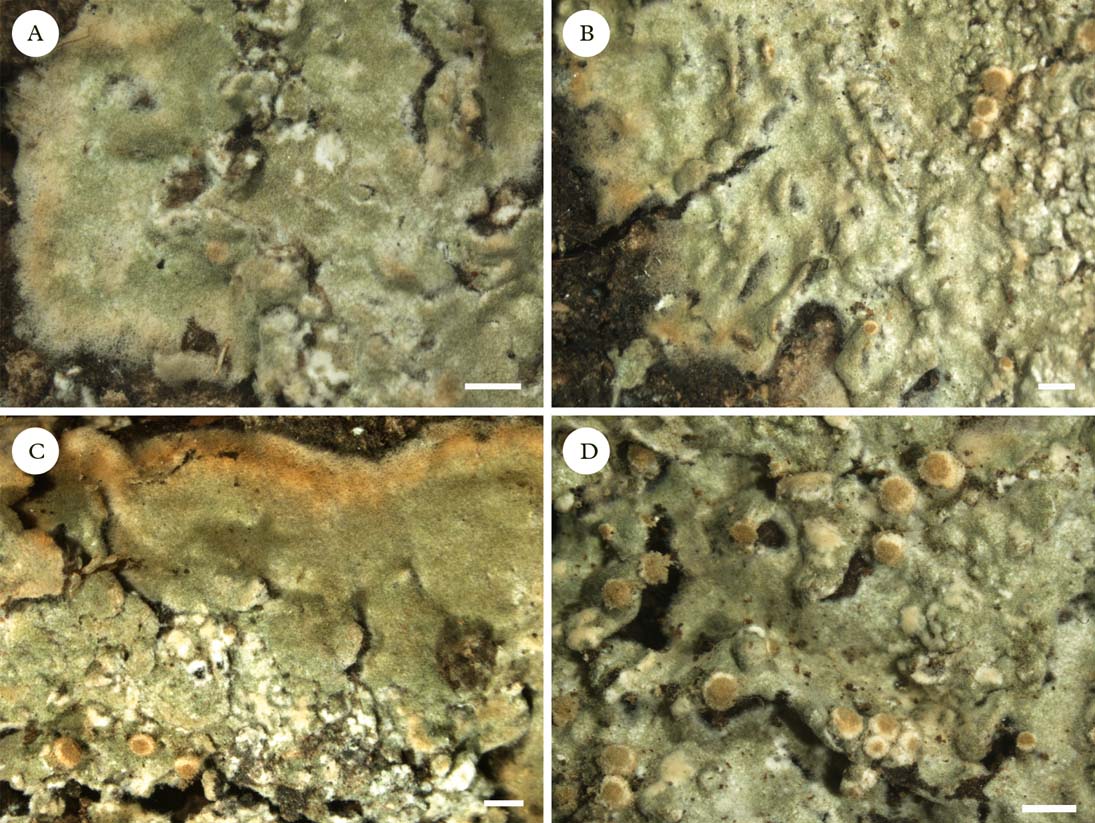
Thallus corticolous, firm to loosely attached, up to 5 cm diam., pale mineral grey to greyish green, dull, not flaking off, felty, uneven, with irregularly elevated verrucae-like structures, up to 180 µm thick, with calcium oxalate crystals; crystals few, 3–8 µm wide. Photobiont layer 8–20 µm thick; photobiont Trentepohlia, cells in short, irregular threads, 6–10×5–8 µm. Medulla white, 80–160 µm thick. Hypothallus below the entire thallus, brown-black, loosely attached to the substratum, composed of densely arranged, brown thick hyphae 1·5–3·0 µm wide. Prothallus dirty whitish in outer and pale brown to pinkish in inner parts, up to 1 mm wide, byssoid, composed of interwoven and radiating smooth hyphae. Isidioid structures few to many, scattered to aggregated, felty, disc-shaped, with many projecting hyphae of same colour as thallus to slightly paler, and tips of brownish orange due to decomposing salazinic acid, 0·4–0·8 mm diam., sometimes slightly elongated, 0·2–0·4 mm high.
Asci and pycnidia not seen.
Chemistry
Thallus K+ yellow then red, C−, P+ orange, UV−; I− and KI−; salazinic acid (major) and norstictic acid (major) detected by TLC.
Remarks
Heiomasia pallescens is characterized by the pale mineral grey to greyish green, firm to loosely attached thallus, dirty whitish to pinkish prothallus, brown-black hypothallus, disc-shaped 0·4–0·8 mm wide isidioid structures, and salazinic and norstictic acids as lichen substances. Heiomasia sipmanii (Aptroot et al.) Nelsen et al. is the only other byssoid taxon possessing disc-shaped isidioid structures, externally somewhat resembling H. pallescens. Heiomasia sipmanii differs from H. pallescens in having protocetraric and hypoprotocetraric acids. Heiomasia seaveyorum Nelsen & Lücking is the other species in the genus, which has cylindrical isidia-like structures, and 5-hydroxy-4-O-demethylnotatic and 4-O-demethylnotatic acids. The byssoid genus Heiomasia Nelsen et al. (Graphidaceae) was recently established to accommodate Herpothallon sipmanii Aptroot et al. and to add Heiomasia seaveyorum Nelsen & Lücking (Nelsen et al. Reference Nelsen, Lücking, Rivas Plata and Mbatchou2010). The new species is included in Heiomasia (Graphidaceae) because the disc-shaped ecorticate isidioid structures are well characterized in Heiomasia (Nelsen et al. Reference Nelsen, Lücking, Rivas Plata and Mbatchou2010). Moreover, it has an I−, KI− thallus unlike Herpothallon which has weak to strong amyloidity in the thallus (Frisch et al. Reference Frisch, Thor and Elix2010a , Reference Frisch, Elix and Thor b ). Heiomasia seaveyorum and H. sipmanii also have an I−, KI− thallus (M. P. Nelsen, pers. comm. 2013).
This species was found on slightly decaying bark and also over a thin layer of mosses on base of tree in a high, humid dense lowland evergreen forest near White Surf Waterfall on Little Andaman Island.
Key to the Herpothallon species in India
-
1 Pigments in thallus visible from above, prothallus with red pigment, K+ red to purple; pseudisidia cylindrical [West Bengal] ... Herpothallon australasicum (Elix) Elix & G. Thor
No pigments in thallus, pseudisidia and prothallus visible from above (rarely yellow pigments located in hidden hypothallus) ... 2
-
2(1) Thallus with irregular cushion-shaped pseudisidia; hypothallus with yellow pigments [West Bengal] ... Herpothallon himalayanum Jagadeesh & G. P. Sinha
Thallus with granular or cylindrical pseudisidia ... 3
-
3(2) Thallus with globose to granular pseudisidia ... 4
Thallus with cylindrical pseudisidia ... 9
-
4(3) Pseudisidia merge into soredia-like granules ... 5
Pseudisidia do not merge into soredia-like granules ... 8
-
5(4) Thallus K+ yellow, P+ orange (stictic acid), pseudisidia granular to irregular wart- like, merging into minute soredia-like granules [Arunachal Pradesh and Sikkim] ... Herpothallon sticticum Jagadeesh & G. P. Sinha
Thallus K−, P− ... 6
-
6(5) Thallus KC+ red (barbatic acid) [Andaman Islands, Meghalaya, Sikkim and West Bengal] ... Herpothallon granulosum Jagadeesh & G. P. Sinha
Thallus KC− (perlatolic acid) ... 7
-
7(6) Thallus foliicolous, with calcium oxalate crystals [Andaman Islands] ... Herpothallon globuliferum Jagadeesh
Thallus corticolous, lacking calcium oxalate crystals [Andaman Islands and Assam] ... Herpothallon granulare (Sipman) Aptroot & Lücking
-
8(4) Thallus UV+ yellow, C− (lichexanthone, norlichexanthone) [Meghalaya, Sikkim and West Bengal] ... Herpothallon flavominutum Jagadeesh et al.
Thallus UV−, C+ red (gyrophoric acid) [Andaman Islands] ... Herpothallon minutum Jagadeesh
-
9(3) Pseudisidia up to 0·5 mm long, thallus with confluentic acid [Sikkim and West Bengal] ... Herpothallon cinereum G. Thor
Pseudisidia over 0·5 mm long ... 10
-
10(9) Thallus K+ yellow or orange ... 11
Thallus K− ... 12
-
11(10) Thallus with stictic acid [Arunachal Pradesh, Assam, Madhya Pradesh, Sikkim and West Bengal] ... Herpothallon isidiatum Jagadeesh & G. P. Sinha
Thallus with confluentic and norstictic acids [Andaman Islands] ... Herpothallon coralloides Jagadeesh
-
12(10) Thallus P+ yellow (psoromic acid) [Andaman Islands and Sikkim] ... Herpothallon echinatum Aptroot et al.
Thallus P− ... 13
-
13(12) Thallus C+ red (gyrophoric acid) [Andaman Islands, Assam and Sikkim] ... Herpothallon philippinum (Vain.) Aptroot & Lücking
Thallus C−, KC−; no lichen substance or with an unidentified minor substance [Andaman Islands] ... Herpothallon lutescens Jagadeesh
My gratitude goes to the Director of the Botanical Survey of India, Kolkata, and the Head of BSI, Andaman and Nicobar Regional Centre, Port Blair, for their meticulous support. I wish to give my profound thanks to the Authorities of the Department of Environment & Forests, Andaman and Nicobar Islands who facilitated the fieldwork.