

Background
Hypothermia is defined as being a core temperature of below 36°C [American Society of PeriAnesthetic Nurses (ASPAN), 2001; NICE, 2008], and is defined as inadvertent hypothermia when there is an unplanned fall in temperature during surgery to below 36°C [ASPAN, 2001]. Inadvertent peri-operative hypothermia (IPH) is a common but preventable complication of surgical procedures [Kurz, Reference Kurz2008; NICE 2008; Paulikas, Reference Paulikas2008; Burger and Fitzpatrick, Reference Burger and Fitzpatrick2009], which can affect up to 70% of patients [NICE 2008; Burger and Fitzpatrick, Reference Burger and Fitzpatrick2009] and is associated with poor patient outcomes [Hegarty et al, Reference Hegarty, Walsh, Burton, Murphy, O'Gorman and McPolin2009].
IPH occurs in patients when there is suppression of their protective reflexes [Parker, Reference Parker2004] and impairment of thermoregulatory control of the hypothalamus [Sessler, Reference Sessler2001], as a result of anaesthetic agents [Hamlin et al, Reference Hamlin, Jenkins and Coulon2009]. This was seen by Pickering [Reference Pickering1958], who found that the most effective way to cool a man is by the administration of an anaesthetic.
In addition to the anaesthetic causing a drop in the temperature, other peri-operative factors also have an effect. These include cold operating theatres [Sessler, Reference Sessler2001; Weirich, Reference Weirich2008; Burns et al, Reference Burns, Wojnakowski, Piotrowski and Caraffa2009], type and length of surgery [Burger and Fitzpatrick, Reference Burger and Fitzpatrick2009] and evaporative loss due to skin prep [Paulikas, Reference Paulikas2008;Weirich, Reference Weirich2008], with some patients having greater risk of developing hypothermia than others, such as the elderly, cachectic patients, patients who undergoing long surgery [Hatfield and Tronson, Reference Hatfield and Tronson2009].
Heat loss related to anaesthesia occurs in three recognisable phases [Kumar et al, Reference Kumar, Wong, Melling and Leaper2005], with the biggest drop in temperature of 1°C to 1.5°C occurring in the first hour of surgery. This is known as the redistribution phase, as heat is rapidly redistributed from the core to the peripheries [Burns et al, Reference Burns, Wojnakowski, Piotrowski and Caraffa2009]. This impact on a patient's temperature can be greatly reduced by ensuring that patients are normothermic before surgery.
There is a lot of research that looks at how the warming of patients peri-operatively reduces the incidence of hypothermia. As NICE guidelines [2008] recommend assessing the patient's temperature an hour before surgery and pre-warming patients if their temperature is <36°C, it would be useful to compare the efficacy of pre-warming patients in addition to peri-operative warming, to explore whether there is a reduction in IPH in patients being given a general anaesthetic. Therefore, this mini-review will ask the question: does pre-operative warming reduce the incidence of IPH in patients undergoing general anaesthesia?
Methods
Inclusion and exclusion criteria
For the mini-review, inclusion and exclusion criteria were set so that appropriate studies could be identified after searching the databases using the facet analysis. For a study to be considered, it needed to be a randomised controlled trial (RCT) as these are considered to be the ‘gold standard’ [Evans and Pearson, Reference Evans and Pearson2001], against which other research designs are compared. Studies needed to compare the effectiveness of pre-warming and peri-operative warming with patients who are just warmed during the peri-operative period. In addition to this, patients needed to be warmed with forced-air systems in the pre-operative period, in order to be included in the mini-review.
In order for trials to be included, the participants had to be human adults undergoing elective surgery with a general anaesthetic that did not induce hypothermia to protect organs, such as cardiac surgery.
1. As there were studies with varying times of pre-warming, those studies that did not warm for 60 minutes were also excluded, as NICE guidelines recommend assessing the patient's temperature an hour before surgery and if their temperature is <36°C then the patient should receive pre-warming for the hour before surgery.
Search strategy
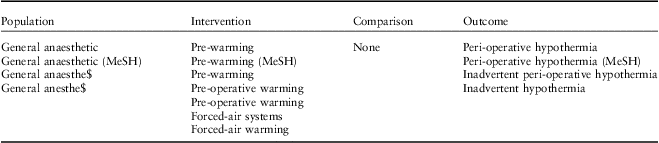
The question was broken down in order to identify the PICO (Population, Intervention, Comparison, Outcome) terms, which would be used as search terms in the Facet Analysis (Table 1), with the components of interest being patients undergoing general anaesthesia (population), who have pre-operative warming (intervention) with forced-air systems, which resulted in a reduced incidence of IPH (outcome). An initial search was conducted on the Cochrane Database of Systematic Reviews using the search terms from Table 1 to ensure that there were no pre-existing systematic reviews that examined the use of pre-operative warming to reduce IPH. Searches were then conducted on the Medline (1950-present) and Embase (1980-present) databases using the search terms from Table 1.
Facet analysis and search terms
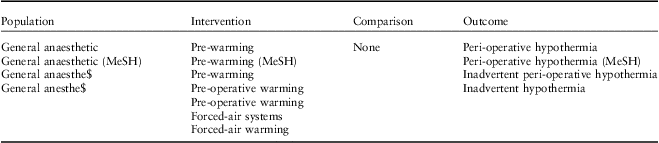
Each of the main facet terms were searched using Medical Subject Headings (MeSH terms) in order to refine the search [Simon, Reference Simon2006], and relevant headings were exploded so that the sensitivity could be increased. The associated terms were then searched as free text. Differences in the spelling of words such as anaesthesia in English and anesthesia in American English were taken into consideration, and both were searched using the symbol for truncation ‘$’ at the appropriate cut-off point (anaesthe$, anesthe$) to allow for increased sensitivity in the results [Booth et al, Reference Booth, Rees and Beechcroft2010], so that all possible permutations of the word would be searched for. In addition to searching for pre-warming (main facet term for the intervention), forced-air warming was searched as a free text term as this was the method of pre-warming, which was of interest. Again, variations in the ways in which pre-warming and pre-operative were spelt were incorporated into the free text search.
From searching both the Medline and Embase databases, over 4000 results were listed between the two (Medline = 1489; Embase = 2725), and therefore limits were placed to include only RCTs, studies that involved humans and those that were about hypothermia; this reduced the number of results to 88 (Medline = 51; Embase = 55), with a further three studies identified through a hand search of reference lists.
Findings of the review
Overview of the findings
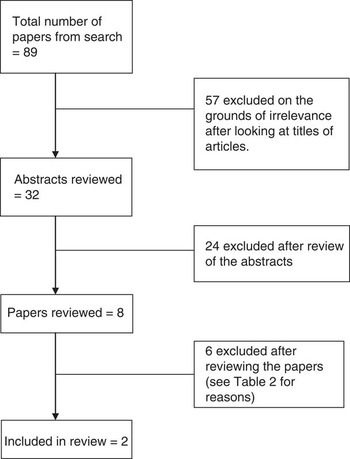
From looking at the titles of the articles found in the search, 54 were excluded as irrelevant. Studies that are not relevant to the search are known as a ‘false positive’ and there is a cost for finding these when searching for information [Simon, Reference Simon2006], which can be time-consuming while sorting through them. Then from going through the abstracts of the remaining articles, a further 24 studies were excluded as they either did not answer the review question or meet the inclusion criteria (see Fig. 1).
Exclusion flow chart.

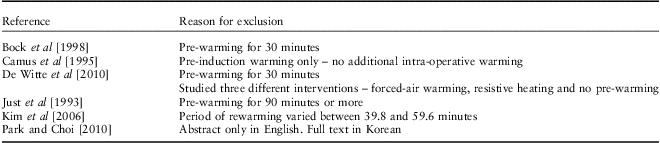
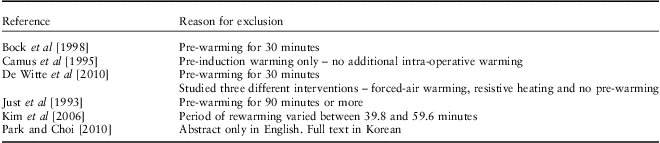
The remaining eight studies were then acquired in full text and read, and using a critical appraisal tool using guidelines based on those given in Greenhalgh and Donald [Reference Greenhalgh and Donald2000] six of these studies were excluded (see Table 2) if the inclusion criteria were not met. This resulted in there being two studies that met the criteria to be included in this mini-review.
Excluded papers
Excluded studies
One study [Park and Choi, Reference Park and Choi2010] was excluded because only the abstract was in English, whereas the full article could only be accessed in Korean. Four of the studies were excluded as pre-warming did not occur for 60 minutes. The decision to exclude articles on the basis of time of pre-warming was made to ensure that the intervention was the same for each sample group. As the NICE guidelines recommend pre-warming for 60 minutes if the patient's temperature is below 36°C, the decision was made to exclude studies that did not meet these criteria. In addition, one study was excluded as it only examined the effect of pre-warming, without additional intra-operative warming.
Included studies
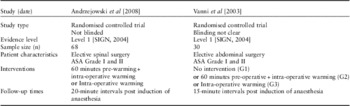
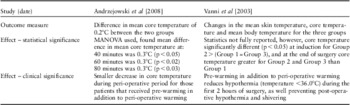
The two studies included in this review both evaluated the effects of pre-warming for 60 minutes using forced-air warming systems in preventing peri-operative hypothermia. Data were extracted and critically appraised using guidelines based on those given in Greenhalgh and Donald [Reference Greenhalgh and Donald2000], with the details of the two studies listed in Table 3.
Details of the included studies

Both the studies were RCTs, which are seen as the ‘gold standard’ of research design [Evans and Pearson, Reference Evans and Pearson2001]. These RCTs can be classed as ‘Level 1’ evidence [SIGN, 2004], which puts these studies at the higher end of ‘levels of evidence’. This means that these studies will have avoided systematic bias by choosing participants from a specific population (patients undergoing elective surgery with American Society of Anesthesiologist (ASA) grades of I or II) and randomly allocating them to the different intervention groups [Greenhalgh, Reference Greenhalgh2010]. This was evident in both the studies as the method of randomisation is discussed.
Owing to the nature of the interventions, blinding would have been difficult to achieve with regard to which intervention group patients were allocated to. This then means that the researchers or the patients could be able to discover which intervention group they were in and this may have influenced the results [Jadad and Enkin, Reference Jadad and Enkin2007]. Only the study by Andrzejowski et al [Reference Andrzejowski, Hoyle, Eapen and Turnbull2008] discussed the issue of blinding and how it would have been difficult to achieve, as the majority of patients who were in the pre-warming group commented about their ‘thermal comfort’. However, this was highlighted by the authors as not being one of their outcome measures.
Before patients were approached in Andrzejowski et al's [Reference Andrzejowski, Hoyle, Eapen and Turnbull2008] study, a power calculation was performed to determine the sample size required to detect a difference of 0.2°C in mean core temperature, which was seen by NICE [2008] as being of clinical significance in hypothermic patients, when comparing any intervention and control group. From their power calculation, they determined that to detect the required difference, with a power of 0.8 and a significance level of 0.05, the sample size for each group needed to be 35. Andrzejowski et al [Reference Andrzejowski, Hoyle, Eapen and Turnbull2008] recruited a sample of 76 patients scheduled for elective spinal surgery. Owing to cancellations, eight patients were excluded from the study, which left a sample of 68, which was close enough to the calculated sample size for the results achieved to be statistically significant [Greenhalgh, Reference Greenhalgh2010]. In contrast, the Vanni et al [Reference Vanni, Braz, Módolo, Amorim and Rodrigues2003] study did not discuss whether a power calculation had been performed to decide on the sample size required to achieve a statistically significant result. They had a sample of 30 patients in total, who were scheduled for elective abdominal surgery, with 10 in each intervention group.
Both studies had the inclusion criteria that patients had to be either ASA Grade I or II, and were scheduled for elective surgery. Only the Vanni et al [Reference Vanni, Braz, Módolo, Amorim and Rodrigues2003] study had any exclusion criteria with regard to which patients were not suitable to be included in their study. This information would have been useful to know as there are patients with certain medical conditions and physical characteristics who are at higher risk of hypothermia, and these patients could have influenced the results if they were included in the study.
The interventions for each study used the same principle of a forced-air warming device in the pre-operative and intra-operative period, as well as just intra-operative warming with a forced-air warming device, with the Vanni et al [Reference Vanni, Braz, Módolo, Amorim and Rodrigues2003] study also having a group that received no additional warming at any point. The length of time that pre-warming was performed for was the same for both studies, with a targeted time of 60 minutes. Although there are similarities between the two interventions, there are two variations. In the Andrzejowski et al study [Reference Andrzejowski, Hoyle, Eapen and Turnbull2008], it is important to note that the length of time varied because of the nature of delayed start times in the theatre, and the average warming time was therefore 72 minutes. The second variation was that different forced-air warming devices were used with different temperature settings, but as the thermal output of the device used in the Andrzejowski et al [Reference Andrzejowski, Hoyle, Eapen and Turnbull2008] study is lower than the device used in the Vanni et al [Reference Vanni, Braz, Módolo, Amorim and Rodrigues2003] study, the increased length of warming is not as much of an issue.
The interventions were assessed by taking the patient's temperature at predetermined points during the pre-warming and intra-operative period. Both the studies assessed temperature before starting the pre-warming and then again at induction, with the Vanni et al study [Reference Vanni, Braz, Módolo, Amorim and Rodrigues2003] taking measurements of temperature every 15 minutes during the pre-warming period. Core temperature was monitored in both studies invasively, using a Thermocouple probe at the tympanic membrane in the Vanni et al [Reference Vanni, Braz, Módolo, Amorim and Rodrigues2003] study, and by placing a probe in the oesophagus in the Andrzejowski et al [Reference Andrzejowski, Hoyle, Eapen and Turnbull2008] study. The gold standard for assessing core temperature is through invasive measurement in the pulmonary artery, but both of the methods used in the two studies are the two next best methods [Torossian, Reference Torossian2008]. Each of the studies measured temperature at preset intervals during the intra-operative period; the Andrzejowski et al [Reference Andrzejowski, Hoyle, Eapen and Turnbull2008] study assessed temperature every 20 minutes, whereas the Vanni et al [Reference Vanni, Braz, Módolo, Amorim and Rodrigues2003] study assessed temperature every 15 minutes.
Although there are some differences between these two studies, they are sufficiently similar in the method of the study and inclusion criteria to be used for this review.
Results
The results of both studies, including both the statistical and clinical significance, can be seen in Table 4. In both studies, statistically significant differences were seen in core body temperature, but the representation of the statistical data varied greatly between the two papers, as did the quantity of the raw data presented. For this reason, a meta-analysis was not performed on the data from the studies, as the data acquired from the statistical analysis within the Vanni et al [Reference Vanni, Braz, Módolo, Amorim and Rodrigues2003] study was mainly presented in the form of graphical figures, in which the exact numerical data were hard to determine.
Study findings

In addition to this, even though the studies were comparing the core body temperature during the peri-operative period, the time intervals were different. The Andrzejowski et al [Reference Andrzejowski, Hoyle, Eapen and Turnbull2008] study used 20-minute intervals, whereas the Vanni et al [Reference Vanni, Braz, Módolo, Amorim and Rodrigues2003] study used 15-minute intervals to measure temperature. However, regardless of these slight differences, both studies came to the same conclusion that by pre-warming patients before surgery in addition to peri-operative warming there is a statistically significant difference between the changes in core temperature at specified points in time.
Both of the studies used analysis of variance (ANOVA) to test for significant differences between the sample means [Huck, Reference Huck2000]. The Andrzejowski et al [Reference Andrzejowski, Hoyle, Eapen and Turnbull2008] study used multivariate ANOVA (MANOVA) to compare the peri-operative core temperature differences between the two groups. This ANOVA identified that there was a slightly smaller decrease in core temperature in the pre-warmed group than in the group that was only warmed peri-operatively. From looking at the tables within the study, the data are set out clearly and it is evident that there is a statistically significant difference in changes in core temperature between the two groups at 40, 60 and 80 minutes (see Table 4), with p-values ⩽ 0.05. This was also seen as a clinically significant result, as NICE [2008] established that a temperature difference of 0.2°C between any control group and intervention was of clinical significance in hypothermic patients, and within this study the temperature difference at 40, 60 and 80 minutes was 0.3°C.
The Vanni et al [Reference Vanni, Braz, Módolo, Amorim and Rodrigues2003] study used a one-way ANOVA to compare not only the continuous data, but also the demographic variables of the groups (age, height, weight and body mass index), as well as the basal core, mean skin and body temperatures and the intra-operative data (operating room temperatures, duration of surgery, total fluid volume and fentanyl dosage). For the latter three groups of data, the means and standard deviations were presented in tables within the text and no statistical differences were seen among these data (p > 0.10). These data tables were easy to follow, and if required the figures could have been combined with data from other studies.
In contrast, the statistical data for the mean skin, core body and mean body temperature were presented in graphs in which the specific means and standard deviations were plotted to show the change over time, but this did not allow for the numerical data to be elicited. Within the text, there were descriptions of the outcomes and whether or not these were statistically significant. This is seen as an acceptable method of reporting the findings of an ANOVA [Huck, Reference Huck2000], but as there were no clear figures to extract and combine with the other studies meta-analysis could not be performed. Core temperature was significantly different (p < 0.05) among the three different groups of interventions at induction of anaesthesia (after 60 minutes of pre-warming) and after 2 hours of anaesthesia, in that the group that was pre-warmed had a higher temperature. This can be seen to be clinically significant as it would be expected that patients who received additional warming over those who did not would have a higher core temperature.
In addition to the MANOVA, the Andrzejowski et al [Reference Andrzejowski, Hoyle, Eapen and Turnbull2008] study used a χ2-test to look at the difference in the proportion of patients who remained normothermic in each group during their surgical procedure. The χ2-test found that there was a bigger proportion of the patients in the pre-warming group (68%) that remained normothermic during the surgical procedure than in the group that was only warmed peri-operatively (43%) and that this was statistically significant as the p-value was < 0.05. This is also clinically significant as it demonstrates that more patients who were not pre-warmed became hypothermic.
From looking at the results of both studies, it can be seen that both studies found that pre-warming patients had a clinical effect at certain times during the peri-operative period. This has clinical significance, as even a small difference in temperature during surgery can make a difference to the patient's post-operative outcome.
Conclusions
The studies that were used in this review both reported that pre-warming patients for 60 minutes pre-operatively had both a statistically significant and clinically significant effect. This means that patients should receive a period of pre-warming before surgery in addition to being warmed peri-operatively, in order to reduce any drop in potential temperature that can lead to IPH. As the majority of patients receive warming by forced-air systems in theatres using disposable blankets attached to the warming device, it would not be costly for patients to be warmed in the ward and then bring the blankets with them to the theatre. In order for this to occur, wards would need to have the forced-air devices, and as many manufacturers will provide the machines free and then charge for the disposable components this would not have a cost implication.
Limitations
Although this mini-review followed guidelines [Griffiths, Reference Griffiths2002] with regard to the format, there are limitations to this review. The first of which is that as the data extraction for this review was done by only the author there is potential for bias or error in the extraction and interpretation of the data [Higgins and Deeks, Reference Higgins and Deeks2008].
Another limitation can be related to the search, as there is potential for there to be problems related to the search being too sensitive and specific. This would allow for false positives (too many irrelevant titles) or false negatives (important information missed) [Simon, Reference Simon2006]. This issue was addressed by searching two different databases and hand-searching the reference lists of key articles. However, there are still many other sources of information that could have been searched to widen the availability of data, but owing to time constraints this was not possible.
Recommendation for research
From conducting this mini-review, it can be seen that pre-warming patients in addition to peri-operative warming can help to reduce the drop in temperature patients experience during surgery. From searching through the literature, it is clear that there are varied lengths of time used to pre-warm patients, and the majority of studies focus on using samples of one surgical speciality based in one hospital. By doing this, the results are useful, but the generalisability of findings is limited. I would therefore suggest that future research needs to be done that explores a range of different times for pre-warming, which has a sample that is made up of patients from different surgical specialities, so that the findings can be more generalisable.