Hypotension in very low birth weight infants is frequently observed in the neonatal ICU, with a reported incidence of up to 50%.Reference Gill and Weindling 1 – Reference Barrington and Dempsey 3 Many episodes of neonatal hypotension occur from unstable clinical conditions associated with prematurity; however, many are not able to be attributed to any identifiable causes and are thought to result idiopathically from immature cardiovascular regulation.Reference Noori and Seri 4 Its incidence is inversely related to gestational age, with an estimated incidence of up to 75% in infants born at less than 28 weeks’ gestation.Reference Seri and Evans 2 – Reference Al-Aweel, Pursley, Rubin, Shah, Weisberger and Richardson 5 Hypotension is associated with increased severity of intraventricular haemorrhage, poor long-term neurodevelopment, and even death.Reference Fanaroff, Wilson-Costello, Newman, Montpetite and Fanaroff 6 In very low birth weight infants who were born weighing less than 1500 g, hypotension within the 1st week of life can be the first indication of a circulatory collapse, a condition that may require inotropic therapy or steroid treatment. Symptoms of hypotension within 1 week of life may be associated with other hospital morbidities in very low birth weight infants. The management of hypotension in very low birth weight infants varies because blood pressure limits without a physiologic basis, such as treating blood pressure below the 10th percentile for age or if the mean blood pressure is less than gestational age in weeks. Thus, significant variations in diagnosis, treatment, and approach persist. Our aim in this study was to evaluate whether very low birth weight infants who were diagnosed with systemic hypotension at⩽1 week of life were at risk of increased hospital morbidities and mortality. Further, the long-term outcomes of very low birth weight infants diagnosed with hypotension at⩽1 week of life were also assessed.
Methods
The clinical data for these infants relating to treatment modalities, hospital morbidities, and mortality were retrospectively collected for analysis. In our unit, we routinely follow-up very low birth weight infant up to corrected age of 18–24 months for neurodevelopmental assessments. At the corrected age of 18 months, surviving infants returned for follow-up evaluations and completed the cognitive, language, and motor components of the Bayley Scales of Infant and Toddler Development, Third Edition (Bayley-III) screening tests. At the corrected age of 18 months, patients were considered at risk if scores were >2 standard deviations (SDs) below the test mean (scores of<70). The long-term data were also retrospectively chart-reviewed for analysis.
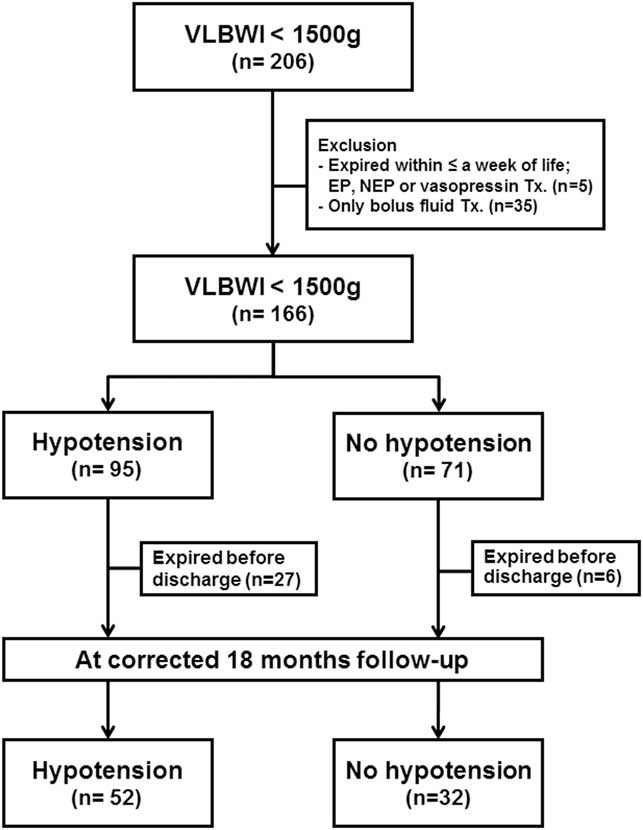
To assess hypotension, blood pressure was measured directly with a transducer connected to an indwelling umbilical arterial catheter or noninvasively using oscillometric measurements. We defined systemic hypotension in very low birth weight infants as a mean blood pressure below the 3rd percentile for gestational ageReference Zubrow, Hulman, Kushner and Falkner 7 or below 30 mmHg 8 with decreased urine output (<1 ml/kg/hour) for >12 hours. For very low birth weight infants who failed to maintain an adequate mean blood pressure with decreased urine output, fluid boluses – isotonic saline at a dose of 10 ml/kg per bolus – were given initially and could be repeated twice. Those who responded with only fluid boluses were not considered as having systemic hypotension at⩽1 week of life and excluded. In addition, those who expired within a week of life were excluded from this study (Fig 1).
Nomogram of the study. VLBWI=very low birth weight infants; Tx=treatment.

If the fluid boluses were unsuccessful in maintaining targeted mean blood pressure, they were diagnosed with systemic hypotension at⩽1 week of life in this study. As an inotropic treatment, dopamine infusion was added. Dopamine infusions were started at a rate of 5 μg/kg/min and increased by 2.5 μg/kg/min until an adequate mean blood pressure – above the hypotensive range – was achieved. If 10 μg/kg/min dopamine failed to maintain an adequate mean blood pressure, dobutamine (10 μg/kg/min) was added.Reference Zubrow, Hulman, Kushner and Falkner 7 If dopamine failed, hydrocortisone at a dose of 5 mg/kg/day IV, divided into three doses at 8-hour intervals, was added. Accordingly, patients with hypotension within 1 week of life treated with either inotropic therapy only or inotropics and a steroid were included in this study. Once patients maintained an adequate mean blood pressure with increased urine output, the inotropes were decreased at the same rate that they had been increased, and then hydrocortisone was tapered. Patients with hypotension that resulted in culture-positive infection, pneumothorax, massive pulmonary haemorrhage, and/or necrotising enterocolitis were excluded from this study. Idiopathic hypotension that had no identifiable cause other than prematurity was studied in relation to clinical outcomes. This study was approved by the Ethics Committee of Seoul St. Mary’s Hospital, The Catholic University of Seoul, Korea.
Definitions
Systemic hypotension in very low birth weight infant was defined as a mean blood pressure below the 3rd percentile for gestational ageReference Zubrow, Hulman, Kushner and Falkner 7 or below 30 mmHg 8 with decreased urine output (<1 ml/kg/hour) for >12 hours. Pulmonary hypertension is defined by the need for nitric oxide or sildenafil or iloprost treatment within 1 week of life. Infants were diagnosed with BPD if they required oxygen use exceeding 0.21% at a corrected gestational age of 36 weeks, at hospital discharge for those born before 32 weeks of gestational age, or at a postnatal age of 28–56 days for those born after 32 weeks of gestational age. Using Bell’s classification, necrotising enterocolitis was defined as grade II or higher. On the basis of the classification criteria for intraventricular haemorrhage established by Papile and Levene, a grade greater than grade II was defined as active bleeding in the ventricles. Retinopathy of prematurity was defined as neovascular tufts found posterior to the ridge, and the classified determinations of higher than stage 3 were made according to the International Classification of Diseases for retinopathy of prematurity. At the corrected age of 18 months, patients were considered at risk if scores were >2 SDs below the test mean (scores of <70). The abnormal neurodevelopmental outcome was defined when scores of <70 in the areas of cognitive, language, or motor were found. The composite outcome was defined as death or abnormal neurodevelopmental outcome (scores of <70).
Statistical analysis
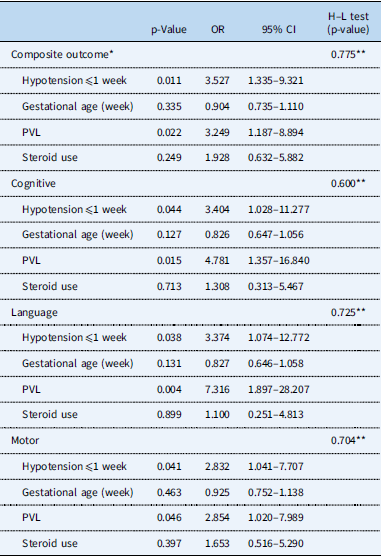
Continuous variables were compared using Student’s t-test and are expressed as the means±standard deviations. Discrete variables were compared using a χ2 test or Fisher’s exact test and are expressed as percentages. All of the analyses were two-tailed, and clinical significance was defined as a p-value lower than 0.05. To assess any confounding factors in relation to neurodevelopmental outcomes, we used a multivariate logistic regression analysis to identify any variables. Odds ratios and 95% confidence intervals were calculated using a multivariate statistical model that included the following variables related to neurodevelopmental outcomes in very low birth weight infants: hypotension⩽1 week, gestational age, periventricular leukomalacia, and steroid use. Hosmer–Lemeshow goodness of fit test for interpretation of the model was performed as noted in Table 3. All statistical analyses were performed with the Statistical Package for the Social Sciences (SPSS), version 15.0 (SPSS-PC, Inc., Chicago, Illinois, United States of America).
Results
Demographic data
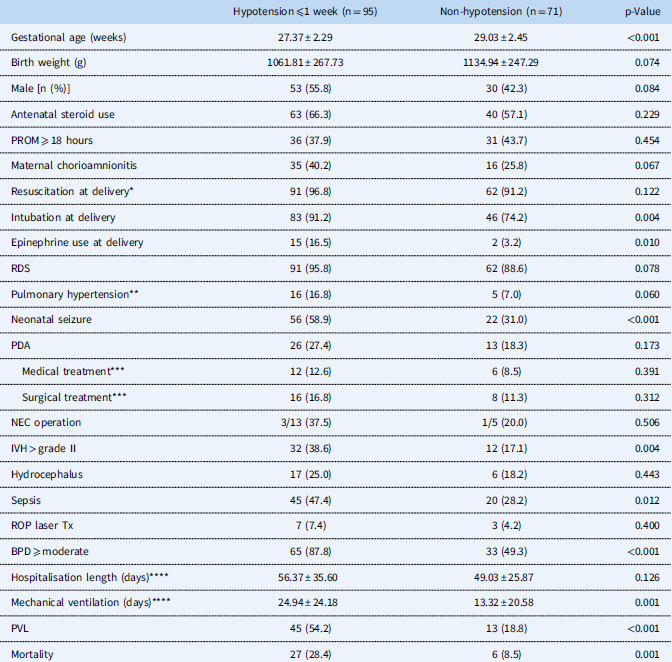
Between July 1, 2013 and October 1, 2015, a total of 206 very low birth weight infants were admitted to our neonatal ICU at Seoul St. Mary’s Hospital (Fig 1). Of the 166 very low birth weight infants, 95 (57.2%) were diagnosed with hypotension at ⩽1 week in the neonatal ICU of Seoul St. Mary’s Hospital, The Catholic University of Korea (Fig 1). The mean gestational age was significantly lower in the hypotensive group. In addition, intubation and epinephrine use at delivery, and seizures, were significantly associated with hypotension at ⩽1 week (p<0.05) (Table 1). In terms of morbidities, hypotension ⩽1 week was significantly related to intraventricular haemorrhage>grade II, sepsis, BPD⩾moderate, longer mechanical ventilation duration periventricular leukomalacia, and increased mortality (p<0.05) (Table 1).
Clinical characteristics of very low birth weight infants (n=166); hypotension versus non-hypotension group

IVH=intraventricular haemorrhage; NEC=necrotising enterocolitis; PDA=patent ductus arteriosus; PROM=premature rupture of membrane; PVL=periventricular leukomalacia; RDS=respiratory distress syndrome; ROP=retinopathy of prematurity; Tx=treatment
* Resuscitation included oxygen use or positive pressure ventilation
** Use of nitric oxide, sildenafil, or iloprost within 1 week of birth
*** Described as multiple answer
**** Patients who died before discharge were excluded
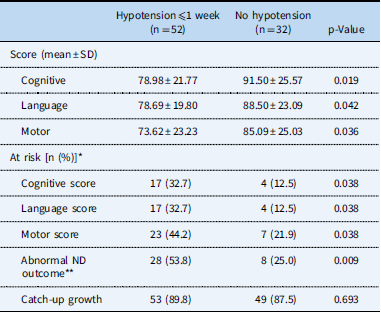
At the corrected age of 18 months, 33 patients died before discharge. Of the surviving very low birth weight infants, 84/133 (63.1%) returned for follow-up evaluations (Fig 1). They completed the cognitive, language, and motor components of the Bayley Scales of Infant and Toddler Development III. Those in the hypotension group had significantly lower composite scores for all three areas – cognitive, language, and motor – of Bayley Scales of Infant and Toddler Development III (Table 2). In addition, the hypotension group had a significantly higher prevalence of children at high risk, defined as a score>2 SDs below the test mean (scores of <70). However, there was little evidence of differences in catch-up growth (Table 2).
Outcomes of surviving very low birth weight infant (VLBWI) on Bayley Scales of Infant and Toddler Development III at 18 months (n=84)

ND=neurodevelopmental
* Children were considered to be at risk if their scores were >2 SD below the test mean (scores of <70)
** Abnormal ND outcome (scores of <70) of cognitive, language, or motor area
To explore the influence of any possible confounding factors on long-term neurodevelopmental outcomes, we performed a multivariable logistic regression analysis to identify any confounding factors related to the cognitive, language, and motor composite scores on the Bayley Scales of Infant and Toddler Development III. In this analysis, we included gestational age, epinephrine use at delivery, mechanical ventilation, periventricular leukomalacia, and steroid use. In addition to hypotension at ⩽1 week, longer mechanical ventilation and periventricular leukomalacia were consistently associated with worse cognitive and language outcomes (Table 3).
Risks for neurodevelopmental outcomes in multiple logistic regression analysis: effects on long-term outcome (adjusted for hypotension⩽1 week, gestational age, epinephrine use at delivery, mechanical ventilation, periventricular leukomalacia (PVL), and steroid use)

OR=odds ratio; CI=confidence intervals
* Death or abnormal neurodevelopmental outcome (scores of <70)
** H–L test: Hosmer–Lemeshow goodness of fit test (p>0.05)
Discussion
Hypotension is a common problem for very low birth weight infants in neonatal ICUs and may be regarded as an indicator of circulatory collapse and organ dysfunction. Kuint et alReference Kuint, Barak, Morag and Maayan-Metzger 9 reported that 66% of very low birth weight infants are treated for hypotension. Similarly, our study showed that 57.2% of very low birth weight infants were treated for hypotension at ⩽1 week of life. In our study, the hypotension was significantly related to unstable clinical factors such as resuscitation needed at delivery (Table 1). Some clinical factors may attribute to hypotension at ⩽1 week of life other than idiopathic hypotension originating from prematurity itself, but, consequently, very low birth weight infants who experienced hypotension requiring inotropics and steroid treatment had worse short- and long-term outcomes. These infants treated for systemic hypotension, a marker for haemodynamic instabilities, were more associated with adverse clinical morbidities, including intraventricular haemorrhage>grade II, sepsis, BPD⩾moderate, longer mechanical ventilation, periventricular leukomalacia, and mortality (Table 1). Other studies have similarly reported that these infants treated for hypotension developed periventricular leukomalacia and they were less likely to survive.Reference Fanaroff, Wilson-Costello, Newman, Montpetite and Fanaroff 6 , Reference Synnes, Chien, Peliowski, Baboolal and Lee 10 In addition to this finding, Faust et alReference Faust, Hartel and Preuss 11 also showed that hypotension in very low birth weight infant within the first 24 hours of life may increase the incidence of BPD and a higher rate of death. The studies by Kuint et alReference Kuint, Barak, Morag and Maayan-Metzger 9 and Mizoguchi et alReference Mizoguchi, Chu, Murphy, Willits and Morse 12 additionally demonstrated that hypotension at ⩽24 hours of life increased the risk for PDA and the development of threshold retinopathy of prematurity, which was not apparent in our study. Moreover, hypotension has been identified as a predictor of inflammatory states, such as infection, necrotising enterocolitis, or following neonatal surgeries.Reference McNamara, Stewart, Shivananda, Stephens and Sehgal 13
As described in our study, very low birth weight infants with hypotension at ⩽1 week of life showed poorer outcomes because they were initially sicker patients. This group required more delivery room resuscitation, and were started with a more complicated clinical course.
Regarding long-term neurodevelopmental outcomes, Batton et alReference Batton, Zhu and Fanaroff 14 described a higher rate of poor neurodevelopmental outcomes, in addition to increased short-term complications, in infants with low blood pressure, regardless of treatment in a case–control study. Fanaroff et al also reported poorer neurodevelopmental outcomesReference Fanaroff and Fanaroff 15 for these patients. Our study similarly observed that very low birth weight infants diagnosed with hypotension at ⩽1 week of life were significantly associated with worse neurodevelopmental outcomes. The association of systemic hypotension and poor neurodevelopment may have been related to cerebral under-perfusion, which may or may not have been clinically recognised. Low superior caval vein flow, a possible indicator of low cerebral blood flow, was reported to be associated with poor neurodevelopmental outcome.Reference Hunt, Evans, Rieger and Kluckow 16 Additional studies have supported that low blood pressure is correlated with poor cerebral blood flow.Reference Tyszczuk, Meek, Elwell and Wyatt 17
Many preterm infants are unable to mount an appropriate cortisol response under stressful conditions.Reference Hingre, Gross, Hingre, Mayes and Richman 18 This is especially a factor in preterm infants before 27 weeks, who are reported to have lower serum cortisol levels compared with adults.Reference Scott and Watterberg 19 Our study also manifested that very low birth weight infants experiencing more hypotension ⩽1 week of life had significantly lower gestational age (27.37±2.29 versus 29.03±2.45). Although some infants develop hypotension secondary to maladaptation of a sudden change in loading conditions, it is possible that in more premature infants a relative adrenal insufficiency may play a more dominant role. Low serum cortisol levels and an association with adverse outcomes have highlighted the relative adrenal insufficiency in some sick preterm infants.Reference Huysman, Hokken-Koelega, De Ridder and Sauer 20 – Reference Watterberg, Scott, Backstrom, Gifford and Cook 21 As a result of this condition, vasopressor-resistant hypotension that is responsive to hydrocortisone can be commonly seen in more sick preterm and neonatal babies.Reference Helbock, Insoft and Conte 22 – Reference Ng, Lee and Bnur 23 Hypotension that cannot be managed only by inotropics but requires further steroid use, either as an anti-inflammatory or to elevate cortisol response under stressful conditions, may suggest additional worse clinical conditions that can result in worse hospital outcomes, such as the longer mechanical ventilation and higher mortality shown in our study (Table 2). The underlying disadvantages associated with more prematurely born infants who also experienced more chorioamnionitis might additionally result in worse neurodevelopmental outcomes in the hypotension group who received more steroids. Accordingly, hypotension within 1 week of life suggests that close follow-up for long-term neurodevelopmental outcomes is necessary for very low birth weight infants. Some limitations of our study are as follows: the retrospective study design, which may not be the proper way to confirm the examined relationships; the relatively small sample size of the study groups, which reduces this study’s power; and the complex clinical conditions and co-morbidities may result hypotension other than originating from the condition of prematurity itself may act as confounding variables in this study. Hypotension within 1 week of life was associated with other morbidities and increased mortality. Our results suggest that hypotension ⩽1 week in very low birth weight infants may increase the risk for poor neurodevelopmental outcomes. Prematurity-related risks may also be considered as risk factors for poor neurodevelopmental outcomes.
Acknowledgements
There are no further acknowledgements to note. Authors’ Contribution: Y.A.Y. wrote the first draft of the manuscript. T.H.K. and Y.A.Y. reviewed all clinical data. T.H.K. and Y.A.Y. designed the study and wrote the initial draft. All authors critically reviewed the article and agreed to its publication.
Financial Support
This research received no specific grant from any funding agency, commercial or not-for-profit sectors.
Conflicts of Interest
None.