Introduction
Many triage algorithms and medical devices have been developed specifically for conventional field trauma and mass-casualty incidents (MCIs).Reference Cone and Koenig 1 Far fewer have been developed specifically for a chemical, biological/emerging infectious disease, radiological, or nuclear (CBRN) MCI. The uniqueness of triage in a CBRN event is mostly because symptoms are affected by the agent involved, as well as by the route and amount of exposure. Medical devices previously developed for conventional triage may need to adapt to monitor and reflect the patient status of casualties within a CBRN event accurately. Fundamentally, triage in a CBRN event requires a drastic change to patient care delivery. 2 Instead of treating casualties on a first-come, first-serve model, triage sorts through those that are the most severely injured and those who have a critical need. 2 The most commonly used conventional triage algorithm by first responders in the field within the United States is the Simple Triage and Rapid Treatment (START) algorithm.Reference Ramesh and Kumar 3 The START algorithm was developed in 1983 by the Newport Beach Fire Department and Hoag Hospital (California USA) after staff noted inefficient triage at a school bus crash exercise.Reference Cone and Koenig 1 , Reference Hogan and Burstein 4 The START algorithm aims to triage and transport the patients with the most severe and treatable injury first. This is accomplished by evaluation of the ability to walk, respiratory status, perfusion/capillary refill, and mental status. Casualties are then classified as minimal/ambulatory (green), immediate (red), delayed (yellow), and expectant (black). Another conventional method is the Sort, Assess, Lifesaving Interventions, Treatment/Transport (SALT) triage algorithm, developed specifically for use in an MCI.Reference Hogan and Burstein 4
In addition to the challenges often seen in conventional triage, the involvement of bulky personal protective equipment, antidotes, and decontamination can further complicate the CBRN triage process. Consequently, medical device technology can have a major role in simplifying CBRN triage by assisting medical personnel to appropriately resource acute care in CBRN disaster scenarios. This is of the utmost importance, given the anticipated large number of potential casualties in a CBRN disaster, which would overwhelm multiple first responder and hospital systems. Triage technologies could lead to optimizing response assets for a CBRN MCI, raising the prehospital standard of care, and improving overall patient outcomes in the field. This report outlines CBRN medical device development for disaster response and public health communities, as well as their potential technological roadblocks and pathways forward.
Report
Recent Advances in Triage Technology
In recent years, medical devices designed for CBRN triage have been developed. The most current technological advancement is the rapid development of mobile medical applications. Mobile medical applications, also called “medical apps,” are a form of mobile technologies that assist in decision support and can be acquired easily by anyone with a smartphone. Industry estimates suggest approximately 500 million smartphone users worldwide will be using a health care application by 2015, as well as 50% of all smartphone and tablet users will have downloaded a mobile health application by 2018. 5 Even with the ease and quickness of mobile medical application development, there remains a lack of CBRN-specific applications.
Decision Support Tools
Helpful technology for use during a CBRN MCI are decision support systems that provide predefined algorithms for standard triage application and patient monitoring.Reference Case, Morrison and Vuylsteke 6 Given the limited exposure and minimal training of first responders to most CBRN events, these decision support systems can assist with identifying CBRN agents in the field. A decision support system, such as the Wireless Information System for Emergency Responders tool, assists the first responder in how to identify and understand the necessary safety precautions and treatments for specific agents. 7 An existing CBRN-specific decision support tool is the Radiation Emergency Medical Management (REMM) mobile application, which provides health care providers guidance on diagnosing and treating radiation injuries. 8 It includes scene management algorithms, a radiation dose estimator, START and JumpSTART (the pediatric version of START) triage algorithms, and radiation reference information. 8 Another decision support tool developed specifically for an aerosol chemical exposure, Chemical Hazards Emergency Medical Management Intelligent Syndromes Tool (CHEMM-IST), assists the user in predicting the chemical toxic syndrome involved through supporting information on variable clinical skin and inhalational toxic symptom manifestations. 9
Mobile Medical Applications
Mobile medical applications, such as the Phoenix Hazard Training CBRN application, provide a guide designed for worldwide media personnel who may find themselves part of a CBRN event in another country. 10 Some of the topics covered include instructing the user on how to check oneself for radiation and how to calculate radiation dose. Studies have shown that radiation dose received is the most reliable indicator of patient outcome for radiological triage.Reference Marx, Hockberger, Walls, Adams and Rosen 11 Another CBRN mobile medical application is the CBRN Survival Guide. It offers first aid advice for victims of CBRN events as well as reference information. 12 These protocols and decision support tools for a wide range of CBRN incidents can be accessible from mobile and PC devices, allowing personnel to follow specific guidelines that may be critical for CBRN events.Reference Williamson 13
Agent Identification and Diagnostic Devices
Identification/diagnostic devices have also been developed for use in a CBRN incident. The ability to identify the agent involved is one of the most important steps in prehospital triage in a CBRN event. These devices can materialize in the form of a deployed laboratory analytical system, such as Joint Biological Agent Identification System, which can identify biological warfare agents reliably within three hours. 14 Once the agent has been identified, the need to identify exposed casualties and dosages received is critical for triage and treatment. For radiological incidents, biodosimetry tools can measure the dose of ionizing radiation within human tissue.Reference Garty, Chen and Turner 15 The “gold standard” for determining dose is currently the Dicentric chromosome assay, in which a cytogeneticist can score a blood sample in as little as 20 minutes.Reference Sullivan, Prasanna and Grace 16 Newer biodosimetry methods include using gene expression, protein and metabolic biomarkers, as well as optically stimulated luminescence of tooth enamel as methods to determine radiation exposure.Reference Sullivan, Prasanna and Grace 16 Current biodosimetry tools can take this measure through a simple finger prick and provide rapid results in the field.Reference Garty, Chen and Turner 15 Accurately identifying the agent and amount of exposure a casualty has received provides a strong basic foundation for first responders with regards to the pathophysiology of the agent as well as disaster scene management.
Smart Physiological Monitoring Devices
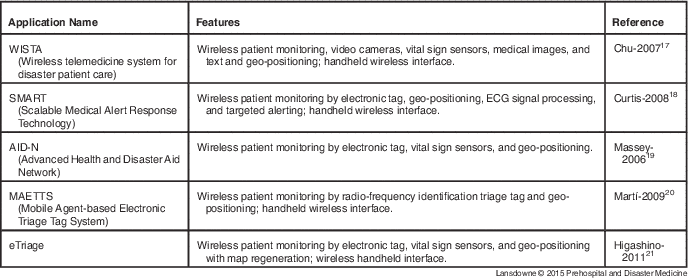
Further technological advances include smart monitoring devices that conduct continuous patient monitoring through medical devices known as mobile triage tags and/or electronic triage tags (Table 1).Reference Chu and Ganz 17 , Reference Curtis, Pino and Bailey 18 Currently, during an MCI, casualties are assessed according to conventional triage algorithms, such as START or SALT, and labeled with a paper triage tag according to their level of severity. Patients are then reassessed periodically and retagged thereafter. Continuous patient monitoring is an important factor in a CBRN event to be able to recognize latency effects and patient deterioration over time. Various types of mobile triage tags have been proposed recently. The basic feature is the electronic storage of patient data and triage information; however, depending on the technological capabilities of the devices and embedded software, mobile triage tags can also assist in disaster scene management by making casualty data and location available to a central monitoring station and assisting in allocating resources at the scene appropriately.Reference Massey, Gao, Welsh, Sharp and Sarrafzadeh 19 Some mobile tags can readily alert of patient deterioration, allow limited medical personnel to monitor larger numbers of patients, and improve the flow of information when a patient is transferred from the disaster scene to a hospital.Reference Martí, Robles and Martín-Campillo 20 This especially is critical during a chemical event when the latency effects and unknown exposure to agents could provide varying symptom onset and result in the rapid deterioration of casualties in the field or hospital.Reference Cone and Koenig 1 In addition to monitoring standard patient vital signs wirelessly, these smart monitoring devices currently are being developed to conduct patient tracking and to reconstruct entire infrastructures in the case of radiological/nuclear disasters.Reference Higashino, Uchiyama and Yasumoto 21
Devices to Track and Monitor Patients at a Disaster Scene

Abbreviation: ECG, electrocardiogram.
Discussion
Current Triage Technologies
Current CBRN-specific triage algorithms vary, and depend on event, size, and severity. Some use the conventional START or SALT triage methods as a foundation, with modifications for the unique challenges of a CBRN event, including: assessment for a toxidrome; accounting for biological events having no “initial scene;” varying symptom onset; additional decontamination procedures; defining a role for antidotes; and identification of agent, agent dose, and route.Reference Cone and Koenig 1 - Reference Ramesh and Kumar 3 Current triage technology has not addressed all of these unique challenges. Simultaneous triage and treatment is one of the biggest on-going problems in patient care during a CBRN event. Treatments during a chemical and/or biological disaster include antidotes/vaccines that can prevent, slow, or completely reverse the effects of an agent. But when to administer these antidotes during prehospital triage has yet to be defined in all cases.Reference Cone and Koenig 1 For example, myeloid cytokines are recommended by REMM to prevent and/or treat neutropenia after radiation/nuclear exposure by stimulating white cell count. 22 Currently, 2 Gy of ionizing radiation is the dose threshold recommended by REMM for administering supplies of myeloid cytokines, due to radiation doses above 2 Gy having a higher likelihood of the casualty suffering from acute radiation syndrome. 22 , 23 Medical disaster response requiring concurrent triage and treatment may benefit from decision support systems that guide less-trained personnel through triage and administration of treatment. Studies have shown improved patient outcomes when using decision support systems as an adjunct.Reference Salinas, Nguyen and Darrah 24 During a CBRN event, physiological symptoms and symptom onset can vary; therefore, use of mobile medical applications and identification/diagnostic tools could lead to more efficient triage due to the rapid agent identification and accessibility of information in the field. Another challenge includes certain CBRN decontamination procedures involving bulky personal protective equipment that has to be worn by first responders in the field. This equipment can confound patient assessment. The use of mobile triage tags could aid first responders in monitoring and tracking patients wirelessly, as described in a comprehensive review of such devices by Case et al.Reference Case, Morrison and Vuylsteke 6
Roadblocks and Pathways
Potential roadblocks of implementing these devices and algorithms include: high costs associated with planning for extremely rare events; decision support algorithm validation; training personnel with varying skill levels on protocols; cybersecurity concerns; government and health information privacy regulation; human factors of decision support systems; and compatibility of hospital resources and smart monitoring devices for central monitoring. Despite these roadblocks, there are pathways for future advances in triage technology in a CBRN event. Further research and development is being conducted to provide comprehensive studies regarding the effectiveness of current devices in a CBRN MCI. Studies have shown modest increases in triage performance using smart physiological monitoring devices.Reference Case, Morrison and Vuylsteke 6 Since 2010, the US Food and Drug Administration (Silver Spring, Maryland USA) has committed to regulatory science in accumulating scientific knowledge regarding the safety and efficacy for evaluating devices anticipated to be used in CBRN events.Reference Scully, Forrest, Galeotti, Schwartz and Strauss 25 A paradigm for advancing technology is that it should be well funded and run parallel with policy and procedure development in order to keep pace and remain current.
Conclusion
When a CBRN incident occurs, the results can be devastating and can be a true public health disaster. Novel triage technologies have been developed to assess, categorize, and monitor patients rapidly in a MCI. However, little development has been achieved in creating triage technologies specific to CBRN incidents that could augment the training received by first responders. Those devices developed for use in a CBRN incident focus heavily on identifying the agent, triaging the casualties, dosage calculation, and managing the patients based on availability of resources and severity. Advancing CBRN triage technologies requires further research and validation within prehospital settings.