

Introduction
Early nutrition is important in all young animals, as it influences their future gut health, digestive efficiency and performance. In addition, young mammals, such as calves, need to transition from a milk based diet onto a grass and grain feed. The weaning process can cause digestive upsets and reduce feed intake and growth during this period. At weaning age of six weeks onwards, calves need to have a suitably developed rumen to be able to digest the forage-based diets they will be ingesting. To achieve this, a cereal-based creep feed and straw is typically offered to them alongside their milk to make such a transition more gradual, with fewer upsets and better rumen development.
There have been numerous publications reporting improvements in performance and health in cattle fed live yeast preparations (Yoon and Stern, Reference Yoon and Stern1995; Chaucheyras-Durand, Reference Chaucheyras-Durand, Walker and Bach2008; Guedes et al., Reference Guedes, Goncalves, Rodrigues and Dias-da-Silva2008), especially regarding Saccharomyces cerevisciae strains. Rumen specific live yeast ingredients, such as Levucell SC™ (Lallemand Animal Nutrition, Hamilton, New Zealand), can be added to the creep feed to aid weaning transition. Levucell SC™ is a rumen specific yeast containing the live yeast Saccharomyces cerevisciae CNCM I-1077 and was developed and is maintained as part of the culture collection at the Pasteur Institute and was selected from a screening process run at INRA in order to maintain correct rumen pH, fibre digestion and rumen development in young animals.
Previous research with Levucell SC™ has shown increases in calf weights at weaning and significantly higher creep feed consumption (Galvao et al., Reference Galvao, Santos, Coscioni, Villasenor and Sischo2005). Detailed work on the impact of Levucell SC™ on rumen development reported higher cellulytic bacterial and ciliate protozoa establishment in lambs (Chaucheyras-Durand and Fonty, Reference Chaucheyras-Durand and Fonty2001). In adult animals, research conducted by Guedes et al. (Reference Guedes, Goncalves, Rodrigues and Dias-da-Silva2008) and Dias da Silva et al. (Reference Dias da Silva, Guedes, Gomes, Loureiro, Brizida, Mena and Lourenco2010) showed increases in NDF and total tract digestibility in a variety of forages and total mixed rations. Therefore the following trial was conducted to determine the effect of feeding a rumen specific live yeast (Levucell SC™) on feed intakes and body weights of calves at weaning.
Materials and Methods
Sixty male Friesian cross dairy calves were obtained from local farms under the same management structure in the Manawatu region of New Zealand. They were randomly allocated to one of six large enclosed pens (4 × 4 m, allowing 1.6 m2 per calf and therefore exceeding NZ welfare requirements), within a metal framed shed. Pens had rubber matted floors and were bedded with clean wood shavings. Three pens were then randomly assigned to the control diet (no Levucell SC™ in starter feed) and three pens to the treatment diet (starter feed containing 400 g/t Levucell SC™, each gram supplying 10 × 109 CFU live yeast giving a total of 4 × 10⁹ CFU/kg feed). The mean body weight for the control group was 40.52 kg and for the treatment group was 40.11 kg (P = 0.7543).
The calves all received colostrum on farm prior to transport to the trial site. Once on site, from four days of age, a commercial CMR (NRM Power Whey, NRM Ltd, New Zealand) was mixed at a rate of 125 g/l in water, with 2 l given per calf via a MilkBar™ Calfeteria automated feeding system twice daily for the first eight days. From day nine, calves each received 500 g in 2.5 l per day in a single morning feed. All pens were equipped with a hanging meal trough, with plastic curtains to prevent birds from consuming the meal (MilkBar™ Ltd, NZ). Calves had free access to a commercial, 20% protein starter feed (Denver Stockfeeds, Palmerston North, NZ) during the indoor phase of the trial (day one to day 42 of the trial) and water was available ad libitum via a trough in each pen. Additionally they were given access to clean barley straw via a haynet in each pen.
During the indoor rearing phase calves were individually weighed on arrival and then weekly. Starter feed and straw consumption was weighed back to measure disappearance which was recorded daily per pen and used to calculate average daily feed intake (ADFI). Any scours or CMR intake issues were monitored and recorded for individual calves. Smaller calves or those not immediately drinking from the calfeteria during the first two days on the trial site were hand fed from CMR bottles to ensure correct consumption. By day three of the trial, all calves were drinking CMR from the calfeterias.
On day 42 of the trial (calves aged 46 d), remaining calves (n = 22 per treatment) were individually weighed and turned out into two paddocks (one control group, one Levucell SC™ supplemented group) of identical size, pasture type (mixed sward fescue, non-endophyte rye, timothy and cocksfoot) and fertiliser history. They had free access to automatic water troughs and ad libitum access to a 16% protein starter diet (Denver Stockfeeds, Palmerston North, NZ) fed via lidded troughs (MilkBar™ NZ Ltd) to prevent water ingress and bird access.
All calves were individually weighed weekly, and daily feed consumption by weigh back of feed offered in troughs, was recorded for both groups. From weekly weight gains, ADG was calculated. Data was collated and analysed using the GLM procedure of Unistat (Unistat Ltd., UK Release 5.5). Confidence limits of 5% were used to denote statistical significance, and P values of less than 0.1 were considered to indicate a trend in the data. The trial protocol was approved by the Kaiawhina Animal Ethics Committee, Palmerston North, New Zealand.
Results
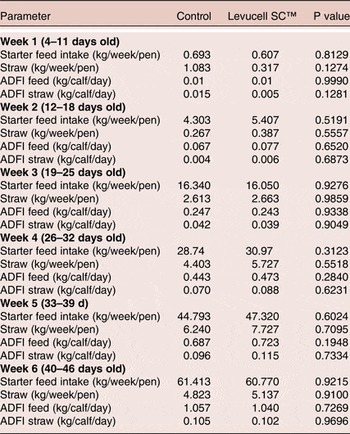
Overall mortality was 6.7%, which was due to scours at the start of the trial. The feed intakes during the indoor phase of the trial (d1 to d42) are shown in Table 1. There were no differences between the control or treatment groups for starter feed or straw intake during the indoor phase when calves received CMR (P > 0.05). Additionally there were no differences (P > 0.05) between the two diets in the CMR feeding period of the trial. At weeks four and five, the calves fed the Levucell SC™ diet had higher numeric ADFI compared to controls, although this was reversed at a lower magnitude at week six and these differences were not significant (P > 0.05).
Weekly and daily feed and straw intakes for indoor housed male dairy calves aged 4–46 d fed either a control diet or diet supplemented with Levucell SC™

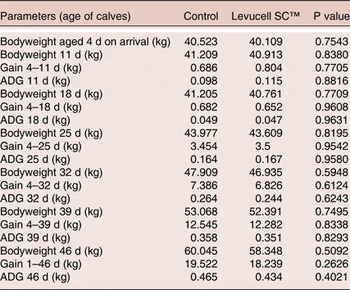
Table 2 shows the bodyweights of calves during the indoor phase of the trial. Calves that died or were culled earlier in the trial were weighed and recorded within the dataset. There were no differences (P > 0.05) between the control or Levucell SC™ fed calves in bodyweight, gains or average daily gains during the indoor phase of the trial.
Bodyweights, gains and average daily gains for indoor housed male dairy calves aged 4–46 d fed either a control diet or diet supplemented with Levucell SC™

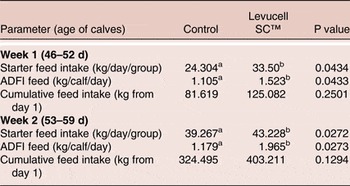
The feed intakes for the outdoor (weaning) phase of the trial are shown below in Table 3. Over the weaning period, where calves were moved outside for free access to grazing and with ad libitum access to starter feed, the calves consumed the Levucell SC™ diet in higher quantities (38% higher, P = 0.0434 for the first week of weaning, and 66% higher P = 0.0272 for the second week) compared to the control, and had corresponding higher ADFI.
Feed intakes for outdoor grazed male dairy calves post weaning aged 46–59 d fed either a control diet or diet supplemented with Levucell SC™

a,b means not sharing a letter differ significantly (P < 0.05).
On day 43 of the trial (calves aged 47 d), the first day they were turned out, the control group only consumed 8.9 kg of starter feed, whereas the Levucell SC™ group consumed 24.9 kg. This showed that the treatment group had no drop off in intake, whereas a clear reduction compared to the 46 day intakes in the control group was seen.
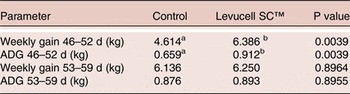
Table 4 below shows the bodyweights, gains and ADG for the calves during the outdoor period of the trial (d46-59). Bodyweight data for the outdoor phase of the calf rearing trial showed that the maintenance of the feed intake during the weaning period seen in the calves fed diets containing Levucell SC™ resulted in significant increases in weekly gain and weekly ADG in the first week of the outdoor phase (aged days 46–52). The second week showed a non-significant numeric increase in growth for the Levucell SC™ calves. This can be related to the significant increase in feed intake seen during this period, whereby the ADG for the control calves was arrested immediately after weaning, and didn't increase to the same level, whereas the ADG of the Levucell SC™ group increased during the first week of weaning.
Bodyweights, gains and average daily gains for weaned, outdoor housed male dairy calves aged 46–59 d fed either a control diet or diet supplemented with Levucell SC™

a,b means not sharing a letter differ significantly (P < 0.05).
Discussion
Although no significant differences were observed between the control and Levucell SC™ fed calves during the indoor phase, at weaning, when they were turned out to pasture with starter feed access, the Levucell SC™ group had increasing levels of daily feed intake, i.e. they carried on the trajectory of intake seen in the preceding weeks. The control group, however, showed a marked reduction in intake during this important adjustment period. The finding that calf feed intakes were reduced at weaning when the calves had CMR removed from their diet and are put out for grazing may be due to the development of the rumen. Levucell SC, along with similar yeast based products, are known to improve rumen development and function, which has an impact on calf growth performance (Lesmeister et al., Reference Lesmeister, Heinrichs and Gabler2004; Kmet et al., Reference Kmet, Flint and Wallace1993). Poor rumen function in calves at weaning could lead to issues with reductions in feed intake and consequent growth (Denev et al., Reference Denev, Peeva, Radulova, Stancheva, Staykova, Beev, Todorova and Tchobanova2007) and can be a time when digestive disorders become apparent, as the animals adapt to a milk-free diet.
As a result of the increases in daily feed intake, increases in weekly weight gains were seen for the Levucell SC™ fed calves during the first two weeks of the weaned (outdoor phase) of the trial, which were significant in the first week post weaning. These increases in feed intake and weight gains in calves fed Levucell SC™ are in agreement with the findings of Galvao et al. (Reference Galvao, Santos, Coscioni, Villasenor and Sischo2005). Such improvements indicated that rumen function and development may be more advanced in the Levucell SC™ fed calves, allowing better access to energy from the diet and improved utilisation of pasture. This would be in line with the findings of Guedes et al. (Reference Guedes, Goncalves, Rodrigues and Dias-da-Silva2008; 2010), who reported higher fibre digestion in cattle fed live yeast.
Conclusions
In commercial terms, maintaining starter feed intakes in calves at weaning is important in ensuring calves growth performance, and can indicate better rumen development, which is important in dairy cattle as they mature. For calf rearers, getting the animals over the weaning period without performance losses is important in terms of the value of the weanlings when selling on. This trial demonstrated how calves can falter in both intakes and consequential weight gain during the first week after weaning. Feeding Levucell SC™ prevented this intake reduction, leading to improved body weight during the weaning phase, which can be attributed to better rumen functionality at this important time of development, as reported in other published trials. The correct early functioning of the rumen can have long term benefits, including feed utilisation, milk production and reduced N excretion in urine, hence such improvements at weaning could be important in future feed utilisation and milk production.
Acknowledgements
This trial was funded by Lallemand Nutrition NZ Ltd, New Zealand with additional grant funding supplied by Calloghan Innovation, New Zealand.
Declaration of interest
A. Turney and A. Clay are employees of Lallemand Animal Nutrition NZ.