Introduction
As the population ages the number of people with dementia is rising and in line with this there is an increase in the number of family and paid carers. Family carers of people with dementia are at a high risk of psychological morbidity (Cooper et al., Reference Cooper, Katona, Orrell and Livingston2006), and it is suggested that this may also be the case for paid carers (Cocco et al., Reference Cocco, Gatti, Lima and Camus2003).
Staff working in long-term care settings face many challenges in their day-to-day work (Zimmerman et al., Reference Zimmerman, Williams, Reed, Boustani, Preisser, Heck and Sloane2005). Caring for people with dementia professionally has been described as emotionally and physically draining (Morgan et al., Reference Morgan, Semchuk, Stewart and D'Arcy2002) with high physical and psychological workloads (Fjelltun et al., Reference Fjelltun, Henriksen, Norberg, Gilje and Normann2009). Intense involvement with residents has been identified as a stressor which can lead to staff burnout (Maslach and Jackson, Reference Maslach and Jackson1981). Workplace stress in long term care homes may be associated with psychological stress in staff and impaired provision of care for the residents (von Dras et al., Reference von Dras, Flittner, Malcore and Pouliot2009). An increase in staff stress and burnout levels has been related specifically to higher levels of resident aggression in nursing homes (Brodaty et al., Reference Brodaty, Draper and Low2003), an increase in staff control over the residents in day care facilities (Lyman, Reference Lyman1989), and a lower level of interaction with residents in residential homes (Jenkins and Allen, Reference Jenkins and Allen1998).
Care homes have historically had difficulty recruiting and retaining staff (Dunn et al., Reference Dunn, Rout, Carson and Ritter1994), and job stress has previously been linked to high-turnover amongst long-term care staff (Schaefer and Moos, Reference Schaefer and Moos1996), hospital nurses (Chui et al., Reference Chui, Chung, Wu and Ho2009) and nurses in general (Larrabee et al., Reference Larrabee2010). Given the high numbers of dementia residents in care homes this systematic review aims to establish the prevalence of psychological stress and level of symptoms in staff caring for people with dementia in residential settings. This will allow an assessment of whether an intervention aimed at improving staff morale could prove useful.
Methods
Search strategy
We conducted a literature search using the MEDLINE (1950–), PsycINFO (1872–) and Web of Science (1945–) databases up to May 2009, with search terms encompassing nursing staff, residential care and psychological distress. Our search terms were: care, nursing, residential, old age, part III/three/3, elderly mentally ill/EMI, 24 hour care or old people's homes, combined with staff, carers, workers, care workers, nurses, nursing assistants, employees or health care assistants, combined with burden, burnout, stress, distress, anxiety, depression and strain.
We subsequently searched the reference lists of included papers that were identified from the databases.
Inclusion criteria
1. Primary research studies
2. Quantitative studies
3. Studies reporting:
a. psychological distress
b. staff directly caring for people with dementia
c. staff working in 24-hour, long-term care setting.
Exclusion criteria
1. Qualitative research
2. Case studies
3. Meeting and dissertation abstracts
4. Papers not published in English
5. Studies in which it was not evident that the entire sample was caring for at least one resident with dementia (e.g. those in generic/non-dementia-specific homes that did not purposively select care staff who were responsible for people with dementia).
Data extraction
We extracted data from all studies, and then evaluated the papers against standardized criteria adapted from Boyle's guidelines (Boyle, Reference Boyle1998). Two authors (CP, KS), blind to each other's assessments, rated the papers and any discrepancies were resolved by discussing with a third author (GL).
Each paper was rated according to criteria in the following standardized checklist, with one point being given if the criteria was fulfilled and a total was calculated:
(1) Was the target population clearly defined by clear inclusion and exclusion criteria?
(2) Was probability sampling used to identify potential respondents (or the whole population approached)?
(3) Did characteristics of respondents match the target population, i.e. was the response rate ≥ 80% or appropriate analysis included comparing responders and non-responders?
(4) Were data collection methods standardized?
(5) Was the burnout/distress measure reliable? (If the original measure was valid but it was translated or adapted without reliability of changed measure being reported, we allocated 0.5 points.)
(6) Was the burnout/distress measure valid? (If the original measure was valid but it was translated or adapted without validity of changed measure being reported, we allocated 0.5 points.)
(7) Were features of sampling accounted for in the analysis, through appropriate weighting of the data, or the whole population approached?
(8) Did the reports include confidence intervals for statistical estimates or, if not, did they provide sufficient data to allow for confidence intervals to be calculated? We calculated 95% confidence intervals (CIs) for the prevalence and/or mean values of distress where the authors had not done so, but had provided sufficient other data for CIs to be calculated.
Results
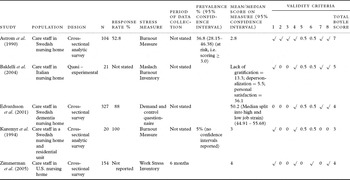
We identified 601 references in our search, of which 93 were selected by two authors (CP and KS) as appearing to meet our inclusion criteria based on titles. For the 93 remaining studies all the abstracts were read and if not excluded at this stage the whole paper was obtained. Eighty-eight papers were not included; 44 were not in long-term care settings; 37 had samples that included staff who were not caring for at least one person with dementia; six had no quantitative measure of staff stress and one was not primary research. Five studies were therefore ultimately included and their study characteristics and validity scores are shown in Table 1.
Design and Boyle Score of included studies

Studies reporting the prevalence of staff distress
Two studies reported the prevalence of staff distress, using the Burnout Measure (Astrom et al., Reference Astrom, Nilsson, Norberg and Winblad1990; Kuremyr et al., Reference Kuremyr, Kihlgren, Norberg, Astrom and Karlsson1994). The Burnout Measure (BM) generates a score ranging from 1 to 7 and has been validated using a cut-off point of ≥4 to signify caseness (Pines and Aronsson, Reference Pines and Aronsson1988; Schaufeli et al., Reference Schaufeli, Bakker, Hoogduin, Schaap and Kladler2001). These studies use a different, non-validated cut-off point (≥3.0) to mean “at risk of burnout” (Schaufeli et al., Reference Schaufeli, Enzmann, Girault, Schaufeli, Maslach and Marek1993). Both studies utilized Swedish translations without validation.
The first interviewed 104 nurses and nursing aides in a Swedish nursing home. Of these, 36.8% were “at risk” of developing burnout (Astrom et al., Reference Astrom, Nilsson, Norberg and Winblad1990). It had a low response rate of 52.8%. The second very small study interviewed 10 nurses in a nursing home and 10 staff in a collective living unit in Sweden twice with a one-year interval (Kuremyr et al., Reference Kuremyr, Kihlgren, Norberg, Astrom and Karlsson1994). There was a month-long training intervention for half of the sample immediately prior to the first measurement. One person (5%) was “at-risk” of burnout but the authors did not indicate at which time period.
The third study (Edvardsson et al., Reference Edvardsson, Sandman, Nay and Karlsson2009) used the Demand and Control Questionnaire (Karasek and Theorell, Reference Karasek and Theorell1990) without defining caseness, but instead dichotomized respondents as experiencing high or low job strain using the median score. They did not report this score so we cannot compare it to the population norm. They found that those with higher strain had less education and were likely to be younger and report less opportunity to discuss difficult issues at work.
Studies reporting mean values on measures of staff distress
Four studies reported a mean score on a measure of staff distress (Baldelli et al., Reference Baldelli, Fabbo, Costopulos, Carbone, Gatti and Zucchi2004; Astrom et al., Reference Astrom, Nilsson, Norberg and Winblad1990; Kuremyr et al., Reference Kuremyr, Kihlgren, Norberg, Astrom and Karlsson1994; Zimmerman et al., Reference Zimmerman, Williams, Reed, Boustani, Preisser, Heck and Sloane2005). Of these, one was an interventional study which evaluated the effects on staff burnout of a therapeutic program for residents in a nursing home in Italy (Baldelli et al., Reference Baldelli, Fabbo, Costopulos, Carbone, Gatti and Zucchi2004). The study used the Maslach Burnout Inventory (MBI) (Maslach and Jackson, Reference Maslach and Jackson1981), but the authors used different terms for the three MBI indices to those in the referenced paper (Lee and Ashforth, Reference Lee and Ashforth1990). We assume that personal satisfaction and lack of gratification are equivalent respectively to personal accomplishment and emotional exhaustion. Staff burnout levels at baseline were: lack of gratification 13.3 (low ≤ 17); depersonalization 5.5 (moderate ≤ 5); and personal satisfaction 36.1 (moderate 34–39).
The next two employed the Burnout Measure and reported mean scores of 2.0 at time 1, and 2.3 at time 2, and of 2.8 respectively (Kuremyr et al., Reference Kuremyr, Kihlgren, Norberg, Astrom and Karlsson1994; Astrom et al., Reference Astrom, Nilsson, Norberg and Winblad1990). The final study administered the Work Stress inventory (WSI) (Schaefer and Moos, Reference Schaefer and Moos1996) in 45 different long-term nursing staff care facilities to 154 staff in the U.S.A. (Zimmerman et al., Reference Zimmerman, Williams, Reed, Boustani, Preisser, Heck and Sloane2005). The WSI assesses six types of work stressors within three major domains: relationship, task and system stressors. They calculate the mean score on each subscale from a possible score of 1 to 5 (1 is never and 5 is high) and then a total mean score by adding the scales and dividing by 6; reporting a mean score of 1.8.
Discussion
We found only five studies that reported either the prevalence or the level of psychological stress specifically in staff working with dementia residents. These either reported small samples or used instruments with unsatisfactory psychometric properties for the purposes used in the study.
Two studies reported the prevalence of staff distress. Their results differed in the prevalence of staff “at risk” of developing burnout (36.8% versus 5%) but both suggest that most staff do not suffer burnout (Astrom et al., Reference Astrom, Nilsson, Norberg and Winblad1990; Kuremyr et al., Reference Kuremyr, Kihlgren, Norberg, Astrom and Karlsson1994).
Similarly, three of the studies reporting mean stress scores all reported low burnout scores or work stress scores (Astrom et al., Reference Astrom, Nilsson, Norberg and Winblad1990; Kuremyr et al., Reference Kuremyr, Kihlgren, Norberg, Astrom and Karlsson1994; Zimmerman et al., Reference Zimmerman, Williams, Reed, Boustani, Preisser, Heck and Sloane2005). A fourth study found that that the staff did not report an absence of gratification but there was a moderate degree of depersonalization (Baldelli et al., Reference Baldelli, Fabbo, Costopulos, Carbone, Gatti and Zucchi2004).
Our findings are limited by the paucity of high quality studies. Only one considered whether the non-responders differed from the responders (Astrom et al., Reference Astrom, Nilsson, Norberg and Winblad1990) and there may be systematic bias in the staff choosing to participate. Staff suffering from burnout could be more inclined to participate in such a study or might avoid it. Those most stressed are likely to leave or be on sick leave.
It is not possible to draw conclusive comments as to the prevalence or extent of burnout in staff caring for residents with dementia at this stage. This preliminary evidence would suggest that staff have lower symptoms of psychological stress than family carers (Mahoney et al., Reference Mahoney, Regan, Katona and Livingston2005) but this may be because most staff who remain working in homes are not as likely to suffer from psychological stress as those who leave.
Lower levels of stress might be expected as staff are trained, work controlled hours and, unlike family carers of people with dementia, are not isolated or looking after people whom they have known and cared about when well. It is interesting, however, that compared to people working in other jobs the staff working with people with dementia report relatively high morale. For example, 80% of one sample of nurses working in critical units (oncology, hematology, brim care, infectious diseases and intensive care) reported medium to high levels of emotional exhaustion on the MBI (Agoub et al., Reference Agoub, Elyazaji and Battas2000). Another paper reports recent findings that prevalence of burnout is high among critical care staff with 50% of critical care physicians and one-third of critical care nurses reporting severe burnout syndrome measured with the MBI (Embriaco et al., Reference Embriaco, Papazian, Kentish-Barnes, Pochard and Azoulay2007). A third study considers burnout in AIDS care nursing, and reports that 66% of their sample scored as moderate or high burnout cases on the emotional exhaustion and personal accomplishment subscales of the MBI (Hayter, Reference Hayter1999). Hayter (Reference Hayter1999) reasons that links between close involvement of staff with patients, death of patients, stigma and discrimination could explain the high levels of burnout in AIDS care. It would seem reasonable that these links also exist in dementia care yet staff working within long-term care settings report relatively low levels of burnout.
We conclude that the evidence is weak but that existing evidence suggests that staff working in 24-hour care settings for people with dementia do not have a high prevalence of psychological stress or level of symptoms. Better studies are needed to show this conclusively and it would be helpful if these were prospective studies to include the staff who may go on sick leave or resign after a short time.
Conflict of interest
None.
Description of authors’ roles
All authors formulated the research questions, designed the study, analyzed the data and wrote the paper.
Acknowledgments
CP is employed through a grant from the Kings Fund.