Children and adolescents are known to be particularly vulnerable to the effects of disasters. The traumatic experiences in the developmental phase lead to various psychiatric problems that can persist for a long period. All these may influence the current functioning of the young individuals and their future potential.
Although the psychological effects of disasters can be broad and can include a wide range of psychiatric disorders,Reference Kar 1 studies usually report posttraumatic stress and depression as these are common. There are great variations in the reported prevalence of these disorders after disasters, which probably reflect the influence of various factors such as degree of trauma, individual vulnerability, personal meaning of trauma, secondary stress, and coping strategies, including the methods of assessment used in the studies.Reference Salcioglu and Basoglu 2 , Reference Zhang, Jiang and Ho 3
Data on the prevalence of PTSD at 1 year following a natural disaster range from no syndromal PTSD after a floodReference Earls, Smith and Reich 4 to 3.8% to 6.2% after Hurricane Hugo,Reference Garrison and Weinrich 5 26.9% in adolescents,Reference Kar and Bastia 6 and 30.6% syndromal and 13.6% subsyndromal PTSD in children and adolescentsReference Kar, Mohapatra and Nayak 7 after the super cyclone in Orissa. Following the flood and landslide in Uttarkashi, India, PTSD was reported in 32.8% of students in grades 8 to 10.Reference Nisha, Kiran and Joseph 8
Studies following earthquakes also report different rates of prevalence of PTSD. For example, 1 year after the Wenchuan earthquake in China, 1.3% of high school students had PTSD symptoms,Reference Zhang, Ran and Li 9 and 28.6% of adolescents with pre-earthquake psychopathology had mild to moderate PTSD after the Northridge Earthquake.Reference Asarnow, Glynn and Pynoos 10 In Haiti, 2.5 years after the earthquake, the prevalence of PTSD and depression among children and adolescents was 36.9% and 46.2%.Reference Cenat and Derivois 11 The prevalence of PTSD among children following the 1999 Marmara earthquake at 6, 18, 36, and 60 months was 78%, 70%, 60%, and 52%, respectively.Reference Bal and Jensen 12 , Reference Kılıç, Kılıç and Yılmaz 13
Even if studies report that high percentages of child and adolescent survivors of disasters have PTSD and other psychiatric problems, only a few of those problems are recognized. PTSD in children usually remains underrecognized, and parents, teachers, and even mental health professionals underestimate both the intensity and the duration of the stress reactions in children.Reference Kar 14 , Reference Jackson 15 A study reported that in 87.2% of cases, parents and teachers did not perceive the mental ill health in children after a disaster.Reference Cohen 16 Similarly, a study conducted in India after 1 year of a natural disaster reported that parents and teachers had mental health concerns about only 7.2% of children, among whom 53.1% had PTSD.Reference Kar, Mohapatra and Nayak 7
Above factors re-emphasize the need for screening for postdisaster mental health consequences, considering the underrecognition of the disorders in spite of their considerable prevalence and that detailed clinical evaluation of a large affected population is neither possible nor warranted. In addition, screening may reveal the extent of the problems so that effective remedial interventions can be put in place.
The Nepal Earthquake
On April 25, 2015, a 7.8 magnitude earthquake struck Nepal, causing widespread destruction and loss of life. The initial earthquake was followed by multiple aftershocks and another powerful quake on May 12 measuring 7.3 in magnitude. The earthquakes caused 8659 deaths (4771 female; 3887 male) and injured over 100,000 people. 17 It was estimated these earthquakes affected 8 million people, almost one-third of the population of Nepal. Out of 75 districts in the country, 14 were declared “crisis-hit” for the purpose of prioritizing rescue and relief operations, and 17 neighboring districts were partially affected. 18
Objectives
The purpose of this research was to study posttraumatic stress and depression in adolescents after the Nepal earthquake. We compared more-affected and less-affected areas and ascertained the coping strategies used by adolescents affected by the earthquake.
METHODS
This was a cross-sectional, questionnaire-based survey using self-reported scales among adolescent students attending schools.
Research Setting and Population
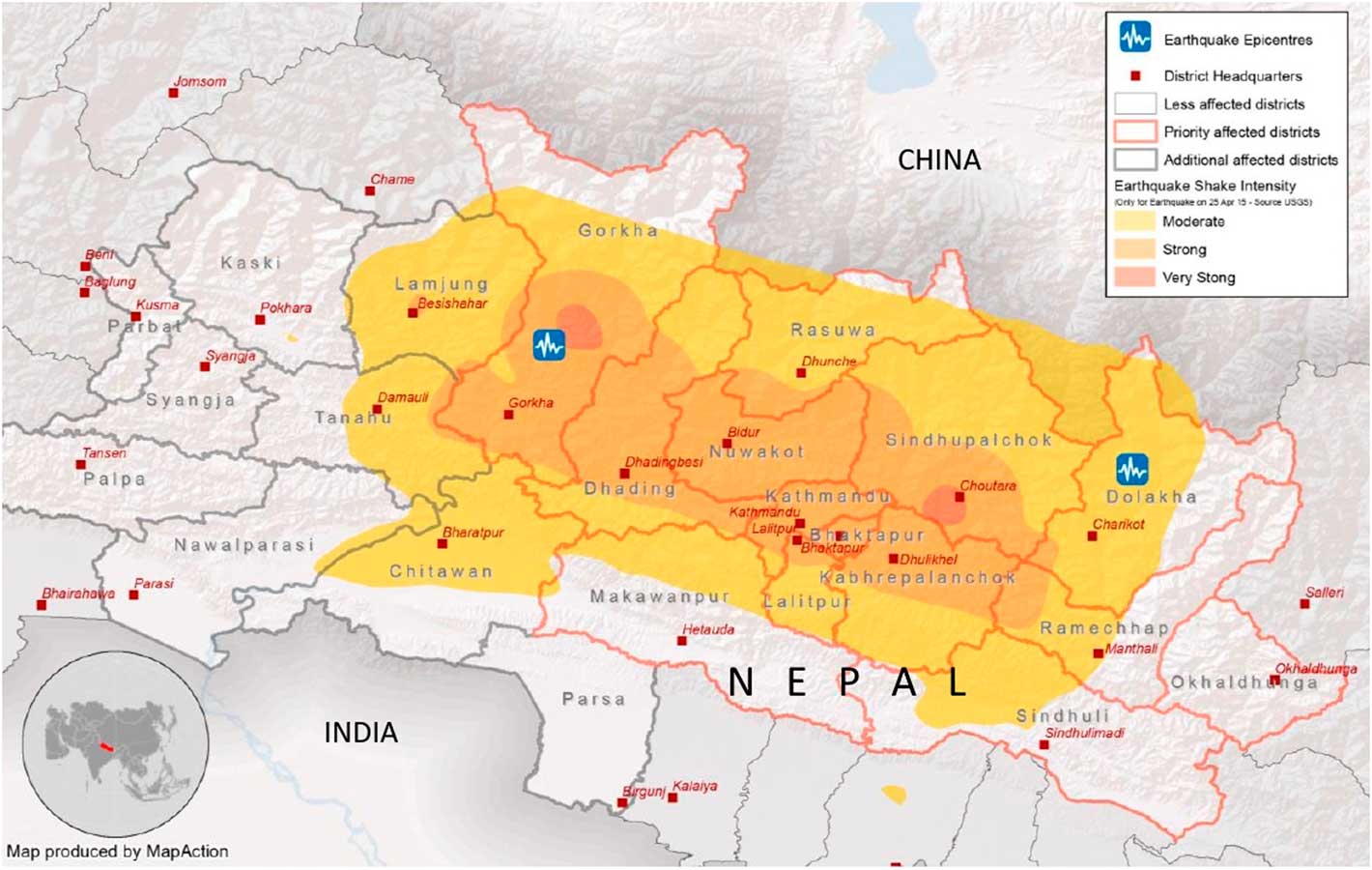
The study was conducted in the Dhading district, which was one of the 14 districts most affected by the earthquake, and in Chitwan district, which was comparatively less affected (Figure 1). Considering the information available by May 22, 2015, earthquake impact figures for the 2 districts, Dhading and Chitwan, were as follows: number of reported deaths, 732 vs 9; persons injured, 702 vs 95; houses destroyed, 43 741 vs 472; and houses damaged, 18 720 vs 754, respectively. 19
Map Showing the Epicenter of the 2015 Nepal Earthquake and the Areas Affected

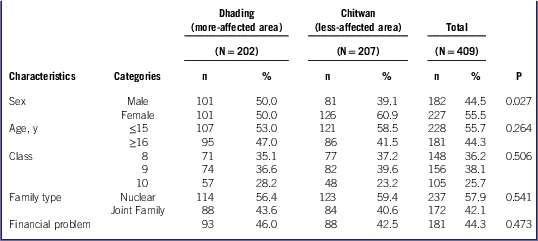
The study population was adolescents from 12 to 19 years old who studied in class 8 to 10 and attended public schools in the selected districts. In a purposive sampling 6 schools from Dhading and 4 schools from Chitwan were selected. We chose one class randomly from the class of 9 to 10 in each school and all children in that class were taken as subjects for the study. There were 207 students from Chitwan and 202 students from Dhading.
Sample Size
We calculated sample size based on the formula n=Z2 PQ/d 2, where n is the required sample size, Z is the value of the standard normal variant at the 95% level of confidence, P is the prevalence of PTSD, Q is 1 − P, and d is the allowable error (5%). Considering the PTSD prevalence of 31% in adolescents and children following a natural disaster in the neighboring country India,Reference Kar, Mohapatra and Nayak 7 it was calculated that the sample size required would be approximately 328. Assuming a 20% nonresponse rate, the total sample size for the study was estimated to be 328+66=394.
We collected sociodemographic information such as gender, age, grade in school, type of family, etc. in a form. Earthquake exposure and related experiences were assessed through a semistructured questionnaire about the intensity of the disaster, damage to the house, displacement, problems related to food, injury or death in the family, injury to self, and fear of death. We also enquired about the participants’ disaster preparedness, any support they received, and adequacy of the support in dealing with disaster trauma. We enquired about their coping strategies, such as talking to and seeking help from others, praying, helping others, engaging in activities, substance use, and just hoping for the best.
We used the Child Posttraumatic Stress Scale (CPSS)Reference Foa, Johnson and Feeny 20 the Depression Self Rating Scale (DSRS) for the assessment. Both CPSS and DSRS have been translated, adopted, and validated for use in a Nepalese context.Reference Kohrt, Jordans and Tol 21
The CPSS is a 17-item scale corresponding to the DSM-IV symptoms. The answers are on a Likert-type scale where 0 is not at all, 1 is once a week or less/once in a while, 2 is 2 to 4 times a week/half the time, and 3 is 5 or more times a week/almost always. The total possible score for the CPSS is 51 and the cutoff score for the validated version in Nepal is 20 or more, which indicates the need for intervention.Reference Kohrt, Jordans and Tol 21
The DSRS is an 18-item self-rating tool to screen for depressive symptoms and exposure to environmental stressors. The total possible score on the questionnaire is 36, with a total of 14 or more indicative of mental stress and/or disorder and the need for diagnostic follow-up and treatment.Reference Kohrt, Jordans and Tol 21
Data collection was done between February 27 and March 26, 2016, almost 1 year after the earthquake.
Ethics Approval
The research proposal was approved by the Research Committee of the Maharajgunj Nursing Campus and the Institutional Review Board of the Institute of Medicine. Formal permission was obtained from concerned schools for data collection by submitting a written request letter from the Maharajgunj Nursing Campus. Written informed consent was obtained from parents by sending a letter of permission after the classes have been randomly selected and before the data collection. The objectives and significance of the study were shared with all the adolescents. Respondents were clearly told that they have the right to ask questions and that they could withdraw from the study at any time without having to give a reason. Written informed consent was also obtained from students before the data was collected. Confidentiality was maintained and obtained data were used for research purposes only.
RESULTS
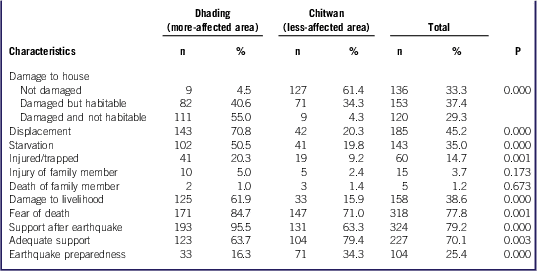
There were 202 respondents in Dhading (the more-affected area) and 207 in Chitwan (the less-affected area), with comparable mean ages of 15±1.25 and 15±1.33 years, respectively. There were comparatively more female respondents in the Chitwan sample. Details of the sociodemographic profile are given in Table 1. The disaster experience of the adolescents in the 2 areas has been summarized in Table 2.
Sample Characteristics

Disaster Experience

It was interesting to observe that 0.5% of adolescents in Dhading and 23.2% of those in Chitwan did not report any stressful events in the CPSS (P<0.001). The adolescents who did not report stress did not complete the CPSS or DSRS questionnaires. It is possible that, without a prompt or a list of events, a proportion of adolescents did not report stressful events even though they experienced them. Most reported stressful events (92.0% in Dhading and 80.5% in Chitwan) occurred within 1 year. While 73.6% of the reported stressful events were directly or indirectly related to the earthquake (85.1% in Dhading and 59.1% in Chitwan), 26.4% were unrelated (14.9% in Dhading and 40.9% in Chitwan) (P<0.001).
The CPSS results revealed that, of those respondents that identified any stress, 49.3% in Dhading and 49.1% in Chitwan had scores of 20 or more, which is suggestive of a probable PTSD diagnosis; the two areas were not significantly different in this regard. Similarly, 42.3% of the respondents in Dhading and 44.7% of those in Chitwan had a probable depression diagnosis based on a DSRS score of 14 or more.
Considering the whole sample, the proportion of adolescents who had PTSD was 49.0% (99/202) in Dhading and 37.9% (78/207) in Chitwan (P<0.05); figures for depression were 42.1% and 34.3% respectively (P=0.12). In total, 43.3% of the whole sample had probable PTSD and 38.1% had probable depression, which suggests a need for intervention.
The prevalence of probable PTSD in adolescents who reported stresses related to the earthquake was 49.4%, while among those who reported other stresses it was 48.4% (not significantly different).
The total CPSS scores in the 2 areas were 20.2±7.9 in Dhading and 19.7±9.0 in Chitwan (P=0.62), and the total DSRS scores were 12.7±4.0 and 13.8±5.3 (P<0.05), respectively. PTSD and depression scores were highly correlated (Pearson correlation, 0.487; P<0.01). The association between PTSD and depression was significant (P<0.001). According to the CPSS and DSRS cutoff scores, out of 360 adolescents 108 (30.0%) had both PTSD and depression, 135 (37.5%) had neither, 69 (19.2%) had only PTSD, and 48 (13.3%) had only depression.
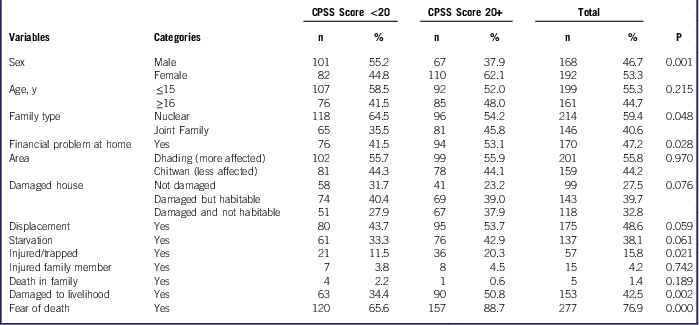
Female gender, joint (extended) family, financial problems at home, displacement, having been injured or trapped in the earthquake, damage to livelihood, and fear of death were factors significantly associated with a probable PTSD diagnosis (Table 3).
Sociodemographic Variables Associated with Probable PTSD

Abbreviation: CPSS, Child Posttraumatic Stress Scale.
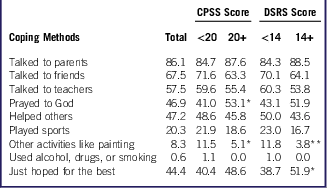
The coping strategies studied are mentioned in Table 4. While most of the coping strategies were comparable, adolescents with PTSD were significantly more likely to pray to God and less likely to engage in other activities than were adolescents without PTSD. Similarly, adolescents with depression were less likely to participate in activities and most of them just hoped for the best.
Coping Methods

*P< .05; **P< 0.01; CPSS, Child Posttraumatic Stress Scale; DSRS, Depression Self Rating Scale.
DISCUSSION
The study reported the psychological consequences of the Nepal 2015 earthquake on school-going adolescents and how the adolescents coped. The study was conducted in 2 districts around the epicenter of the earthquake. The affected areas were classified as more or less affected considering the damage and proximity to the epicenter of the earthquake; the difference in the impact is also evident from the responses of the adolescents in this study (Table 2). However, although Dhading was closer to the epicenter than Chitwan, it was still away from it.
Prevalence
The estimated prevalence of probable PTSD (43.3%) and depression (38.1%) is reflective of the severity of the stress of the earthquake. Many post–natural disaster studies reported lower and higher prevalence rates than those found in this study.Reference Kar and Bastia 6 , Reference Kar, Mohapatra and Nayak 7 , Reference Cenat and Derivois 11 - Reference Kılıç, Kılıç and Yılmaz 13 , Reference Kar 22 - Reference Ma, Liu and Hu 24 It is well known that many factors contribute to the prevalence of post-disaster morbidity, including severity of trauma, secondary traumatic experiences, and available support.Reference Kar 1 In this study, the prevalence of probable PTSD was comparable whether the stress mentioned was related to the earthquake or not. This suggests that, besides the nature of the trauma, there may be other factors that may contribute to the development of PTSD, such as the degree of trauma, the personal meaning of the trauma, vulnerability, and coping strategies.
Adolescents in this study were asked to report the most stressful event in their life in an open-ended question in the CPSS. While almost all (99.5%) of the adolescents in the Dhading district (more-affected area) reported an event, only 76.8% of the adolescents in Chitwan (less-affected area) reported so. While the Dhading adolescents more frequently reported the earthquake as the “most distressing event,” other type of stresses were reported by the adolescents in Chitwan. Irrespective of the nature of the stress, the prevalence of PTSD and depression among adolescents who reported any stress was comparable in the 2 areas. However, the difference in PTSD prevalence in the 2 areas was significant when the whole sample was considered, while the depression prevalence was comparable.
There could be other reasons for the findings in this study. More adolescents in Chitwan than in Dhading reported having preparedness for earthquakes. While the adolescents in Dhading received support, more adolescents in Dhading than in Chitwan considered the support to be inadequate. Adequate support in the postdisaster period may help to mitigate the impact of the stress.
Comorbidity
In this study, PTSD and depression were comorbid diagnoses in 30.0% of adolescents. It is well known that these 2 diagnoses have a high degree of comorbidity, and this has been reported in many postdisaster studies.Reference Kar and Bastia 6 , Reference Cenat and Derivois 11 , Reference Kolaitis, Kotsopoulos and Tsiantis 25 This may be because the common etiology of stress can lead to some degree of symptomatic overlap.Reference Gros, Price and Magruder 26
Associated Factors
The study findings suggested that female gender, displacement, injury, having been trapped in the earthquake, and fear of death have been associated with morbidity. These factors have been reported in other studies.Reference Fan, Long and Zhou 27 - Reference Zhu, Situ and Zhang 30 The sense that it may not be possible to be rescued and the fear of death are factors that have considerable influence on the outcome of the trauma. It was interesting to observe that a higher proportion of adolescents from joint families (55.5% versus 44.9% from nuclear families) had probable PTSD. Joint (extended) families appear less protective regarding the development of PTSD as a disaster outcome, but it is difficult to explain the possible reasons behind this association. Financial problems in the family and damage to livelihood bring in more secondary stresses and make the victims of disasters more prone to psychiatric morbidities.
Coping Strategies
Studying coping strategies is an important aspect of disaster management.Reference Zhang, Jiang and Ho 3 , Reference Kar 31 The study results suggested that most of the adolescents reported coping strategies to deal with this traumatic experience. Talking to others (parents, teachers, and friends) was most common; this probably involved venting and sharing the trauma. Almost half of the adolescents prayed to God, significantly more so the ones who had probable PTSD; so it did not appear to be effective. A considerable proportion of adolescents helped others and found that as a coping strategy. Altruism brings a “feel-good factor,” in addition to the sense of dealing with the traumatic situation as a challenge, which probably helps. Although a small minority of participants engaged in sports and other activities like painting, this was found to be an effective strategy—it was associated with a significantly higher proportion of adolescents being CPSS and DSRS negative. It suggests that engagement in activities in the postdisaster situations should certainly be considered and encouraged, and an early return to usual routines should be facilitated. The use of drugs or alcohol was low, reflecting the sociocultural setting. However, many adolescents just hoped for the best. Overall, the effectiveness of most of these strategies is not very clear as their frequencies were rather similar for those with or without a diagnosis.
Strengths and Limitations
The study was conducted in a representative sample of adolescents, had adequate sample size, and used validated, translated scales in the Nepali language. This study remained open about the nature of stressful life events without specifying the earthquake. This helped us to understand the variations of stress perception among the adolescents; it was interesting observe that many adolescents who experienced the earthquake and were living in the affected areas did not report any stress. While it is possible that they may not recognize and report the stress and its effects, nonetheless they may not consider the event as stressful.
There are a few limitations. The studied areas were not at the epicenter of the earthquake—the experience there might be different. The study is limited by a single source of information, i.e., on self-reporting by adolescents; the observations could have been improved with information from parents and teachers. Involvement of parents and teachers is specifically recommended. CPSS considered the most distressing event; however, the existence of multiple stressors is a possibility and it would be better to explore this aspect and its effect in future studies. There was no scope for clinical evaluation to consolidate the survey findings in this study; in disaster situations where a large population is affected, it is probably better to screen and then refer the screen-positive individuals for further clinical evaluation. Future studies should link screen findings to clinical diagnoses using changing criteria for PTSD in classificatory systems.Reference Maercker, Brewin and Bryant 32
CONCLUSIONS
The study suggested that a considerable proportion of adolescents had a probable diagnosis of PTSD and depression following the 2015 Nepal earthquake. Almost one-third of the adolescents had both of these diagnoses. Various coping strategies were used by the adolescents, however, most strategies were used at a comparable rate among the adolescents with and without diagnoses. Further studies are needed to evaluate the prevalence of these diagnoses over the time and to observe the outcome. There should be studies to assess the effectiveness of any interventions.
Acknowledgements
This research project was conducted for the Master of Nursing Program (Pediatric Nursing) thesis of Asmita Sharma, which was submitted to the Institute of Medicine, Tribhuvan University, Kathmandu, Nepal. The thesis advisor was Professor Tara Pokhrel and the co-advisor was Tumla Shrestha at Maharajgunj Nursing Campus. We thank MapAction for permission to use the map prepared by them. The project was supported in part by Quality of Life Research and Development Foundation.
Funding
This research did not receive any specific grant from funding agencies in the public, commercial, or not-for-profit sectors.