Introduction
Aquatic ecosystems near ports with frequent international shipping traffic are vulnerable to the introduction of non-native species, which can lead to ecological disruptions and changes in local biodiversity. For marine invertebrates, there are three main pathways of introduction: (I) international trade and demand for aquaculture goods accelerating the movement of species across borders (Hulme, Reference Hulme2021; Lins and Rocha, Reference Lins and Rocha2023), (II) adult specimens travel attached to ship hulls (i.e., biofouling) and dislodged at a new location or releasing gametes into the water, (III) larvae transported in ballast water and accidentally released in a new location; or a combination of these (Briski et al., Reference Briski, Ghabooli, Bailey and MacIsaac2012; Harvey et al., Reference Harvey, Hoy and Rodriguez2009).
Serpulid annelid worms are important components of biofouling communities (Bastida-Zavala et al., Reference Bastida-Zavala, McCann, Keppel and Ruiz2017). Serpulid species can rapidly colonize new hard substrates due to high environmental tolerances, high fecundity, free swimming larvae, and short generation times (Capa et al., Reference Capa, Kupriyanova, Nogueira, Bick and Tovar-Hernández2021; Kupriyanova et al., Reference Kupriyanova, Nishi, ten Hove and Rzhavsky2001). At least 30 serpulid species are facultative bioconstructors, i.e., they are able to live as solitary forms but, under certain conditions, can form reef-like structures, which provide substrate, shelter, and food for other species (Kupriyanova et al., Reference Kupriyanova, Rzhavsky, ten Hove, Purschke, Westheide and Böggemann2019; Montefalcone et al., Reference Montefalcone, Oprandi, Azzola, Morri and Bianchi2022). Among annelids, serpulids encompass the second highest number of invasive species (after Spionidae) (Alvarez-Aguilar et al., Reference Álvarez-Aguilar, Van Rensburg and Simon2022). The genus Ficopomatus Southern, 1921 comprises osmoconforming and estuarine species that are found in a wide range of salinities (Dittmann et al., Reference Dittmann, Rolston, Benger and Kupriyanova2009). Currently, the genus contains six recognized species that can occur as solitary or form aggregations (Capa et al., Reference Capa, Kupriyanova, Nogueira, Bick and Tovar-Hernández2021). Ficopomatus species occur primarily in tropical brackish waters, except for F. enigmaticus which is found in warm-temperate regions (Dittmann et al., Reference Dittmann, Rolston, Benger and Kupriyanova2009). Ficopomatus enigmaticus (Fauvel, 1923) originally described from Canal de Caen (France) is a well-known invader in estuarine systems worldwide (Dittmann et al., Reference Dittmann, Rolston, Benger and Kupriyanova2009); while F. uschakovi (Pillai, Reference Pillai1960), originally described from Panadura River (Sri Lanka), has emerged as an invader in the last two decades. The earliest record of invasion of this species in North America dates to 1997 in Pascagoula River, Mississippi (Ruiz et al., Reference Ruiz, Fofonoff, Carlton, Wonham and Hines2000).
Reports of invasive F. uschakovi in the Americas include a wide range of biogeographic provinces such as Tropical Northwestern Atlantic (Arteaga-Flórez et al., Reference Arteaga-Flórez, Fernández-Rodríguez and Londoño-Mesa2014; Bastida-Zavala et al., Reference Bastida-Zavala, McCann, Keppel and Ruiz2017; Liñero-Arana and Díaz-Díaz, Reference Liñero-Arana and Díaz-Díaz2012), North Brazil Shelf (de Assis and Christoffersen, Reference de Assis and Christoffersen2008), and the Tropical East Pacific (Bastida-Zavala and García-Madrigal, Reference BastidaZavala and García-Madrigal2012; Tovar-Hernández et al., Reference Tovar-Hernández, de León-gonzález and Kupriyanova2022). For the Americas, Arteaga et al. (Reference Arteaga-Flórez, Fernández-Rodríguez and Londoño-Mesa2014) hypothesized that F. uschakovi was initially introduced to the Caribbean from the Indo-Pacific through the Panama Canal via shipping; however, details about the initial point of introduction and the subsequent expansion in North America remain unclear (Bastida-Zavala and García-Madrigal, Reference BastidaZavala and García-Madrigal2012).
Reports on the invasion of F. uschakovi in the Americas were initially based on morphological observations. The notable morphological characters include a bulbous operculum ornamented with numerous transparent or yellow spines pointing outwards and a dorsally fused thoracic membranes. The latter is diagnostic for the species (Kupriyanova et al., Reference Kupriyanova, Rzhavsky, ten Hove, Purschke, Westheide and Böggemann2019), and is so unique that Pillai (Reference Pillai1960) used it to erect a new genus (Neopomatus), later synonymized with Ficopomatus by ten Hove and Weerdenburg (Reference ten Hove and Weerdenburg1978). However, the shape, count, size, and arrangement of the spines within the species present significant variation, either indicating a high degree of intraspecific variation or the presence of two or more unrecognized species (Kupriyanova et al., Reference Kupriyanova, Tovar-Hernández, Mejía-González, Jayachandran, Brandão and de León-gonzález2024). Tube colouration in the invasive records varied from orange, red to pink.
Kupriyanova et al. (Reference Kupriyanova, Tovar-Hernández, Mejía-González, Jayachandran, Brandão and de León-gonzález2024) analysed mitochondrial cytochrome b (cytb) sequences from Ficopomatus species (e.g., F. enigmaticus, F. macrodon, F. miamiensis, and F. cf. uschakovi) each with several representatives from Tropical America, India, Australia, and California. Their goal was to determine whether invasive F. cf. uschakovi reported from both coasts Mexico (Tovar-Hernández et al., Reference Tovar-Hernández, de León-gonzález and Kupriyanova2022) belong to the same species. Their analyses clearly grouped F. cf. uschakovi into two monophyletic clades with low intra-clade genetic variation: one clade including the Australian samples, and the other grouped all the other samples. The Australian specimens were also morphologically distinct from those forming the North American/Thailand clade by having unfused thoracic membranes (Kupriyanova et al., Reference Kupriyanova, Tovar-Hernández, Mejía-González, Jayachandran, Brandão and de León-gonzález2024). The Australian clade is currently being described as a new species (Kupriyanova, pers. comm.). Re-examination of topotypes from Sri Lanka would be necessary to determine whether the North America/Thailand clade represents the actual F. uschakovi. We here follow Kupriyanova et al. (Reference Kupriyanova, Tovar-Hernández, Mejía-González, Jayachandran, Brandão and de León-gonzález2024)’s nomenclature and refer to both genetic clades as F. cf. uschakovi.
Ficopomatus uschakovi has been previously reported in Galveston Bay (GB) (Texas, USA) on settlement panels from oligo – to mesohaline sites and low current (Bastida-Zavala et al., Reference Bastida-Zavala, McCann, Keppel and Ruiz2017; Fernandez-Rodriguez et al., Reference Fernández-Rodríguez, Jurgens and Schulze2023; Jurgens et al., Reference Jurgens, Ciesielski, Agrawal and Hubbard2022). However, our ongoing research on the spatial-temporal distribution of invasive serpulids in the same location did not detect the presence of F. cf. uschakovi from May of 2022 to May 2024 (Fernandez-Rodriguez, pers. obs.), until a recent small outbreak in summer of 2024 was observed in a private marina on the northwest side of the bay. The outbreak was recorded a few weeks after the landfall of Hurricane Beryl (with rain peak of 344 mm near Galveston) (NOAA, Reference Kupriyanova, Tovar-Hernández, Mejía-González, Jayachandran, Brandão and de León-gonzález2024), which was followed two consecutive weeks of heavy rain, reducing the salinity.
Galveston Bay, located on the southeast coast of Texas, USA, is embedded in the warm-temperate Northwest Atlantic province (Spalding et al., Reference Spalding, Fox, Allen, Davidson, Ferdaña, Finlayson, Halpern, Jorge, Lombana, Lourie, Martin, McManus, Molnar, Recchia and Robertson2007). It is a subtropical estuary that hosts three major ports: Houston, Galveston, and Texas City, with a high volume of shipping traffic year-round. GB is the seventh largest estuary in the USA, characterized by low salinity and high productivity (Texas Commission of Environmental Quality, 1993). The western side of the bay is adjacent to urban and industrialized areas of Houston (Dorado et al., Reference Dorado, Booe, Steichen, McInnes, Windham, Shepard, Lucchese, Preischel, Pinckney, Davis, Roelke and Quigg2015). Despite the potential threats of invasive species to native estuarine communities, the available information for invasive estuarine invertebrates is mainly based on presence/absence reports, while analyses of DNA sequence data supporting reports based on morphology are non-existent. Herein, we aimed to provide the first genetic characterization of F. cf. uschakovi from GB using cytb sequence data to determine pathways of invasion and population structure. Furthermore, considering that taxonomic corroboration is fundamental in bioinvasion studies, we also analysed the morphological characters of F. cf. uschakovi and compared them with those reported in nearby localities.
Materials and methods
Field collections
Specimens of F. cf. uschakovi were collected in July 2024, from 10 settlement plates in Bayland Marina, GB, Texas, USA (Figure 1). Bayland Marina is a private shipyard located in the northwest of GB, where it is subject to freshwater inflow from the San Jacinto River. The map was made using ArCGIS Pro 3.3. The shapefiles were sourced from United States Geological Survey.
Location of Bayland Marina within Galveston Bay, Texas, USA.

Settlement plates were deployed in early May of 2024, and left in the water for 12 weeks. Plates were retrieved 3 weeks after the landfall of Hurricane Beryl on July 8th of 2024 near Martagorda Bay (∼156 km west of GB). Water environmental measurements were taken at a depth of 1 m from the surface using a YSI water quality instrument (Pro2030, Yellow Springs Instruments, Yellow Springs, OH, USA). Plates were transported to the laboratory in plastic containers inside insulated coolers. In the laboratory, the taxonomic identification of specimens as belonging to F. cf. uschakovi was confirmed based on opercular morphology and the observation of fused thoracic membranes following Arteaga-Florez et al. (Reference Arteaga-Flórez, Fernández-Rodríguez and Londoño-Mesa2014), Bastida-Zavala and García-Madrigal (Reference BastidaZavala and García-Madrigal2012), and Bastida-Zavala et al. (Reference Bastida-Zavala, McCann, Keppel and Ruiz2017). Worms were immediately fixed in 95% ethanol and stored at 4°C for genetic analysis. Specimens have been deposited in the public repository Biodiversity Research and Teaching Collection of Texas A&M University, lot number TCWC-1-3898.
Cyt b amplification and analysis
DNA was extracted from the posterior end of the 10 largest worms using DNA using Quick-DNA miniprep ZYMO Research© following manufacture’s guidelines. DNA quality and quantity were checked using Nanodrop 2000c ThermoFisher Scientific and Qubit dsDNA HS Assay Kit ThermoFisher Scientific, respectively, following manufacture’s guidelines. In addition, we checked for DNA integrity using 1% agarose gel containing ethidium bromide at 65 V for 1 h and visualized with UV light.
For amplification, we used the primers CytB 424F (5ʹ-GGW TAY GTW YTW CCW TGR GGW CAR AT-3ʹ) and cobr825 (5ʹ-AAR TAY CAY TCY GGY TTR ATR TG-3ʹ) (Boore and Brown, Reference Boore and Brown2000). Amplifications were carried out in 25 μL reaction volumes containing 12.5 μL of OneTaq® 2X Master Mix with Standard Buffer (New England Biolabs), 9.5 μL water, 1.25 μL of each primer at 20 μM final concentration and 1 μL of DNA template. Thermal cycles were 95°C 1 min, then 40 cycles, 95°C 30 s, 48.6°C 30 s, 68°C 45 s, and a final extension of 68°C 5 min. Polymerase chain reaction (PCR) products were run on a 1% agarose gel containing ethidium bromide for 25 min at 100 V and visualized with UV light. PCR products were cleaned using ExoSAP-IT™ PCR Product Cleanup Reagent (ThermoFisher Scientific) following the manufacturer’s guidelines. Finally, products were quantified using Qubit™ dsDNA BR Assay Kit (ThermoFisher Scientific) following the manufacturer’s guidelines. Successfully amplified products were sequenced in both directions by GENEWIZ from Azenta Life Sciences.
Chromatograms were examined and trimmed using Geneious Prime® 2025.0.3. Sequences for each specimen were assembled into contigs and manually corrected whenever one of the matched sequences had ambiguities where the second one showed clear peaks. We obtained 375 bp of high-quality sequences for seven out of the 10 worms. Resulting sequences were verified using BLAST algorithm (Altschul et al., Reference Altschul, Gish, Miller, Myers and Lipman1990) to confirm that the correct region was amplified. New sequences were submitted to GenBank and were assigned accession numbers PV185521–PV185527. We aligned our sequences with those used in Kupriyanova et al. (Reference Kupriyanova, Tovar-Hernández, Mejía-González, Jayachandran, Brandão and de León-gonzález2024).
The final analysed dataset comprises 30 sequences including F. enigmaticus, F. macrodon, F. miamiensis, and F. cf. uschakovi. We carried out multiple sequence alignment using MUSCLE in Geneious Prime® 2025.0.3. The alignment was trimmed to 267 bp to remove overhanging ends. Phylogenetic analyses were carried out using maximum likelihood in IQ-TREE (Minh et al., Reference Minh, Schmidt, Chernomor, Schrempf, Woodhams, von Haeseler and Lanfear2020). The selected nucleotide substitution model using the Bayesian information criterion was K3Pu + F + I + G4 using W-IQ-TREE (Trifinopoulos et al., Reference Trifinopoulos, Nguyen, von Haeseler and Minh2016). Branch support was estimated using 1000 ultrafast bootstraps. The resulting tree was edited using FigTree v.1.4.5 and Adobe Illustrator v.29.3.1. A haplotype network was generated with all F. cf. uschakovi sequences from the Americas using the minimum spanning network method in PopArt v1.7 with an epsilon value of zero. More than 5% of the sites in this analysis contained undefined states and were automatically masked by the software. Genetic diversity statistics were calculated using the same software.
Results
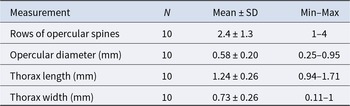
The water at the collection site presented oligohaline conditions with relatively high temperatures (Table 1). We counted 53 specimens of F. cf. uschakovi on the settlement panels. The identification of all specimens as F. cf. uschakovi was confirmed by examining the opercula and the thoracic membranes. No other annelid species was observed on the panels. The observed worms were small (<1 cm), probably juveniles based on the absence of gametes, and most of them were damaged when extracted from the tubes; therefore, complete body measurements could not be performed. A total of 10 out of 53 worms were selected for DNA sequencing. After the DNA extraction was completed, we measured the thorax and operculum of these specimens (Table 2).
Water environmental conditions in the study site

Opercular measurements Ficopomatus cf. uschakovi from GB, Texas, USA

Morphological diagnosis
Specimens on settlement plates forming early aggregations (Figure 2a). Irregularly curved calcareous tubes white with longitudinal orange stripes. Slight growth rings but absence of peristomes (Figure 2b). A few recently settled worms with tubes present (Figure 2b). Operculum spherical to slightly convex; distal plate with 1–4 rows of yellowish or colourless single spines curving outwards (Figure 2c, Table 2). Spines of interior row approximately one-half the length of spines in the other rows (Figure 2d). Peduncle smooth, inserted in the left radiolar lobe. Collar with coarsely serrated chaetae; thoracic membranes fused dorsally (Figure 2e). Thorax with collar chaetae and six thoracic chaetigers with uncini.
Ficopomatus CF. uschakovi from GB, Texas, USA: (a) Settlement plate with juvenile specimens of F. CF. uschakovi; (b) tube with orange stripes accompanied by white tube (red arrow) from recently settled worm on settlement plate; (c) radiolar crown and operculum (lateral view); (d) detail of operculum showing rows of spines; and (e) thorax (dorsal view), showing fused thoracic membranes. The red arrow shows the insertion of the opercular peduncle.

Remarks
Specimens identified here as F. cf. uschakovi were smaller than specimens reported by Bastida Zavala and García-Madrigal (Reference BastidaZavala and García-Madrigal2012), probably because our specimens were still juveniles, as indicated by the absence of gametes. Specimens did not present incomplete rows of opercular spines, or a flat operculum as observed by Bastida Zavala and García-Madrigal (Reference BastidaZavala and García-Madrigal2012) and Tovar-Hernández et al. (Reference Tovar-Hernández, de León-gonzález and Kupriyanova2022). The shapes of the spherical opercula resemble those in the figures by Bastida-Zavala et al. (Reference Bastida-Zavala, McCann, Keppel and Ruiz2017) for specimens from Corpus Christi (Texas) and the number of rows (1–4) was the same as reported by Arteaga-Flórez et al. (Reference Arteaga-Flórez, Fernández-Rodríguez and Londoño-Mesa2014). All the specimens had dorsally fused thoracic membranes which clearly distinguishes them from F. cf. uschakovi (Clade 3) from Pambula creek (Yowaka River) in Southern NSW, Australia (Styan et al., Reference Styan, McCluskey, Sun and Kupriyanova2017). Specimens from GB exhibited the same colouration and vertical orange lines described by Tovar-Hernández et al. (Reference Tovar-Hernández, de León-gonzález and Kupriyanova2022) in specimens collected from Veracruz, Mexico.
Genetic characterization
The resulting maximum likelihood phylogram (Figure 3) revealed the same four well-supported clades previously observed by Kupriyanova et al. (Reference Kupriyanova, Tovar-Hernández, Mejía-González, Jayachandran, Brandão and de León-gonzález2024), as follows: (1) F. miamiensis from Florida and Veracruz, (2) F. macrodon from India, (3) F. cf. uschakovi ‘clade 3’ from Australia (Styan et al., Reference Styan, McCluskey, Sun and Kupriyanova2017), and (4) F. cf. uschakovi from the Americas and Thailand. The GB sequences fall into the latter clade with 95% bootstrap support.
Maximum likelihood (ML) tree of Ficopomatus spp. rooted with Galeolaria caespitosa. Numbers above branches are bootstrap values from ML analysis. Only bootstrap values over 70 are shown. The F. macrodon clade from India, F. miamiensis from Veracruz, and the F. CF. uschakovi from NSW, Australia, were collapsed to simplify the figure. The number of original sequences in these clades is indicated in parentheses after the clade names. Sequences generated for this study are highlighted in blue.

The haplotype analysis was based on 11 sequences from four localities in the Americas: Florida (USA), Veracruz (Mexico), Mexican Pacific and Texas (USA), and one sequence from Thailand, which resulted in a total of five haplotypes, of which two were shared among individuals from Texas and Mexican Pacific, and from Veracruz and Florida (Figure 4). The number of polymorphic sites (S = 8), parsimony informative sites (total = 2), and nucleotide diversity (π = 0) indicate low genetic variation among the sampled individuals.
Haplotype network from Tropical America Ficopomatus cf. uschakovi samples. Numbers indicate accession numbers. The marks indicate the number of mutations separating each node. Abbreviations: mxpc, Mexican pacific; FL, Florida; TX, Texas.

Discussion
This study presents the first genetic analysis of F. cf. uschakovi in Texas and reports the first seasonal outbreak of this species in GB. The cytb sequence data strongly indicate that F. cf. uschakovi in GB belongs to the same genetic species reported by Kupriyanova et al. (Reference Kupriyanova, Tovar-Hernández, Mejía-González, Jayachandran, Brandão and de León-gonzález2024) from Florida, Thailand, and both of coasts of Mexico. The presence of shared haplotypes between Texas, the Mexican Pacific, Thailand, as well as between Veracruz and Florida and the overall low nucleotide diversity, suggests possible invasion pathways from Asia and subsequent expansion on both coasts of Central and North America. Nonetheless, the observed low genetic diversity of sequences obtained from Americas and Thailand specimens may be a result of the low overall number of available F. cf. uschakovi sequences; therefore, we highlight the importance of analysing additional sequences from other locations where F. cf uschakovi was introduced, such as Brazil, Colombia, Mexico, Venezuela, and the USA, as well as from supposedly native Indo-Pacific locations, such as Thailand, the Philippines, India, Malaysia (see Table 2 in Kupriyanova et al., Reference Kupriyanova, Tovar-Hernández, Mejía-González, Jayachandran, Brandão and de León-gonzález2024, and especially from the type locality in Sri Lanka.
All records of F. cf. uschakovi from GB were from low-salinity sites (5–10 ppt). This includes a biofouling community analysis conducted in low-gradient salinity areas by Jurgens et al. (Reference Jurgens, Ciesielski, Agrawal and Hubbard2022), where F. cf. uschakovi was consistently present but at low frequencies in Bayland Marina from 2019 to 2020. However, ongoing research on invasive serpulids in the marina did not detect F. cf. uschakovi from May 2022 to May 2024 (Fernandez-Rodriguez, pers. obs.), until the small outbreak reported here. Records of F. cf. uschakovi in low-salinity sites suggest that this species either does not tolerate higher salinities or that it cannot establish populations at higher salinities because it is outcompeted by other species, particularly by the sympatric congener Ficopomatus enigmaticus. This latter species has demonstrated a great capacity to live in a wide range of environments which gives it a significant competitive advantage in the invasive process. It colonizes natural and artificial substrates in a wide range of salinities (Dittmann et al., Reference Dittmann, Rolston, Benger and Kupriyanova2009), including GB (Fernández-Rodríguez et al., Reference Fernández-Rodríguez, Jurgens and Schulze2023), and can build massive reef-like aggregations that alter physical factors (e.g., hydrodynamic, water circulation) (Dittmann et al., Reference Dittmann, Rolston, Benger and Kupriyanova2009; Schwindt et al., Reference Schwindt, Bortolus and Iribarne2001). Specimens of F. cf. uschakovi studied here were found after an above average input of rainfall in GB, which significantly decreased the salinity (2.28 ppt) due to the San Jacinto River influx to Bayland Marina. This species has been observed at even lower salinities, for example, Arteaga et al. (Reference Arteaga-Flórez, Fernández-Rodríguez and Londoño-Mesa2014) found abundant specimens at 0.4 ppt in an estuary in the Southern Colombian Caribbean. These findings suggest low salinity as a driver for the establishment and proliferation of F. cf. uschakovi populations. Additional studies on the ecology of F. cf. uschakovi populations in GB are needed to understand the environmental drivers that trigger its outbreaks.
Morphologically, Ficopomatus cf. uschakovi from GB, TX, presented all the diagnostics features of the species as described by Pillai (Reference Pillai1960) except that they lacked the bright red colouration of the tubes. Tubes on our panels were mainly white with orange strips (Figure 2b), which differs from the red to orange background with darker orange strips and white near the mouth described by Bastida Zavala and García-Madrigal (Reference BastidaZavala and García-Madrigal2012) and Tovar-Hernández et al. (Reference Tovar-Hernández, de León-gonzález and Kupriyanova2022). A few recently settled worms with white tubes were observed (Figure 2b). In our ongoing studies on larval development and settlement of Ficopomatus spp., we have observed that it takes 4–5 weeks for the tubes of newly settled juveniles to develop colouration. These colour variations should be documented in any field surveys and complemented by more detailed morphological and genetic analysis for reliable identification. We also observed variation in the number of rows and spines on the operculum compared to previous studies in the Tropical Americas (Arteaga et al., Reference Arteaga-Flórez, Fernández-Rodríguez and Londoño-Mesa2014; Bastida Zavala and García-Madrigal, Reference BastidaZavala and García-Madrigal2012; Tovar-Hernández et al., Reference Tovar-Hernández, de León-gonzález and Kupriyanova2022). We have shown here that Ficopomatus cf. uschakovi from GB represents the same species as reported from other locations in the Americas and one locality in Thailand. Larger samples sizes from multiple locations and genome-wide sampling (e.g., ddRAD sequencing) would allow more detailed reconstruction of the species’ invasion and geographical expansion. To clarify the genetic identity of F. cf. uschakovi, the inclusion of samples from the type locality in Sri Lanka would be crucial. Additionally, further research into the ecological drivers of F. cf. uschakovi outbreaks, including the impact of salinity changes and other environmental factors in GB such as temperature and dissolved oxygen, is essential for a comprehensive understanding of its proliferation and establishment in non-native habitats.
Acknowledgements
We acknowledge the cooperation of Bayland Marina Manager’s Office and boat owners for allowing us to deploy the settlement panels. We also thank Bailey Lin, Nicolas Ledesma-Lubertino, and Jamie Brinkley (Marine Biology Department, Texas A&M University at Galveston) for their assistance with the map and fieldwork collections, respectively. Finally, we thank the anonymous reviewers whose comments helped us to improve this work.
Author contributions
V.F.R., conceptualization; funding acquisition; sampling; data acquisition, data analysis; writing; original draft preparation, review and editing. E.K., data analysis; writing and editing; A.S., data analysis; writing, review, editing and approval of the final draft.
Funding
This research was funded by the MARB mini grant (Marine Biology Department, Texas A&M University at Galveston) given to V.F.R. from 2023-2024.
Data availability statement
The data that support the findings of this study are openly available in GenBank at https://www.ncbi.nlm.nih.gov/genbank/, accession numbers are available in the manuscript text.
Competing interests
Authors declared there is no conflict of interest.
Ethical standards
The specimens used in this study were sampled under scientific research permit number SPR-0619-095 issued by Texas Parks and Wildlife Commission. No approval of research ethics committees was required. However, the authors confirm that all worms were handled according to the usual ethical standards.