At the end of an elevated highway connecting Singapore's premier arts complex to the financial district stands the statue of a hybrid creature, part mermaid (or merman: who knows?) and part lion – a ‘merlion’. This strange animal sits there unmoved, day and night, relentlessly spouting a stream of water that falls into an artificial reservoir created by damming the Singapore River. Hybrid confections such as the merlion are a dime a dozen in postcolonies such as Singapore, which has been transformed from a nineteenth-century fishing village into one of the wealthiest countries in the world (judged by per capita GDP) in the twenty-first century. The country is marked by modernization, both materially (witness the continual construction of new buildings)Footnote 1 and rhetorically (for example, in ‘The Renaissance City Report’, a government arts-policy study which features cosmopolitan discourse appropriate to the aspiration of becoming a ‘global arts city’).Footnote 2 Traditional ways of life have become liminal as wet markets give way to supermarkets and the last of the villagers move into high-rise apartments. In the midst of this barrage of cultural forces, modern and traditional, local and global, Western, non-Western and hybrid, citizens and non-citizens are collectively greeted with state articulations of what it means to be ‘Singaporean’.Footnote 3
The main musical life of the country consists of mass-media imports from America, Taiwan, Hong Kong, Bollywood, Malaysia and Indonesia, catering to the Chinese majority and the Malay and Indian minorities, as well as the non-residents who make up 40% of the population. At the periphery are traditional musics, indie rock bands, canonical Western classical music and ‘new music’, which I define as modernist, experimental and pastiche compositions in the high-art genre. New music in Singapore often partakes of hybridization with traditional musics, extending a practice already well established in the twentieth century from Debussy to Kaija Saariaho, but responding to the different cultural conditions of a globalized, non-Western milieu in the twenty-first century. In a 1985 essay on the postcolonial condition, ‘Signs Taken for Wonders’, Homi Bhabha famously articulated the duplicity within a single cultural phenomenon, namely the dissemination of the Christian Bible in British India.Footnote 4 While the Christian evangelical effort may appear to be successful, the high-volume dissemination of the Bible was really sparked by its commodity value as paper, rather than by its message. A similar duplicity can be observed in Singaporean new music, which can be understood as being affiliated either to the West or to the non-West. Ranging from Romantic tonality through pentatonicism to high dissonance, from Western orchestra to gamelan, and from musical modernism to traditional musical modes, Singaporean new music contains myriad vacillations, exhibiting the condition of postcolonial ambivalence. This condition has long been acknowledged,Footnote 5 but this article will take the unprecedented step of focusing on ambivalence at the level of the affect of hybrid Singaporean sounds (as opposed to ambivalence as applied to sociopolitical context) in connection with the global imaginary. My study is focused around a piece of intercultural new music (new music drawing on one or more non-Western musics) by the Belgian-born Singaporean citizen Robert Casteels (b. 1958) which by title alone suggests the ambivalence of global interculturalism: L’(autre) fille aux cheveux de Bali (2002), a riff on Debussy's original figure of the girl with flaxen hair and Bartók's Báli szigetén.
While ethnomusicology has amassed voluminous documentation relating to diverse musics across the world, its turn towards the musical imaginary is fairly recent.Footnote 6 As is well known, the musical imaginary has been practised in the form of Western orientalist exoticism for several centuries.Footnote 7 Exotic works are criticized for their stereotyping effects, homogenizing complex musical cultures into a few simple features, such as pentatonic ‘Chinese’ music or a uniform ‘gamelan’ (where gamelans would be reflective of localized differences within Indonesia and Malaysia). Instead of focusing on exotic works, ethnomusicology's emphasis has been on empirically based studies of music, with careful consideration of informant perspectives. However, this approach may not be suitable for the intercultural new-music genre at hand, for reasons outlined below.
While informant perspective may assist in the reconstruction of the space and place of a particular work's première, my focus is not on the reception history of intercultural new music, but on the potential of this little-heard repertoire to shed light on new ways of imagining the globe. My aim is to show that global interaction, musically imagined and affectively experienced, is ambiguous in nature. This ambiguity will emerge largely from the imagined interaction between different cultures, although there will clearly also be ambiguous alternation between the experience of the imagined homogeneity of musical culture and knowledge of real-world complexity. It is the former ambiguity which will be my focus, for the classic anti-orientalist critique of homogenizing stereotypes is increasingly becoming outmoded in relation to the Singaporean milieu, where traditional musics are now little more than museum artefacts preserved by specialized cultural organizations, and the musical imaginary is situated instead in non-Western forms of popular music which do not carry the mandate of diversity preservation sometimes imposed by ethnomusicologists. ‘Chinese’ music, for instance, is usually widely heard in Singapore only during Chinese New Year, in syncretic form with harmonic accompaniment, and is often pentatonic rather than heptatonic or chromatic, as is the case with music for Chinese solo instruments or instrumental ensemble.Footnote 8
Structurally, the relation between the musical imaginary and socio-musical practices that afford this imaginary can be compared to Arjun Appadurai's distinction between ‘global imaginary’, on the one hand, and the uneven global flows of media, ideology, finance, technology and ethnic groups which are formative for the imaginary, on the other.Footnote 9 The global imaginary refers to the ubiquitous imagining of cultures in the world. For Veit Erlmann, the global imagination has become detached from socio-economic processes driven by capitalism, which has achieved near universal penetration, and the resultant separation between artistic imagination and capitalist reality is reflected in the random hybridity of unrelated cultures in world music.Footnote 10 In this article, the West, China (or Chinese music) and Indonesia (or gamelan) are imaginary entities that are impacted by global flows (including the media flow of traditional and other musics) without being entirely congruent with them.
As I have explained, this article will proceed from the intersection of the global imaginary with musical affect, whereas the predominant thrust of studies of imagined otherness has been to focus on narratives, submitting representations of the Other, both in music and in writings about music, to serious examination. A summary of these narratives is therefore not entirely out of place. As we know, ‘orientalism’ had at one time become a ‘master’ signifier of sorts, conferring fairly fixed meanings on terms like ‘exotic’ (an imperial, representational practice) and ‘imperialism’ (global domination by the West).Footnote 11 Orientalism denotes a fundamental power inequity between the powerful, who create representations, and the powerless, who are on the receiving end of these depictions. From within the suffocating scenario where the Other is completely deprived of autonomy, however, a second version of the Other has emerged: this Other is resilient, resists power and is self-made rather than made by the Other.Footnote 12 Our second narrative of the Other carries the burden of the promise of freedom and happiness. But this weight eventually tips back into reality, for there is a third narrative of postcolonial ‘ambivalence’ (elucidated earlier), emerging from the combination of the first two. The ambivalent Other seems to be conforming to (to be ‘caused’ by) the West's preferred image of it, but in fact the Other is being duplicitous – vacillating between being a ‘good’ native and clandestinely conducting autonomous subversion.
Let us consider these narratives in relation to Robert Casteels's L’(autre) fille aux cheveux de Bali. The (Other) girl with the hair of Bali? Leaving aside the question of historical context for now, consider the representation of the Other. L’(autre) fille is a play on Debussy's famous piano piece La fille aux cheveux de lin. Between the pieces, hair changes hue from blond to Bali, and the model of origination changes from named composer (Debussy) to anonymous collectivity (tradition of ‘Bali’). A further layer of complication resides in the fiction of the titular ‘Bali’, whose imagined sonority is destabilized by the presence of mostly Javanese (and some Chinese) instruments in alternation. On the one hand, L’(autre) fille could be read as resisting the exoticizing gaze on Bali through the autonomous act of casting the gaze back onto the exoticizer: playing the music of La fille, gamelan gazes back at Debussy, who is popularly imagined, on the basis of his ‘gamelan’-infused pieces such as Pagodes, as an exoticizer. Alternatively, L’(autre) fille could be read as the mere perpetuation of exoticism, except that – instead of approaching Bali from afar – the composer has gone to the extent of recreating a (Javanese) sound that is practically like that of Bali. Is this not, from the perspective of materializing ‘local flavour’, the epitome of exoticism – an act reflecting no real comprehension or even intentional miscomprehension? In this interpretation, we see that Bali is merely a puppet on strings, whose movements are ‘caused’ by the exoticizer. Finally, there is a third narrative, featuring ambivalence arising from the persistence of exoticism – even in the form of hubris – that is inevitable in any postcolonial act of deconstructing the representational practice.
Perhaps these narratives are not going to bring us any closer to an answer regarding the ‘truth’ of the situation. Try a different approach, and actually listen to the opening of La fille on gamelan.Footnote 13 The familiar intervals of the original melody are mangled to the point of unrecognizability in the rendition, because the gamelan scale clashes microtonally with a Westernized ear's expectation of equal temperament. Whatever narrative one may desire, the body will respond in a concrete manner. The ears detect an alien factor, and the listener feels something – something that could be delight, disgust or anything in between. In this radically new situation, perceptions and feelings are unscripted, and if we pay close attention to them, the narratives we eventually articulate will be much closer to those already clandestinely formed in the mind. This is the power of affect, which is Gilles Deleuze's term for new forms of politically enabling perceptions and feelings.Footnote 14
In ‘The Autonomy of Affect’, the literary theorist Brian Massumi famously argued that affect has a different ‘logic’ from narrative–language–reason–consciousness.Footnote 15 Affect has a concrete materiality – your feelings and perceptions objectively exist and cannot be overwritten by pre-existing narratives. Whether one is delighted or disgusted at the perception of the yawning gap between Western and gamelan tonalities is a fact that conditions narrative. Exotically delighted, or delighted at Debussy's dethroning, or delighted with the gamelan? Disgusted at the gamelan, or at exoticism, or – again – at Debussy's dethroning? Or some ambivalent mixture? This is a personal question which each individual listener can answer, but I suggest that there will be mixed feelings. Affect is multivalent.
The logic of multivalent affect can be directed against pre-existing narratives, especially those that are not quite right. As we move forward from 2002, when L’(autre) fille was written, we can arguably expect ambivalence or uncertainty of intercultural contact to escalate as the global flow of often incompatible cultures and peoples intensifies and touches the most far-flung reaches of the world. I am not suggesting that there is a complete dislocation of cultural identity, but rather a determined proliferation of contradiction, conflict, disunity and fragmentation in relation to fixed identity-essences. This dialectic of determinacy and indeterminacy is perhaps the ultimate ambivalent narrative – the self in transition from coherence to incoherence, and back, and forward again. Consider ‘self’ in the moment of L’(autre) fille's opening, as you shift microtonally between different aural frames of reference: the sounded gamelan tuning versus ingrained habits of equal temperament. Did one not have to become incoherent – spaced somewhere between France and Indonesia – before coming back to oneself? Did the feeling of delight or disgust not forcibly move self to one pole or another, before the regaining of composure through sheer psychical persistence?
Casteels's L’(autre) fille aux cheveux de Bali arguably epitomizes postcolonialism by inverting La fille aux cheveux de lin. The pentatonic mode is so pervasive in Debussy's oeuvre that it is difficult to sustain the argument that ‘gamelan’ is the exoticized referent.Footnote 16 However, in Casteels's piece, an intertextual relation is established between the two imagined entities ‘Debussy’ and ‘gamelan’. L’(autre) fille begins with a statement of Debussy's La fille on a composite gamelan (of Balinese, Burmese and mainly Javanese instruments) – in a quick twist, Debussy's Westernization of the gamelan (if not in La fille, then most certainly in Pagodes) has turned into the gamelanization of the Western composer's own piano piece.
Casteels is part of a small cadre of new-music composers in Singapore, all of whom were trained in the West. Casteels himself initially intended to pursue an international conducting career, leading performances of both common-practice era and modernist music. When he arrived in 1995 to assume the position of dean of performing arts at Singapore's LaSalle School of the Arts, Casteels explained, he had reached a saturation point as far as complex modernist music was concerned.Footnote 17 It was at this time that he came into contact with the gamelan ensemble owned by the conservatoire, and also with traditional Chinese instruments found in Singapore. Casteels's compositional approach, shaped by the combined circumstance of new-music fatigue and exposure to traditional musics, is wonderfully captured in his CD liner notes for L’(autre) fille: ‘Composers play with time. Hidden in Casteels’ secret garden, Bali is the “isle joyeuse” where he dares to meet Claude-Achille and Béla.’Footnote 18 L’(autre) fille is a note-for-note translation of Debussy's La fille for Chinese string trio and Bartók's Báli szigetén for gamelan; one of the few exceptions to this instrumentation is found at the opening, where Debussy's music is played on gamelan. L’(autre) fille is constructed by fragmenting the original works into short segments, and then juxtaposing the segments in such a way that the linear ordering within each piece is preserved. In his use of pedagogical piano miniatures by canonical composers, Casteels signals a sceptical attitude towards the high-minded concept of the ‘masterpiece’, opting instead to ‘play with time’.Footnote 19 Table 1 presents a schematic chart of L’(autre) fille; Table 2 provides a list of instruments and terms it takes from traditional music.
| Casteels (bars) | Debussy (bars, on gamelan (G) or Chinese trio (C)) | Bartók (bars, always on gamelan) |
|---|---|---|
| 1–4 | 1–4 (G) | |
| 5–8 | 1–4 | |
| 9–11 | 5–7 (C) | |
| 12–13 | 8–9 (G) | |
| 14–16 | 10–12 (C) | |
| 17–23 | 5–11 | |
| 24–7 | 13–16 (C) | |
| 28–32 | 12–16 | |
| 33–7 | 17–21 (C) | |
| 38–9 | 17–18 | |
| 40 | 22 (C) | |
| 41–5 | 19–22 | |
| 46 | 23 (C) | |
| 47–9 | 23–6 | |
| 50 | 24–52 (C and G) | |
| 51–2 | Casteels's imitation of bar 25 (G) | |
| 53–9 | 252–31 (C) | |
| 60–70 | 29–39 (27–8 are absent) | |
| 71–82 | 32–9 (C) | bars 40–3 of Bartók are superimposed on bars 38–9 of Debussy |
| Instruments | Traditional music | Description |
|---|---|---|
| erhu | Chinese | high 2-string fiddle |
| zhonghu | Chinese | middle 2-string fiddle |
| dagehu | Chinese | low 2-string fiddle |
| jegog | Balinese | low-pitched mallet percussion, 8 bamboo keys |
| saron | Solonese (Java) | mallet percussion, 7 bronze keys (highest in pitch) |
| gender | Solonese (Java) | mallet percussion, 10–14 bronze keys |
| slentem | Solonese (Java) | mallet percussion, 6–7 bronze keys |
| bonang | Solonese (Java) | set of tuned bronze pots (interlocking melodic function in traditional music) |
| kenong | Solonese (Java) | set of tuned bronze pots (rhythmic function in traditional music) |
| kempul | Solonese (Java) | suspended gong tuned to a particular scale pitch |
| suwuk | Solonese (Java) | suspended gong tuned to a particular scale pitch (larger than kempul) |
| kendang | Solonese (Java) | drum |
| kecer, ceng-ceng | Solonese (Java) | small cymbals |
| mong | Burmese | suspended gong |
| gamelan terms | ||
| panerus | — | small-sized instrument |
| barung | — | medium-sized instrument |
| demung | — | large-sized instrument |
| slendro | scale with 5 pitches (anhemitonic) | |
| pelog | scale with 7 pitches (hemitonic) | |
| cipher notation | relative pitch system with numbers as notational symbols |
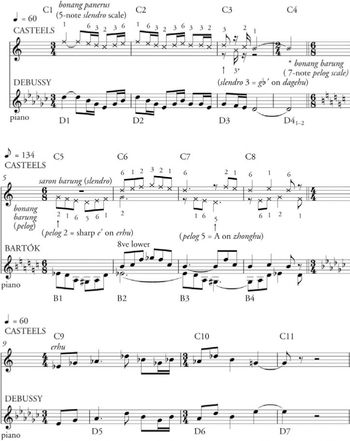
If L’(autre) fille sounds nothing like what we normally think of as new music, this is probably because of the exceptional liberties Casteels felt he could take with three relatively regimented items: the ‘Western canon’, ‘Asian’ instruments and ‘new music’. In L’(autre) fille, all of these entities are destabilized through the formation of glistening threads of new relations. Debussy's original Westernization of the gamelan through the abstraction and incorporation of the pentatonic scale into tonality is deftly inverted by Casteels's arrangement of Debussy in bars 1–4 (see Example 1; bar numbers used in this article refer to Casteels's L’(autre) fille, not the original pieces). The next fragment of Debussy's La fille (bars 9–11) is tossed to the Chinese string instrumentalists. Between the two Debussy fragments, Bartók's original incorporation of what in this context are Balinese-sounding scales (G♯–A–D–E♭ and B–C–F–G♭) into his modernist chromatic language is countered by the ‘ex-corporation’ of Bartók's Báli szigetén onto actual gamelan instruments (bars 5–8). It is as if some barrier had been broken and Indonesia now appears in the flesh, in the living, sounding body of the gamelan ensemble. Where can these curious relations be formed other than on Casteels's isle joyeuse?
Derivation of the opening (bars 1–11) of Robert Casteels's L’(autre) fille aux cheveux de Bali (C-type bars in upper stave, bars C1–11) from original piano pieces, Debussy's La fille aux cheveux de lin (D-type bars, lower stave) and Bartók's Báli szigetén (B-type bars, lower stave), performed on gamelan metallophones bonang panerus, bonang barung and saron barung, and Chinese strings erhu, zhonghu and dagehu. Numerals above or below gamelan parts refer to scale pitches.

‘I was isolated from the world, no one in my vicinity could make me lose confidence in myself or bother me, and so I had to become original.’Footnote 20 Haydn's famous words, uttered over two centuries ago, would sound equally convincing from the mouth of Casteels, who, incidentally, explicitly compares himself to Haydn on account of Singapore's distance from Western musical centres.Footnote 21 We must necessarily be a little sceptical about exactly how isolated Haydn was in his patron's estate at Esterháza, given his visits to Vienna with Prince Nikolaus I and the performance of numerous operas by over 20 other composers at the estate, including Cimarosa, Anfossi, Paisiello and Sarti. But the point of the comparison is clear. Casteels feels that he has been freed from his bonds to the Western establishment, and is answerable only to local musicians and critics in a Singaporean milieu that does not fully subscribe to Western ideologies of new music.Footnote 22 While Casteels's relative freedom from the Western cultural order is enabling as far as his creative life is concerned, it can also be viewed as a barrier to professional recognition at an international level. Non-Western new music tends to slip through the cracks between genres which suffer less acutely from identity issues, such as ‘Western classical music’, ‘Asian traditional musics’ and ‘American pop music’. But these interstitial, subcultural musics, such as the repertoire in question, give direct expression to the global condition of postcolonial ambivalence towards Western cultural power.Footnote 23
In the following sections, I will examine L’(autre) fille through the lenses of postcolonialism and affect. Musical affect is an embodied capacity – a capacity of the body – which comprises feeling and the perception of musical material. Because of the emphasis on perception, musical analysis will feature prominently in my exegesis of Casteels's work. A study of affect through ambiguous relationality between cultural identities leads to embodied narratives of the global imaginary. Embodied narrative, rather than deriving more or less exclusively from historical context in a narrative of sociocultural influence, also takes into account embodied ‘feelings’Footnote 24 and perception. The notion of ‘affect’ as the incremental modulation of feeling and perception is crucial.Footnote 25
From the perspective of musical form, L’(autre) fille is a straightforward, postmodern mash-up of two existing works, perhaps nothing more than an anti-modernist expression. Yet, as I hope I have shown already, feeling and perception of the piece are anything but obvious, and it is through its micrological or incremental change that I will articulate a politics of ambivalence that chips away at stereotype. I conclude this article by elucidating the place of affect among the scholarly trajectories of musicology.
Part one: postcolonialism
Western music in the non-West is culturally ambivalent and has escaped the scrutiny of the various subdisciplines in the academic study of music. A recent exchange with an eminent musicologist about music in China produced this response: ‘That's ethnomusicology, isn't it?’ My correspondent's opinion is borne out of particular disciplinary structures.Footnote 26 There are in fact extensive studies of the new music of East Asia by Barbara Mittler and Christian Utz.Footnote 27 In spite of their work, however, we can almost forgive a musicologist working today in the Anglo-American circuit for misrepresenting the musical world map. Mittler and Utz are, after all, only two among many musicologists, and both are based in Germany.Footnote 28 A smattering of articles on the subject of non-Western new music has appeared in journals, but almost exclusively in those with an ethnomusicological focus, including Asian Music, The World of Music and Ethnomusicology.Footnote 29 In this academic landscape, the publication of the collection of essays Locating East Asia in Western Art Music is remarkable,Footnote 30 and, aside from composer-centred monographs on Toru Takemitsu, remains singular within the world of Anglo-American academia of the last two decades.Footnote 31
In spite of recent methodological reviews in both ethnomusicology and musicology,Footnote 32 there remains a clear geographical or genre referent for each field. Musicology has expanded outward from the Western canon to include less canonical composers as well as Western popular music, but remains largely entrenched within the West. Ethnomusicology has not generally broached high-art music – the most elitist and identifiably ‘Western’ genre – and thus inadvertently retains its association with the Other.Footnote 33 As a result, two areas of music-making in the non-Western sphere fall largely by the wayside: the performance of Western classical music, and the composition of new music.
The musicology of Singaporean music illustrates this neglect of Western music in the non-West in that journal publications have focused mainly on popular and traditional music genres. Yet there have recently been significant developments in Western music in Singapore, beginning with the institution of special music programmes in high schools in the 1980s. Two official government policy papers for arts development were released in 1989 and 2000,Footnote 34 which led to the creation of the brand new Yoh Siew Toh Conservatory in 2001 and the opening in 2002 of the new premier arts complex, the iconic Esplanade – Theatres on the Bay, new home of the Singapore Symphony Orchestra.Footnote 35
The institutionalization of Western art forms in postcolonies may seem to offer nothing more than a demonstration of ‘Western impact’,Footnote 36 a scholarly paradigm that has been discredited in postcolonial circles for its purported myopia with regard to empowered social agents in the non-West. Against the former framework, Achille Mbembe famously argued that postcolonial power is decentred rather than held by the nominally powerful. In his case study of Cameroon, power is circulated through the appropriation by ordinary citizens of the lifestyle of the powerful, leading to the diffusion of the ‘aesthetics of vulgarity’ (binging, genitality and crude laughter).Footnote 37 Transposing Mbembe's insights to the global musical scenario, Western musical practices and ideologies are understood to be locally appropriated, as opposed to – or at least, in addition to – being external impositions.Footnote 38 In this interpretative framework, the institutionalization of Western music in Singapore points not to the imprint of Western ideology, but to local power. From the state's perspective, the development of the arts serves an economic purpose. According to the then minister for information and the arts George Yeo: ‘We should see the arts not as luxury or mere consumption but as investment in people and the environment […]. We […] need the arts to help us produce goods and services which are competitive in the world market […]. With taste, we will be able to produce goods and services of far greater value.’Footnote 39
Singapore's stunning economic success stems from the willingness of the political elite to play the game of global capitalism, ‘investing’ in people as a labour source for economic production.Footnote 40 The reduction of lives into production force aside, there is surely nothing wrong with choosing to act in consort with global forces if this leads to beneficial outcomes. But a story telling us only of free choice is not a complete one.Footnote 41 In the literature on world music, the genre is understood to be both an opportunity for the exercise of political or cultural agency by non-Westerners through music-making, on the one hand, and the imposition of a music industry centred on the West in terms of marketing, music ownership and corporate profits, on the other.Footnote 42 While the Westernization of Singaporean music creates symbolic and economic value, it also has the effect of inculcating generations of minds inflected towards the West. Performance and composition of Western music in the postcolony is understood through an original/copy logic which elevates the West and casts a benign but judgmental eye on non-Westerners, who are deemed to be mimicking the West; local popular music in the English language is greeted with a self-directed ‘cultural cringe’ because of the perceived inferiority of the Singaporean dialect called ‘Singlish’.Footnote 43
Anyone who audaciously uses terms such as ‘East’ and ‘West’ should retreat at some point from the general argument to explain what they mean. We all know that the ‘West’ is not an unchanging, homogeneous entity. But this assertion is true of any cultural object, however particularized. I contend that the notion of the imagined West is relevant in social milieux which seek to emulate cultural forms of which Euro-American examples constitute the epitome, either because of the historical origination or the contemporary cultivation and sponsorship of those forms: Western classical and new music, visual arts, literature in European languages, art cinema and American mass media. The milieu associated with these art forms is often referred to using such euphemistic terms as ‘global’ and ‘world class’, intimating a general attraction to that changing and heterogeneous but nevertheless existing entity known as ‘the West’. In other words, the West often appears in the disguise of discourses on globalization or universal (‘world’) standards of excellence. The Singaporean government's ‘Renaissance City Report’, which uses various forms of the root word ‘global’ 18 times and the phrase ‘world class’ five times, compares Singapore with five other cities – Melbourne, Glasgow, London, New York and Hong Kong (i.e. four Western cities and one Asian city, decolonized as recently as 1997).Footnote 44
There appears to exist a group of unchanging features which constitute the core or essence of any imagined identity. Concrete evidence of the persistence of essentialism can be found in mundane sources, such as the Singaporean census. Ostensibly, the census crafts a definition of ethnicity that is designed to allow persons of mixed racial parentage to choose an ethnic affiliation: ‘Ethnic group refers to a person's race. It is as declared by the person.’ However, the bizarre implication of this definition is that in an extreme case of constructionism, Chinese persons could theoretically declare themselves to be Indian. Thus, the operating assumption arguably must be that individuals of single-race parentage would not randomly betray their ‘true’ ethnicity.Footnote 45 In essentialism, we observe a twofold logic. First, the essence of an identity is constituted by the biology of physical appearance, or ‘race’Footnote 46 (which is why the state dares to allow Singaporeans the ‘choice’ of ethnicity), a process which has not been disrupted by discourses of anti-racism.Footnote 47 Secondly, ethnicity is essentialized by the ‘really existing’ register of biology. Given the ‘social fact’ of imaginary identities, it is imperative that they are part of any postcolonial study.Footnote 48 The process by which individuals are forced into adopting essentialized identities is what Rey Chow calls ‘coercive mimeticism’.Footnote 49
A consideration of essentialized identities can reveal the ways in which subjects conform to or deviate from a given cultural order. In this framework, a substantive difference from Western priority may emerge. Beginning with the notion of a substantive, even if self-imagined, non-Western difference, we can depart from the purportedly total permeation of Western power throughout discourse, in such a way that any non-Western entity is merely a Western invention. This latter paradigm is in accordance with Edward Said's concept of orientalism.Footnote 50 Said famously argued that Western academic discourse on the Middle East, far from representing reality, in fact conjures up an imaginary entity – the Orient – which, for the musicologist, is a figure expressed in a multitude of exotic musical pieces by composers ranging from Mozart to Cage. In order to examine agents in non-Western spheres, however, it is necessary for intercultural studies to bring itself into proximity with cases such as Singapore, departing from the status quo of focusing on composers in Western milieux. Unlike with earlier centuries, there is a strong possibility of working with non-Western art created since imperialism. From a conceptual viewpoint, the goal is to allow for the emergence of a substantive difference, as opposed to one invented by the West.Footnote 51 The following analysis of L’(autre) fille aux cheveux de Bali focuses on the ambivalent or ambiguous relationality between imagined identity-essences on the global stage, considering both substantive and invented difference.
Part two: ambiguous relationality
In L’(autre) fille, ambiguity arises from the unstable, partial and temporary hybridization of four identities – Indonesia, China, Bartók and Debussy. When hybrids emerge, old relations are disrupted while new ones are formed. I propose to analyse these relations in terms of proximity (nearness) versus aproximity (remoteness), affiliation (belonging) versus disaffiliation (not belonging) and affinity (attraction) versus disaffinity (repulsion).
(1) A/proximity
Exoticism can be described as the delicate dialectic between the proximate aesthetic representation of, for example, Bali, on the one hand, and its remote reality, on the other. This play of far and near creates yearning for the unattainable Other, as in Debussy's ‘East’, which is really the placeholder for the inaccessible girl with flaxen hair in La fille. In L’(autre) fille, the first four bars present the musical sound of the gamelan and thus render the East proximate, while the specificity of the note-for-note arrangement of Debussy's original La fille renders the West also proximate. Yet La fille appears only remotely as a carbon copy of its Western self, reproduced in slendro colouring (five-note gamelan scale). Perhaps indeterminacy is a better description of the a/proximity of cultural identities in L’(autre) fille.
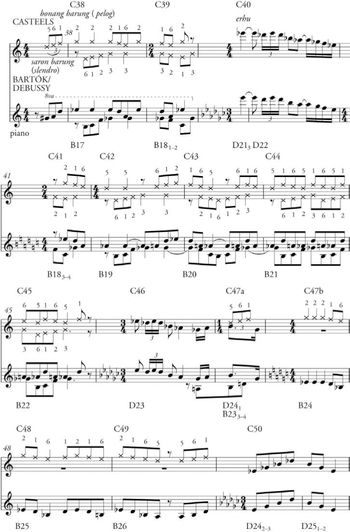
While the opening gamelanization of the originary Debussy retains both East and West in a delicate dialectic, the ‘ex-corporation’ of Bartók onto gamelan in bars 5–8 has the effect of causing him to disappear altogether, resulting in the elimination of the relation of distance in a/proximity. This is because Bartók's original piece imitates gamelan music, and contains passages which might actually have been transcribed from it (the unison section in bars 47–9 of L’(autre) fille, for example, might be heard in the explosive Balinese gong kebyar style;Footnote 52 see Example 2). A performance of Báli szigetén on the gamelan diminishes Bartók into a whisper, especially because the composer's pitches can be reproduced only inexactly on gamelan scales. In comparison, Debussy's La fille retains a quality of unassimilable otherness in its rendition both by gamelan and by Chinese string trio because its opening arpeggio figure is foreign to gamelan music (bars 1–4), while its diatonic matrix sits oddly with the pentatonic definition of ‘Chinese’ music derived from Chinese New Year songs.Footnote 53
Robert Casteels, L’(autre) fille aux cheveux de Bali, bars 38–50. Melodic material alternates between gamelan (bonang and saron) for Bartók fragments and erhu for Debussy fragments.

(2) Dis/affiliation
For a Westernized listener, the ‘East’ in Debussy's La fille is incorporated into a familiar tonal language, while Debussy in L’(autre) fille is translated into an unfamiliar gamelan scale (bars 1–4). In this respect, the Westernized listener is probably affiliated to La fille, but disaffiliated from L’(autre) fille. Conversely, the gamelan performer may be affiliated only to gamelan and not to Debussy. Interestingly, Casteels tells me that his performers are dedicatees of new music and do not participate in traditional gamelan ensembles. They are mainly Chinese players who are disaffiliated from gamelan by ethnicity but become affiliated to it through the new-music ethos of dissolving boundaries, including, apparently, that of ethnic differentiation.Footnote 54
On the level of relations ‘in’ the music, the Debussy and Bartók fragment types are disaffiliated in melodic and rhythmic content, instrumentation and musical scale. In terms of modality, the Chinese instruments are disaffiliated from Debussy's G♭ major (rarely used in music for Chinese instruments, if at all), while the gamelan instruments are disaffiliated from Bartók's chromatic pitches. This last relation turns out to be very intricate, as a close examination of the first Bartók fragment (bars 5–8) will reveal. The limited pitches of the oscillating bonang part are approximately a semitone above the original part in Báli szigetén. To derive this relation, we can begin by observing the rendition of the limit pitches on the Chinese strings in sustained notes – the mid-sized zhonghu plays an a that corresponds to pelog 5 (the lower limit) in bar 7; the smallest erhu plays a sharpened e′ that corresponds to pelog 2 (the higher limit) in bar 5. Bartók's own limit pitches are g♯ and e♭′ (see again Example 1). (The pitch correspondence between Chinese and gamelan instruments is indicated by Casteels in his score.) In a similar fashion to the bonang, and in dialogue with it, the oscillating saron part in slendro scale also approximates the original part in Báli szigetén. We know that the saron's higher limit pitch of slendro 3 (bar 6) is g♭′′, as in the original Bartók phrase, because of what we have heard in the opening Debussy fragment (bars 1–4): the largest Chinese string dagehu had entered in bar 3 with the Debussyian tonic of g♭′, coinciding pitch-wise with the simultaneously sounded slendro 3 in the bonang. Returning to the Bartók fragment (bars 5–8), we observe that despite the g♭′/slendro 3 correspondence, the saron ultimately cannot reproduce Bartók's original semitones, b–c′ and f′′–g♭′′.
Analysis of micro-relations within a mere four bars (bars 5–8) has revealed several intricacies of affiliations combined with disaffiliations: (1) although the contour of the original Bartók phrases is retained, their chromatic pitches cannot be reproduced on gamelan scales; (2) the same focal pitch g♭′ is shared by the disaffiliated Debussy and Bartók fragments, thus reflecting a pitch affiliation found in the original pieces; (3) sustained notes on Chinese strings are tuned to gamelan notes even as their timbres clash.
(3) Dis/affinity
Although the jagged juxtaposition of the Debussy and Bartók fragments suggests antagonistic interruption, the two fragment types are functionally associated. Because Casteels preserved the linear flow of La fille and Báli szigetén even while dicing and mixing them, each truncated musical fragment is linked by affinity both to the preceding and to the subsequent music from the original composition. This is especially prominent in bars 38–50 (see again Example 2), where the brevity of the one-bar Debussy interjections (bars 40, 46) from the climax of La fille escalates their attractional pull towards a future release of musical tension. Heightened affinity is also found between the Bartók segments (bars 38–9, 41–5, 47–9), which are translated from the climactic point in the original Báli szigetén. The heightened momentum of this climatic passage is further amplified by the obstruction of energetic flow through the abrupt truncation of each fragment. Thus the Debussy and Bartók fragment types are affiliated in that they both contribute to the overall linear momentum in L’(autre) fille, while being disaffiliated in identity.
From the opening kernel of both Debussy and Bartók on gamelan in bars 1–8, L’(autre) fille proceeds in large part with Bartók on gamelan and Debussy on Chinese string trio. The Chinese translation of Debussy in bars 9–11 involves several relational shifts. First, an imagined ‘China’ is newly proximate through the use of Chinese instruments, but is also rendered remote by Debussy's G♭ major. Conversely, Debussy is made indeterminate through timbral sinicization. In addition, different ideal-type listeners may be affiliated to Chinese music only, Debussy only, or both, and be unpredictably attracted to or repulsed by either of them.
As we have observed, relationality in L’(autre) fille is a shifting target. This is true at the cusp of bar 9, where Debussy's relationality has a high degree of volatility. In L’(autre) fille, none of the sonic identities are clearly orientated towards any other in a relation of pure identification (proximity, affiliation and affinity), or in a pure relation of opposition (aproximity, disaffiliation and disaffinity). Cultural relationality in L’(autre) fille is ‘ambiguous’, by which I mean that the relation is blurry and indistinct, as if a pair of aural ‘spectacles’ may be needed in order to hear clearly. I use ‘ambivalence’ to refer to an external opposition between two identities, such as the bare-knuckle opposition between Western composers and Asian instruments in L’(autre) fille. ‘Ambiguity’ refers to an internal blurriness within a relation, such as both affiliation and disaffiliation between Debussy and Bartók. Ambivalence is polarized (‘divide[d] into two sharply contrasting groups’) while ambiguity is indistinct (‘not sharp or clearly defined’).Footnote 55
In summary, there are two defining features of ambiguous relationality:
(1) Modulation. Rather than being fixed, relations change as the music progresses. Relations are always modulating. For example, the entry of the Chinese string trio in L’(autre) fille in bars 9–11 precipitates several shifts in relations involving Debussy's La fille, traditional Chinese and Indonesian musics, ‘Bali’ and the audience.
(2) Incrementalism. Three types of relations can give rise to multiple combinatorial relationalities, ranging from pure identification to pure opposition as represented in the top and bottom rows of Table 3 respectively. Each intervallic step from one pole to the other is an increment. Relations can be measured incrementally, and they certainly can modulate incrementally, even if that is clearly not always the case. The micro-register of ambiguous relations is opposed to the macro-register of pure identification or opposition, and assimilation or resistance. For example, the Debussy and Bartók fragments in L’(autre) fille are related by both affiliation and disaffiliation, and both affinity and disaffinity. Micro-relationality is revealed upon close examination of the musical affect – perception and feeling – of nearness or remoteness, familiarity or foreignness and attraction or repulsion, corresponding to the six relation types (a/proximity, dis/affiliation and dis/affinity).
| Relationality | Dis/affiliation | Dis/affinity | A/proximity | |
|---|---|---|---|---|
| 1 | Pure identification: pianist identified with Debussy | affiliation | affinity | proximity |
| 2 | Western pianist and liminal Bartók | affiliation | affinity | aproximity |
| 3 | piano student bored of Debussy | affiliation (unravelling) | disaffinity | aproximity |
| 4 | Debussy–China and Bartók–gamelan | affiliation (by global linear momentum) and disaffiliation (by identity) | disaffinity (between fragment types); cf. affinity (between same-type fragments) | proximity |
| 5 | pianist and gamelanized Debussy (split allegiance) | affiliation (to Debussy) and disaffiliation (from gamelan) | affinity (to Debussy) and disaffinity (from gamelan) | proximity |
| 6 | Debussy and his gamelanized pieces (exoticism) | disaffiliation (by prior identity) and affiliation (by new identification) | affinity (to invented gamelan) and possible disaffinity (from actual gamelan) | proximity (of invented gamelan) and aproximity (of actual gamelan music) |
| 7 | multicultural harmony | disaffiliation (by ethnicity) and affiliation (by nation) | affinity | proximity |
| 8 | pianist's indeterminate taste for gamelan | disaffiliation | affinity/disaffinity? | proximity |
| 9 | Robert Casteels's study and incorporation of gamelan | disaffiliation | affinity | proximity (of gamelanized Debussy and gamelan set) |
| 10 | conservative pianist and gamelan (reactionary response) | disaffiliation | disaffinity | proximity |
| 11 | macro view of Debussy–China and Bartók–gamelan | disaffiliation | disaffinity | proximity |
| 12 | racial conflict | disaffiliation | disaffinity | proximity |
| 13 | Pure opposition: imaginary negative stereotypes | disaffiliation | disaffinity | aproximity |
As explained, Table 3 is a representation of incremental changes in combinatorial relationality, leading from the top extreme of pure identification or perfect assimilation of self-identity with cultural order, to the bottom extreme of pure opposition to or complete rejection of a cultural order. Note that the spectrum between the two extremes is not necessarily a smooth progression from most unified to most opposed, although I have organized the rows according to the relation-type dis/affiliation, in order to evince a measure of change towards opposition as we move down the table.
The table should be read first from left to right, in such a way that a particular relationality between two entities is explained in terms of the three relation types. Identify yourself with the first term, e.g. pianist in Relationality 1, and consider whether the second term (Debussy) would belong to you (dis/affiliation); whether you would like it (dis/affinity); and your distance from it (a/proximity). While Relationality 4 has already been discussed in great detail, other relationalities have been mentioned or implied in passing. These relationalities expand beyond the music of L’(autre) fille to include consideration of composers, traditional musical genres, listeners and performers, and sociocultural forms; while the discussion in this article is focused on the piece, relationality is relevant as an affective analytic in other contexts.
In the construction of this model of relationality, I chose the three relation types as analytical terms through a process of phenomenological reflection. These relation types are experiential and can easily be grasped as narrative elements, but, as we have seen, the language of relationality translates into detailed observations regarding musical affect. Delving into relationality, we have approached the microlevel of observation, where changes are incremental. By emphasizing the role of affect in the study of L’(autre) fille, I have shown that there is a logic of ambiguous relationality that cannot be discerned from a critical analysis of the historical context.
Part three: affect and narrative
We have seen how musical affect in L’(autre) fille is ambiguous through the relatively abstract language of relationality, but ambiguity can be articulated in terms of conventional feelings, too. When a listener inhabits the flow of musical sound without conscious reflection on the unfolding of the juxtapositional form, the abrupt juxtaposition of fragment types can cause some surprises. Each interruptive alternation is experienced as a relatively unexpected, playful change. Or does the intensity of the surprise feel a little stressful? When focus is placed on anticipating the next alternation, anxiety arises because the musical elements in one fragment allow the listener only to predict how that fragment will continue, and not when the next alternation will occur. There is a high degree of net uncertainty and anticipation becomes apprehensive.Footnote 56 Surprise or anxiety arises because of differences between the fragment types, which are highlighted at each juxtaposition. At the cusp of bar 9, for instance, several changes are observed at this transitional point between the Bartók and Debussy fragments: there is the change from gamelan scales to G♭ major; the striking timbral shift from metallophones (bonang, saron) to Chinese strings; an increase in pitch definition (from gamelan metallophones to strings); a change from uniform quavers to varied rhythmic values; and a change from sparse melodic lines to three-part harmony. These increments accumulate into a macro-impression of opposition at this juncture.
The impact of the synchronized changes at each juxtaposition can be observed in the fact that certain micro-relations, which ameliorate the difference between the two fragment types, are truncated or occluded in our macro-impression of L’(autre) fille as juxtapositional. These micro-relations include: (1) Chinese instruments playing sustained gamelan pitches during Bartók fragments (e.g. bars 5–8), (2) the disaffiliated fragment types being related by the function of contributing to the overall linear momentum, and (3) both fragment types having either a direct (Bartók) or indirect (Debussy) relation with gamelan scales and the idea of Bali. Micro-relations of affiliation which could potentially have accumulated into some kind of happiness are swept away by the tide of difference.Footnote 57
Musical feeling in L’(autre) fille helps us to gain a critical perspective on narratives of imagined identity in multicultural societies. Such narratives are predominantly organized around the rhetoric of happiness, and articulated in implicit and/or explicit relations of proximity, affiliation and affinity, as in the national pledge: ‘We, the citizens of Singapore, pledge ourselves to be one united people, regardless of race, language, or religion, to build a democratic society, based on justice and equality, so as to achieve happiness, prosperity, and progress for our nation’ (emphasis added).Footnote 58 Happiness, in short, is dependent on a synthesis of multiple cultures into one national self. Now, a reading of L’(autre) fille could adopt this discursive frame and map it onto music. After taking musical feeling into account, however, it appears that the multiculturalist rhetoric of harmony is ideologically motivated by the need to occlude everyday emotions of surprise and anxiety in the encounter with otherness. Through affect, L’(autre) fille underpins the conventional scholarly understanding that multicultural societies are far from homogeneous, and are in fact best described by narratives of differentiation, ambivalence and ambiguity, rather than synthesis. The ethical course of action is to recognize and ameliorate the reality of intercultural surprise and anxiety, as opposed to the occlusion of unhappiness with happy rhetoric.
The reason why we must pay heed to surprise and anxiety is that there is a growing body of scientific research on music which proves the commonly accepted conception of emotion as irreducibly embodied, where emotion is defined as an intense bodily state that is involuntarily aroused by the perception or even memory of stimuli.Footnote 59 Emotion is embodied in that it consists in physiological arousal, which is the basis of feelings as the combination of emotional bodily states with modes of thought. But how can meaning and narrative be embodied, too? In what way can the body be said to have the capacity to ‘understand’ meaning? Narrative is not only processed rationally by the conscious mind in a referential framework. Rather, ‘truth’ is sensed tacitly before we have had the chance to evaluate a truth claim conceptually.
Having analysed L’(autre) fille affectively, we can proceed to sketch out a narrative structure in a further interpretative step. The piece is perhaps ultimately about the ambiguity of whether the primary relation in the narrative is between Malays and Chinese in an antagonistic multiracial context, or between Westerners and Asians in the self-effacing throes of ambiguous contact. Consider an alternative narrative of L’(autre) fille which takes the form of a transcontinental case of art sales, with a multicultural team of Singaporean executives operating two projects, one involving Chinese-themed art from France, the other involving Hungarian-themed art from Indonesia. I personally find this latter narrative less convincing than the previous narrative of competing relations. First of all, the blandness of feeling contributes for me to the narrative's weakness and suggests that arresting narratives are always feeling-narratives. In relation to the evaluation of the two narratives, I could rationally surmise that I chose the first narrative because musical feeling is disrupted by the specifics of plot and characters in the art sales interpretation. But this logical point was grasped only after I had tacitly decided which interpretation was more appropriate.
Grasping musical meaning tacitly is like grappling with a problem that we intuitively know how to solve before the solution (in our case, the narrative) is known.Footnote 60 Tacit meaning is grasped on a pre-conscious level, as demonstrated in recent research into brain science of the mind; neural biochemistry, it turns out, can provide a perspective on the meaning of conscious life, as embodied in ‘reward, desire, reputation, avarice, friendship, trust, [and] hunger’.Footnote 61 Why do we desire particular musics, or trust particular truths? The emergence of the meaning of life from neural circuitry lies beyond the full control of our conscious understanding and volition.Footnote 62 Tacit meaning exists because humans have a neurophysiologically embodied capacity to acquire knowledge about the world by doing and experiencing things. In other words, tacit meaning cannot exist in the hypothetical scenario where the mind exists independently without a socially situated, material body that affords us perception and feeling. Since meaning is tacitly grasped in an embodied way, we might ask if referential meaning derived from narratives or discourses (rather than affect) is thereby excluded from consideration. Are there any boundaries to meaning? I would argue that there is every reason for us to consider how tacit meaning is related to counter-intuitive postcolonial, feminist, neo-Marxist or anti-racist narratives (e.g. antagonism in L’(autre) fille versus multicultural harmony).
A final point I wish to make in relation to L’(autre) fille concerns the bivalence of pitch perception.Footnote 63 As a Western-trained listener hears the opening Debussy fragment on bonang (bars 1–4), they might spontaneously recall the original version in equal temperament on the piano and intuitively try to map the heard pitches onto Western sol-fa. However, the bonang comprises a set of gongs which produce impure tones, making pitches imprecise. More importantly, gamelan scales cannot be mapped onto equal temperament. The slendro scale of the saron in bars 5–8, for instance, comprises five roughly equidistant pitches, whereas the piano octave can be divided only into four minor thirds or six whole tones. The slendro scale is commonly said to sound like the Chinese pentatonic scale (do re mi so la), which consists of a mixture of major seconds and minor thirds that represent the nearest approximation to a five-part division of the octave. However, the instinctively attempted approximation of slendro pitches in terms of sol-fa yields predictably ambiguous results. In Example 1, slendro 2 in the saron sounds like mi in bar 6 and fa in the continuation after the rest in bar 7. The ambiguity of slendro 2 arises from the different local melodic ambits – (6123) or (do re mi so) before the rest; (612) or (do re fa) after the rest. This ambiguity is significant because it is a perceptual fact of interculturalism and cannot be written off as mere ignorance. Ambiguity arises here because of the nature of perception, which consists in the massive generation of expectation (of sol-fa), against which novel sensory inputs are highlighted.Footnote 64
Affect gives us pause over the conventional ‘outrage’ at contemporary references to musical autonomy, which has come to be viewed over the last two decades as a bankrupt concept that blinkers us to the study of music's historical contextualization. Yet this latter model of musicology is not quite satisfactory, for, as we have seen, music's affect can indeed have a different logic from its context, although this will not always be the case. Signs of dissatisfaction with the contextual model can be discerned in key articles which have revisited the notion of autonomy, although writers have been careful to distance themselves from that polemical term, preferring discussions of the ‘drastic’ or of music as ‘dance’. James Currie proposes that music is a force of negation acting against subjective identity, causing that very identity to dissolve, a process which translates into the metaphor of the reluctant boyfriend letting loose on the dance floor; identity, instead of remaining fixed in one definition, becomes unravelled in dance.Footnote 65 For Carolyn Abbate, the live performance of music has a ‘drastic’ dimension: music as real-time event disrupts the decoding of abstruse hermeneutic meaning. Complex meaning-making is purportedly executed as a ruse to camouflage music's seductive powers over a musicologist.Footnote 66
If there is something qualitatively distinct about music, then it cannot possibly be fully described through a consideration of history, context, discourse, ideology, identity, cultural order, emotion, narrative, subjectivity, listener or even the body. While attention has been paid to socially situated, embodied listeners, music has not often been analysed in terms of embodied affect, and never in the micrological terms of relationality.Footnote 67 Apart from specific issues of methodology, there are also broader ontological ramifications if we acknowledge that musical affect is autonomous and has a different logic from context. An appropriate model for the relation between music and context is one of collision with mutual impact. Contextual factors condition music, and vice versa: Music ↔ Context. It is probably true that this mutual conditioning is assumed in most musicological studies, but because of the prevailing emphasis on history and general culture, the model arguably becomes (as Currie has explained in more detail): Context → Music.
To trace the origins of affective autonomy beyond musicology, we have to refer to the postwar trend of regarding language as a tool of imprisonment in literary theory. The concept of affect had taken root in the last decade as a foil against the dominance of theories such as Michel Foucault's discursive formation, wherein reality is straitjacketed into regularities as constituted in language (e.g. the Orient).Footnote 68 Interrogating the significance of language implies revising the basic theory of how social forms are produced, and challenging the power of language to condition reality. Scholars of affect have examined a variety of alternatives to texts as primary objects, including film, sound and painting.Footnote 69 As the antithesis of language, affect is the opposite of referentiality, wherein a word (‘music’) refers to something other than itself (the music you hear), and a discursive formation (orientalism) refers to an underlying reality (imperialism) – in relations of equivalence. In the affective paradigm, the focus is the body's subversion of language.
As it has been fashionable to say for some time, we need to move ‘beyond orientalism’, and affect presents us with a concrete way forward by inserting ambiguous perceptions and feelings where previously there were suspiciously clean-cut narratives of oppression and autonomy. In L’(autre) fille, the co-mingling of identities gives rise to ambiguous combinations of a/proximities, dis/affiliations and dis/affinities that disrupt extremes of unity and opposition. Through this confusion, L’(autre) fille dissipates ossified ideologies and identities. By introducing feeling back into our musicological lives, paying heed to musical sound and juggling myriad embodied and referential narratives, we can discern how intercultural new music impacts upon us by partially lifting the oppressive anchor of neocolonial power over the global imaginary. If intercultural new music points to a politics of possibility marked by ambiguity, our task is to modulate incrementally into unmarked cultural territories.
I am grateful to Philip Rupprecht and Louise Meintjes, who read early drafts of this article, as well as to the two anonymous readers for this journal.