Introduction
It is well recognized that in many ecosystems seed banks are crucial in ensuring persistence of taxa (e.g. Fisher and Matthies, 1998; Piessens et al., Reference Piessens, Honnay and Hermy2005), especially for those that are short lived (Venable and Lawlor, Reference Venable and Lawlor1980; Valleriani, Reference Valleriani2006). Although theory emphasizes the importance of seed banks in plant species population dynamics (e.g. Grime, Reference Grime1981; Russi et al., Reference Russi, Cocks and Roberts1992; Meyer et al., Reference Meyer, Quinney and Weaver2006), empirical estimates of this important life-history stage are scarce, particularly for parasitic plants (but see López-Granados and Garcia-Torres, Reference López-Granados and Garcia-Torres1999; Benvenuti et al., Reference Benvenuti, Dinelli, Bonetti and Catizone2005). Often, we are much better informed about the laboratory responses of seeds than about their behaviour under natural conditions (Fenner, Reference Fenner2000). Baskin and Baskin (Reference Baskin and Baskin1998) pointed out, however, that seeds stored under natural conditions may not respond in the same way as when studied under controlled laboratory conditions. To understand the role of seeds in the population dynamics of a specific species, it would thus be very helpful to track the fate of buried seeds exposed to natural temperature and moisture cycles. Seed death and/or death of seedlings that fail to emerge from the soil can account for a substantial loss of seeds and thus strongly influence the establishment response and ecology of a species (Klinkhamer et al., Reference Klinkhamer, De Jong and Van der Meijden1998; Grundy et al., Reference Grundy, Mead and Burston2003). Some seeds may be attacked by pathogens, others lose viability in the course of time and die of old age, and still others may be lost from the seed bank via early germination (Baskin and Baskin, Reference Baskin and Baskin1998). During the burial period, seeds are not necessarily in a constant state of being able to germinate if placed under appropriate temperature, light and moisture conditions. In fact, annual cycles in dormancy state occur in seeds of many species (e.g. Baskin and Baskin, Reference Baskin and Baskin1985, Reference Baskin and Baskin1998; Van Assche and Vanlerberghe, Reference Van Assche and Vanlerberghe1989; Van Assche et al., Reference Van Assche, Debucquoy and Rommens2003), and this is probably very common among species with persistent seed banks (Van Assche and Vanlerberghe, Reference Van Assche and Vanlerberghe1989; Jayasuriya et al., Reference Jayasuriya, Baskin and Baskin2009). Dormancy cycling is indeed regularly found in seeds having physiological dormancy (PD) caused by the embryos which can cycle back and forth between dormancy and non-dormancy many times before seeds eventually germinate or die (e.g. Baskin and Baskin, Reference Baskin and Baskin1985; Bouwmeester and Karssen, Reference Bouwmeester and Karssen1993). The same phenomenon has been documented in a few species producing physical dormant (PY) seeds. Nonetheless, because PY seeds can not return to a dormant state once dormancy is broken (Jayasuriya et al., Reference Jayasuriya, Baskin and Baskin2009), cycling in these seeds is not due to changes in dormancy state per se, but to changes in the sensitivity to dormancy-breaking factors (i.e. sensitivity cycling; some species from Fabaceae in Van Assche et al., Reference Van Assche, Debucquoy and Rommens2003; Ipomoea lacunosa in Jayasuriya et al., Reference Jayasuriya, Baskin and Baskin2008a; Cuscuta australis in Jayasuriya et al., Reference Jayasuriya, Baskin, Geneve, Baskin and Chien2008b). The seeds of species with sensitivity cycling respond to dormancy-breaking treatments while they are in the sensitive stage but fail to respond to the same treatments while they are in the insensitive stage. For example, in C. australis seeds, high temperature acts as a dormancy-breaking treatment. Nonetheless, high temperature can only break dormancy when seeds are incubated at 35/20°C under wet conditions, which increases the sensitivity to dormancy-breaking treatments (Jayasuriya et al., Reference Jayasuriya, Baskin, Geneve, Baskin and Chien2008b). However, essentially nothing is known about possible germination cycling in seeds with combinational dormancy (PY+PD), i.e. seeds possessing both water impermeable seed coats and dormant embryos.
In the present study, we focus on the seed bank of the short-lived pseudo-annual Cuscuta epithymum L. (L.) (common dodder; Convolvulaceae), an early successional holoparasite. A pseudo-annual species is a perennial plant that behaves as a vegetatively propagating annual, of which hibernating organs (here haustoria) emerge as new plants the next growing season (Meulebrouck et al., Reference Meulebrouck, Ameloot, Brys, Tanghe, Verheyen and Hermy2009a). In north-western Europe, the species occurs mostly in recently managed dry heathland vegetation, which has, for example, been mown, burned or subjected to turf cutting 0–3 years earlier (Doyle, Reference Doyle1993; Schaminée et al., Reference Schaminée, Stortelder and Weeda1996; Meulebrouck et al., Reference Meulebrouck, Ameloot, Verheyen and Hermy2007). In European dry heathlands it is a rare and often threatened species (Weeda et al., Reference Weeda, Westra, Westra, Westra, Weeda, Westra, Westra and Westra1988, in The Netherlands; Cheffings et al., Reference Cheffings, Farrell, Dines, Jones, Leack, McKean, Pearman, Preston, Rumsey and Taylor2005, in the UK; Van Landuyt et al., Reference Van Landuyt, Hoste, Vanhecke, Van den Bremt, Vercruysse and De Beer2006, in Flanders). To conserve heathland vegetation, a rotational management is mostly applied, which creates a dynamic landscape of heathland patches of variable time since last management, containing a range of stages of heathland succession. The high variability in frequency and spatial configuration of management activities in successional heathlands in combination with natural canopy closure during heathland succession (Gimingham et al., Reference Gimingham, Chapman, Webb, Goodall and Specht1979; Kleyer et al., Reference Kleyer, Biedermann, Henle, Obermaier, Poethke, Poschlod, Schröder, Settele and Vetterlein2007) causes spatiotemporal cycles in habitat quality and makes germination and establishment success of the short-lived parasite highly unpredictable (Meulebrouck et al., Reference Meulebrouck, Ameloot, Verheyen and Hermy2007, Reference Meulebrouck, Verheyen, Brys and Hermy2009b). In ever-changing landscapes such as managed heathlands, seed dormancy that spreads germination of seeds from a single cohort across multiple years is an important way in which the species can cope with habitat uncertainty. Previous research on this parasite indeed suggests that seed dormancy and the ability to build up a persistent soil seed-bank are the most important traits ensuring long-term survival in dynamic heath landscapes (Meulebrouck et al., Reference Meulebrouck, Ameloot, Verheyen and Hermy2007, Reference Meulebrouck, Ameloot, Van Assche, Verheyen, Hermy and Baskin2008, Reference Meulebrouck, Ameloot, Brys, Tanghe, Verheyen and Hermy2009a, Reference Meulebrouck, Verheyen, Brys and Hermyb), but empirical data are absent. Seeds of this species have a combination of PY and PD (i.e. combinational dormancy), and after cold stratification only 15–30% of the seed crop becomes water permeable and germinates under optimal temperatures. The remaining seeds stay PY and potentially form a persistent soil seed-bank (Meulebrouck et al., Reference Meulebrouck, Ameloot, Van Assche, Verheyen, Hermy and Baskin2008). Furthermore, the results obtained by Meulebrouck et al. (Reference Meulebrouck, Ameloot, Van Assche, Verheyen, Hermy and Baskin2008) may indicate an annual germination cycle, just as other species living under seasonally predictable conditions which are typical for the temperate zone (Van Assche and Vanlerberghe, Reference Van Assche and Vanlerberghe1989; Van Assche et al., Reference Van Assche, Debucquoy and Rommens2003), but this hypothesis has not been tested. Also, for C. epithymum the response of its seeds during burial under natural conditions has not been investigated. Therefore, we studied the viability, depletion and dormancy break of buried seeds exposed to normal seasonal changes for 31 months. More specifically, the following questions are posed: (1) Do C. epithymum seeds exhibit dormancy cycles and, if cycles are present, what mechanism is involved? (2) Which portion of the seeds stays available (viable) in the seed bank under natural conditions compared to that of seeds stored dry at room temperature? (3) Do seeds of the parasite remain viable for extended periods of time in the soil? The results of this study are interpreted in an ecological context to provide insight into the fate of buried seeds subjected to natural processes.
Materials and methods
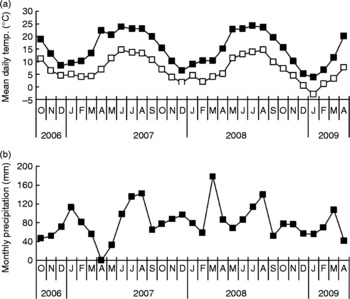
On 16 September 2006, during the period of natural seed shed, mature seeds were collected by hand from different C. epithymum populations growing in ‘Hoge Kempen’ National Park (50°58′17″N; 5°37′38″E), Limburg, Belgium. This national park includes remnants of formerly extensive heathland landscapes, once a characteristic landscape feature in much of north-western Europe (Webb, Reference Webb1998). The climate in the region of the park is temperate, with an annual mean temperature of 10–11°C and an annual total rainfall of 750–800 mm. Mean daily maximum and minimum monthly air temperatures and precipitation were calculated from records made by the weather station at Maasmechelen (~3 km from study site) (Fig. 1).
(a) Mean daily maximum (black) and minimum (white) monthly air temperatures and (b) monthly precipitation in the study area for the duration of the research (weather station ‘Maasmechelen’).

To determine the fate of C. epithymum seeds under natural conditions, freshly mature seeds were placed in ten fine mesh (0.13 mm2 average mesh) nylon bags within a few days after harvest. Each bag contained 200 seeds mixed with 20 g white acidophilous sand, and it was buried at a depth of 7 cm in a 15-cm diameter clay pot with a drainage hole in the bottom filled with local soil. The pot was buried in early successional heathland vegetation which was mown in 2005 so that the rim was even with the soil surface. This experimental set up allowed seeds to be exposed to natural temperature and soil moisture conditions. Another aliquot of the harvested seeds was stored dry at room temperature (about 20°C) until the start of germination experiments (hereafter called control seeds). Furthermore, to determine the viability of the freshly collected seeds, we performed tetrazolium viability tests on 200 of the harvested seeds (see Meulebrouck et al., Reference Meulebrouck, Ameloot, Van Assche, Verheyen, Hermy and Baskin2008 for details).
On the first day of every third month, one randomly selected bag was exhumed, allowing ten exhumation dates starting from 1 October 2006 (fresh seeds) and ending on 1 April 2009. After exhumation, soil was washed off the bag, and its contents were immersed in distilled water to separate seeds from sand. At this point the number of seeds remaining in the bags was quantified, and those no longer present in the bags were termed ‘unaccounted for’.
The dormancy status of the remaining seeds was determined by germination tests. Three replicates of a maximum of 50 exhumed seeds and of 40 control seeds each were tested for germination on filter paper (Machery & Nagel 440B) moistened with distilled water in 9-cm diameter Petri dishes at a constant temperature of 23°C for 3 weeks in light- and temperature-controlled incubators. Light [photosynthetically active radiation (PAR) = c. 36 μmol m− 2 s− 1, 400–700 nm photon irradiance] was provided by fluorescent tubes for 12 h each day. These incubation conditions were chosen because previous research had shown them to be optimal for germination of C. epithymum seeds (Meulebrouck et al., Reference Meulebrouck, Ameloot, Van Assche, Verheyen, Hermy and Baskin2008). The portion of seeds germinated after 3 weeks of incubation (hereafter called ‘germinated’) refers to seeds without any dormancy (i.e. they had neither PY nor PD).
After 3 weeks of incubation, all non-germinated seeds were checked for viability by gently pinching them with forceps, following Baskin and Baskin (Reference Baskin and Baskin1998). Seeds that collapsed when pinched were considered to be non-viable (hereafter called ‘permeable, but non-viable’), while those that did not collapse following pinching, were regarded as dormant, viable seeds. Since the dormant, viable seeds were not swollen, they were water-impermeable and thus had PY. To determine if the seeds also had PD, they were scarified and incubated in light at 23°C for another 3 weeks. Scarified seeds that did not germinate had PD, while those that germinated during the 3-week period did not have PD.
For all germination tests, distilled water was added as needed, and germinated seeds were counted three times each week. Protrusion of the radicle was the criterion for germination. Percentages of ‘germinated seeds’, ‘dormant seeds’, ‘permeable, but non-viable’ and ‘unaccounted for’ seeds were calculated after the first incubation period and germination percentages of the scarified ‘dormant seeds’ after the second incubation period.
To achieve normality homogeneity of variances, data were arcsine transformed before statistical analysis. Potential differences between buried and control seeds were analysed using a t-test for independent samples, using SPSS for Windows 15.0 (SPSS Inc., Chicago, Illinois, USA, 2008).
Results
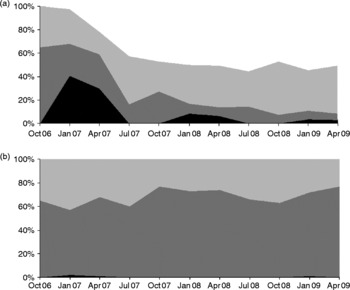
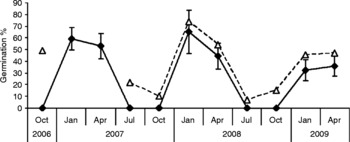
Tetrazolium tests revealed that, on average ( ± SE), 65 ± 1.93% of the freshly collected seeds were viable (n = 3), while the other seeds contained non-viable embryos. Thus, the maximum potential germination percentage of seeds used in this study was, on average, 65%. Freshly collected mature C. epithymum seeds were dormant and failed to germinate after 3 weeks of incubation at 23°C in light (Fig. 2a). During the 31-month period of burial under natural conditions, C. epithymum seeds exhibited a seasonal cycle in germination, with a peak of germination in winter and spring and no germination in the other seasons (Figs 2a and 3). When combining the percentages of seeds germinated after the first incubation with those germinating during the second incubation period after scarification (i.e. presenting all non-PD seeds) seasonal cycling in PD becomes clearly visible (Fig. 3). More research is needed to find out if there is also a cycling in sensitivity of seeds to conditions required to break PY. The observed seasonal changes in PD were noticeably synchronized with seasonal changes in temperature, but not with the limited changes in precipitation (Figs 1a and 3). Following exposure to winter temperatures (min. temperature ≤ 5°C, Fig. 1a) germination of seeds subsequently exhumed and tested at 23°C was promoted, but following exposure to late spring and summer temperatures (min. temperature >10°C, Fig. 1a) germination of exhumed seeds was inhibited.
Percentage of the seeds belonging to one of four categories, namely germinated seeds (black), dormant seeds (dark grey), permeable, but non-viable seeds (light grey), unaccounted for seeds (white), following 0–31 months of (a) burial in the soil (200 seeds per bag) or (b) storage at room temperature (control; 120 seeds). Germinated seeds: non-dormant seeds that germinated during 3 weeks' incubation at 23°C. Dormant seeds: viable seeds that did not germinate during 3 weeks incubation at 23°C. Permeable, but non-viable seeds: seeds had imbibed but had non-viable embryos following tetrazolium (fresh seeds) or pinching tests (seeds buried or dry lab-stored for 3–31 months). Unaccounted for seeds: seeds that ‘disappeared’ from the bags during 3–31 months of burial.

Seasonal changes in germination (mean percentages ± 1 SE) of non-dormant seeds (i.e. ‘germinated seeds’, i.e. no PY or PD) (solid line) and of seeds with non-dormant embryos (dashed line) incubated at 23°C following burial for 0–31 months under natural conditions. Seeds with non-dormant embryos (non-PD seeds) include both seeds germinated after the first incubation period and those germinating after scarification and a second incubation period at 23°C. The results are rescaled to 100% viable seeds (i.e. ‘germinated’ + ‘dormant’ seeds) to stress the pattern. Results of January and April 2007 are not available for the dashed line.

Germination percentage, however, never reached the maximal germination potential (i.e. when all viable seeds should germinate) (Fig. 3). On average ( ± SE) only 39.5 ± 6.7% of all viable seeds germinated, i.e. release of both PY and PD. The other ungerminated, viable seed still had an impermeable seed coat (PY) and/or a dormant embryo (PD) (Fig. 3). After scarification and incubation at 23°C, only a low portion of these dormant seeds germinated, with an average ( ± SE) germination over the 31 months of only 17.2 ± 4.2% (i.e. non-PD seeds).
During burial under natural conditions, seeds ‘disappeared’ quite rapidly from the seed bank, especially during the first year (Fig. 2a). At the end of the study, the bags contained only 8.5% viable seeds which could possibly contribute to the next generation; 41% of the seeds contained a dead embryo and 50.5% of them were unaccounted for. During the 31 months, the portion of non-viable buried seeds containing dead embryos stayed almost constant (average ± SE, 33.5 ± 2.2%), while the portion of unaccounted for seeds increased during the studied period (Fig. 2a).
For seeds stored dry at room temperature, the germination percentage of non-scarified seeds ranged from 0 to 2%, regardless of when they were tested (Fig. 2b). Further, there was no increase in loss of seed viability during the 31 months, with an almost constant proportion of viable and non-viable seeds. Consequently, the portion of viable seeds (i.e. ‘germinated’+‘dormant’ seeds) was significantly higher for seeds stored at room temperature than for those buried in soil (t-test: t = − 6.6; P < 0.001). In contrast to the results of the buried seeds, PD did not show any seasonal changes. The percentage of non-dormant embryos (non-PD) was relatively low (average ± SE, 22.01 ± 4.1%) and stayed almost constant during the 31 months.
Discussion
Not only did seeds of C. epithymum exhibit a marked seasonal germination periodicity (Fig. 2a), but scarification of exhumed seeds that failed to germinate at 23°C revealed that embryos cycle back and forth between physiological dormancy (PD) and non-dormancy (Fig. 3). That is, the changes in physiological state of the embryo are comparable to the annual changes in the dormancy state observed in many species whose seeds have PD (Baskin and Baskin, Reference Baskin and Baskin1998). To the best of our knowledge, this is the first report of PD cycling in seeds with combinational dormancy.
Benvenuti et al. (Reference Benvenuti, Dinelli, Bonetti and Catizone2005) and Van Assche et al. (Reference Van Assche, Debucquoy and Rommens2003) reported cycling of germinability in hard-seeded C. campestris and some Fabaceae, respectively. Nevertheless, those seeds have only impermeable seed coats, while the embryo is non-dormant. Thus, as explained by Jayasuriya et al. (Reference Jayasuriya, Baskin and Baskin2009) these observed germination periodicities are due to cycling in sensitivity to dormancy-breaking treatments during burial in the soil and not to dormancy cycling. Sensitivity cycling has also been observed in C. australis (Jayasuriya et al., Reference Jayasuriya, Baskin, Geneve, Baskin and Chien2008b). From our results it is, however, not completely clear whether the water-impermeable coat of C. epithymum seeds undergoes such cycles in sensitivity or if PY is broken in a portion of the seeds each winter. We can, however, conclude that PD is cycling and that there are periods of the year, i.e. late winter and spring, when a portion of the seeds are water permeable. Further, it is worth mentioning that seeds of C. epithymum were not imbibed when retrieved from the soil, indicating the presence of water-impermeable seed coats at this point. These observations suggest that the seeds undergo sensitivity cycling during burial, as suggested by Jayasuriya et al. (Reference Jayasuriya, Baskin and Baskin2009). It seems that in spring seeds are sensitive to dormancy-breaking treatment, namely a noticeable increase in temperature, and in autumn they are insensitive. Jayasuriya et al. (Reference Jayasuriya, Baskin and Baskin2009) have already pointed out that temperature-driven sensitivity cycling could be an adaptive advantage to species with PY in temperate regions, allowing seeds to germinate only at certain times of the year and thus possibly contributing to their persistence in the soil seed-bank. This aspect of the seed biology of C. epithymum, however, needs some additional experiments, as described in Jayasuriya et al. (Reference Jayasuriya, Baskin and Baskin2009).
Nevertheless, the dormancy-breaking mechanism present in C. epithymum seeds is clearly fine-tuned with predictable seasonal temperature shifts, in such a way that germination only occurs in spring when conditions are favourable for both germination and completion of the life cycle. Seedling emergence in the field showed similar strong seasonal periodicity, with appearance from April until July (Meulebrouck et al., Reference Meulebrouck, Verheyen, Brys and Hermy2009b). In addition, dry storage at constant room temperatures did not break PY or PD, which reinforces the importance of seasonal temperature changes for dormancy loss. Thus, in addition to Orobanche crenata (López-Granados and Garcia-Toures, Reference López-Granados and Garcia-Torres1999), C. campestris (Benvenuti et al., Reference Benvenuti, Dinelli, Bonetti and Catizone2005) and C. australis (Jayasuriya et al., Reference Jayasuriya, Baskin, Geneve, Baskin and Chien2008b), we present another example of a parasitic species whose germination is controlled by temperature changes instead of chemical cues of the host plant (e.g. Striga and Orobanche in Matusova et al., Reference Matusova, Rani, Verstappen, Franssen, Beale and Bouwmeester2005).
In contrast to the results from previous laboratory studies in which PD was broken in 100% of seeds after a cold period followed by temperature elevation (Meulebrouck et al., Reference Meulebrouck, Ameloot, Van Assche, Verheyen, Hermy and Baskin2008), results from our study demonstrate that under natural field conditions PD was broken in only 74% of the viable seeds (Fig. 3). Thus, both PY and PD are responsible for delaying germination of a portion of the seed crop. In this way, only the portion of the seeds containing both non-dormant embryos and sensitive seed coats can respond to temperature elevation occurring during spring. The remaining dormant seeds with PY and/or PD remain ungerminated in the soil seed-bank until some subsequent growing season. These data thus confirm the risk-spreading strategy of seeds, hypothesized in our previous research (Meulebrouck et al., Reference Meulebrouck, Ameloot, Van Assche, Verheyen, Hermy and Baskin2008), which is especially advantageous under the unpredictable environmental growing conditions characteristic of the C. epithymum successional heathland habitat.
In contrast to our expectations, there was substantial loss of buried seeds (Fig. 2a). After 31 months of burial, more than 90% of the seeds were lost (50.5% ‘unaccounted for’ and 40% non-viable embryos) from the seed bank and were no longer available for germination. This loss of seeds from the bags may be attributed to several things. First, about 35% of the seeds were not viable from the beginning of the experiment, due to presence of dead embryos or the absence of an embryo. We assume that these non-viable seeds were quickly attacked and decomposed by soil micro-organisms. Second, loss of seeds may be due to in situ germination followed by death and decomposition of seedlings in the bag. Even if C. epithymum seeds had not been in bags, seedlings from seeds at a depth of 7 cm are not likely to emerge from the soil and find an appropriate host to infect (see Meulebrouck et al., Reference Meulebrouck, Verheyen, Brys and Hermy2009b). Third, a part of the loss may be due to natural senescence of seeds in the soil and seed death due to activities of soil organisms such as fungi and bacteria that attack seeds (Baskin and Baskin, Reference Baskin and Baskin1998).
The loss of c. 90% of the buried seeds over a 31-month period indicates that, without immigration of seeds, large quantities of C. epithymum seeds are required for long-term persistence at a site. That is, large numbers of seeds must be produced while heathland vegetation is in an early successional stage (when the species is flourishing) to ensure that there will be some viable seeds in the soil for re-establishment of at least a few individuals at the time heathland vegetation is set-back via management to an early successional stage that promotes growth of the species. Although there was a remarkably high seed decline of C. epithymum seeds buried in the soil, our study provides unequivocal evidence that a small portion of them can survive for at least 31 months (Fig. 2a) and thus C. epithymum has the potential to form persistent seed banks (cf. Grime, Reference Grime1981). Since our results only give a view on seed germination three springs after seed burial, the maximum period of viability of C. epithymum seeds under natural conditions is still unknown. Thus, we do not know if C. epithymum seeds form a long-term persistent soil seed-bank (sensu Bakker et al., Reference Bakker, Poschlod, Strykstra, Bekker and Thompson1996). However, C. epithymum re-established on several sites in Flemish heathland that had been unsuitable for growth (forest/old heath) for several decades; re-establishment occurred when early successional heathland vegetation was created by clearing forest or by rejuvenating old heath vegetation (Meulebrouck et al., Reference Meulebrouck, Ameloot, Verheyen and Hermy2007). In addition, C. epithymum reappeared from the soil seed-bank after heath vegetation, not managed for >15 years, was mowed (Meulebrouck, not published). These observations strengthened the hypothesis that C. epithymum may be able to form a small, long-lived soil seed-bank. As for many other species living in landscapes with spatiotemporal cycles in habitat quality, persistent seeds may be crucial for population survival (e.g. Venable and Brown, Reference Venable and Brown1988; Pons, Reference Pons1991; Piessens et al., Reference Piessens, Honnay and Hermy2005).
In contrast, seeds stored in the laboratory did not show any reduction in seed viability (Fig. 2b). This is in accordance with results found for seeds of Orobanche crenata (López-Granados and Garcia-Torres, Reference López-Granados and Garcia-Torres1999). Therefore, caution should be used in extrapolating laboratory-obtained viability data to the field situation.
Conclusion
Given the predictability of temperature dynamics in temperate climates and the unpredictable spatiotemporal cycles in habitat quality in managed heathlands, the combination of seasonal dormancy cycling, delayed germination and persistent seeds makes C. epithymum well adapted for living in dynamic temperate-zone heathlands. Nevertheless, the rapid decrease in number of seeds in the seed bank alerts us to the sensitivity of this parasite to local extinction because seed reserves at a site may not be large enough and/or long-lived enough to be available at the site after extended periods of unfavourable habitat quality. This may partly clarify the endangered character of this species.
Acknowledgements
The authors would like to thank Jozef A. Van Assche and an anonoymous reviewer for their very constructive comments during the research and/or on the earlier drafts of this manuscript. We are also grateful to Filip Vandelook and Steve Meuris for help with the germination experiments. The first author held a grant from the Fund for Scientific Research (F.W.O. Vlaanderen). We further acknowledge the Laboratory of Plant Ecology (K.U. Leuven, Belgium) for giving us the opportunity to perform research within their labs.