Prenatal diagnosis of congenital heart disease can now be made with a very high level of diagnostic accuracy in specialist centres.Reference Allan 1 – Reference Perolo, Prandstraller and Ghi 4 The detection of congenital heart disease at the routine anomaly scan has also improvedReference Sharland 3 , Reference Marek, Tomek, Skovranek, Povysilova and Samanek 5 and is anticipated to improve further after implementation of the Fetal Anomaly Screening Program guidelines in 2010. 6
The advantages of making a prenatal diagnosis include the provision of appropriate counselling, preparation of parents before delivery, and the opportunity to make an advanced plan for delivery and postnatal management.Reference Yeu, Chalmers, Shekleton, Grimwade and Menahem 7 In addition, there is an increased cost associated with a postnatal diagnosis and transfer of a sick infant.Reference Jegatheeswaran, Oliveira and Batsos 8
Improvements in the pre-operative status and survival in babies with a prenatal diagnosis have been demonstrated for certain conditions such as coarctation of the aorta and transposition of the great arteries.Reference Franklin, Burch, Manning, Sleeman, Gould and Archer 9 – Reference Tuo, Volpe and Bondanza 11 However, there is controversy over the impact of a prenatal diagnosis.Reference Peterson, Quartermain, Ades, Khalek, Johnson and Rychik 12 , Reference Tworetzky, McElhinney, Reddy, Brook, Hanley and Silverman 13
The majority of pregnant women with a foetus affected by congenital heart disease do not live in close proximity to the centre providing tertiary cardiac services. Thus, after the diagnosis of congenital heart disease, a decision has to be made on the most appropriate place for delivery. The main factor governing this decision is the nature and severity of the cardiac defect and the likelihood of the neonate requiring intervention during the early neonatal period. This decision is important as there are potential disadvantages to delivery at a tertiary centre, including induction of labour or an elective Caesarean section, which are undertaken in order to avoid an unplanned delivery away from the tertiary centre. Induction of labour has been associated with an increased rate of emergency Caesarean sections and instrumental deliveries when compared with spontaneous onset of labour.Reference Dunne, Da Silva, Schmidt and Natale 14
We performed a review of all babies with an antenatal diagnosis of congenital heart disease delivered at our tertiary centre over a 2-year period. Our aim was to determine the timing of the first neonatal surgical or catheter-based cardiac intervention in order to ascertain the proportion of babies requiring early intervention. The mode of delivery was investigated to determine whether it was adversely affected by a planned delivery at a tertiary centre.
Materials and methods
Design
The study design included a retrospective review of case notes and data of mothers and babies delivered at our centre (Guy's and St Thomas’ Hospitals NHS Foundation Trust) between 1 January, 2008 and 31 December, 2009 for cases in which the baby was diagnosed with congenital heart disease prenatally.
Setting
This study was carried out at a tertiary centre with the following services on site: foetal and paediatric cardiology, paediatric cardiac surgery, maternal–foetal medicine and obstetrics, neonatal services, paediatric intensive care services, and genetics.
Study population
Cases to be studied were identified from our prospectively acquired databases (Filemaker Pro8, Astraia version 1.20.1_R2, Munich, Germany, Terranova Healthware version 5.7.6) and included all babies with a prenatal diagnosis of congenital heart disease who were delivered at our unit between 1 January, 2008 and 31 December, 2009. This study included local patients with a foetal cardiac abnormality as well as those referred from other hospitals for specialised care after the prenatal diagnosis of a cardiac abnormality; 85 patients were referred from another tertiary unit that has foetal cardiology services but no paediatric cardiology and cardiac surgical services. In some cases, even though neonatal cardiac intervention was not anticipated during the newborn stage, delivery at a tertiary centre was arranged at the request of either the parents or the obstetrician or the paediatrician at the respective local hospital.
Exclusions
Pregnancies that terminated or had resulted in an intrauterine death were excluded. Pregnancies with an antenatal diagnosis of congenital heart disease that were not scheduled to deliver at our tertiary centre, for example, those with non-duct-dependent lesions, or those that were delivered at local units because of premature onset of labour were also excluded.
Data collection
The foetal cardiology and foetal medicine databases were reviewed to identify the age of the mother, the postcode, address, the prenatal cardiac diagnosis, the presence of associated extracardiac and/or karyotype abnormalities, and the hospital at which the initial obstetric booking was made. The maternity database and maternity medical records and were reviewed to collect data on the parity, plan for labour, onset of and progress during labour, mode of delivery, gestation of delivery, and birth weight.
The postnatal records were reviewed to identify the birth weight, birth outcome, postnatal diagnosis, and the first neonatal surgical or catheter intervention before discharge from the hospital, including the nature and timing of cardiac intervention. Data on the commencement of Prostaglandin E2 infusion were also collected. The most recent postnatal follow-up was identified from our paediatric cardiology database Heartsuite 3.19 (Systeria Ltd, Glasgow).
Mode of delivery
Mothers were given the option of being allowed to go into spontaneous labour, when obstetrically appropriate, if they lived locally or could reach the tertiary centre within 1 hour. All other mothers were given a date for induction, usually at 38–39 weeks of gestation, either for obstetric reasons or, in most cases, to have a planned delivery at our centre. A Caesarean section was planned for obstetric indications or when induction was not appropriate, for example, a previous Caesarean section with an unfavourable cervix or a high head, and in most cases this final decision was made on the day of admission. Some patients were delivered prematurely because of preterm labour or maternal reasons such as pre-eclampsia.
Diagnostic grouping for data analysis
For analysis of neonatal data, the patients were subdivided into the following diagnostic categories of congenital heart disease: aortic and pulmonary valve stenosis, atrioventricular septal defect (excluding unbalanced defects), suspected coarctation of the aorta, hypoplastic left heart (defined as single ventricle circulation with hypoplasia of the left ventricle including unbalanced atrioventricular septal defects), pulmonary atresia with intact ventricular septum, pulmonary atresia with a ventricular septal defect, transposition of the great arteries, tetralogy of Fallot, ventricular septal defect. When multiple defects were present, the patients were classified under the defect that would dictate their early postnatal management. Patients who did not fall into the above-mentioned diagnostic categories were grouped as “other”.
Statistical analysis
All analyses were carried out using SPSS version 18 for Mac. Normally distributed data are expressed as mean (standard deviation); data not normally distributed are expressed as median (interquartile range). Categorical data were compared using Chi-square and Fisher's exact tests. A p-value of <0.05 was considered significant for all analyses.
Ethical considerations
The ethical considerations comprise a retrospective audit of data collected as an integral part of routine clinical visits for which informed consent from the women is a part. Discussion with the institutional review board deemed ethical approval was not necessary.
Results
During the study period, 217 women whose foetuses were prenatally detected with congenital heart disease were booked for delivery at our centre. Of these, seven – five live births and two intrauterine deaths – delivered unexpectedly at local hospitals. A total of 210 (98%) women delivered at our centre. For five patients who delivered at our centre, the delivery took place after an intrauterine death, and therefore they were excluded from the study.
A total of 205 women with a prenatal diagnosis of a congenital heart disease who delivered a live baby at our unit were included for the analysis. Of these, 11 were twin pregnancies in which one foetus had a cardiac defect that necessitated delivery at the tertiary centre.
General characteristics
The mean (±standard deviation) maternal age was 30.6 (±6.2) years. Nulliparous women constituted 51.7% of all cases. A total of 46 women (22.43%) were already booked for delivery at our centre before the foetal cardiac diagnosis was made.
Antenatal cardiac diagnosis
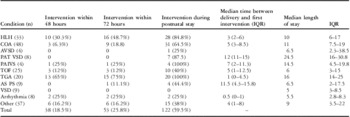
Of 205 babies, 197 had structural congenital heart diseases and eight had isolated rhythm disturbances. The number of foetuses in each diagnostic subgroup is listed in Table 1. The most common cardiac diagnoses were suspected coarctation of the aorta (n = 48), single ventricular physiology with a small left ventricle (n = 33), tetralogy of Fallot (n = 25), and transposition of the great arteries (n = 20).
Cumulative number of patients receiving cardiac intervention within the first 48 hours, 72 hours, and at any time during their total hospital stay.

AS PS = aortic and pulmonary stenosis; AVSD = atrioventricular septal defect; COA = coarctation of the aorta; HLH = single ventricle physiology with small left ventricle; IQR = interquartile range; PAIVS = pulmonary atresia with intact ventricular septum; PAT VSD = pulmonary atresia with ventricular septal defect; TGA = transposition of the great arteries; TOF = tetralogy of Fallot; VSD = ventricular septal defect
Extracardiac and karyotype abnormalities
Of the babies delivered at our centre, 48/205 (23.4%) had extracardiac structural abnormalities, including six babies in whom it was diagnosed postnatally. Of these patients, eight also had an abnormal karyotype.
Of the patients, 157/205 (76.5%) had a known karyotype result, performed either prenatally or postnatally. In 22/157(14%) patients, the karyotype was abnormal. The most common chromosomal abnormalities were trisomy 21 (n = 8), 22q11 deletions (n = 5), and trisomy 18 (n = 2). Balanced translocations or inversions were observed in two patients.
All other children had no dysmorphic features suggestive of underlying genetic abnormalities on postnatal examination.
Plans for delivery and obstetric outcome
The median distance women had to travel from home to the tertiary centre was 14 miles (interquartile range 8.2–35.4). The range varied from 0.4 to 142.4 miles. The tertiary centre is in the middle of a high-density city and therefore traffic congestion led to prolonged travel times.
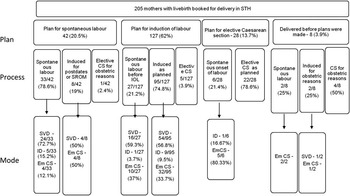
The details of the plans that were made for delivery, the actual process that ensued, and the mode of delivery are shown in Figure 1.
Plan of labour, labour process, and mode of delivery. CS = caesarean section; EMCS = emergency caesarean section; ID = instrumental delivery; SROM = spontaneous rupture of membranes; SVD = spontaneous vaginal delivery.

Induction of labour was planned in 127/205 (62.7%) women, but was actually carried out in 95/127 as others had gone into spontaneous labour or needed an elective Caesarean section on the day of induction for obstetric reasons. Overall, the rate of induction was 105/205 (51.2%). The indication for induction was to facilitate a planned delivery – when it was anticipated that it would take the woman more than 60 minutes to reach the tertiary centre – in 88/105 (83.8%) women, for obstetric conditions, including postdates, prolonged spontaneous rupture of membranes, intrauterine growth restriction, or maternal diabetes in 15/105 (14.3%) women, and both in two women.
Mode of delivery
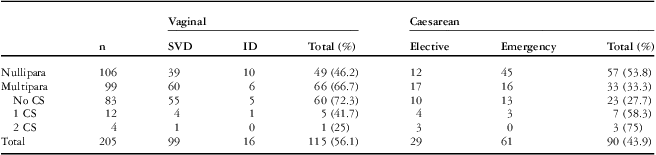
The modes of delivery are shown in Table 2. The overall incidence of Caesarean sections was 43.9% (53.8% in nulliparous women, 28.0% in multiparous women with no previous Caesarean section, and 58.3% in women with a previous Caesarean section).
Mode of delivery.

CS = Caesarean section; ID = instrumental delivery; SVD = spontaneous vaginal delivery
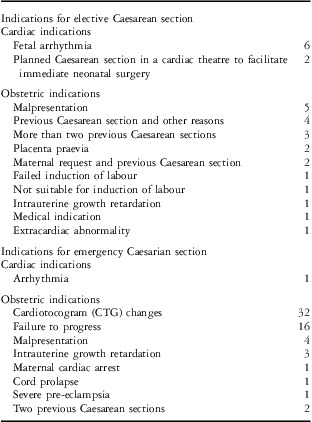
The indications for elective Caesarean section are shown in Table 3. All patients with arrhythmia except one, who had a resolved supraventricular tachycardia, were delivered by Caesarean section. In two patients with a foetal hypoplastic left heart and restriction of flow across the atrial septum, a planned Caesarean section was carried out in a cardiac theatre to allow for emergency cardiac surgery immediately after delivery. Foetal arrhythmias, either a significant tachycardia or a congenital complete cardiac block, and a hypoplastic left heart were the most common indications for an elective Caesarean section, followed by obstetric indications, including malpresentation and placenta praevia. An elective Caesarian section was performed on maternal request in two cases with a previous Caesarian section.
Indications for elective and emergency caesarean section.

The most common indications for an emergency Caesarean section were cardiotocograph abnormalities – when feasible, it was confirmed by pH < 7.19 on foetal blood sampling – during labour (32/61), followed by a failure to progress (16/61), malpresentation (4/61), and intrauterine growth retardation (3/61).
Once Caesarean sections for cardiac indications were excluded, the rate of Caesarean sections for obstetric indications was estimated at 42.3% (83/196). After excluding cases with a planned elective Caesarean section, the rate of Caesarean sections after the onset of spontaneous labour (16/62–25.80%) and induced labour (37/105–34.7%) was not significantly different (p = 0.234, Fisher's exact test).
Neonatal intervention
A total of 122 babies (59.5%) needed catheter or surgical intervention during their initial postnatal stay. Table 1 shows the cumulative number of babies undergoing cardiac intervention within 48 hours, 72 hours, and at any time during their postnatal admission period. All babies with transposition of the great arteries and pulmonary atresia with intact ventricular septum underwent intervention before discharge from the hospital. Of the 33 (84.8%) babies with single ventricular physiology with a small left ventricle, 28 underwent intervention. Among the five patients who did not undergo an intervention, one died before surgery, one was considered inoperable because of significant right atrioventricular valve regurgitation, palliative care was opted for by parents of one patient, and two patients had a balanced postnatal circulation not requiring early intervention.
Timing of first intervention
Of the 205 babies, 38 (18.5%) underwent an intervention within 48 hours and 53/205 (25.8%) underwent the same within 72 hours. The median time to first intervention was 4 days (interquartile range 2–8, range 0–82). Babies with single ventricular physiology with a small left ventricle (median 3, interquartile range 2–6) and transposition of the great arteries (median 1, interquartile range 0–4.5) had a significantly earlier time to first intervention compared with those with other conditions (p = 0.001; Table 1). Of the eight patients with arrhythmia requiring pacing or cardioversion, two required intervention within the first 48 hours.
Use of prostaglandin
Data on prostin use was available in 184 patients. A total of 96 neonates received a prostaglandin infusion during the postnatal period. Of these, 83 underwent intervention and 13 were discontinued on prostaglandin infusion and did not undergo intervention. The diagnostic subgroups of these latter patients were single ventricle physiology with a small left ventricle in two patients, coarctation of the aorta in two patients, tetralogy of Fallot in two patients, pulmonary stenosis in two patients, and others in five patients.
Length of hospital stay
The median length of stay was 11 days (interquartile range 5–27). The median length of stay for each condition is given in Table 1.
Indication for delivery at the tertiary centre in those not requiring intervention
Of the 83 neonates (33.7%) not requiring intervention, 28 were local patients – booked for delivery at our centre before prenatal diagnosis of congenital heart disease was made – thus, the delivery plan was not altered because of the cardiac condition. A further 29/83 (34.9%) were referred from another tertiary unit for delivery; a different clinical team had therefore already made the decision on the site of delivery. The remaining 26 patients did not undergo postnatal intervention. The explanation for delivery at the tertiary centre was examined from patient records. In seven cases, this was because of parental request – six babies had a significant extracardiac abnormality, and one baby died before intervention. The remaining patients were prenatally considered likely to require postnatal intervention, including four patients with suspected coarctation of the aorta.
Outcome
Complete follow-up data were available in 202 of 205 patients. Of these, 158 babies (77.1%) were alive at completion of the study. The minimum follow-up period was 12 months after the last baby in the series was delivered. A total of 28 babies (13.7%) died within the first 30 days of life. A further 13 babies (6.3%) died between 30 days and 1 year of age. Moreover, three children (1.5%) died beyond the age of 1 year within the study period.
Of the 84 babies who did not undergo intervention, no follow-up data was present on the database for three babies. Of the 81 babies who did not undergo an intervention during the postnatal stay, 12 (14.5%) died within 30 days and four (4.8%) died between 30 days and 1 year. Further details are shown in Table 4.
Outcome.

*Follow-up unavailable in three patients
INFD = infantile death; NND = neonatal death
Low birth weight and prematurity
The median birth weight was 3020 g (interquartile range 2660−3340 g). The prevalence of low birth weight (<2500 g) was 19.0% (39/205) and that of a birth weight less than the 10th centile was 28.42%. The median gestational age at delivery (interquartile range) was 38 weeks + 4 days (38 + 0 – 39 + 3). The prevalence of preterm birth was 2.4% for <34 weeks of gestation and 12.7% for that between 34 weeks and 36 + 6 weeks.
The intervention rate and the number of deaths among low-birth-weight and preterm infants
There was no significant difference between the proportion of babies who underwent intervention and those who died and between those of normal weight and those had low birth weight (<2.5 kg).
Discussion
The antenatal diagnosis of congenital heart disease has an impact on the obstetric management when transfer to a tertiary unit for delivery is required.Reference Yeu, Chalmers, Shekleton, Grimwade and Menahem 7 In most cases, a foetal cardiologist will advise on the site of delivery; however, both the parents and the local hospital team are involved in the final decision.
If surgical or catheter intervention is anticipated in the early neonatal period, the mother is advised to deliver at or near the tertiary unit. In our experience, excellent communication between the referring hospital, foetal cardiology unit, foetal medicine unit, maternity services, neonatal intensive care unit, and paediatric cardiology/cardiothoracic services facilitates a smooth transition of antenatal and intrapartum care between the referring hospital and the tertiary centre.
Obstetric management
The potential disadvantages of delivery at the tertiary centre are the increased need for induction/planned delivery, which medicalises the process of childbirth. Our policy has been to aim for vaginal delivery unless obstetric or cardiac indications dictate a Caesarean section. Intrapartum management is carried out by a specialist midwife team and is overseen by a medical team if problems exist. With this approach, we have achieved high rates of vaginal delivery for both transferred cases and the local population. Vaginal delivery has many advantages, including facilitating the onset of neonatal respiratory adaptation and allowing the mother greater mobility to visit the baby after delivery. We have shown that, although obstetric induction and elective delivery rates are high, vaginal delivery rates of over 50% are achieved. As a comparison during the study period, the incidences of Caesarean section and instrumental deliveries at our hospital were 29.5% and 13.5%, respectively.
Neonatal cardiac intervention
Our data confirm that early neonatal surgical intervention rates are determined by the type of cardiac lesion. It is well recognised that, after birth, some babies with duct-dependent conditions, particularly transposition of the great arteries and hypoplastic left heart, can develop a rapid haemodynamic compromise.Reference Brown, Ridout, Hoskote, Verhulst, Ricci and Bull 2 The findings in the present study that babies with hypoplastic left heart and transposition of the great arteries had the highest rates of cardiac intervention within 72 hours support the view that these infants should be delivered at or near a unit where early intervention can be provided.
In other conditions there is a wide variation in severity. Thus delivery at a tertiary centre is not always conclusive and the need for change in the obstetric plan should be on an individual basis. For example, many children with tetralogy of Fallot and a good-sized right ventricular outflow tract are very stable in the newborn period, but some can have severe restriction of pulmonary blood flow, necessitating surgical placement of a Blalock–Taussig shunt in the neonatal period.Reference Pepas, Savis, Jones, Sharland, Tulloh and Simpson 15 However, the difficulty in determining which of these patients will need early intervention is supported by our results showing only 40% of patients with tetralogy of Fallot who were delivered at our centre needed intervention before discharge from the hospital.
Prenatal diagnosis of coarctation of the aorta remains a challenge, despite improved diagnostic accuracy shown by comparison of arch and ductal dimensions with published Z-scores,Reference Pasquini, Mellander and Seale 16 measurement of the isthmal to ductal ratio in the three vessel and tracheal view, identification of shelf and serial measurements,Reference Matsui, Mellander, Roughton, Jicinska and Gardiner 17 and confirmation beyond the neonatal period in those with a high suspicion.Reference Head, Jowett, Sharland and Simpson 18 This is illustrated in the findings of our study in that only 18.8% of patients with a prenatal diagnosis of possible coarctation required intervention within the first 72 hours of life. Arch repair was performed on 64.5% of patients during postnatal hospital admission. This reflects that, even after birth, the diagnosis of some cases of coarctation may not be clear-cut, sometimes requiring a trial of stopping prostaglandin and having a recognised incidence of late presentation.Reference Head, Jowett, Sharland and Simpson 18
Some tertiary foetal and paediatric cardiac units differ from our unit in that they do not have on-site obstetric services. However, a similar decision-making process is undertaken with transfer of care of patients likely to require early intervention to an obstetric hospital closer to the tertiary centre with expertise in the management of neonates with congenital heart disease. Delivery in the tertiary hospital closer to the surgical services has the advantage of being able to provide rapid specialist assessment and imaging, followed by instituting the initial cardiac treatment. It may also reduce the anxiety of parents and clinicians about the ex-utero transfer to a specialist centre.
Local hospitals should also be prepared for the immediate management of these pregnancies in case obstetric emergencies, necessitating urgent delivery, arise before the planned delivery time in tertiary hospitals, although from our data this is rare. Delivery at the local hospital is encouraged when it is possible to determine confidently in the antenatal period that cardiac intervention is not likely to be required and also when palliative care is considered appropriate. In our experience, the majority of patients and medical and midwifery teams at local hospitals agree with this. However, some patients insist on delivery at a tertiary centre, even when not indicated clinically. Moreover, a few local hospitals do not have the expertise or facilities to manage these babies in the newborn period and therefore refer such patients to a tertiary centre for delivery. With the development and strengthening of paediatric cardiac networks, it may become more feasible to deliver all babies who are unlikely to require early intervention at local hospitals.
Extracardiac abnormalities
Congenital heart disease has a significant association with extracardiac and chromosomal abnormalities.Reference Hartman, Rasmussen and Botto 19 , Reference Tennstedt, Chaoui, Korner and Dietel 20 As our study cohort included only the group delivering at the tertiary centre and did not include pregnancies that terminated, it is not possible to comment on the rates for individual conditions. Depending on the overall prognosis and local specialist support, these women may need to be delivered at a tertiary centre if additional specialist paediatric services are required, but each case should be assessed individually.
Limitations
This study has the limitations of a retrospective study. We did not evaluate the outcome (both obstetric and neonatal) of patients who had prenatally diagnosed congenital heart disease but were delivered at local units. It would be an interesting further study to examine whether any patients delivered locally required transfer for intervention within 72 hours. Owing to our policy to deliver all potential duct-dependent babies at a tertiary centre, we do not have data to compare the outcome with that of patients who were delivered at an obstetric unit and were transferred to the tertiary centre with paediatric cardiac surgical facilities. There is controversy surrounding the impact of a prenatal diagnosis on postnatal outcome measures, which was not addressed by our study. This would be an important topic for future studies, particularly when considering future service configuration needs.
Conclusion
High vaginal delivery rates can be achieved in women delivering babies with a major congenital heart disease in a tertiary centre experienced in the management of prenatal and postnatal congenital heart disease. Delivery at or near a tertiary centre is recommended for major forms of congenital heart diseases that are likely to require early intervention. These include duct-dependent lesions and some types of arrhythmias. However, transfer of care is not necessary in all major forms of congenital heart diseases. Further larger studies are required to more accurately identify all patients requiring early intervention and for those that do not, it is anticipated that local delivery may be possible with the provision of more local support with the development of paediatric specialist networks.
Acknowledgements
The authors would like to thank and acknowledge Dr John Simpson and Dr Owen Miller, consultant Paediatric and foetal cardiologists, for their very important contribution in the clinical care of the patients included in this study. They would also like to thank the following staff from St. Thomas Hospitals and Evelina Children Hospital, London: Nicky Callaghan, foetal cardiac nurse counsellor, Kylie Gould, specialist midwife, Vahideh Zahiri, foetal medicine specialist midwife, Lisa Story, academic clinical trainee in Women's Health, Susern Tan, consultant neonatologist, and Thomas Witter, IT coordinator, for their help in data collection and case ascertainment. The authors would like to thank Dr Vita Zidere and Professor Lindsey Allan, Consultants, Fetal cardiology, King's College Hospital, London, and the teams from other referring hospitals.
Conflicts of interest
None.
Contribution to authorship
P.K. and G.S. conceived the idea, P.K., G.S., S.R., V.J., and S.S. contributed to case selection and ascertainment. V.J. and S.S. contributed equally to the collection and analysis of data and production of the manuscript and should be considered as the joint first authors. G.S., S.R., and P.K. assisted with data collection. R.H. assisted with the cytogenetic and molecular genetics data collection. P.K. and G.S. supervised the project and contributed to the manuscript draft. All authors approved the final version.