In 1962, Polish director Jerzy Grotowski mounted an adaptation of playwright Stanisław Wyspiański's 1904 play Akropolis. When James MacTaggart filmed it in 1968,Footnote 1 the production gained immediate cult status among American theatre critics, scholars, and practitioners. Although Grotowski's production had already been seen internationally (though by a very limited audience), the film made it available to those outside major theatre centers. Notwithstanding the buzz that surrounded the film's release, most of the interest was focused on the acting and the set design; the fact that the show was based on an obscure modernist drama evoked little critical comment. Although the film's voice-over translated some lines of the play, the dialogue was not the main focus of commentary about the film or criticism of the play after the film was released. In 1974, Harold Clurman wrote that “the lines [of Grotowski's adaptation] spoken at incredible speed are not dialogue; they are tortured exclamations projected in the direction of another being, but with no shape as personal address. (It has been said that a knowledge of Polish does not make the lines readily intelligible… ”Footnote 2 Clurman sidestepped discussing the text altogether, arguing that one does not need to understand it in order to understand the production.
Polish remains an obscure language, and Wyspiański's Akropolis remains an obscure play. Those who try even to scratch the surface of Polish drama or literature know it is notoriously hermetic, and Wyspiański's text is no exception. It is particularly dense and inaccessible. Ludwik Flaszen's 1965 English-language essay “Wyspiański's ‘Akropolis’” attempted to anchor Grotowski's production in Wyspiański's text, but his attempt fell short.Footnote 3 The essay, like those that followed it, focused primarily on the visual aspects of the production, merely alluding to Wyspiański in its opening paragraphs as a way to contextualize the historical framework of Grotowski's vision. Flaszen wrote, “They both [Wyspiański and Grotowski] want to represent the sum total of a civilization and test its values on the touchstone of contemporary experience. To Grotowski, contemporary means the second half of the twentieth century. Hence his experience is infinitely more cruel than Wyspiański's and the century-old values of European culture are put to a severe test.”Footnote 4 Like Clurman, Flaszen circumvented in-depth analysis of what might have constituted the “century-old values of European culture” to which Wyspiański's text referred. Because Flaszen's early role as dramaturge in Grotowski's group carried the weight of the insider's view, his avoidance of a direct confrontation with Wyspiański's text set the tone for the English-language critical response to Grotowski's production that was to follow during the next four decades.
The fact that in 1968 Grotowski's version of Akropolis was being delivered from beyond the Iron Curtain certainly did not help open the script to the critical scrutiny it might have otherwise received, but that is only one of many reasons why the text has eluded critical inquiry for so long. Considering Grotowski's influence, particularly the impact that his version of Akropolis has had on American experimental theatre over the past forty years, an in-depth dramaturgical exploration of Grotowski's relationship to Wyspiański is long overdue. If Wyspiański's Akropolis was an attempt to capture, condense, and understand the Polish psyche at the end of the nineteenth century, Grotowski's Akropolis was an attempt to capture, condense, and understand the new twentieth-century Polish consciousness, one forever framed by the smoke from the Auschwitz ovens. The fact that Grotowski chose Akropolis as his framework for a performance piece that sought to respond to the trauma of Holocaust has broad consequences for our understanding of Grotowski's work and the ways that translating national trauma through the prism of performance can significantly alter and deflect the historical and national meaning of dramas that were written before the trauma occurred.
***
Wyspiański's Akropolis is steeped in Polish national martyrology and the particular psychological framework of Central European identity. Milan Kundera once described Poland's central location as a site of perpetual geoschizophrenia. Central Europe, he argues, is a pit of contradictions. Located in the geographic heart of Europe and caught between “two halves which evolved separately: one tied to ancient Rome and the Catholic Church, the other anchored in Byzantium and the Orthodox Church,”Footnote 5 Central Europe has historically evolved a kind of double split consciousness (one perhaps unified only by its deep—if often contentious—Judaic subconscious).Footnote 6 In his The Struggles for Poland, Neal Ascherson cites an anecdote to make a similar point: “When a visitor commented that Poland was an abnormal country, [Kazimierz Brandys, a contemporary Polish novelist] retorted: ‘It is a perfectly normal country between two abnormal ones.’”Footnote 7 Brandys was referring to Russia and Germany, the latter at that time undergoing its experiment with communism, the former just recovering from its experiment with fascism. Using a similar critical lens, Norman Davis, in what is now considered an authoritative English-language work on Polish history, appears to be less nuanced, arguing that Poland's geographic location creates a state of perpetual psychopolitical emergency.Footnote 8 To further drive home his point, Davis titled his book God's Playground. The view of Poland as a bundle of contradictions shaped by serendipitous historical forces and fickle geopolitical circumstances is by no means a recent, post–World War II assessment. It has subtly evolved and set in European consciousness throughout many centuries, particularly—if curiously so—within the dramatic tradition.
In 1636, Pedro Calderón de la Barca set the plot of his drama Life Is a Dream in Poland. At that time, Poland was an empire, the Polish–Lithuanian Commonwealth, that spread from the Baltic Sea to the Black Sea and bordered on Sweden to the north and Turkey to the south. Culturally and politically, Poland's seventeenth-century northern and southern borders were at odds with each other, and Calderón's philosophical tractatus on the mutually exclusive natures of democracy and self-determination versus despotism and predetermination seemed to fit naturally with the country's complex social, political, and cultural makeup. Following in Calderón's footsteps more than two and a half centuries later, Alfred Jarry set his 1896 absurdist play Ubu Roi in Poland, “c'est nulle part”—that is to say, nowhere. Jarry's choice reflected a similar sense of political and national aporia, though the historical context was drastically different. At the time Jarry wrote Ubu Roi, Poland existed only as an idea; it had been partitioned since 1772 among Russia, Austria, and Germany. It was a country that was not, the ultimate political and national embodiment of a Derridean ontological riddle: being that was not. Or, as Benedict Anderson would put it, a perfect “imagined community,” a national identity that rested only on shared language and historical memory.Footnote 9 For Jarry, Poland was an embodiment of the absurd, a country that was to be found nowhere.
At the turn of the century, around the time Jarry wrote Ubu, Poland—in tune with its bleak European image—was swept by Romantic dreams of national greatness characterized by a combination of ironic self-awareness and fatalistic determination. Wyspiański wrote Akropolis in 1904 (only eight years after Jarry wrote Ubu), at a moment when the underground currents of liberation ran in all directions, from martyrological fantasies of grandiose national uprising filled with pathos and glory, to pragmatic assessments of Europe's current political and military situation, to cynical (or “kynical,” as Peter Sloterdijk would call it)Footnote 10 attempts at irony and sarcasm as a way to survive and withstand the cultural and political repression of the partitioners. At that time, Wyspiański was already renowned as both a painter and playwright. Born in 1869, he had studied philosophy at Jagiellonian University and art at the School of Fine Arts, both in Kraków. Wyspiański's paintings and writings attempted to combine the Romantic style of Polish national painters with French impressionism. From 1890 to 1895, Wyspiański traveled extensively, visiting Italy, Switzerland, and France; in France he studied at the private atelier Académie Calarossi. While traveling, Wyspiański became avid theatregoer and saw some of the greatest productions of Shakespearean and ancient dramas of that time.
Greatly impressed by the expressive potential of theatre, Wyspiański began to write, and by 1904, he had completed all of his greatest plays: Warszawianka [Varsovian Anthem] (1898); Protesilas i Leodamia [Protesilas and Laodamia] (1899); Meleager (1899); Klątwa [The Curse] (1899); Legion (1900); Wesele [The Wedding] (1901); Wyzwolenie [Liberation] (1903); and Noc listopadowa [November Night] (1904). All of the plays combined Polish national themes with ancient and classical elements and modernist forms. Each was instantly performed or printed, confirming Wyspiański's status as Poland's foremost playwright and thinker. Akropolis was, in fact, Wyspiański's last great drama, followed only by the lesser-known Skałka [A Small Rock] (1907), Powrót Odysa [Return of Odysseus] (1907], and Zygmunt August, which was never finished.
Akropolis appeared in Kraków's bookstores five weeks after it was finished, on Good Friday of 1904. The date of release was a symbolic choice that drew on the long-established parallel between Poland's dreams of national emancipation and Christ's Resurrection. According to Leon Schiller, theatre director, critic and theoretician, often considered the father of modern Polish theatre, each time Wyspiański's play was published, the event was anticipated with the kind of enthusiasm that is typical for theatre openings. The play became the main topic of discussion in Kraków's artistic circles.Footnote 11 The reviews, though, were mixed, characterized by sentiments that ranged from outrage to misunderstanding to reverence. The responses can be best summarized by Witold Noskowski, who many years later wrote in his review of the 1932 production in Poznań: “The question of what Akropolis means is not as important as what Akropolis is. To answer this question though, you need to use your imagination and empathy, not your reason.”Footnote 12 From the start, Akropolis was a cultural enigma, one that even Poles had to absorb on a subconscious, subnational level. The play was Wyspiański's third and final installment in a series that begin with Wesele and Wyzwolenie. Tadeusz Sina called the trilogy a Polish Divine Comedy in which Wesele represented Hell, Wyzwolenie Purgatory, and Akropolis Heaven.
Akropolis was partly inspired by actual events. After years of failed Polish attempts to regain Wawel Cathedral, the Austro-Hungarian government ceded the building to the Polish council of Galicja (a partially self-governed Polish state that remained under Austro-Hungarian control).Footnote 13 The cathedral needed significant repair, and as early as 1888, a committee met to arrange fund-raising for renovations. Wyspiański, collaborating with well-known Polish architect Władysław Ekielski (1855–1927), designed a series of sketches for extensive restoration that included a set of opulent Tiffany-style stained-glass windows. Faced with the choice between Wyspiański's grand visions and the conservative approach of Sławomir Odrzywolski, another Polish designer, the castle's administrators eventually chose Odrzywolski's designs.Footnote 14
When the renovation of Wawel Cathedral began in 1895, the workers uncovered Gothic and baroque frescoes concealed beneath layers of paint in one of the crypts. A few years later, Wyspiański received permission to view the frescoes. The experience affected him greatly. The figures, which had been painted centuries before, seemed to Wyspiański to come to life:
On both sides of the room, large figures of angels, both female and male, strong, burly men with unconventional, but expressive faces. They have “character,” beautiful youths. They hold in their hands various instruments for torture—everyone has a different tool.Footnote 15
The main theme of Akropolis, that of historic figures in a tapestry coming to life, was inspired by Wyspiański's symbolic interpretation of his encounter with the recently uncovered frescoes. Analyzing this aspect of Akropolis, Wojciech Bałus notes that the idea of resurrecting statues is not new in European literature; an example is the statue of the Commander that comes to life in almost all of the versions of Don Juan.Footnote 16 But by setting the play in Wawel yet renaming it Akropolis, Wyspiański follows the modernist tradition of figurative replacement. Akropolis is a replacement for Wawel and vice versa; both are conduits for history, memory, and identity—Akropolis for European and Wawel for Polish.Footnote 17
Historically, Wawel was the royal castle when Kraków was the Polish capital, but even after the capital was moved to Warsaw, Wawel remained a major royal residence. More important, Polish monarchs were buried in its crypts. In Polish culture, Wawel is considered a seed of national self-definition, the place where history mixes with artifacts and nostalgia for past greatness. In 1845, Józef Mączyński called it a “national bible.”Footnote 18 During the partition of Poland, the castle was often referred to as a Polish necropolis—a cemetery where Polish history and the Polish sense of national selfhood lay buried in its cathedral under piles of dust and time. Wyspiański aptly called it “the cemetery of the tribes”—a phrase that became the main refrain of Grotowski's production. Wyspiański designed his ill-fated and never-realized stained-glass window so Wawel could channel “the visions of decomposing bodies deposited in the cathedral, forcing the viewer to rethink the role of the national necropolis for Polish society, its function as a source of identity and vitality and hope for the future.”Footnote 19 The renovation of Wawel, which uncovered the hidden frescoes, became a ghostly event, or so it seemed to Wyspiański, who wrote his Studium o Hamlecie [A Study on Hamlet] with Wawel in mind. Hamlet's uneasy relationship with the ghost of his father closely paralleled Wyspiański's own emotions when confronted with the ghosts of Polish history that suddenly emerged from the frescoes.Footnote 20 A number of Polish critics have suggested that Wawel is the actual hero of Akropolis and that its works of art play the roles of actors; the living people do not appear until the fourth act, and their roles are not as significant as those of the mythical figures. Because of its place in Polish history, Wawel has always had a nearly sacred status: it is a place where religious and national trajectories intertwine in the literal “body politics” of the buried royals. In locating his drama in the castle's cathedral, Wyspiański, whether consciously or unconsciously, blurred the line between art and the sacred. The play became a form of mysterium tremendum, a ritual performed by and for the few initiates who understand the weight of history and its sacred dimension. It was this sacred, ritualistic aspect of Wyspiański's drama that eventually captured Grotowski's imagination.
In many ways Wyspiański was ahead of his time, anticipating the twentieth century's crisis of representation. Łempicka notes that Akropolis is a literary hybrid both structurally and thematically—part drama, part opera, part poem, with themes that stretch across cultures and epochs. It was partially this conglomeration of themes, motives, and genres that prompted Solski to reject the idea of staging it.Footnote 21 The play broke with prevalent late nineteenth-century realist conventions to draw on newly emerging avant-garde trends. Elżbieta Kalemba-Kasprzak points out that “Wyspiański questions in his drama the rule of ‘repraesentatio’ that dominated the nineteenth century theatrical space…. His reality is multi-perspective, multi-dimensional, and symbolic.”Footnote 22Akropolis borders on the threshold between two trajectories: the lingering nineteenth-century Romantic tradition steeped in nationalistic and revolutionary longings and the European modernist tradition framed by postnational avant-garde aesthetics. In 1904 the play was considered “the most fantastical” of all Wyspiański's dramas, full of symbols, allegories, and modern conventions. But it was also a nationalist drama in the same sense that Wesele and Wyzwolenie were considered nationalist dramas.Footnote 23 Indeed, in Akropolis Wyspiański attempted to capture Poland's ambivalence toward its history, its present, and its future and sought to re-create the ephemeral effect, the sense of loss and hope that Wawel embodied. But first and foremost the play was an attempt to represent through allegories and metaphors a sense of Polish national consciousness, with all of its conscious and subconscious elements, both sacred and profane.
The play consists of four acts, which at first glance have nothing to do with each other. However, they come from a common source: a tapestry that hung in Wawel Castle. Act 1 focuses on national themes and draws on Zygmunt Krasiński's 1840 play Trzy Mysli Henryka Ligenzy [Three Thoughts of Henry Ligenzy]. Wyspiański resurrects the angels that carry Saint Stanisław's coffin; the Lady figure and the Cupid figure from the monument to Andrzej Ankwicz, a Roman Catholic archbishop of Prague (1833–8) who was born and ordained in Kraków; the Lady figure from the memorial to Stanisław Skotnicki (1894–1939), the general of the émigré brigade in Switzerland; and the Cleo figure from a memorial to Roman Sołtyk (1790–1843), the Polish general of Napoleon's Russian campaign. Wyspiański drew on other scenes from the tapestry for the themes of the play's remaining three acts. Act 2 focuses on the Greek story of Hector and Andromache and Act 3 on the Hebrew story of Jacob and Esau. Act 4 revolves around King David of Israel, who in this version becomes a Polish prophet. In Akropolis, Greco-Roman mythology intertwines with Judeo-Catholic sacrum, intermingled with references to Polish national literature and military culture. As Kalemba-Kasprzak has noted, “The integration of Wawel with Akropolis, Troy, Mount Sinai, and Jerusalem allows one to define European tradition as a space of common mythical identity.”Footnote 24 The rediscovered baroque and Gothic frescoes and Greek mythological figures of royal ghosts come to life to tell their dramas and become allegorical representations of Polish national tragedy framed in the larger European context.
Drawing on The Iliad, the Old Testament, and Krasiński's play Three Thoughts, Wyspiański attempts to recover and restructure a current historical moment. Like Krasiński, Poland's renowned Romantic poet, Wyspiański merges the location, the cathedral, time, the night, and the idea of angels coming to life. Tomasz Raczek notes that the Trojan myth is about the “conscious acceptance of one's death, apathy, and the fatality of faith. The story of Jacob is all about action, dynamism, struggle with one's destiny.”Footnote 25 The dichotomy between apathy and action, between fatalism and self-determination, reflects a peculiar Polish schizophrenia. Thus, along with the dreams of greatness and images of resurrection, Akropolis also contains resigned undertones:
The dead won't rise.
Their bodies will turn to ashes
Full of the ashes is this crypt
Today, the dust that is left
Does not have the strength
To rise and to be.
We're only immortal
In spirit—.Footnote 26
The fatalism of the first act of Akropolis is a theme that Wyspiański, like many Poles, had been pondering for almost a decade. In 1896, he began work on illustrations for a new publication of The Iliad. That same year, he visited Paris, where he saw an adaptation of Sophocles' Oedipus Rex, another thematic source for Akropolis. He also read Aeschylus' dramas around this time.Footnote 27 The Greek heroes, living and dying on the playgrounds of the gods, became models for the Polish sense of national fatalism, framed by the centuries of oppression and uprisings and forever etched in national memory. In 1907, Stanisław Brzozowski wrote: “Wyspiański once more relives the historical legacy of Poland to prove that one cannot live on memory alone. Memories do not exist. But Wyspiański doesn't know the world of the living. He simply defends himself from the madness of memory.”Footnote 28 In this context, Wawel, at once a cemetery and a repository of Poland's national legacy, becomes fatalistically entangled in the myths of national martyrology and revival.
Akropolis is set in the castle during the Night of the Resurrection, a holiday just before Easter that, according to folk legend, is a night of miracles. The exact time is from midnight to four o'clock in the morning, the liminal hours. Bałus argues that
the religious liminality, the condition between sacred and profane, can never be sustained for too long. There will always be “something” separate created in the space/time of “in-between.” Between the cemetery and the village, there is a wall. This is the place to bury suicides. Two fields are always separated by the balk [medzia]. This is the place where the ghosts appear.Footnote 29
(Medzia, the Polish word for “balk” [i.e., an unplowed ridge of land, separating two fields], comes from the word między, which literally means “in between.”) The in-betweenness of time is important in Akropolis because it denotes the “something” that is created in the space between the sacred and profane and that parallels what is created between the West and the East. This is the space of Polish national identity: one in constant geopsychological struggle with itself and its surroundings.
Drawing on The Iliad, Wyspiański retells the Greek story of Priam and Hector, of Paris and Helena. To allow Paris and Helena their happiness, Hector follows his fate and goes to war, knowing well that he will die. He believes he will return in spirit, wrapped in everlasting glory. In the meantime, Paris and Helena romance each other, unaware of their tragic destiny. In vain Priam chastises Paris: “Do you know that your folly means our unhappiness?” To which Paris replies: “And isn't it your virtue/that we can be as foolish as we want to/under the majesty of your will/and your strength?” The exchange is a bitter allusion to Poland's political situation: Poles who accept the protectorate of their occupants are foolish, Wyspiański seems to suggest. The act ends with a battle between Hector and Ajax. Standing ominously among the scavenging ravens, Cassandra tries to calm Andromache, Hector's desperate wife, who wanders aimlessly through the battlefield, sensing the looming tragedy.
Wyspiański's Hector is more aware of the inevitability of his death than he is in The Iliad. In this sense, Hector symbolizes a Polish soldier who is aware of the futility of his fight and the inevitability of his death yet is unable to resist it. The play ponders a deeply paradoxical sense of Polish identity: Poles send their children to wars (Wyspiański seems to say) with all the patriotic pathos and fanfare that each such an endeavor entails, yet they are fully conscious of the inevitable failure. They believe (and yet they do not believe) in the greatness and nobility of personal sacrifice on the altar of national and international struggles. They are resigned to absurdity just as they are resigned to pathos, balancing perpetually on the border between them; they are at once Europe's greatest Romantics and its greatest cynics. Tadeusz Sinko argues that Wyspiański's Greece is different from the “sensual and beautiful poetic marble of French or Italian neoclassicism; it is a mysteriously gloomy, passionate and archaically colorful place. It is Greece looked at through the pessimistic lens of Nietzschean philosophy.”Footnote 30
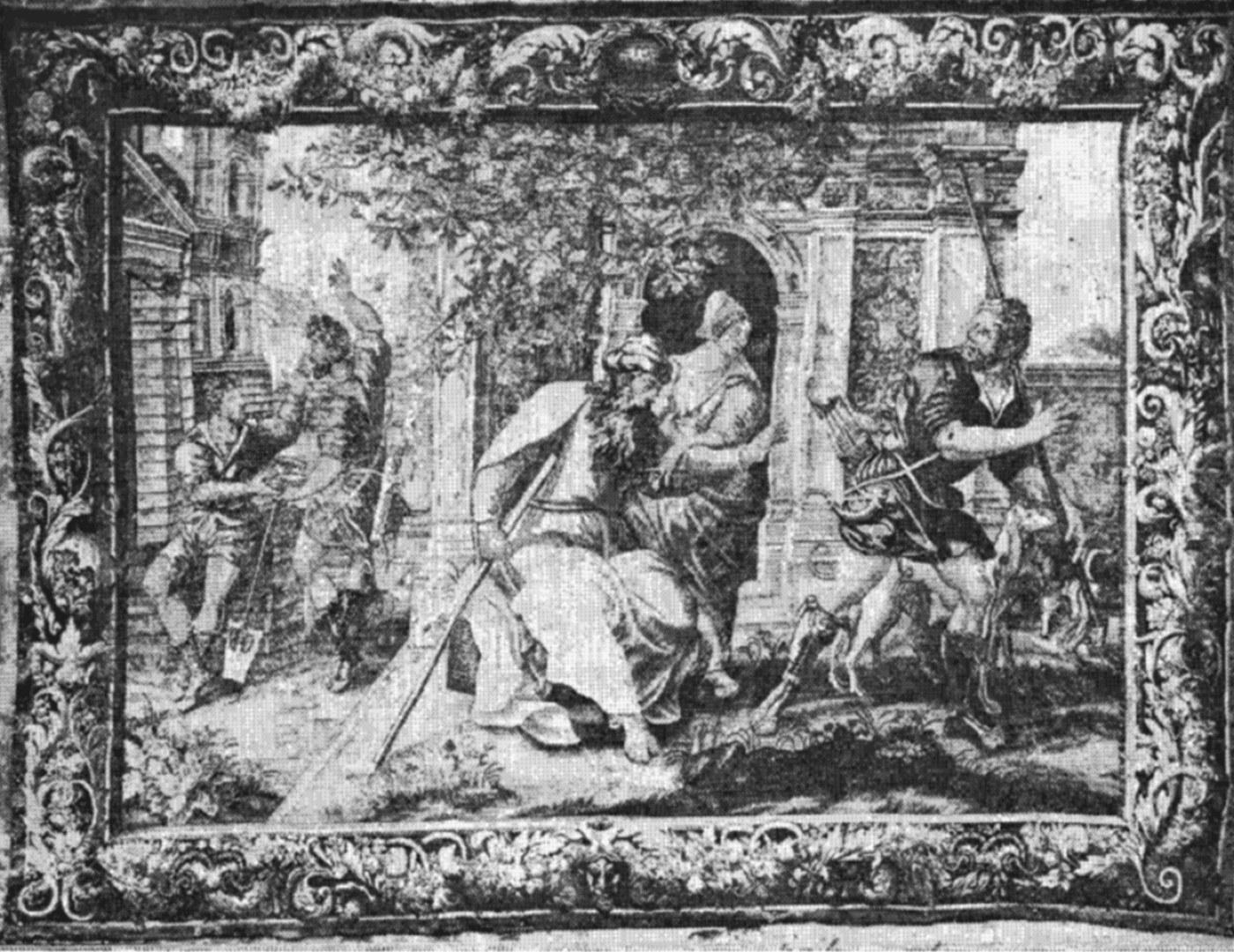
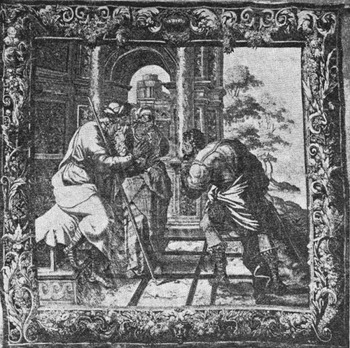
Act 3 of Akropolis focuses on the Hebrew story of Jacob and Esau. Wyspiański's version of this tale opens as the two brothers prepare to go hunting, Esau sent by the father and Jacob by the mother. Since Esau is the firstborn, he is the one Isaac wants to bless. The Abrahamic blessing that Jacob intended to give would have ensured that Esau's descendants would be the chosen people. However, Esau, aware that God had pronounced that Abraham's descendants would be enslaved for four hundred years before they would be allowed to return to their homeland, sells his birthright for a bowl of lentil soup (Fig. 1). He is eventually outwitted by Jacob, who receives Isaac's blessing and thus becomes the one whose descendants will be forever blessed (Fig. 2). Wyspiański portrays Esau as the victim and Jacob as the one who (albeit reluctantly) betrays him. Although he is ordered to do so by his mother, Rebecca, Jacob feels guilty and doubts whether a blessing received by deceit is legitimate. Maria Stobrecka suggests that Wyspiański's Esau represents Poles who both mistrust their legacy and feel robbed of it.Footnote 31
“Jacob Buys Esau's Birthright and Sends Him Hunting.” Detail from tapestry in Wawel Castle. Photo J. Krieger. Published in Stanisław Wyspiański and Bolesław Rczyński, Akropolis: dramat w 4-ech [i.e., czterech] aktach [Akropolis: Drama in Four Acts] (Kraków: Odbito v drukarni Uniw. Jag. nakładem autora, 1904).

“Isaac Blesses Jacob.” Detail from tapestry in Wawel Castle. Photo J. Krieger. Published in Stanisław Wyspiański and Bolesław Rczyński, Akropolis: dramat v 4-ech [i.e., czterech] aktach [Akropolis: Drama in Four Acts] (Kraków: Odbito v drukarni Uniw. Jag. nakładem autora, 1904).

Wyspiański further describes Jacob's travel to Haran and his struggle with the angel, who blesses him and his descendants but also confirms that his descendants will suffer for all of their generations. After twenty years of pilgrimage, Jacob eventually returns to Esau's home, and Esau forgives him. In this sense, like Hector, Jacob and Esau are both tragic characters. Each is fully aware of the fundamental absurdity of his predicament: one is betrayed, the other is forced to betray. Józef Rachwał writes: “Life, for Wyspiański, is eternally ambivalent, and thus, an eternal struggle in which man never comes out as the winner…. For this reason, the temporal triumph is itself tragic because it contains the element of inevitable defeat.”Footnote 32
Act 4 takes place on the ground level of the cathedral. The characters are the sculptures of King David and Christ-Salvatore, a Catholic saint known to heal the sick. King David's sculpture comes to life carrying a harp, which suggests that he represents Wyspiański/the poet himself. The Vistula River, which was depicted as Troy's Scamander River in Act 1, now becomes the Jordan River. Christ-Salvatore stands above the poet, who descends to earth into the human domain. Wojciech Bałus notes that there are two ways of reading Christian sacred architecture. Byzantine churches are constructed in a way that places Christ on the highest point of the church's cupola, an arrangement that symbolizes neoplatonic hierarchy, both ontological and axiological; everything comes from and focuses on God. The movement of mosaics and the interior architecture of the church thus follow from top to bottom. In Western churches, the structure is focused on man, who looks up in his search and yearns for God. The movement of the interior design is thus from the bottom up. In Akropolis, Wyspiański reads the design of the cathedral as Western: the movement is from the poet up to Christ-Salvatore.Footnote 33 This suggests that Wyspiański identifies more with Western than with Eastern ontotheology. Bałus also notes that in Akropolis the figure of Christ-Salvatore is referred to as Apollo, who “stands for Polish resurrection.”Footnote 34 The conflation of the figures suggests once again the hybridity of Polish identity.
In the final scene, Wawel Castle collapses and Saint Stanisław's coffin is destroyed. Józef Rachwał suggests that the coffin and by extension Wawel represent the past that suffocates the living spirit of the nation: “Escaping from under its spell and its weight would allow the nation to live in the moment and look forward to the future.”Footnote 35 To a degree, Akropolis illustrates the conflict in Polish literature and culture at the turn of the twentieth century between Romantics and classicists, one calling for action, the other for pragmatism. Wyspiański tackles both sides, suggesting the futility of the argument.
Because it balances between pathos and irony, Akropolis is difficult to stage. Some Polish directors and critics regard it as a poem rather than drama. Jerzy Bober suggested that the play does not have a “dramatic form.”Footnote 36 Maciej Szybist concurred: “This drama as drama cannot be staged.”Footnote 37 As Marta Fik has noted, “One false step, and instead of originality and genuine pathos, you get falsity and pretension.”Footnote 38 Elżbieta Morawiec, writing about the 1978 production directed by Krystyna Skuszanka, says: “In the history of Polish theatre, the production will remain one more attempt to resurrect a play that in this form cannot be resurrected.”Footnote 39 Krzysztof Pleśniarowicz points out that Wyspiański's play presents two challenges. The first is the issue of stylistic consistency, as the play comprises four one-act plays that differ in structure and style. The second is the fact that it is virtually impossible to stage the final scene, with its dual challenges of Apollo-Salvatore entering the stage riding a chariot drawn by horses and the destruction of the castle.Footnote 40 Thus, Polish theatres have generally avoided the play.
Parts of the play were sung by the choir at the Teatr Miejski in Lwów on 28 September 1904, and Leonard Bończa staged the first and fourth acts on 1 December 1916 in Kraków's Słowacki Theatre, which at that time was under the artistic direction of Adam Grzymała-Siedlecki. Bończa's production was prepared in an attempt to commemorate both Wyspiański's death and the anniversary of the November uprising against the Russians in 1830 that ended in Poland's defeat. The scenery was designed by Zygmunt Wierciak and the costumes by Zbigniew and Andrzej Proszanek.Footnote 41
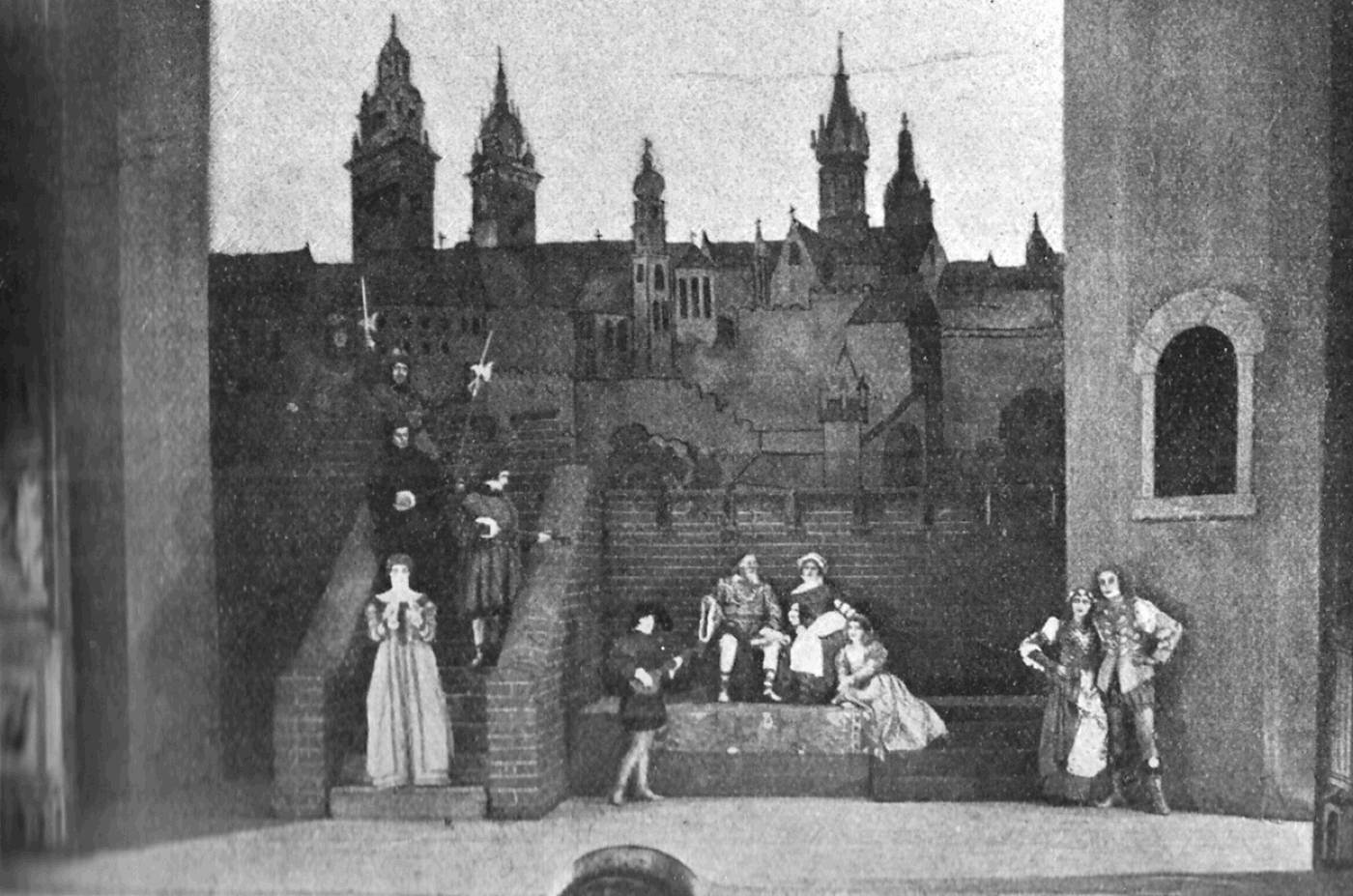
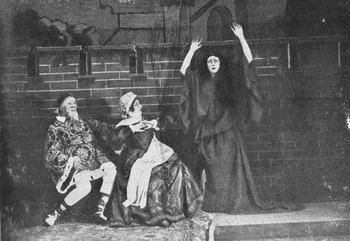
Akropolis was staged in its entirety for the first time twenty-two years after its publication. A conflict had evolved between the Słowacki Theatre in Kraków and the National Theatre in Warsaw as to who should be the first to premier the play; the Słowacki Theatre won. It opened on 29 November 1926. The production was directed by Józef Sosnowski, who also acted in it, and the set was designed by Bolesław Kudewicz (Figs 3, 4). Although the production eventually was acclaimed by both critics and the audience, Leon Schiller did not like it: “Akropolis got stuffed in the box of Kraków's scene among decorations copied ad verbatim from Wawel architecture, the choice that turned the play into some kind of postcard from Kraków, unnecessarily allegorical.”Footnote 42 In this production, the final scene showed the cathedral falling apart into the darkness as the back wall rose, revealing Apollo-Salvatore riding a chariot driven by four white stallions. The last production staged before World War II was the 1932 version directed by Teofil Trzciński, which opened on 26 November at the Teatr Polski in Poznań. The set was designed by Zygmunt Szpingier, who based his design on Wyspiański's drawings and Wyczółkowski's graphics. Schiller liked this production, declaring: “Teofil Tczciński, in Poznań, was able to mount—against difficult odds—a memorable, incredibly clear and successful production.”Footnote 43 As in previous productions, in this one the final scene had underpinnings of liberation.Footnote 44 Both Iwo Gall and Leon Schiller later attempted to stage the play, and sketches of their designs are preserved in Polish archives, but the concepts were never realized.Footnote 45
Akropolis, 1926, Słowacki Theatre, Kraków, directed by Józef Sosnowski, set design by Bolesław Kudewicz. Reprinted from Wyspiańskiemu Teatr Krakowski [For Wyspiański from Kraków's Theatre] (Kraków: Zakłady Graficzne “Styl.,” 1932), 41.
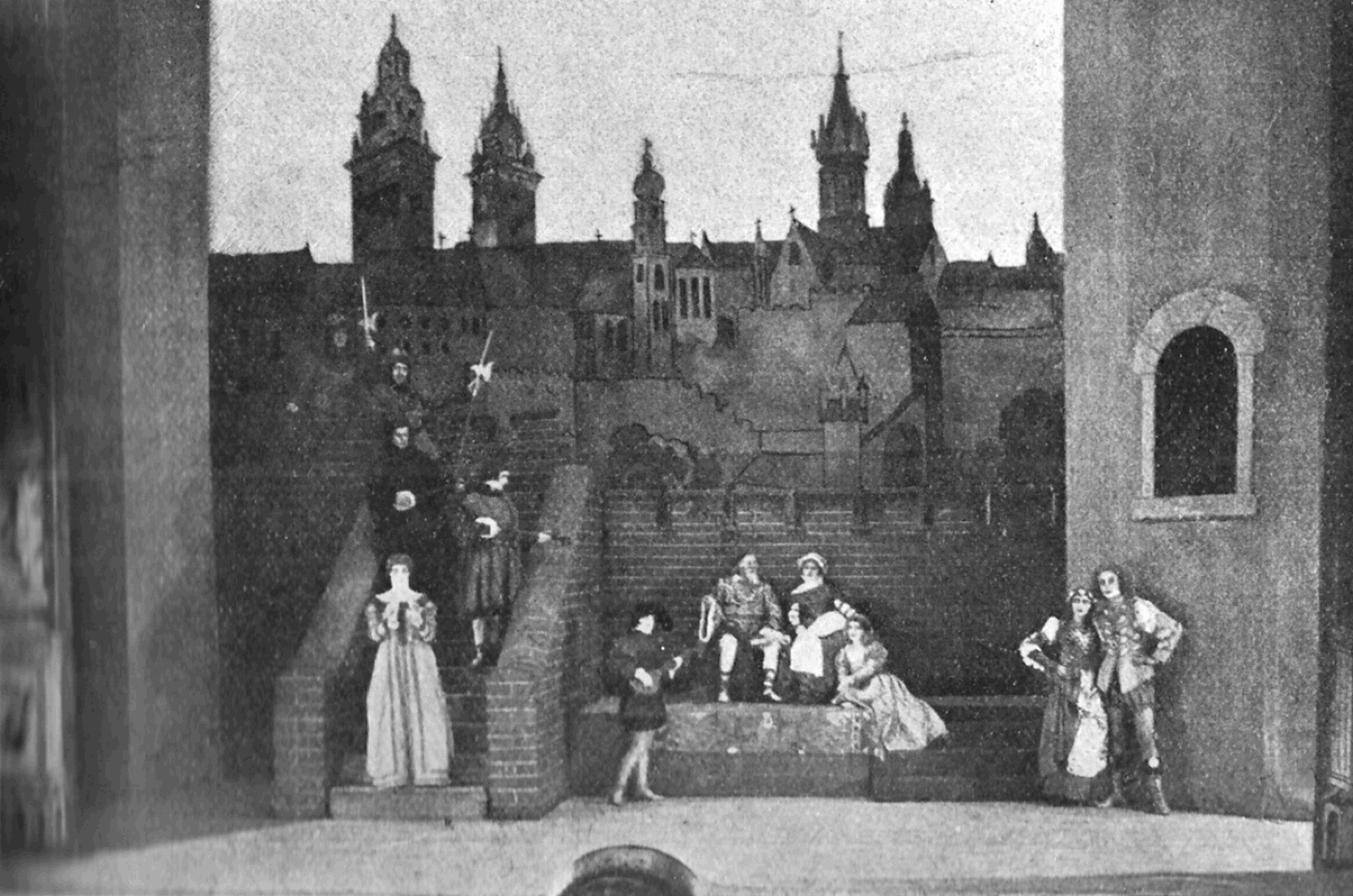
Akropolis, 1926, Słowacki Theatre, Kraków. Trojan tapestry scene: Priam (W. Szymborski), Hecuba (A. Kosmowska), and Cassandra (H. Halacinska). Reprinted from Wyspiańskiemu Teatr Krakowski [For Wyspiański from Kraków's Theatre] (Kraków: Zakłady Graficzne “Styl.,” 1932), 43.

After the war Akropolis was staged by Kazimierz Dejmek in 1959 without great success. In 1966, Mieczysław Kotlarczyk directed a production at Teatr Rapsodyczny in Kraków.Footnote 46 According to Osiński, Dejmek chose to interpret Hector as a symbol of “Polish madness” and the entire play as a condemnation of Polish Romanticism.Footnote 47 The relative lack of interest in staging Akropolis runs counter to the near-obsession with Wyspiański's other dramas (such as Wesele or Wyzwolenie), which have been in the repertoire of almost every Polish theatre since they were written.
***
Grotowski is one of a small handful who brought Akropolis back to the Polish stage in the second half of the twentieth century.Footnote 48 Grotowski's production garnered high praise; at a symposium organized by Jagiellonian University in 1969 to commemorate Wyspiański's hundredth birthday, there was a suggestion that Grotowski's staging of Akropolis was the most successful of all of the productions of any of Wyspiański's dramas.Footnote 49 The unofficial world premier of Grotowski's version of Akropolis is marked as either 9 or 10 October 1962 (depending on the source), the official premier as 20 October 1962. At that time, the line between rehearsal and public performance was somewhat blurry; Grotowski would often rehearse a piece with an invited audience or show a piece to the public, then withdraw it to rework on it some more. This was the case with his production of Akropolis, which was shown at various stages of its development beginning in early 1962.Footnote 50 According to Józef Kelera, there are five versions (“variants”) of the production, each considered by Grotowski's group as a separate work that had its own opening.Footnote 51 Osiński lists them as October 1962, Opole (variant I); 1962, Opole (variant II); 1964, Opole (variant III); 1965, Wrocław (variant IV); and 1967, Wrocław (variant V).Footnote 52
In his 1962 program notes for the production, Flaszen points out that Grotowski did not add any new lines to the play but merely stripped it to the bare bones of its poetics.Footnote 53 However, Grotowski made a drastic change in the staging: he moved the play from Wawel Cathedral to an Auschwitz crematorium. Summarizing the Polish response to this transposition, Konstantyn Puzyna wrote: “Like Schiller, Grotowski connects romantic tradition with the twentieth century avant-garde. This connection was so shocking at the time that it was not easily accepted and understood…. Particularly sacrilegious seemed Grotowski's attempt to profane the two ‘national sacrums.’”Footnote 54
Grotowski's goal was not to merely reenact or represent the condition of the concentration camp but to somehow embody it in a kind of ritualistic fashion. In this sense, instead of just acting their parts, the actors transformed the audience into witnesses, not just spectators. The text itself was used very loosely, a single sentence from Wyspiański here and there, barely recognizable except to those familiar with the original script. Konstantyn Puzyna wrote of Akropolis, “Dialogue is no longer subjected to the literary structure of the drama. It becomes a matter of game, play…. The actors are no longer subjugated to the text; the text is subjugated to the actors.”Footnote 55 In his review, Jan Paweł Gawlik called the show “radical” precisely because it used the text as one of its elements rather than as an anchor.Footnote 56 With such a limited connection to Wyspiański, why set Akropolis in Auschwitz? If Auschwitz, why Akropolis? If Akropolis, why Auschwitz?
Grotowski explained his thinking in an interview:
I reworked [Akropolis] to analyze not only the great myths of the past but the biblical and historical traditions as well. It dramatized the past from the point of view of heroic values. Since World War II we have noticed that the great lofty ideas of Western civilization remain abstract. We mouth heroic values, but real life proves to be different. We must confront the great values of the past and ask some questions. Do these values remain abstract, or do they really exist for us? To discover the answer we must look at the most bitter and ultimate trial: Auschwitz. Auschwitz is the darkest reality of our contemporary history. Auschwitz is the trial of humankind. What has been our goal in this play? To put two opposite views on the stage, to create brutal confrontation in order to see if these past dreams are concrete and strong, or only abstractions. In other words, we wanted to confront our ancestral experiences in a situation where all values were destroyed, and that is why we chose Auschwitz. What was the reaction to this play? The audience watches the confrontation; they observe the dreams of the prisoners, and the dreams of the great people of our past. Past dreams appear annihilated by the reality of Auschwitz. But in another sense, the dreams survive because they give weight and depth to the prisoners, for they feel themselves part of the collective past. Man in that situation is being tested, pitted against past ideals. Does he survive the test? The audience will decide.Footnote 57
Waldemar Krygier's design for the poster for the 1962 performance was stylized like a Greek pantheon. It was an allusion to the play's original script and the production's own modernist transpositions. The poster quotes a fragment of a poem by Tadeusz Borowski (1922–51), a Polish writer, poet, and essayist who survived Auschwitz, wrote a highly acclaimed series of concentration camp stories (published in the United States under the title This Way for the Gas, Ladies and Gentlemen), and eventually committed suicide in 1951 by breathing gas from an oven. The 1942 poem goes:
Nad nami—noc. Goreją gwiazdy,
dławiący, trupi nieba fiolet.
Zostanie po nas złom żelazny
i głuchy, drwiący śmiech pokoleń.
Above us—night. Smoldering stars,
stifling, putrid purple of the sky.
We'll leave behind us iron scraps
and hollow sneering laughter [of those—generations—who'll come after us].Footnote 58
In Poland, the last two lines of Borowski's poem are considered a kind of sacred motto of the so-called Columbus 20 generation, the generation born in the 1920s. They were in their late teens and early twenties when the war broke out, they fought in the underground army and during the Warsaw uprising, and they died in concentration camps and in Nazi prisons. They were the lost generation, those who died and those who survived but never truly recovered from the horrors of the war. Borowski's poem acknowledges the tragic truth of this generation: the fundamental cosmic inconsequentiality of their sacrifice. It also asks, implicitly and bitterly, for remembrance. This remembrance was intrinsic to the postwar nation-building of communist Poland, but because it was wrapped in the newly installed communist doctrine, it inevitably became a part of Soviet propaganda. The new establishment equated fascism with capitalism and emphasized the Soviet victory over both. Communist leaders cultivated wartime memories for their own purposes: the dead were to be remembered as a constant reminder of the military deliverance and the military might of the Soviet Union. Thus, the everyday life of Poles revolved around national holidays commemorating the people, the battles, the victories, and the defeats of the war.
The war existed in Poland's national consciousness on two levels: the personal and the political. Personal mourning progressed along its natural course through works of literature, poetry, and films. But this mourning never had a chance to work itself out fully because it was perpetually reinforced and redefined by the artifice of the official politically sanctioned mourning that was framed and imposed by the governmental structures that regulated all the media and celebrations, school ceremonies, and numerous other secular rituals of remembrance that seemed never to end. If, as Eric Santner argues, Germans as the perpetrators were not allowed to mourn their dead openly,Footnote 59 Poles in a way were doomed not just to mourn them forever but to live with them in the constant, frozen presence of Soviet propaganda. A national posttraumatic stress syndrome was ingrained in the very fabric of the political regime and became an essential part of the postwar Polish psyche.
Historically speaking, Grotowski's generation, the one born during or just before the war, did not remember the war from an adult perspective. Grotowski was born in 1933 and was thus six years old when the war started and twelve when it ended. But Grotowski and his peers were the children of the Columbus 20 generation and lived in the same psychic reality as their parents had. It is no accident that Grotowski chose Borowski's poem for his poster. His choice of Auschwitz as the setting for Wyspiański's play was very deliberate. Since World War II, Auschwitz has been a part of Polish self-definition, the knowledge of it ingrained in the national consciousness and passed on as part of the nation's epistemology. Grotowski captured this feeling in one of his interviews: “I didn't do Wyspiański's Akropolis, I met it. I didn't illustrate Auschwitz from the outside; it's this thing in me which is something I didn't know directly, but indirectly I knew.”Footnote 60 He added: “We eliminate those parts of the text which have no importance for us, those parts with which we can neither agree nor disagree. Within the montage one finds words that function vis-à-vis our own experience. The result is that we cannot say whether it is Wyspiański's Akropolis. Yes, it is. But at the same time it is our Akropolis.”Footnote 61 Grotowski's own stamp on the play was indelible and powerful; in his 1963 review, Bogdan Bąk wrote that the play might as well have been titled Akropolis from the Epoch of the Ovens. Footnote 62
The original program for Grotowski's production also included a long passage from Borowski's At Our Auschwitz. (The title is hard to translate into English in a way that would preserve Borowski's bitter nonchalance. In French, it would be “Chez Nous Auschwitz,” suggesting a restaurant, a family retreat, or a summer camp.) The passage goes as follows:
We work underground and on the ground, under the roof and in the rain, with shovels, on the trucks, with hacks and crowbars. We carry bags of cement, arrange bricks and railroad tracks, fence fields, trample the soil…. We lay the foundations of some new, horrific civilization. Only now do I fully comprehend the full price of antiquity…. What will happen to us if Germans win? They will erect huge buildings, highways, factories, and grand monuments. Our hands will cushion every brick; the steel tracks and concrete plates will be carried on our shoulders. They will murder our families, the sick and the old. They will murder all our children. And no one will know about us. We'll disappear under the proclamations of poets, lawyers, philosophers and priests. They'll re-create beauty, goodness and truth. They'll re-create religion….
When we walked in groups to the camp, there was an orchestra accompanying our steps. DAW came along with tens of other commandos and we were all waiting in front of the gates: ten thousand men. And then, trucks full of naked women drove in from FKL. The women stretched their hands and cried: “Save us. We are going to the gas chambers. Save us.” And they passed us, standing still, in deep silence, ten thousand men. Not one of the men moved, not one raised his hand.
Because the living are always in the right against the dead.Footnote 63
Although it was not the only passage from Borowski that Grotowski drew upon,Footnote 64 this particular fragment fittingly grounds the conceptual framework of Grotowski's production. The set of Akropolis was bare, stripped to its essentials: pipes, bags of cement, wooden planks, a wheelbarrow. Designed by Józef Szajna, himself an Auschwitz survivor, the set attempted to reflect the bareness of the camp.Footnote 65 In his review of the show, Gawlik compared the staging to a scene from one of the paintings of Jerzy Adam Brandhuber (1897–1981), an Auschwitz survivor and one of the founding members of the Auschwitz museum site, whose series of paintings, “Forgotten Earth,” depicted scenes from daily camp life.Footnote 66 Émile Copermann review of Grotowski's Paris premier compared the staging to Bosch's Hell. Footnote 67
Grotowski's Akropolis has no plot as such; there is only action that parallels Borowski's description: the prisoners working in the camp, carrying bags of cement, pipes, and planks. Grotowski describes the action of the play:
The prisoners worked all the time. They took metal pipes that were piled in the center of the room and built something. At the start, the room was empty except for the pile of pipes and the spectators were disseminated through all the space. By the end of the production the entire room was filled by the metal…. We organized it all into the rhythm of work in the extermination camp, with certain breaks in the rhythm where the characters refer themselves to the traditions of their youth, the dreams of their people.Footnote 68
Within this camp structure, Wyspiański's Akropolis enters the production in metatheatrical fashion as a play within the play. Grotowski did not stage Wyspiański's Akropolis as such; he staged it within Borowski's story. The story provides the primary setting of the production.Footnote 69 To amuse themselves, to pass the time, and to take their minds off their work, the prisoners in Akropolis “reenact scenes from the Old Testament and Homer” during the breaks in their labor. Kalemba-Kasprzak writes that “this ambivalent play-acting of grandiose mythic scenes brings both hope and despair.”Footnote 70 Lisa Wolford notes that although the actors were “performing archetypes of Western cultural mythology,” the choice of archetypes was not accidental; they are the characters from Wyspiański's drama.Footnote 71
But the double layering of the texts, Borowski's and Wyspiański's, is skewed, and “the framework for identification with the mythical heroes is suspect, or even impossible. Jacob kills Laban while arguing over Rachel, who can be replaced by either a pipe or a man, while Jacob's fight with the Angel remains unsolved.”Footnote 72 The skewed layering of the structure of the play and the pairing of the two texts is significant. Although many Auschwitz survivors in postwar Poland were writing wartime memoirs, it was Borowski's story that Grotowski chose as a framework for Wyspiański's drama. To understand his choice and its cultural and stylistic implications, one needs to know more about Borowski and his writing.
Borowski is often considered one of the most tragic figures in Poland's Columbus 20 generation. In his essay novel The Captive Mind, Miłosz uses Borowski as one of his “captive” types.Footnote 73 Borowski is “Beta,” the “unhappy lover” who survives Auschwitz and becomes zealously entangled in the Soviet regime, believing wholeheartedly that it is the only way to protect humanity from fascism. When he realizes that he has become a part of the totalitarian regime he sought to fight, a disappointed and disillusioned Beta takes his own life. Like Beta, Borowski survived Auschwitz and eventually reunited with his fiancée, Maria, who survived the women's camp. During their stay at Auschwitz, Maria was seriously ill, and Borowski repeatedly risked his own life to smuggle medicine, food, and his letters to her. After the war, Borowski stayed at various prisoner camps, searching for Maria. He eventually found her in a Swedish hospital, and they both returned to Poland. This is the time when the Soviets began using fear of fascism as the primary propaganda tactic, and Borowski, like many intellectuals who survived the war, came to the side of the Soviet regime. His former colleagues instantly accused him of betrayal and (once his Auschwitz stories were published) of distorting the reality of camp life.
Borowski wrote about Auschwitz with nonchalant distance. There is none of Elie Wiesel's moral outrage or Primo Levi's philosophical outrage in his writing. He described daily life in Auschwitz in a casual, deadpan tone, embedding himself completely in its reality: there are no heroes here. The line between victim and perpetrators blurs, and survival means acceptance and normalization of the horror. No one is without guilt, and Borowski implicated himself as much as anyone else. After his stories were published, many accused Borowski of perpetrating the acts that his literary alter ego commits. (The actual witness accounts contradict Borowski's story. He was reportedly one of the rare few who retained his human impulses and regularly helped fellow inmates.) Eventually, the lack of heroics in Borowski's writing ran counter to Communist propaganda, and he became the subject of criticism from both the regime and the opposition. For Borowski, though, the mere fact of survival was enough to implicate survivors, and he challenged them to tell the truth:
The first duty of Auschwitzers is to make clear just what a camp is…. But let them not forget that the reader will unfailingly ask: But how did it happen that you survived? … Tell, then, how you bought places in the hospital, easy posts, how you shoved the “Moslems” [prisoners who had lost the will to live] into the oven, how you bought women, men, what you did in the barracks, unloading the transports… ; tell about the daily life of the camp, … But write that you, you were the one who did this. That a portion of the sad fame of Auschwitz belongs to you as well.Footnote 74
Through his Auschwitz experience, Borowski came to believe that the human being is a fundamentally cruel and unforgiving creature, capable, with a slight shift in circumstances, of the most appalling acts, and his writing, with its normalization of camp ethics, makes this realization shockingly pervasive. Borowski wrote about Auschwitz as though he were writing about summer camp and with a chilling distance. Irving Howe summarized Borowski's style: “Borowski writes in a cold, harsh, even coarse style, heavy with flaunted cynicism, and offering no reliefs of the heroic.”Footnote 75 Jan Kott concurred: “The most terrifying thing in Borowski's stories is the icy detachment of the author.”Footnote 76 Stylistically Borowski's writing was not just a skillful use of dark humor, although there is some of that as well. His writing used almost Swiftian irony in its self-incrimination, but it was also fully steeped in the tradition of Polish grotesque, following the likes of Witold Gombrowicz and Bruno Schultz. It had a particular Polish je ne se quoi detachment in the face of utter despair and the overwhelming, brutal force of history.
In Akropolis, Grotowski transposed Borowski's writing style into theatrical language. Although the play presents the horror of Auschwitz with a matter-of-fact tone that translates into detachment, that detachment does not translate into a lack of emotion. On the contrary, it is a detachment that creates emotion; it asks the spectators not just to remember the dead but also to question their own humanity. It asks them to ask themselves, What am I capable of doing to survive? Kalemba-Kasprzak wrote, “The Aristotelian concept of catharsis escapes aesthetic categories and begins to carry psychosocial functions. Grotowski's vision of the Akropolis–necropolis is as much an image of the twentieth century as it is a process of descending into the dark and unspoken realms of our subconscious.”Footnote 77 Like Borowski, Grotowski challenges the spectators to tell the truth, foremost about themselves. But here in the theatrical space, the detachment is threefold: it is the detachment of the spectators from the actors, of the actors from their roles as prisoners, and of the prisoners from the mythical roles they reenact. Grotowski plays with three planes: the reality of spectators, the reality of the concentration camps, and the reality of Wyspiański's drama, which the prisoners reenact. There is also a fourth layer: Wyspiański's own skepticism about the national ideals of Polish martyrology, a kind of ad absurdum double remove that is both ironic and quixotic in light of Auschwitz. Thus, Grotowski's Akropolis is not just metatheatrical. The structure of the performance is that of a Russian matryoshka doll—a play within a play within a play within a play—that nonetheless leaves the actors on the outside, beyond any of the structural frames, in a reality untouched by text, context, or historical memory. The distancing is accomplished by the textual framing, the setting of the audience, the acting, and the structure of the play.
Ludwik Flaszen writes that “the balance of the text has been somewhat altered by the deliberately obsessive repetition of certain phrases such as ‘our Akropolis’ or ‘the cemetery of the tribes.’ This liberty is justified because these phrases are the motifs around which the play revolves.”Footnote 78 But in addition to those selective phrases from Akropolis, Grotowski also used a fragment of a letter about Akropolis that Wyspiański wrote to Adam Chmiel: “Reading the scenes from Akropolis, I am pleased with them, and I feel like each scene has behind it the lightness of the air.”Footnote 79 And he used one sentence from Zenon Parvi's 1904 review of the play: “This drama, the fantastic and symbolic dimension of which is unprecedented, reflects an image of evolving humanity, its fighting and its sheepherding aspects, that nonetheless remains dominated by the power of the song.”Footnote 80 In a Brechtian maneuver, the two fragments are spoken in the Prologue of the production by the harp player, framing the text of Akropolis in its metatheatrical context.
The actor–audience relationship is also consciously reframed. Grotowski wrote that in Akropolis he consciously (and counterintuitively) mixed the actors with the spectators. The goal was to keep the spectators distant, like witnesses, but also to immerse them in the theatrical reality. Because the actors and the spectators are intermingled, they become separated by a cognitive distance, functioning as though in two separate worlds: the world of the living and the world of the dead. Grotowski writes: “Emotive osmosis is impossible—and to create the distance between the two worlds, two realities, two different human reactions, you need intermingling.”Footnote 81 Spectators, explained Grotowski,
were treated as people of another world, either as ghosts which only got in the way or as air. The actors spoke through them. The personal situation of the spectators was totally different from that of the characters. The spectators functioned both as spectators and within the context of the play. They are in the middle and at the same time they are totally irrelevant, incomprehensible to the actors—as the living cannot understand the dead.Footnote 82
In a 1958 interview, Grotowski said that he was interested in the form of medieval European morality play that employs a direct dialogue between the audience and the performers.Footnote 83 This dialogue in Akropolis is more complex, as the actors look through the spectators as though they were transparent. The physical closeness translates into psychological distance. The actors are like ghosts who move “like in a nightmare, in which the dead haunt the living, surround them from all directions.”Footnote 84 Their faces are like masks, frozen grimaces of indifference, created without makeup through the use of facial muscles only. Their faces were to remain frozen throughout the entire show, like the faces of “Muslims,” an Auschwitz term for a prisoner who, in total exhaustion and despair, withdraws into himself, losing the will to survive.Footnote 85 As in Borowski, “there is no redemption here and except for the closing moment—the march to the Holocaust—very little pathos.”Footnote 86
Thematically and structurally, Grotowski's theatrical vision of European civilization negates Wyspiański's: Resurrection is replaced by voluntary descent into the underworld. In an interview, Grotowski explained:
The Royal Palace is not a sanctuary anymore; it is not what it was for Wyspiański in the 19th century: the cemetery of our civilization. That's why Wyspiański called the Royal Palace the Akropolis: it was Europe's ruined past. We asked ourselves painful and paradoxical questions. What is the cemetery of our civilization? Perhaps a battleground from the war. One day I knew that without a doubt it was Auschwitz. In the play of Wyspiański, at the end the Savior arrives. But in Auschwitz the savior never came for those who were killed…. The final procession was the march to the crematorium. The prisoners took a corpse and they began to sing: ‘Here is our Savior.’ All the procession disappears into the hole during the song of triumph.Footnote 87
Kalemba-Kasprzak describes this Savior:
a headless, raggedy doll rag; the prisoners raise it up in religious fervor and follow in a procession that leads to a trunk. One by one, they disappear into the trunk that now is their coffin. Once the last prisoner is gone and the cover is shut, the voice coming from inside recites two lines from Wyspiański's text: “they're gone—and smoke circles linger above.”Footnote 88
Osiński points out that the structure of Wyspiański's Akropolis “is ascending, framed by and culminating in the myth of resurrection. Grotowski's version of Akropolis, however, is descending, framed by the myths of death and sacrifice. Such an approach made explicit the tragic-grotesque character of Grotowski's work, and allowed one to define the entire theatrical reality in the context of absurd, suffering and irony.”Footnote 89 He further notes that Grotowski's use of juxtaposition—resurrection versus mass graves, cathedral versus crematory ovens—is a technique known since the Middle Ages, the so-called coincidentia oppositorum, the aim of which is to create a larger, overarching synthesis.Footnote 90 “We looked for ways to express a tragic situation in an unsentimental way,” wrote Grotowski. “How to find a human expression which would remain cool, distant? We took some elements from classic pantomime, but we changed it…. We wanted to create a struggle between structure and impulse.”Footnote 91
The symbolic transposition of Akropolis to Auschwitz brought structural and stylistic parallels. Kalemba-Kasprzak astutely notes:
It seems that the two authorial visions—of Wyspiański and Grotowski—could not be farther apart in their conceptual and stylistic framing, but it does not mean that they are not connected. Although their structural relationship is complex, and it does not have anything to do with the traditionally understood notion of “interpretation,” nonetheless, the connection is there, not only in terms of construct, but also audience reception. Both versions show “the drama of civilization,” both attempt to create a global vision of European culture, both epitomize the theatrical accomplishments of their epochs. Wyspiański's play is a synthesis of the nineteenth century, opening up well-established theatrical conventions. Grotowski's production communicates—on different levels—the crisis of the twentieth century, while announcing the inevitable crisis of representation that is to dominate all future theatrical endeavors.Footnote 92
Grotowski wrote of the final scene:
The absolute act happens in the final scene of Akropolis, when the prisoners all go to the crematorium. When the absolute act takes place, then the actor, the human being, moves beyond temporal to which we all are confined in our everyday life. The distinction between thought and feeling, body and soul, consciousness and subconsciousness, seeing and impulse, sex and reason. The actor who accomplishes this becomes whole with himself.Footnote 93
According to Leszek Kolankiewicz, the last scene of Grotowski's Akropolis was transitional for the director's work; following the experience, he eventually came to believe that words such as theatre, spectator, spectacle, and actor were no longer relevant.Footnote 94 They were to be replaced by words such as ritual, celebration, and ceremony.
***
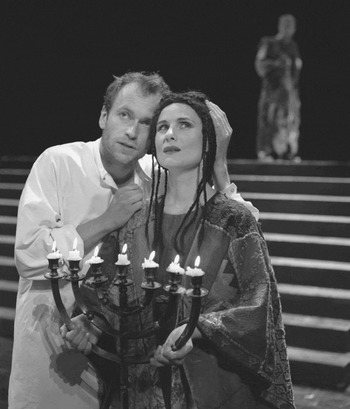
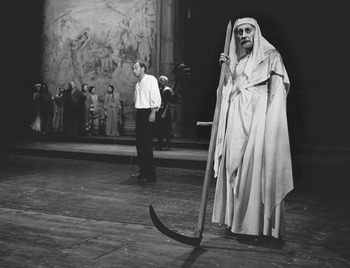
On April 28, 2001, Akropolis was again revived at Teatr Narodowy under the direction of Ryszard Peryt (set design by Ewa Starowieyska), who is better known as an opera director than a theatre director. Peryt's production stressed the national and religious character of the play while adding one more character from another Wyspiański play, Wyzwolenie. Konrad, a hapless Polish Romantic hero who turns into Hector, Jacob, and King David, contains in himself all of the major characters, thus unifying the plot structure of the play (Figs 5, 6). Wyspiański had taken Konrad from Mickiewicz's Forefathers' Eve (Dziady, 1823, 1832; fully staged 1901), a Polish Romantic drama with undertones of the Hamletian dilemma of action versus inaction. Roman Pawłowski, writing in Gazeta Wyborcza, mocked Peryt's choice as an unfortunate attempt to reframe the national liberatory theology in a new European context (“Poland the Christ of the nations becomes Poland the Europe of the nations”), thus replicating the close-minded pathos of the national-religious eschatology, something that, Pawłowski notes, both Wyspiański and Grotowski luckily escaped.Footnote 95 Peryt's interpretation, though, inadvertently reveals the full impact of Grotowski's intention. By reframing Wyspiański's work in the context of Holocaust, Grotowski turned it into a prism that can capture, translate, and respond to a particular historical moment. However successful subsequent attempts to do so have been could be argued, but the fact remains that by moving Wyspiański's play from its hermetic nationalistic context into Auschwitz, an internationally recognized symbol of the twentieth century, Grotowski not only deconstructed the “unrepresentable” but also drew attention to the roles that context and form can and should play in a theatrical production. Though such contextual transpositions are common practice right now (with Shakespeare the main target of these experiments), Grotowski was one of the first directors to make the postmodern mental leap into the parallel juxtaposition that came to govern our modern dramatic sensibility.
Akropolis, 2001, Teatr Narodowy, directed by Ryszard Peryt. Mariusz Bonaszewski as Konrad, Dorota Landowska as Rachel. Archiwum Artystycznego Teatru Narodowego [Artistic Archive of the National Theatre]. Photo by Wojciech Plewiński.

Akropolis, 2001, Teatr Narodowy, directed by Ryszard Peryt. Czesław Lasota as Tempus from the memorial to Roman Sołtyk. Archiwum Artystycznego Teatru Narodowego [Artistic Archive of the National Theatre]. Photo by Wojciech Plewiński.