In US schools, the number of English learners—students who come from non-native English-speaking homes and are acquiring academic English proficiency—has grown to nearly 10% of the school-age population (Ruiz Soto, Hooker, & Batalova, Reference Ruiz Soto, Hooker and Batalova2015). Although there are many languages represented among English learners, Spanish speakers continue to be the largest and fastest growing language group, representing 71% of the total population of English learners (Ruiz Soto et al., Reference Ruiz Soto, Hooker and Batalova2015). Recent research highlights the English reading comprehension improvement of multilingual students (Kieffer & Thompson, Reference Kieffer and Thompson2018). However, the importance of vocabulary knowledge remains noteworthy for English learners from Spanish-speaking homes. Even though many English learners can decode proficiently, their developing vocabulary knowledge may limit their meaning-making process, which can hinder opportunities to access grade-level curriculum (Mancilla-Martinez & Lesaux, Reference Mancilla-Martinez and Lesaux2011). A persistent challenge is that studies vary widely in how vocabulary is operationalized and measured, particularly when English learners are the target population.
Vocabulary knowledge refers to knowledge of word meanings, but entails more than the acquisition of word meanings as isolated units. As individual word meanings are acquired, new conceptual understandings are constructed, which help build and/or refine background knowledge (Glaserfeld, Reference Glaserfeld and Watlawick1984; Harris, Golinkoff, & Hirsch-Pasek, Reference Harris, Golinkoff, Hirsh-Pasek, Neuman and Dickinson2011; Langer, Reference Langer1984; Lipson, Reference Lipson1982; Ouellette, Reference Ouellette2006; Resnick, Reference Resnick1983; Rupley, Nichols, Mraz, & Blair, Reference Rupley, Nichols, Mraz and Blair2012; Stanovich, Reference Stanovich1986; Stevens, Reference Stevens1980; Tennyson & Cocchiarella, Reference Tennyson and Cocchiarella1986). Yet, there is a scarcity of measures that operationalize vocabulary as a conceptually rich construct (Stahl & Bravo, Reference Stahl and Bravo2010). Instead, most vocabulary measures tap knowledge of whether meaning has been assigned to a specific lexical label (also referred to as form–meaning connections; see Carey, Reference Carey, Halle, Bresnan and Miller1978; Clark, Reference Clark1993; Jenkins & Dixon, Reference Jenkins and Dixon1983; Laufer & Girsai, Reference Laufer and Girsai2008; Ortega, Reference Ortega2009; Rott, Reference Rott2005; Schmitt, Reference Schmitt2008; Webb, Reference Webb2007). This approach can be especially problematic for English learners, as their vocabulary knowledge is distributed across their two languages, (Bedore, Peña, Garcia, & Cortez, Reference Bedore, Peña, García and Cortez2005; Mancilla-Martinez, Pan, & Vagh, Reference Mancilla-Martinez, Pan and Vagh2011; Oller & Pearson, Reference Oller, Pearson, Oller and Eilers2002; Pearson, Fernandez, & Oller, Reference Pearson, Fernandez and Oller1995). That is, English learners may have the label for a concept in one, but not necessarily both, of their languages. Furthermore, the use of conceptually scored vocabulary measures that take English learners’ language proficiency across both of their languages into consideration may help shift from a subtractive, deficit view of bilingualism toward a more additive, asset-oriented view of what English learners bring to learning. In this study, we thus chose an alternative method to measure vocabulary among English learners from Spanish-speaking homes: conceptually scored vocabulary measures designed to tap knowledge of the number of known concepts, regardless of the language (Spanish or English) used to label the concept. We investigated the relationship between conceptually scored receptive and expressive Spanish–English vocabulary, academic English proficiency, and English reading comprehension outcomes among second- and fourth-grade English learners from Spanish-speaking homes (N = 62). This work extends a line of bilingual language development research on the utility of conceptually scored vocabulary measures that has been centered on toddlers and preschoolers.
Vocabulary Cross-Linguistic Associations
Unlike phonological and word reading development, which have consistently shown positive cross-linguistic transfer (e.g., Bialystok, Majumder, & Martin, Reference Bialystok, Majumder and Martin2003; Dickinson, McCabe, Clark-Chiarelli, & Wolf, Reference Dickinson, McCabe, Clark-Chiarelli and Wolf2004), the cross-linguistic transfer of vocabulary skills is less conclusive. To begin with, English learners’ home language environments differ substantially in the relative quantity and quality of language input they receive in each language, both across learners (Bialystok, Reference Bialystok2001; Grosjean, Reference Grosjean1982, Reference Grosjean1989, Reference Grosjean2008; Hoff & Core, Reference Hoff and Core2015; Romaine, Reference Romaine and Barrett1999) and over the course of time for a single learner (Mancilla-Martinez & Kieffer, Reference Mancilla-Martinez and Kieffer2010). Furthermore, once English learners enter formal schooling in the US, the vast majority are educated in English-only instructional contexts (Gándara et al., Reference Gándara, Losen, August, Uriate, Gomez, Hopkins, Gándara and Hopkins2010). It is thus not only expected, but natural, that English learners vary widely in their dual language skills (Grosjean, Reference Grosjean1989; Hoff, Reference Hoff2018).
By extension, it is also not surprising that vocabulary cross-linguistic transfer findings similarly vary widely. For example, Proctor, August, Carlo, and Snow (Reference Proctor, August, Carlo and Snow2006) found an interactive cross-linguistic relationship between Spanish vocabulary and English reading comprehension among fourth-grade students. Of note, most students had received formal Spanish literacy instruction. Likewise, Kelley, Roe, Blanchard, and Atwill (Reference Kelley, Roe, Blanchard and Atwill2015) found that kindergarten receptive Spanish vocabulary predicted second-grade English reading comprehension. In this study, children were provided with English-only instruction, but resided in a US–Mexico border community in which Spanish was the dominant language. Furthermore, all students in the study entered kindergarten with no English ability. In contrast, other studies reveal that Spanish vocabulary skills contribute minimal, if any, variance to English reading comprehension above and beyond English skills, independent of whether students received Spanish language support or English-only instruction (Mancilla-Martinez & Lesaux, Reference Mancilla-Martinez and Lesaux2010, Reference Mancilla-Martinez and Lesaux2017; Manis, Lindsey, & Bailey, Reference Manis, Lindsey and Bailey2004).
An important consideration that may shed light on these conflicting findings is that studies to date have relied on monolingual English and/or Spanish measures to understand English learners’ vocabulary. This reliance not only limits our understanding of English learners’ vocabulary knowledge but also likely influences resultant findings concerning associations (or lack thereof) between English learners’ vocabulary and their English language and literacy outcomes.
The Promise of Conceptually Scored Vocabulary Measures for English Learners
In comparison with monolingual school-aged children and younger English learners, the relationship between vocabulary and English language and literacy outcomes has been more difficult to establish for school-aged English learners, partly because of the complexity of measuring vocabulary and literacy across two languages. With younger English learners, studies often use naturalistic language samples (e.g., audio recordings) or vocabulary self-reports completed by caregivers to investigate children’s language development (e.g., Fenson et al., Reference Fenson, Dale, Reznick, Bates, Thal, Pethick and Stiles1994; Mancilla-Martinez et al., Reference Mancilla-Martinez, Pan and Vagh2011; Marchman & Martínez-Sussman Reference Marchman and Martínez-Sussman2002; Paradis, Reference Paradis2005). However, the practical utility of collecting natural language samples or vocabulary self-reports is greatly limited for school-aged populations given the time needed to collect and process this data and especially the need to analyze the data with attention to the English learners’ two languages.
At the risk of oversimplifying the complexity of word learning, for monolinguals there is more or less a one-to-one connection—or at least a tight coupling—between lexical labels and their corresponding concepts (Jardak & Byers-Heinlein, Reference Jardak and Byers-Heinlein2019). In sharp contrast, English learners can be exposed to and can acquire two sets of lexical labels for the same corresponding concepts. That is, the lexical labels English learners possess in a single language (Spanish or English) are not necessarily (or even likely) synonymous with their overall conceptual knowledge. It is well known that English learners are not two monolinguals in one person and that “equal” proficiency in both languages should thus not be expected (Grosjean, Reference Grosjean1989). Yet, the typical approach entails assessing a Spanish–English bilingual child with an English, monolingually normed vocabulary measure requiring knowledge of the English lexical label assigned to the concept. In the best case scenario, the approach is then repeated using a Spanish, monolingually normed vocabulary measure requiring knowledge of the Spanish lexical label assigned to the concept. Of concern, when utilizing this approach, numerous studies have reported that young Spanish–English bilinguals demonstrate low Spanish and low English vocabulary, but comparable performance to their monolingual peers when both languages are accounted for (e.g., Gross, Bauc, & Kaushanskaya, Reference Gross, Bauc and Kaushanskaya2014; Mancilla-Martinez & Lesaux, Reference Mancilla-Martinez and Lesaux2011; Mancilla-Martinez, Ochoa, & Greenfader, Reference Mancilla-Martinez, Ochoa and Greenfader2018; Mancilla-Martinez & Vagh, Reference Mancilla-Martinez and Vagh2013; Peña, Bedore, & Kester, Reference Peña, Bedore and Kester2015).
Recently, standardized vocabulary measures are expanding beyond a monolingual view of vocabulary acquisition by allowing students to respond in either language. This conceptually scored vocabulary approach differs markedly from the traditional single-language approach. Conceptually scored vocabulary measures are designed to give students credit for known concepts, regardless of the language in which the lexical labels for the concepts are known (e.g., English or Spanish). This approach accounts for bilingual children’s distributed vocabulary knowledge (Bedore et al., Reference Bedore, Peña, García and Cortez2005; Mancilla-Martinez & Leasux, Reference Mancilla-Martinez, Pan and Vagh2011; Oller & Pearson, Reference Oller, Pearson, Oller and Eilers2002; Pearson et al., Reference Pearson, Fernandez and Oller1995). For example, if an English learner knows the concept of a seed, the conceptually scored assessment allows English learners to respond in either language by giving credit for labeling the concept, whether the label is produced in English (seed) or in Spanish (semilla). It is worth underscoring that this approach does not require that the English learner provide the lexical label for the concept in both languages, as is most often the case when monolingual English and then separate monolingual Spanish vocabulary assessments are administered. In this way, the language in which the label for the concept is known is not the focal target; the focal target is whether the concept is known. This approach is essential for English learners because, compared to monolinguals for whom concepts are linked to lexical labels in a single language, concepts can be linked to one or two languages, resulting in one or two corresponding lexical labels. However, research on conceptually scored vocabulary measures has been predominantly focused on toddlers and preschoolers rather than school-aged English learners.
Theoretical basis for conceptually scored vocabulary measures
Building on scientific understandings of bilingual language acquisition, we adopt the revised hierarchical model (RHM) proposed by Kroll and Stewart (Reference Kroll and Stewart1994) to account for vocabulary in English learners using a conceptually scored approach. According to the RHM, the brain utilizes a conceptual (language-free) system that subserves both languages that are represented in separate lexicons. In line with other findings (e.g., Bilson, Yoshida, Tran, Woods, & Hills, Reference Bilson, Yoshida, Tran, Woods and Hills2015; Cummins, Reference Cummins1979), the RHM suggests that proficiency in one language supports proficiency in another language. Of relevance, new work reveals that concept development is similar among monolinguals and bilinguals and that encounters with concepts rather than with lexical labels contribute more to early vocabulary development (Jardak & Byers-Heinlein, Reference Jardak and Byers-Heinlein2019). Similarly, the knowledge hypothesis (Anderson & Freebody, Reference Anderson, Freebody and Guthrie1981) holds that students who have amassed a large vocabulary store have also likely amassed a large store of conceptual knowledge, such that vocabulary is an integral part of general conceptual knowledge. Considering the RHM and knowledge hypothesis together, English learners’ knowledge of concepts likely represents a more accurate reflection of their overall vocabulary than single-language measures of vocabulary designed to tap a match between language-specific lexical labels to concepts in each of their two languages, separately. In turn, use of conceptually scored vocabulary measures may better elucidate the extent to which English learners’ vocabulary effectively relates to their English language and literacy outcomes, overcoming the limitation of relying on monolingual single-language vocabulary measures to explore these relationships.
Conceptually scored vocabulary, academic English proficiency, and reading comprehension
In a review of the literature on teaching academic English to English learners, DiCerbo, Anstrom, Baker, and Rivera (Reference DiCerbo, Anstrom, Baker and Rivera2014) define academic English broadly as “the language used in school to help students acquire and use knowledge” (p. 3). Other research has focused on academic English as a means of identity formation and social positioning (Heller & Morek, Reference Heller and Morek2015), particularly among English learners from Spanish-speaking homes who are often perceived as having linguistic deficits (Flores & Rosa, Reference Flores and Rosa2015; MacSwan, Reference MacSwan2018). While there is little consensus on an exact definition of academic English (Baumann & Graves, Reference Baumann and Graves2010; DiCerbo et al., Reference DiCerbo, Anstrom, Baker and Rivera2014; Heller & Morek, Reference Heller and Morek2015; Snow & Uccelli, Reference Snow, Uccelli, Olson and Torrance2009; Valdés, Reference Valdés2004), there is general agreement that the use of more precise, abstract, and complex vocabulary (i.e., commonly known as academic word knowlege) is an essential feature (e.g., Nagy, Townsend, Lesaux, & Schmitt, Reference Nagy, Townsend, Lesaux and Schmitt2012; Snow & Uccelli, Reference Snow, Uccelli, Olson and Torrance2009; Uccelli et al., Reference Uccelli, Barr, Dobbs, Phillips Galloway, Meneses and Sanchez2014). Lesaux, Phillips Galloway, and Marietta (Reference Lesaux, Phillips Galloway and Marietta2016) argue that vocabulary knowledge is the most critical component of academic English because it serves as an indicator of the “existing conceptual knowledge” (p. 23) students bring to make sense of complex text. Based on the RHM (Kroll & Stewart, Reference Kroll and Stewart1994) and other work that similarly underscores that proficiency in one language supports proficiency in another language (e.g., Bilson et al., Reference Bilson, Yoshida, Tran, Woods and Hills2015; Cummins, Reference Cummins1979), English learners with greater conceptually scored vocabulary knowledge can be expected to have greater facility in acquiring academic vocabulary that is essential for academic English proficiency. However, this remains an open empirical question.
A long research history also establishes a relationship between English vocabulary knowledge and English reading comprehension (e.g., Anderson & Freebody, Reference Anderson, Freebody and Guthrie1981; Blachowicz, Fisher, Ogle, & Watts-Taffe, Reference Blachowicz, Fisher, Ogle and Watts-Taffe2006; McKeown, Beck, Omanson, & Perfetti, Reference McKeown, Beck, Omanson and Perfetti1983; Stahl, Reference Stahl1983). For English learners, the use of conceptually scored vocabulary measures that proxy their conceptual, rather than single-language, knowledge may help provide a more accurate understanding of the relationship between their vocabulary knowledge and English reading comprehension. Semantic understanding of words is essential to several foundational theories of reading (e.g., Gough & Tunmer, Reference Gough and Tunmer1986; Kintsch, Reference Kintsch, Louwerse and Van Peer2002; Perfetti, Reference Perfetti2007), including the aforementioned knowledge hypothesis (Anderson & Freebody, Reference Anderson, Freebody and Guthrie1981). Both the word (lexical) and conceptual knowledge facilitate reading comprehension and the knowledge hypothesis thus posits that vocabulary and reading comprehension are indirectly related via general conceptual knowledge (or schemata). For instance, a student who is familiar with words such as barn and windmill has likely also developed some, likely broader, conceptual understanding of a farm. In other words, students must have sufficient experience with the concepts present in the text in order to interpret the meaning of the text (Gee, Reference Gee2010).
The knowledge hypothesis may therefore be especially applicable for English learners given the posited link between vocabulary and conceptual knowledge in predicting reading comprehension. By tapping English learners’ knowledge of concepts independent of the lexical label (in this case, Spanish or English) assigned to the concepts, a better proxy of their overall language-independent vocabulary knowledge may be obtained. This aligns with recent findings that concept development is similar among monolingual and bilinguals, but lexical development can differ (Jardak & Byers-Heinlein, Reference Jardak and Byers-Heinlein2019). To continue the farm example, a student may know some farm vocabulary in Spanish only (granero, which is the Spanish word for barn), in English only (windmill), or in both languages (vaca/cow). Without attention to conceptually scored vocabulary, we are left tapping English learners’ knowledge of lexical labels in a single language (whether Spanish or English). In turn, their overall vocabulary knowledge base is likely underestimated, potentially disrupting the actual link between vocabulary knowledge and reading comprehension. In other words, taking an integrated conceptually scored approach in which English learners can respond in either language may provide a more accurate representation of the relationship between vocabulary and reading comprehension, because learning words involves building conceptual understandings about the world, regardless of the language used to label those understandings (Graves, August, & Mancilla-Martinez, Reference Graves, August and Mancilla-Martinez2013; Mancilla-Martinez & McClain, Reference Mancilla-Martinez, McClain, Moje, Afflerbach, Enciso and Lesaux2018). This reasoning aligns with Nagy’s (Reference Nagy, Wagner, Muse and Tannenbaum2007) assertion that “It is one's store of concepts and the relationships among them that drives comprehension, with vocabulary knowledge simply being the visible tip of the conceptual iceberg” (p. 52). Thus, English learners with a greater conceptually scored vocabulary, regardless of whether those concepts have been assigned a lexical label in Spanish, in English, or in both languages, may have greater facility in comprehending texts (English, in this case).
In summary, to our knowledge, studies have yet to examine whether conceptually scored vocabulary measures predict future academic English proficiency and English reading comprehension outcomes among school-aged English learners, as the theoretical basis underlying their use would predict.
Receptive and Expressive Vocabulary
Studies on the relationship between oral vocabulary and language and literacy outcomes among monolingual school-age children conceptualize vocabulary as receptive (comprehension) or expressive (production), and both have been found to predict reading comprehension (Catts, Herrera, Nielsen, & Bridges, Reference Catts, Herrera, Nielsen and Bridges2015; Scarborough, Reference Scarborough1998; Snyder, Caccamise, & Wise, Reference Snyder, Caccamise and Wise2005; Spear-Swerling, Reference Spear-Swerling, Ruddell and Unrau2004; Tunmer & Chapman, Reference Tunmer and Chapman2012). In addition to research that explores the role of receptive and expressive vocabulary separately, some studies have operationalized oral vocabulary by combining the receptive and expressive measures (e.g., Catts, Nielsen, Bridges, Bontempo, & Liu, Reference Catts, Nielsen, Bridges, Bontempo and Liu2015; Kendeou, Van den Broek, White, & Lynch, Reference Kendeou, Van den Broek, White and Lynch2009). As might be expected, the composite likewise predicts later English reading comprehension outcomes among school-aged children. Moreover, recent research with monolingual English speakers has found no evidence of a distinction between English receptive and expressive vocabulary measures in predicting comprehension outcomes during the preschool and elementary years (Lonigan & Milburn, Reference Lonigan and Milburn2017). However, research that investigates the extent to which receptive or expressive vocabulary measures better predict school-aged English learners’ later language and literacy outcomes is scant. Theoretically, understanding whether there is a differential influence of receptive compared to expressive vocabulary in predicting English learners’ language and literacy outcomes can help researchers arrive at more parsimonious models of reading comprehension for this growing population of learners. Practically, it is essential for educators in real school settings to utilize measures that best relate to later language and literacy outcomes, as compromising instructional time due to testing is a key concern.
In summary, while conceptually scored vocabulary measures may more accurately reflect English learners’ distributed vocabulary abilities, the utility of these measures, in the receptive and expressive domains, in predicting students’ academic English proficiency and English reading comprehension remains an open empirical question. In this study, we seek to address two related research questions: (a) what is the association between conceptually scored receptive and expressive Spanish–English vocabulary knowledge and academic English proficiency among second- and fourth-grade Spanish-speaking English learners? and (b) what is the association between conceptually scored receptive and expressive Spanish–English vocabulary knowledge and English reading comprehension skills among second- and fourth-grade Spanish-speaking English learners? Drawing on theoretical understandings of bilingual language acquisition (Bilson, et al., Reference Bilson, Yoshida, Tran, Woods and Hills2015; Cummins, Reference Cummins1979; Kroll & Stewart, Reference Kroll and Stewart1994), we hypothesize that conceptually scored receptive and expressive measures will be positively associated with school-aged English learners’ academic English proficiency and English reading comprehension.
Method
Participants
Students (N = 62) for the current study were recruited from three elementary schools in a large urban school district in the Southeastern region of the US as part of a larger study that was designed to investigate conceptually scored vocabulary across the elementary grade years. As part of the larger study, all students in kindergarten, second, and fourth grades at the three participating schools received recruitment letters in August 2016. Of those who returned letters (N = 266), 75% indicated that they spoke Spanish at home (N = 200; including English learners and non-English learners) and were thus eligible to participate in the larger study. Of these, 31% (N = 62) were eligible for the current study as they were second graders (53%) and fourth graders (47%) who were formally classified as English learners by the school district based on the Word-Class Instructional Design and Assessment Consortium’s Assessing Comprehension and Communication in English State-to-State for English language learners placement tests (ACCESS for ELLs; www.wida.us/assessment/ACCESS20.aspx). We note that kindergarten students were excluded from the current study because the statewide English reading comprehension assessment is not administered to students until second grade.
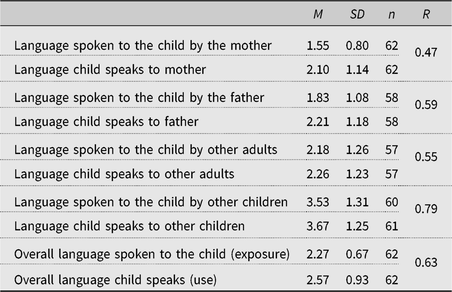
A parent questionnaire was administered by trained Spanish–English bilingual research assistants at study entry to gather demographics and language use data. Parents were given the option of completing the questionnaire over the phone or in person at the school. All of the participants’ parents completed the questionnaire (N = 62), and of those, nearly all (95%) did so with a bilingual research assistant. The great majority (89%) of students were born in the US. In contrast, all of the parents were foreign born and the majority (61%) were from Mexico. Parents were asked eight questions about patterns of home language use across various family members (as applicable) on a 5-point scale, as follows: 1 = only Spanish, 2 = mostly Spanish, 3 = English and Spanish equally, 4 = mostly English, and 5 = only English. As Table 1 shows, on average, parents reported that the language their children heard at home (language exposure) was Spanish dominant (M = 2.27, SD = 0.67). While the average rating for the language their children used at home (language use) was slightly higher (M = 2.57, SD = 0.93), it remained Spanish dominant. Finally, of the parents who reported their family income level (n = 34; 55%), families had an average income-to-needs ratio at the poverty level (0.90).
Patterns of language exposure to child and language use by child with all household members, with Spearman’s correlation coefficient between language exposure and use

Note: Each statement was rated on a 5-point scale: 1 = only Spanish, 2 = mostly Spanish, 3 = English and Spanish equally, 4 = mostly English, and 5 = only English.
Procedure
Trained Spanish–English bilingual research assistants administered the conceptually scored vocabulary assessments in the fall (October–November 2016). The ACCESS for ELLs was administered by certified English learner specialists from March to April 2017 per the standardized protocol in order to meet state and federal requirements for Title III funding. The Measures of Academic Progress (MAP) Growth reading assessments (www.nwea.org/map-growth) were administered by certified literacy interventionists in May 2017. The assessments were administered per the standardized protocol as part of state-mandated response to intervention progress monitoring procedures.
Measures
Conceptually scored vocabulary
The Receptive One-Word Picture Vocabulary Test—4: Spanish–Bilingual Edition (Martin, Reference Martin2013a) and the Expressive One-Word Picture Vocabulary Test—4: Spanish–Bilingual Edition (Martin, Reference Martin2013b) were used to measure English learners’ vocabulary. These vocabulary measures were specifically designed for and normed on Spanish–English bilinguals with varying levels of English proficiency. The measures utilize conceptual scoring, which focuses on the total number of concepts rather than language-specific lexical labels a child knows in Spanish or English. Students were tested one-on-one by trained research assistants. Vertically scaled scores are not available for this measure, and we thus used raw scores for analytic purposes.
Conceptually scored receptive vocabulary
The Receptive One-Word Picture Vocabulary Test—4: Spanish–Bilingual Edition (Martin, Reference Martin2013a) taps children’s ability to identify pictured objects, actions, and concepts. As a conceptually scored measure, children are presented with the target item in Spanish or English (depending on the child’s language dominance), and missed items are readministered in the opposite language, allowing for the assessment of their receptive knowledge in either language. The items are ordered by increasing difficulty, beginning with the easiest concepts and ending with less frequently encountered concepts. Each item displays four pictures. The child is asked which of the four pictures represents the target word, and is then prompted to point to the correct picture. The task is discontinued when the child makes four errors within six consecutive responses. The publisher reports the median internal consistency reliability coefficient as 0.95.
Conceptually scored expressive vocabulary
The Expressive One-Word Picture Vocabulary Test—4: Spanish–Bilingual Edition (Martin, Reference Martin2013b) taps children’s ability to label pictured objects, actions, and concepts. Children are presented with a target picture and are prompted in Spanish or English to name the item. The items are ordered by increasing difficulty, beginning with the easiest concepts and ending with less frequently encountered concepts. Each item displays a picture. The child is asked, “What is this?” or “¿Qué es esto?” depending on language dominance. The response is correct whether it is provided in Spanish or English, allowing for the assessment of expressive knowledge in either language. The task is discontinued when the child fails six consecutive items. The publisher reports the median internal consistency reliability coefficient as 0.95.
Academic English proficiency
The ACCESS for ELLs is a comprehensive measure of academic English proficiency for kindergarten through 12th-grade English learners. To our knowledge, the ACCESS for ELLs represents the only psychometrically validated comprehensive measure of academic English proficiency currently available for the age range of students included in our sample. Thirty-nine states currently utilize it to determine whether students have the necessary proficiency in academic English to exit from English language support services. The measure is theoretically grounded in research that conceptualizes academic English as the necessary language for school success, and focuses on general school-based instructional language as well as discipline-specific language (language arts, math, science, and social studies), attending particularly to the linguistic features of academic English across morphological, lexical, syntactical, discourse, and pragmatic levels (Bauman, Boals, Cranley, Gottlieb, & Kenyon, Reference Bauman, Boals, Cranley, Gottlieb, Kenyon and Abedi2007). The four subtests of the ACCESS for ELLs are designed to assess student progress on academic English across the domains of speaking, reading, writing, and listening, and all items are based on model performance indicators from the Word-Class Instructional Design and Assessment Consortium’s standards. Items are leveled according to linguistic complexity, with more challenging items indicative of greater facility with academic English. For example, sample items from the ACCESS for ELLs student preparation website (https://wida.wisc.edu/assess/access/preparing-students) focus on students’ comprehension of specific academic vocabulary, such as approximately, in the reading and listening subtests; students’ ability to use conjunctions, adverbs, and adjectives to give more sophisticated responses on the speaking subtest; and students’ mastery of discourse-specific features in academic genres, such as including an introduction and conclusion in a science report, on the writing subtests. The combination of all items across the four domains is designed to provide a comprehensive measure of overall academic English proficiency. The listening and reading subtests of the ACCESS for ELLs are group administered, and they consist of multiple-choice items. The writing subtest is also group administered and requires students to write short answers or essays based on a prompt. The speaking subtest is administered individually and adaptively in an online interview format. Scores are vertically scaled, range between 100 and 600, and can be compared across grades within a language domain/subtest. However, there is a separate scale for each language domain/subtest, and those scores cannot be compared across language domains/subtests (e.g., 300 in reading does not mean the 300 in speaking). Because we wanted a global, comprehensive measure of academic English proficiency, we used the overall scale scores in the analyses. Nonetheless, we tested for, but found no effects of, individual ACCESS for ELLs subtests. Thus, our use of the ACCESS for ELLs overall scale scores for analytic purposes was warranted. The ACCESS technical manual reports the median internal consistency reliability for the overall composite proficiency score coefficient as 0.95 for second grade and 0.95 for fourth grade (Center for Applied Linguistics, 2018).
English reading comprehension
The Northwest Evaluation Association’s Measures of Academic Progress (MAP) Growth is a commercially available nationally normed, computer-based, multiple-choice assessment designed to measure academic growth utilizing dynamic adaptation to adjust to each student’s performance (www.nwea.org/map-growth). It has been shown to demonstrate construct validity across academic years, grade levels, and geographic regions of the US (Wang, McCall, Jiao, & Harris, Reference Wang, McCall, Jiao and Harris2013). Students are presented with items of varying difficulty, and achievement levels are determined. For the current study, we used the reading subtest, which measures students’ ability to identify literal meanings, make inferences, and evaluate texts of varying complexity. We used MAP Growth reading Rasch unit scores scores in the analysis, as these are vertically scaled scores. The MAP technical manual reports the marginal reliability consistency for the reading assessment as 0.96 for second grade and 0.94 for fourth grade (Northwest Evaluation Association, 2011).
Analysis plan
To answer our two research questions, we conducted series of ordinary least squares (OLS) regressions. For our first research question, students’ academic English proficiency was the outcome, and conceptually scored receptive and expressive vocabulary served as the key predictors. We also included students’ grade level as a covariate, with second graders being the reference group. Given that reading is one of the four subtests that contributes to the ACCESS for ELLs overall scale scores (our measure of academic English proficiency), we did not additionally control for students’ MAP Growth reading (our measure of English reading comprehension) in this analytical model; that would result in overcontrolling for reading comprehension, and thus not leaving much variance in the academic English proficiency scores to be explained by conceptually scored receptive and expressive vocabulary, our key predictors of interest. To answer our second research question, students’ English reading comprehension was the outcome, and conceptually scored receptive and expressive vocabulary scores served as the key predictors. In this model, we included students’ academic English proficiency as a covariate as we were interested in investigating whether the potential relationship between conceptually scored vocabulary and English reading comprehension would hold even when controlling for students’ overall academic English proficiency. Finally, students’ grade level was also included as a covariate, with the second graders being the reference group.
Results
Descriptive analyses
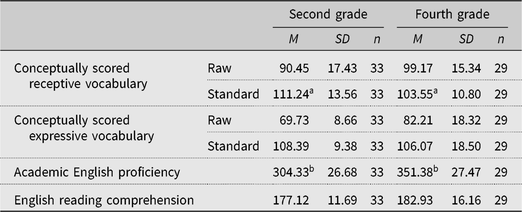
The third to sixth rows of Table 2 display the sample means for conceptually scored vocabulary by English learners’ grade levels, with standard deviations. We report both raw and standard scores. The second grade English learners’ mean for conceptually scored receptive vocabulary raw scores was 90.45 (SD = 17.43) and for conceptually scored expressive vocabulary raw scores it was 69.73 (SD = 8.66). The median raw scores for 8-year-old children in the normative sample were 87.8 for receptive and 69.8 for expressive, suggesting that our second-grade sample mean scores were similar to those from the normed sample. The fourth-grade English learners’ mean for conceptually scored receptive vocabulary raw scores was 99.17 (SD = 15.34) and for conceptually scored expressive vocabulary raw scores it was 82.21 (SD = 18.32). The median raw scores for 10-year-old children in the normative sample were 108.2 for receptive and 87.0 for expressive, suggesting that our fourth-grade sample mean scores were somewhat lower than those from normed sample. The conceptually scored vocabulary standard scores indicate that our sample of English learners was performing in the average to high-average range. The gap between second- and fourth-grade students’ conceptually scored expressive vocabulary standard scores was small and not statistically significant, t(60) = 0.64, p = 0.53. However, the gap between their conceptually scored receptive vocabulary standard scores was larger and statistically significant, t(60) = 2.45, p = 0.02. Further, second- and fourth-grade students showed somewhat different receptive and expressive conceptually scored vocabulary patterns. For second graders, the receptive vocabulary scores were higher than the expressive vocabulary scores, and the reverse was the case for fourth graders. However, the difference between receptive and expressive conceptually scored vocabulary standard scores was not statistically significant for both grades. There was a moderate positive correlation between receptive and expressive vocabulary (r = 0.41, p < 0.001), indicating that English learners with higher receptive conceptually scored vocabulary were likely to also have higher expressive conceptually scored vocabulary, on average.
Sample means on conceptually scored receptive and expressive vocabulary, academic English proficiency, and English reading comprehension by students’ grade level, with standard deviations

Note: Conceptually scored receptive and expressive vocabulary were assessed with Receptive One-Word Picture Vocabulary Test—4: Spanish–Bilingual Edition and Expressive One-Word Picture Vocabulary Test—4: Spanish–Bilingual Edition, respectively. Raw and standard scores were reported for conceptually scored receptive and expressive vocabulary. Academic English proficiency and English reading comprehension were assessed with ACCESS for ELLs and MAP Growth reading, respectively. Overall scale scores are reported for academic English proficiency, and Rasch unit scores are reported for English reading comprehension; these scores are comparable across grade levels. aDifference in scores is statistically significant at p <0.05. bDifference in scores is statistically significant at p < 0.001.
The seventh and eighth rows of Table 1 display the sample means for English learners’ academic English proficiency and English reading comprehension scores by grade levels, with standard deviations. The sample means reveal that, on average, English learners’ academic English proficiency scores were associated with their grade levels, such that fourth graders (M = 351.38, SD = 27.47) tended to have higher scores compared to second graders (M = 304.33, SD = 26.68). The difference between second- and fourth-grade students’ academic English proficiency scores was statistically significant, t(60) = –6.83, p < 0.001. For English reading comprehension, the average normative score at the end of the school year is 188.7 for second graders and 205.9 for fourth graders (Northwest Evaluation Association, 2017). Our sample means are lower for English learners in both grade levels, and the gap is larger for fourth graders compared to second graders. The fourth-grade English learners (M = 182.93, SD = 16.16) had higher English reading comprehension scores than the second graders (M = 177.12, SD = 11.69), but the difference between the two grade levels was not statistically significant, t(60) = –1.63, p = 0.11. Given the significant difference on academic English proficiency scores for second and fourth graders, and as previously noted, we included grade level as a covariate in our statistical models.
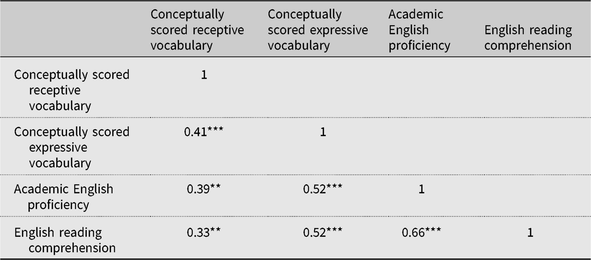
Table 3 displays the pairwise correlations between conceptually scored receptive and expressive vocabulary, academic English proficiency, and English reading comprehension. As shown, all correlations were positive and statistically significant. This indicates that English learners who scored higher on conceptually scored vocabulary in the fall also tended to score higher on academic English proficiency and English reading comprehension in the spring. Of note, there was a positive and strong correlation between English reading comprehension and academic English proficiency despite different patterns across grades for these measures. Specifically, fourth graders’ academic English proficiency was significantly higher than that of second graders. However, there was no significant difference between the two grade levels on English reading comprehension. Nonetheless, within each grade level, students who had higher scores on one measure also tended to have higher scores on the other measure. We underscore that the academic English proficiency measure (ACCESS for ELLs) is designed to assess overall English language proficiency for English language learners whereas the English reading comprehension measure (MAP Growth reading) is intended to assess reading comprehension skills for both English learners and non-English learners. Thus, the different patterns across grades for these measures is not unexpected.
Correlations among measures of conceptually scored receptive and expressive vocabulary, academic English proficiency, and English reading comprehension

Note: Conceptually scored receptive and expressive vocabulary were assessed with Receptive One-Word Picture Vocabulary Test—4: Spanish–Bilingual Edition and Expressive One-Word Picture Vocabulary Test—4: Spanish–Bilingual Edition, respectively. Raw scores were used for the conceptually scored vocabulary measures. Academic English proficiency and English reading comprehension were assessed with ACCESS for ELLs and MAP Growth reading, respectively. Overall scale scores were used for academic English proficiency, and Rasch unit scores was used for English reading comprehension. **p < 0.01. ***p <0.001.
OLS regression analyses
Research Question 1: Conceptually scored receptive and expressive vocabulary predicting academic English proficiency
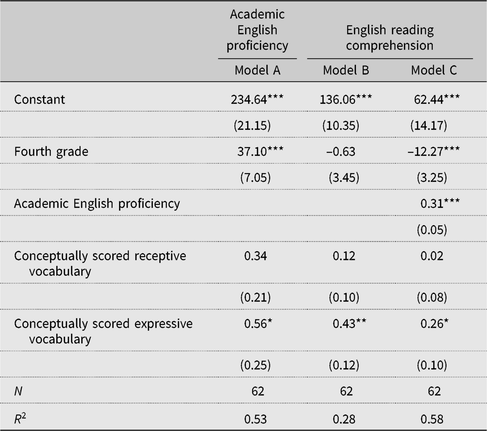
Table 4, Model A displays the OLS regression results with academic English proficiency as the outcome and conceptually scored receptive and expressive vocabulary as predictors. Grade level was included as a covariate, and second graders were the reference group. Fourth graders (B = 37.10, p < 0.001) had significantly higher academic English proficiency scores compared to second graders, on average. This coefficient reflects the difference in scores between second and fourth graders, accounting for their conceptually scored receptive and expressive vocabulary scores. Our regression results revealed that conceptually scored receptive vocabulary was not a statistically significant predictor of academic English proficiency. In contrast, conceptually scored expressive vocabulary was a significant predictor (B = 0.56, p < 0.05). This indicates that, on average, a 1-point increase in fall conceptually scored expressive vocabulary was associated with a 0.56-point increase in academic English proficiency, controlling for grade level. Finally, we tested for potential interaction effects by grade levels (e.g., conceptually scored expressive vocabulary × fourth grade), but none of the interaction terms were statistically significant (models not shown).
Ordinary least squares regression coefficients predicting academic English proficiency and English reading comprehension

Note: Conceptually scored receptive and expressive vocabulary were assessed with Receptive One-Word Picture Vocabulary Test—4: Spanish–Bilingual Edition and Expressive One-Word Picture Vocabulary Test—4: Spanish–Bilingual Edition, respectively. Raw scores were used for the conceptually scored vocabulary measures. Academic English proficiency and English reading comprehension were assessed with ACCESS for ELLs and MAP Growth reading, respectively. Overall scale scores were used for academic English proficiency, and Rasch unit scores were used for English reading comprehension. *p < 0.05. **p < 0.01. ***p < 0.001.
Research Question 2: Conceptually scored receptive and expressive vocabulary predicting English reading comprehension
Table 4, Models B and C show the OLS regression results with English reading comprehension as the outcome and conceptually scored receptive and expressive vocabulary scores as predictors. Grade level (second graders were the reference group) was again a covariate in both of these models, and academic English proficiency was also included as a covariate in Model C. As shown in Model C (our final model), academic English proficiency positively and significantly predicted English reading comprehension (B = 0.31, p < 0.001). We underscore, as noted in the Measures section, that we were interested in a global measure of academic English proficiency and thus utilized the ACCESS for ELLs overall scale scores analytically. However, we also proceeded to examine the effects of the three language domains/subtest scale scores from the ACCESS for ELLs (i.e., listening, writing, and speaking), excluding the reading language domain/subtest scale scores so that English reading comprehension would not be overcontrolled in the models. The overall findings remained unchanged, supporting the appropriateness of using the ACCESS for ELLs overall scale scores for parsimony. Further, on average, fourth graders’ English reading comprehension scores were lower than second-grade students’ scores (Model C B = –12.27, p < 0.001). As Table 2 shows, the fourth-grade students’ average English reading comprehension score was higher than that of the second-grade students, although the difference in scores was not statistically significant, t(60) = –1.64, p = 0.11. This nonsignificant difference between second- and fourth-grade students is reflected in Model B, where coefficient for fourth grade was not statistically significant (B = –0.63, p = 0.86). However, the parameter estimate associated with fourth graders in Model C becomes negative and statistically significant when an academic English proficiency variable is included in the analysis. This result indicates, for second and fourth graders who perform similarly on academic English proficiency, fourth graders are predicted to have lower English reading comprehension. Conceptually scored receptive vocabulary was again not statistically significant, but conceptually scored expressive vocabulary predicted English reading comprehension (Model C B = 0.26, p < 0.05). This indicates that a 1-point increase in conceptually scored vocabulary was associated with an average 0.26-point increase in English reading comprehension performance tested later in time, controlling for grade level and academic English proficiency. We tested for potential interaction effects by grade levels, but none of the interaction terms were statistically significant (models not shown).
Discussion
This study examined the relationship between conceptually scored vocabulary measures designed for Spanish-speaking children with varying levels of English proficiency and standardized measures of academic English proficiency and English reading comprehension. Our results revealed that conceptually scored expressive vocabulary was predictive of second- and fourth-grade Spanish-speaking English learners’ academic English proficiency and English reading comprehension, whereas conceptually scored receptive vocabulary was not. These results speak to both rationales for the study: first, they underscore the importance of utilizing conceptually scored vocabulary measures for Spanish-speaking English learners, and second, they lend insight into the need to distinguish the utility of receptive versus expressive vocabulary in models of reading comprehension for English learners. Our findings also contribute to the literature that supports leveraging students’ Spanish language for English language and literacy development. We discuss the theoretical, practical, and policy implications of our findings below.
Utility of conceptually scored vocabulary for English learners
There is no doubt that developing proficiency in English is critical for academic success in the US, where the language of instruction and assessment is predominantly English only. However, recent findings report that Spanish-speaking English learners who enter school with high Spanish language proficiency levels tend to also have higher English language proficiency in kindergarten, compared to students who enter with low or medium Spanish language proficiency (Arellano, Liu, Stoker, & Slama, Reference Arellano, Liu, Stoker and Slama2018). Students with high Spanish language proficiency tend to be reclassified by fourth or fifth grade and demonstrate grade-appropriate readiness. Relatedly, Umansky and Reardon (Reference Umansky and Reardon2014) found that Latino English learners in dual-language programs were reclassified as English proficient at a slower pace compared to those in English-only programs, but had higher long-term outcomes, such as the overall reclassification rate and higher English proficiency and academic performance. These findings align with the revised hierarchical model (Kroll & Stewart, Reference Kroll and Stewart1994) of bilingual language processing that suggest proficiency in one language supports proficiency in another language. The fact that second- and fourth-grade English learners’ conceptually scored vocabulary scores significantly correlated with and predicted future English language- and reading-related outcomes led to important theoretical, practical, and policy implications.
When English learners are assessed with single-language measures, studies report an achievement gap relative to English-proficient peers at the onset of schooling, and the gap appears to persist throughout the school years (e.g., Mancilla-Martinez & Lesaux, Reference Mancilla-Martinez and Lesaux2011; National Center for Education Statistics, 2018). Too often, assessment of English learners’ first language proficiency has been neglected, even though theoretical and increasing empirical evidence suggest that proficiency in the first and second language are closely related (Bilson et al., Reference Bilson, Yoshida, Tran, Woods and Hills2015; Cummins, Reference Cummins1979; Kroll & Stewart, Reference Kroll and Stewart1994; Proctor et al., Reference Proctor, August, Carlo and Snow2006). We are learning that, by attending to bilingual students’ language skills in both languages (i.e., the distributed nature of their vocabulary), the vocabulary gap is actually not as pronounced (Mancilla-Martinez et al., Reference Mancilla-Martinez, Ochoa and Greenfader2018; Mancilla-Martinez & Vagh, Reference Mancilla-Martinez and Vagh2013). Our current findings reveal a meaningful relationship between English learners’ conceptually scored vocabulary knowledge and standardized measures of English language and reading. This means that using measures that incorporate English learners’ first and second language skills can help educators gain a more comprehensive understanding of the conceptual knowledge English learners bring to language and reading tasks. This approach is theoretically supported by bilingual language development research as bilinguals acquire vocabulary utilizing a conceptual (language-free) system that subserves both languages, and thus assessing concepts—regardless of language—is critical (Kroll & Stewart, Reference Kroll and Stewart1994). Moreover, encounters with concepts rather than with lexical labels appears to contribute more to early vocabulary development (Jardak & Byers-Heinlein, Reference Jardak and Byers-Heinlein2019). Similarly, the knowledge hypothesis would predict that students who have knowledge of many words likely also have greater knowledge of the general concepts associated with these words, and by extension would have greater facility comprehending the text they read. Furthermore, administering conceptually scored vocabulary measures can be more cost- and time-effective than administering vocabulary measures separately in two languages. This also has direct practical implications by virtue of lessening the testing burden on students and teachers. However, an arguably more compelling rationale is that Spanish-speaking English learners in the US have too commonly been described as having limited language skills in both languages, contributing to a narrative that perpetuates the ill-informed notion of “semilingualism” (see MacSwan, Reference MacSwan2000). Utilizing conceptually scored vocabulary measures and taking students’ first language proficiency into consideration may help shift from a subtractive, deficit view of bilingualism toward a more additive, asset-oriented view of what English learners bring to learning.
Receptive versus expressive vocabulary
Previous research shows that both receptive and expressive language skills predict reading comprehension (e.g., Catts, Herrera, et al., Reference Catts, Herrera, Nielsen and Bridges2015; Scarborough Reference Scarborough1998; Snyder et al. Reference Snyder, Caccamise and Wise2005; Spear-Swerling, Reference Spear-Swerling, Ruddell and Unrau2004; Tunmer & Chapman, Reference Tunmer and Chapman2012). Thus, we hypothesized (based largely on theoretical grounds as empirical studies are scant) that both conceptually scored receptive and expressive vocabulary would be predictive of English learners’ academic English proficiency and English reading comprehension outcomes. However, this hypothesis only partially held true. We found that second- and fourth-grade English learners’ conceptually scored expressive vocabulary predicted their later academic English proficiency and English reading comprehension outcomes. However, their conceptually scored receptive vocabulary did not. This finding is particularly interesting given that previous research with monolingual English speakers has found no evidence of a distinction between receptive and expressive vocabulary outcomes (Lonigan & Milburn, Reference Lonigan and Milburn2017). As our measure of academic English proficiency encompassed both receptive (i.e., listening and reading) and expressive (i.e., speaking and writing) linguistic skills and our measure of English reading comprehension assessed mainly receptive linguistic skills, it remains an open question why English learners’ receptive conceptually scored vocabulary was not predictive.
One potential explanation is that the words that were targeted on the expressive measure included more words representative of academic language. Our post hoc examination of the target words on the conceptually scored receptive and expressive vocabulary measures indicate that the percentage of words on the statewide academic vocabulary list was higher for the expressive (22%) compared to the receptive measure (12%). Because the expressive vocabulary measure included a higher percentage of words from the academic vocabulary list compared to the receptive vocabulary measure, it is possible that the expressive vocabulary measure thus served as a stronger predictor of English reading comprehension and academic English proficiency. In other words, the receptive vocabulary measure was composed of a greater mix of both lower and higher frequency words compared to those in the expressive vocabulary measure. These differences in word-level characteristics of the target words in each measure may have influenced our findings. Notwithstanding, our current results reveal that conceptually scored expressive vocabulary is a more predictive measure of Spanish-speaking English learners’ later English language and literacy outcomes, which carries practical and theoretical implications.
From a theoretical standpoint, the ability to express vocabulary may be related to lexical quality and word retrieval. Perfetti (Reference Perfetti2007) defines lexical quality as “the extent to which a mental representation of a word specifies its form and meaning components in a way that is both precise and flexible” (p. 359), and posits that “word-level knowledge has consequences for word meaning processes in (reading) comprehension” (p. 257). Furthermore, high lexical quality includes robust knowledge of appropriate usage (Perfetti & Adolf, Reference Perfetti, Adolf, Sabatini, Albro and O’Reilly2012). Thus, the ability to produce a word may help explain the predictive role of expressive vocabulary for reading comprehension. Our findings may also implicate word retrieval, as more efficient word retrieval appears be related to high-quality lexical representations (Newman & German, Reference Newman and German2002; Ouellette, Reference Ouellette2006; Storkel & Morrisette, Reference Storkel and Morrisette2002). Likewise, Swain’s output hypothesis (Reference Swain and Lantold2000), albeit focused on linguistic competence and linguistic interactions among second language learners in general, suggests that as students produce expressive language in interactions with others, they “produce language more deeply, with more mental effort than does input, which would thus seem to have a potentially significant role in language development” (p. 99). Swain’s output hypothesis underscores the importance of language production as a central cognitive tool that helps with language knowledge construction, which is integral to reading comprehension. If expressive vocabulary does more effectively predict both academic English proficiency and English reading comprehension for English learners, it may be warranted to test more parsimonious models of both language development and reading comprehension for this population. For practitioners, this finding could help improve the efficiency of language assessment by narrowing the battery to include only expressive, rather than both expressive and receptive, measures. It may also justify greater attention to ensuring students are provided with ample instruction opportunities to first and foremost develop and refine conceptual understandings (Glaserfeld, Reference Glaserfeld and Watlawick1984; Harris et al., Reference Harris, Golinkoff, Hirsh-Pasek, Neuman and Dickinson2011; Langer, Reference Langer1984; Lipson, Reference Lipson1982; Resnick, Reference Resnick1983; Rupley et al., Reference Rupley, Nichols, Mraz and Blair2012; Ouellette, Reference Ouellette2006; Stanovich, Reference Stanovich1986; Stevens, Reference Stevens1980; Tennyson & Cocchiarella, Reference Tennyson and Cocchiarella1986) and to then also provide students with opportunities to engage in language production, a call made by several researchers (e.g., Dickinson & Porche, Reference Dickinson and Porche2011; Gámez, Reference Gámez2015; Mancilla-Martinez & Lesaux, Reference Mancilla-Martinez and Lesaux2011, Reference Mancilla-Martinez and Lesaux2017).
Limitation and future directions
As with any study, there are limitations and next steps to consider. First, and as previously acknowledged, our sample size was small, particularly when conducted by grade level. Furthermore, our sample was rather homogeneous in terms of linguistic and socioeconomic background (i.e., Spanish-speaking students from low-income, immigrant homes). Considering the exploratory nature of the current study, the results should be replicated with larger samples of English learners from diverse linguistic and socioeconomic backgrounds. Second, we only used one measure to assess the constructs of interest. More research studies that employ diverse measures are needed to replicate our findings. In particular, future research should explore the extent to which various measures of academic language relate to reading comprehension outcomes among early elementary grade Spanish-speaking English learners. On a related measures vein, a third limitation is that we did not assess word reading. The present study specifically focused on investigating the utility of conceptually scored vocabulary among elementary-aged students given that vocabulary represents a key barrier to language and literacy development for many English learners, and the associated complexity of operationalization and measuring vocabulary among English learners. Yet, previous work with English learners finds that word reading can exert an outsized predictive role for English reading comprehension, even in older students (e.g., Mancilla-Martinez & Lesaux, Reference Mancilla-Martinez and Lesaux2010).
Notwithstanding these considerations, our study extends an established line of research on the value of conceptually scored measures for toddlers and preschoolers for use with English learners during the formal school-age years. Our results suggest that supporting English learners’ expressive vocabulary development represents an important step, as its development appears to relate to both academic English proficiency and English reading comprehension. Schools can thus take advantage of the knowledge bilingual students bring—especially in their home language—to support their academic success. In this way, we might move from a limited view of English learners to a more asset-based view of their knowledge upon school entry and during the school years.
Acknowledgments
This research was supported by Eunice Kennedy Shriver National Institute of Child Health & Human Development Grant P20 HD075443 to Vanderbilt University. The content is solely the responsibility of the authors and does not necessarily represent the official views of the Eunice Kennedy Shriver National Institute of Child Health & Human Development or the National Institutes of Health.