Introduction
Although smoking epidemic is declining in developed countries, it is diffusing speedily in low- or middle-income countries.Reference Mackay and Crofton 1 – Reference Stebbins 3 Jordan, one of these countries with a population of 5.7 million, 4 has also experienced this epidemic. According to the most recent World Health Organization (WHO) report on the global tobacco epidemic, 5 the prevalence of tobacco use among Jordanian adult males was estimated to be as high as 62% and for adult females 8%. Tobacco use in Jordan and many other Eastern Mediterranean countries is not limited to cigarettes smoking; ‘water pipe’ represents an additional popular mode of tobacco intake.Reference Kandela 6 – Reference Tamim, Terro and Kassem 9 The WHO 10 ascertains that water pipe is not a harmless substitute to cigarette smoking as it also entails sober health risks. Tobacco use in general has been identified as a risk factor in the development of human diseases throughout different periods of life. It increases the risks of male and female infertility,Reference Augood, Duckitt and Templeton 11 , Reference Vine, Margolin, Morrison and Hulka 12 complicated pregnancyReference Castles, Adams, Melvin, Kelsch and Boulton 13 and various types of fetal abnormalities.Reference Bernstein, Plociennik, Stahle, Badger and Secker-Walker 14 – Reference Li, Mueller and Hickok 16 In addition, tobacco is a chief factor in heart diseases, strokes, chronic lung diseases and certain types of cancers. 17 Moreover, tobacco use has been linked to some other health problems like type II diabetes mellitusReference Willi, Bodenmann, Ghali, Faris and Cornuz 18 and orodental diseases.Reference Bergstrom, Eliasson and Dock 19 Hence, smoking prevention will decrease the development of tobacco-related diseases.
Smoking habits among Jordanian university students should merit special awareness as less attention in Jordan is given to young adult university students,Reference Kofahi and Haddad 20 which is the target group for this study. High cigarette-smoking rates were reported among university students in the Arab world. Accessible studies in Jordan,Reference Al-Omari and Hamasha 21 – Reference Khader and Alsadi 23 Saudi ArabiaReference Hashim 24 and LebanonReference Tamim, Terro and Kassem 9 showed that the prevalence of cigarette smoking ranged from 17% to 29%. Since Jordan is still in the early stage of the smoking epidemic, targeting the early adaptors like the better-educated adults and these with high socioeconomic status (SES) is extremely relevant giving their modeling role for the other segments of the young adult population that tend to imitate behaviors of their high SES peer.Reference Nierkens, de Vries and Stronks 25 Smoking behaviors in Jordan embody a big challenge to both policymakers and public health professionals; an important public health enterprise is to determine effective methods for promoting anti-smoking policies. Hence, theoretical research is essential to comprehend the psychosocial factors that are coupled with smoking behaviors.
This study aimed to investigate the psychosocial determinants of cigarette smoking among Jordanian university students. The first objective was to describe the prevalence of cigarette use and water pipe smoking in Jordanian university students. The second objective was to analyze differences in determinants between cigarette smokers and non-smokers. The third objective was to assess whether the I-Change model can explain cigarette-smoking behavior sufficiently.
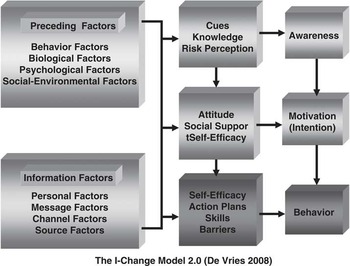
The theoretical framework for this study is the integrated model of behavioral and motivational change, abbreviated as the I-Change model,Reference De Vries, Mudde and Leijs 26 as it represents a comprehensive psychological model with inputs from diverse social cognitive models. The I-Change model (Fig. 1) acknowledges that behavior onset and change are complex processes, which are influenced by various proximal and distal factors. It differentiates between three motivational phases regarding a specific behavior, namely the pre-motivational, motivational and post-motivational phases. Predisposing factors include any behavioral factors that may affect cognitions. Of special concern are the life styles such as physical activity and consumption of healthy foods. The pre-motivational phase determines the development of cognitions through three major subdivisions: predisposing factors, information factors and awareness factors. The motivational phase consists of three well-defined dimensions namely attitude, social influence and self-efficacy. These three dimensions had been the core components of the earlier version of I-Change model when it was known as ASE model (attitude–social influence–self-efficacy model).Reference De Vries, Dijkstra and Kuhlman 27 The last and most proximal phase to the behavior is the post-motivational phase. The I-Change model presumes that intention is the most proximal determinant/predictor of current behaviors as well as a potent predictor of future behaviors, and has been used to study the determinants of smoking in various countriesReference Ariza, Nebot and Tomás 28 – Reference Vitoria, Kremers, Mudde, Pais-Clemente and de Vries 32 as well as for developing smoking prevention and cessation interventionsReference De Vries, Dijk and Wetzels 33 – Reference Vartiainen, Pennanen and Haukkala 35 and other lifestyle-related interventions.Reference De Vries, Kremers, Smeets, Brug and Eijmael 36
The I-Change model.26

Methodology
Procedure
The study was conducted at Al-Hussein Bin Talal University, south Jordan. Ethical approval was obtained from the Ethics Committee of the University. For the academic semester 2007–2008, 6864 students were registered, among which 58% were female students (M. Btoush, personal communication, 16 March 2008). The study was cross-sectional and data were collected using a close-ended self-administered questionnaire. A pilot test of the questionnaire was done before the study took place. Students were invited via a general invitation to participate in the study, and were explained that their data would be treated confidentially. An introductory letter was enclosed ensuring the anonymousness of the respondents and informing that by submitting the questionnaire passive informed consent was provided.
Questionnaire
The questionnaire consisted of 82 items that were based on existing questionnaires and scales. 37 – Reference Van Oort, Der Ende and Crijnen 46 A parallel translation method was used to translate the original English questionnaire in Arabic. This translation approach entails translating the source questionnaire to Arabic by a number of independent translators, comparing the two target questionnaires and subsequently creating the final version.
Measures
Predisposing factors
Behavioral factors: fruit intake (number of pieces of fruit per week) and physical activity (number of days per week active for more than 20 min) were measured. Psychological factors: the depressive status of the respondents was assessed using the Beck Depression Inventory (BDI).Reference Beck, Steer and Brown 47 This measurement tool has previously been translated into Arabic version,Reference Ghareeb 40 which has been proven valid and culturally relevant across many Arab countries.Reference Alansari 48 , Reference Alansari 49 The total level of depression was assessed by the summation of all scores where higher scores indicate greater depressed mood (α = 0.89). Biological factors: respondents were asked to indicate their gender (male = 1, female = 2) and their age. Social and cultural factors: three socio-cultural factors were included; Muslim identity (religion), living with family and level of emancipation. Muslim identity was adapted from a seven-item instrument.Reference Van Oort, Der Ende and Crijnen 46 Students were asked to indicate on a 5-point scale their personal beliefs (totally agree = 2, totally disagree = −2) for instance, I see myself as a real Muslim (α = 0.68). Students were asked to indicate if they lived with family (no = 1, yes = 2). The level of gender emancipation was assessed using a 10-item instrument.Reference Nierkens 44 Students were asked to indicate on a 5-point scale to what extent they agree with each statement (totally agree = 2, totally disagree = −2), for example, women can best be responsible for the housekeeping (α = 0.67).
Motivational factors
Perceived advantages of smoking were measured on a 5-point scale by four itemsReference Nierkens, Stronks, Oel and De Vries 38 (totally agree = −2, totally disagree = 2), for example, smoking makes me feel more comfortable (α = 0.89). Perceived disadvantages of smoking were measured on a 5-point scale by six itemsReference Nierkens, Stronks, Oel and De Vries 38 (totally agree = 2, totally disagree = −2), for example, If I smoke, I have a higher risk of getting lung disease (α = 0.88). Mean scores were then computed where higher scores indicate less pros and more cons. Social influences were assessed according to the European smoking prevention framework approach (ESFA) measurement tool, 37 where social norms, modeling and pressure were judged relating to two significant groups: family (parents and siblings) and peers (friends and fellow students). Social norms were measured on a 7-point scale, for example, my friends think that I definitely should smoke = −3 to definitely should not smoke = 3 (α = 0.83). Social modeling was measured by four items based on two different scales. Perceived behavior of the social environment was assessed by two items using 2-point scales (no = 0, yes = 1): Does one or more of your parents smoke? Does one or more of your siblings smoke? Owing to the low correlation between modeling from parents and siblings (r = 0.1), each item was used separately in the subsequent analysis. Perceived behavior of the peers was assessed by two items using 5-point scales (everybody = 4, nobody = 0): How many of your friends smoke? How many of your fellow students smoke? (r = 0.8). Social pressure was measured on a 5-point scale to assess how often they encountered social pressure not to smoke by parents, siblings and friends, for example, have you ever felt pressure not to smoke from your parents? (never = 0, very often = 4; α = 0.89). Self-efficacy was assessed by 10 items based on a 7-point scale (very confident = 3, very unconfident = −3; α = 0.95). Nine items were based on the ESFA questionnaire, 37 measuring equal numbers of social, stress and routine self-efficacy's sub-constructs. The 10th item addressed negative outcome self-efficacy.Reference Dijkstra, De Vries and Roijackers 39 Students indicated how confident they were not to smoke in social situations, for example, If you are with friends who smoke, in stressful situations, for example, If you feel nervous, in routine situations, for example, If you are at the shops with friends and finally in face of a negative outcome ‘If you experience withdrawal symptoms’.
Behavior
Respondents were classified as cigarette non-smokers (I do not smoke, I am an ex-smoker = 0) or as current smokers (I am currently a smoker = 1). Water pipe smoking was measured by a 3-point scale item, which was modified from an instrument for measurement of water pipe use.Reference Maziak, Ward, Afifi Soweid and Eissenberg 43 Students were asked to pick the statement that best described them. Accordingly, students were classified as water pipe smokers (=1) or non-water pipe smokers (=0).
Statistical analyses
Data were analyzed using the SPSS software program (version 13.0). Frequencies, descriptive and χ 2 tests were used to describe the characteristics of the population and to test differences in demographic characteristics between male and female students. Internal consistency of multi-item scales was measured using Cronbach's alpha (α). Furthermore, t-test and χ 2 tests were performed to assess significant differences in smoking determinants between smokers, and non-smokers and male smokers and female smokers. Binary logistic regression analysis was used to identify the factors that had the strongest unique association with smoking. Significant differences are given when P < 0.05.
Results
Characteristics of the sample
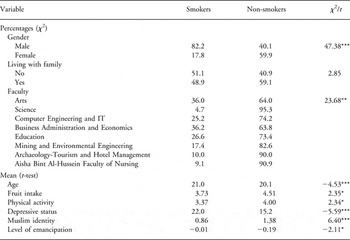
Of the 400 students agreeing to participate in the study, 374 (93.5%) returned the questionnaires. Twenty-seven questionnaires were excluded from further analysis either because the percentage of the missing data exceeded 10% or data on outcome variables was missing. Hence, the final sample was 347 respondents. Attrition analysis between included cases (n = 347) and excluded cases (n = 27) showed no significant differences in outcome variables. The sample consisted of 51% male student. This so seem oversampling of male students might be attributed to non-responses by female students. The mean age was 20.37 years (s.d. = 1.59). Just below half of the students was living away from their families (43%). The distribution of students according to faculties was as follows: College of Arts 24.8%, College of Science 12.4%, College of Computer Engineering and Information Technology 8.9%, College of Business Administration and Economics 19.9%, College of Education 18.4%, College of Mining and Environmental Engineering 6.6%, College of Archaeology, Tourism and Hotel Management 5.8% and Aisha Bint Al-Hussein Faculty of Nursing 3.2%. The mean pieces of fruit intake per week of the sample was 4.31 (s.d. = 2.74), which is noticeably lower than recommended by the WHO. 50 The mean days of physical activity per week was 3.83 (s.d. = 2.21) which is also lower than recommended. 51 The mean level of depressive status was 17.0 (s.d. = 10.33); according to BDI,Reference Beck, Steer and Brown 47 most students suffered from mild-to-moderate depression. Whereas the majority of students scored high in Muslim identity with a mean of 1.24 (s.d. = 0.61), the minority scored high in emancipation with a mean of −0.14 (s.d. = 0.63). One-fourth of the students (25.9%) were currently cigarette smokers, men were significantly more likely to currently smoke than women (41.8% v. 9.4%, P < 0.001). Smoking rates were significantly higher among Faculty of Arts students (36%) and Business Administration students (36%) and lower among Faculty of Science students (5%) and Nursing students (9%). Concerning water pipe smoking, the prevalence of currently smokers was 23.3%; again, men were more likely to smoke (35% for males v. 11.2% for females, P < 0.001). In addition, 13.5% of students were both cigarette and water pipe smokers.
Differences between smokers and non-smokers
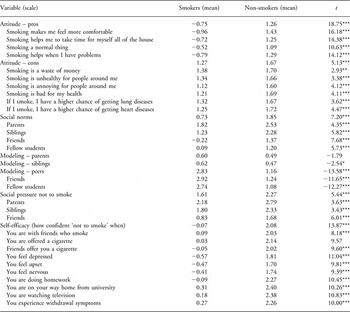
Differences in determinants between non-smokers and smokers are presented in Tables 1 and 2. Smoking students differed significantly from their non-smoker peers in all predisposing factors except for residency with family. Smokers were more likely to be males, older in age, consuming less fruits, being less physically active, having more depressive symptoms, having less Muslim identity and being more emancipated. In addition, analysis showed that smokers differed significantly from non-smokers on all motivational factors with the exception of modeling from parents. For the major significant differences, analyses at the item level showed that the two groups differed significantly on almost all determinants. Overall, non-smokers were significantly less convinced of the advantages of smoking and more convinced of the disadvantages of smoking. Non-smokers also reported more negative norms about smoking from their environment and encountered fewer smokers in their social environment. In addition, non-smokers encountered more social pressure not to smoke. Lastly, non-smokers reported significantly higher self-efficacy to refrain from smoking in all situations outlined in the questionnaire.
Demographic differences between smokers (n = 90) and non-smokers (n = 257)

*P < 0.05, **P < 0.01, ***P < 0.001.
Motivational differences between smokers (n = 90) and non-smokers (n = 257)

*P < 0.05, **P < 0.01, ***P < 0.001.
Regression analysis
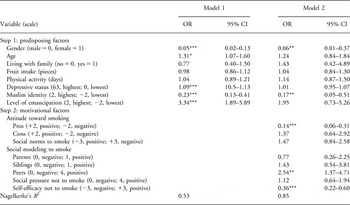
Table 3 summarizes the results of binary logistic regression analysis on the predisposing and motivational factors. The results with respect to the predisposing factors, which were entered in the first step, reveal that smoking was significantly associated with being male, older age, higher depression levels, a low Muslim identity and a high level of emancipation. These variables explained 53% of the variance in smoking behavior. In the second step, when the motivational factors were added, gender and Muslim identity remained significant. The effects of age, depressive status and level of emancipation became insignificant which implies that their effects are mediated by the cognitive factors. Perceived pros of smoking, modeling from peers and self-efficacy were found to be positively associated with smoking. The total explained variance of smoking behavior was 85%. Therefore, the inclusion of the motivational factors added another 32% of explained variance.
Results of logistic regression of smoking on predisposing factors and motivational factors

*P < 0.05, **P < 0.01, ***P < 0.001.
Discussion
This study assessed several psychosocial factors associated with smoking behavior in Jordanian university students. The first objective of this study was to describe the prevalence of cigarette use and water pipe smoking. Both smoking behaviors were widespread with cigarette smoking somewhat more prevalent than water pipe smoking (25.9% for cigarette v. 23.3% for water pipe). In accordance with most available Arab studies,Reference Tamim, Terro and Kassem 9 , Reference Al-Omari and Hamasha 21 – Reference Khader and Alsadi 23 , Reference Mohammed, Newman and Tayeh 52 this study revealed that equally cigarette and water pipe smoking were significantly more prevalent among males than females. Nonetheless, gender difference in prevalence with respect to water pipe smoking were smaller than cigarette smoking, which might be partly explained by the social acceptance of water pipe smoking among females.Reference Kandela 6 , Reference Tamim, Terro and Kassem 9 , Reference Maziak 53 Conversely, the conformist nature of the Arab society has tended to decline cigarette smoking by females.Reference Islam and Johnson 54 , Reference Maziak, Asfar and Mzayek 55 To compare the prevalence rates in this study with previous studies among university students in Jordan and other Arab countries, considerable variations are present. For instance, the overall prevalence of cigarette smoking ranges from 9% to 29%.Reference Kofahi and Haddad 20 , Reference Haddad and Malak 22 , Reference Hashim 24 , Reference Mandil, Hussein, Omer, Turki and Gaber 56 In addition, the prevalence rates of cigarette smoking and water pipe smoking among females range widely from 2% to 22% and from 5% to 23%,Reference Tamim, Terro and Kassem 9 , Reference Haddad and Malak 22 , Reference Hashim 24 respectively. These variations in smoking prevalence might be attributed to the noticeable methodological differences among various studies, such as lack of consistency in defining smoking status, particularly with respect to water pipe smoking. Moreover, inappropriately adopting/adapting non-Arabic instruments is additional problem. Underperformance of the translation process, underestimation of cultural sensitivity and inconsistency in terminology could also contribute to the discrepancy in prevalence statistics. 57 In addition, some Arab people are inclined to hide their smoking behaviors due to expected stigmatization and feelings of embarrassment, particularly among females. 58 Finally, inter-regional variation in smoking in Arab is conceivable; yet this topic in the Arab countries is understudied.
The second objective of this study was to analyze the differences in determinants between cigarette smokers and non-smokers. First, in accordance with Arab studiesReference Afifi 59 – Reference Yunis, Mattar and Wilson 61 and other international studies,Reference Klungsoyr, Nygard, Sorensen and Sandanger 62 – Reference Murphy, Horton and Monson 64 smokers were more likely to suffer from depressive symptoms than non-smokers. Second, males were more likely to smoke cigarettes than females. This is a persistent finding in most available Arab studies.Reference Tamim, Terro and Kassem 9 , Reference Al-Omari and Hamasha 21 – Reference Hashim 24 Furthermore, consistent with previous Arab studies,Reference Tamim, Terro and Kassem 9 , Reference Mandil, Hussein, Omer, Turki and Gaber 56 , Reference Maziak, Hammal and Rastam 65 smokers were older than non-smokers. Third, smokers had less Muslim identity than non-smokers. This negative association between smoking and religion has been also revealed by some Arab studies.Reference Maziak 53 , Reference Afifi Soweid, Khawaja and Salem 66 In addition, this study has revealed that smokers in general were more emancipated than non-smokers. This result is in concordance with an Arab study that compared smoking females with non-smoking ones, revealing that the former were more emancipated.Reference Maziak, Asfar and Mzayek 55 This association might be due to perceiving female smoking as a symbol of being free, independent and liberated.Reference Mohammed, Newman and Tayeh 52 , Reference Maziak 53 Significant differences were also found in smoking-related cognitions. Smokers had a more positive attitude toward smoking, perceived social norms toward smoking from family and peers and had higher numbers of smoking siblings and peers. In addition, smokers encountered less social pressure not to smoke from parents, siblings and peers. Finally, smokers had lower levels of social, stress, routine and negative outcome self-efficacy to refrain smoking than non-smokers did. Although the cognitive differences between smokers and non-smokers have been well studied in Western countries, only a few studies are available in Arab literature. Yet, most findings accord with the existing studies among high school and university students relating to attitude,Reference Haddad and Malak 22 , Reference Islam and Johnson 54 norms from family,Reference Al-Haddad and Hamadeh 67 modeling from both familyReference Mandil, Hussein, Omer, Turki and Gaber 56 and peersReference Mandil, Hussein, Omer, Turki and Gaber 56 , Reference Maziak, Hammal and Rastam 65 and self-efficacy.Reference Islam and Johnson 54
The third objective of this study was to assess whether the I-Change model could sufficiently explain smoking behavior in Jordanian students. Results reveal that the factors of the model explained 85% of the variance in smoking behavior, which is a satisfactory percentage of explained variance. In addition, the application of the model revealed several psychosocial determinants of cigarette smoking among Jordanian students. Male gender, older age, depressive status, lower Muslim identity, higher level of emancipation, perceiving more pros of smoking, modeling from peers and lower levels of self-efficacy were all significantly associated with smoking. These determinants raise a number of reflections. First, although males are more likely to take up smoking, females should also be given enough attention in health promotion actions and activities because of the steady increase in smoking among Jordanian females. Additionally, given that emancipated Arab women are at a greater risk to start smoking,Reference Maziak 53 , Reference Maziak, Asfar and Mzayek 55 it is recommended to invite local women's rights organizations to play a role in promoting lucid anti-smoking messages.Reference Maziak, Asfar and Mzayek 55 Second, since smoking onset is increasing with age, effective preventive efforts for younger peers in the age range of 12–25 are recommended to prevent them to take up smoking. Third, the significant association between Muslim identity and smoking highlights the importance of the religious conviction in promoting anti-smoking norms. Moreover, some useful lessons might be learnt from other countries’ experiences. For instance, it was found that integrating young adults in religious activities protect non-smokers from taking up smoking and assist current smokers in remaining off smoking as well.Reference Whooley, Boyd, Gardin and Williams 68
Some of the study outcomes are similar to those described in other cross-sectional and longitudinal studies. 69 Yet, interesting findings are not always identified in all studies and that needs further research to assess how a religious identity influences the development of certain beliefs about behavior. Other studies also assess similarities and differences of outcomes of socio-cognition models and outline similarities and novelties, for instance, concerning smokingReference Nierkens, Stronks and de Vries 70 , Reference Nierkens, Stronks, Oel and De Vries 71 or concerning HIV prevention.Reference Dlamini, Taylor and Mkhize 72 – Reference Taylor, Dlamini, Sathiparsad, Jinabhai and de Vries 74
Strengths and limitations
The study had considerable strengths. It is the first to provide insight into the psychosocial determinants of smoking among young adults in south Jordan. Furthermore, the study included a large number of variables, which contributed to uncovering further risk factors. Finally, the confinement of the study to a very narrow age range can be seen as a privilege in terms of staying away from the complexity of the ‘cohort effects’.Reference Breslau and Peterson 75 However, this study has some significant limitations. The first limitation is the cross-sectional design that was used. Hence, causal inferences cannot be made, which means that we cannot say whether or not, a more positive attitude preceded smoking behavior or was the result from smoking. It is, therefore, recommended that a longitudinal study be conducted in order to assess the directions of our findings. Yet, our results are in principle similar to those found in other international studies. Second, it was not feasible to include all factors proposed by the I-Change model in this study. For instance, in addition to the awareness and information factors, availability and prices, parental practices and academic achievement are considered important factors. Third, the results of this study were based on participant's self-reports; biochemical validation was not feasible. ‘To minimize underreporting of smoking behaviors as possible, substantial efforts were made to ensure students’ confidentiality and anonymity. As such, many studies assured that self-report method would be reliable.’Reference Caraballo, Giovino, Pechacek and Mowery 76 – Reference Vartiainen, Seppälä, Lillsunde and Puska 78 The fourth limitation concerns the extent to which study's findings can be generalized. As the study has only sampled students in Al-Hussein Bin Talal University, which is located in the suburban Ma'an city, results may not be generalized to other universities in Jordan. Students living in more urbanized cities may have different motives to smoke.Reference Islam and Johnson 54 Lastly, ex-smokers were categorized under non-smoker group for analysis purposes. Although further analysis did not show significant differences in outcome measures when ex-smokers were excluded from analysis, a better approach might be to consider ex-smokers in a separate group formerly.
Practical implications
The findings of this study results in a number of implications. First, since men were more likely to take up smoking, future research is needed to assess differences in determinants of smoking onset between men and women. Second, there is an apparent need for behavior change interventions to limit the acceleration of smoking epidemic among Jordanian university students. The development of such interventions may require data from longitudinal studies to replicate these results and verify the chronological sequences. Alongside with focusing on preventing the initiation of smoking, these interventions also need to focus on cessation assistance. Promoting a smoke-free university with strict policy is necessary to maintain the desired long-term benefits. Third, it is recommended to construct and validate questionnaires for measuring cigarette smoking and water pipe smoking separately. Fourth, as the study revealed considerable degrees of depressive symptoms, low fruit intake and low physical activity among student populations, prompting healthy food habits, physical activity and mental health are recommended. Fifth, as the results of this study showed various similarities in smoking determinants between Jordanians and some other Western populations, existing evidence-based anti-smoking interventions might be applicable to the Jordan situation. Finally, the fact that the I-Change model could explain a good amount of variance in this study shows it can be a promising theoretical background for coming studies in Jordan and other Arab countries.
Conclusions
This study has shown that cigarette and water pipe smoking behaviors are equally prevalent among university student populations, predominantly among male students. To limit the spread of smoking epidemic among this population segment, comprehensive societal tobacco control measures, including university-based smoking prevention intervention, are needed. The I-Change model proved to be applicable to determine smoking behavior in this setting.