Exoskeletons are electromechanical devices that are worn by a human operator and designed to increase the physical performance of the wearer (Reference Cenciarini and Dollar1). Exoskeleton technology has evolved substantially over the past decade as a result of improvements in robotics technology and mechatronics technology (Reference Mertz2). Exoskeletons produced by Ekso Bionics Holdings (EKSO™) in the United States (Reference Ekso3), Rex Bionics PLC (REX®) in New Zealand (Reference Rex4), ReWalk Robotics (ReWalk™) in Israel (Reference ReWalk5), and Parker Hannifin Corp (Indego®) in the United States (6), have already reached the commercial market internationally (Reference Gwynne7). In addition, a system developed by Cyberdene (the hybrid assisted limb - HAL®) in Japan received a global safety certification in 2013 and has subsequently received an EC Certificate of Conformity in Germany, although is yet to be distributed widely within Europe (Reference Woollaston8).
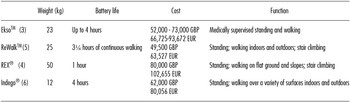
All of the currently available commercial systems have different design specifications in terms of overall configuration, weight, battery life, cost, and functionality (see Table 1), but the overall aim of each system is to enable individuals who have been paralyzed by neurological dysfunction to stand up and walk.
Design Specifications of Commercially Available Exoskeletons

There have been recent reports in the media, which sensationally refer to the current exoskeleton systems as “extraordinary robotic suits that enable those with paralysis to stand and walk” (Reference Buckland and Low9). Indeed for some individuals with neurological impairment, these exoskeletons will provide their first opportunity to be mobile without their wheelchair. However, there are also opposing accounts on social media, written by wheelchair users who do not consider current exoskeletons to be a satisfactory alternative to the independence afforded to them by their wheelchairs. For example, Nicholson (Reference Nicholson10) states “My wheelchair is a very capable tool and to be honest, the last thing I want is to be strapped to a District 9-esque robot and become a puppet in some corporations half-baked execution of an obsession with making the non-walkers walk again.”
Despite their functional capabilities, the existing generation of exoskeletons have significant limitations with respect to their affordability, size, weight, speed, and efficiency (Reference Mertz2). The exoskeletons available within the United Kingdom to date weigh between 12 kg (6) to 38.5 kg (Reference Rex4). Although the user physically carries none of the weight of the device while standing and walking (because the device fully supports the user's body weight in addition to its own weight), they are heavy and cumbersome pieces of equipment to maneuver when trying to put on and take off, transport, and store.
Furthermore, walking speed is markedly reduced when wearing an exoskeleton as compared to normal walking speed in an able-bodied adult. Bohannon (Reference Bohannon11) published normative values for comfortable and maximal gait speeds based on data from 230 healthy individuals. Comfortable gait speed for young adults in their 20s is cited as 1.39 m/second (males) and 1.40 m/second (females), whereas for those in their 70s as 1.33 m/second (males) and 1.27 m/second (females). In contrast, walking speeds for those with spinal cord injury who have been trained to walk using the ReWalk™ exoskeleton are reported to range from 0.03 to 0.5 m/second (Reference Gwynne7;Reference Esquenazi, Talaty, Packel and Saulino12). Consequently, whereas the exoskeleton may restore an individual's ability to walk, it does not yet do so at a speed that is commensurate with ambulation being a functional component of mobility for those with neurological impairment. Indeed, there is evidence to suggest that walking within an exoskeleton is slower than mobilizing in either a manual or powered wheelchair. Karmarkar et al. (Reference Karmarkar, Cooper, Wang, Kelleher and Cooper13) report an average speed of manual wheelchair propulsion of 0.64 m/second and an average speed of powered wheelchair mobility of 0.7 m/second in adults aged 50 years or older while using their wheelchairs in a community setting.
These limitations reduce the access to and, hence, the functional usefulness of these devices for individuals with neurological impairment. Future devices are likely to harness emerging innovative technology such as 3D printing to develop bespoke, lightweight devices based on individual body size and shape (Reference Cowan, Fregly, Boninger, Chan, Rodgers and Reinkensmeyer14). The development of a device, which is functionally useful, safe, and imperceptible to all but the user, is, therefore, likely to be the ultimate goal in the design of exoskeleton technology.
A recent Wintergreen research report states that the rehabilitation robot market will grow from 43.3 million USD to 1.8 billion USD by 2020 (Reference Tobe15). The lucrative potential of this technology, however, should not overshadow or take focus away from the need to understand how the technology can be accessible and useful to the end user.
Evidence that considers the development of more established and accessible assistive technology such as functional electrical stimulation, where electrodes are used to stimulate contraction of weak or paralyzed muscles, advocates user involvement in the design process to ensure appropriate usability of the end product within everyday life (Reference Demain, Burridge and Ellis-Hill16). McMillen and Söderberg (Reference McMillen and Söderberg17) suggest that assistive technology may only be accepted by a person with disability if they see the device as useful for their own purposes. Others (Reference Brown-Triolo, Roach, Nelson and Triolo18) advocate that people with disability act as consultants in the development process of assistive technology, to provide valuable insight, ensuring that devices developed provide end users with worthwhile gains in independence and quality of life.
The authors are part of a team at University College London who, with a grant from the Engineering and Physical Science Research Council, seek to develop a wearable assistive material for use in exoskeleton technology. Thus the current study aims to identify and review existing literature that reports user perspectives of exoskeleton technology to inform the design and technical development of future devices.
METHODS
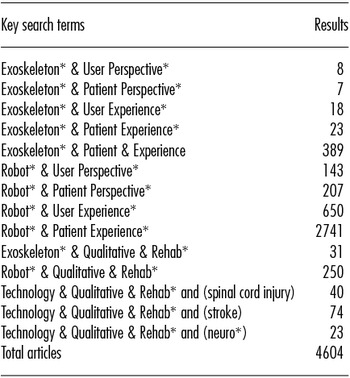
A literature search was conducted across several healthcare related online databases, including Pubmed, Scopus, The Cochrane Library, Medline, and Cinahl. The search terms exoskeleton or robot were combined with the terms user perspectives or patient perspectives and user experiences or patient experiences. The terms qualitative and rehabilitation were combined with technology, robot, or exoskeleton using Boolean operators. The terms qualitative, rehabilitation, and technology, were then further combined with the terms spinal cord injury, or neurological, or stroke. Terms were truncated to capture all possible derivatives of a key word (see Table 2). Searches were limited to published articles, written in English. No year restriction was entered. The search was initially conducted in September 2014 and revised in April 2016.
Results from Database Search

To be selected for review, articles were required to meet the following inclusion criteria: (i) Exoskeletons, meeting the following definition “Powered motorized orthosis that is placed over a paralyzed person's limbs for the purpose of facilitating standing, walking, climbing stairs and performing activities of daily living” (Reference Miller, Zimmermann and Herbert19), must have been evaluated within the study; (ii) Study participants must have been diagnosed with a neurological impairment that reduced their ability to move independently; and (iii) User perspectives of exoskeleton technology must have been reported as an outcome of the study.
Studies were not excluded on the basis of research methods; those using qualitative methods and quantitative methods (all research designs) where included.
The literature searches were completed by D.H., who screened the titles and abstracts of all studies. Irrelevant titles were excluded from the review process. Abstracts were also reviewed for relevance against the inclusion criteria. Potentially included studies were reviewed independently by D.H. and Y.P. against the inclusion criteria, before deciding in common, which studies met these. Discrepancies in opinion would be resolved by a third reviewer, but these did not occur. D.H. extracted data from all included studies, and Y.P. reviewed the data. The data extraction sheet was then reviewed by all authors against the inclusion criteria.
RESULTS
Study Selection
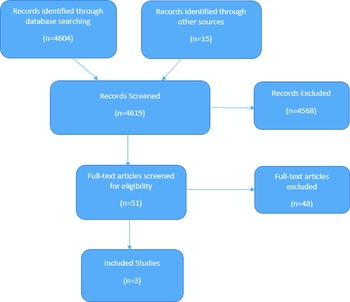
A total of 4,604 studies (see Table 2) were identified using the search terms, of which 4,516 were excluded following the screening of the titles. Of the remaining eighty-eight studies, a further fifty-two were excluded based on the review of their abstract against the inclusion criteria. The remaining thirty-six articles were reviewed in full by two authors. A further fifteen articles were identified from references cited in those articles. Of the fifty-one articles selected for full review, only three were identified that met the inclusion criteria (see Figure 1).
Flow diagram detailing literature review process.

Study Characteristics
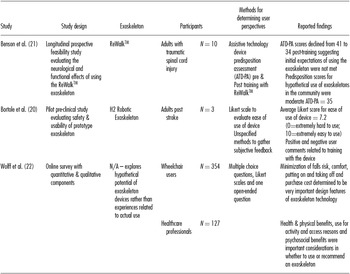
Of the studies included, one was a pilot preclinical study to evaluate the functionality, safety, and usability of a prototype robotic exoskeleton for individuals post stroke (Reference Bortole, Venkatakrishnan and Zhu20); another was a longitudinal prospective feasibility study evaluating the neurological and functional effects of using the ReWalk™ exoskeleton in individuals with spinal cord injury (Reference Benson, Hart, Tussler and van Middendorp21); and the other used an online survey to examine and compare stakeholder (wheelchair user and healthcare professionals) perspectives of exoskeleton technology, with respect to perceived importance for design features and potential reasons for use (Reference Wolff, Parker, Borisoff, Mortenson and Mattie22). Further details of each study are provided in Table 3.
Summary of Findings from Studies Reviewed

DISCUSSION
Within the literature, there are examples of different prototype exoskeletons that have been developed for use during rehabilitation of individuals with neurological impairment. Several studies use therapeutic outcome measures to determine the efficacy of exoskeleton technology as compared to standard rehabilitation (Reference Esquenazi, Talaty, Packel and Saulino12;Reference Rosati, Oscari and Reinkensmeyer23). Other studies describe the development of specific design features of exoskeletons to augment or replace functional movement in individuals with neurological impairment (Reference Zeilig, Weingarden, Zwecker, Dudkiewicz, Bloch and Esquenazi24;Reference Giszter25). Nevertheless, only three studies were identified that report user perspectives of exoskeleton technology and all of these have been published within the past 2 years. This might be explained because exoskeletons are relatively novel devices. Consequently, only a small number of users have had the opportunity to use the technology, with very few individuals having their own exoskeleton.
Two of the studies included in this review report user perspectives related to experience of using an exoskeleton as one of several outcome measures used to determine feasibility (Reference Benson, Hart, Tussler and van Middendorp21) and safety (Reference Bortole, Venkatakrishnan and Zhu20) of exoskeleton use in a clinical setting.
Bortole et al. (Reference Bortole, Venkatakrishnan and Zhu20) used a single Likert-scale question to evaluate user perspectives regarding ease of use of the device. They report the average rating for all participants across all training as 7.2, where 0 indicates “extremely hard to use” and 10 indicates “extremely easy to use.” This suggests that users found this particular device easy to use, but this result should be viewed with caution due to the fact that the small number of participants were reported to be less impaired than, hence not representative of, the target stroke population that are ultimately intended to benefit from using this device.
Furthermore, these results relate to one specific device design and cannot, therefore, be extrapolated to other devices. However, in posing the question to the participants regarding ease of use, the authors appear to consider that it is important that exoskeletons are easy to use. This matter might be explored in greater depth by designers to establish an understanding of the basis on which users determine ease of use in relation to the design and function of exoskeletons and their applicability in daily life.
In contrast, Benson et al. (Reference Benson, Hart, Tussler and van Middendorp21) evaluated user perspectives of the ReWalk™ exoskeleton using the Assistive Technology Device Predisposition Assessment© (ATD-PA) questionnaire. Before training, questions focused on users’ expectations of the device, whereas at the end-point of the study, questions assessed users’ experiences of the exoskeleton and their expectations for hypothetical use of the exoskeleton in the community. ATD-PA scores were higher at pretraining and declined at the end-point of the study, suggesting that, although participants had positive expectations of using the exoskeleton, not all of those expectations were met. ATD-PA scores for expectations of using an exoskeleton in the community were reported as moderate for those who completed the study and as poor for those who did not.
Benson et al. (Reference Benson, Hart, Tussler and van Middendorp21), report adverse events associated with use of the exoskeleton, numerous postponements to the anticipated training schedule, and a significant drop-out rate among their participants with only five of ten participants completing the training. It is possible that these events had an impact on users’ perspectives of exoskeleton technology, with the reality of the experience not aligning to their preconceived aspirations. Indeed of those who dropped out of the study, ATD-PA scores were lower than those who had completed the training, suggesting greater disillusionment with the technology based on their experience.
The final study included in this review aimed to evaluate perspectives on potential rather than actual use of exoskeleton devices (Reference Wolff, Parker, Borisoff, Mortenson and Mattie22). Among other questions, participants ranked seventeen design features of exoskeletons on a Likert scale from 1 (very unimportant) to 5 (very important). Those features that were considered very important by users were comfort, minimized risk of falling, repair and maintenance costs, and purchase cost; whereas those features listed as important were range of battery life, ease of putting on and taking off the device, ability to walk on uneven surfaces, portability of the device, amount of energy needed for use, and ability to carry out daily tasks while standing. Findings from this study might be useful to inform priorities for future development of exoskeleton technology, based on the perceptions of potential users. However, Benson et al. (Reference Benson, Hart, Tussler and van Middendorp21) suggest that perceptions of and experience of exoskeleton technology might be incongruent. Indeed, based on their findings, they suggest the need for further independent investigation into consumers’ perspectives on the novel use of exoskeletons to elucidate how users might determine the cost versus benefit of exoskeleton use.
These findings are supported by evidence identified across a wide spectrum of literature relating to more established assistive technology and its use by those with neurological disability, which suggests the value of involving end users in technology design to ensure their often-complex needs are met (Reference Cowan, Fregly, Boninger, Chan, Rodgers and Reinkensmeyer14;Reference Shah and Robinson26).
Lane et al. (Reference Lane, Usiak, Stone and Scherer27) state that capturing the wants and needs of the end user is a common practice in consumer product marketing and in the medical device design process but is a practice not widely applied to assistive technology. Assistive technology, being any item, piece of equipment, software, or product system that is used to increase, maintain, or improve the functional capabilities of individuals with disabilities (28), therefore, includes exoskeleton technology within its definition. Assistive technology abandonment by end users is a well-documented phenomenon (Reference Biddiss and Chau29;Reference Kittel, Marco and Stewart30) and underlies the emerging awareness that individuals with disability should be involved in the development of assistive technology relevant to their needs (Reference Cowan, Fregly, Boninger, Chan, Rodgers and Reinkensmeyer14).
Shah and Robinson (Reference Shah and Robinson26) identify that the main benefits of user involvement with respect to medical device technology development and evaluation are increased access to user needs, experiences, and ideas; improvements in medical device design and user interfaces; and an increase in the functionality, usability, and quality of the devices. Indeed, Wolff et al. (Reference Wolff, Parker, Borisoff, Mortenson and Mattie22) have demonstrated that users are able to provide insight into their priorities for exoskeleton design based on their perceived needs. Shah and Robinson (Reference Shah and Robinson26) also identified barriers to user participation, which relate to the time and cost associated with involving them in the design process. However, they conclude that, despite limited resources, user involvement is essential in the development and evaluation of medical device technology.
Kiesler and Hinds (Reference Kiesler and Hinds31) suggest that technical advances with respect to assistive technology have up until now dominated the published literature, and argue that the fundamentals of robotic design need also to consider psychological and social factors. Pape et al. (Reference Pape, Kim and Weiner32) suggest that the successful integration of assistive technology into daily living requires potential device users to explore the meanings they assign to specific devices; their expectations of assistive technology; the anticipated social costs and the degree to which their disability defines their identity. All of these considerations could be usefully explored with respect to exoskeleton technology in those with neurological impairment.
In evaluating user perspectives of exoskeleton technology, Benson et al. (Reference Benson, Hart, Tussler and van Middendorp21) used the SCI-specific Appraisals of Disability: Primary and Secondary Scale (ADAPSS) questionnaire to assess participants’ appraisal of their individual coping strategy related to their disability. Results showed considerable differences in appraisal of disability between the participants at the onset of the study, with some individuals’ scores increasing and others decreasing over time. Such differences between individuals with the same neurological condition (spinal cord injury), although not a homogenous sample, emphasize how each individuals’ unique experiences of their disability, might shape their overall perspectives of exoskeleton technology.
Some individuals might view exoskeleton technology as a means to restore their ability to walk, with the expectation that they will be able to resume normal functional ambulation in daily activities. As such, the anticipated impact on social participation and quality of life is likely to redefine their perception of self. However, for others, the technology may not meet their aspirations with respect to functional ambulation, for example due to speed, and the appearance of the device in situ might lead them to feel more conspicuous with respect to their disability. Brown-Triolo et al. (Reference Brown-Triolo, Roach, Nelson and Triolo18), in their study looking at consumer perspectives on mobility relating to neuroprosthesis design, report that individuals with spinal cord injury seem ready to disregard anything that will add to stigma, regardless of how effective it is. Therefore, only by seeking an understanding of potential stigma associated with the use of exoskeleton technology will designers be able to develop products that mitigate these concerns.
Bates et al. (Reference Bates, Spencer, Young and Rintala33) report the possibility of intense emotional responses to the introduction of wheelchairs and other assistive devices into a person's life following the onset of acquired disability. It is possible that similar emotional responses might be expected when an individual is introduced to exoskeleton technology. The responses may vary from the extremes of euphoria associated with re-enablement, to despair associated with a renewed realization of loss. Meanings attributed by the user to assistive technology play a decisive role in whether the technology will be successfully integrated into an individual's life (Reference Pape, Kim and Weiner32).
McMillen and Söderberg (Reference McMillen and Söderberg17) suggest that a device may only be accepted by the person who sees the aid as useful for their own purposes. Shah et al. (Reference Shah, Robinson and Alshawi34) suggest that end users quickly discard devices that do not fulfil their personal expectations, even though manufacturers and healthcare professionals may consider those end users’ requirements met. This appears consistent with the findings of Benson et al. (Reference Benson, Hart, Tussler and van Middendorp21), particularly in relation to participants’ reduced ATP-DA scores over time, which suggest that the device did not meet their expectations, and the overall drop-out rate, which suggests device abandonment. It is, therefore, important to acknowledge a potential for discrepancy between end users of technology and those responsible for its development and prescription, further justifying the relevance and importance of user involvement within design processes.
It has been suggested that the development of most medical devices arise from either the desire to fulfil an unmet need in healthcare diagnosis or treatment, or because a scientific/technological advance offers an improved solution to a known problem (Reference Martin, Murphy, Crowe and Norris35). Pioneers of new medical technology are typically scientists or engineers with little experience as device users (Reference Martin, Murphy, Crowe and Norris35). As a consequence, there is a risk that end-products will not meet the needs of the population for which they have been developed. Kilgore et al. (Reference Kilgore, Scherer and Bobblitt36) suggest that from the consumer's perspective, the focus of research to restore function ought to be based on the needs and desires of the consumer, not just in the scientifically intriguing aspects of a particular technology.
The development of exoskeleton technology has caught the attention of popular media, who describe the technology as revolutionary (37). It has been acknowledged that the wider acceptance of exoskeletons for both rehabilitation and function is dependent on the end user being central to the design and development of the technology (Reference Pons38). Nevertheless, the current literature review has identified a paucity of evidence to suggest that the scientific community responsible for development of exoskeleton technology have identified or sought to understand the needs or desires of individuals who may ultimately benefit from using it to augment their functional independence.
CONCLUSION
Although exoskeleton technology has evolved in recent years, the evidence base that focuses on the design specifications of the technology far outweighs the evidence that considers user perspectives of the technology. There is evidence to suggest that exoskeleton technology has the potential to improve the functional capabilities of individuals with neurological impairment, particularly in relation to ambulatory outcomes (Reference Esquenazi, Talaty, Packel and Saulino12;Reference Bortole, Venkatakrishnan and Zhu20;Reference Benson, Hart, Tussler and van Middendorp21;Reference Zeilig, Weingarden, Zwecker, Dudkiewicz, Bloch and Esquenazi24). However, there is minimal evidence that reports user perspectives of exoskeleton technology and no evidence that reports involvement of users in the development or design of exoskeleton technology.
The heterogeneity of the few studies included within this review leaves the authors unable to suggest any consensus as to user perspectives of exoskeleton technology. Further research is required to improve our understanding of the needs and aspirations of potential users of the technology to inform successful designs. However, from studies included within this review it is apparent that users are able to hypothesize and express opinions about what they consider to be the priorities for exoskeleton design, opinions that might usefully inform the process of exoskeleton design. It is also apparent that user's perceptions of exoskeleton technology might change in response to experiences of using the technology.
The authors, therefore, suggest that exoskeleton design should be an iterative process, whereby user perspectives are sought, incorporated, and continually refined by tangible experience with exoskeleton devices to ensure that devices developed are acceptable and usable by the populations they seek to re-enable. Future work is, therefore, also required to establish the feasibility and effectiveness of user-centered design in relation to exoskeleton technology.
The authors also wish to encourage research groups that have achieved the commercialization of their exoskeleton technology to publish their findings from focus groups investigations.
CONFLICTS OF INTEREST
The authors acknowledge the support of the wider Wearable Assistive Material (WAM) Project Group: Richard Jackson; Mark Miodownik; Benjamin Oldham; Kristopher Page; Quentin Pankhurst; Ivan Parkin; Mark Ransley; Nick Tyler; and Rhys Williams. This work was supported by the Engineering and Physical Sciences Research Council (grant number EP/K020323/1). Mrs. Hill reports grants from Engineering & Physical Sciences Research Council, during the conduct of the study. Dr. Holloway, Morgado Ramirez, and Smitham report grants from EPSRC during the conduct of the study. Dr. Pappas has nothing to disclose.