Introduction
Interpretation of curved saw marks on masonry from Bronze Age Greece has led some to propose the existence of a stone-working device known as a pendulum saw (Pendelsäge). Although no physical examples survive in the archaeological record, a blade attached to a vertical pendulum is thought to have swung back and forth to cut hard sedimentary rock, such as conglomerate. This hypothetical device represents a remarkable innovation in Mycenaean craftsmanship during the late fourteenth and thirteenth centuries BC. It has received much attention in recent scholarship due to its impressive cutting capability and the prospect that both the Mycenaeans and the Hittites employed the technology (e.g. Schwandner Reference Schwandner, Hoffmann, Schwandner, Hoepfner and Brandes1991; Küpper Reference Küpper1996: 16–25; French Reference French2002: 56; Neve Reference Neve and Hopkins2002: 93; Wright Reference Wright, Deger-Jalkotzy and Lemos2006a: 34; Seeher Reference Seeher2007: 31–34, 2008: 3–8; Thaler Reference Thaler, Antoniadou and Pace2007: 295; Blackwell Reference Blackwell2014: 454, 460–62). Current understanding of the nature of the pendulum saw stems from the observation of preserved tool marks on masonry and sculpture, and from reconstructions based on those cuts. Küpper's (Reference Küpper1996: 21–24) valuable monograph on Mycenaean architecture proposed grandiose heights—up to 8m—for the pendulum saw and its support frame, generating an awe-inspiring perception of the device (Wright Reference Wright1999: 361, Reference Wright, Deger-Jalkotzy and Lemos2006a: 34; Thaler Reference Thaler, Antoniadou and Pace2007: 295). Several questions remain about the size and mechanics of the pendulum saw, thus prompting modern experimentation to elucidate this Bronze Age technology.
Understanding the pendulum saw's operation is necessary to evaluate scholarly interpretations of the prehistoric tool marks. The decision to build and experiment with a pendulum saw stemmed from questions concerning the saw's blade shape and the method of height adjustment during a cut. Several proposals for the design of the pendulum saw already exist, including one built by Seeher (Reference Seeher2007, Reference Seeher, Pirson and Wulf-Rheidt2008) for a stone-cutting experiment related to central Anatolian (Hittite) masonry. Despite these earlier reconstructions, this paper provides the first detailed report of the pendulum saw's functionality. The aim here is to publish the results of several experimental cuts, to compare the new markings against preserved Mycenaean incisions and to propose the most effective pendulum saw design. The findings notably call into question the imposing conceptions of the device's size.
Traces of the pendulum saw in the archaeological record
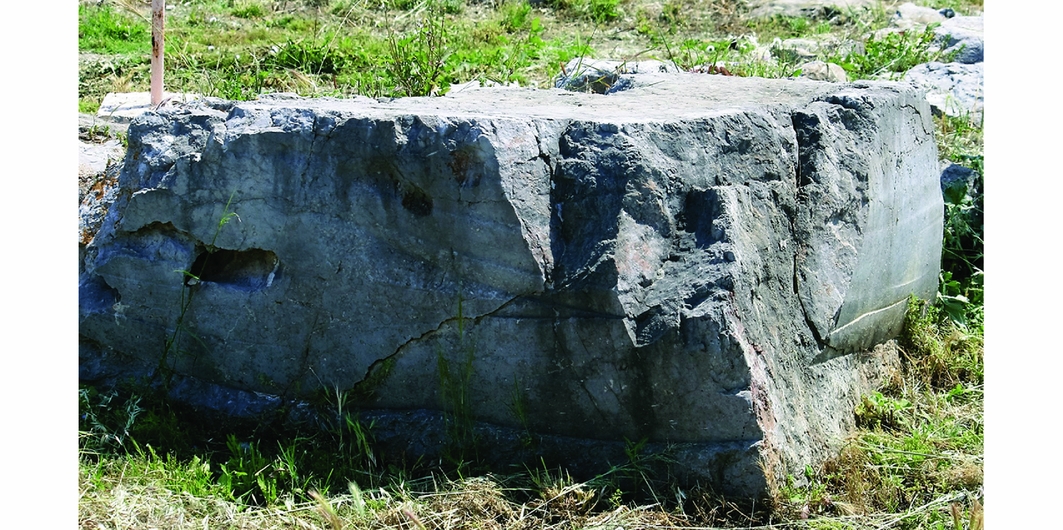
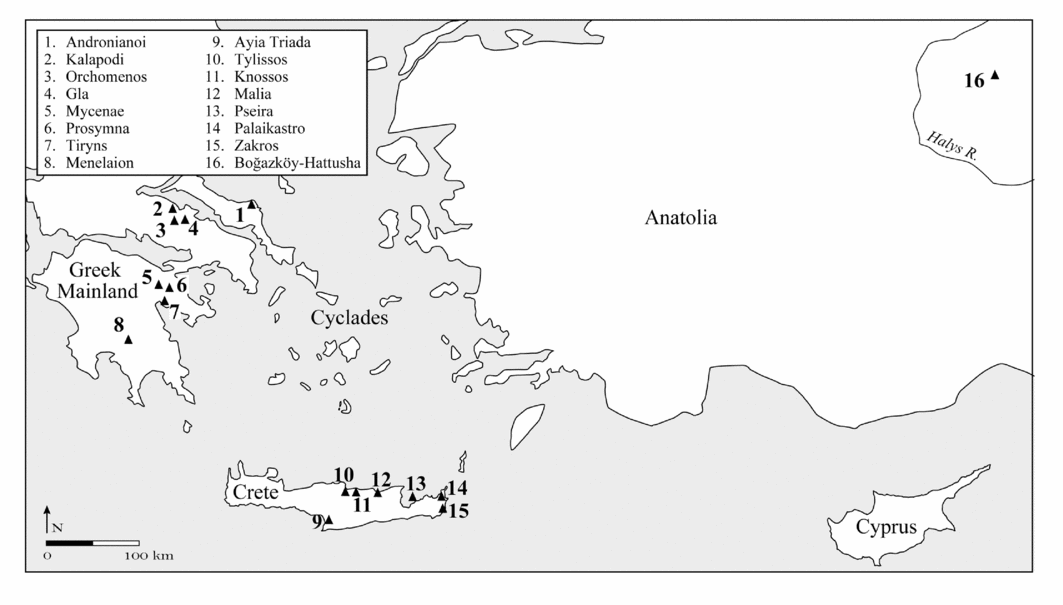
Early archaeologists excavating at Tiryns, near Argos (Dörpfeld Reference Dörpfeld and Schliemann1885; Müller Reference Müller1930), believed curved cuttings visible on masonry (Figure 1) to have been made by a sawing knife (Messersäge). Such a handheld tool, however, would have been ineffective in preparing the conglomerate and various types of limestone found throughout the Oberburg (upper citadel) of the site (for an overview of stone at Tiryns, see Maran Reference Maran, Maran, Juwig, Schwengel and Thaler2006; Brysbaert Reference Brysbaert2015). By the late twentieth century, scholars explained the same curved markings as the product of a pendulum saw (Schwandner Reference Schwandner, Hoffmann, Schwandner, Hoepfner and Brandes1991; Küpper Reference Küpper1996). Evidence for the device has now been recognised at several Greek mainland sites. Although Tiryns and Mycenae exhibit the most conspicuous incisions, threshold blocks in the Melathron at Gla and the Treasury of Minyas at Orchomenos also attest to the use of the sawing technique north of Mycenae and Tiryns, in the central Greek region of Boeotia (see Figure 2 for a map with key sites).
Limestone anta from Tiryns’ great propylon, showing numerous pendulum saw cuts.

Map with sites mentioned in the text (© Tina Ross).

The length, depth and angle of the pendulum cuts on Mycenaean architecture vary, for the device fulfilled different needs, depending on the block. Markings on thresholds are relatively shallow, while cuts on antae and pillar bases are substantially deeper (Küpper Reference Küpper1996: pls 5–13). The primary goal in sawing a threshold block was the delineation, in a straight line, of the block's front and back edges. As only the uppermost threshold remained above ground, the lower portions of the blocks were roughly worked and not sawn. The sides of pillar bases and antae were visible, so masons employed the pendulum saw to fashion the entire exposed surface. How the pendulum saw produced the deepest cuts on these blocks was investigated through experimental work.
At Tiryns, masons selectively used the pendulum saw at key architectural locations. Within the citadel the device was frequently employed at transitional spaces, such as gateways and thresholds, where conglomerate masonry was placed for symbolic and prestigious reasons (Wright Reference Wright and Laffineur1987: 174–83; Maran Reference Maran, Maran, Juwig, Schwengel and Thaler2006: 82–85; Wright Reference Wright, Deger-Jalkotzy and Lemos2006b: 59–60; Brysbaert Reference Brysbaert2015; Hitchcock et al. Reference Hitchcock, Chapin, Banou and Reynolds2016: 83–84). Conspicuous cuts occur on the limestone antae of the great or outer propylon, which leads to the upper citadel's core area, and on the conglomerate antae of the entrance to the megaron, the palatial structure from where the wanax (or king) ruled (Küpper Reference Küpper1996: pls 5–12). The masonry has well-defined cuts, showing some but not extensive standardisation, on sides whose surfaces are near vertical but not entirely smooth (Figure 1). The lengths, angles and curvatures of these cuts are distinctive and varied.
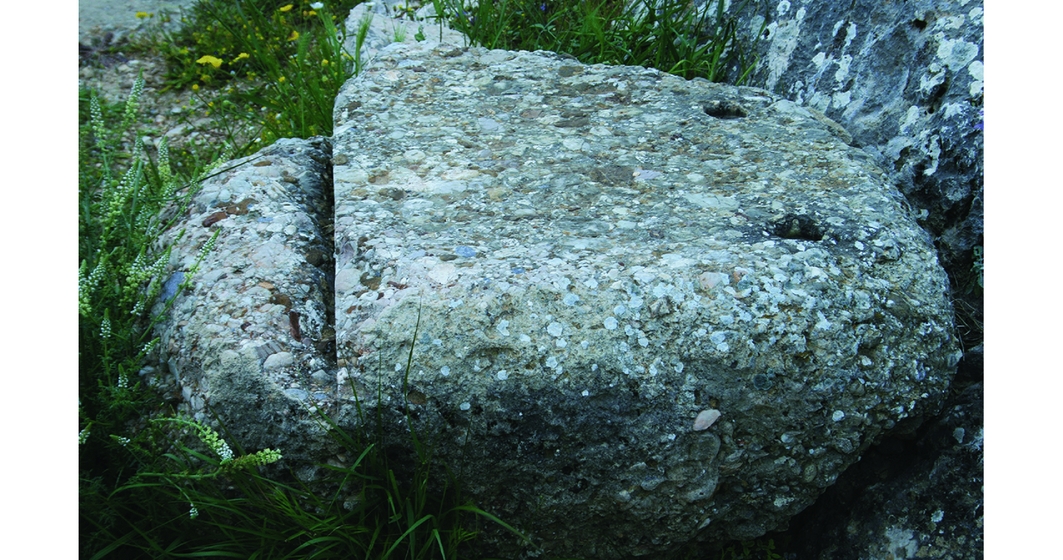
At Mycenae, traces of curved saw cuts occur on: the limestone Lion Gate relief; the conglomerate posts and lintels of the citadel's primary and postern gateways; scattered conglomerate blocks within the citadel and near the megaron; the conglomerate column bases of the Treasury of Atreus; and the conglomerate fascia of the Atreus and Klytemnestra tholoi (tholos being a beehive tomb; Küpper Reference Küpper1996: 22–25, pls 14, 15.3, 27, 54.2; Blackwell Reference Blackwell2014: 460–62). An important unfinished cut on a conglomerate base from the citadel's House of Columns sheds light on the operation of a pendulum saw (Figure 3; Küpper Reference Küpper1996: pl. 4). This mark offers specific evidence for how the pendulum saw made deep cuts—a process explained later.
Base from the House of Columns at Mycenae with an unfinished cut.

Several threshold edges from the Melathron at Gla preserve pendulum saw cuts (Küpper Reference Küpper1996: 23, pl. 13.2). These cuttings are shallow and slightly curved, yet the elongated markings recall threshold cuttings at Tiryns. A piece of sawn conglomerate from Gla (Iakovidis Reference Iakovidis2001: pl. 75.168–69) resembles the smooth conglomerate cuts from the Argolid region (in the north-east Peloponnese) discussed above, further suggesting the use of the pendulum saw at Gla. At Orchomenos, shallow, curved cuttings define the threshold edges of the Treasury of Minyas’ inner entrance to its tomb chamber (personal observation), thus suggesting that masons here too used the pendulum saw. Furthermore, Wright (Reference Wright2013) tentatively suggests that a pendulum saw could have fashioned a threshold at the Menelaion in Laconia (Catling Reference Catling2009: pl. 53).
Use of the pendulum saw beyond mainland Greece is debated. Crete is certainly excluded, as saw marks on Minoan architecture are not curved (Shaw Reference Shaw2009: 48–50). Concave sawn incisions, however, appear on an adyton block in the Great Temple at Boğazköy-Hattusha, the Hittite capital city. Schwandner (Reference Schwandner, Hoffmann, Schwandner, Hoepfner and Brandes1991) and Neve (Reference Neve and Hopkins2002) attribute these cuttings to the pendulum saw, thus creating a tantalising craft link to the Mycenaeans (Wright Reference Wright, Deger-Jalkotzy and Lemos2006a: 33–34; Thaler Reference Thaler, Antoniadou and Pace2007: 295). Through comparison of the Tiryns tool marks with his own stone-cutting experiments, Seeher (Reference Seeher2007, Reference Seeher, Pirson and Wulf-Rheidt2008) rejected the idea that the pendulum saw fashioned the Anatolian cuts. Müller-Karpe (Reference Müller-Karpe2006: 220), however, interpreted a curved cutting on the underside of a relief sculpture of a Hittite seated goddess as evidence for pendulum saw use in central Anatolia.
Reconstructing the pendulum saw: various designs
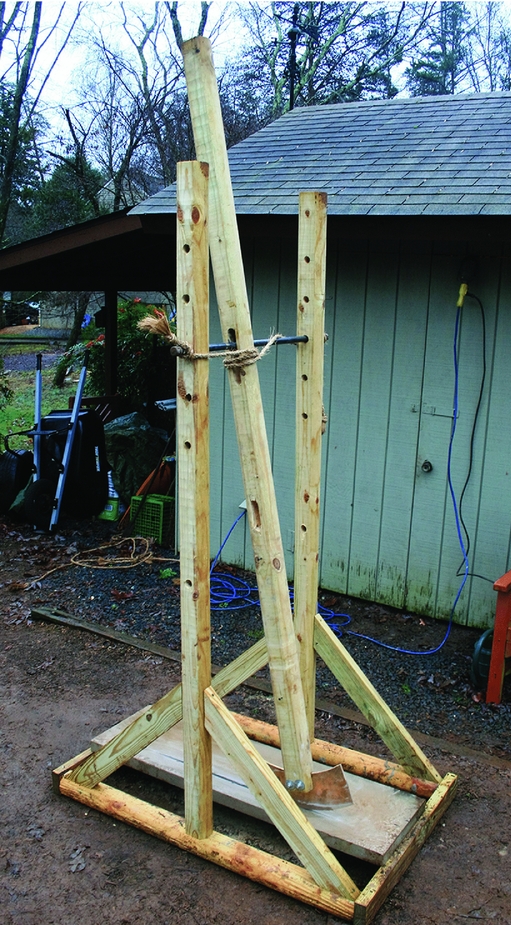
The framework for my pendulum saw consisted of two wooden side posts (landscaping timbers) with multiple holes drilled at incremental levels, supported by a base and diagonalstruts (Figure 4). Wooden boards connected the bases to ensure frame stability, while a horizontal steel bar ran through the posts’ upper sections. A 2.5m-long wooden pendulum, with a 0.18m-long oval hole, hung from the bar; the pendulum length above the bar was retained for additional weight. A pure tin-bronze (e.g. 90 per cent copper, 10 per cent tin) saw blade was hafted to the pendulum bottom by two stainless-steel bolts. Extra weight was attached to the pendulum to increase friction while sawing. The method of lowering the pendulum was a two-step procedure. The oval notch enabled the pendulum to move up and down freely while sawing (Figure 4). Once the blade cut deep enough that the pendulum caught on the bar—thereby preventing it from sawing further—the pendulum and bar were lowered to the next set of drill holes.
A review of earlier designs highlights unresolved questions about the pendulum saw's operation and the significance of the current contribution. Although seven reconstructions have so far been published, there has been no consensus about blade shape, framework design or method of enabling an incision to progress downward. Schwandner (Reference Schwandner, Hoffmann, Schwandner, Hoepfner and Brandes1991: 220, fig. 6–7) provided three options. His first sketch placed the framework directly on the stone to be worked, while the second used an elongated notch in the pendulum (similar to the design in Figure 4) for facilitating downward progression. Schwandner disregarded both designs as impractical due 1) to stability concerns and 2) to his assertion that the Bronze Age cuttings reflected a single pendulum size. Given that Schwandner interpreted the pendulum radius as a standard 1.4m, he rejected the elongated notch, believing it would cause substantial variation in cuts.
Built pendulum saw.

Schwandner's final sketch (1991: 220, fig. 8) represented his proposed design. Although not discussed explicitly, he ultimately included a small pendulum notch in this reconstruction to allow for fine-level movements, apparently in the belief that any variation caused by a short oval was negligible (Küpper Reference Küpper1996: 17). As for greater height adjustments, a series of vertical holes appear on the timber framing (as in the version in Figure 4). In his sketches, Schwandner emphasised the uncertainty of the blade shape by including several curved blades, each with a different cutting-edge length.
Küpper's (Reference Küpper1996) meticulous study of the masonry at Tiryns and Mycenae led him to hypothesise a different reconstruction. He recognised cut diversity and identified a range of pendulum radii, rather than a standardised one. For his design, Küpper kept the holes on the timber framework for major height alterations, but proposed a radically different concept for fine tuning. Rather than using a notch in the pendulum, Küpper (Reference Küpper1996: 286, pl. 12.2) advocated a setup that allowed a stone block—instead of the pendulum—to be lowered while cutting. This elaborate proposal stemmed from Küpper's assumption, although not stated explicitly, that the curved cuts on Mycenaean masonry represented segments of perfect circles. Küpper thus disregarded the oval notch, thinking it would create too much variation in the incisions. His design, however, is impractical and more laborious than necessary—a conclusion also reached by Seeher (Reference Seeher2007: 31 note 14). Although Seeher's built pendulum saw (Reference Seeher, Pirson and Wulf-Rheidt2008: 5, fig. 5) resembled Schwandner's basic design, he did not describe how his device operated, other than to state that it successfully produced a curved saw mark. His construction included holes in the timber frame for substantial height adjustment. While the importance of an oval notch (referred to as Öse) is mentioned, it is unclear in his construction how the blade descended when the pendulum moved back and forth. Rather than a detailed presentation of his pendulum saw results, Seeher illustrated how a handheld saw with a convex blade (termed Rückensäge) could replicate the curved marks seen at Boğazköy-Hattusha. While two other conjectural illustrations of the pendulum saw offer varied models for the timber framework and systems of lowering the saw blade (French Reference French2002: 53; Blackwell Reference Blackwell2014: fig. 18), explicit explanations for these reconstructions are lacking, as only the basic notions of the device were conveyed.
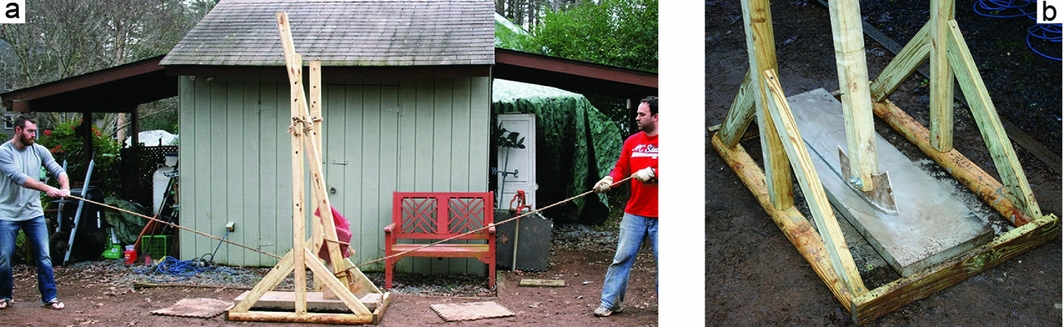
Pendulum saw in action with two sawyers; detailed view of the saw blade in action.

Cutting stone with a pendulum saw: operation and results
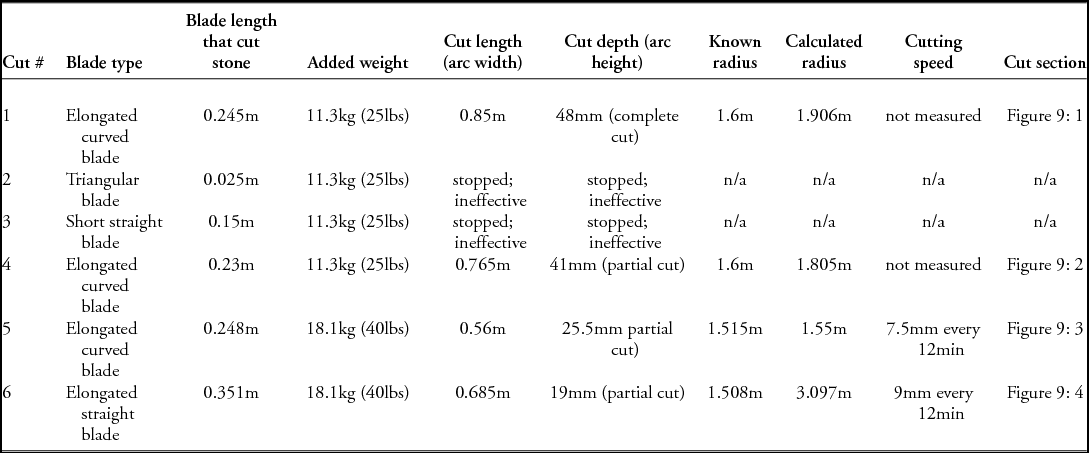
Using the built pendulum saw described above (Figure 4), I attempted six experimental cuts (Table 1) on a hard limestone block from a quarry in Pennsylvania (USA), in lieu of Greek limestone and conglomerate. The goals were threefold: first, to test the effectiveness of different blade shapes; second, to investigate the method for making the deepest incisions on antae and pillar bases; and finally, to document, measure and compare the experimental cut marks to known heights of the built pendulum saw.
Results of experimental cuts with a pendulum saw.

In the experiment, two sawyers operated the pendulum saw, standing on opposite sides of the device and pulling the saw back and forth with a rope (Figure 5a & b; Video 1 in the online supplementary material (OSM)). Water and sand served as a lubricant and abrasive respectively while cutting (Video 2 in the OSM). An initial block weighing 11.3kg was attached at the lower portion of the pendulum to increase friction. The weight was later increased to 18.1kg through the employment of two blocks.
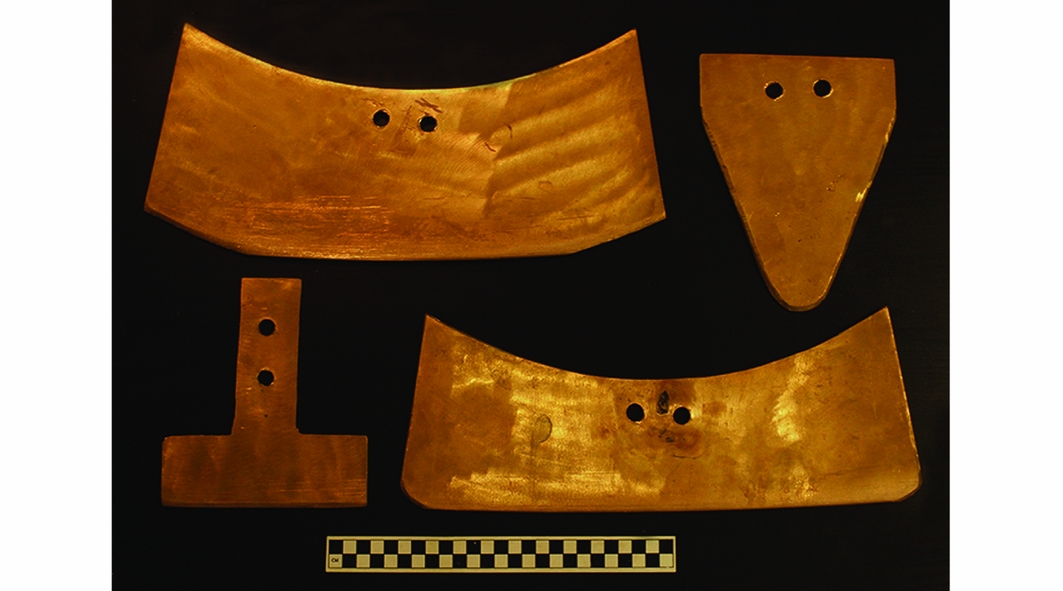
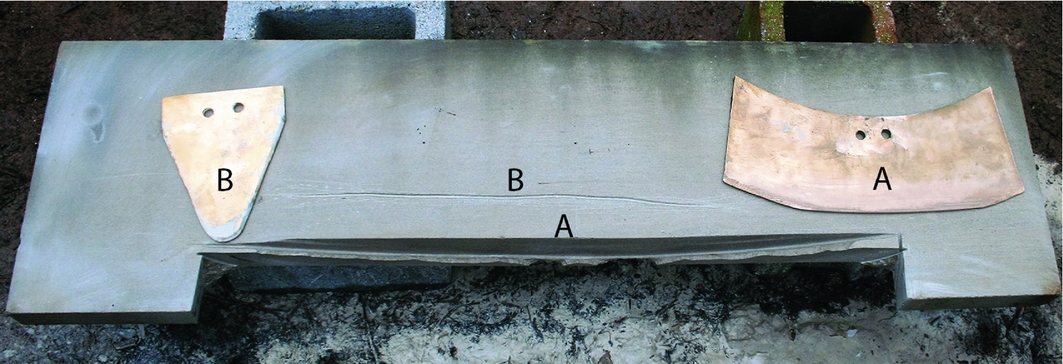
Questions concerning blade shape stemmed from uncertainty over whether the curved cuts were made by a similarly shaped saw or primarily by the motion of the pendulum swing. Four non-serrated blades of pure tin-bronze were thus tested (Figure 6): an elongated, curved blade (0.39m long × 0.15m high); a triangular blade (0.15m wide × 0.2m high); a short, straight-edged saw (0.15m long × 0.17m high); and a longer, straight-edged saw with slightly rounded edges (0.38m long × 0.095–0.14m high). A metalsmith from Crete manufactured these bronze blades using sand moulds (cf. Maragoudaki & Kavvouras Reference Maragoudaki and Kavvouras2012: 205). While Aegean Bronze Age saws are typically 1–3mm in thickness (Shaw Reference Shaw2009: 49–50), the experimental blades were 5mm thick. This difference stems from the difficulty in manufacturing blades thinner than 4–5mm using sand moulds (E. Maragoudaki pers. comm.). Although several rounds of annealing could reduce blade thickness, the experimental blades were annealed only once. They were heated to 600°C for one hour, immersed in cold water and then hammered. Ideally, this procedure would have been repeated to increase blade strength and to reduce thickness, yet the single annealing proved sturdy enough to cut limestone. The blade dimensions are somewhat arbitrary; the generous height ensured that the blades were reusable, as the deterioration rate was unknown prior to experimentation. A saw from Andronianoi on Euboea measuring 0.557m × 0.077–0.09m and one from Prosymna measuring 0.217 × 0.039m (Maragoudaki & Kavvouras Reference Maragoudaki and Kavvouras2012: 201) indicate that the experimental blades are within the length range of preserved Mycenaean saws, although these particular examples were designed for woodworking.
Four experimental saw blades.

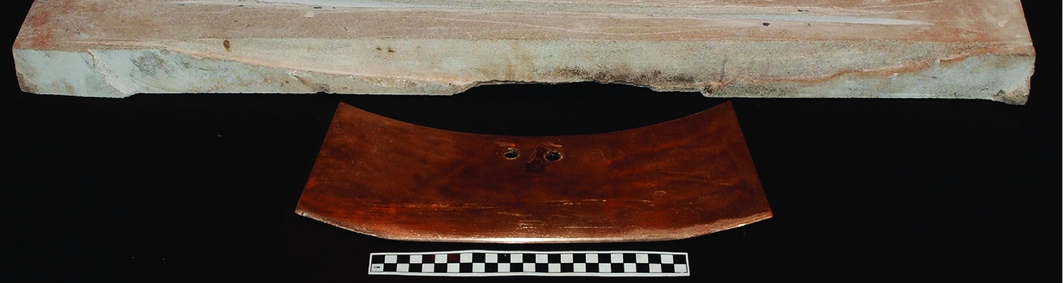
The long, curved experimental blade generated concave markings (Figures 7–8). This saw successfully made three incisions, each stopped artificially at a different point to ensure variety in cut depth and length (Table 1: cuts 1, 4 & 5; Figure 9: 1–3). The angles of these cuts were homogeneous and nearly vertical, thus notably different from the angled incisions recorded at Boğazköy-Hattusha (Seeher Reference Seeher2007: 35, fig. 10). The experimental pendulum saw might be capable of cutting at an angle if the pendulum were placed and secured diagonally, but further work is required to test the efficiency of this position. These three experimental cuts, ranging from 0.56–0.85m in length and 25.5–48mm in depth, resemble the dimensions of the Tiryns saw cuts, which are typically 0.6–0.8m in length and 30–60mm in depth (Seeher Reference Seeher2007: 38–40). The cutting speed with a curved blade was recorded for one incision (Table 1: cut 5): a depth of 25.5mm was reached after 45 minutes. The first nine minutes produced a starting groove 3mm deep; afterwards, sawing progressed at a steady rate of 7.5mm every 12 minutes. During these 12-minute segments, water and sand were added at two-minute intervals.
Curved saw cut (0.85m long) produced by a curved saw.

Limestone block after experimental cutting; a) the curved saw made an 0.85m cutting; b) the triangular blade created a wobbly incision.

Lengthwise sections of experimental saw cuts: 1) cut 1 (complete), produced by a curved blade, cut length = 0.85m, greatest cut depth = 48mm; 2) cut 4 (nearly complete), produced by a curved blade, cut length = 0.765m, greatest cut depth = 41mm; 3) cut 5 (partial), produced by a curved blade, cut length = 0.56m, greatest cut depth = 25.5mm; 4) cut 6 (partial), produced by an elongated straight blade, cut length = 0.685m, greatest cut depth = 19mm.

The triangular blade and short, straight blade (Table 1: cuts 2 & 3) were ineffective for use with a pendulum machine. Wear on the triangular blade revealed that only its tip—0.025m long—touched the stone. This blade created a wobbly groove on the limestone surface (Figure 8), thus eliminating it as a possibility due to its inability to form a straight cut. The short straight blade also proved to be useless, as its corners repeatedly stuck into the stone and prevented the pendulum from swinging back and forth.
The elongated straight blade with rounded corners produced cut 6 (Table 1; Figure 9: 4). After making an initial groove 1mm deep, this saw fashioned a curved cut 19mm deep after 24 minutes of operation. The cutting speed was noticeably faster and more efficient than the curved saw blade, progressing at a rate of 9mm every 12 minutes, while also producing a longer cut. When assessing experimental cutting speeds, one must acknowledge that several variables today differ from those in antiquity. These include the skill and experience of the workers, the saw blade's thickness, the abrasive used (e.g. emery sand would have been better than sedimentary sand) and the type of stone.
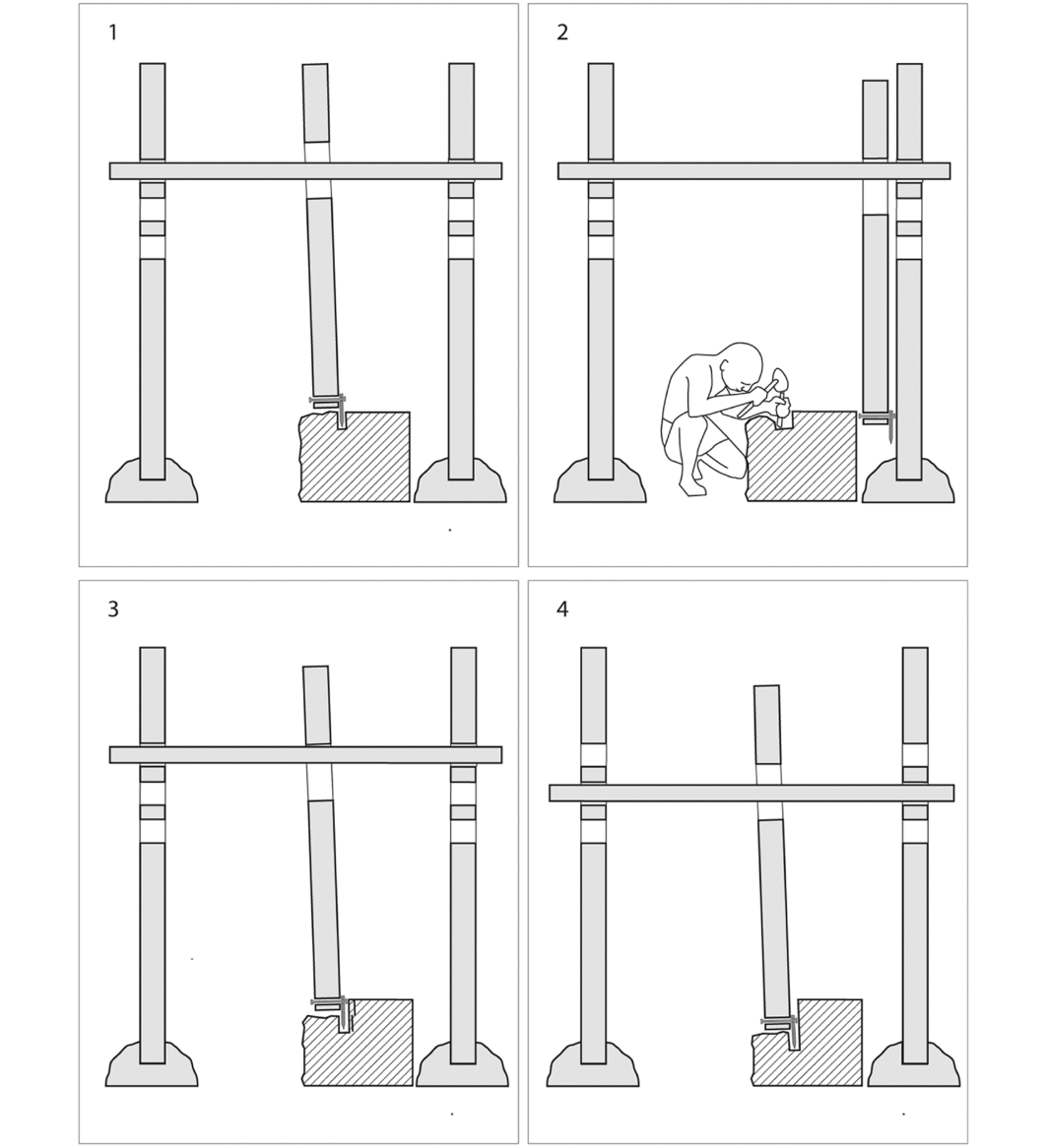
The experimental saw created long, curved incisions. Yet it remained unclear how the pendulum saw made deep cuts on antae and pillar bases, as the wooden bottom of the actual pendulum would eventually hit the stone. The solution became apparent after considering the aforementioned base in the House of Columns at Mycenae (Figure 3). If a blade were appended to the pendulum's side, as Seeher (Reference Seeher2007: 40, fig. 19a, Reference Seeher, Pirson and Wulf-Rheidt2008: 7, fig. 12b) hypothesised for a saw at Tiryns, the sawing device—through a multi-stage process—could reach the lowest parts of the block. The saw would initially (Figure 10: 1) cut until the pendulum end prevented the blade from progressing. Unwanted portions of the block were then chiselled or hammered away to provide sufficient space for the pendulum to descend again (Figure 10: 2). After removal of this excess stone, the saw could continue cutting without hindrance (Figure 10: 3; Video 3 in the OSM). The half-finished base from Mycenae (Figure 3), and perhaps a threshold from Tiryns (Küpper Reference Küpper1996: pl. 13.3), preserves evidence of this procedure in progress. Rivets (bolts in the experiment) securing the blade protruded slightly from the blade side (Video 4 in the OSM), so that the pendulum saw cut the stone at a slight angle (Figure 10: 3–4). This process would be repeated with the entire pendulum moved to lower rungs (Figure 10: 4) to fashion a block's lower end. This procedure might account for the heterogeneity of Mycenaean pendulum cuts, including the imperfect vertical profiles of sawn antae and bases (Küpper Reference Küpper1996: pls 5–12), even though the experimental cuts only produced near-vertical sections.
Multi-stage process for how the pendulum saw made deep cuts on antae and pillar bases (drawn by Giuliana Bianco).

A final issue investigated by the experiment was whether a pendulum's height corresponded to the arc of a curved cut. Küpper (Reference Küpper1996: 21–25) proposed that the radius of the pendulum's swing (thus providing an estimated size for the device) was between 3 and 8m high for various cuts, the largest figures corresponding to threshold marks. To check the reliability of such calculations, the length and depth of the experimental saw cuts were compared to the known pendulum heights. Using basic geometry, the radius of a circular segment can be calculated if the arc width and arc height are known. Using Pythagoras's Theorem, the equation is: arc radius =
 $\ \frac{{{\rm{arc\ height}}}}{2} + \frac{{{\rm{arc\ widt}}{{\rm{h}}^2}}}{{8( {{\rm{arc\ height}}} )}}$
. Restated with the dimensions of a curved saw cut, the formula is: pendulum radius =
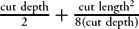 $\ \frac{{{\rm{cut\ depth}}}}{2} + \frac{{{\rm{cut\ lengt}}{{\rm{h}}^2}}}{{8( {{\rm{cut\ depth}}} )}}$
. The calculated pendulum radii based on the experimental cut measurements are listed in Table 1. The known pendulum saw heights, taken from the deepest point of each cut to the height of the horizontal bar, are also provided. None of the calculated radii match the measured pendulum heights. It is worth highlighting cut 6 (0.685m long × 19mm deep) made by the elongated straight saw (Table 1; Figure 9: 4). Based on the arc radius formula (
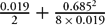 $\frac{{0.019}}{2} + \frac{{{{0.685^2}}}}{{8\,{\times}\,0.019}}\ $
= 3.097), the dimensions of this cut indicate an expected radius of 3.097m, which is 1.589m longer than the known pendulum length of 1.508m. The experimental cuts and calculations prove that a pendulum saw using an oval notch creates imperfect segments of a circle.
Küpper (Reference Küpper1996: 17–21, fig. 12.2) suspected that an oval notch would cause variability, which led to his cumbersome solution of lowering the block, rather than the pendulum apparatus, during cutting. From his detailed illustrations, it appears that Küpper assumed that the curved saw marks at Mycenae and Tiryns were parts of true geometric circles (1996: figs 133–41). If that were the case, calculation of the original height of the device—that is, the pendulum radius—would be possible based on the length and depth of curved cut marks. The experimental cuts and profiles presented here (Figure 9: 1–4), however, illustrate the difficulty in determining whether a curved saw mark represents part of a circle. For instance, would experimental cuts 5 and 6 (Table 1; Figure 9: 3–4)—seemingly symmetrical—have been identified as circular segments if their pendulum radii were not already known? This challenge is even greater if only a small portion of the saw cut is preserved.
An unavoidable conclusion is that Küpper's calculations for pendulum radii (especially those of extreme height), which have puzzled scholars (Seeher Reference Seeher2007: 32), are greatly overestimated. Küpper's work on the pendulum saw, however, remains valuable; he identified pairs of cuttings on blocks that reflected similar pendulum lengths (Küpper Reference Küpper1996: 17–18, figs 132–35). While his estimated heights may be inaccurate, the relative relationship of the markings to each other, and the prospect of paired cuts, should not be disregarded. Küpper's observation of paired incisions made from a common height, in my opinion, supports the existence of a device that allowed for incremental pendulum-height adjustments.
Conclusions
This experiment has clarified several aspects of the pendulum saw's mechanics, including how masons made the deepest cuts on antae and bases, and the ideal saw blade for the device. An oval slot in the pendulum was crucial for enabling the device to cut efficiently, although it hindered the production of a standardised cut. An important conclusion is that curved pendulum cuts are unlikely to reflect circular segments, thus casting doubt on previous height estimates of pendulum radii.
Two questions related to the pendulum saw—its origin and use beyond mainland Greece—remain unresolved. The device appears to be a Mycenaean invention given its restricted use on the mainland, yet the lack of stone-cutting saws (e.g. toothless blades) from Mycenaean contexts is perplexing. Only a handful of Mycenaean saws are known (13 in a recent tool database; Blackwell Reference Blackwell2011: 190), and most examples are fragmentary and serrated, probably intended for woodworking. Experimental work confirmed that cast replicas of serrated saws from Andronianoi and Prosymna were excellent carpentry tools (Maragoudaki & Kavvouras Reference Maragoudaki and Kavvouras2012). Similarly, the serrated band saw (Bandsäge) from Kalapodi would have been more effective on wood than stone (Küpper Reference Küpper1996: fig. 128). Without a mainland stone-cutting tradition, the inspiration for the pendulum saw may have come from elsewhere.
An Anatolian derivation of the tool is unlikely, despite the disputed evidence for the pendulum saw at Boğazköy-Hattusha. In rejecting claims for the device in Anatolia, Seeher (Reference Seeher2007, Reference Seeher, Pirson and Wulf-Rheidt2008) argued that curved saw cuts on Hittite masonry were deeper and at a greater angle than the Mycenaean dataset. These observations led him to propose the use of a handheld convex saw. Further experimental work with the pendulum saw is necessary to resolve whether the device was applied to Hittite masonry, or whether Seeher is correct in his rejection of the presence of this technology in Anatolia.
It is tempting to look to Egypt for the source of the pendulum saw, as the practice of sawing stone existed there by the early third millennium BC (Stocks Reference Stocks2003: 32, 106–107). No obvious Egyptian parallel, however, exists for the machine. Moreover, one need not leave the Aegean to find a possible source of inspiration. More than 80 per cent of Aegean Bronze Age saws are Cretan (79 out of 96 examples; Blackwell Reference Blackwell2011: 190–91), meaning that Minoan artisans valued the tool more than the Mycenaeans. Evidence for the earliest saw use on Minoan architecture comes from the early second-millennium BC Chrysolakkos funerary structure at Malia (Shaw Reference Shaw2009: 49). The stone-working saw became ubiquitous on Crete by the Late Bronze Age, as indicated by cuts on masonry from Zakros, Palaikastro, Tylissos, Pseira, Ayia Triada, Malia and the Lapis Lacedaemonius blocks from Knossos (Figure 2; Shaw Reference Shaw2009: 48–50, pl. 57a–f). These markings are straight, corresponding to Cretan saws with straight edges, and differ from the elongated, curved cuts on the mainland. Linear B references to saws (ideogram *74) on Knossian tablets (Palaima Reference Palaima, Steinkeller and Hudson2015: 629–31) may signal Knossos as the point of contact where Mycenaeans became acquainted with Cretan saw types.
If the Cretan straight-edged stone-working saw came to the mainland via the Argolid peninsula—and no examples can verify this supposition—the tool may have been ineffective in working the region's hard stones. In contrast to the soft Cretan sandstone and gypsum, conglomerate was particularly difficult to work (Hitchcock et al. Reference Hitchcock, Chapin, Banou and Reynolds2016: 83). Its sawn appearance in elite spaces and on prestigious monuments offered an aesthetically pleasing polychrome image (Küpper Reference Küpper1996: pls 10–12). Perhaps Mycenaean craftspeople developed the pendulum saw (after trying a straight-edged toothless saw) to increase power and friction when cutting hard materials. The wish to display worked conglomerate for prestige purposes and conspicuous statements of palatial power (Wright Reference Wright and Laffineur1987; Maran Reference Maran, Maran, Juwig, Schwengel and Thaler2006; Brysbaert Reference Brysbaert2015) may have been the impetus for devising the remarkable pendulum saw technology.
Acknowledgements
The Institute for Aegean Prehistory generously funded this project, which I completed as a postdoctoral teaching scholar in the Department of History at North Carolina State University. My work benefited from the expertise, advice and assistance of James Wright, Elena Maragoudaki, Brandon Synan, Giuliana Bianco, Joseph Shaw, George Blackwell and Ioanna Damanaki. I thank the anonymous reviewers whose comments greatly improved this paper. Any remaining errors are mine alone.
Supplementary material
To view supplementary material for this article, please visit https://doi.org/10.15184/aqy.2017.226