Introduction
Food webs are a critical mapping tool used to investigate the ecological interactions that regulate energy flow within a given community or ecosystem (Cain et al., Reference Cain, Bowman and Hacker2008). The patterns in energy flow elucidated by food webs form an essential component of assessing the impact of any single species on trophic organization, dynamic stability, and the function of communities exposed to a novel stressor or disturbance, in addition to answering fundamental questions about feeding interactions, i.e. predator–prey, herbivore–plant, detritivore–detritus and parasite–host (McCann, Reference McCann2000; Pascual & Dunne, Reference Pascual and Dunne2006; Thompson et al., Reference Thompson, Brose and Dunne2012).
Parasites are ubiquitous among all ecosystems, account for a substantial share of the Earth's biomass (Dobson et al., Reference Dobson, Lafferty, Kuris, Hechinger and Jetz2008; Kuris et al., Reference Kuris, Hechinger and Shaw2008), represent approximately half of all species (Poulin & Morand, Reference Poulin and Morand2004) and are involved in 50–75% of food-web links (Dobson et al., Reference Dobson, Lafferty, Kuris, Hechinger and Jetz2008). Nevertheless, the exact roles that parasites play within the classical food-web structure are poorly characterized (Marcogliese & Cone, Reference Marcogliese and Cone1997; Sukhdeo, Reference Sukhdeo2012). Although a few food-web ecologists realized the importance of parasites in food-web structure as many as 20 years ago (e.g. Marcogliese & Cone, Reference Marcogliese and Cone1997), formal attempts to construct food webs that include parasites have been sporadic at best. Most recently, two seminal reviews have revisited the importance of including parasites in food-web ecology and concluded that food webs that exclude parasites are likely to produce misleading results (Lafferty et al., Reference Lafferty, Allesina and Arim2008, Dunne et al., Reference Dunne, Lafferty and Dobson2013).
Stable isotopes (SIs) of the light elements (e.g. carbon and nitrogen) are a powerful tool for tracing the source and flow of nutrients between two species. The changing ratios of these SIs as they progress through a food web (the kinetic isotope effect) provide a unique tracer of the flow of energy within a system (Brand & Coplen, Reference Brand and Coplen2012). Stable-isotope analysis (SIA) has been widely applied in food-web ecology to quantify the sequence of organisms in food chains (i.e. who feeds on whom) by calculating the relative increase of nitrogen isotope ratios from primary producers to apex predators (Fry, Reference Fry2006; detailed in the section ‘Bulk stable-isotope applications in parasite ecology’ below). Furthermore, SIs have been used to characterize the complex links in food webs, elucidating connections between organisms and their food resource by calculating the difference in isotope ratios between connected species, and using that information to record energy transfer between nodes in the food web. However, previous studies utilizing the so-called ‘bulk’ approach to tackle some of the issues surrounding the incorporation of parasites and host–parasite interactions into food webs, found their results to be inconsistent at best (Lafferty et al., Reference Lafferty, Allesina and Arim2008). A potential explanation is that parasites often feed on specific compounds within their hosts, which have a unique composition of such compounds in their tissues (Boag et al., Reference Boag, Neilson, Robinson, Scrimgeour and Handley1998; Iken et al., Reference Iken, Brey, Wand, Voigt and Junghans2001; Pinnegar et al., Reference Pinnegar, Campbell and Polunin2001; Deudero et al., Reference Deudero, Pinnegar and Polunin2002; Neilson et al., Reference Neilson, Boag and Hartley2005; O'Grady & Dearing, Reference O'Grady and Dearing2006; Demopoulos & Sikkel, Reference Demopoulos and Sikkel2015).
Recent analytical developments enable SI technology to be applied to specific molecules within tissue, e.g. amino acids (McClelland & Montoya, Reference McClelland and Montoya2002; McMahon & McCarthy, Reference McMahon and McCarthy2016) and fatty acids (Meier-Augenstein, Reference Meier-Augenstein2002; McLeod et al., Reference McLeod, Hyndes, Hurd and Frew2013), providing a valuable tool to trace molecular exchanges between the host and parasite (Sabadel et al., Reference Sabadel, Woodward, Van Hale and Frew2016). This approach, known as compound-specific isotope analysis (CSIA), has the potential to improve our fundamental understanding of food webs in general, and to facilitate the addition of parasites into these webs by utilizing very small samples that can focus on specific molecules that are targeted by parasite species. This novel approach applies SI measurements at the molecular level to reveal the specific energy source of a parasite, the quantity of biomass transferred and the flow-on repercussions to the food web in unprecedented detail.
Our goals in this review are to summarize the progress that has been made in the field of SIs applied to parasitism, and to suggest approaches using SIA and CSIA that will further incorporate parasites into our current understanding of food-web ecology. We hope that this review will also initiate a dialogue between chemists and ecologists that will enrich both disciplines. We conclude by strongly encouraging food-web researchers to use CSIA and to incorporate their data into models that could place parasites, from all types of ecosystem, systematically and consistently into their respective food webs.
The pitfalls of incorporating parasites into food webs
To understand why parasites have been ignored in food-web ecology, we must first understand the challenges inherent when incorporating parasites into food webs. The first reason may be as straightforward as their size, as it has long been assumed that the contribution of parasites to the biomass of a given system was negligible (Marcogliese & Cone, Reference Marcogliese and Cone1997; Kuris et al., Reference Kuris, Hechinger and Shaw2008). More recent studies, however, demonstrate that this is not the case, and that in some instances the biomass of parasites may even rival that of top predators (Kuris et al., Reference Kuris, Hechinger and Shaw2008). The second reason may be the complex nature of the trophic transmission utilized by parasite species to reach subsequent hosts in their life cycle. To place both a parasite and its hosts into a food-web model, the nature of their transmission strategies and feeding behaviour is key, especially as different parasite life stages have vastly different requirements for transmission and nutrition. Finally, the abundance of each parasite life stage is difficult to estimate, and the interactions between parasite and host at each transmission stage affect the overall parasite biomass. As an example, snails infected with a trematode parasite in a given system will produce hundreds to hundreds of thousands of free-swimming larvae per metre squared per day (Thieltges et al., Reference Thieltges, De Montaudouin, Fredensborg, Jensen, Koprivnikar and Poulin2008). Some fraction of these larvae will infect the next stage of their life cycle successfully, while most will fail and become a food resource for non-host organisms, representing a substantial addition to the zooplankton component of the food web (Morley, Reference Morley2012).
Overview of stable-isotope analysis
Over the past 30 years, the field of SIA has become of increasing interest to ecologists, due to its potential to elucidate previously intractable connections between components of ecosystems. Since SIA was introduced and used in environmental science, the number of applications has increased as methodologies evolve (see the review in Brand & Coplen, Reference Brand and Coplen2012), although the applications within parasite ecology have been limited (Boecklen et al., Reference Boecklen, Yarnes, Cook and James2011). Ultimately, SIA provides an incredibly useful tool to trace isotopes (i.e. C, H and N) through food webs and to determine spatial and temporal changes from primary producers to subsequent trophic level (TL) species.
Nuts and bolts of stable-isotope analysis
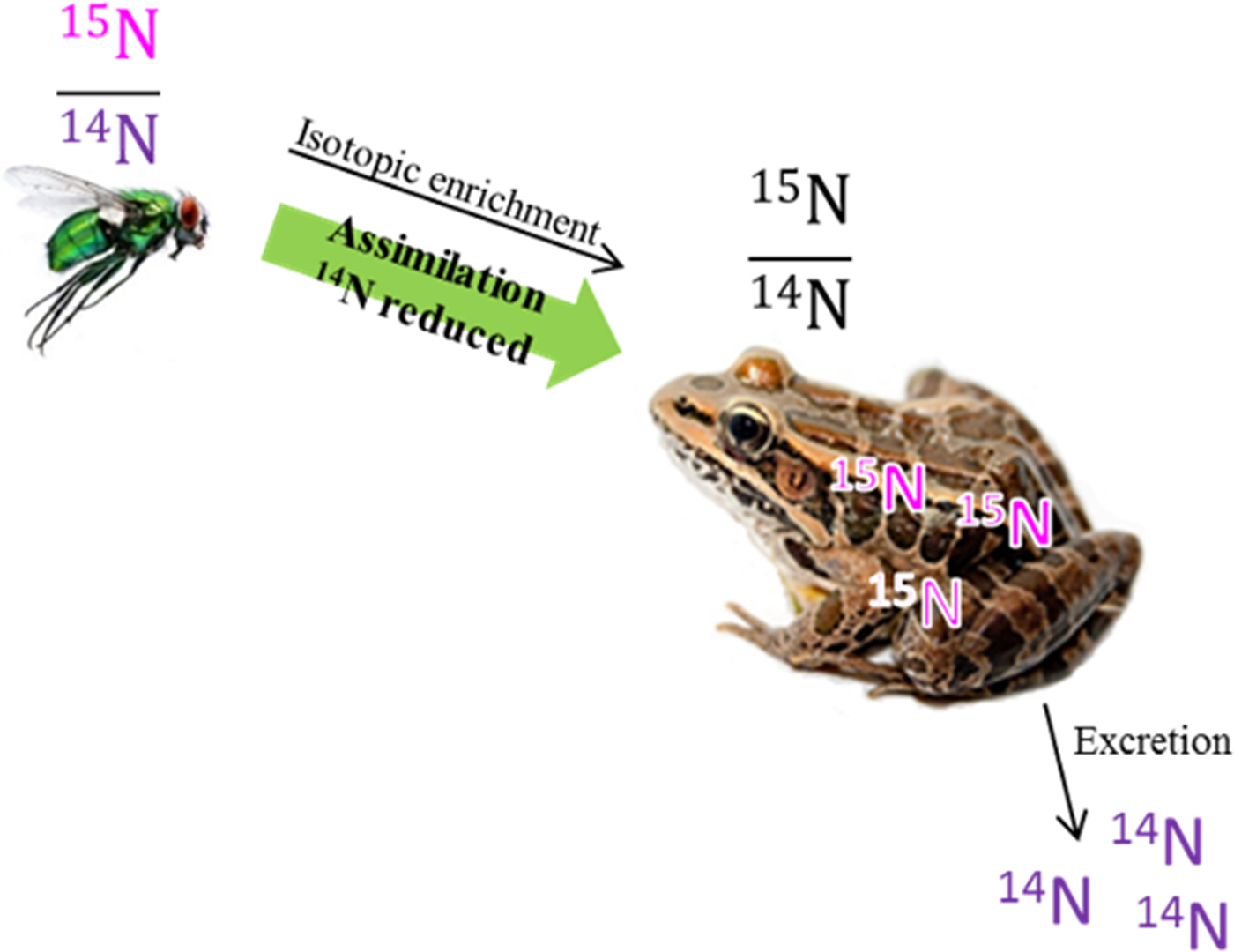
SI ratios, reported in parts per thousand (‰), are expressed as the ratio of heavy to light isotopes (13C/12C, 2H/1H or 15N/14N) giving us δX (the difference (delta) between sample and standard: δX = [(R sample/R standard) − 1] × 1000). With this information, we can trace the movement of nutrients between organisms. The changing ratios of SIs through a food web (the kinetic isotope effect) represent the flow of energy within a system (Vander Zanden & Rasmussen, Reference Vander Zanden and Rasmussen2001; Brand & Coplen, Reference Brand and Coplen2012; Wing et al., Reference Wing, Mcleod, Leichter, Frew and Lamare2012). This is due to the lighter isotopes being excreted in greater proportions than the heavier isotopes, leaving the organism enriched in 13C and 15N relative to its food source (fig. 1). This fractionation process leads to a measurable trophic enrichment (the values of ~1‰ and 3.4‰ are the standard values that have been assigned to C and N, respectively: DeNiro & Epstein, Reference DeNiro and Epstein1981; Hobson, Reference Hobson1999; Post, Reference Post2002). However, recent studies have pointed out that the trophic enrichment factor (TEF) was significantly affected by the consumer taxonomic group, the consumer tissue and its diet (Caut et al., Reference Caut, Angulo and Courchamp2008, Reference Caut, Angulo and Courchamp2009). These authors recommend the careful choice of TEF when calculating TLs and proposed a ‘Decision diagram’ (Caut et al., Reference Caut, Angulo and Courchamp2009) that will help select a more appropriate TEF depending on the taxonomy and tissue of the consumer.
The excretion rate of the lighter isotope (14N) is greater than that of the heavier isotope (15N) during metabolism, inducing about 3.4‰ of accumulation per trophic level.

Based on this information, it is possible to use the SI of C to trace the origin of matter, and the SI of N to follow the flow of energy and nutrients through a food web, unravelling trophic connections between species along the way. At the base of the food web, primary production is crucial to support species at higher TLs. The universally recognizable δ13C values of various primary producers (e.g. C3 and C4 plants, marine algae, bacteria, fungi, etc.) represent information that can be used to trace the provenance of the C source. As C fractionates only slightly through a food web, it is possible to trace the C source that fuels a specific food web to its origin and suggest feeding strategies. Conversely, the known fractionation of N with each trophic transfer brings information regarding the position of a species in a food web. Simultaneously measuring the δ13C and δ15N values of the primary producers of a food web is therefore the key to understanding the role and place of any give species within this food web. Complementary information can be gained via H as its SI ratio in rainwater increases with altitude and latitude, representing a biomarker to track the provenance of a species and potentially follow its migration patterns.
Calculation of trophic level using bulk stable isotopes
Based on the observed enrichment via N isotopic fractionation that occurs between two species within the same food web (fig. 1), and knowing the δ15N value of the primary producer, it becomes possible to calculate an animal's TL (DeNiro & Epstein, Reference DeNiro and Epstein1981; Minagawa & Wada, Reference Minagawa and Wada1984; Post, Reference Post2002). In initial investigations, TLs were calculated using bulk data of N by subtracting the change in isotopic ratio of the primary producer from the change in isotope ratio of the consumer, dividing the resulting value by the appropriate TEF plus a constant of one:
 $${\rm T}{\rm L}_{{\rm bulk}} = (({\rm \delta }^{{\rm 15}}{\rm N}_{{\rm consumer}}{ - }{\rm \delta }^{{\rm 15}}{\rm N}_{{\rm producer}}{) / TEF) + 1}$$
The ‘consumer’ is the species of interest, the ‘producer’ is the species located at the base of the food web and TEF is the isotopic fractionation occurring between consumer and producers, as discussed above.
Bulk stable-isotope applications in parasite ecology
Pioneering food-web studies used SIA of bulk tissue samples from whole organisms, or specifically from chosen parts relevant to the experiment (e.g. muscle or bone collagen), to identify food sources as dietary tracers, assess organisms’ dietary preferences from the past and present (for reviews, see Koch, Reference Koch2008; Lee-Thorp, Reference Lee-Thorp2008), and to examine food-web relationships in marine and terrestrial ecosystems (for a review, see Peterson & Fry, Reference Peterson and Fry1987). A handful of studies have attempted to use SIA on various parasite–host systems, but the results have been inconsistent at best (Boag et al., Reference Boag, Neilson, Robinson, Scrimgeour and Handley1998; Iken et al., Reference Iken, Brey, Wand, Voigt and Junghans2001; Pinnegar et al., Reference Pinnegar, Campbell and Polunin2001; Deudero et al., Reference Deudero, Pinnegar and Polunin2002; Neilson et al., Reference Neilson, Boag and Hartley2005; O'Grady & Dearing, Reference O'Grady and Dearing2006; Demopoulos & Sikkel, Reference Demopoulos and Sikkel2015). Indeed, the seminal perspective paper by Lafferty et al. (Reference Lafferty, Allesina and Arim2008), written to promote the incorporation of parasites into food webs, was only able to dedicate a short section to SIA as a tool to calculate TLs. The authors rightly concluded that a topological (qualitative) approach, rather than SIA, was the most feasible method of determining parasite TL at that time. However, in the past decade, methodologies have again advanced, and more studies have been published that focus on the use of N and C SI, which can help expound complex parasite–host trophic relationships. Bulk SI measurements of C and N have been used successfully to confirm or refute the suspected parasitic nature of a trophic relationship, by looking at the enrichment in δ15N from host to parasite (Gómez-Díaz & González-Solís, Reference Gómez-Díaz and González-Solís2010; Clark & Hawke, Reference Clark and Hawke2014) or by assessing, through shifts in δ13C and δ15N, the quantity of food originating from the host moving into the parasite during its metamorphosis and host transfer (Fritts et al., Reference Fritts, Fritts, Carleton and Bringolf2013). However, bulk SIA has never been pushed as far as assessing the quantity of biomass transferred from a host to its parasite and its subsequent repercussion on the rest of the food web. Most studies have been based on simple yes/no links between nodes, without tackling the issue of actual energy flows.
Stable isotopes to assess the dietary sources of parasite and host
Stable isotopes can be used to assess dietary sources of any given species via SIA of C, H and/or N: food resource, feeding strategies and trophic transfer. Gómez-Díaz & González-Solís (Reference Gómez-Díaz and González-Solís2010) used SIA to quantify the trophic position of three mites and one flea (all ectoparasites) of the seabird Calonectris. Based on the known δ13C values of primary producers, they found that the dietary source was of marine rather than terrestrial origin, and also concluded that the three mites were most likely feeding on the host's feathers while the flea fed on the host's blood.
Nachev et al. (Reference Nachev, Jochmann, Walter, Wolbert, Schulte, Schmidt and Sures2017) used δ15N to shed light on parasite feeding strategies by comparing the isotopic signature of two parasite species that infect the same fish host (Barbus barbus), but exhibit different feeding strategies: an acanthocephalan that absorbs digested food from inside the host's gut (passive feeding) and a nematode that feeds directly on its host (active feeding). The δ15N enrichment observed in the nematode parasite was characteristic of predator–prey trophic relationships, but SIA of the acanthocephalan showed low isotopic discrimination of δ15N from host to parasite, with seasonal variations attributed to the host change of food source. Consequently, the use of bulk isotope measurements is not without its limitations, as it cannot integrate the host's change of diet. Fritts et al. (Reference Fritts, Fritts, Carleton and Bringolf2013) focused on the isotopic changes that occur during the trophic transfer of a freshwater mussel (Unionoidea) in its parasitic larval stage from its maternal parent to its transitory fish host, where the larvae metamorphose into their juvenile life-stage. The distinct isotopic shifts observed indicated that 57.4% of the δ15N in juvenile tissues were obtained from the host fish, confirming the parasitic nature of the relationship.
Stable isotopes to measure the impact of a parasite on its host
SIs can be used to unravel the impact of parasitic infection on host species (e.g. Britton & Andreou, Reference Britton and Andreou2016) by comparing δ13C and δ15N of infected vs. uninfected conspecifics. In a study by Sánchez et al. (Reference Sánchez, Varo, Matesanz, Ramo, Amat and Green2013), brine shrimp (Artemia parthenogenetica) infected by a cestode parasite (Flamingolepis liguloides) change their spatial distribution by swimming closer to the surface than uninfected individuals, presumably to increase the probability of being consumed by the cestode's definitive host. This behavioural modification has significant trophic consequences, as revealed through SIA: (1) the diet of infected brine shrimp is modified as it feeds in a novel micro-habitat; (2) the trophic status of infected vs. uninfected hosts is unequal; and (3) infected brine shrimp must compete with species that normally dominate the surface waters.
Furthermore, measuring δ2H relates directly to the spatial provenance of water and can also be incredibly useful when studying parasite spatial evolution. In a study by Altizer et al. (Reference Altizer, Hobson, Davis, De Roode and Wassenaar2015), the SI of H was used to investigate the location where monarch butterflies (Danaus plexippus) were infected by the protozoan Ophryocystis elektroscirrha, and the latter's lethal impact on the butterfly's migratory journey. Uninfected butterflies, with a lower δ2H, were found to originate from more northerly altitudes, enabling researchers to calculate that the migratory distance of uninfected butterflies was longer than that of infected conspecifics.
Pulkkinen et al. (Reference Pulkkinen, Aalto and Nykänen2016) looked at the impact of Glugoides intestinalis, an obligatory microsporidian parasite of Daphnia magna. They demonstrated, for the first time, that parasitic infections alter the isotopic composition of the host, independently of the host's diet, which strongly supports the use of SIs for future parasite–host studies. Furthermore, this change in δ13C and δ15N values, correlating with decreased Daphnia growth and lipid concentrations, is clearly indicative of the parasite's impact on the host's physiological functions. In light of this information, trophic relationships and food webs can be untangled using SIs with these alterations in mind.
The advantages of compound-specific stable-isotope analysis
How? / Why? And the limitations of bulk stable isotopes
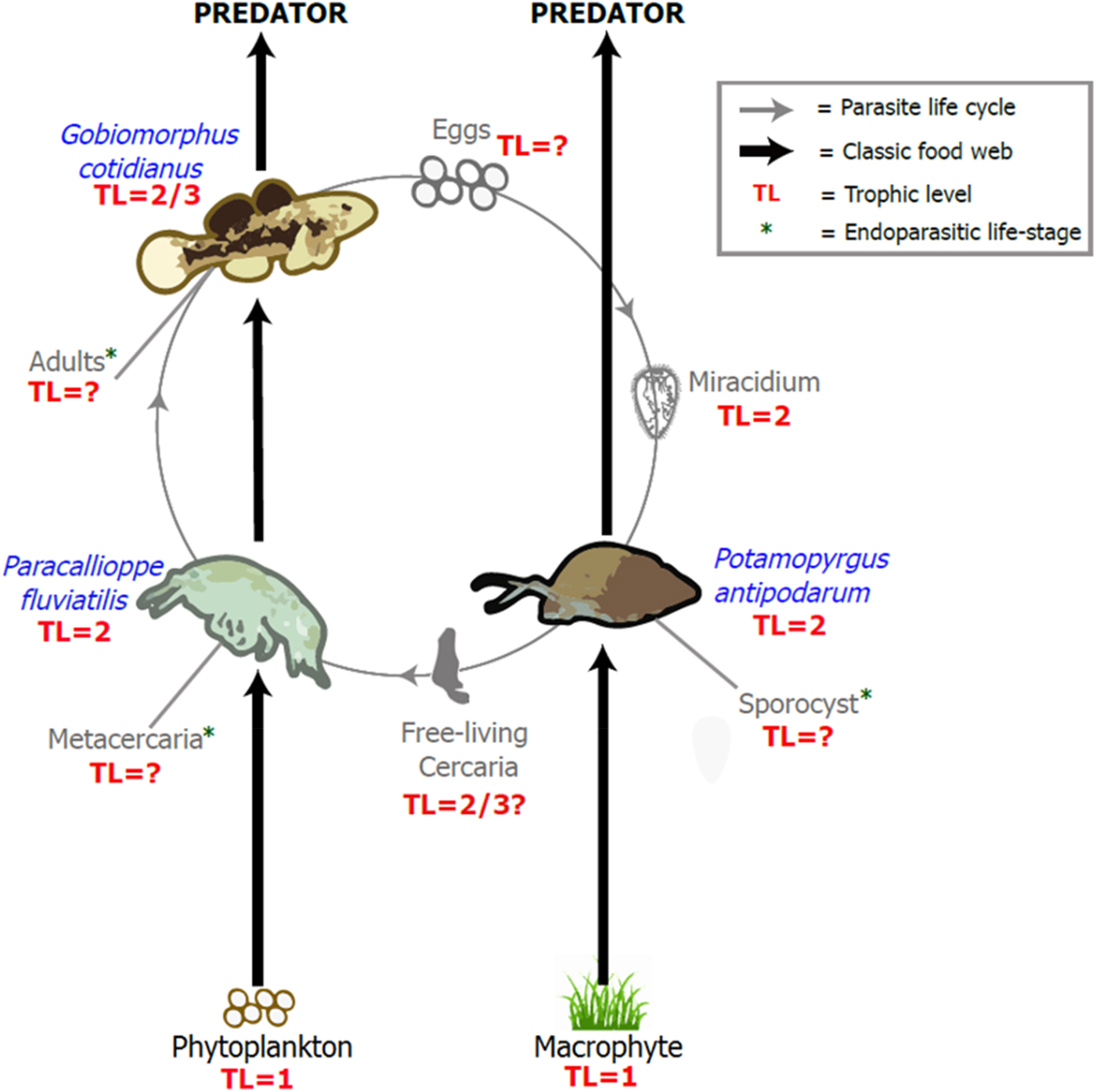
The advantages of CSIA are perhaps best illustrated using a parasite with a relatively complex life history (fig. 2). The endemic New Zealand trematode parasite, Coitocaecum parvum, uses three hosts (a gastropod, an amphipod and a fish), and six distinct life stages to complete its life cycle (Lagrue & Poulin, Reference Lagrue and Poulin2007). Like many trematode species, C. parvum uses a fish as the definitive host, i.e. the host in which adult parasites sexually reproduce, releasing eggs in fish faeces. The parasite eggs then develop into miracidia, a motile life stage, which seek out and infect the next host in the parasite's life cycle, the first intermediate host, in this case a snail. Within the snail host, miracidia develop into sporocysts, which asexually produce a free-swimming transmission stage known as cercariae. Periodically, cercariae are released from the snail and actively seek out the next host in the life cycle, the second intermediate host, in this case an amphipod. Cercariae transform into metacercarial cysts within the amphipod and await a predation event that will transfer the metacercariae to the fish definitive host, thus completing the parasite's life cycle. In such a situation, establishing the position of C. parvum within its food web represents a significant challenge, due to the aforementioned complications caused by a multi-step life cycle (see ‘Overview of stable-isotope analysis’ above). Trophic-level calculations are the key to meeting this challenge, but basing such calculations on bulk SIs has certain limitations.
The life cycle of C. parvum shown across two distinct food chains and the respective trophic levels of all species involved.

First, C. parvum sporocysts should, in theory, have a higher TL than the snail host, evidenced by an increase of the δ15N ratio in parasite vs. host tissue. However, the sporocyst and snail may not have the same molecular composition; for example, a sporocyst does not necessarily use all the molecules present in the snail tissue from which it is extracting nutrients, thus creating a difference between the sporocyst and snail chemical composition. This would alter their respective N composition and their δ15N values, subsequently confounding the calculated TLbulk.
Second, C. parvum can interconnect multiple food webs that may not be of the same origin (e.g. the base producer for the snail host and fish host likely differ, depending on the population). Indeed, some trematode species also link marine and freshwater food webs (Collinge & Ray, Reference Collinge and Ray2006). This difference in primary producer is crucial as it changes the baseline isotopic value between food webs.
Third, depending on the parasite's life stage, their food resource will generate a different isotopic signature. An adult C. parvum may feed on gut contents, which are 15N depleted, vs. sporocysts that feed directly on host tissues that are 15N enriched (see fig 1).
Fourth, to our knowledge, no study has ever looked into the isotopic signature of parasite eggs, so that we do not know the isotopic baseline values of the tissues that compose the larvae, nor do we know their trophic position.
Fifth, as C. parvum moves through its life cycle its molecular composition and food requirement will likely change. This suggests that a single biomarker, which is common to all metabolic molecules and food sources, should be used to trace variations in a parasite's isotopic signature and corresponding TLs, rather than a bulk approach which would measure all C-, H- or N-containing molecules. Focusing on the molecules that drive isotopic changes will improve the signal-to-noise ratio by removing the influence of unvarying molecules that are measured in bulk SIA.
Calculation of trophic level using compound-specific stable isotopes
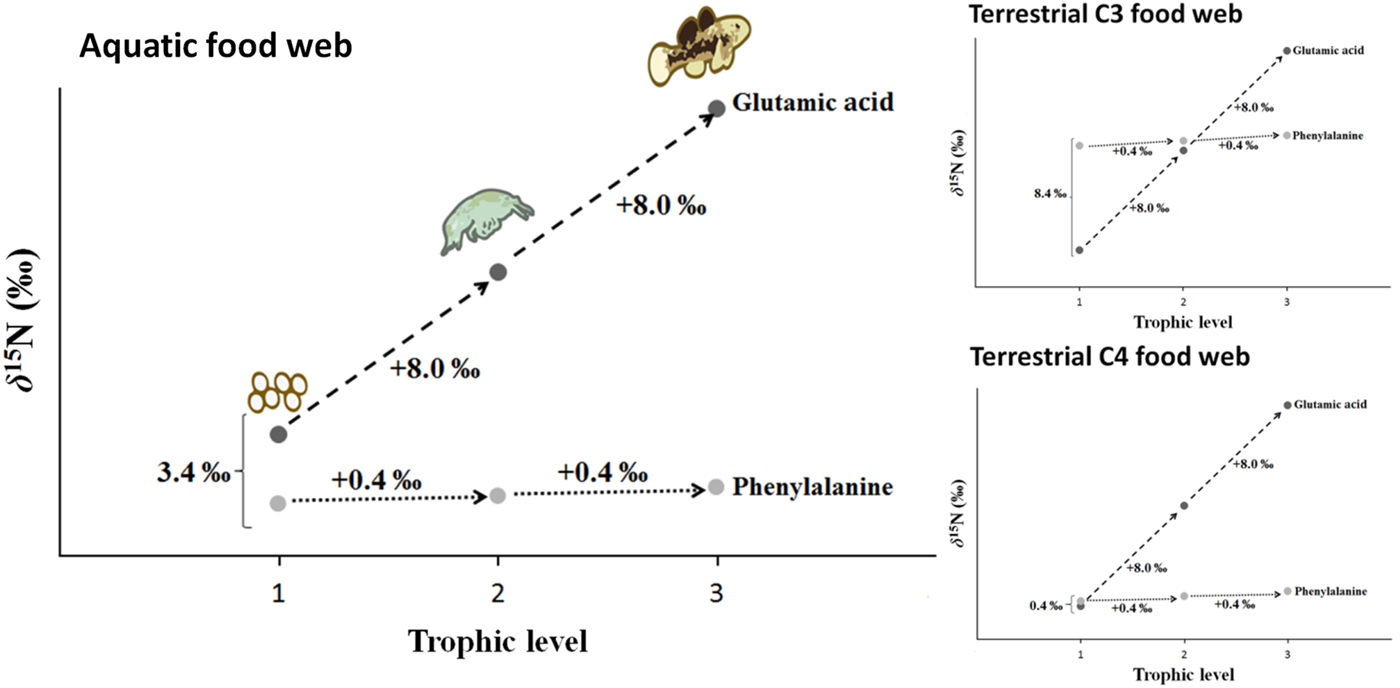
CSIA allows researchers to focus on a single molecular biomarker, e.g. amino acids (AAs), the building blocks of proteins, which are found in all organisms. As precursors of N-containing metabolites (e.g. haems nucleotides, glutathione, physiologically active amines, etc.), AAs play a fundamental role in all metabolic processes, including nutrient uptake from host to parasite, and are integral to N and C cycles. Unlike isotopic ratio measurements of bulk material, CSIA makes use of isotopic differences in AA profiles which can arise from the different metabolic pathways used by the various categories of AAs or from different isotopic effects during the biosynthetic processes. By focusing on two specific AAs, glutamic acid (Glu) and phenylalanine (Phe), it is possible to calculate precisely the TL of an organism. The factor that underpins this precision is the metabolic role of these two AAs; Glu is a ‘trophic’ AA, which undergoes great fractionation as it passes through the food web; whereas Phe is a ‘source’ AA, which undergoes very little fractionation, creating an ‘isotope baseline’ (fig. 3) (for a review see Ohkouchi et al., Reference Ohkouchi, Chikaraishi and Close2017). This allows a calculation of TL by comparing the difference between δ15NGlu and δ15NPhe for consumer and producer, subtracting the latter from the former, dividing by the TEF and adding a constant of 1:
 $${\rm T}{\rm L}_{{\rm Glu - Phe}}{\rm = ((}{\rm \delta }^{{\rm 15}}{\rm N}_{{\rm Glu}}{\rm - }{\rm \delta }^{{\rm 15}}{\rm N}_{{\rm Phe}}{\rm - \beta ) / TEF) + 1}$$
Schematic illustration of the relationship between the N isotopic composition of AAs (phenylalanine, grey circles and glutamic acid, black circles) and trophic level in an aquatic, a terrestrial C3 and a terrestrial C4 food web.

where β represents the isotopic difference between Glu and Phe in the primary producers. β values differ substantially between food webs: +8.4‰ for C3, −0.4‰ for C4 and −3.4‰ for aquatic food webs. The TEF value of 7.6‰ is commonly used in all food-web studies; it represents the 15N-enrichment factors with each TL for Glu and Phe, respectively. One of the major advantages of CSIA is that it allows the calculation of the trophic position of a given species, independently from the primary producer at the base of its food web (equation 1). Finally, the efficacy of the method is reflected in the TEF: 3.4‰ in the bulk method and 7.6‰ when measuring the difference between Glu and Phe, providing a twofold improvement in the precision of TL calculation. However, as parasite–host trophic relationships have never been studied using CSIA-AA before, consideration of the choice of β and TEF parameters has to be taken into account. Indeed, recent studies have highlighted the variability of these parameters, and found it to be driven mainly by diet quality and nitrogen excretion mode (McMahon & McCarthy, Reference McMahon and McCarthy2016). These parameters, however, should be quite straightforward to assess for parasites, given the closed nature of their diet as they feed exclusively on a single host at any given stage of their life cycle. Thus, further refinement could be achieved via controlled-feeding experiments involving various parasite–host species, conditions and positions within trophic hierarchies (Chikaraishi et al., Reference Chikaraishi, Steffan, Ogawa, Ishikawa, Sasaki, Tsuchiya and Ohkouchi2014).
Food source and TL yes, what about energy flow?
A major advantage of CSIA is that it is possible to use SI ratio data to quantify the energy (i.e. biomass) transferred from hosts to parasites, subsequently expanding to the entire food web. As mentioned previously (see ‘Bulk stable-isotope applications in parasite ecology’ above), SIs have never been pushed as far as assessing the quantity of biomass transferred from a host to its parasite in either classic SIA or CSIA. Do parasites at specific stages actually derive energy from their host (e.g. metacercariae) and how much energy is transferred from specific hosts to parasites? How can CSIA help to answer these questions?
To continue using the C. parvum system: CSIA focuses on one specific molecule of choice (e.g. AA, fatty acids), so by feeding isotopically labelled food to each of C. parvum’s hosts, it is possible to quantify the energy transfer/pathways between parasite and host. The evolution of the SI signature can subsequently be traced for various molecules at each life-cycle stage, to determine the direction and magnitude of SI fractionation as biomass (and energy) is transferred within the system. These data can be related to the parasite–host biomass ratios at various life stages by applying the calibrated fractionation patterns to infer transferred biomass. Furthermore, one can imagine designing experiments during which infected and uninfected hosts will be fed to their respective predators, outside of the parasite life cycle, allowing for the quantification of the altered biomass within the extended food web. This will address a critical gap in classic food-web ecology, expanding a food-web model in a way that has never been done before.
Implementing CSIA in food-web ecology and future guidelines
The field of CSIA is now more than a decade old and many studies have paved the way for the incorporation of CSIA into parasite food-web ecology (McMahon & McCarthy, Reference McMahon and McCarthy2016; Ohkouchi et al., Reference Ohkouchi, Chikaraishi and Close2017). Moreover, Sabadel et al. (Reference Sabadel, Woodward, Van Hale and Frew2016) demonstrated, for the first time, that: (1) it is possible to apply compound-specific analysis to the limited tissues of small parasites; and (2) measureable SI changes occur from host to parasite.
The proliferation of CSIA studies will shed light on the various ways in which SIs can be used to untangle trophic relationships within food webs. Furthermore, CSIA is not just limited to AAs and can be focused on any molecule of relevance, such as fatty acids. Indeed, SIs of fatty acids are often used as dietary biomarkers. They help us to understand the specific roles of key primary producers in supporting secondary production (McLeod et al., Reference McLeod, Hyndes, Hurd and Frew2013). These can be applied to parasite–host trophic relationships.
Many parasite–host studies could have already benefited from using CSIA. For example, the study of Knudsen et al. (Reference Knudsen, Siwertsson, Adams, Newton and Amundsen2014), who compared the use of parasites or SIs as time-integrated biomarkers to unravel foraging behaviours and trophic niche adaptation of Arctic charr (Salvelinus alpinus), or that of Sánchez et al. (Reference Sánchez, Varo, Matesanz, Ramo, Amat and Green2013), who demonstrated parasite-induced lipid accumulation increasing the profitability and attractiveness of prey for the final host.
Altogether, combining these compound-specific biomarkers generates a powerful tool for understanding energy flow within a specific food web, a parasite life cycle and the integration of both. We hope that this review will encourage ecologists to look into the use of CSIA to help further their knowledge in food-web ecology and parasitology, hence generating a greater database for future work with SIs.
Acknowledgements
The authors would like to thank an anonymous reviewer for the very helpful comments that helped sharpen this article.
Financial support
The writing of this review involved no specific grant from any funding agency, commercial or not-for-profit sectors.
Conflict of interest
None.