Introduction
Suicide, especially among adolescent females, has become a leading public health concern. Adolescence is associated with a marked increase in suicidal thoughts and behaviors, and 12–17% of adolescents report contemplating suicide (Nock et al. Reference Nock, Green, Hwang, McLaughlin, Sampson, Zaslavsky and Kessler2013; Kann et al. Reference Kann, Kinchen, Shanklin, Flint, Kawkins, Harris, Lowry, Olsen, McManus, Chyen, Whittle, Taylor, Demissie, Brener, Thornton, Moore and Zaza2014). The toll of suicide among adolescent girls has been increasing, becoming the second leading cause of death in 2013 (Centers for Disease Control and Prevention, 2016). The risk for the first onset of suicidal behavior begins during early adolescence (12 years), increasing exponentially until age 17, with 34% of those with suicidal ideation going on to make an attempt (Nock et al. Reference Nock, Green, Hwang, McLaughlin, Sampson, Zaslavsky and Kessler2013). This suggests adolescence is a critical period of development warranting further investigation of risk and protective factors implicated in the etiology of suicidal thoughts and behaviors.
Life stress and suicidality during adolescence
Life stress is one of the most widely studied risk factors for the development of suicidality (King & Merchant, Reference King and Merchant2008) and there is a large literature demonstrating the relationship between life stress and suicidal thoughts and behaviors during adolescence (O'Connor & Nock, Reference O'Connor and Nock2014; for a review see Overholser, Reference Overholser, Spirito and Overholser2003). Although the majority of past research investigating the effect of life stress on suicidality has focused on stress broadly, studies have also explored the impact of interpersonal (Buitron et al. Reference Buitron, Hill, Pettit, Green, Hatkevich and Sharp2016), dependent (Stone et al. Reference Stone, Liu and Yen2014), and peer-related stressors (Heilbron & Prinstein, Reference Heilbron and Prinstein2010), all of which are particularly salient during adolescence. Previous studies have suggested that an increase in exposure to stress plays an etiological role in promoting suicidality during adolescence (Pettit et al. Reference Pettit, Green, Grover, Schatte and Morgan2011).
Current theoretical models of suicide emphasize interpersonal factors (Van Orden et al. Reference Van Orden, Merrill and Joiner2005; O'Connor, Reference O'Connor, O'Connor, Platt and Gordon2011), likely because interpersonal stressors (e.g. fought more with parents, relationship problems with a friend) are particularly potent predictors of suicidality (King & Merchant, Reference King and Merchant2008; Whitlock et al. Reference Whitlock, Wyman and Moore2014). For example, ongoing interpersonal relationship difficulties during adolescence are associated with suicidal ideation (Pettit et al. Reference Pettit, Green, Grover, Schatte and Morgan2011), and interpersonal difficulties during middle adolescence predict later suicide attempts (Johnson et al. Reference Johnson, Cohen, Gould, Kasen, Brown and Brook2002). Furthermore, individuals are at an increased risk of attempting suicide after experiencing a negative interpersonal life stressor, even if the person had not been planning a suicide attempt (Bagge et al. Reference Bagge, Glenn and Lee2013). In contrast, no connection was found between non-interpersonal life stressors (e.g. unwanted change in appearance, had health problems) and suicidality in previous adolescent samples (Johnson et al. Reference Johnson, Cohen, Gould, Kasen, Brown and Brook2002; Pettit et al. Reference Pettit, Green, Grover, Schatte and Morgan2011). Importantly, adolescent girls frequently report more interpersonal life stress than boys (Rudolph & Hammen, Reference Rudolph and Hammen1999), while also demonstrating an increased vulnerability (Ge et al. Reference Ge, Lorenz, Conger, Elder and Simons1994; Hankin et al. Reference Hankin, Mermelstein and Roesch2007). These factors make interpersonal life stress an important factor in understanding the development of suicidal symptoms in adolescent girls.
The buffering effect of social support
The benefits of social support are widespread and well documented (Seeman, Reference Seeman1996; Cohen, Reference Cohen2004). Social support is a critical factor in numerous theories of suicide (Durkheim, Reference Durkheim1951; Van Orden et al. Reference Van Orden, Merrill and Joiner2005; O'Connor, Reference O'Connor, O'Connor, Platt and Gordon2011) and is especially important for suicidal adolescents; lower levels of parental support distinguish adolescents with a history of suicide attempts from those with suicidal ideation or without any history of suicidality (Saffer et al. Reference Saffer, Glenn and Klonsky2015). However, the processes that make social support an effective protective factor against the development of negative health and psychological factors are not well understood. The stress-buffering model (Cohen & Wills, Reference Cohen and Wills1985) proposes that social support reduces the negative impact of stressful life events, perhaps offsetting the burden of stress via coping assistance (Thoits, Reference Thoits1986). There is evidence that social support reduces risk for suicide attempts during adolescence (Borowsky et al. Reference Borowsky, Ireland and Resnick2001) and that social support and positive events synergistically buffer the effect of negative events on suicidal ideation (Kleiman et al. Reference Kleiman, Riskind and Schaefer2014). However, findings investigating the stress-buffering model have been mixed, possibly due to differences in measurement. For instance, social support can be derived from different sources (i.e. family, peer, community), which may differ in importance to the development of suicidality. Studies that have included social support from more distal family members or adults in the community have failed to find support for the buffering effect of social support (Dubois et al. Reference DuBois, Felner, Brand, Adan and Evans1992; Windle, Reference Windle1992). However, parents are particularly important sources of social support during adolescence via emotional support and social modeling of appropriate coping strategies (Felner et al. Reference Felner, Ginter and Primavera1982; Holahan et al. Reference Holahan, Valentiner and Moos1994) and studies examining the protective effect of parental support specifically have found support for the stress-buffering model (Evans et al. Reference Evans, Kim, Ting, Tesher and Shannis2007; Natsuaki et al. Reference Natsuaki, Ge, Brody, Simons, Gibbons and Cutrona2007; Ge et al. Reference Ge, Natsuaki, Neiderhiser and Reiss2009; Hazel et al. Reference Hazel, Oppenheimer, Technow, Young and Hankin2014). Similarly, a previous study that did not distinguish between types of life stress failed to find support for the buffering hypothesis despite methodical measurement of parental and peer provided support (Burton et al. Reference Burton, Stice and Seeley2004). However, because of the increased importance of peer relationships during adolescence (Ladd & Troop-Gordon, Reference Ladd and Troop-Gordon2003), it is possible that social support provided by peers may also buffer the harmful effects of life stress on suicidal symptoms in adolescents. Furthermore, it is unclear whether social support is more protective for some psychiatric outcomes than others. In order to test the specificity of stress-buffering effects, we also examined dysphoria, which captures the core emotional and cognitive features of depression and anxiety (Watson et al. Reference Watson, O'Hara, Naragon-Gainey, Koffel, Chmielewski, Kotov, Stasik and Ruggero2012).
The current study
The current study examined the impact of social support on the association between life stress and prospectively assessed suicidal symptoms among adolescent girls. Our study improves upon many of the limitations of prior stress-buffering investigations by using multidimensional measures of stress, social support, and psychopathology in a large-scale longitudinal design; we investigated two critical sources of social support (i.e. parent and peer) using two measures of each, two types of episodic life stress (i.e. interpersonal and non-interpersonal), and two distinct, but related, dimensions of psychopathology (i.e. suicidality and dysphoria). To our knowledge, this is the first study to examine parental and peer social support separately as buffers of life stress on suicidality during adolescence. Thus, it is unclear to what extent the source of social support matters in the development of suicidality in adolescents. Differences in relative influence between peers and parents may provide insight as to how to prevent the development of suicidality during adolescence. Similarly, distinguishing between types of life stress allows us to investigate whether specific sources of social support protect more against interpersonal stressors than other types of stressors, and the design of the current study allows us to test the specificity of the buffering effect on different psychiatric outcomes. We hypothesized that high levels of either parental or peer social support would buffer against the potential increase in suicidality and dysphoria that result from stressful life events, especially interpersonal stressors, but that parental support would be superior to peer support.
Method
Participants
Participants included 550 adolescent female volunteers, aged 13.5–15.5 (mean = 14.39, s.d. = 0.63), and their parents recruited from Long Island as part of the Adolescent Development of Emotions and Personality Traits (ADEPT) Project, a study of predictors and consequences of first-incident depression. The majority of the sample was of a non-Hispanic Caucasian background (80.5%) and 57.8% of parents had a bachelor's degree or greater.
Procedure
Never-depressed adolescent girls were recruited from the community using several strategies including commercial mailing lists, presentations at local school districts, online classified advertisements, and postings in the community. Eligibility requirements included being female, between 13.5 and 15.5 years of age, able to read English, and having a biological parent who was willing to take part. Exclusion criteria were a lifetime history of major depressive disorder, dysthymia, or developmental disabilities. Depressive disorders were exclusionary because we sought to investigate the development of depression. Participants were not excluded for diagnoses of other psychopathologies. Initial eligibility was established over the phone by using a brief structured interview that included a depression screen (Kroenke et al. Reference Kroenke, Spitzer and Williams2001) modified to assess for lifetime episodes of major depression (Cannon et al. Reference Cannon, Tiffany, Coon, Scholand, McMahon and Leppert2007) and confirmed through use of the Kiddie Schedule for Affective Disorders and Schizophrenia for School-Age Children, Present and Lifetime Version (K-SADS-PL; Kaufman et al. Reference Kaufman, Birmaher, Brent, Rao, Flynn, Moreci, Williamson and Ryan1997) at the baseline visit.
For this study, adolescent girls completed self-report questionnaires about depressive symptoms and social support during an in-person visit at our laboratory in Stony Brook, New York (T1). At a 9-month follow-up assessment (T2), life stress interviews were conducted over the phone and self-report questionnaires about depressive symptoms were completed online. All subjects were compensated for their participation.
Measures
Negative stressful life events
Adolescent life stress was assessed through use of the Stressful Life Events Schedule for adolescents (SLES; Williamson et al. Reference Williamson, Birmaher, Ryan, Shiffrin, Lusky, Protopapa, Dahl and Brent2003), a structured clinical interview. The SLES includes probes for 77 events in a number of domains (e.g. education, health, and relationships), and includes follow-up probes to assess context of the event. Each event was classified a priori as interpersonal or non-interpersonal based on the description of the event type (see Supplementary Appendix 1). Final ratings of objective threat were ranked on a 4-point scale ranging from ‘little or no effect’ to ‘great effect’. All ratings were determined at a consensus meeting by three trained interviewers. The SLES has been shown to agree substantially with widely used and validated measures such as the Life Events and Difficulties Schedule (κ = 0.77) and the Life Events Checklist (ICC = 0.83; Williamson et al. Reference Williamson, Birmaher, Ryan, Shiffrin, Lusky, Protopapa, Dahl and Brent2003). The SLES demonstrates acceptable psychometric properties with inter-rater consensus reliability of κ = 0.67 for objective threat as well as adequate test–retest reliability when investigating specific event comparisons (κ = 0.68; Williamson et al. Reference Williamson, Birmaher, Ryan, Shiffrin, Lusky, Protopapa, Dahl and Brent2003). Because all ratings were made via team consensus, we could not calculate reliability for the current study without re-rating each of the life stress interviews with a completely independent consensus team. However, consensus ratings of structured interviews have been shown to have significantly higher validity when compared to individual interviewer ratings (Pulakos & Schmitt, Reference Pulakos, Schmitt, Whitney and Smith1996). The SLES was administered beginning at T2 in order to assess negative episodic life stress over the previous nine-month interval.
Perceived social support
Adolescent perception of social support was assessed through use of both the Network of Relationship Inventory – Relationship Qualities Version (NRI; Buhrmester & Furman, Reference Buhrmester and Furman2008) and the Multidimensional Scale of Perceived Social Support (MSPSS; Zimet et al. Reference Zimet, Dahlem, Zimet and Farley1988). We included the MSPSS as a second measure of social support in an attempt to reproduce our results. Each measure examines a different aspect of social support; while the NRI measures specific relationship qualities with individual members of a social network (i.e. parents, best friend), the MSPSS provides a more general measure of family and peer provided support.
The NRI is a self-report measure designed to examine a range of positive and negative relationship characteristics with different members of the individual's social network (e.g. mother, father, best friend, romantic friend; Buhrmester & Furman, Reference Buhrmester and Furman2008). It consists of 10 scales measuring different aspects of a relationship, each comprised of three items, with higher scores indicating better relationship quality. The present study assessed the adolescents' reports of their relationship quality with their mother, father, and best friend (NRI Peer) on four scales: satisfaction (e.g. How happy are you with your relationship with this person?), approval (e.g. How often does this person seem really proud of you?), conflict (e.g. How often do you and this person disagree and quarrel with each other?), and criticism (e.g. How often does this person point out your faults or put you down?). We did not include the romantic friend scale from the NRI in our analyses because only 41% of participants identified a romantic friend. However, romantic relationships are largely driven by age, typically not becoming as important as parent and peer relationships until college (Furman & Buhrmester, Reference Furman and Buhrmester1992). Mother- and father-provided social support scores were moderately correlated (r = 0.60) and similar in magnitude (meanmother = 4.14, meanfather = 4.13; t = 0.70, p = 0.49), allowing us to create a composite parental support score (NRI Parent) by calculating the mean of the mother and father items for each participant.
The MSPSS is a self-report measure of social support that consists of three subscales; family (MSPSS Family), friends (MSPSS Peer), and significant other. Similar to the NRI, the significant other scale was not considered. Each subscale contains four items measured on a 7-point Likert-type scale ranging from very strongly disagree (1) to very strongly agree (7; Zimet et al. Reference Zimet, Dahlem, Zimet and Farley1988). The MSPSS has been shown to be psychometrically sound (Zimet et al. Reference Zimet, Dahlem, Zimet and Farley1988, Reference Zimet, Powell, Farley, Werkman and Berkoff1990; Dahlem et al. Reference Dahlem, Zimet and Walker1991; Kazarian & McCabe, Reference Kazarian and McCabe1991).
Suicide and dysphoric symptoms
Adolescent symptoms of suicidality and dysphoria were assessed using the expanded version of the Inventory of Depression and Anxiety Symptoms (IDAS-II; Watson et al. Reference Watson, O'Hara, Naragon-Gainey, Koffel, Chmielewski, Kotov, Stasik and Ruggero2012) at both the baseline and nine-month follow-up visits. The IDAS-II is a self-report inventory that consists of 99 items comprising 19 factor-analytically derived scales. Symptoms are reported for the past two weeks and are rated on a Likert-type scale ranging from 1 (not at all) to 5 (extremely). The inventory has been validated both in adults and adolescents (Watson et al. Reference Watson, O'Hara, Naragon-Gainey, Koffel, Chmielewski, Kotov, Stasik and Ruggero2012). The current study utilized the IDAS-II subscales of suicidality (six items) and dysphoria (10 items). The suicidality scale includes items reflecting both suicidal ideation and non-suicidal self-injury (NSSI; for a list of items and rates of endorsement, see Supplementary Appendix 2); however, these subsets of items were highly correlated at both time points (r's > 0.80, p's < 0.01)Footnote 1 Footnote †.
Data analysis
Of the 550 girls who participated at T1, 483 (88%) completed all portions of the follow-up visit at T2 required for our analyses. Attrition analyses showed that participants who did not complete T2 were not different from the girls who participated in T2 in terms of ethnicity (p = 0.71), perceived parental support (p's > 0.12), NRI measured perceived peer support (p = 0.36), suicidal symptoms (p = 0.30) or dysphoric symptoms (p = 0.33) at T1. However, there was a significant although small effect of age, parent education level, and MSPSS measured peer support; participants were slightly older than attriters (meanparticipated = 14.40, meanattriters = 14.24; Cohen's d = 0.17, p = 0.05), had higher levels of parental education (Φ = 0.11, p = 0.01), and reported more peer-provided support on the MSPSS (meanparticipated = 6.02, meanattriters = 5.68; Cohen's d = 0.20, p = 0.02). We controlled for differences in age and parent education level by including these variables as covariates in all analyses.Footnote 2
We conducted bivariate correlations between predictor and outcome variables for preliminary analyses. Then, using hierarchical linear regression, we entered age, parent education, and T1 symptoms as covariates (step 1), and examined the main effects of T1 social support and T2 life stress (step 2) and their interaction (step 3) in predicting levels of suicidality and dysphoria at T2. Thus analyses indicate prediction of T2 symptoms over and above T1 symptoms. In total, this resulted in eight multiple linear regression models predicting T2 suicidality, and eight models predicting T2 dysphoria given each unique combination of life stress variables and social support variables. All main effect variables were mean centered before being used to calculate the cross-product interaction terms or being entered into the regression equation (Aiken & West, Reference Aiken and West1991). Although including multiple measures of social support and symptom dimensions increased the possibility of committing a type I error, this risk is outweighed by the ability to test the reproducibility of our results across measures and domains of psychopathology. Furthermore, finding consistent results across different measures improves confidence in the reliability of our results.
Ethical standards
The authors assert that all procedures contributing to this work comply with the ethical standards of the relevant national and institutional committees on human experimentation and with the Helsinki Declaration of 1975, as revised in 2008.
Results
Bivariate associations
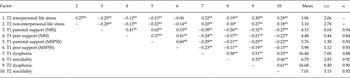
The bivariate correlations between predictor and outcome variables, as well as the mean, standard deviation (s.d.), and Cronbach's α value for each measure, are shown in Table 1. Levels of suicidality and dysphoria are slightly lower than those reported in past community studies of older high school students (Watson et al. Reference Watson, O'Hara, Simms, Kotov, Chmielewski, McDade-Montez, Gamez and Stuart2007). The NRI and MSPSS measures of parent support were highly correlated (r = 0.62), but the correlation for the peer support scales were lower (r = 0.41), likely because the NRI inquires specifically about social support provided by the best friend whereas the MSPSS examines social support provided by friends more generally.
Means, standard deviations, and correlations among factors

T1, Time 1 (baseline visit); T2, Time 2 (9-month follow-up visit); NRI, Network of Relationship Inventory – Relationship Qualities Version; MSPSS, Multidimensional Scale of Perceived Social Support.
*p < 0.05, **p < 0.01.
Hierarchical linear regression
Predicting T2 suicidal symptoms
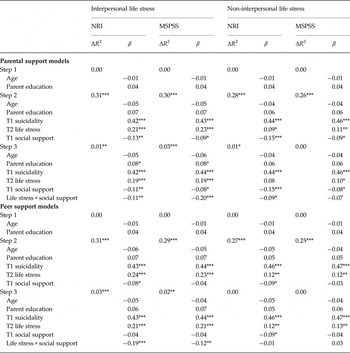
Table 2 presents the results for the hierarchical regression analyses for suicidality. Five of the eight social support × life stress interactions were significant predictors of T2 suicidality.
Predictors of T2 suicidal symptoms

T1, Time 1 (baseline visit); T2, Time 2 (9-month follow-up visit); NRI, Network of Relationship Inventory – Relationship Qualities Version; MSPSS, Multidimensional Scale of Perceived Social Support.
All variables entered in Step 1 were entered as covariates.
*p < 0.05, **p < 0.01, ***p < 0.001.
When controlling for T1 suicidal symptoms, T2 suicidal symptoms were predicted by parental support in all four models. However, peer support was a significant predictor in only one of four models. Three of the four interactions between parental support and life stress were significant, whereas only two of four interactions including peer support were significant. Both significant peer support models examined interpersonal life stress.
Both forms of life stress were also significant predictors of T2 suicidality, although effects for non-interpersonal stress were consistently weaker and non-significant in one model. Social support buffered the increase in suicidality associated with high levels of interpersonal life stress in all four models tested, but social support buffered non-interpersonal stress in only one of four models. Furthermore, the buffering effect for the one significant model including non-interpersonal stress was weaker than any of the models including interpersonal life stress.
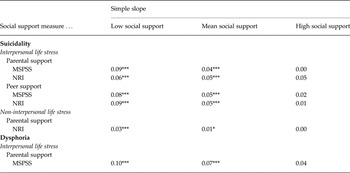
Decomposition of the significant interaction shown in Fig. 1a revealed that high levels of parental support are protective against the development of suicidal symptoms at high levels of interpersonal stress. However, at mean and low levels of parental support, participants experience significantly higher levels of suicidal symptoms at increased levels of interpersonal stress. Decomposition of the other significant interactions between life stress and social support looked nearly identical to the above interaction, and the simple slopes and significance levels for all significant interactions are reported in Table 3.
These graphs display the interpersonal life stress × parental support (MSPSS) interaction and its effects on levels of (a) suicidality (all values mean centered) and the interpersonal life stress × parental support (MSPSS) interaction and its effects on levels of (b) dysphoria (all values mean centered). MSPSS, Multidimensional Scale of Perceived Social Support.

Decomposition of significant interactions

NRI, Network of Relationship Inventory – Relationship Qualities Version; MSPSS, Multidimensional Scale of Perceived Social Support.
*p < 0.05, **p < 0.01, ***p < 0.001.
Predicting T2 dysphoric symptoms
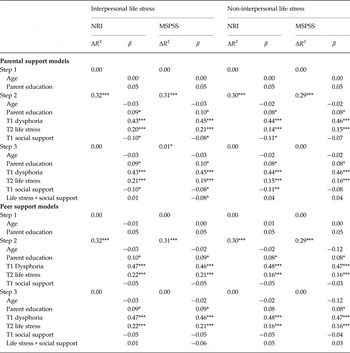
Table 4 presents the results for the hierarchical regression analyses for dysphoria. Even controlling for T1 dysphoria symptoms, life stress (both types) was a significant predictor of T2 dysphoria in all eight models. Parental social support was a significant predictor of T2 dysphoria in three of the four models, including both models that included interpersonal life stress. However, neither measure of peer support predicted dysphoric symptoms at T2. Importantly, only one of the eight social support × life stress interactions predicted dysphoric symptoms at T2, and it accounted for less variance than any of the significant social support × life stress interactions predicting suicidal symptoms at T2.
Predictors of T2 dysphoric symptoms

T1, Time 1 (baseline visit); T2, Time 2 (9-month follow-up visit); NRI, Network of Relationship Inventory – Relationship Qualities Version; MSPSS, Multidimensional Scale of Perceived Social Support. All variables entered in step 1 were entered as covariates.
*p < 0.05, **p < 0.01, ***p < 0.001.
Similar to the models predicting suicidal symptoms, decomposition of the only significant interaction between social support and interpersonal stress on dysphoria (Fig. 1b ) showed that high levels of parental support are protective against the development of dysphoric symptoms at high levels of interpersonal stress, but that mean and low levels of parental support are not.
Discussion
Consistent with previous findings (e.g. Evans et al. Reference Evans, Hawton and Rodham2004), our results showed that adolescents who experienced higher rates of life stress, especially interpersonal events, also reported significantly higher rates of suicidal symptoms. Furthermore, higher levels of parental support were associated with lower levels of suicidality. The effect of peer support was not as strong. This suggests that parental support continues to play an important role in protecting against the development of suicidality during adolescence. Although previous studies have found evidence for the buffering effect of parental support (Ge et al. Reference Ge, Natsuaki, Neiderhiser and Reiss2009; Hazel et al. Reference Hazel, Oppenheimer, Technow, Young and Hankin2014), few have examined the effects of peer support specifically, and no previous studies have examined the effects of social support as provided by parents and peers separately in the same study. Furthermore, we assessed two aspects of peer support (general and best-friend provided support), thus improving confidence in our results indicating that parental support has stronger buffering effects than peer support during adolescence.
When examining social support in the presence of life events, both parental and peer support protected against the effect of interpersonal life stress on suicidal symptoms. This effect was much less robust for non-interpersonal life stress, suggesting that social support is beneficial specifically for buffering interpersonal events. Although interactions between interpersonal stress and life events were reliable, their magnitude was small, which is in part due to rigorous testing that controlled for T1 symptom levels.
In order to investigate the specificity of the buffering effect of social support, we also examined the interaction between social support and life stress on dysphoric symptoms. Only one of the eight interactions was significant for buffering dysphoric symptoms, suggesting that there may be different developmental pathways for adolescent suicidality v. general dysphoria. These results imply that social support is effective in protecting against the adverse effects of life stress on certain dimensions of depressive symptoms, such as suicidality, but not others.
The findings in the current study are consistent with existing theories of suicide, including Joiner's Interpersonal Theory of Suicide (IPTS; Van Orden et al. Reference Van Orden, Merrill and Joiner2005) which states that the desire to engage in suicidal behaviors is the result of two interpersonal constructs; thwarted belongingness (i.e. loneliness and the absence of reciprocally caring relationships) and perceived burdensomeness (i.e. perception of being a burden on others). Feelings of perceived burdensomeness often result from a number of intense life stressors (Van Orden et al. Reference Van Orden, Witte, Cukrowicz, Braithwaite, Selby and Joiner2010). Consistent with the IPTS, high levels of social support, especially parental support during adolescence, would preclude the development of loneliness while also serving as a reciprocally caring relationship. Although stressors contribute to feelings of perceived burdensomeness, high levels of social support could mitigate the development of burdensome feelings. Importantly, our findings showed that high levels of social support buffer the effect that life stress has on the development of suicidal symptoms, possibly through protecting against the thwarted belongingness and perceived burdensomeness. Future research should investigate whether levels of perceived burdensomeness or thwarted belongingness mediate the stress-buffering effect of social support on suicidal symptoms during adolescence.
Findings from the current study also provide support for the Integrated Motivational-Volitional Model of Suicide (IMV; O'Connor, Reference O'Connor, O'Connor, Platt and Gordon2011). The IMV is a diathesis-stress model proposing that individuals develop the capability for suicidal behavior as a result of a complex interplay of events in three phases: pre-motivational (i.e. background factors and triggering events), motivational (i.e. formation of ideation/intention), and volitional (i.e. behavioral enaction). Life stress is an important factor in both the pre-motivational and motivational phases, and social support is implicated primarily in the motivational phase. According to the IMV model, life stress can lead to defeat and humiliation, entrapment, and in combination with low social support, suicidal ideation. However, consistent with our results, high levels of social support can prevent the onset of suicidal ideation, even when encountering high levels of life stress (O'Connor, Reference O'Connor, O'Connor, Platt and Gordon2011).
Our results highlight the importance and specificity of social support in protecting against the development of suicidality in teenage girls while also implicating family and peer relationships as possible therapeutic targets for preventing suicidal behaviors in this population. This is especially important, as adolescence is the period of greatest risk for the first onset of suicidal thoughts and behaviors (Bolger et al. Reference Bolger, Downey, Walker and Steininger1989; Kessler et al. Reference Kessler, Borges and Walters1999; Nock et al. Reference Nock, Green, Hwang, McLaughlin, Sampson, Zaslavsky and Kessler2013). Furthermore, being female is positively associated with both suicidal thoughts and behaviors during adolescence (Waldrop et al. Reference Waldrop, Hanson, Resnick, Kilpatrick, Naugle and Saunders2007). Interventions focused on modifying parenting behaviors in order to help promote healthy parent-child relationships (e.g. improving parent–child communication) during the transition from late childhood to early adolescence could be especially effective in offsetting the increase in life stress that frequently occurs during adolescence and prevent the development of suicidal symptoms. Previous intervention studies have demonstrated an association between modifying parenting behaviors with interventions such as Family Cognitive Behavioral Therapy (FCBT) and child psychopathology (Kendall et al. Reference Kendall, Hudson, Gosch, Flannery-Schroeder and Suveg2008). However, evidence regarding effective prevention and interventions for adolescents with suicidal thoughts or behaviors is extremely limited (Robinson et al. Reference Robinson, Hetrick and Martin2011; Glenn et al. Reference Glenn, Franklin and Nock2015). Among the sparse extant research on interventions for suicidal thoughts and behaviors, several elements emerged as being common across efficacious treatments, most notably family skills training (e.g. family communication and problem solving; Glenn et al. Reference Glenn, Franklin and Nock2015). To our knowledge, there are no current studies examining whether modifying parent behaviors to improve the parent-child relationship can prevent the onset of suicidal ideation during adolescence. Based on the main effects of parental support on dysphoric symptoms, interventions focused on promoting the parent-child relationships should also be successful in reducing dysphoric symptoms. However the mechanism of action would likely be different, as parental support did not buffer the negative effects that life stress had on dysphoria.
There were several limitations to the current study. The present study examined suicidal thoughts and self-injury, not actual suicide attempts. A much larger sample size would be needed in order to examine factors predicting and protecting against suicidal behaviors or attempts, though suicidal thoughts are a key risk factor for future suicidal behaviors and attempts. Also, we did not distinguish between non-suicidal and suicidal self-injury, which differ in intent, prevalence, frequency, and medical lethality (Hamza et al. Reference Hamza, Stewart and Willoughby2012; Grandclerc et al. Reference Grandclerc, De Labrouhe, Spodenkiewicz, Lachal and Moro2016). Another limitation is that, because the current study excluded life events that began before prior to T1, findings are biased towards acute stressors. Acute and chronic stress may have different impact on suicidality and dysphoric mood, and future studies should investigate the buffering effect of social support on chronic stressors. Additionally, the current study did not include male participants. However, it is important to investigate gender-specific effects because the etiology of suicidality appears to differ between genders. Lastly, there were some attrition biases in our sample. We controlled for differences in age and parental education level by including these variables as covariates in our analyses. There was also a small but significant difference in peer support as measured by the MSPSS. Because attriters reported lower levels of peer support, this likely reduced the range for this variable, resulting in overly conservative analyses.
The current results are consistent with a number of prominent theories explaining suicide, including the IPTS and the IMV. Future studies should include biological measures of stress in order to investigate pathophysiological models of suicide (e.g. Turecki & Brent, Reference Turecki and Brent2016). Furthermore, although the findings implicate interpersonal stress as an important target for preventing the onset of suicidality, further classification of interpersonal stress (i.e. familial v. peer) could provide further insight for the development of more effective interventions.
Conclusion
The results from our study provide further support for the view that life stress and deficiencies in parental support synergistically increase the risk of suicidal ideation (Pettit et al. Reference Pettit, Green, Grover, Schatte and Morgan2011; Buitron et al. Reference Buitron, Hill, Pettit, Green, Hatkevich and Sharp2016). Furthermore, it appears that the source of social support (i.e. parent v. peer), type of stressor (i.e. interpersonal v. non-interpersonal), and psychiatric outcome (i.e. suicidality v. dysphoria) all are critical factors to consider when examining the stress-buffering hypothesis. Our results provide evidence for the stress-buffering model, particularly when examining parental social support in the context of interpersonal life stress on suicidal symptoms. Furthermore, our results are consistent with a number of current theories explaining suicide, notably the IPTS and the IMV, highlighting the importance of interpersonal stressors and social support in suicidality. Finally, the current study suggests that interventions promoting social support, specifically parental support, may be beneficial in preventing the onset of suicidal thoughts and behaviors for adolescent girls.
Supplementary material
The supplementary material for this article can be found at https://doi.org/10.1017/S0033291716003275.
Acknowledgements
This study was supported by the National Institute of Mental Health grant R01 MH093479 awarded to R.K. We would like to thank Michala Godstrey and the rest of the ADEPT team for their work on the project.
Declaration of Interest
None.