Introduction
As demand for health and social care services continues to rise in most countries – and particularly in more mature economies with increasing life spans and ageing populations, and a greater potential to fund expansion – policy makers have inevitably turned their gaze towards economies to be achieved in delivering services. Yet, whether publicly or privately provided, there are limited ways to reduce cost in labour-intensive services, particularly if the objective is to do so without reducing quantity or quality. While measures impacting directly on pay and productivity are perhaps to the forefront of economists' minds, there has been a long history in most caring services of attempts to achieve cost efficiencies by means variously described as ‘skillmix’ or ‘grademix’ reviews or even ‘reprofiling the workforce’. At root, such attempts consist de facto of labour substitution – the practice of substituting cheaper for more expensive labour. This is by no means the same thing as substituting less for more skilled labour, although the two are often conflated (for a full review in the healthcare context, see Thornley, Reference Thornley, Crompton, Gallie and Purcell1996a, Reference Thornley and Komaromy2001a): it may, for example, entail changing grades (and pay) of existing jobs.
This practice has been fully evident in the context of recent policy in UK healthcare. While the grade of Health Care Assistant/Support Worker was first introduced by a Conservative government in 1990, intensifying an existing series of initiatives around skillmix and reprofiling (see Thornley, Reference Thornley and Davies2003a), interest in expanding support grades has continued throughout the period of ‘New’ Labour governments, as evidenced by a series of policy documents. The NHS Plan in 2000 made explicit the desire to challenge ‘traditional professional boundaries’ and ‘demarcations’, and ‘old hierarchical ways of working’ (DoH, 2000a). This approach has been carried forward in the new pay system, Agenda for Change, with a new Knowledge and Skills Framework (DoH, 2004), where more flexible working across traditional boundaries' is listed amongst policy achievements (DoH, 2005a: 6–10; also NHS Employers, 2006a and 2006b).
The financial imperatives for such policies have also been clear. Indeed, a major recommendation in Derek Wanless' influential final report to the Treasury in 2002, on the longer-term future of the health service, concerned the ‘considerable scope’ that greatly increased numbers of ‘health care assistants’ could allow for changes in ‘skillmix’ in the healthcare labour force, with a particular emphasis on cost savings on registered nurses (Wanless, Reference Wanless2002: 57). From an economist's perspective, since two-thirds of the NHS budget is spent on pay (ibid.) and the nursing pay bill is the largest single element in the overall pay bill – a fact which often surprises non-specialists – the nursing workforce represents a particular target for savings. Stringent financial objectives and efficiency/productivity savings now documented in current plans (DoH, 2006) may lend continuing impetus to substitution.
While cost considerations have been an important driver behind change, it is nonetheless the case that current policy on the NHS workforce also includes reference to equity considerations. The Agenda for Change agreement, for example, contains explicit references to an intention to ‘improve all aspects of equal opportunity and diversity’ and to ‘meet equal pay for work of equal value criteria’ (DoH, 2004: 2). Similarly, the NHS Employers state that:
The new pay system ensures fair pay and a clearer system for career progression. For the first time staff are now paid on the basis of the jobs they are doing and the skills and knowledge they apply to these jobs. This reform is underpinned by a job evaluation scheme specifically designed for the NHS, a system that is fair and transparent. (NHS Employers, 2006b) (emphasis added)
It is thus argued that there will be ‘recognition and reward for the skills and competencies staff acquire throughout their career’, and a ‘system that should improve recruitment and retention and contribute to making the NHS a model employer’ (ibid.).
Such ‘equity’ considerations could be seen to accord with wider government policy priorities on equalities (see Thornley, Reference Thornley, Coffey and Thornley2003b), in particular equal pay and low pay as apparent in the establishment of the Women and Work Commission and the Low Pay Commission. Most recently, the Equality Act 2006 has, in particular, placed gender as well as race and disability equality obligations upon public sector employers through processes including gender pay audits, equality schemes and action plans. The Act, inter alia, creates ‘a duty on public authorities to promote equality of opportunity between men and women, and to prohibit sex discrimination in the exercise of public functions’, ensuring that they ‘pay their workforce in accordance with the equal pay laws’ (Personnel Today, 2007). These policies, of course, reflect union pressure and influence in recent public sector ‘modernisation’ and new payment systems, as well as in wider social policy (Thornley, Reference Thornley2006).
The consideration of employment realities for an important group of staff in the NHS enables an exploration of the extent to which policies focused on cost efficiency are proving to be compatible with or to dominate considerations of equity, when ‘equity’ is understood to encompass remuneration for jobs actually performed and the experience and skills brought to bear in those jobs, with competencies acquired over a career duly rewarded; and in a wider governmental context, equity too is to be understood with ‘equalities’ issues more generally, vis-à-vis mitigation of low pay and promotion of equal pay as policy agendas. The question with which we are concerned is therefore whether ‘equity’, as set forth in the particular stances adopted by the NHS as an employer and by government more generally, is proving to be a laudable policy ambition overwritten in practice by the drive to constrain costs.
To this end, the article draws upon the author's own commissioned research to detail the context to the introduction of these new grades and to highlight issues in practice and usage to date. As Saks and Allsop (Reference Saks and Allsop2007) note, health support work has been under researched (see also Buchan and Dal Poz, Reference Buchan and Dal Poz2002; Sibbald et al., Reference Sibbald, Shen and McBride2004), although some work on most recent workforce changes is now emerging (see, for example, the collection in Davies, Reference Davies2003; Hyde et al., Reference Hyde, McBride, Young and Walshe2005; McBride et al., Reference McBride, Hyde, Young and Walshe2005). This article contributes to this important topic by drawing on a series of national studies, case studies and interviews commissioned by UNISON and conducted by the author between 1996 and 2005.
Health care assistants and support workers
A ‘new’ – and locally paid – grade of health service worker, the Health Care Assistant (HCA) (or Support Worker) was introduced in the 1990 NHS and Community Care Act, alongside proposals for National Council for Vocational Qualifications (NCVQ) certificates for this new grade. Initiatives on skillmix and reprofiling were concurrently intensified. The origins of this grade reflected partly a direct attempt by employers to reduce labour costs, but also a reaction to attempts by nursing ‘professionalisers’ to achieve a more complete professional closure for registered nurses via changes to the nurse education system in the late 1980s, which became known as Project 2000 (see Thornley Reference Thornley and Davies2003a). The new grade of HCA quickly began to replace the long-standing – and nationally paid – grade of Nursing Auxiliary/Assistant (NA), itself first introduced in 1955 (and acknowledging the then already existing supporting roles, as indeed did the earlier grade of Enrolled Nurse, established in 1943). Negligible academic or policy attention had been paid to the grade of NA since its inception, despite the fact that much direct patient care was conducted by NAs and despite the importance of their role (see Salvage, Reference Salvage1985: 88; Davies, Reference Davies1995: 95). The introduction of HCAs threatened to add to the public ‘invisibility’ of roles at the lower end of the nursing hierarchy, whilst also raising questions about how this ‘new’ grade differed in roles from the existing grade. The research conducted by the author was designed to clarify these issues, as well as to evaluate the shift from national to local pay.
An early national study (Thornley, Reference Thornley1996b) confirmed a rapid growth of HCAs, with numbers, proliferation of titles and duties outstripping official accounts. This study was subsequently augmented by a series of national questionnaire surveys of managers, trade unionists and remaining NAs as well as HCAs, together with analyses of pay data, case studies and in-depth focus group interviews, involving cumulatively over two thousand participants (and reported in Thornley, Reference Thornley1997, Reference Thornley1998a, Reference Thornley1998b, Reference Thornley1999, Reference Thornley2001b, Reference Thornley2005). These further evidenced the growth in usage of the new grade, constituting jointly the most extensive independent study yet made of HCAs and Support Workers. For example, findings formed part of UNISON's Evidence to the Nurses' Pay Review Body in successive years. The studies also evidenced new forms of disadvantage and neglect vis-à-vis the aspirations and needs of these workers. While informed by this background, this article gives particular emphasis to the updated pay series in the 2005 research project, with illustrative use also made of the qualitative findings of a small-group study (based on completion of in-depth questionnaires followed by an extended focus group interview in a session lasting just under five hours with the same nine participants from four geographically spread NHS Trusts) to bring out some of the most pressing issues.
To date, problems with official recognition of multiple job titles, and of real work performed by HCAs and Support Workers (and NAs) relative to other health professionals including registered nurses, continue to be reflected in DoH Statistics (see Thornley, Reference Thornley and Davies2003a, Reference Thornley2005). Nonetheless, it is clear even from official statistics that registered nurse numbers stagnated in the second half of the 1990s, while numbers for ‘other direct care staff’ rose. Officially, HCAs and support staff constituted 11 per cent of the overall NHS workforce in England by 2000 (DoH, 2000b). The latest official statistics show the numbers of staff in support to doctors and nurses have risen proportionately faster than doctors and registered nurses in the period 1997–2004, with the combined numbers of HCA/SWs and NAs increasing steadily over this period (DoH, 2005b, see especially Tables 1a and 2a).
Type of ‘Nursing’ or direct patient care duties performed

Profile, job content and training
The authors' own large-scale surveys also show that, despite a very wide variety of job titles, the HCA/SW grade has been subsuming the NA grade, with titles now virtually interchangeable. The majority (over four-fifths) are female, and around half work part-time – with the usual implications for undervaluation of ‘women's work’. An outstanding characteristic of these workers is maturity and experience; the great majority are aged over 30, with nearly half of all HCAs (and 60 per cent of NAs) aged over 40. In line with this, there is substantial experience in prior caring roles, both formal (for example, HCAs previously employed as NAs, or in other caring roles in the NHS or local government), and informal (such as caring experience in the home). Length of service is also striking – for HCAs coming from an NHS caring background around half have over five years, and nearly a third have between 10 and 28 years, experience; the average length of employment as an NA is over 12 years. A majority of each tend moreover to undertake self-teaching during their employment. The 2005 small group sample reflects this profile, although with a slight over-representation of male and non-white ethnicity workers and an average length of service of almost 15 years.
Since job content, recognition of competencies and career progression are all key points from the viewpoint of the equity considerations outlined above vis-à-vis both NHS and wider government policy, it is instructive to consider each in turn.
The author's large national surveys found little difference between HCAs/SWs on the one hand and NAs on the other in terms of work actually performed, regardless of particular job title. Moreover, the bulk of work undertaken is clearly nursing work across all the main service areas, and notwithstanding an extensive blurring of the boundaries between job content related to ‘ancillary’ work and job content related to nursing and extended nursing tasks. While many of these workers are expected to engage in certain aspects of ‘non-clinical’ work (such as clerical, cleaning, cooking/making drinks, portering, transport, messenger work and, in a few cases, laundry), the very great majority are also employed in the performance of ‘clinical/nursing’ duties, and for the bulk of their work – an important finding. Furthermore, these national surveys (see especially Thornley, Reference Thornley1997, Reference Thornley1998b) also found significant numbers of HCAs/SWs and NAs engaging in more extended clinical/nursing tasks.
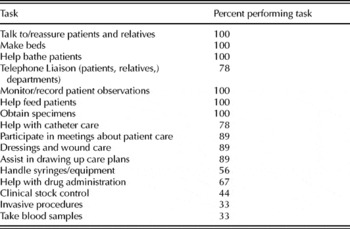
In this connection, the 2005 study small-group sample is suggestive of an increase in the extent of nursing tasks being undertaken by some HCAs/SWs and NAs. Table 1 shows percentages of focus group participants engaging in specified nursing tasks (and of the sort also identified in the earlier national surveys):
Participants' responses also aptly illustrate the nature more generally of engagement with extended clinical/nursing tasks: the majority liaise with doctors; just under half help train student/newly qualified nurses, supervise staff, or set up drip feeds; yet others variously (and depending upon service area) assist with cardiac massage in case of arrest, set up/monitor diagnostic machines, give injections, take charge of shifts or undertake sole care of patients in their homes. Indeed, these participants continue to note development of new roles and more extensive nursing and clinical tasks, especially where NVQs have been acquired; extensive supporting details are provided of these, as well as of the often over-looked but (for nursing) absolutely essential ‘soft-skills’ of looking after patients and seeing to daily living needs. In fact, they are even more likely than suggested in previous surveys to perceive themselves as employees used to substitute for registered nursing staff ‘all or most of the time’. Only one felt used only ‘sometimes’ in this way. All but one also reported ‘little or no’ direct supervision, and, consistent with enlarged responsibility, all but one noted that non-registered nurses carry out the larger part of direct patient care in their wards or community rounds.
These are realities easily ignored in official accounts of work-roles, but central to any debate around ‘equity’ that takes job content and responsibility seriously. Moreover, there may even be a tendency for non-registered staff to understate tasks actually performed, and the degree of unsupervised responsibility actually exercised. Discussions in extended group interviews around a ‘typical day's work’, with supporting questions from other participants, suggest that this group of workers may typically under-rate or even neglect to mention some extremely important and difficult tasks, involving both ‘technical’ and ‘soft’ or ‘holistic’ skills.
As for training and progression, recognition of existing competencies through formal qualification (e.g. NVQs), with adequate provision of further training opportunities to allow HCAs (and by implication NAs) to progress into nurse training, was a key official promise when the grade was introduced. By 2005, there were certainly some indications of improvement. But despite policy initiatives like Individual Learning Accounts, signs of improved access to registered nurse training, and the ‘Skills Escalator’ – achieved in large part through very sustained campaigning work by UNISON (for a detailed review, see Thornley Reference Thornley2006) – in practice progress has been slow and patchy. NVQ attainment is gradually becoming an expectation for HCAs (and for NAs), gathering pace over the period of the author's research, with ever-growing numbers achieving them. But there have also been substantial problems: reported blockages in progressing to higher-level NVQs, patchy arrangements for – and amounts of – training, and few evident linkages between NVQ attainment and pay or promotion, with an ensuing lack of career paths and recognition. And financial impediments to nurse training remain paramount. As one participant put it: ‘I could not afford now to live on a student bursary – I've a partner and a small child.’
While Agenda for Change and other current initiatives are intended in part to address these issues, there remain substantial problems at the point of writing. But despite continuing deficits in training and accreditation of existing skills, the maturity, experience and experiential learning of HCAs/SWs and NAs underpins the important work they carry out, and underpins the potential for substitution.
Pay and morale
Research conducted by the author consistently demonstrates substantial problems of low pay for non-registered nurses, exacerbated by local pay for HCAs/SWs. As one 2005 interviewee put it:
We could get more stacking shelves, but we're a dedicated lot and continue to do the hard work for very little pay. Will [our pay rise] be enough to pay rising costs when water, rates, gas, electricity are all rising and my wages have been rising less . . . I am struggling to make ends meet . . . having to use credit before the end of even a short month.
Despite the recent provision of additional increments at the top of Scales A and B for achievement of NVQs 2 and 3 respectively (for those on national Whitley contracts), there is no evidence in the 2005 study of any real or generalised improvement in pay. At time of writing, assimilation on to the new Agenda for Change payspine has been slow and the new system is inadequately advanced to gauge its potential impact – indeed, it may take some time before effects are known. Meanwhile, pressing problems remain.
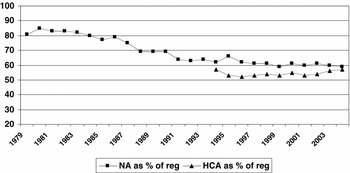
Looking first at national evidence, Figure 1 shows that NAs have seen a steady deterioration in gross pay gauged against registered nurses' pay, from a position of around 80 per cent in 1979 to just 59 per cent in 2004. In making this point, it should be noted that registered nurses also suffer disadvantages in remuneration when properly located in the wider economy, so that this is a comparison of one, hugely disadvantaged, group with another, badly paid, group. The situation for HCAs/SWs is even worse: their pay has undercut that of NAs, only just regaining in 2004 their starting position in 1994 – the year when official statistics begin – of just 57 per cent of the average gross salary for a registered nurse.

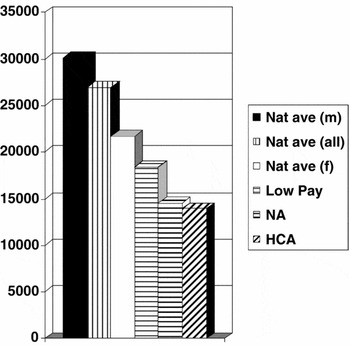
Figure 2 demonstrates that HCAs/SWs and NAs are amongst the poorest workers in the economy, with average earnings well below the official Council of Europe decency threshold measures of low pay. Most earn just half the current national average, and this feminised occupation earns less than half the average for male workers in the economy.
HCAs/NAs gross pay compared with average and low pay indicators 2004.
Source: Author's calculations from ASHE, 2004.

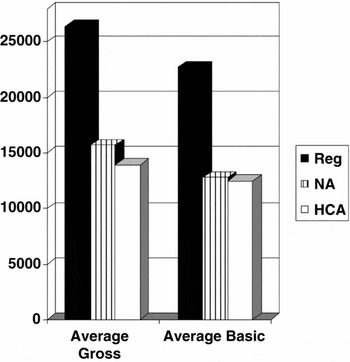
Figure 3 shows HCAs' and NAs' average (whole time equivalent) basic and gross pay, compared with registered nurses' in absolute terms. NAs earn an average basic pay of just £12800, while HCAs earn even less at £12500; both figures fall within the Whitley ‘A’ scale for 1 April 2005, confirming reports that the majority of non-registered nurses are still to be found on this scale or its local equivalent. There appears less opportunity for HCAs than for NAs to supplement basic pay with additional payments, confirming earlier concerns about ‘consolidated’ local pay structures for this group. More generally, the large absolute differential between HCAs/NAs and registered nurses is clearly visible.
HCAs/NAs' basic and gross pay compared with registered nurses.
Source: Author's calculations from DoH, 2005c.

With respect to the 2005 study participants, a picture broadly consistent with this national overview emerges. Although those on Grade B or its equivalent appeared to be over-represented in this small sample, all confirmed that most non-registered nurses in their Trust were on Grade A. Findings also suggested that there may have been rather more movement in pay grades recently, possibly linked to improvements in NVQ attainment and linkage to pay for some. However, the average time spent by participants in their current grade was still seven years, and more participants had failed to receive a pay increase following NVQ attainment than had actually received one, suggesting this is still a major problem. Only one had access to paid overtime, despite the fact that most worked between three and five hours a week unpaid overtime; a third of the sample attempted to improve on basic pay by working on a nurse bank – others by working nights and unsocial hours.
Views on pay were extremely strong with ‘fairer pay and recognition’ viewed as most important to ‘improve feelings about the job’, as well as the second most important issue (after staff shortages and workload) informing intentions to leave. Earnings were an important part of household income for all focus group participants, with all but two being their household's sole or main earner. All but two currently had caring responsibilities at home for pre-school or school-age children or elderly relatives, for which additional income is generally needed. All strongly agree (78 per cent), or agree (22 per cent), that they are ‘not paid enough for workload and responsibilities’, and strongly agree (89 per cent), or agree (11 per cent), that ‘pay is too low to meet needs’.
This was expanded upon in written comments and interviews, with comments on the lack of reward for experience and on-the-job acquisition of skills and NVQs: ‘We want to be valued for what we already do!’; ‘I only get 20p more per hour for my NVQ attainment.’ The difficulties of managing on such low incomes was also brought vividly alive: ‘I'm using my credit card to survive on’; ‘We don't manage on our incomes – I'm terribly in debt’; ‘Most of us are in debt, especially if you have childcare commitments and have to cut back your hours’; ‘Most of us live hand to mouth’; ‘A caravan in Skegness is a luxury holiday for me!’
The pressure this put on working extra jobs or shifts, and impact on health, were widely mentioned: ‘I help out in a sandwich bar’; ‘Most are lucky if they have one day off a week as they have to work on the bank just to survive especially where there's no paid overtime. I've frequently worked 10–14 days in a row’; ‘Several weeks of nights in a row isn't that uncommon’; ‘You get burn out due to the extra jobs’; ‘It caused my heart attack’; ‘I've had a serious illness too – if they actually paid us a decent salary sickness would drop’; ‘You can't afford to have holidays – you try and take a weekend off at Easter so you can go in and work it’; ‘Yes – book a week off and then do agency work.’
The stresses routinely involved in dealing with ill and vulnerable people can be considerable, but easily underestimated. These stresses can be magnified by work-related difficulties with finances and health – at least some of which, as shown in the preceding discussion, can be linked to low pay and poor status accorded these workers. Staff shortages are seen as an important source of additional stress: ‘Last week the shortages were very bad, they caused tensions – I almost walked out’; ‘Most of us are working in unsafe staffing levels’; ‘There's only one RN [registered nurse] on at nights’; ‘Most of us don't take breaks’; ‘Sometimes I've cried at work because of the workload and the urgency – just thought “where do I go first?” and I've ended up in tears.’
And all but two of the participants had considered leaving their job in the previous 12 months. The most important reasons given were ‘staff shortages and workload’, closely followed by ‘levels of pay and/or conditions’ and ‘low morale and stress’, while additional reasons include problems with working hours, managers' treatment of staff, the lack of a clear delineation of duties and status when compared to registered nurses, and having to compromise on standards of care: ‘The stresses are very high – we're undervalued, underpaid and overworked’; ‘Morale is very low throughout the Trust – all are looking to get out.’
When asked what steps would ‘most improve feelings about the job’, the top-ranked response for all but one was ‘fairer pay and recognition’, followed by ‘reduced workload’ and ‘increased safety at work’. All felt unions needed a ‘stronger voice’ in improving pay and conditions – with all but one a member of UNISON. But despite these problems, the interviews demonstrate a deep and long-standing commitment to patients, and a love for the job itself. Such factors may well have previously weighed heavily in favour of decisions to stay in the job and to attempt to improve pay and conditions. However, these same factors are easily exploited in the name of ‘productive efficiency’, and the resulting low pay is a genuine source of distress: ‘I never wanted to do anything else’; ‘but don't tell the managers!’; ‘We have a love–hate relationship with the job – we love the NHS and we feel if we don't come in we're letting patients down’; ‘But you love the job, and you hate the pay!’; ‘If we were paid a decent salary, we'd love it all’.
Conclusions: issues of efficiency and equity
Recent policies in rebalancing ‘grademix’ in health and social care undoubtedly carry the advantage that cost savings are likely to accrue in the shorter term. However, the findings in this article on care assistants and support workers in the health service suggest that policies targeted at cost efficiencies need to be more broadly conceptualised, to avoid conflicting with equity objectives and longer-run efficiency considerations.
At one level, cost efficiencies in a crude sense have been prioritised and achieved. But paradoxically, this has meant an actual decline in relative pay even as accumulating evidence demonstrates the real experiential skills attained by these workers, the important tasks undertaken, a substantial and increasing attainment of accreditation and training and a degree of de facto substitution for registered staff. Local pay for HCAs/SWs had an initial and pernicious effect, but relative pay for NAs on national pay determination arrangements has also declined. Partly through sustained campaigning by UNISON (Thornley, Reference Thornley2006) this decline has been arrested in recent years, with new national arrangements put in place for training and pay. However, these workers are still left with poor pay relative both to their closest health service comparators and to wider comparators in the national economy.
A number of equity considerations flow from this. Firstly, if these workers have deep perceptions of unfairness, there is substance to these perceptions. Pay diverged initially between HCAs/SWs and NAs, but both groups have lost position relative to registered staff – for whom they routinely and increasingly substitute. Secondly, their pay constitutes ‘low pay’ under official measures, and low pay for this group of staff reflects a problem more generally for disproportionately female occupations – both in the public and private sectors (see also Thornley, Reference Thornley2006; and Thornley, Reference Thornley2007 on local government workers). There is clear evidence of undervaluation of roles actually performed and skills actually attained, which also link again into wider issues of undervaluation of ‘women's work’ and equal pay considerations. This is also a problem for registered nursing staff, but the overall growth in employment of HCAs/SWs and NAs compounds its extent and severity. These facts run counter to any wider policy attempts to address low and unequal pay, and this again constitutes a paradox in a sector where government is the ultimate ‘employer’.
If there is here a tension between ‘efficiency’ and ‘equity’, the facts also suggest the need for wider conceptualisations of ‘efficiency’, which also take into full account equitable (or distributional) issues and employ a longer time horizon. If cost efficiencies have been achieved, they have been achieved at the direct expense of one of the poorest groups of workers who demonstrate large amounts of commitment to their work. And if the lack of equity in the employment of these workers leads to loss of morale, deteriorating industrial relations, and additional stress – then this must impact on recruitment and retention as well as (potentially) on productivity levels. Thornley (Reference Thornley1999), for instance, describes how the tendency towards poor official record keeping on these workers has obscured the real extent of retention problems.
Finally, HCAs/SWs and NAs represent a major resource for the development of either parallel practitioner roles in health services or of recruitment into registered staff training. This longer-term resource is squandered if the ‘low road’ of poor practices around accreditation, training, pay and progression takes precedence over ‘higher-road’ practices that seek to satisfy efficiency and equity considerations in tandem.
There are some signs of an increased interest in the details of employment of these workers, not least in discussions about the issue of potential registration (for a full review, see Saks and Allsop, Reference Saks and Allsop2007), and in proposals around training, pay and progression in the new pay system, Agenda for Change. Clearly, it remains to be seen whether the measures associated with the latter effect major changes to the picture presented in this article; however, constraints on funding for Agenda for Change, combined with the current financial deficits being experienced by Trusts, suggest the path may be rocky. At a deeper level, short-term cost advantages achieved through labour substitution, and associated constraints on pay, may prove hard to reconcile with higher-road approaches that give equal weight to distributional concerns and broader conceptions of efficiency.
Acknowledgements
I am pleased to acknowledge both UNISON and research participants. Thanks, too, to the anonymous peer reviewers, to Dr Dan Coffey, and the Editors for their helpful comments.