Introduction
Recent interest in hydrogen storage research for automotive applications has led to a search for materials, primarily composed of light elements (Z ≤ 13), with high gravimetric hydrogen capacities. Although the interstitial metal hydrides exhibit excellent hydrogen reversibility (the ability to hydrogenate and dehydrogenate) under moderate pressure and temperature conditions, they have limited storage capacities (≤2 wt%)Reference Sandrock1 and are often considered to be unsuitable for automotive fuel cell applications. In recent years, much attention has been devoted to aluminum-based hydrides, many of which have appreciable gravimetric hydrogen storage capacities.Reference Graetz2
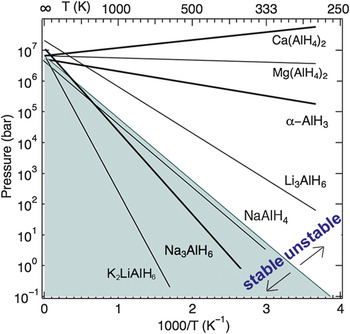
Aluminum hydride (AlH3), also known as alane, is a covalently bonded solid that comes in a variety of polymorphs (α, α’, β, γ), all of which are thermodynamically unstable at room temperature. However, AlH3 can easily be prepared as a kinetically stabilized solid with excellent stability even in air.Reference Graetz, Reilly, Yartys, Maehlen, Bulychev, Antonov, Tarasov and Gabis3 Many of the complex aluminum hydrides (alanates) are considerably more stable since the covalently bonded Al–H complex exists as an anion (e.g., [AlH6]3–, [AlH4]–) that is stabilized by a cation, typically an alkali (e.g., Li), an alkaline earth (e.g., Mg), or a transition metal (e.g., Zn). In general, complex aluminum hydrides come in two forms: the tetrahydroaluminates (M n+(AlH4)n), where Al is tetrahedrally coordinated by H, and hexahydroaluminates ( $M_3^ + {\rm{AlH}}_6 ,\;M^{2 + } {\rm{AlH}}_5 ,\;M_2^{2 + } {\rm{AlH}}_7$), where Al is octahedrally coordinated by H. Hydride stability is often represented in a van’t Hoff plot, which gives the equilibrium hydrogen pressure (Peq) as a function of temperature. The stability of the Al-based hydrides varies significantly, from those that are unstable at room temperature (e.g., Mg(AlH4)2 and AlH3) to those that are stable up to 300°C (e.g., K2LiAlH6), as shown in the van’t Hoff plots in Figure 1. A more thorough review of these materials and their hydrogen storage properties can be found in recent review articles.Reference Graetz, Reilly, Yartys, Maehlen, Bulychev, Antonov, Tarasov and Gabis3–Reference Jain, Jain and Jain5
Calculated van’t Hoff plots from a variety of aluminum-based hydrides.Reference Graetz and Reilly6 The compounds that are stable at room temperature appear in the lower left (Peq ≤1 bar), and those that are unstable appear in the upper right (Peq >1 bar). Reprinted with permission from Reference Reference Graetz and Reilly6. © 2007 Elsevier.

Crystal structures of Al-based hydrides
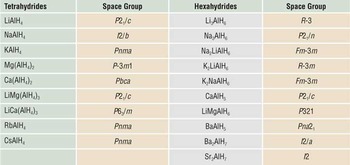
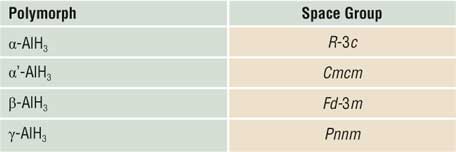
The structural properties of alanes and alanates were recently reviewed by Hauback et. al and others,Reference Orimo, Nakamori, Eliseo, Zuttel and Jensen4,Reference Jain, Jain and Jain5,Reference Hauback7,Reference Tarasov and Kirakosyan8 and a summary of the crystal structures is listed in Tables I and II. In most cases, the crystal structures were determined by powder diffraction techniques. Although x-ray diffraction (using standard laboratory and synchrotron radiation sources) is useful for determining the space group and many of the atomic positions, the low x-ray scattering cross section of light elements makes it especially difficult to determine the location of the hydrogen atoms. Neutron diffraction is especially sensitive to hydrogen and deuterium and is commonly used to determine hydride structures. However, due to the large incoherent cross-section of hydrogen, the H atoms are often replaced with deuterium, which generally has little impact on the structure.
Experimentally determined structures of various alanates.

Experimentally determined structures of alanes.
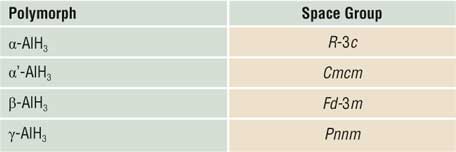
Aluminum hydride, AlH3, comes in a variety of different crystal structures (polymorphs), but the most stable (and common) phase is α-AlH3, which crystallizes in the trigonal space group, R-3c, with a hexagonal unit cell (Figure 2a).Reference Hauback7 The structure consists of corner-connected AlH6 octahedra with H bridging bonds and is similar to the other polymorphs (α’, β, γ), which typically consist of corner-connected and, in some cases, edge-sharing AlH6 octahedra. Although the structures of the AlH3 polymorphs appear strikingly similar to the structures of hexahydroaluminates (Figure 2), the AlH3 phases are missing the stabilizing cations (e.g., alkali metals) that balance the structure by donating some of their charge to the AlH6 complexes.
Structures of (a) α-AlH3 showing AlH6 octahedra (blue) and (b) Na2LiAlH6 showing Na atoms (yellow), LiH6 octahedra (green), and AlH6 octahedra (blue).

The general formula for the tetrahydroaluminates is M x+N y+(AlH4)x+y, where M and N are typically alkali (x, y = 1) or alkaline earth metals (x, y = 2), or a combination thereof. In some cases, transition metal elements will also form alanates (e.g., Ti(AlH4)4),Reference Wiberg and Lacal9 but these compounds are typically unstable and only form at low temperatures (e.g., –80°C). Examples of a few tetrahydroaluminates with high gravimetric hydrogen capacity include LiAlH4 (10.6 wt%), LiMg(AlH4)3 (9.7 wt%), Mg(AlH4)2 (9.3 wt%), Ca(AlH4)2 (7.9 wt%), and NaAlH4 (7.5 wt%). In these materials, the H atoms are covalently bonded to Al in well-separated, isolated (AlH4)– tetrahedra that are connected via the cations (M and N), as shown in the representative structures of Ca(AlH4)2 and LiMg(AlH4)3 of Figure 3.Reference Hauback7,Reference Sato, Sørby, Ikeda, Sato, Hauback and Orimo10 The tetrahedra in NaAlH4 have perfect symmetry, but in most other cases (Li-, K-, Mg- and Ca-alanates), the tetrahedra are slightly disordered, with average Al–H (or Al–D) distances in the range of 1.605–1.644 Å. The coordination number of the cations increases with the corresponding ionic radius (typically 5–10 for the known tetrahydroaluminates) along with a similar increase in the distance to the nearest H atom.
(a) Structure of Ca(AlH4)2 showing Ca (red) and Al (blue) atoms along with AlD4 tetrahedra (blue). (b) Structure of LiMg(AlH4)3 showing Mg (yellow), Li (green), and AlD4 tetrahedra (blue). The different shades of blue represent Al in different positions.

There exist several other alanates composed of alkali and alkaline earth elements and AlH6 octahedra, which have the general formula M ax+N by+AlH3+ax+by. These include (1) the mixed alkali hexahydroaluminates, such as Na2LiAlH6 (Figure 2b), K2NaAlH6, and K2LiAlH6; (2) the alkaline earth hydrides, such as CaAlH5, BaAlH5, Ba2AlH7, and Sr2AlH7; and (3) the mixed alkali-alkaline earth hydrides, such as LiMgAlH6. It is interesting to note that many of the hexahydroaluminates form as intermediates during hydrogen desorption from the tetrahydroaluminates, as shown:
 $${\rm{Ca(AlH}}_{\rm{4}} {\rm{)}}_{\rm{2}} \to {\rm{CaAlH}}_{\rm{5}} + {\rm{Al}} + {\rm{3/2H}}_{\rm{2}} \to {\rm{CaH}}_{\rm{2}} + {\rm{2Al}} + {\rm{3H}}_{\rm{2}}$$
 $${\rm{LiMg(AlH}}_{\rm{4}} {\rm{)}}_{\rm{2}} \to {\rm{LiMgAlH}}_{\rm{6}} + {\rm{Al}} + {\rm{H}}_{\rm{2}} \to {\rm{MgH}}_{\rm{2}} + {\rm{2Al}} + {\rm{3H}}_{\rm{2}} {\rm{.}}$$
In the hexahydroaluminates, the hydrogen is covalently bonded to Al in (AlH6)3– octahedra that are linked in a number of different ways. In Li3AlH6, the structure forms a three-dimensional network that can be described as a distorted bcc structure of (AlH6)3– units with all tetrahedral sites filled with Li. In the mixed alkali alanates, such as Na2LiAlH6, the structure consists of corner-sharing (AlH6)3– and (LiH6)3– octahedra, where each octahedron is surrounded by six octahedra of a different type (Figure 2b). In other examples, such as BaAlH5 and CaAlH5, the structure is an infinite zigzag chain of (AlH6)3– octahedra sharing one corner.
Reversibility and regeneration
Reversible Al-based hydrides
Aluminum hydrides exhibit a high hydrogen capacity (10 wt% and 148 g H2/L) and undergo a reversible dehydrogenation reaction at low temperature (∼100°C),
 $${\rm{\alpha - AlH}}_{\rm{3}} \leftrightarrow {\rm{Al}} + {\rm{3/2 H}}_{\rm{2}} {\rm{.}}$$
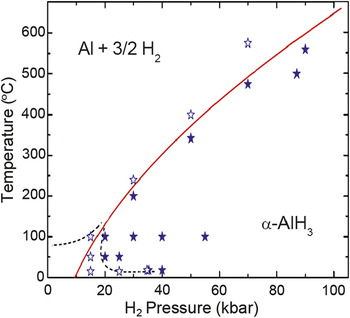
Although reaction 3 is reversible, the hydrogenation of aluminum (driving the reaction from right to left) requires extremely high pressures and temperatures (e.g., 28 kbar and 300°C), as shown in the phase diagram of Figure 4; therefore, this material is currently considered impractical for applications that require onboard rehydrogenation.Reference Graetz, Reilly, Yartys, Maehlen, Bulychev, Antonov, Tarasov and Gabis3
Pressure-temperature phase diagram for the Al-H system, with markers indicating the pressure and temperature conditions where α-AlH3 formed (closed symbols) or did not form (open symbols) along with a solid red line representing the calculated equilibrium for AlH3 ↔ Al + 3/2H2. Reprinted with permission from Reference Reference Graetz, Reilly, Yartys, Maehlen, Bulychev, Antonov, Tarasov and Gabis3. © 2011 Elsevier.

The desorption from alkali-based tetrahydroaluminates typically follows a two-step reaction:
 $${\rm{MAlH}}_{\rm{4}} \to {\rm{1/3 M}}_{\rm{3}} {\rm{AlH}}_{\rm{6}} + {\rm{2/3Al}} + {\rm{H}}_{\rm{2}}$$
 $${\rm{M}}_{\rm{3}} {\rm{AlH}}_{\rm{6}} \to {\rm{3MH}} + {\rm{Al}} + {\rm{3/2H}}_{\rm{2}} {\rm{.}}$$
After desorption, the remaining hydrogen (present as MH) can only be released at high temperatures (>400°C) and is therefore generally not considered to be part of the “useful” hydrogen.
The decomposition of uncatalyzed LiAlH4 occurs by endothermic melting followed by an exothermic transition as it releases hydrogen and solidifies as the hexahydride phase (Li3AlH6). However, in the catalyzed state, LiAlH4 releases H2 prior to melting through a slightly endothermic reaction to Li3AlH6.Reference Andreasen11 Despite tremendous effort to modify the kinetics and thermodynamics of LiAlH4, this system remains irreversible.
One of the best performing and most well-studied complex hydrides is sodium alanate (NaAlH4), which is reversible when catalyzed with a small amount of a transition metal catalyst (e.g., 2–4 mol% Ti).Reference Bogdanovic and Schwickardi12 Despite the slow kinetics, the discovery of reversible hydrogen cycling in the alanates was a breakthrough in solid-state hydrogen storage since catalyzed sodium alanate exhibits approximately twice the reversible capacity of any of the conventional metal hydrides (e.g., LaNi5Hx, FeTi2Hx). More recently, hydrogen reversibility has been demonstrated in a number of other complex hydrides, including Na2LiAlH6, KAlH4, K3AlH6, K2LiAlH6, and K2NaAlH6.Reference Bogdanovic and Schwickardi12–Reference Mosegaard Arnbjerg and Jensen14 However, all of these compounds have lower gravimetric hydrogen densities and are more stable than sodium alanate.
Reversibility in the complex aluminum hydrides has motivated considerable interest in identifying new catalysts to improve the quantity and rate of hydrogen uptake and release, and although a variety of catalysts seem to be effective (Zr, V, Fe, Ni, C, Sc, Ce, Pr),Reference Zidan, Takara, Hee and Jensen15–Reference Bogdanovic, Felderhoff, Pommerin, Schüth and Spielkamp18 Ti remains the preferred catalyst for both alanes and alanates.Reference Graetz, Reilly, Yartys, Maehlen, Bulychev, Antonov, Tarasov and Gabis3–Reference Jain, Jain and Jain5 Srinivasan et al. have demonstrated reversible hydrogen cycling in Ti-catalyzed sodium alanate over 100 cycles, with a measured capacity of nearly 4 wt% H2 at 160°C.Reference Srinivasan, Brinks, Hauback, Sun and Jensen19 More recently, a number of groups have developed full-scale hydrogen storage tanks based upon catalyzed sodium alanate and demonstrated system capacities just above 2 wt% along with rapid hydrogen evolution rates (0.02 g H2/s) in a few optimized cases.Reference Anton, Mosher, Xia, Brown, Arsenault and Saitta20–Reference Bellosta von Colbe, Metz, Lozano, Pranzas, Schmitz, Beckmann, Schreyer, Klassen and Dornheim22 Although the capacity and cycling properties of catalyzed sodium alanate are unlikely to ever meet all of the targets for automotive hydrogen storage, prototype tanks based on this material have demonstrated some of the highest system capacities for solid-state hydrogen storage to date.Reference Anton, Mosher, Xia, Brown, Arsenault and Saitta20–Reference Bellosta von Colbe, Metz, Lozano, Pranzas, Schmitz, Beckmann, Schreyer, Klassen and Dornheim22
Thermodynamic tuning
In addition to a high hydrogen capacity and rapid kinetics, a suitable hydrogen storage material must supply H2 at low temperatures (T <100°C) and useful pressures (P 80°C ≈ 1–10 bar). Given these constraints, the ideal reaction enthalpy (ΔH) can easily be calculated using the van’t Hoff equation: Rln(P) = ΔH/T – ΔS, where R is the universal gas constant. For direct hydrogenation with H2 gas, the entropy term (ΔS) is typically dominated by the entropy of the gas (S H2 = 131 J/(mol K)), and using this approximation, the ideal decomposition enthalpy is around 39–46 kJ/(mol H2). The thermodynamics of most hydrides fall outside this range, making these hydrides too stable (requiring high temperatures to release the H2) or too unstable (requiring high pressures to rehydrogenate) for a low-temperature polymer electrolyte membrane fuel cell.
One simple approach to meeting both the capacity and the thermodynamic requirements is to develop general methods to tune the thermodynamics of the high capacity complex hydrides. This is a relatively straightforward process with interstitial metal hydrides where the initial metal can be alloyed with a second metal to alter the hydride stability. This process is a little trickier with the complex hydrides, where the electronegativities of the cation and anion complexes determine the structure and bonding of the compound. A direct correlation exists between cation electronegativity and bond strength, which can be seen as a function of decomposition temperatureReference Matsunaga, Buchter, Miwa, Towata, Orimo and Zuttel23 or reaction enthalpy. Therefore, the reaction thermodynamics can be altered by making substitutions for either the cation (e.g., Li, Mg) or the anion complex (e.g., [AlH6]3– or [AlH4]–).Reference Graetz, Lee, Reilly, Park and Vogt13,Reference Ronnebro and Majzoub24,Reference Brinks, Fossdal and Hauback25
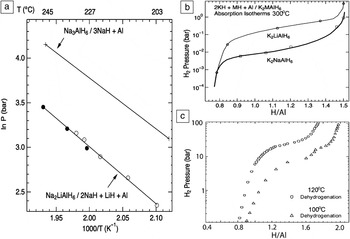
The hexahydroaluminates favor a structure with two different cation sites, such as fcc (Fm–3m),Reference Graetz, Lee, Reilly, Park and Vogt13 which can accommodate two different alkali cations (M and N) to yield a bialkali alanate of the form M 2NAlH6 (Figure 2b). Changing the cation composition significantly alters the decomposition thermodynamics. As an example, Na3AlH6, consisting of Na ions located in both cation sites, has an equilibrium H2 pressure of 63 bar at 245°C. When the Na on the octahedral site is replaced with Li (Na2LiAlH6), the new compound has an equilibrium pressure of 32 bar at 245°C, which is a pressure reduction of almost fifty percent (Figure 5a).Reference Graetz, Lee, Reilly, Park and Vogt13 A similar shift in the equilibrium pressure was observed in K2NAlH6, where the equilibrium pressure at 300°C was 0.2 bar with N = Li and 0.015 bar with N = Na (Figure 5b).Reference Graetz, Lee, Reilly, Park and Vogt13 Although some control over thermodynamics is clearly possible through cation substitution, only a few specific combinations are possible, and some of the more promising stoichiometries, such as Li2NaAlH6, are unstable.Reference Graetz, Lee, Reilly, Park and Vogt13 More recently, a number of alanates have been prepared with mixed alkali and alkaline earth metal cations (e.g., LiMg(AlH4)3, LiMgAlH6, LiCa(AlH4)3).Reference Liu, Qian, Si and Zhang26–Reference Mamatha, Bogdanovic, Felderhoff, Pommerin, Schmidt, Schuth and Weidenthaler28 Although some of these materials exhibit favorable decomposition temperatures, they have not been demonstrated to be reversible hydrides.
(a) van’t Hoff plots for the reversible dissociation of Ti-catalyzed Na3AlH6Reference Bogdanovic, Brand, Marjanovic, Schwickardi and Tölle16 and Na2LiAlH6 with (○) and without (●) a Ti catalyst.Reference Graetz, Lee, Reilly, Park and Vogt13 (b) van’t Hoff plots for the hydrogenation of K2LiAlH6 and K2NaAlH6 at 300°C.Reference Graetz, Lee, Reilly, Park and Vogt13 (c) Hydrogenation and dehydrogenation isotherms for Na3AlH6–xFx with x ≈ 4.Reference Brinks, Fossdal and Hauback25

It was recently shown that the thermodynamics of Na3AlH6 can be tuned through anion substitution.Reference Brinks, Fossdal and Hauback25 A mixed hydride-fluoride, confirmed to be Na3AlH6–xFx with x ≈ 4, was prepared from NaF, Al, and H2 using TiF3 as a catalyst. Pressure composition isotherms revealed a plateau pressure of approximately 25 bar for dehydrogenation at 120°C (Figure 5c) compared to ∼1.5 bar for Na3AlH6, indicating a significant destabilization. However, it has been shown that fluorine anion substitution is not likely feasible for the alane (AlH3) system.Reference Fonneløp, Corno, Grove, Pinatel, Sørby, Ugliengo, Baricco and Hauback29
The thermodynamics of a hydrogenation/dehydrogenation reaction may also be tuned through particle size (when particles are a few nm in diameter or less)Reference Kim, Dai, Johnson and Sholl30 and nanoconfinement. de Jongh et al. recently demonstrated that hydrogen release occurs at lower temperatures and in a single step (as opposed to the two-step decomposition shown in Reaction 4) when NaAlH4 is confined in 2–3 nm carbon pores.Reference Gao, Adelhelm, Verkuijlen, Rongeat, Herrich, van Bentum, Gutfleisch, Kentgens, de Jong and de Jongh31 In addition to this kinetic effect, they also observed a clear increase in thermodynamic stability of NaAlH4, since hydrogenation occurred at considerably lower pressures (24 bar H2 at 150°C)Reference Gao, Adelhelm, Verkuijlen, Rongeat, Herrich, van Bentum, Gutfleisch, Kentgens, de Jong and de Jongh31 than what was expected for complete hydrogenation (up to NaAlH4) in the bulk (∼60 bar H2 at 150°C).Reference Bogdanovic, Brand, Marjanovic, Schwickardi and Tölle16 Fichtner et al. also showed a single step, solid-solution-like behavior from NaAlH4 encapsulated in a mesoporous carbon matrix (0.5–4 nm pores), with isothermal measurements also indicating an increase in thermodynamic stability.Reference Lohstroh, Roth, Hahn and Fichtner32
Nonreversible Al-based hydrides
There are quite a few aluminum-based hydrides, which also exhibit high gravimetric hydrogen densities that are known to be less stable than sodium alanate. One example is Mg(AlH4)2, which undergoes a single-step decomposition at ∼150°C:Reference Mamatha, Bogdanovic, Felderhoff, Pommerin, Schmidt, Schuth and Weidenthaler26
 $${\rm{Mg(AlH}}_{\rm{4}} {\rm{)}}_{\rm{2}} \to {\rm{MgH}}_{\rm{2}} + {\rm{2Al}} + {\rm{3H}}_{\rm{2}} {\rm{.}}$$
A similar compound that also exhibits a high gravimetric capacity is Ca(AlH4)2, which undergoes two-step desorption:Reference Mamatha, Bogdanovic, Felderhoff, Pommerin, Schmidt, Schuth and Weidenthaler26
 $${\rm{Ca(AlH}}_{\rm{4}} {\rm{)}}_{\rm{2}} \to {\rm{CaAlH}}_{\rm{5}} + {\rm{Al}} + {\rm{3/2H}}_{\rm{2}}$$
 $${\rm{CaAlH}}_{\rm{5}} \to {\rm{CaH}}_{\rm{2}} + {\rm{Al}} + {\rm{3/2H}}_{\rm{2}} {\rm{.}}$$
Reaction 7 is exothermic and occurs at 100°C, while reaction 8 is endothermic and occurs at temperatures >180°C. Another interesting alanate is LiMg(AlH4)3, which undergoes a two-step decomposition reaction:Reference Mamatha, Bogdanovic, Felderhoff, Pommerin, Schmidt, Schuth and Weidenthaler26
 $${\rm{LiMg(AlH}}_{\rm{4}} {\rm{)}}_{\rm{3}} \to {\rm{LiMgAlH}}_{\rm{6}} + {\rm{2Al}} + {\rm{3H}}_{\rm{2}}$$
 $${\rm{LiMgAlH}}_{\rm{6}} \to {\rm{MgH}}_{\rm{2}} + {\rm{LiH}} + {\rm{Al}} + {\rm{3H}}_{\rm{2}} {\rm{.}}$$
The first desorption step is exothermic and occurs at ∼100°C, while the second step is endothermic and occurs at 150°C. Despite their promising capacities, these materials are not known to be reversible under moderate pressure conditions.
Regeneration
Direct hydrogenation of many of the more promising aluminum-based hydrides is either extremely difficult (requiring high pressures or temperatures) or impossible. Despite this challenge, there have been considerable efforts in recent years to develop low energy regeneration pathways to reform the hydrides from the spent material through a chemical process. One idea is to simply recycle the by-products from the conventional synthesis, which typically involves an ethereal reaction between a binary hydride and an aluminum halide:
 $${\rm{4LiH}} + {\rm{AlCl}}_{\rm{3}} \to {\rm{LiAlH}}_{\rm{4}} + {\rm{3LiCl}} \downarrow$$
 $${\rm{3LiH}} + {\rm{AlCl}}_{\rm{3}} \to {\rm{AlH}}_{\rm{3}} + {\rm{3LiCl}} \downarrow {\rm{,}}$$
or a reaction between a metal halide and another alanate:
 $${\rm{MgCl}}_{\rm{2}} + {\rm{2LiAlH}}_{\rm{4}} \to {\rm{Mg(AlH}}_{\rm{4}} {\rm{)}}_{\rm{2}} + {\rm{2LiCl}} \downarrow {\rm{.}}$$
However, the precursors to these reactions are costly, and the byproducts (e.g., metal chlorides) are extremely stable and difficult to separate. Even with excellent recycling efficiency (capturing all of the heats of reactions), the energy input required to recycle the hydride will likely be considerably more than the fuel energy contained within the material.
Other approaches to regenerate the aluminum-based hydrides include electrochemical hydrogenation. In this process, an electrolytic potential is used to increase the hydrogen activity and drive the hydrogen into the host material. Since the electrolytic potential scales as the natural log of the pressure (V ∝ ln[P]), the thermodynamic requirement can be met by a relatively low voltage. This approach is currently being explored for the regeneration of AlH3.Reference Zidan, Garcia-Diaz, Fewox, Stowe, Gray and Harter33
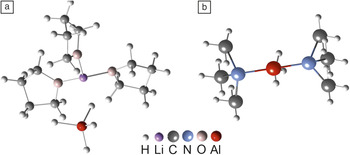
Another approach to regenerating the aluminum-based hydrides under mild conditions makes use of a two-step process involving hydride stabilization followed by separation. In many cases, the unstable or metastable hydrides can be stabilized as an adduct with a Lewis base (e.g., an ether or amine). In the presence of a stabilizing agent, the thermodynamic barrier to Al hydrogenation is substantially reduced and can occur at pressures of just a few bar at room temperature. Once the hydride adduct has formed, the second step involves adduct separation and the recovery of the pure alane or alanate. This method was recently used to regenerate LiAlH4 from LiH and catalyzed aluminum using tetrahydrofuranReference Graetz, Wegrzyn and Reilly34 (THF) to form LiAlH4·nTHF (Figure 6a):
 $${\rm{LiH}} + {\rm{Al}} + n{\rm{THF}} + {\rm{3/2H}}_{\rm{2}} \to {\rm{LiAlH}}_{\rm{4}} n{\rm{THF}} - \to {\rm{LiAlH}}_{\rm{4}} + n{\rm{THF}} \uparrow {\rm{.}}$$
Adducts used in the regeneration of alanates and alane showing (a) LiAlH4•3THFReference Lacina, Yang, Chopra, Muckerman, Chabal and Graetz36 and (b) AlH3•2TMA.Reference Lacina, Wegrzyn, Reilly, Johnson, Celebi and Graetz37

More recently, a similar regeneration procedure was developed using dimethyl ether,Reference Liu, McGrady, Langmi and Jensen35 which is a gas at room temperature and can be separated from the hydride without heating the adduct.
A similar procedure is being developed for the regeneration of AlH3. However, AlH3 is considerably less stable than LiAlH4 and therefore requires a stronger Lewis base (e.g., amines) to make the hydrogenation favorable at reasonable pressures. In one method, amines (NR3) are used to form a stabilized adduct, which is subsequently decomposed to recover AlH3:
 $${\rm{Al}} + {\rm{NR}}_{\rm{3}} + 3{\rm{/2H}}_{\rm{2}} \to {\rm{NR}}_{\rm{3}} {\rm{AlH}}_{\rm{3}} \to {\rm{AlH}}_{\rm{3}} + {\rm{NR3}} \uparrow {\rm{.}}$$
A number of other tertiary amines are also effective at stabilizing AlH3, including triethylenediamine (TEDA),Reference Graetz, Chaudhari, Wegrzyn, Celebi, Johnson, Zhou and Reilly38 trimethylamine (TMA),Reference Lacina, Wegrzyn, Reilly, Johnson, Celebi and Graetz37 quinuclidine,Reference Lacina, Reilly, Johnson, Wegrzyn and Graetz39 hexamine, and dimethylethylamine (DMEA).Reference Lacina, Wegrzyn, Reilly, Celebi and Graetz40 The structure of the AlH3·2TMA adduct is shown in Figure 6b. These stabilized phases form under much milder pressure and temperature conditions than the pure hydride and are often easily isolated from the excess solvent and unreacted material. The primary challenge with this procedure is the separation step. High temperatures (>100°C) are often required to break the Al–N bond and remove the amine, which also leads to the rapid decomposition of the hydride. In general, the key to this approach is to identify an adduct that is stable enough to form under mild conditions, but weak enough so that it can be split apart at low temperatures (<100°C).
It is interesting to note that the first step (hydrogenation) is completely reversible with a reasonable theoretical capacity (typically >2 wt%) and thermodynamics (TEDA·AlH3 has a plateau pressure of 1.5 bar at 72°CReference Graetz, Chaudhari, Wegrzyn, Celebi, Johnson, Zhou and Reilly38). During cycling, the hydrogen atoms are reversibly added or removed from the aluminum, similar to a conventional metal hydride, and the organic molecule remains relatively unchanged. Despite the moderate capacity of this particular reaction, a number of higher capacity reactions can be envisioned, such as using a bi-functional ligand to accommodate multiple alanes, or a more complex reaction that incorporates chemical hydrogenation along with alane formation.
Outlook
The increasing demand for innovative energy storage at all scales (from microelectronics to grid-scale) will continue to drive interest in the metastable aluminum-based hydrides, which are especially well-suited for high value, portable electronics that require lightweight and compact energy storage systems. One of the more obvious near-term applications includes portable power systems, such as wearable devices built into backpacks, jackets, and clothing where size and weight are critical, but cost may be less of an issue. These systems currently rely on lithium batteries, but much greater energy densities may be possible with a system utilizing a high capacity metastable hydride bed (e.g., AlH3) paired with a proton exchange membrane fuel cell. Although automotive hydrogen storage is a much more difficult task, there remains a need for a low pressure (e.g., solid state) option for onboard vehicular hydrogen storage, and AlH3 and LiAlH4 were recently identified as two of only a few “near-term materials” for this purpose.Reference Klebanoff41 Ultimately, the success of the aluminum-based hydrides will depend upon improvements in synthesis and regeneration procedures (increasing yield and reducing cost) and the development of a compact and efficient storage system suitable for low temperature fuel cells.